Page 1
1.
Which factor will not cause an increase in the supply of cornflakes?
A)
an increase in the price of cornflakes
B)
a cost-saving improvement in the technology of corn production
C)
a reduction in the price of corn
D)
the expectation by producers that the price of cornflakes will fall in the future
Use the following to answer questions 2-6:
\\
2.
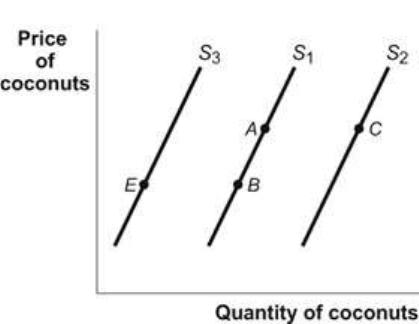
(Ref 6-1 Figure: Supply of Coconuts) Use Figure: Supply of Coconuts. If the price of
coconuts decreased, it would be represented in the figure as a movement from:
A)
A to B.
B)
B to A.
C)
C to A.
D)
E to B.
3.
(Ref 6-1 Figure: Supply of Coconuts) Use Figure: Supply of Coconuts. If the prices of
inputs (e.g., labor, fertilizer, and fuel) used to produce and transport coconuts increased,
it could be represented in the figure as a movement from:
A)
A to B.
B)
B to A.
C)
C to A.
D)
E to B.
Page 2
4.
(Ref 6-1 Figure: Supply of Coconuts) Use Figure: Supply of Coconuts. If the prices of
inputs (e.g., labor, fertilizer, and fuel) used to produce and transport coconuts decreased,
it could be represented in the figure as a movement from:
A)
A to B.
B)
B to A.
C)
C to A.
D)
E to B.
5.
(Ref 6-1 Figure: Supply of Coconuts) Use Figure: Supply of Coconuts. An improvement
in the technology used to harvest coconuts (e.g., a faster, less expensive coconut picker)
would be represented in the figure as a movement from:
A)
A to C.
B)
B to A.
C)
C to A.
D)
B to E.
6.
(Ref 6-1 Figure: Supply of Coconuts) Use Figure: Supply of Coconuts. An expectation
on the part of coconut suppliers that the price of coconuts will be significantly higher in
the very near future would be represented in the figure as a movement from:
A)
A to B.
B)
B to A.
C)
A to C.
D)
B to E.
Page 3
Use the following to answer questions 7-8:
7.
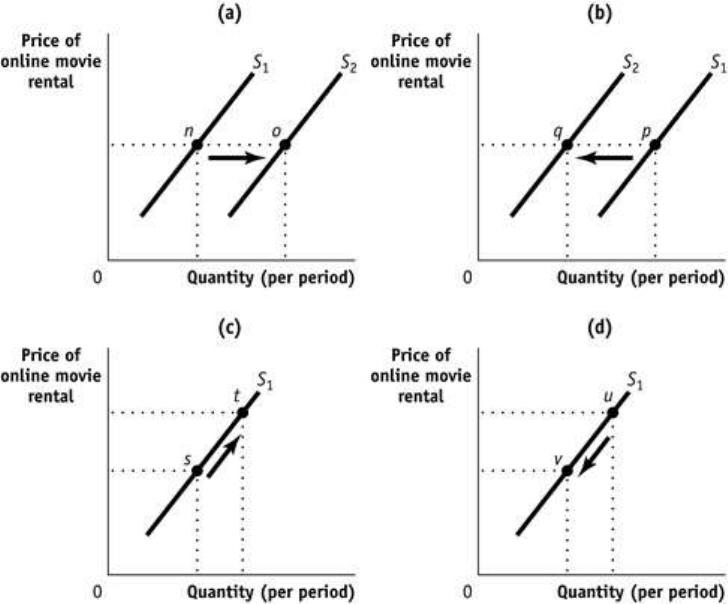
(Ref 6-2 Figure: The Supply of Online Movie Rentals) Use Figure: The Supply of
Online Movie Rentals. A decrease in the price of online movies sold by movie
producers to rental outlets like Amazon and Apple would result in a change illustrated
by the move from:
A)
n to o in panel A.
B)
p to q in panel B.
C)
s to t in panel C.
D)
u to v in panel D.
8.
(Ref 6-2 Figure: The Supply of Online Movie Rentals) Use Figure: The Supply of
Online Movie Rentals. A decrease in the price of online movie rentals would result in a
change illustrated by the move from:
A)
n to o in panel A.
B)
p to q in panel B.
C)
s to t in panel C.
D)
u to v in panel D.
Page 4
Use the following to answer questions 9-10:
9.
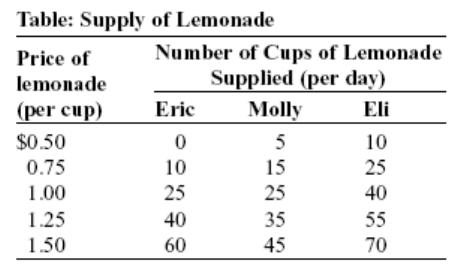
(Ref 6-3 Table: Supply of Lemonade) Use Table: Supply of Lemonade. If the price of
lemonade is $1 per cup, the total quantity of lemonade supplied will be _____ cups per
day.
A)
50
B)
80
C)
25
D)
90
10.
(Ref 6-3 Table: Supply of Lemonade) Use Table: Supply of Lemonade. When the price
of lemonade is $1 per cup, the quantity of lemonade supplied by Eli will be _____ cups
per day.
A)
40
B)
90
C)
10
D)
25
11.
_____ illustrates a positive relationship between price and quantity.
A)
A demand curve
B)
A supply curve
C)
A production possibility frontier
D)
Equilibrium
Page 5
12.
The typical supply curve illustrates that:
A)
other things equal, the quantity supplied for a good is inversely related to the price
of a good.
B)
other things equal, the supply of the good creates its own demand for the good.
C)
other things equal, the quantity supplied for a good is positively related to the price
of a good.
D)
price and quantity supplied are unrelated.
13.
When the price of lamps increases, the:
A)
supply increases.
B)
quantity supplied increases.
C)
supply decreases.
D)
quantity supplied decreases.
14.
When the price of desks increases, the:
A)
quantity supplied increases.
B)
supply increases.
C)
quantity supplied decreases.
D)
supply decreases.
15.
A decrease in supply of good X means:
A)
a shift to the left of the entire supply curve for good X.
B)
a movement down the supply curve as prices of good X go down.
C)
that less of good X will be demanded at every price.
D)
that more of good X will be supplied at every price.
16.
The primary difference between a change in supply and a change in the quantity
supplied is that:
A)
a change in quantity supplied is a movement along the supply curve, while a
change in supply is a shift in the supply curve.
B)
both a change in quantity supplied and a change in supply are movements along the
supply curve, only in different directions.
C)
a change in supply is related to the supply curve, while a change in quantity
supplied is related to shifts in the demand curve that shift the supply curve.
D)
a change in supply is a movement along the supply curve, while a change in
quantity supplied is a shift in the supply curve.
Page 6
17.
If the price of a commodity increases, you can usually expect the:
A)
supply to increase.
B)
quantity supplied to increase.
C)
quantity supplied to decrease.
D)
supply curve to shift to the right.
18.
In the market for tacos, the factor that does not shift the supply curve to the left is:
A)
an increase in the price of beef.
B)
an increase in the wages of taco shop workers.
C)
fewer taco shops.
D)
a decrease in the price of tacos.
19.
In the local market for coffee, if Joyce’s Java and Everyday Joe’s coffee shops go out of
business, the _____ curve shifts to the _____.
A)
supply; right
B)
demand; left
C)
supply; left
D)
demand; right
20.
Which factor is not a determinant of supply?
A)
expectations regarding future prices
B)
the technology of production
C)
the cost of production
D)
consumer tastes
21.
Which influence does not shift the supply curve?
A)
people deciding that they want to buy more of the product
B)
a decrease in the price firms expect to receive in the future
C)
a rise in the wages paid to workers
D)
the development of a new production technology
22.
Which factor will not cause an increase in the supply of good X?
A)
an improvement in the technology used to produce good X
B)
an increase in the number of firms that sell good X
C)
an increase in the price of inputs used to produce good X
D)
a decrease in the price of labor used to produce good X
Page 7
23.
Consider the supply curve for cotton shirts. An increase in the price of cotton will:
A)
increase the supply of cotton shirts.
B)
decrease the supply of cotton shirts.
C)
increase the quantity supplied of cotton shirts.
D)
decrease the demand for cotton shirts.
24.
Over the past few years, the technology associated with producing flat-panel televisions
has improved. This has led to a(n) _____ in the _____ flat-panel televisions.
A)
increase; supply of
B)
decrease; demand for
C)
decrease; supply of
D)
decrease; quantity supplied of
25.
A technological advance in the production of automobiles will _____ the _____
automobiles.
A)
decrease; demand for
B)
increase; supply of
C)
decrease; demand
D)
decrease; supply of
26.
Which factor would cause an increase in the supply of a good?
A)
input prices rising
B)
a fall in the price of the good
C)
an increase in the number of sellers
D)
expectations of future price increases
27.
Which factor would cause an increase in the supply of a good?
A)
an increase in input prices
B)
suppliers’ expectations of higher prices in the future
C)
an increase in the price of the good
D)
a decrease in the price of resources used in production
28.
Which factor would cause a decrease in the supply of a good?
A)
an increase in the price of goods that are used in production
B)
suppliers’ expectations of lower prices in the future
C)
an advancement in the technology for producing the good
D)
an increase in the number of producers
Page 8
29.
If the price of mozzarella cheese (an ingredient in pizza) declines, there will be:
A)
a decrease in the supply of pizza.
B)
an increase in the supply of pizza.
C)
a decrease in the quantity of pizza supplied.
D)
no change in the supply of pizza.
30.
Which factor would cause an increase in the supply of a good?
A)
an increase in input prices
B)
a decrease in the number of sellers in the market
C)
suppliers’ expectations of higher prices in the future
D)
an advancement in the technology for producing the good
31.
Which factor would cause a decrease in the supply of a good?
A)
a decrease in input prices
B)
an increase in the number of sellers in the market
C)
suppliers’ expectations of higher prices in the future
D)
an advancement in the technology for producing the good
32.
Which factor would not cause the supply curve to shift?
A)
a change in the technology of production
B)
a change in factor costs
C)
a change in the price of the good
D)
a change in suppliers’ expectations of future prices
33.
Which factor would cause a leftward shift in the supply curve for a good?
A)
an increase in the number of sellers
B)
a technological improvement in production
C)
an increase in the cost of an input
D)
an increase in the number of buyers
34.
Which factor is most likely to shift the supply of milk to the right?
A)
a tax on each gallon of milk produced
B)
an increase in household income, milk being a normal good
C)
a decrease in the price of feed given to dairy cows
D)
the bankruptcy of many small dairy farms
Page 9
35.
In the market for wheat, if the price of ethanol (which is made from corn, a substitute in
the production process) increased dramatically, the _____ wheat would _____.
A)
supply of; increase
B)
supply of; decrease
C)
demand for; increase
D)
demand for; decrease
Use the following to answer questions 36-41:
36.
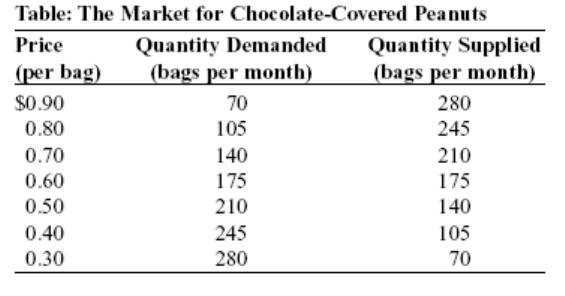
(Ref 6-4 Table: The Market for Chocolate-Covered Peanuts) Use Table: The Market for
Chocolate-Covered Peanuts. If the price of chocolate-covered peanuts is $0.60, the price
will:
A)
not change.
B)
fall to $0.30.
C)
fall to $0.50.
D)
rise to $0.70.
37.
(Ref 6-4 Table: The Market for Chocolate-Covered Peanuts) Use Table: The Market for
Chocolate-Covered Peanuts. The equilibrium quantity and the equilibrium price are
_____ bags per month and _____.
A)
140; $0.40
B)
175; $0.60
C)
175; $0.80
D)
210; $0.50
Page 10
38.
(Ref 6-4 Table: The Market for Chocolate-Covered Peanuts) Use Table: The Market for
Chocolate-Covered Peanuts. If the price of chocolate-covered peanuts is $0.80, there is
a monthly:
A)
surplus of 140 bags per month.
B)
shortage of 140 bags per month.
C)
surplus of 70 bags per month.
D)
shortage of 70 bags per month.
39.
(Ref 6-4 Table: The Market for Chocolate-Covered Peanuts) Use Table: The Market for
Chocolate-Covered Peanuts. A surplus of 210 bags of chocolate-covered peanuts per
month exists if the price is _____ per bag.
A)
$0.90
B)
$0.80
C)
$0.60
D)
$0.40
40.
(Ref 6-4 Table: The Market for Chocolate-Covered Peanuts) Use Table: The Market for
Chocolate-Covered Peanuts. If the price of chocolate-covered peanuts is $0.50, there is
a:
A)
surplus of 35 bags per month.
B)
shortage of 35 bags per month.
C)
surplus of 70 bags per month.
D)
shortage of 70 bags per month.
41.
(Ref 6-4 Table: The Market for Chocolate-Covered Peanuts) Use Table: The Market for
Chocolate-Covered Peanuts. A shortage of 210 bags of chocolate-covered peanuts per
month exists if the price is _____ per bag.
A)
$0.80
B)
$0.60
C)
$0.40
D)
$0.30
42.
What is the difference between a shortage and scarcity?
A)
Scarcity will almost always exist, but a shortage will exist only if the price is kept
below the equilibrium level.
B)
Scarcity is a result of two or more alternative uses, and quantities of supply and
demand adjusting to flexible prices will create shortages.
C)
A shortage will exist when a good is scarce.
D)
There is no distinction between the two. They are the same thing.
Page 11
Use the following to answer questions 43-50:
43.
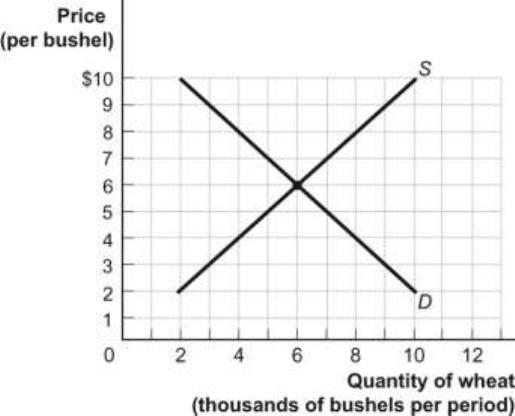
(Ref 6-5 Figure: The Demand and Supply of Wheat) Use Figure: The Demand and
Supply of Wheat. If a price of $10 temporarily exists in this market, a _____ of _____
bushels per period will result.
A)
shortage; 10,000
B)
shortage; 8,000
C)
surplus; 8,000
D)
surplus; 4,000
44.
(Ref 6-5 Figure: The Demand and Supply of Wheat) Use Figure: The Demand and
Supply of Wheat. A price of _____ will result in a _____.
A)
$6; shortage
B)
$9; surplus
C)
$8; shortage
D)
$4; surplus
45.
(Ref 6-5 Figure: The Demand and Supply of Wheat) Use Figure: The Demand and
Supply of Wheat. If there is an increase in demand of 2,000 bushels per period at each
price, the equilibrium price and quantity will be _____ and _____ bushels per period,
respectively.
A)
$5; 5,000
B)
$6; 7,000
C)
$7; 7,000
D)
$8; 8,000
Page 12
46.
(Ref 6-5 Figure: The Demand and Supply of Wheat) Use Figure: The Demand and
Supply of Wheat. If there is a decrease in supply of 2,000 bushels per period at each
price, the equilibrium price and quantity will be _____ and _____ bushels per period,
respectively.
A)
$5; 5,000
B)
$7; 5,000
C)
$6; 4,000
D)
$8; 6,000
47.
(Ref 6-5 Figure: The Demand and Supply of Wheat) Use Figure: The Demand and
Supply of Wheat. A temporary price of $2 in this market would result in a _____ of
_____ bushels per period.
A)
surplus; 4,000
B)
shortage; 8,000
C)
shortage; 10,000
D)
surplus; 10,000
48.
(Ref 6-5 Figure: The Demand and Supply of Wheat) Use Figure: The Demand and
Supply of Wheat. What is the equilibrium quantity in this wheat market each period?
A)
12,000 bushels
B)
2,000 bushels
C)
10,000 bushels
D)
6,000 bushels
49.
(Ref 6-5 Figure: The Demand and Supply of Wheat) Use Figure: The Demand and
Supply of Wheat. If a price of $8 temporarily exists in this market, a _____ of _____
bushels per period will result.
A)
shortage; 2,000
B)
surplus; 4,000
C)
shortage; 4,000
D)
surplus; 6,000
50.
(Ref 6-5 Figure: The Demand and Supply of Wheat) Use Figure: The Demand and
Supply of Wheat. A temporary price of $4 in this market would result in a _____ of
_____ bushels per period.
A)
rising price to eliminate the shortage.
B)
rising price to eliminate the surplus.
C)
falling price to eliminate the shortage.
D)
market in equilibrium.
Page 13
Use the following to answer questions 51-53:
51.
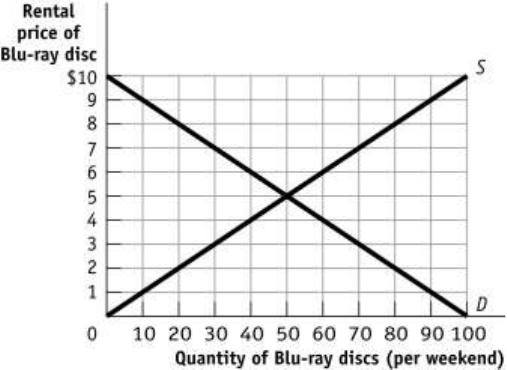
(Ref 6-7 Figure: The Blu-ray Disc Rental Market) Use Figure: The Blu-ray Disc Rental
Market. If the rental price of Blu-ray discs rises from $5 to $7:
A)
demand will decrease from 50 to 30 rentals per weekend.
B)
the quantity demanded will decrease from 50 to 30 rentals per weekend.
C)
supply will increase from 50 to 70 rentals per weekend.
D)
the quantity supplied will increase from 50 to 60 rentals per weekend.
52.
(Ref 6-7 Figure: The Blu-ray Disc Rental Market) Use Figure: The Blu-ray Disc Rental
Market. At a rental price of $3, there will be:
A)
equilibrium in the rental market for Blu-ray discs.
B)
an increase in demand.
C)
an excess supply of 40 Blu-ray disc rentals.
D)
an excess demand of 40 Blu-ray disc rentals.
53.
(Ref 6-7 Figure: The Blu-ray Disc Rental Market) Use Figure: The Blu-ray Disc Rental
Market. At a rental price of $6, there will be:
A)
equilibrium in the rental market for Blu-ray discs.
B)
a decrease in demand.
C)
an excess supply of 20 Blu-ray disc rentals.
D)
an excess demand of 20 Blu-ray disc rentals.
Page 14
54.
If the market for buffalo meat is in equilibrium, the price of buffalo meat will probably
_____ in the near future.
A)
increase
B)
not change
C)
decrease
D)
increase considerably
55.
Market equilibrium occurs when:
A)
there is no incentive for prices to change in the market.
B)
quantity demanded equals quantity supplied.
C)
the market clears.
D)
there is no incentive for prices to change in the market, quantity demanded equals
quantity supplied, and the market clears.
56.
The market equilibrium is found at the:
A)
price where quantity demanded exceeds quantity supplied.
B)
price where quantity demanded equals quantity supplied.
C)
price where quantity supplied exceeds quantity demanded.
D)
highest price possible in the market.
57.
Suppose the equilibrium price of good Y is $5 and the equilibrium quantity is 150 units.
Supply in this market is upward sloping. If the price of good Y is $12:
A)
the quantity demanded will be greater than 150 units.
B)
the quantity supplied will be less than 150 units.
C)
there will be an excess demand for good Y.
D)
there will be an excess supply of good Y.
58.
Excess supply occurs when the:
A)
price is above the equilibrium price.
B)
quantity demanded exceeds the quantity supplied.
C)
price is below the equilibrium price.
D)
quantity demanded exceeds the quantity supplied and the price is below the
equilibrium price.
59.
If in a competitive market the quantity supplied exceeds the quantity demanded, we
expect prices to:
A)
stay the same.
B)
rise.
C)
fall.
D)
rise first, then fall when demand decreases.
Page 15
60.
If the quantity of housing supplied in a community is greater than the quantity of houses
demanded, the existing price:
A)
is above the market equilibrium price.
B)
will rise to clear the market.
C)
will either rise or remain unchanged.
D)
is below the market equilibrium price.
61.
If the supply and demand curves intersect at a price of $47, then any price above that
would result in:
A)
a shortage.
B)
a surplus.
C)
equilibrium.
D)
an increase in demand.
62.
If the supply and demand curves intersect at a price of $14, then any price below that
would result in:
A)
a shortage.
B)
a surplus.
C)
equilibrium.
D)
an increase in demand.
63.
Suppose the equilibrium price of good X is $25 and the equilibrium quantity is 124
units. If the price of good X is $2:
A)
there will be excess demand for good X.
B)
there will be an excess supply of good X.
C)
the market will clear.
D)
the quantity demanded of good X will be less than 124 units.
64.
The _____ tomatoes will decrease if fertilizer prices rise.
A)
demand for
B)
shortage of
C)
supply of
D)
equilibrium price of
65.
If the price of corn rises, we generally expect the:
A)
quantity of corn demanded to rise.
B)
quantity of corn supplied to rise.
C)
demand for corn to shift inward.
D)
supply of corn to shift outward.
Page 16
66.
The supply curve for apartments in Oregon reflects how many apartments landlords are
willing and able to offer for rent at various prices.
A)
True
B)
False
67.
An increase in the price of contact lenses will increase the supply of contact lenses.
A)
True
B)
False
68.
A major input into vanilla ice cream is cream. An increase in the price of cream will
reduce the quantity of vanilla ice cream supplied, but it will not reduce the supply of
vanilla ice cream.
A)
True
B)
False
69.
If the input costs associated with supplying gasoline increases in Wisconsin, the supply
of gasoline in Wisconsin will decrease.
A)
True
B)
False
70.
If there is an excess supply of a good, the problem of scarcity does not apply to that
good.
A)
True
B)
False
71.
Suppose there is an excess supply of chemical engineers in India. Over time, the salaries
for chemical engineers will fall in India.
A)
True
B)
False
Page 17
Use the following to answer questions 72-73:
72.
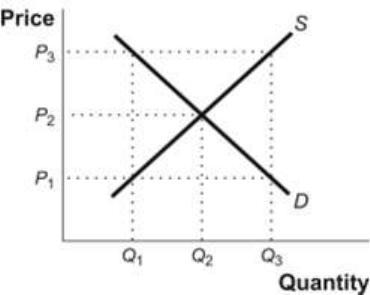
(Ref 6-8 Figure: Supply, Demand, and Equilibrium) Use Figure: Supply, Demand, and
Equilibrium. In the figure, there will be excess demand for the good at a price of P3.
A)
True
B)
False
73.
(Ref 6-8 Figure: Supply, Demand, and Equilibrium) Use Figure: Supply, Demand, and
Equilibrium. In the figure, there will be an excess supply of the good at a price of P1.
A)
True
B)
False
74.
Suppose there is an excess demand for water in Florida. This means that we can expect
the price of water to increase in Florida over time.
A)
True
B)
False
75.
Suppose the supply curve for soap bubbles has a slope of +1 and intersects the vertical
axis at a price of $2 per bottle. Further suppose that the horizontal axis unit is thousands
of soap bubble bottles. Interpret the meaning of both the y-intercept and the slope.
76.
How would each of the listed events affect the supply of compact cars?
I. The price of steel rises.
II. The production technology for car manufacturing improves.
III. The price of sport utility vehicles falls.
77.
Why do many stores have big after-Halloween sales on their Halloween merchandise?
Page 18
78.
Milk is an important ingredient in the production of ice cream. If the price of milk
increases, then one would expect, holding all other things constant:
A)
the supply curve for ice cream to shift left.
B)
the supply curve for ice cream to shift right.
C)
no change in the supply curve for ice cream.
D)
a movement along the supply curve for ice cream curve, resulting in more ice
cream supplied.
79.
High-fructose corn syrup, which is derived from corn, is an important ingredient in the
production of many soft drinks. If the price of corn increases, one would expect the:
A)
supply curve for soft drinks to shift left.
B)
quantity supplied of soft drinks to increase.
C)
demand for soft drinks to increase.
D)
supply curve for soft drinks to shift right.
80.
Which factor would not result in an increase in the supply of a good?
A)
a decrease in input prices
B)
a beneficial technological change
C)
an increase in the number of suppliers
D)
an increase in input prices
81.
A farmer finds that when he produces more corn, he also has more cornstalks that he
can sell as decorations. To the farmer, corn and cornstalks are:
A)
complements in production.
B)
substitutes in production.
C)
unrelated goods.
D)
inferior goods.
82.
If two of a producer’s goods are substitutes in production, this suggests that the producer
(with her fixed set of resources) will need to reduce production of one good when she:
A)
produces less of the other good.
B)
produces more of the other good.
C)
has an increase in resources.
D)
produces more of the other good and has an increase in resources.
Page 19
83.
Researchers find a new strain of genetically modified seeds that result in a higher yield
for corn producers. Holding all other things constant, this research will:
A)
shift the supply curve for corn left.
B)
increase the quantity supplied of corn.
C)
decrease the quantity supplied of corn.
D)
shift the supply curve for corn to the right.
84.
If suppliers expect prices for their product to rise next year, then one would expect a:
A)
shift in the demand curve for the product this year.
B)
decrease in the quantity demanded this year.
C)
shift to the left in the supply curve for the product this year.
D)
shift to the right in the supply curve for the product this year.
85.
The market for good Y, a perfectly competitive good, is made up of 15 producers who
each produce the same amount of good Y. If the price of good Y is $100 and the total
quantity supplied is 150, how many units of good Y is each producer supplying?
A)
10
B)
150
C)
100
D)
15
Use the following to answer questions 86-87:
86.
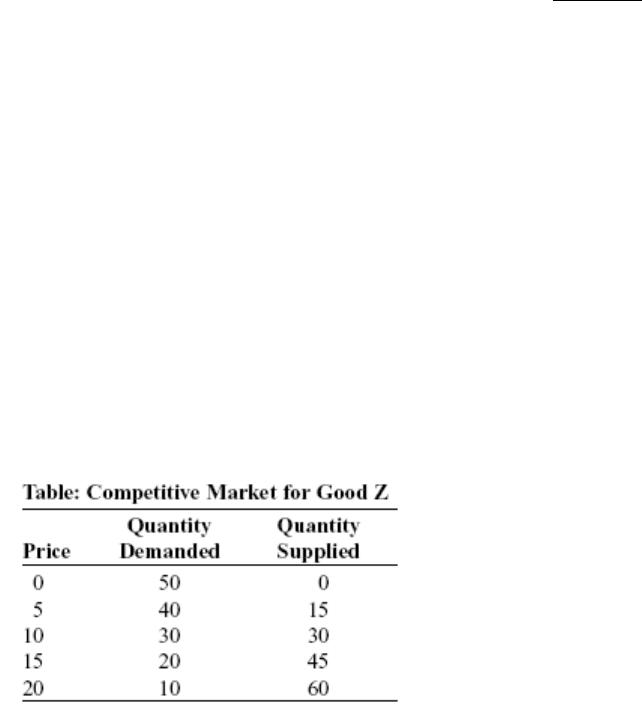
(Ref 6-9 Table: Competitive Market for Good Z) Use Table: Competitive Market for
Good Z. A surplus of the good will occur at a price of
A)
$0.
B)
$5.
C)
$10.
D)
$15.
Page 20
87.
(Ref 6-9 Table: Competitive Market for Good Z) Use Table: Competitive Market for
Good Z. The equilibrium price and quantity in this market are, respectively:
A)
$5 and 40 units.
B)
$20 and 60 units.
C)
$10 and 30 units.
D)
$10 and 60 units.
Use the following to answer questions 88-89:
88.
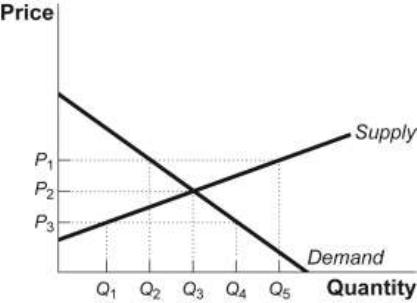
(Ref 6-10 Figure: The Market for Candy) Use Figure: The Market for Candy.
Equilibrium occurs at a price of _____, and the equilibrium quantity is equal to _____.
A)
P1; Q5
B)
P2; Q3
C)
P3; Q2
D)
P1; Q3
89.
(Ref 6-10 Figure: The Market for Candy) Use Figure: The Market for Candy. A surplus
of the good will exist at a price of:
A)
P1.
B)
P2.
C)
P3.
D)
There are no surpluses in this market.
90.
When a market is in equilibrium, the quantity:
A)
demanded is equal to zero.
B)
demanded is equal to quantity supplied.
C)
demanded is greater than quantity supplied.
D)
supplied is zero.
Page 22
Page 23