19) In the Solow model, if f(k) = 2k0.5, s = 0.25, n = 0.1, and d = 0.4, what is the value of k at
equilibrium?
A) 1
B) 2
C) 3
D) 4
20) In the Solow model, if f(k) = 6k0.5, s = 0.1, n = 0.1, and d = 0.2, what is the value of c at
equilibrium?
A) 10
B) 10.4
C) 10.8
D) 11.2
21) In the Solow model, if k = 8, y = 20, and s = 0.2, what is c?
A) 24
B) 20
C) 16
D) 12
22) In the Solow model, if k = 8, y = 24, and s = 0.25, what is c?
A) 24
B) 20
C) 18
D) 12
23) The Solow model demonstrates that
A) in the absence of productivity growth, economic growth will turn negative in the long run.
B) in the absence of productivity growth, economic growth will reach a steady state of zero per-
capita growth in the long run.
C) productivity growth must exceed the rate of growth in the population to avoid a steady state in
the long run.
D) productivity growth will inevitably decline due to diminishing marginal productivity.
24) A striking conclusion of the Solow model is that in the absence of productivity growth, in the
long run
A) the economy reaches a steady state.
B) consumption per worker equals the capital stock per worker.
C) consumption per worker equals output per worker.
D) consumption per worker equals investment per worker.
25) An earthquake destroys a good portion of the capital stock. How would you expect this to
affect the capital—labor ratio in the long run? There would be
A) a rightward movement along the saving-per-worker curve and an increase in the capital—
labor ratio.
B) no change in the long-run capital—labor ratio.
C) a downward shift in the saving-per-worker curve and a decrease in the capital—labor ratio.
D) a leftward movement along the saving-per-worker curve and a decrease in the capital—labor
ratio.
26) In the Solow model, if saving per worker initially exceeds investment per worker,
A) the economy will experience inflation.
B) the capital—labor ratio will increase.
C) investment per worker will decline.
D) saving per worker will decline.
27) Which of the following changes would lead, according to the Solow model, to a higher level
of long-run output per worker?
A) A lower level of capital per worker
B) An increase in the saving rate
C) A rise in the rate of population growth
D) A decrease in productivity
28) An increase in the saving rate in a steady-state economy would cause
A) a rightward movement along the saving-per-worker curve and an increase in the capital—
labor ratio.
B) an upward shift in the saving-per-worker curve and an increase in the capital—labor ratio.
C) a downward shift in the saving-per-worker curve and a decrease in the capital—labor ratio.
D) a leftward movement along the saving-per-worker curve and a decrease in the capital—labor
ratio.
29) In the long run, an increase in the saving rate in a steady-state economy will cause
A) an increase in the capital—labor ratio and an increase in consumption per worker.
B) an increase in the capital—labor ratio and a decrease in consumption per worker.
C) a decrease in the capital—labor ratio and a decrease in consumption per worker.
D) a decrease in the capital—labor ratio and an increase in consumption per worker.
30) All else being equal, a permanent decrease in the saving rate in a steady-state economy
would cause
A) an increase in the capital—labor ratio and an increase in consumption per worker.
B) an increase in the capital—labor ratio and a decrease in consumption per worker.
C) a decrease in the capital—labor ratio and a decrease in consumption per worker.
D) a decrease in the capital—labor ratio and an increase in consumption per worker.
31) An increase in the growth rate of population in a steady-state economy would cause
A) a parallel shift upward in the investment line.
B) a pivot up and to the left in the investment line.
C) a pivot down and to the right in the investment line.
D) a parallel shift downward in the investment line.
32) In the Solow model, the steady-state capital—labor ratio will decline if
A) the saving rate per worker increases.
B) the consumption rate per worker declines.
C) population growth increases.
D) productivity increases.
33) An increase in population growth will lead to a ________ in the steady-state capital—labor
ratio and a ________ in output per worker.
A) fall; fall
B) fall; rise
C) rise; rise
D) rise; fall
34) A decrease in population growth will lead to a ________ in the steady-state capital—labor
ratio and a ________ in output per worker.
A) fall; fall
B) fall; rise
C) rise; rise
D) rise; fall
35) A productivity improvement will cause
A) a rightward movement along the saving-per-worker curve and an increase in the capital—
labor ratio.
B) an upward shift in the saving-per-worker curve and an increase in the capital—labor ratio.
C) a downward shift in the saving-per-worker curve and a decrease in the capital—labor ratio.
D) a leftward movement along the saving-per-worker curve and a decrease in the capital—labor
ratio.
36) In the steady-state diagram of the Solow model, an increase in saving per worker is shown by
A) shifting the saving-per-worker curve down, resulting in a lower steady-state capital—labor
ratio.
B) shifting the saving-per-worker curve up, resulting in a higher steady-state-capital—labor
ratio.
C) shifting the saving-per-worker curve up, resulting in a lower steady-state capital—labor ratio.
D) shifting the saving-per-worker curve down, resulting in a higher steady-state capital—labor
ratio.
37) An increase in pollution has caused a permanent increase in the rate of capital depreciation.
This would cause
A) an increase in the capital—labor ratio.
B) output per worker to fall.
C) a decline in consumption per worker.
D) the capital—labor ratio to be unaffected.
38) In the long run, a reduction in productivity will cause
A) an increase in the capital—labor ratio and an increase in consumption per worker.
B) an increase in the capital—labor ratio and a decrease in consumption per worker.
C) a decrease in the capital—labor ratio and a decrease in consumption per worker.
D) a decrease in the capital—labor ratio and an increase in consumption per worker.
39) In the very long run, the level of consumption per worker can grow continually if
A) the saving rate continually falls.
B) the population growth rate continually rises.
C) productivity continually improves.
D) the depreciation rate continually rises.
40) Briefly explain the shape of the per-worker production curve in the Solow model. If
investment per worker initially exceeds saving per worker, how is the steady-state capital—labor
ratio achieved?
41) A country has the per-worker production function
yt = 5 ,
where yt is output per worker and kt is the capital—labor ratio. The depreciation rate is 0.2 and
the population growth rate is 0.05. The saving function is
St = 0.2Yt,
where St is total national saving and Yt is total output.
(a) What is the steady-state value of the capital—labor ratio?
(b) What is the steady-state value of output per worker?
(c) What is the steady-state value of consumption per worker?
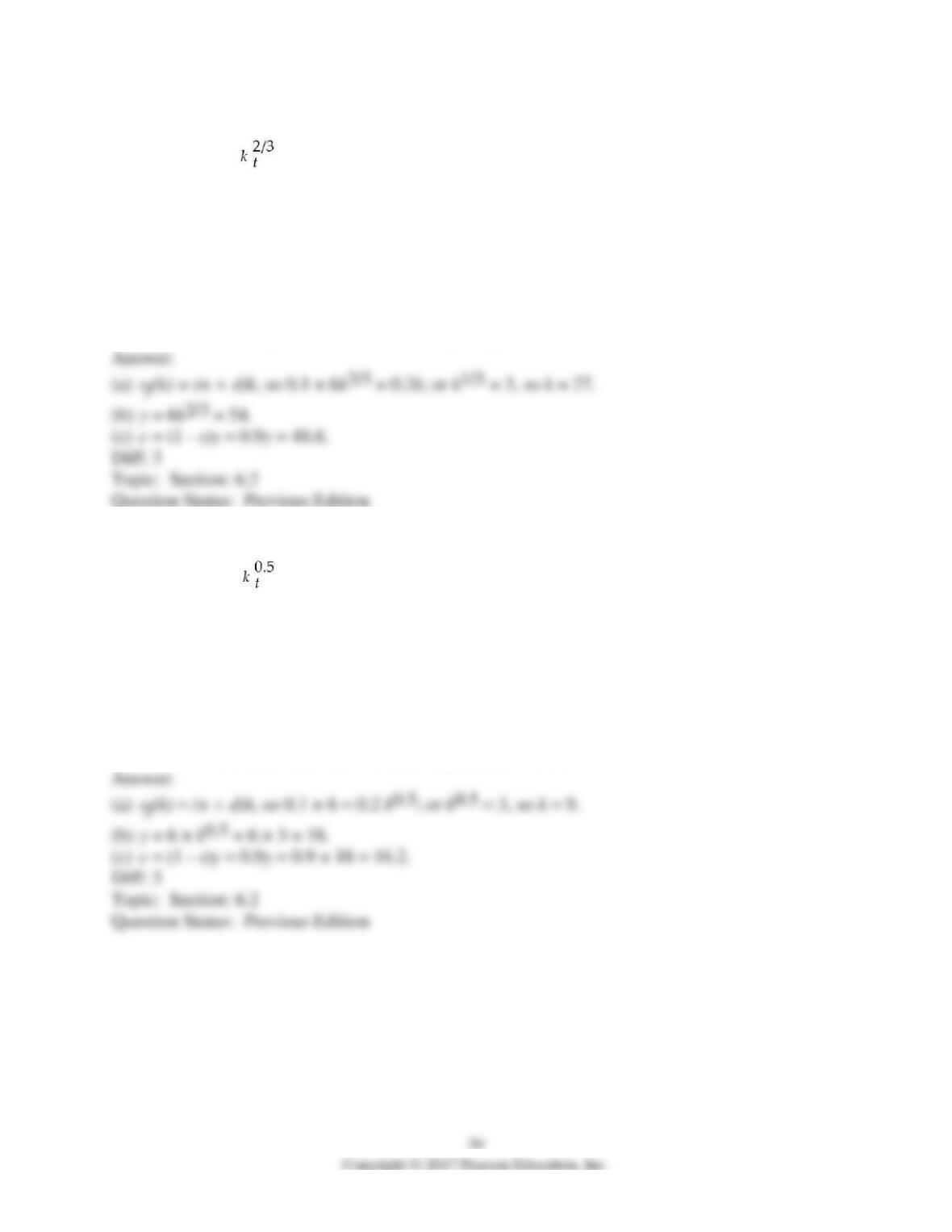
42) A country has the per-worker production function
yt = 6 ,
where yt is output per worker and kt is the capital—labor ratio. The depreciation rate is 0.1 and
the population growth rate is 0.1. The saving function is
St = 0.1Yt,
where St is total national saving and Yt is total output.
(a) What is the steady-state value of capital—labor ratio?
(b) What is the steady-state value of output per worker?
(c) What is the steady-state value of consumption per worker?
43) A country has the per-worker production function
yt = 6 ,
where yt is output per worker and kt is the capital—labor ratio. The depreciation rate is 0.1 and
the population growth rate is 0.1. The saving function is
St = 0.1Yt,
where St is total national saving and Yt is total output.
(a) What is the steady-state value of capital—labor ratio?
(b) What is the steady-state value of output per worker?
(c) What is the steady-state value of consumption per worker?
44) What happens in the steady state to the capital—labor ratio, output per worker, and
consumption per worker when each of the following events occur? You should assume that the
steady-state capital—labor ratio is below the Golden Rule level.
(a) Productivity falls.
(b) Population growth falls.
(c) The saving rate falls.
(d) The depreciation rate falls.
45) Country A has a capital—labor ratio that is initially twice as big as that of country B, but
neither is yet in a steady state. Both countries have the same production function, f(k) = 6k1/2.
Country A has a 10% saving rate, 10% population growth rate, and 5% depreciation rate, while
country B has a 20% saving rate, 10% population growth rate, and 20% depreciation rate.
(a) Calculate the steady-state capital—labor ratio for each country. Does the initial capital—
labor ratio affect your results?
(b) Calculate output per worker and consumption per worker for each country. Which country
has the highest output per worker? The highest consumption per worker?
46) How would each of the following changes affect the steady-state values of the capital—labor
ratio, output per worker, and consumption per worker?
(a) A change in the composition of the capital stock raises the depreciation rate.
(b) A change in social mores lowers the population growth rate.
(c) Government tax policies change to encourage a higher saving rate.
(d) A supply shock reduces productivity sharply.
6.3 Endogenous Growth Theory
1) Endogenous growth theory attempts to
A) replace the Solow model with a model in which money growth plays a key role.
B) explain how societies can more easily reach the “Golden Rule.”
C) show how population growth reduces capital and output.
D) explain why productivity changes.
2) In the textbook model of endogenous growth, the production function is modeled as
A) Y = AK.
B) Y = C + I + G + NX.
C) Y = X.
D) Y = S – I.
3) In the textbook model of endogenous growth, in equilibrium, output grows at the rate of
A) sA – d.
B) n + d.
C) K.
D) A.
4) In the textbook model of endogenous growth, long-run output growth would decline if there
were either a ________ in the saving rate or a ________ in the depreciation rate.
A) rise; rise
B) rise; fall
C) fall; rise
D) fall; fall
5) In the textbook model of endogenous growth, long-run output growth would increase if there
were either a ________ in the saving rate or a ________ in the depreciation rate.
A) rise; rise
B) rise; fall
C) fall; rise
D) fall; fall
6) Which of the following is not an example of human capital formation?
A) Increases in the educational achievements of the population
B) Increases in job skills of the labor force
C) Improvements in the nutrition and health of the labor force
D) Increases in the birth rate of the population
7) Describe the main ideas of endogenous growth theory. What does it have to say about the role
of government in economic growth?
8) (a) In the model of endogenous growth, if s = 0.1, A = 2, and d = 0.15, calculate the
economy’s growth rate. Show your work.
(b) If the depreciation rate declines to d = 0.10, calculate the economy’s growth rate. Show your
work.
(c) Is the impact on the growth rate arising from a change in the depreciation rate in the
endogenous growth model the same as in the Solow model?
6.4 Government Policies to Raise Long-Run Living Standards
1) A government policy that would reduce the saving rate is
A) eliminating the social security system.
B) giving tax breaks to increase the real return that savers receive.
C) increasing the government budget surplus by cutting government spending.
D) switching the tax system to tax consumption instead of income.
2) Which of the following would be a useful way to increase the saving rate?
A) Tax breaks to increase the real return that savers receive
B) Increasing taxes if Ricardian equivalence holds
C) Increasing government spending
D) Increasing taxes on capital goods
3) Government policies to raise the rate of productivity growth include all of the following
except
A) improving infrastructure.
B) encouraging research and development.
C) reducing the government budget surplus.
D) improving human capital development.
4) Government policies to raise the rate of productivity growth include all of the following
except
A) improving infrastructure.
B) improving forecasts of unemployment.
C) helping build human capital by worker training programs.
D) encouraging research and development.
5) A government policy that would raise the rate of productivity growth is
A) shifting infrastructure expenditures to the private sector.
B) taxing expenditures on research and development.
C) reducing the government budget surplus.
D) improving human capital development.
6) What types of government policies can increase long-run living standards?