the legislator to arrange for pork-barrel projects that provide concentrated benefits for his
district.
c.
Logrolling increases the likelihood that pork-barrel projects will be approved.
d.
All of the above are correct.
92. Legislation that offers immediate and easily recognized benefits, at the expense of costs that are
observable only in the distant future, is often enacted even when economic inefficiency results. This
can be expected because of
a.
a lack of incentive for operational efficiency in the public sector.
b.
market failure.
c.
the special-interest effect.
d.
the shortsightedness effect.
93. The shortsightedness effect suggests that
a.
politicians have a strong incentive to support projects that yield immediate and easily
recognized benefits, especially when the costs of the projects are difficult to identify and
are observable only in the distant future.
b.
politicians have a strong incentive to support projects that yield benefits in the distant
future, especially when the costs of the project must be paid for in the current period.
c.
voters will tend to weigh future costs and benefits more heavily than current costs and
benefits.
d.
legislators will be unwilling to trade votes on issues, especially when those issues benefit
only special interest groups.
94. Government decisions tend to be biased toward actions that have
a.
current costs and future benefits that are both easily observable.
b.
future costs that are difficult to identify and current benefits that are easily observable.
c.
future costs and future benefits that are both difficult to identify.
d.
current costs that are easily observable and future benefits that are difficult to identify.
95. Government decisions tend to be biased against actions that have
a.
current costs and future benefits that are both easily observable.
b.
future costs that are difficult to identify and current benefits that are easily observable.
c.
future costs and future benefits that are both difficult to identify.
d.
current costs that are easily observable and future benefits that are difficult to identify.
96. Which of the following is an example of political action that reflects the shortsightedness effect?
a.
budget surpluses
b.
the promise of future benefits without providing for their funding
c.
spending on roads and highways
d.
spending on programs that transfer income from the rich to the poor
97. Which of the following explains why elected representatives will find borrowing to be an attractive
method of financing current government programs?
a.
the shortsightedness effect
b.
pork-barrel politics
c.
the invisible hand principle
d.
the public goods argument for government spending programs
98. In economics, actions by individuals and interest groups designed to influence public policy in a
manner that will either directly or indirectly redistribute more income to themselves are known as
a.
logrolling.
b.
rent seeking.
c.
influence peddling.
d.
redistribution searching.
99. Subsidizing coal mining and orange growing have both been found to be economically inefficient in
that the costs outweigh the benefits. However, a subsidy on coal mining would help the coal
producers in West Virginia and a subsidy on orange growing would help the orange farmers in Florida.
So the senator from West Virginia approaches the senator from Florida and says that he will vote for
the orange subsidy if the Florida senator votes for the coal-mining subsidy. The Florida senator
agrees. Which term best describes what just happened?
a.
the shortsightedness effect
b.
logrolling
c.
the use of user charges
d.
the political voter theory
100. Economic studies have concluded that a new bill lowering the trade restrictions on the importation of
sugar would be good for the economy. President Sweet Tooth highlights the results of this study in
his state of the union address and sends the “Sweet Tooth” bill to Congress. Another economic study
declares that subsidizing coal mining and orange growing have both been found to be economically
inefficient in that the costs outweigh the benefits. However, a subsidy on coal mining would help the
coal producers in West Virginia and a subsidy on orange growing would help the orange farmers in
Florida. So when the “Sweet Tooth” bill makes its way through congress the senators from West
Virginia and Florida will only vote for it if they have their coal-mining and orange-growing subsidies
attached to it. The bill gets to President Sweet Tooth with these and other economically inefficient
subsidies attached to it, and he passes the bill in its entirety. Which term best describes what just
happened?
a.
pork-barrel legislation
b.
public good provision
c.
rational-ignorance effect
d.
the political voter theory
101. Dairy farmers hold an annual Capitol Hill ice cream social that provides free ice cream for
congressional staffers during which time representatives from the industry discuss issues with, and
provide information to, congressional staff. This is an example of
a.
logrolling.
b.
rent seeking.
c.
pork-barrel legislation.
d.
the shortsightedness effect.
102. In 2006, the American Association of Retired Persons (AARP) spent over $70 million on
lobbying-related expenses in an attempt to get policies enacted that would benefit retirees. In
economics, the term used to describe such activity is
a.
logrolling.
b.
rent seeking.
c.
influence peddling.
d.
redistribution searching.
103. Producers tend to be better represented in lobbying efforts and other elements of the political process
than consumers because
a.
producers are generally more intelligent and, therefore, better informed.
b.
producers are generally better organized than consumers.
c.
producers are better educated than consumers.
d.
the number of producers affected by the outcome of a particular political issue is usually
greater than the number of consumers affected.
104. As both the budget and regulatory powers of government grow, public choice analysis indicates that
individuals and groups will find it in their interest to
a.
increase their efforts devoted toward market production.
b.
spend less time attempting to secure redistribution through government.
c.
spend more time informing themselves about political issues, so they can cast a
well-informed vote.
d.
spend more time rent seeking.
105. Which of the following is a predictable side effect of increased government activity (for example,
taxes and subsidies) designed to redistribute income among citizens?
a.
improvement in the operational efficiency of government agencies
b.
budget surpluses
c.
reduction in the poverty rate
d.
an increase in rent-seeking activity
106. When governments become more heavily involved in taxing one group in order to provide benefits to
other groups, which of the following will be encouraged?
a.
rapid economic growth
b.
rent-seeking activity
c.
an improvement in the efficiency of government bureaucracies
d.
competitive private markets
107. From the standpoint of society as a whole, rent seeking is
a.
counterproductive because it takes resources away from the creation of wealth in the
private sector.
b.
counterproductive because it fails to alter public policy.
c.
productive because each interest group gains more than they spend on rent-seeking
activities.
d.
productive because the resources used in rent seeking have no opportunity cost to society.
108. Which of the following factors explains why managers of government agencies (the public sector)
have little incentive to operate efficiently?
a.
It is relatively easy for voters to detect operational inefficiency in the public sector and do
something to correct it.
b.
Public-sector managers face fierce competition.
c.
Public-sector managers have no fear of losses and bankruptcy when operational efficiency
is not achieved.
d.
All of the above explain why government agencies have little incentive to be efficient.
109. Which of the following represents why private production tends to be more efficient then government
production?
a.
Politicians have a strong incentive to support projects that have immediate and easily
recognized benefits and distant and unidentifiable costs, even if the total costs outweigh
the total benefits.
b.
Politicians have a strong incentive to support programs where the benefits are highly
concentrated on special interest groups and the costs are widely dispersed among voters,
even if the total costs outweigh the benefits.
c.
Private companies face a profit motive that keeps them operating efficiently, government
bureaucracies use taxpayer money and, therefore, do not face this profit motive.
d.
All of the above are reasons why private production tends to be more efficient then
government production.
110. Approximately what percent of government transfer payments are directed toward the poor (means
tested)?
a.
one-sixth
b.
one-fourth
c.
one-half
d.
three-quarters
111. Public choice theory suggests that politicians will be most likely to favor redistribution of income from
a.
the rich to the poor.
b.
unorganized taxpayers to well-organized interest groups.
c.
well-organized business groups to consumers.
d.
none of the above.
112. Which of the following is true?
a.
The incentives to engage in rent-seeking activities increase with the ease with which the
political process can provide personal gain at the expense of others.
b.
The amount of resources devoted toward rent seeking generally has no impact on the
economic prosperity of a nation.
c.
Income transfers directed toward the poor constitute about half of all income transfers in
the United States.
d.
All of the above are correct.
113. Most income transfer programs in the United States
a.
are means-tested programs that transfer income to the poor.
b.
allocate income to small businesses and small farmers.
c.
are designed to help those with very little economic and political power.
d.
allocate income to concentrated interest groups, such as the elderly, large farmers, and
business interests.
114. According to public choice theory, which of the following groups will likely benefit the most from
government income transfers under a system of representative democracy?
a.
the poor
b.
consumers
c.
small businesses
d.
concentrated interest groups
115. Public choice analysis indicates
a.
most income transfers will be directed toward the poor.
b.
rent-seeking activities will improve the efficiency of resource allocation and promote
economic growth.
c.
rent seeking will be less attractive if the nation’s legal (or constitutional) structure makes it
difficult to use the political process to take the property or income of others.
d.
politicians will consistently oppose programs favored by rent seekers if those programs
reduce the welfare of society.
116. Economic theory implies that the incentive for a manager of a publicly operated firm (for example, a
state university or the post office) to promote internal efficiency of their operations would be
a.
strong because inefficiency is easily detected and leads to the loss of voter support.
b.
strong because public officials are unconcerned about personal gain.
c.
weak because government employees are less educated than employees who work in the
private sector.
d.
weak because it is difficult for voters to detect inefficiency and for public officials to gain
from actions that would improve the efficiency of government.
117. Which of the following factors explains why managers of government agencies have little incentive to
achieve operational efficiency?
a.
Public-sector managers have no fear of bankruptcy when operational efficiency is not
achieved.
b.
Public-sector managers face fierce competition.
c.
It is relatively easy for voters to detect operational inefficiency in the public sector and do
something to correct it.
d.
All of the above explain why government agencies have little incentive to be efficient.
118. Crony capitalism is present when
a.
businesses are either implicitly or explicitly prohibited from making donations to
political candidates.
b.
businesses either implicitly or explicitly provide political decision-makers with
contributions and other forms of political support in “exchange” for government favors
that will improve their profitability.
c.
rule of law is present and government officials treat all citizens alike.
d.
government officials spend taxpayer funds only on productive projects.
119. If new regulations make it illegal to sell older model electrical appliances, then
a.
producers of new models that meet the regulations will see demand for their output rise.
b.
consumers who might have purchased to older appliances are clearly made better off.
c.
consumers are helped, but the profits of appliance producers are not affected.
d.
consumers will certainly gain from the change.
120. Economics indicates that government funding of special interest projects and favoritism of some
business firms relative to others will lead to
a.
efficient allocation of resources because the government action will correct the failures of
the market.
b.
the funding of productive projects that will improve the well-being of most citizens.
c.
economic inefficiency because the funding will be driven by political rather than
economic considerations.
d.
a decline in political contributions and a reduction in the quality of the candidates willing
to run for political office.
121. Which of the following is most likely to result in an increase in crony capitalism?
a.
a reduction in entry barriers and an increase in the competitiveness of markets.
b.
an increase in government spending and growth of government regulation
c.
a reduction in the size of government
d.
an increase in the share of the population voting in elections
122. An analysis of market failure and government failure indicates
a.
government decision making is always preferable to using markets.
b.
market decision making is always preferable to public-sector action.
c.
government action is necessary whenever market failure occurs.
d.
both the market and the government may fail to meet conditions of economic efficiency;
in each individual case, the choice of market or public-sector action requires careful
evaluation.
123. Which of the following factors weakens the case for government provision of goods and services
relative to private-sector provision?
a.
monopoly
b.
externalities
c.
public goods
d.
the special-interest effect
124. Which of the following factors weakens the case for private-sector provision of goods and services
relative to public-sector provision?
a.
externalities
b.
the rational-ignorance effect
c.
the shortsightedness effect
d.
well-informed consumers
125. Which of the following factors weakens the case for private-sector provision of goods and services
relative to public-sector provision?
a.
constitutional rules
b.
the shortsightedness effect
c.
the special-interest effect
d.
public goods
126. Public choice analysis indicates
a.
politicians under representative democracy are led as if by an invisible hand to adopt
legislation that enhances the wealth of a nation.
b.
political structures consistent with economic efficiency tend to emerge naturally from the
ordinary political process.
c.
constitutional rules establishing procedures and limiting the ability of the political process
to engage in redistributive activities can improve the economic efficiency of government.
d.
all of the above are correct.
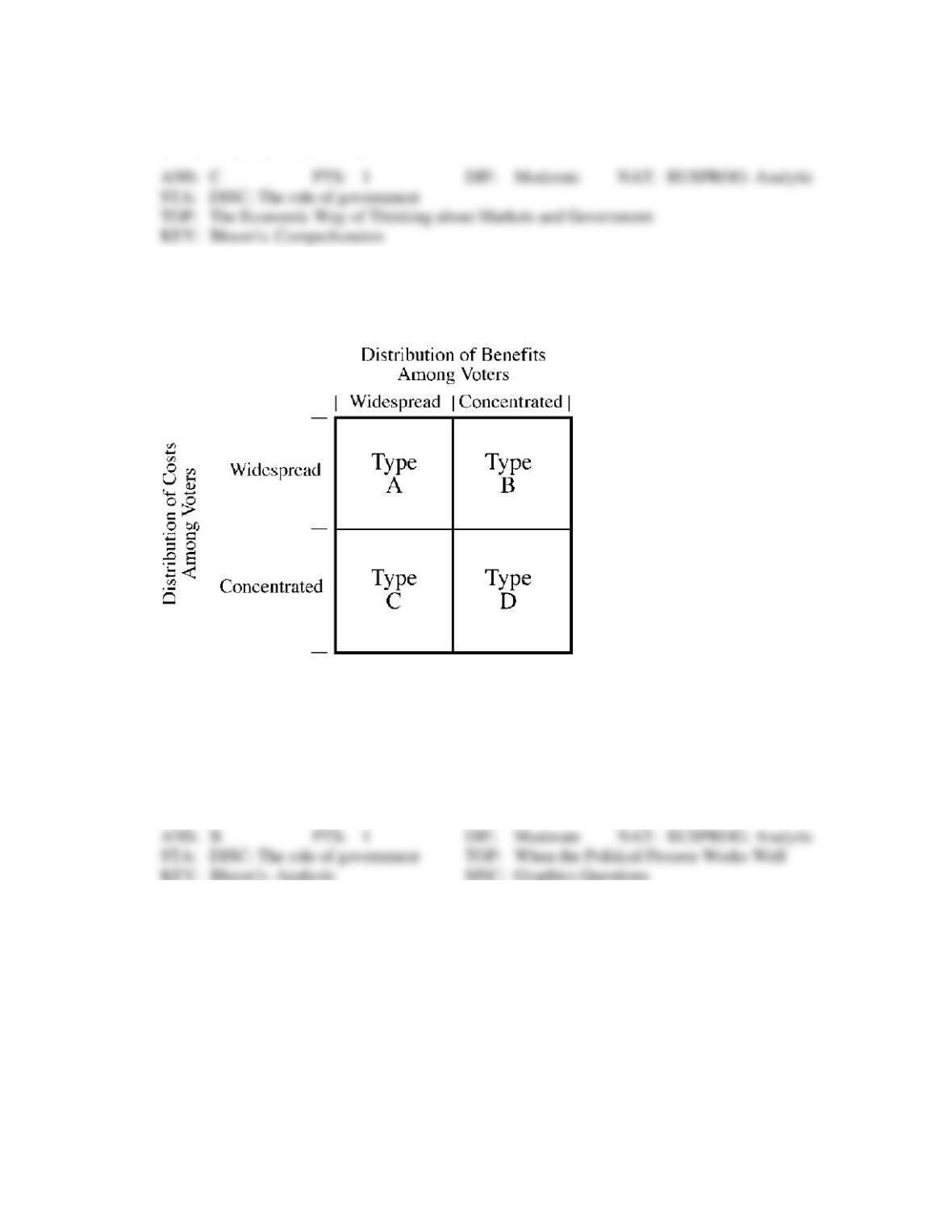
Use the figure below to answer the following question(s).
Figure 6-1
127. Figure 6-1 illustrates the four possibilities of the distribution of costs and benefits among voters for a
government project. A tariff on imported steel to protect jobs in the domestic steel industry that raises
the cost of many products for consumers would be considered which type of project?
a.
type A
b.
type B
c.
type C
d.
type D
128. Figure 6-1 illustrates the four possibilities of the distribution of costs and benefits among voters for a
government project. Programs that give subsidies to a small group of producers at general taxpayer
expense would be considered
a.
type A projects, and the government would be likely to undertake these projects if they
were efficient and to reject them if they were inefficient.
b.
type B projects, and the government would be likely to undertake many of these projects
even when they were counterproductive (inefficient).
c.
type C projects, and the government would be likely to fail to undertake many of these
projects even when they were productive (efficient).
d.
type D projects, and the government would be likely to undertake these projects if they
were efficient and to reject them if they were inefficient.
129. Figure 6-1 illustrates the four possibilities of the distribution of costs and benefits among voters for a
government project. For which type would the government most likely undertake many projects that
would be considered inefficient or counterproductive (in other words, do too many of them relative to
economic efficiency)?
a.
type A
b.
type B
c.
type C
d.
type D
130. Figure 6-1 illustrates the four possibilities of the distribution of costs and benefits among voters for a
government project. For which type would the government most likely fail to undertake many projects
that would be considered efficient or productive (in other words, do too few of them relative to
economic efficiency)?
a.
type A
b.
type B
c.
type C
d.
type D
131. Figure 6-1 illustrates the four possibilities of the distribution of costs and benefits among voters for a
government project. For which types of projects would government action most likely work well,
undertaking only efficient projects and rejecting inefficient ones?
a.
types A and B
b.
types B and D
c.
types B and C
d.
types A and D
Use the figure below to answer the following question(s).
Figure 6-2
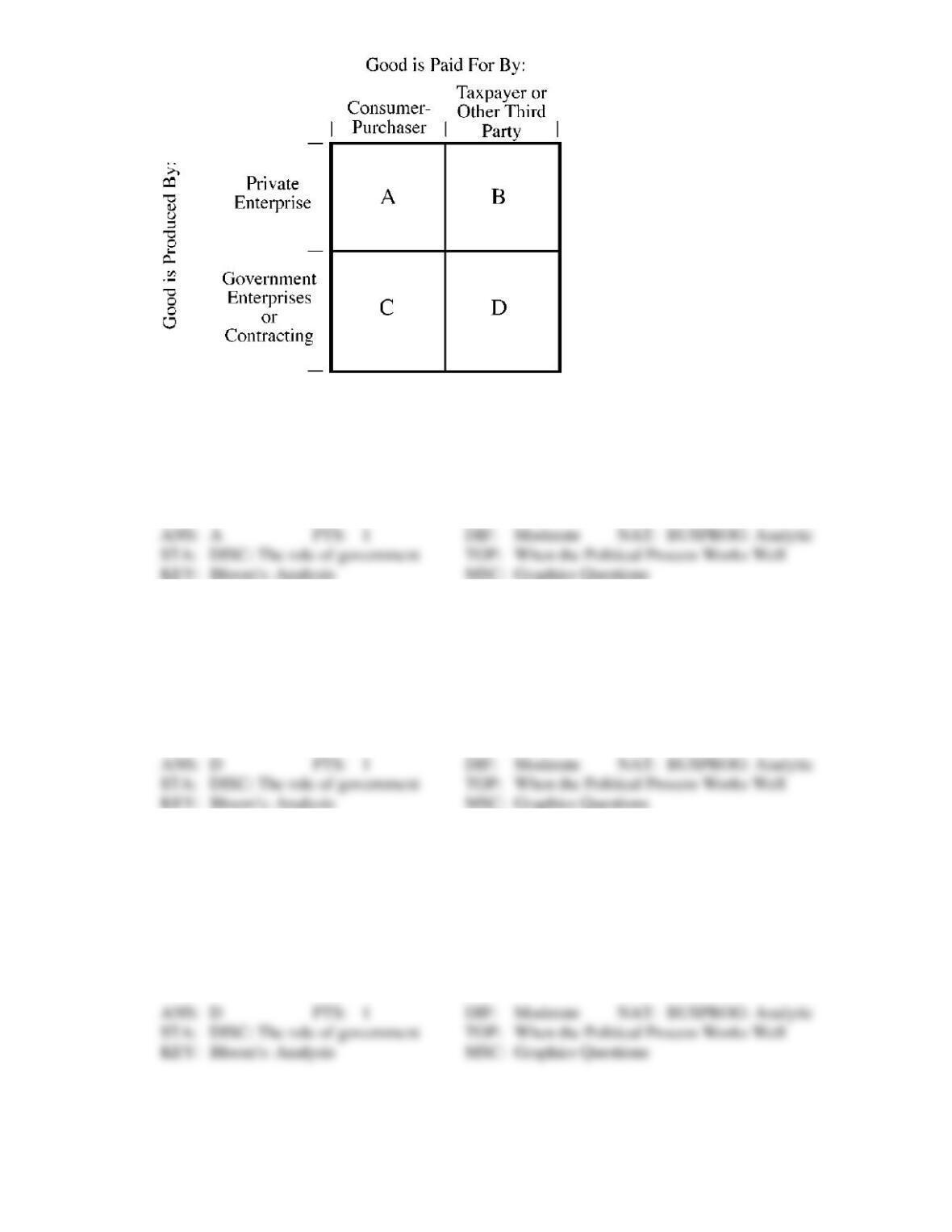
132. Figure 6-2 illustrates the four possibilities of the structure of production and consumption for a good or
service. In which case is the incentive of producers and consumers to economize the strongest?
a.
A
b.
B
c.
C
d.
D
133. Figure 6-2 illustrates the four possibilities of the structure of production and consumption for a good or
service. In which case is the incentive of producers to be efficient and the incentive for consumers to
economize the weakest?
a.
A
b.
B
c.
C
d.
D
134. Figure 6-2 illustrates the four possibilities of the structure of production and consumption for a good or
service. When the structure of production and consumption for a good places it in quadrant B,
a.
consumers have little incentive to search out and patronize low-cost suppliers.
b.
private producers of such goods will have little incentive to operate efficiently and to keep
prices low.
c.
goods and services will only be supplied if consumers are willing to pay an amount
sufficient to cover their production costs.
d.
both a and b, but not c, will be true.
Scenario 6-1