20) The real wage rate measures the
A) quantity of goods and services that an hour of work will buy.
B) average weekly earnings in dollars of a worker.
C) dollar value of an hour of work.
D) dollar value of what a worker could earn in another job.
21) Which of the following is TRUE regarding the real wage rate? The real wage rate
I. is always greater than the money wage.
II. measures the quantity of goods and services an hour’s work can buy.
A) only I
B) only II
C) both I and II
D) neither I nor II
22) The real wage rate equals
A) (money wage rate)/(price level).
B) (price level)/(money wage rate).
C) (money wage rate) × (price level).
D) (money wage) + (number of hours worked)/(price level).
23) The relationship between the labor employed by a firm and the real wage rate is shown by
the
A) supply of labor curve.
B) supply of jobs curve.
C) demand for jobs curve.
D) demand for labor curve.
24) The quantity of labor demanded depends on the
A) money wage rate not the real wage rate.
B) real wage rate not the money wage rate.
C) price of output not the money wage rate nor the real wage rate.
D) money wage rate AND the real wage rate.
25) Because the productivity of labor decreases as the quantity of labor employed increases
A) the quantity of labor a firm demands increases as the real wage rate decreases.
B) the quantity of labor a firm demands increases as the money wage rate decreases.
C) the labor demand curve shifts right as the real wage rate decreases.
D) the aggregate production function shifts upward as the real wage rate decreases.
26) Which of the following is TRUE regarding the labor market?
I. The labor supply curve slopes upward because firms maximize profits as they hire more
workers.
II. If the real wage rate falls, the quantity of labor firms demand increases.
III. The demand for labor curve slopes downward because as the real wage rate falls, workers
demand to work fewer hours.
A) I and II
B) I and III
C) II only
D) I, II and III
27) Which of the following statements are TRUE regarding the demand for labor?
I. The quantity of labor demanded depends on the real wage rate.
II. If the money wage rate increases and the price level remains the same, the quantity of labor
demanded decreases.
A) I only
B) II only
C) I and II
D) neither I nor II
28) If the price level falls by 5 percent and workers’ money wage rates remain constant, firms’
A) quantity of labor demanded will decrease.
B) quantity of labor demanded will increase.
C) supply of jobs will increase.
D) None of the above answers are correct.
29) If the price level rises by 5 percent and workers’ money wage rates remain constant, firms’
A) quantity of labor demanded will decrease.
B) quantity of labor demanded will increase.
C) supply of jobs will decrease.
D) None of the above answers are correct.
30) Suppose there is a rise in the price level, but no change in the money wage rate. As a result,
the quantity of labor demanded
A) increases.
B) decreases.
C) does not change because there is no change in the real wage rate.
D) decreases only if the money wage rate also decreases.
31) Suppose there is a rise in the real wage rate. As a result, the quantity of labor demanded
A) increases.
B) decreases.
C) does not change because there is no change in the money wage rate.
D) increases only if the price level also decreases.
32) Suppose the money wage rate and the price level both fall by 5 percent. As a result
A) the quantity of labor demanded increases.
B) the quantity of labor demanded decreases.
C) the quantity of labor demanded does not change because there is no change in the real wage.
D) people are worse off and there is more unemployment.
33) If the price level rises by 3 percent and workers’ money wage rates increase by 2 percent,
then the
A) quantity of labor demanded will decrease.
B) quantity of labor demanded will increase.
C) quantity of labor demanded does not change because there is no change in the real wage rate.
D) real wage rate increases.
34) If the price level rises by 3 percent and workers’ money wages increase by 3 percent, then the
A) quantity of labor demand will decrease.
B) quantity of labor demand will increase.
C) quantity of labor demanded does not change because there is no change in the real wage rate.
D) Any of the above could occur depending on the magnitude on the dollar increase in the price
level versus the dollar increase in the wage rate.
35) The demand for labor curve is
A) upward sloping at potential GDP and downward sloping elsewhere.
B) vertical at potential GDP.
C) downward sloping.
D) upward sloping because firms demand labor.
36) The labor demand curve slopes downward because
A) the firm maximizes profits by hiring more labor when the real wage rate rises.
B) workers supply more hours of work when the real wage rate rises.
C) the firm maximizes profits by hiring more labor when the real wage rate falls.
D) workers supply fewer hours of work when the real wage rate rises.
37) If the price level increases, but workers’ money wage rates remain constant,which of the
following is TRUE?
I. The quantity of labor demanded will increase.
II. The real wage rate will decrease.
III. The demand for labor curve shifts rightward.
A) I only
B) I and II
C) II and III
D) I, II and III
38) The quantity of labor supplied depends on the
A) money wage rate not the real wage rate.
B) real wage rate not the money wage rate.
C) price of output not the money wage rate nor the real wage rate.
D) level of profits.
39) People base their labor supply on the ________ because they care about ________.
A) real wage; what their earnings will buy
B) real wage; the equality of money wages and the price level
C) money wage; a surplus of labor
D) money wage; the amount of labor firms demand
40) If workers’ money wage rates increase by 5 percent and the price level remains constant,
workers’
A) quantity of labor supplied will decrease.
B) quantity of labor supplied will increase.
C) quantity of labor supplied will not change.
D) demand for jobs will decrease.
41) If the price level rises by 4 percent and workers’ money wage rates increase by 2 percent,
then the
A) quantity of labor supplied decreases.
B) quantity of labor supplied increases.
C) quantity of labor supplied does not change because there is no change in the real wage rate.
D) the supply curve of labor shifts rightward.
42) If the price level rises by 2 percent and workers’ money wages increase by 2 percent, then the
A) quantity of labor supply decreases.
B) quantity of labor supply increases.
C) quantity of labor supplied does not change because there is no change in the real wage rate.
D) More information about the dollar change in the price level and money wage rate are needed
to answer the question.
43) If the price level rises by 3 percent and workers’ money wage rate increase by 1 percent, then
the
A) quantity of labor supplied decreases.
B) quantity of labor supplied increases.
C) quantity of labor supplied does not change because there is no change in the real wage rate.
D) real wage rate increases.
44) The labor force participation rate
A) does not change when the real wage rate changes.
B) decreases as the real wage rate rises.
C) increases as the real wage rate increases.
D) has an inverse effect of the supply of labor.
45) The supply of labor curve
A) has a negative slope.
B) is independent of the wage rate.
C) shows how much labor workers are willing to supply at various real wage rates.
D) is usually vertical.
46) The supply of labor curve is
A) vertical at potential GDP.
B) upward sloping.
C) downward sloping.
D) horizontal at the equilibrium wage rate.
47) Which of the following statements is CORRECT?
A) When the real wage increases, the labor supply curve shifts rightward.
B) When the real wage increases, the labor supply curve shifts leftward.
C) When the real wage decreases, the labor supply curve shifts leftward.
D) None of the above statements are correct.

48) As the real wage rate increases, the
A) quantity of labor supplied increases.
B) supply of labor curve shifts rightward.
C) supply of labor curve shifts leftward.
D) quantity of labor supplied increases and the supply of labor shifts rightward.
49) If the price level increases and workers’ money wage rates remain constant,which of the
following will occur?
I. The quantity of labor supplied will decrease.
II. The real wage rate will decrease.
III. The labor supply curve will shift rightward.
A) I only
B) I and II
C) II and III
D) I, II and III
50) Greater labor force participation for households at higher real wage rate is one reason that
A) the demand for labor curve is upward sloping.
B) the demand for labor curve is downward sloping.
C) the supply of labor curve is upward sloping.
D) the supply of labor curve is downward sloping.
51) If the money wage rate rises relative to the price level, firms ________ the quantity of labor
they demand and workers ________ the quantity of labor they supply.
A) increase; increase
B) increase; decrease
C) decrease; increase
D) decrease; decrease
52) If the price level rises relative to the money wage rate, firms ________ the quantity of labor
they demand and workers ________ the quantity of labor they supply.
A) increase; increase
B) increase; decrease
C) decrease; increase
D) decrease; decrease
53) If the real wage rate is such that the quantity of labor supplied equals the quantity of labor
demanded
A) a full-employment equilibrium occurs.
B) actual GDP equals potential GDP.
C) the supply curve of labor is vertical.
D) Both answers A and B are correct.
54) If at the prevailing real wage rate, the quantity of labor supplied exceeds the quantity
demanded
A) there is a shortage of labor.
B) the real wage rate will rise to restore equilibrium.
C) the real wage rate is greater than the equilibrium real wage rate.
D) None of the above answers is correct.
55) If the real wage rate is such that the quantity of labor supplied is greater than the quantity of
labor demanded
A) the economy is at full employment.
B) actual real GDP will not equal potential GDP.
C) job search decreases.
D) labor resources are allocated efficiently.
56) If the real wage rate is such that the quantity of labor supplied by workers is less than the
quantity of labor demanded by firms
A) the economy is at full employment.
B) there is a shortage of labor.
C) the real wage rate will fall to restore equilibrium.
D) actual real GDP equals potential GDP because firms make the decision about how many
workers to hire.
57) At the full-employment equilibrium in the labor market
A) there is no unemployment.
B) there are no job vacancies.
C) there is neither a shortage nor a surplus of labor.
D) the money wage rate equals the real wage rate.
58) Equilibrium in the labor market
A) cannot occur if the production function is shifting upward.
B) can happen only when actual GDP exceeds potential GDP.
C) means that resources are allocated inefficiently
D) occurs when actual GDP is equal to potential GDP
59) When the quantity of labor demanded exceeds the quantity of labor supplied, the real wage
rate
A) rises to eliminate the labor-market shortage.
B) falls to eliminate the labor-market surplus.
C) rises to eliminate the labor-market surplus.
D) falls to eliminate the labor-market shortage.
60) If the labor market is in equilibrium and then the labor supply curve shifts rightward
A) there will be a shortage of labor at the original equilibrium wage rate.
B) there will be a surplus of labor at the original equilibrium wage rate.
C) the equilibrium wage rate will rise.
D) there will be a surplus of jobs at the new equilibrium.
61) In the labor market, an increase in labor productivity ________ the real wage rate and
________ the level of employment.
A) raises; increases
B) raises; decreases
C) lowers; increases
D) lowers; decreases
Real wage rate
(2009 dollars
per hour)
Quantity of labor
demanded
(billions of hours
per year)
Quantity of labor
supplied (billions
of hours per year)
15
70
10
20
60
20
25
50
30
30
40
40
35
30
50
62) The table above shows the labor market for the country of Pickett. When the labor market is
in equilibrium, the real wage rate is ________ and ________ of labor a year are employed.
A) any value less than $25 an hour; any value greater than 40 billion hours
B) any value greater than $30 an hour; any value more than 40 billion hours
C) any value greater than or equal to $25 an hour; any value less than 40 billion hours
D) $30 an hour; 40 billion hours
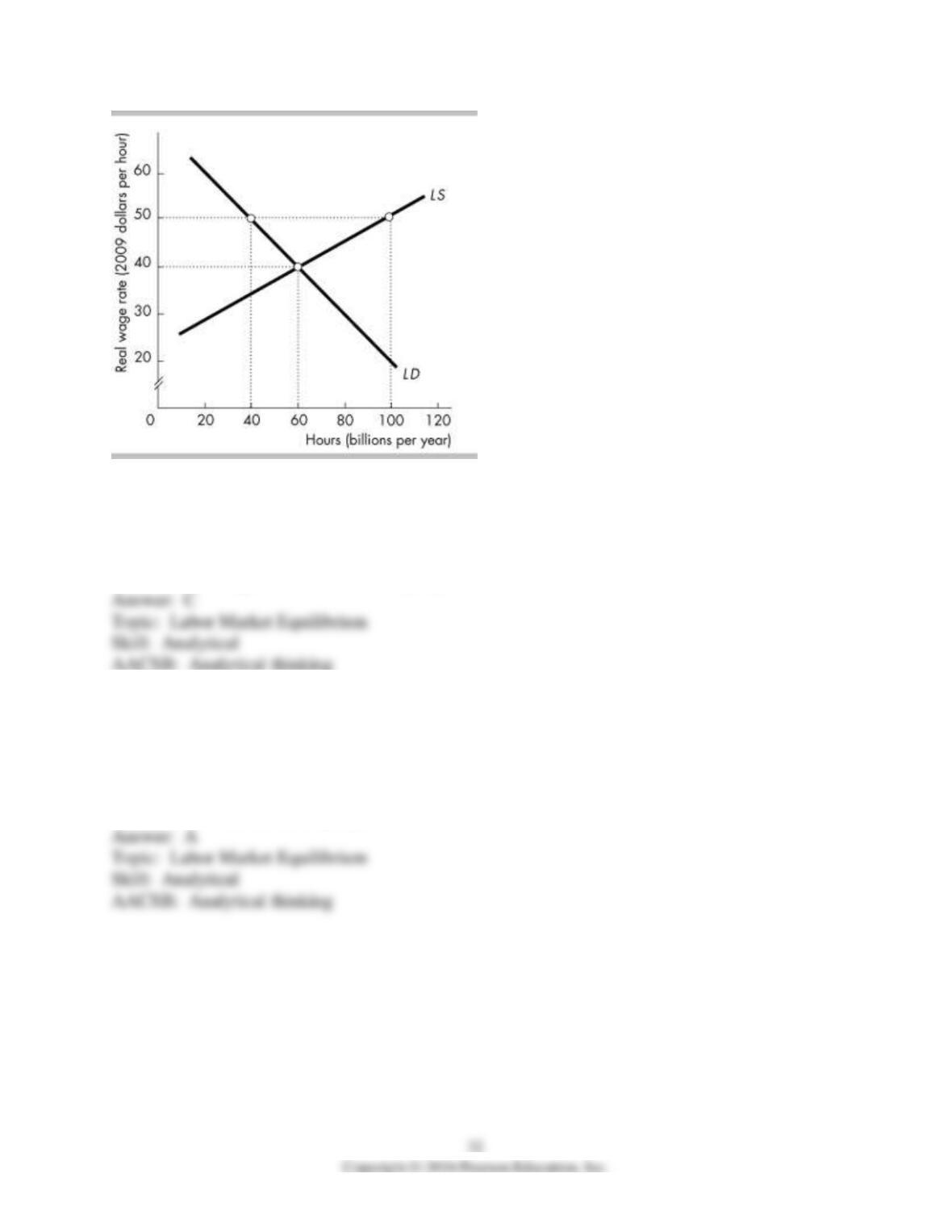
63) In the above figure, at the real wage rate of $50
A) there is a surplus of 100 billion hours per year.
B) there is a shortage of 100 billion hours per year.
C) there is a surplus of 60 billion hours per year.
D) there is shortage of 20 billion hours per year.
64) In the above figure, what is the full-employment real wage rate and quantity of hours per
year?
A) $40 and 60 billion hours per year
B) $50 and 100 billion hours per year
C) $35 and 100 billion hours per year
D) $50 and 40 billion hours per year
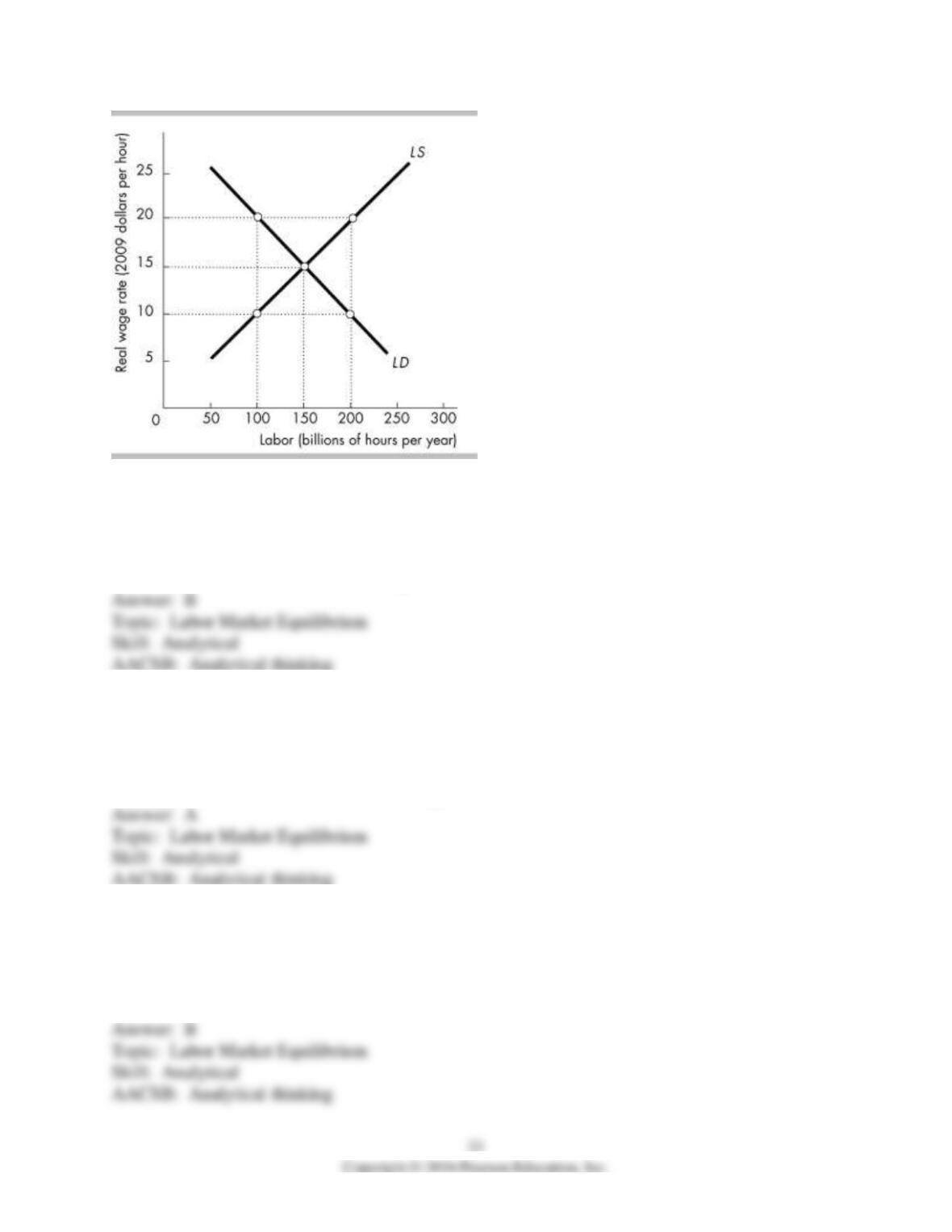
65) In the above figure, at a wage rate of $20 per hour
A) there is a shortage of labor.
B) there is a surplus of labor.
C) the labor supply curve will shift rightward.
D) the labor demand curve will shift rightward.
66) In the figure, when the real wage rate is $10 an hour, ________.
A) a shortage of labor exists and the real wage rate will rise
B) the demand for labor will increase
C) the demand for labor will decrease
D) a surplus of labor exists and the real wage rate will fall
67) In the above figure, the equilibrium real wage rate is
A) $10 per hour.
B) $15 per hour.
C) $20 per hour.
D) none of the above
68) In the above figure, the equilibrium level of labor is
A) 100 billion hours.
B) 150 billion hours.
C) 200 billion hours.
D) none of the above
69) In the above figure, if the real wage is $20 per hour, a labor
A) shortage will occur and the real wage will rise.
B) shortage will occur and the real wage will fall.
C) surplus will occur and the real wage will rise.
D) surplus will occur and the real wage will fall.
70) In the above figure, if the real wage is $10 per hour, a labor
A) shortage will occur and the real wage will rise.
B) shortage will occur and the real wage will fall.
C) surplus will occur and the real wage will rise.
D) surplus will occur and the real wage will fall.
71) Full employment corresponds to
A) equilibrium in the labor market, with actual GDP being equal to potential GDP.
B) labor demand being greater than labor supply and actual GDP being equal to potential GDP.
C) being at the point where the marginal product of labor equals zero.
D) equilibrium in the labor market, and actual GDP exceeding potential GDP.
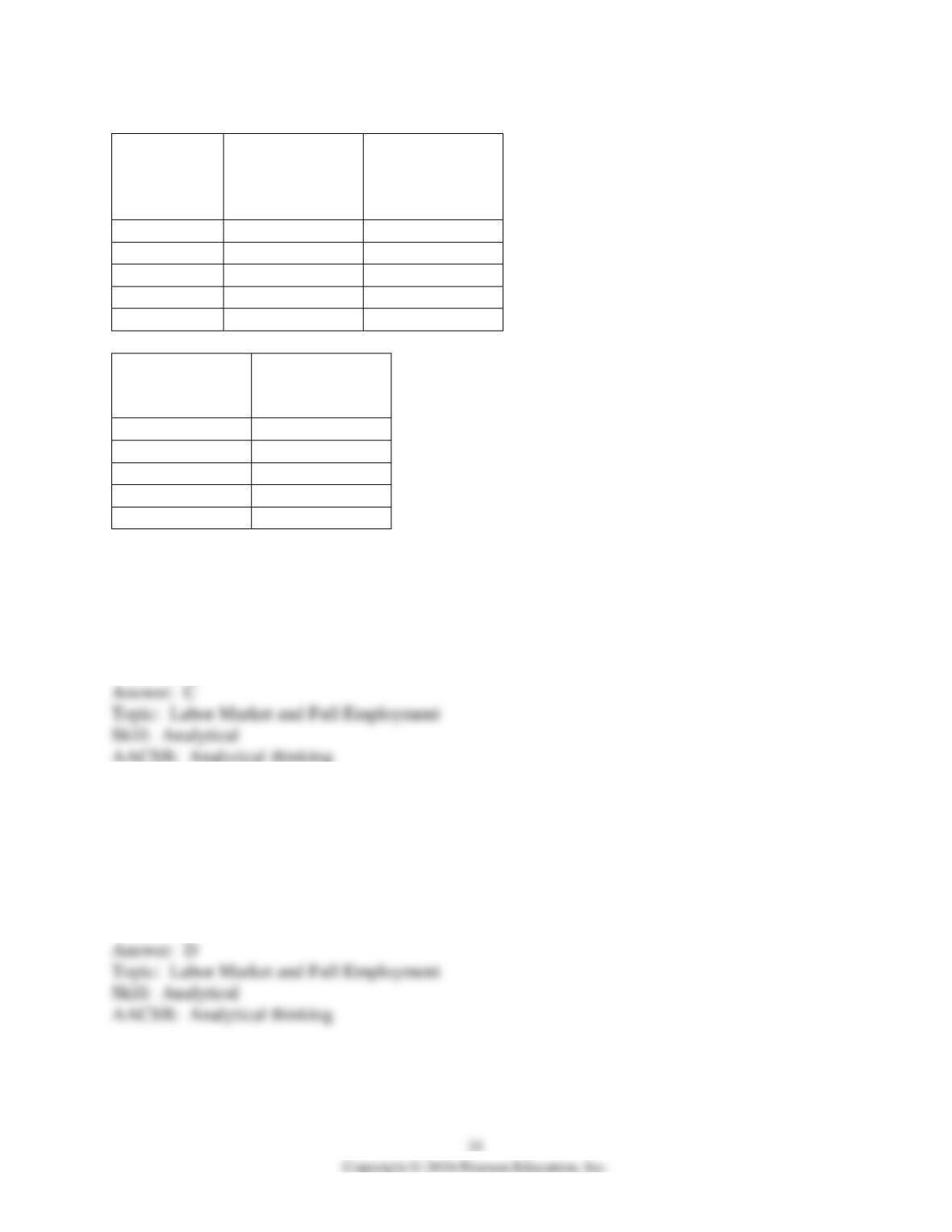
Real wage rate
(2009 dollars
per hour)
Quantity of labor
demanded
(billions of hours
per year)
Quantity of labor
supplied (billions
of hours per year)
15
70
10
20
60
20
25
50
30
30
40
40
35
30
50
Real GDP
(trillions of 2009
dollars per year)
Quantity of labor
(billions of hours
per year)
3
20
9
30
14
40
18
50
21
60
72) The tables above show the labor market and the production function schedule for the country
of Pickett. Potential GDP is ________.
A) $40 trillion
B) $9 trillion
C) $14 trillion
D) $25 trillion
73) The tables above show the labor market and the production function schedule for the country
of Pickett. An increase in population changes the labor supply by 20 billion hours at each real
wage rate. Potential GDP ________.
A) does not change
B) decreases to $3 trillion
C) increases to $50 trillion
D) increases to $18 trillion
74) Real GDP grows when
I. the quantities of the factors of production grow.
II. persistent advances in technology make factors of production increasingly productive.
III. human capital grows.
A) only I
B) both I and III
C) only II
D) I, II, and III
75) If the labor and capital grow more quickly, then real GDP will
A) not grow fast enough.
B) grow more quickly.
C) grow more slowly.
D) stay fixed at potential GDP.
76) The real wage rate will fall if the
A) labor supply curve shifts rightward and the labor demand curve does not shift.
B) labor supply curve shifts leftward and the labor demand curve does not shift.
C) labor demand curve shifts rightward and the labor supply curve does not shift.
D) labor demand curve shifts rightward more than the labor supply curve shifts rightward.
77) The U.S. employment-to-population ratio peaked in 2000 and in 2014 fell to 59 percent, a
level not seen since the early 1980s. This fall in the employment-to-population ratio shifts the
________ curve ________.
A) labor supply; leftward
B) labor supply; rightward
C) labor demand; leftward
D) labor demand; rightward
78) The U.S. employment-to-population ratio peaked in 2000 and in 2012 fell to 58 percent, a
level not seen since the early 1980s. This fall in the employment-to-population ratio ________
the equilibrium quantity of labor and ________ potential GDP.
A) increases; increases
B) increases; decreases
C) decreases; increases
D) decreases; decreases
79) An increase in a nation’s population results in
A) an upward shift in the production function.
B) a movement along the production function.
C) a leftward shift in the labor supply curve.
D) Both answers A and C are correct.
80) An increase in a nation’s population results in
A) a rightward shift in the labor demand curve.
B) a movement along the nation’s production function.
C) a decrease in the full-employment quantity of labor.
D) an upward shift of the nation’s production function.
81) An increase in the population and hence the supply of labor causes a
A) shortage of labor at the original real wage rate and the real wage rate will fall.
B) surplus of labor at the original real wage rate and the real wage rate will rise.
C) surplus of labor at the original real wage rate and the real wage rate will fall.
D) shortage of labor at the original real wage rate and the real wage rate will rise.
82) Employment and (total) potential GDP increase if the
A) labor supply curve shifts rightward and the labor demand curve does not shift.
B) labor demand curve shifts leftward more than the labor supply curve shifts rightward.
C) labor demand curve shifts leftward and the labor supply curve does not shift.
D) None of the above answers are correct.
83) When the population increases with no change in labor productivity, employment ________
and potential GDP ________.
A) decreases; decreases
B) increases; increases
C) decreases; increases
D) increases; decreases
84) If the population increases, then potential GDP ________ and employment ________.
A) increases; increases
B) increases; decreases
C) decreases; increases
D) decreases; decreases
85) An increase in the working-age population results in a
A) rightward shift of demand for labor curve and an increase in potential GDP.
B) rightward shift of the demand for labor curve and no change in potential GDP.
C) rightward shift of the supply of labor curve and an increase in potential GDP.
D) leftward shift of the supply of labor curve and a decrease in potential GDP.
86) Potential GDP per labor hour can increase due to
A) increases in labor productivity.
B) increases in the quantity of money.
C) increases in population.
D) decreases in the quantity of capital.
87) Labor growth depends mainly on ________ and labor productivity growth depends mainly
on ________.
A) population growth; increases in real GDP
B) population growth; technological advances
C) growth in real GDP per person; growth rate of capital
D) growth in real GDP per person; technological advances
88) Labor productivity is
A) real GDP per hour of labor times the hours of work.
B) real GDP per hour of labor times the number of people.
C) real GDP per hour of labor.
D) the rate of change in real GDP per hour of labor.
89) Dividing the value of real GDP by aggregate labor hours gives
A) the net domestic product.
B) labor productivity.
C) the size of the labor force.
D) the rate of capital accumulation.
90) Labor productivity is defined as
A) total output attributable to labor.
B) total real GDP.
C) the growth rate of the labor force.
D) real GDP per hour of labor.
91) Labor productivity equals
A) real GDP divided by the capital stock.
B) real GDP divided by the working-age population.
C) total wages divided by real GDP.
D) real GDP divided by aggregate labor hours.
92) If real GDP is $800 million and aggregate labor hours are 20 million, labor productivity is
________.
A) $40 per hour
B) $16,000 million
C) $40 million
D) $160 per hour
93) If real GDP is $13,000 billion and aggregate hours are 270 billion, labor productivity equals
A) $6.50 per hour.
B) $45 per hour.
C) $48 per hour.
D) $650 per hour.