Macroeconomics: Policy and Practice, 2e (Mishkin)
Chapter 6 The Sources of Growth and the Solow Model
6.1 Economic Growth Around the World
1) The economic growth of the United States over the last half-century ________.
A) is best understood as the result of high levels of saving and investment
B) is quite unlike the experience of most other economies
C) was driven by rising import purchases
D) has been faster than in any other economy
2) The economic growth of the United States over the last half-century ________.
A) is best understood as the result of high levels of saving and investment
B) is quite similar to the experience of most other economies
C) was driven by rising import purchases
D) has been slower than growth in several other economies
3) Countries with different initial levels of per capita income may gravitate to a similar level of
per capita income. Economists call this phenomenon ________.
A) convergence
B) simulation
C) gravitation
D) depreciation
4) In the past 50 years, per capita income in some countries such as ________ and ________ has
hardly changed relative to per capita income in the United States.
A) Mexico; Argentina
B) Kenya; Nigeria
C) South Korea; India
D) France; United Kingdom
6.2 The Solow Growth Model
1) The per-worker production function is ________.
A) upward-sloping
B) downward-sloping
C) vertical
D) horizontal
2) The Solow model is ________.
A) the basic model of how technology changes over time
B) the foundation for the classical economic thought of Adam Smith
C) one of the dominant explanations of the business cycle
D) based on the notion of diminishing marginal product of capital and labor
3) In the Solow model, which of the following is an exogenous variable?
A) productivity
B) the capital-labor ratio
C) consumption per worker
D) investment per worker
4) In the Solow model, which of the following is an endogenous variable?
A) output per worker
B) government spending
C) the saving rate
D) the depreciation rate
5) The positive slope of the per-worker production function illustrates the relationship between
per-worker output and ________.
A) diminishing marginal returns
B) the capital-labor ratio
C) the rate of inflation
D) the rate of unemployment
6) The per-worker production function flattens out due to ________.
A) the negative relationship between price and quantity demanded
B) the positive relationship between price and quantity demanded
C) the diminishing marginal product of capital
D) an increase in the general level of prices
7) With a closed economy and no government spending, the total demand for output is equal to
________.
A) consumption per-worker plus investment per-worker
B) consumption per-worker minus investment per-worker
C) consumption per-worker times investment per-worker
D) consumption per worker divided by investment per-worker
8) In a closed economy ________.
A) investment equals consumption
B) investment equals savings
C) saving equals consumption
D) exports are greater than imports
9) If depreciation is equal to investment ________.
A) capital per-worker rises over time
B) capital per-worker is stable
C) capital per-worker falls over time
D) capital per worker equals saving
10) If capital per-worker is rising, then ________.
A) depreciation is equal to investment
B) depreciation is greater than investment
C) depreciation is less than investment
D) depreciation is less than consumption
11) If depreciation is less than investment ________.
A) capital per-worker is falling
B) capital per-worker is rising
C) capital per-worker is constant
D) capital per worker is greater than saving
12) Changes in the capital stock are caused by changes in ________.
A) the quantity of labor
B) depreciation and investment
C) depreciation and entrepreneurship
D) depreciation and the quantity of labor
13) If investment per-worker equals some value X, and depreciation per-worker equals some
value Z, then the change in the capital stock per-worker is equal to ________.
A) X+Z
B) X-Z
C) X times Z
D) X divided by Z
14) In the bathtub analogy, which of the following is a stock variable?
A) the amount of investment
B) the rate of depreciation
C) the amount of capital-per worker
D) the Cobb-Douglass value
15) If an economy invests more than it loses through depreciation ________.
A) the saving rate will fall
B) the saving rate will rise
C) the quantity of labor will fall
D) the capital stock will expand
5
16) The loss of capital due to the wearing out of machines is known as ________.
A) saving
B) investment
C) consumption
D) depreciation
17) If an economy initially starts away from the steady state ________.
A) output will gradually fall over time
B) the economy will converge to the steady state in the long-run
C) consumption spending must be greater than investment spending
D) consumption spending must rise
18) The Solow model suggests that economies with the same aggregate production function,
ratio of workers to the total population and saving rates will ________.
A) trade with one another
B) start with different initial levels of per capita income
C) possess the same rate of depreciation
D) experience convergence
19) Strong evidence of convergence exists for ________.
A) wealthy nations that belong to the Organization for Economic Cooperation and Development
B) both rich and poor nations
C) sub-Saharan African economies and the economies of North America
D) European and Caribbean economies
20) Which of the following had the highest rate of growth during the period 1948-72?
A) West Germany
B) Vietnam
C) Japan
D) The United States of America
6
21) Within rich economies, there is strong evidence of convergence ________.
A) for regions within a country
B) with developing economies
C) leading to military conflict
D) of capital stocks, rather than output
22) Evidence that convergence occurs within economies is drawn in part from the example of
________.
A) Hiroshima and Nagasaki Japan
B) North and South Korea
C) West and East Germany during the Cold War
D) Hong Kong and Singapore
23) In the typical bathtub, the flow of water into the tub is controlled by a faucet independently
of the quantity of water in the tub. How is the bathtub analogy of the steady state in the Solow
model different? How does this difference relate to the phenomenon of convergence?
7
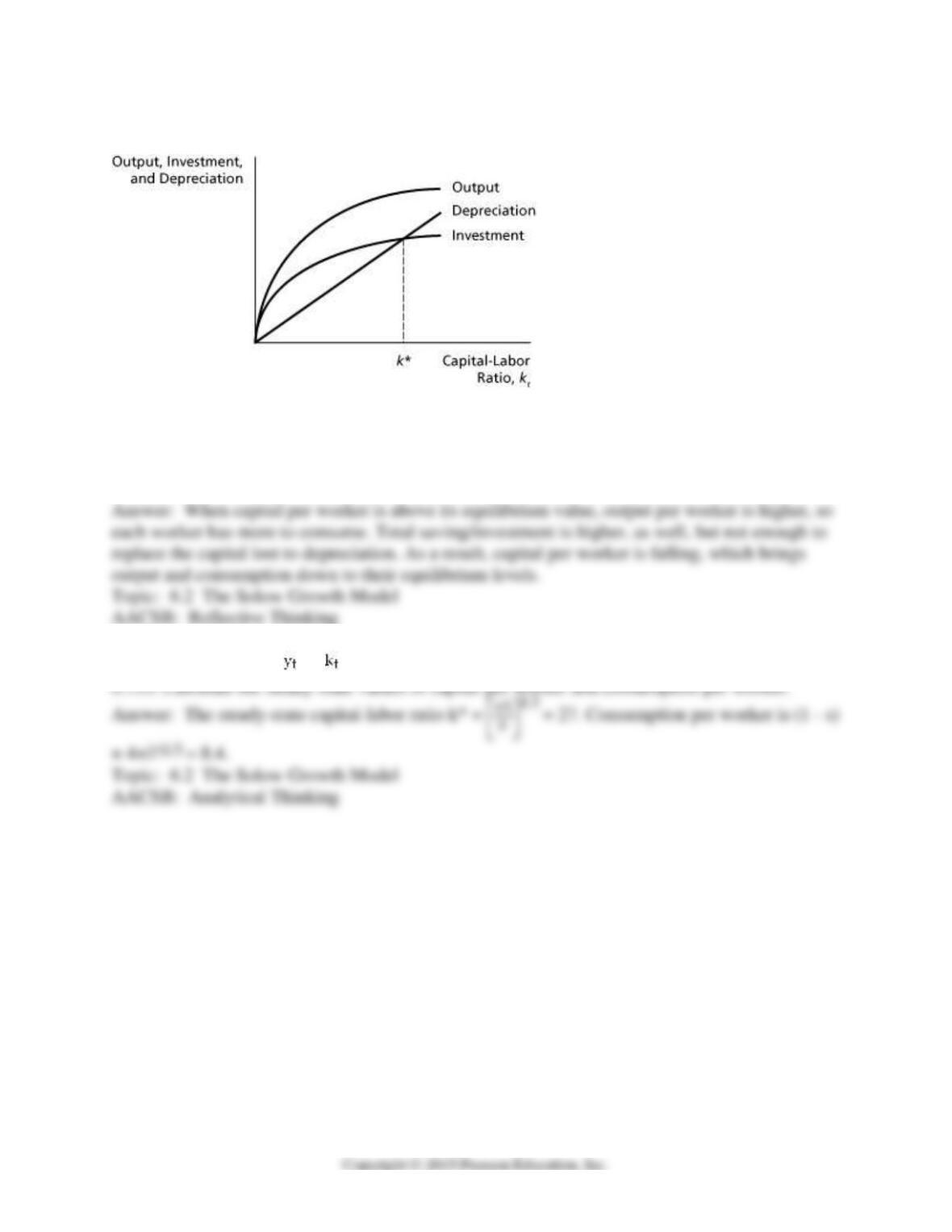
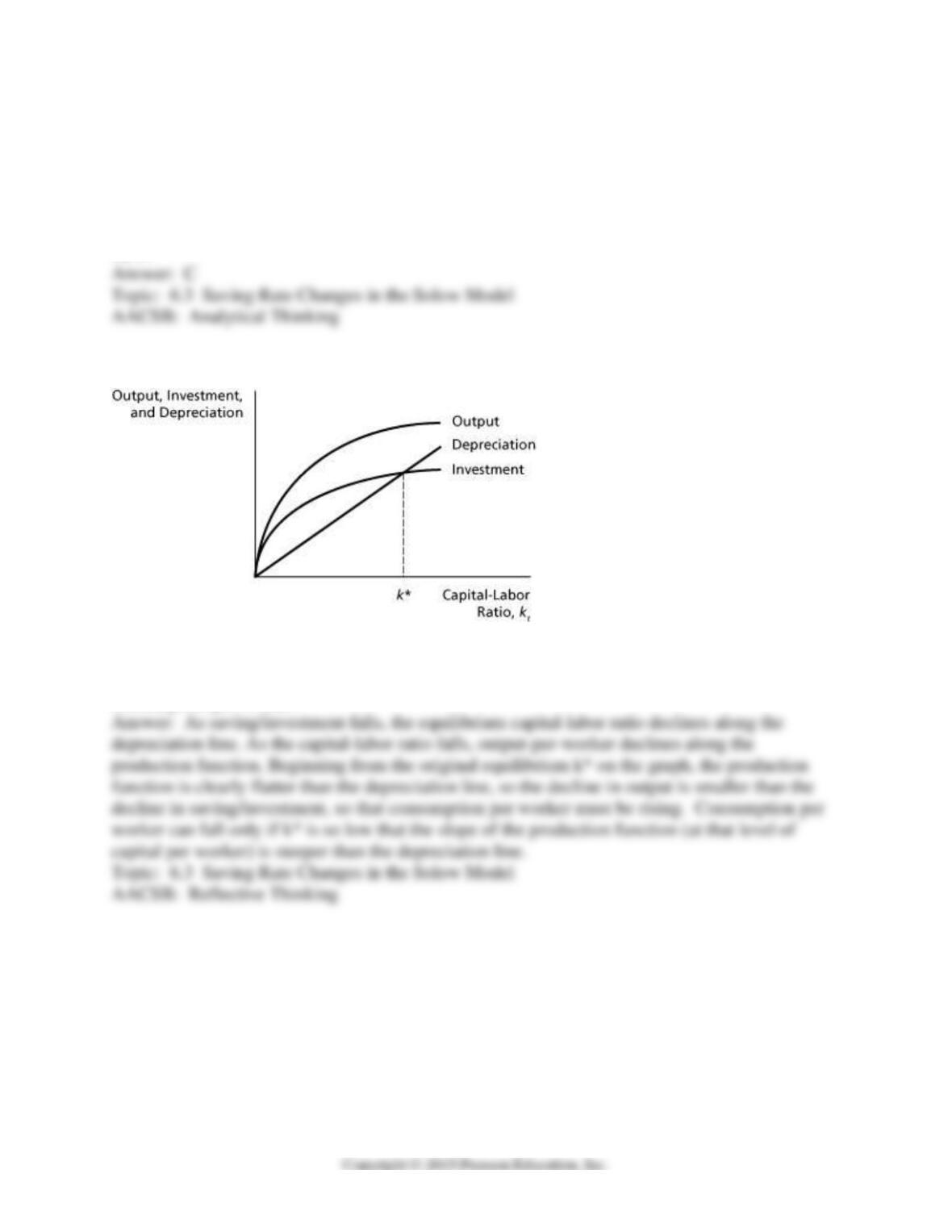
Solow Diagram
24) On the diagram above, show the quantity of consumption per worker in equilibrium. If the
actual capital per worker were greater than k*, would consumption be higher or lower than it is
in equilibrium? Describe what would happen in an economy with such a high level of capital per
worker.
25) Output per worker = 4 1/3, the saving rate is 30 percent, and the depreciation rate is
6.3 Saving Rate Changes in the Solow Model
1) A higher rate of saving at the national level will, in the long-run ________.
A) cause a decrease in levels of capital and output
B) have no effect on levels of capital and output
C) lead to an increase in population growth
D) cause an increase in levels of capital and output
2) On the Solow Diagram, an increase in the saving rate is shown by ________.
A) an upward shift of the depreciation line
B) an upward shift of the investment function
C) an upward shift of the per-worker production function
D) a downward shift of the investment function
3) An increase in the saving rate results in a higher steady state ________.
A) growth rate of capital
B) growth rate of output per worker
C) level of consumption per worker
D) level of capital per worker
4) In the Solow model, the faster growth of output that results from an increase in the saving rate
is temporary, because ________.
A) of diminishing marginal product of capital
B) with a larger stock of capital, consumption is encouraged more than investment
C) the rising capital stock depreciates at a faster rate
D) the economy settles into a steady state in which saving no longer rises
5) Following an increase in the saving rate, consumption per worker ________.
A) increases
B) decreases
C) is unaffected
D) may either rise or fall
9
6) Suppose an economy is in a steady state, then its saving rate falls, once and permanently. As
the economy approaches its new long-run steady state, consumption per worker is ________.
A) falling
B) rising
C) unaffected
D) either rising or falling
7) International evidence on the relationship of per capita income and the saving rate suggests
that ________.
A) a high level of income per person requires a high saving rate
B) a high saving rate guarantees a high level of income per person
C) a high saving rate might result in a high level of income per person
D) a high saving rate requires a high level of income per person
8) In a steady-state economy with no population growth, output per worker is 35, the saving rate
is 20 percent, and the depreciation rate is 11 percent. The level of capital per worker is
________.
A) 64
B) 19
C) 39
D) 28
9) In a steady-state economy with no population growth, capital per worker is 86, the saving rate
is 25 percent, and the depreciation rate is 11 percent. The level of output per worker is ________.
A) 195
B) 38
C) 35
D) 47
10
10) In a steady-state economy with no population growth, consumption per worker is 45, the
saving rate is 25 percent, and the depreciation rate is 15 percent. The level of capital per worker
is ________.
A) 75
B) 36
C) 100
D) 27
Solow Diagram
11) On the diagram above, show the new steady-state capital-labor ratio that results from a
decrease in the saving rate. Can you say what has happened to the equilibrium level of
consumption per worker?
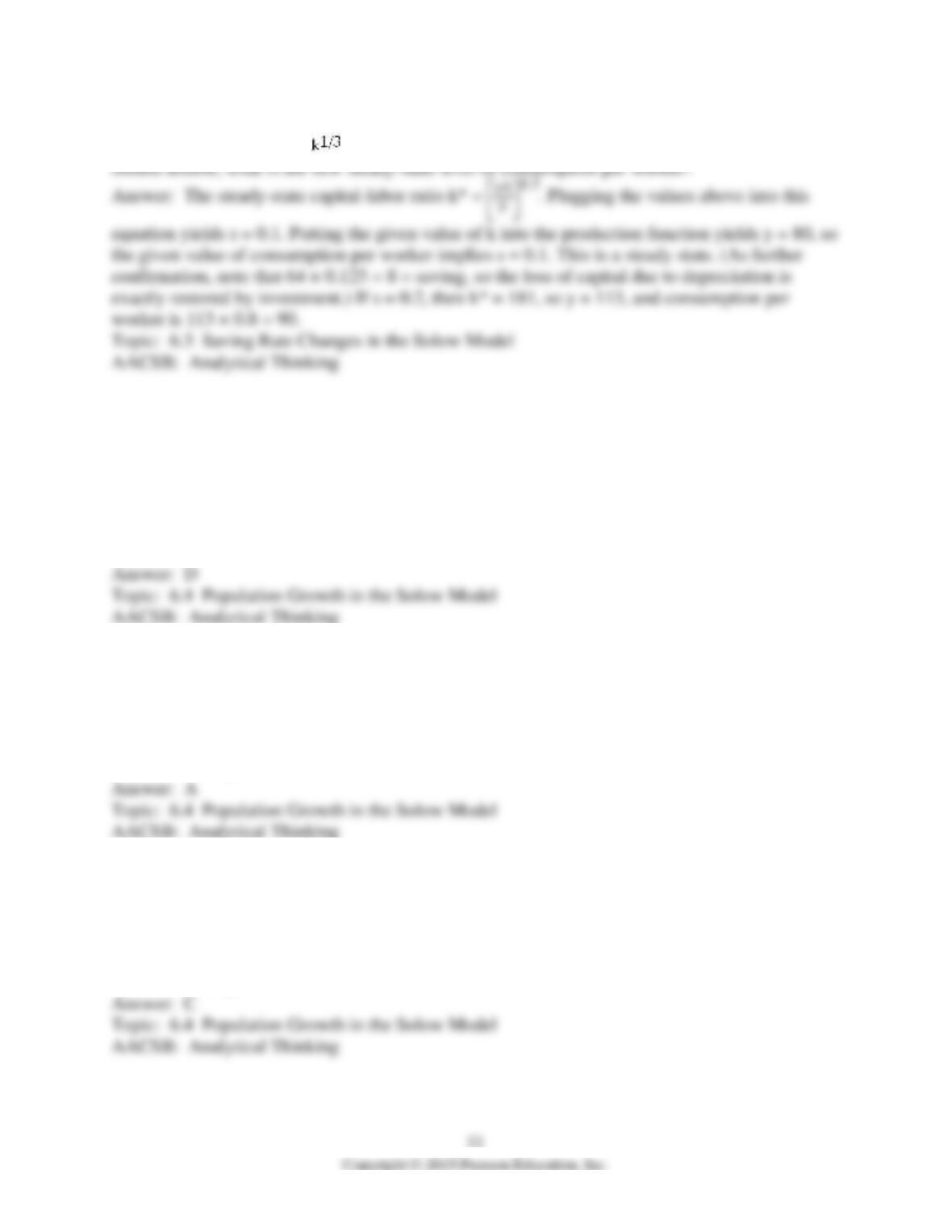
12) Consumption per worker is 72, depreciation is 12.5%, and capital per worker is 64. Given the
production function y = 20 , show that this economy is in a steady state. If the saving rate
6.4 Population Growth in the Solow Model
1) Other things the same, in the Solow model in the steady state, a higher rate of population
growth ________ the level of output per worker.
A) leads to an increase in
B) has no long-run effect on
C) has an ambiguous effect on
D) leads to a decrease in
2) Other things the same, in the Solow model in the steady state, a higher rate of population
growth ________ growth rate of output.
A) leads to a higher
B) leads to a lower
C) has no long-run effect on the
D) has an ambiguous effect on the
3) Other things the same, in the Solow model in the steady state, a higher rate of population
growth ________ growth rate of output per worker.
A) leads to a higher
B) leads to a lower
C) has no long-run effect on the
D) has an ambiguous effect on the