a.
True
b.
False
True
Moderate
DISC: Supply and demand
United States – BPROG: Analytic
Supply and demand
Price Elasticity of Demand: Its Effect on Total Revenue and Total Expenditure
Multiple Choice
77. Elasticity
a.
deals with percentage changes in price and quantity demanded.
b.
employs percentage changes calculated in terms of average values of the prices and quantities at issue.
c.
is generally stated in absolute value.
d.
All of the above are correct.
Easy
DISC: Elasticity
United States – BPROG: Analytic
Elasticity
Elasticity: The Measure of Responsiveness
78. Price elasticity of demand is defined as
a.
slope divided by price.
b.
percentage change in price divided by percentage change in quantity demanded.
c.
percentage change in quantity demanded divided by percentage change in price.
d.
the inverse of the price elasticity of supply.
c
Easy
DISC: Elasticity
United States – BPROG: Analytic
Elasticity
Elasticity: The Measure of Responsiveness
79. The formula for price elasticity of demand that is used in practice
a.
usually drops all minus signs.
b.
usually takes on different values at different points on the demand curve.
c.
may calculate the percentage change in price between P1 and P2 as “(P2 − P1) as a percentage of (P1 + P2)/2.“
d.
All of the above are correct.
Moderate
DISC: Elasticity
United States – BPROG: Analytic
Elasticity
Elasticity: The Measure of Responsiveness
80. A correct formula (dropping all minus signs) for the calculation of the elasticity of demand between point Q1, P1 and
point Q2, P2 is
a.
[(P2 − P1)/(P2 + P1)]/[(Q2 − Q1)/(Q2 + Q1)].
b.
[(P2 − P1)/P1]/[(Q2 − Q1)/Q1].
c.
[(Q2 − Q1)/(Q2 + Q1)]/[(P2 − P1)/(P2 + P1)].
d.
[(Q2 − Q1)/Q2)]/[(P2 − P1)/P2].
c
Moderate
DISC: Elasticity
United States – BPROG: Analytic
Elasticity
Elasticity: The Measure of Responsiveness
81. At $6 per steak, consumers are willing to buy two steaks. At a price of $2, consumers are willing to buy six steaks.
The elasticity of the market demand curve between P = $6 and P = $2 (dropping all minus signs) is
a.
0.33.
b.
1.
c.
2.
d.
4.
Difficult
DISC: Elasticity
United States – BPROG: Reflective Thinking – BPROG: Analysis
Elasticity
Elasticity: The Measure of Responsiveness
82. If the price of gasoline rises by 20 percent and consumption of gasoline falls 5 percent,
a.
demand is elastic.
b.
demand is unit-elastic.
c.
demand is inelastic.
d.
elasticity of demand cannot be calculated.
c
DISC: Elasticity
United States – BPROG: Analytic
Elasticity: The Measure of Responsiveness
83. Demand is said to be price elastic at a point on a demand curve if a
a.
1 percent rise in price reduces the quantity demanded by more than 1 percent.
b.
1 percent rise in price reduces the quantity demanded by less than 1 percent.
c.
1 percent rise in price reduces the quantity demanded by more than 10 percent.
d.
10 percent rise in price reduces the quantity demanded by less than 10 percent.
DISC: Elasticity
United States – BPROG: Analytic
Elasticity: The Measure of Responsiveness
84. Demand is said to be elastic when percentage changes in quantity demanded are
a.
less than the percentage changes in price.
b.
higher than the percentage changes in price.
c.
equal to the percentage changes in price.
d.
zero when price changes.
DISC: Elasticity
United States – BPROG: Analytic
Elasticity: The Measure of Responsiveness
Figure 6-1
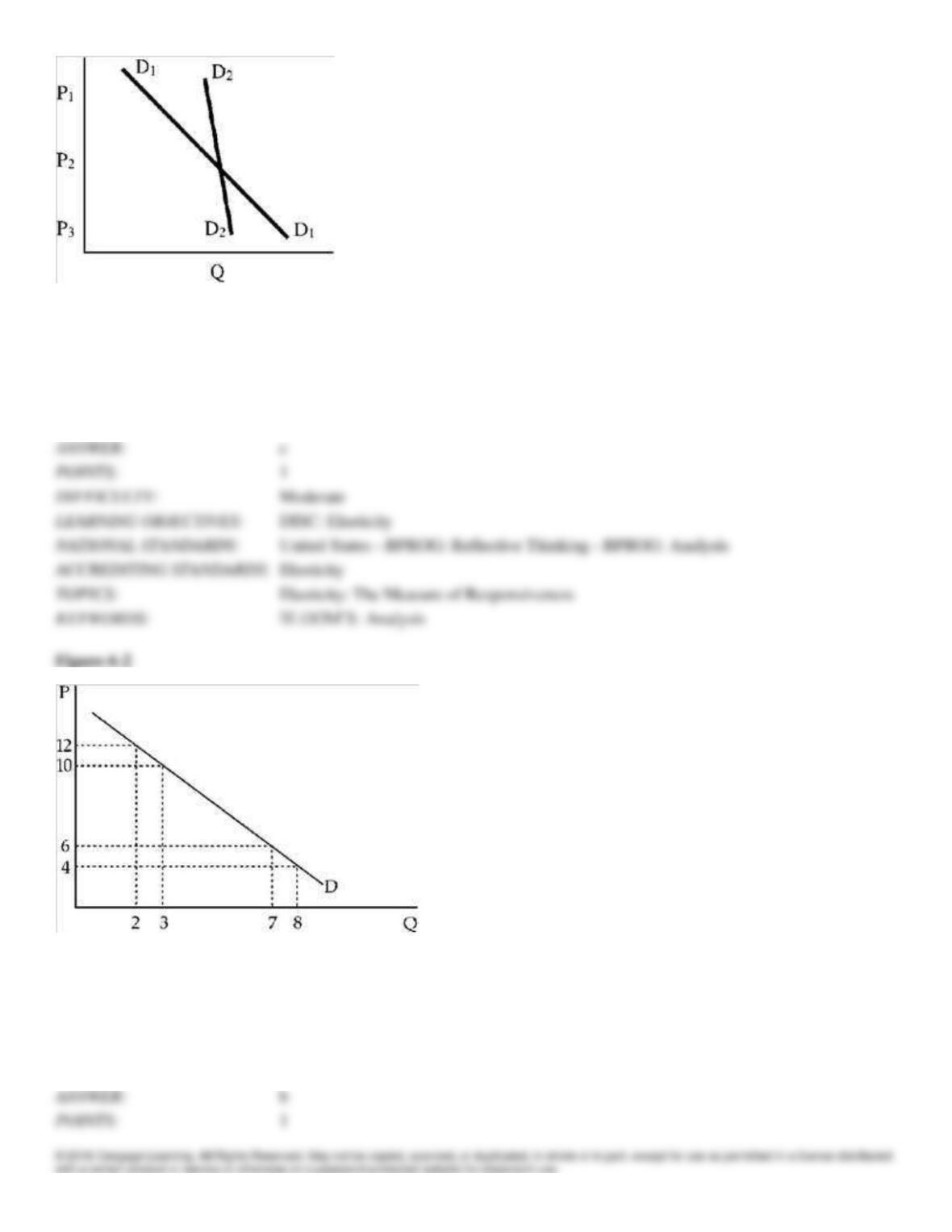
85. In Figure 6-1,
a.
D1 is more elastic than D2 below P2 and less elastic above P2.
b.
D1 is less elastic than D2 at all prices.
c.
D2 is less elastic than D1 at all prices.
d.
D2 is more elastic than D2 above P2 but less elastic below P2.
DISC: Elasticity
United States – BPROG: Reflective Thinking – BPROG: Analysis
Elasticity: The Measure of Responsiveness
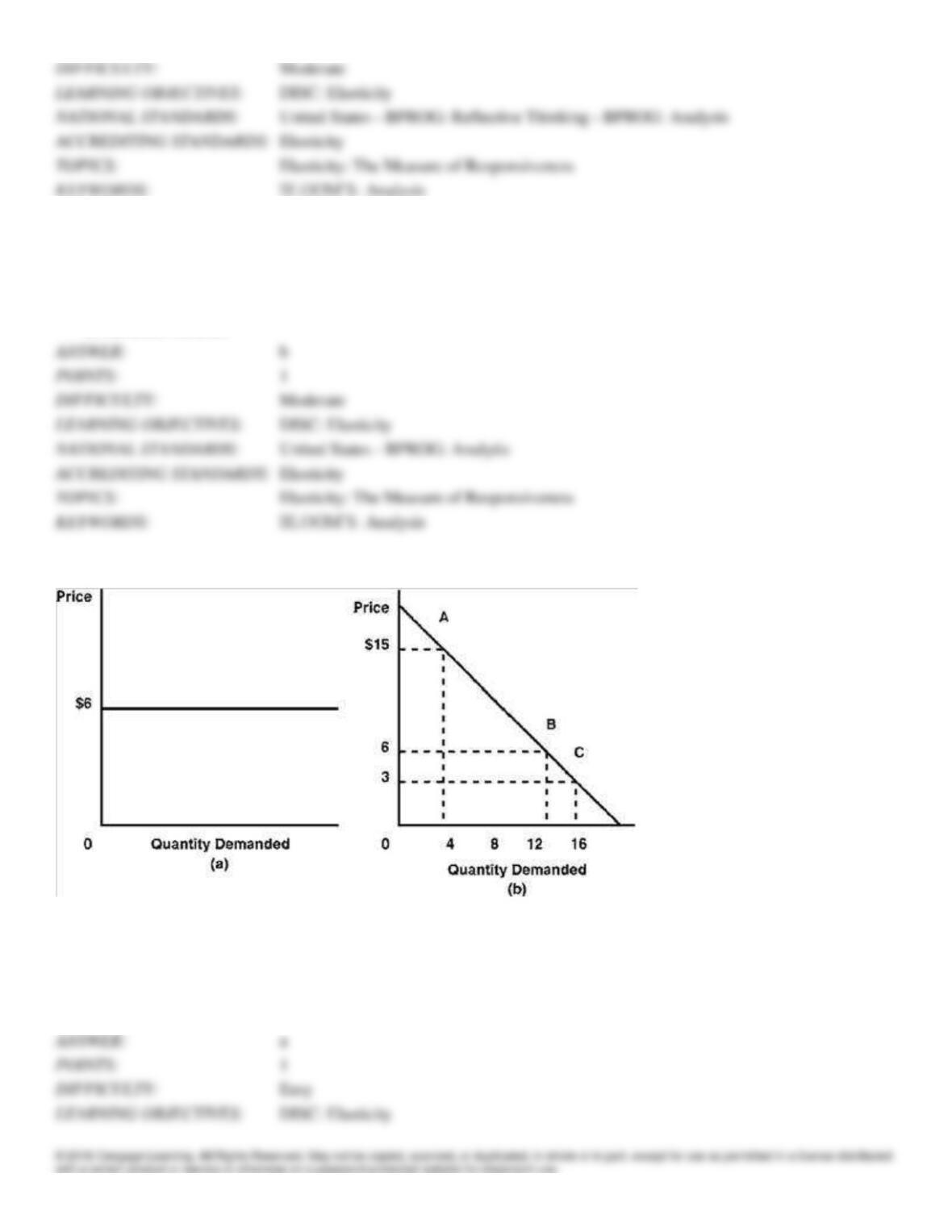
86. In Figure 6-2, the price elasticity of demand (dropping all minus signs) is ____ between P = 4 and P = 6 than between
P = 10 and P = 12 because between the lower set of prices the percentage change in price is ____.
a.
smaller; smaller
b.
smaller; greater
c.
greater; smaller
d.
greater; greater
DISC: Elasticity
United States – BPROG: Reflective Thinking – BPROG: Analysis
Elasticity: The Measure of Responsiveness
87. From Figure 6-2, we can infer that demand is ____ between P = 12 and P = 10 and ____ between P = 6 and P = 4.
a.
elastic; elastic
b.
elastic; inelastic
c.
inelastic; elastic
d.
inelastic; inelastic
DISC: Elasticity
United States – BPROG: Analytic
Elasticity: The Measure of Responsiveness
Figure 6-3
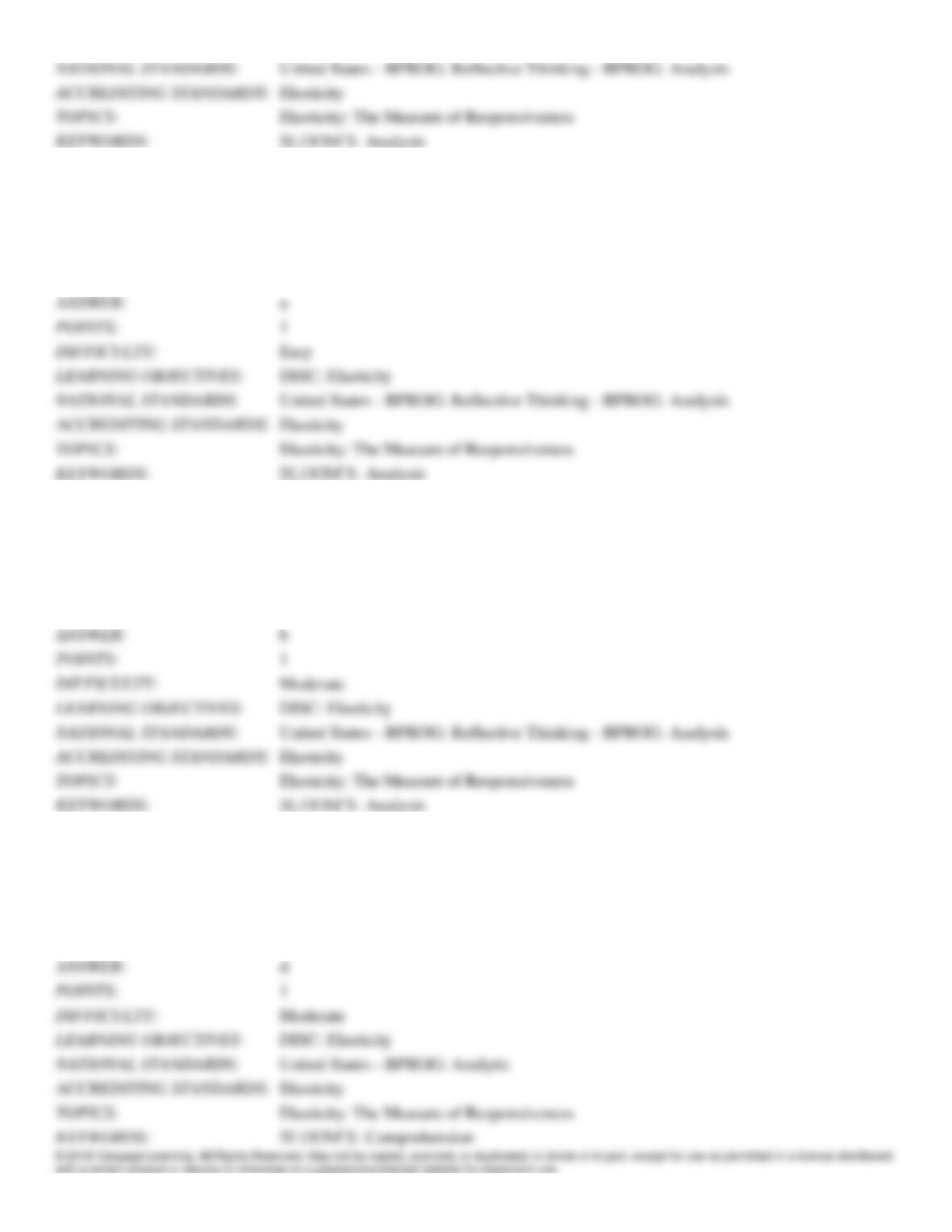
88. In Figure 6-3(a), at any price above $6, quantity demanded
a.
falls to zero.
b.
becomes infinitely large.
c.
is equal to price.
d.
is equal to the elasticity of demand.
DISC: Elasticity
United States – BPROG: Reflective Thinking – BPROG: Analysis
Elasticity
Elasticity: The Measure of Responsiveness
89. In Figure 6-3(a), demand is
a.
perfectly elastic.
b.
perfectly inelastic.
c.
unit elastic.
d.
fixed at one particular quantity.
a
Easy
DISC: Elasticity
United States – BPROG: Reflective Thinking – BPROG: Analysis
Elasticity
Elasticity: The Measure of Responsiveness
90. In Figure 6-3(b), as price falls from $15 to $6, total expenditure
a.
falls.
b.
increases.
c.
remains constant.
d.
first falls and then increases.
Moderate
DISC: Elasticity
United States – BPROG: Reflective Thinking – BPROG: Analysis
Elasticity
Elasticity: The Measure of Responsiveness
91. Along the inelastic portion of a demand curve, the
a.
change in price will always be less than the change in quantity demanded.
b.
percentage change in price will be less than the percentage change in quantity demanded.
c.
change in price will always be more than the change in quantity demanded.
d.
percentage change in price will be more than the percentage change in quantity demanded.
Moderate
DISC: Elasticity
United States – BPROG: Analytic
Elasticity
Elasticity: The Measure of Responsiveness
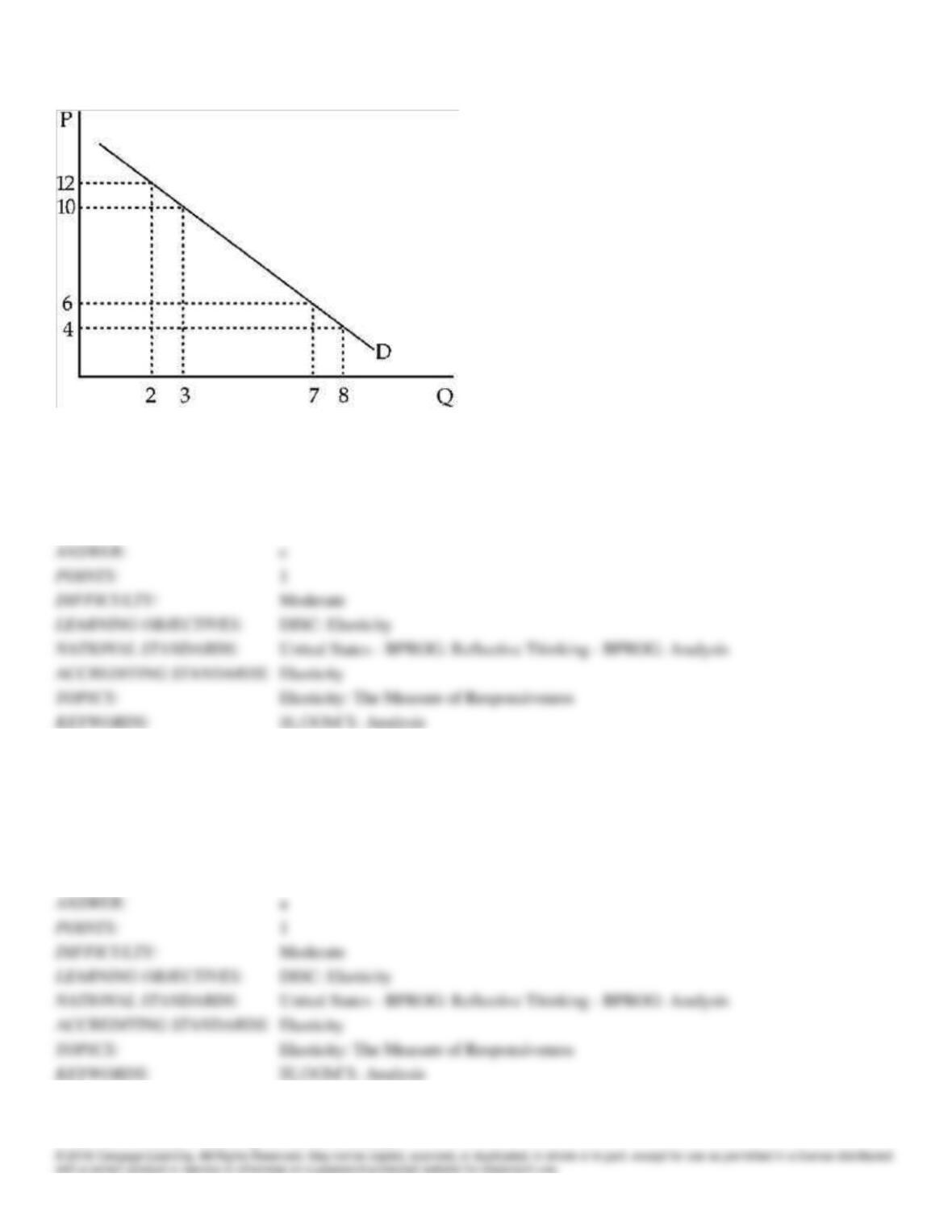
Figure 6-4
92. In Figure 6-4, total expenditure ____ as price falls from P = 12 to P = 10.
a.
falls
b.
stays constant
c.
rises
d.
rises by more than $12
c
Moderate
DISC: Elasticity
United States – BPROG: Reflective Thinking – BPROG: Analysis
Elasticity
Elasticity: The Measure of Responsiveness
93. If the elasticity of demand for cigarettes is 0.4, then an increase in the price of a pack of cigarettes from $5.00 to $6.00
would reduce quantities demanded by about
a.
7 percent.
b.
40 percent.
c.
42 percent.
d.
220 percent.
a
Moderate
DISC: Elasticity
United States – BPROG: Reflective Thinking – BPROG: Analysis
Elasticity
Elasticity: The Measure of Responsiveness
94. If the price of apples decreases by 2 percent and causes apple consumption to increase by 4 percent, the price elasticity
of demand is ____, indicating the demand is ____.
a.
2, elastic
b.
2, inelastic
c.
0.5, elastic
d.
0.5, inelastic
DISC: Elasticity
United States – BPROG: Reflective Thinking – BPROG: Analysis
Elasticity: The Measure of Responsiveness
95. If a 10 percent rise in price leads to a reduction in quantity demanded of more than 10 percent,
a.
demand is elastic.
b.
demand is inelastic.
c.
elasticity of demand is unitary.
d.
None of the above is correct.
DISC: Elasticity
United States – BPROG: Analytic
96. All of the following observations concerning the elasticity formula are true except
a.
the changes with which it deals is measured as a percentage change.
b.
each of the percentage changes is calculated in terms of the average values.
c.
the calculation considers both positive and negative signs.
d.
each percentage change is taken as an “absolute value.”
DISC: Elasticity
United States – BPROG: Analytic
Elasticity: The Measure of Responsiveness
97. If the price elasticity of demand for radios is 2.5 (dropping the minus sign), then a 50 percent reduction in the price of
radios will lead to
a.
the sale of 200 additional radios.
b.
the sale of 125 percent more radios than before.
c.
the sale of 150 percent more radios than before.
d.
the sale of 25 percent more radios than before.
DISC: Elasticity
United States – BPRPOG: Analysis
Elasticity: The Measure of Responsiveness
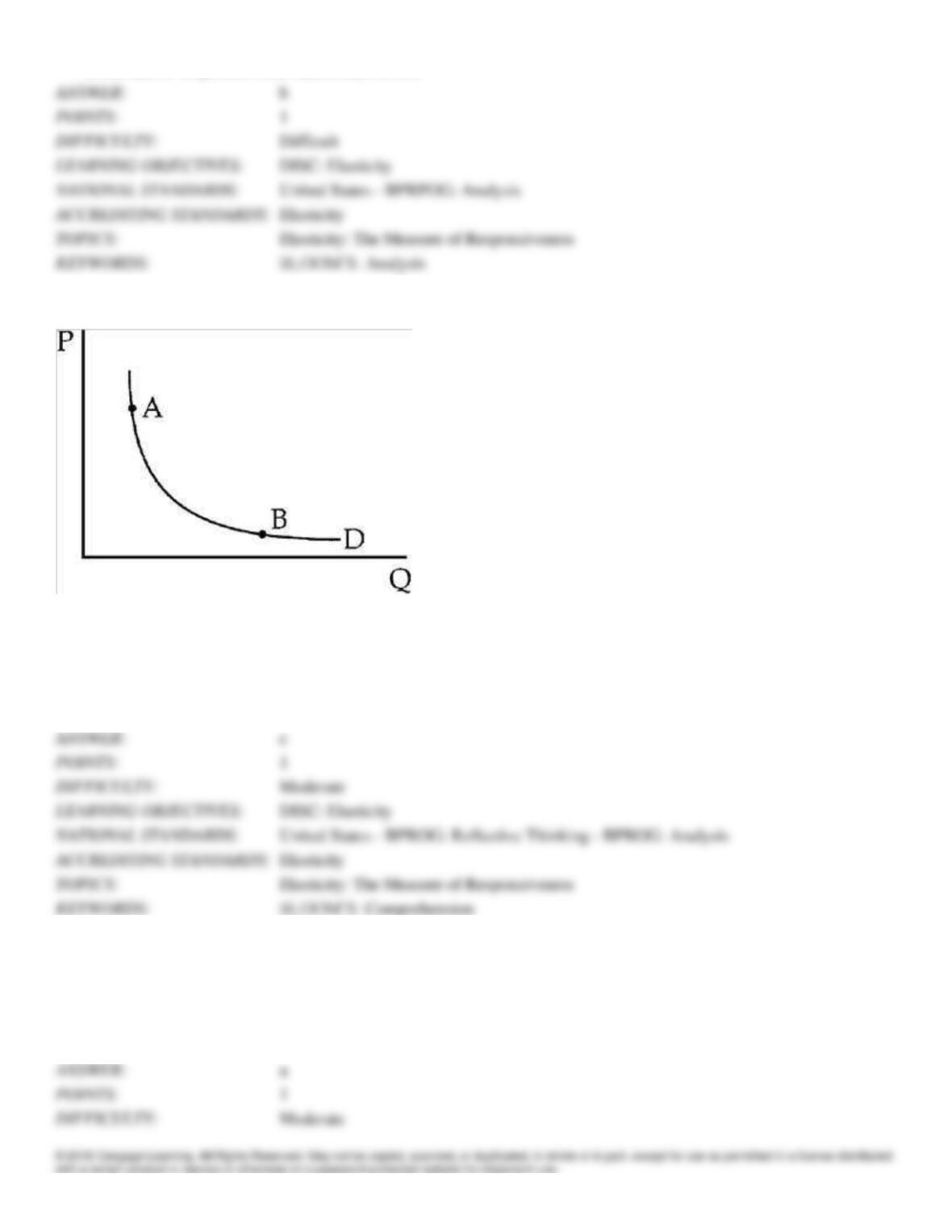
Figure 6-5
98. If the demand curve in Figure 6-5 is unit elastic, then total expenditure at A is ____ total expenditure at B.
a.
greater than
b.
less than
c.
equal to
d.
less elastic than
DISC: Elasticity
United States – BPROG: Reflective Thinking – BPROG: Analysis
Elasticity: The Measure of Responsiveness
99. In Figure 6-5, if price falls from point A to point B along the unit-elastic demand curve,
a.
total expenditure remains unchanged.
b.
total expenditure increases.
c.
total expenditure decreases.
d.
total expenditure first increases and then declines.
DISC: Elasticity
United States – BPROG: Reflective Thinking – BPROG: Analysis
Elasticity: The Measure of Responsiveness
100. A demand curve is described as perfectly inelastic if
a.
the same quantity is purchased regardless of price.
b.
the same price is charged regardless of quantity sold.
c.
neither price nor quantity demanded ever change.
d.
only quantity demanded can change.
DISC: Elasticity
United States – BPROG: Analytic
Elasticity: The Measure of Responsiveness
101. A demand curve is described as perfectly elastic if
a.
any quantity can be sold at a given price.
b.
the same quantity is sold regardless of price.
c.
neither price nor quantity demanded ever change.
d.
only price can change.
DISC: Elasticity
United States – BPROG: Analytic
Elasticity: The Measure of Responsiveness
102. A perfectly elastic demand curve for a firm
a.
is represented by a vertical line.
b.
means that with every unit price increase there will be a unit decrease in demand.
c.
is formulated by P × Q = a constant, for all prices and quantities.
d.
indicates that any increase in price will eliminate all purchases of its product.
DISC: Elasticity
United States – BPROG: Analytic
Elasticity: The Measure of Responsiveness
103. The price elasticity of a vertical demand curve is always
a.
infinitely large.
b.
zero.
c.
one.
d.
increasing as price increases.
Easy
DISC: Elasticity
United States – BPROG: Analytic
Elasticity
Elasticity: The Measure of Responsiveness
104. The price elasticity of a horizontal demand curve is always
a.
infinitely large.
b.
zero.
c.
one.
d.
increasing as price increases.
a
Easy
DISC: Elasticity
United States – BPROG: Analytic
Elasticity
Elasticity: The Measure of Responsiveness
105. Along a perfectly elastic demand curve,
a.
the slope is always zero.
b.
the price elasticity of demand is 1.
c.
consumer purchases will not respond at all to a change in price.
d.
All of the above are true.
a
Easy
DISC: Elasticity
United States – BPROG: Analytic
Elasticity
Elasticity: The Measure of Responsiveness
106. If the demand curve is vertical, the elasticity is
a.
1.0.
b.
0.0.
c.
0.5.
d.
infinite.
Easy
DISC: Elasticity
United States – BPROG: Analytic
Elasticity
Elasticity: The Measure of Responsiveness
107. As we move down a straight-line demand curve, the price elasticity becomes
a.
larger.
b.
smaller.
c.
larger, then smaller.
d.
smaller, then larger.
Difficult
DISC: Elasticity
United States – BPROG: Reflective Thinking – BPROG: Analysis
Elasticity
Elasticity: The Measure of Responsiveness
108. Along a straight-line demand curve (dropping all minus signs), the price elasticity of demand
a.
gets larger as quantity demanded gets larger.
b.
gets smaller as quantity demanded gets larger.
c.
always equals one.
d.
is constant (though not necessarily equal to one).
Difficult
DISC: Elasticity
United States – BPROG: Reflective Thinking – BPROG: Analysis
Elasticity
Elasticity: The Measure of Responsiveness
109. Along a straight-line demand curve the
a.
slope is constant.
b.
ratio P/Q constantly changes.
c.
elasticity grows much smaller toward the right-hand end.
d.
All of the above are correct.
1
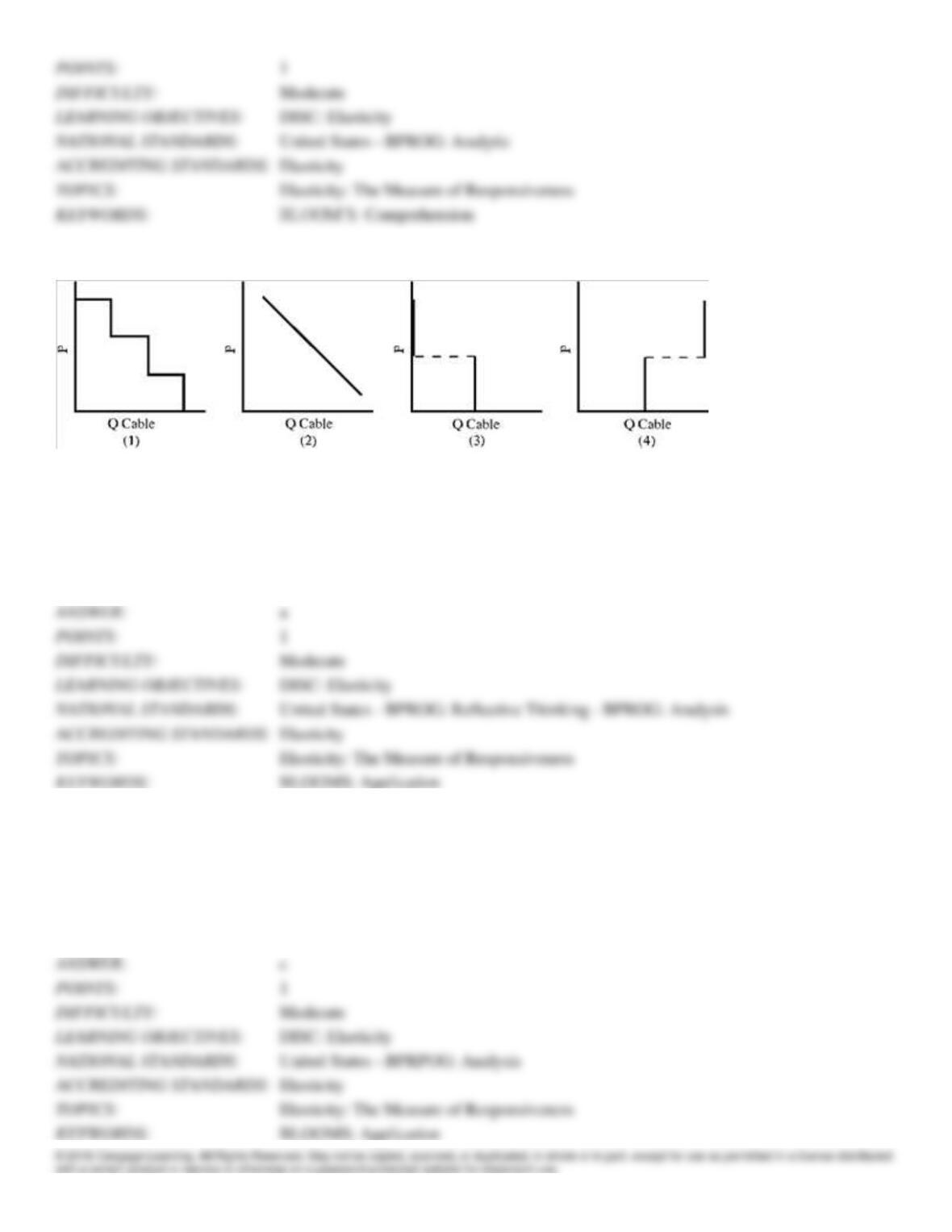
Figure 6-6
110. The purchase of premium cable channels is an “all or nothing” choice. Which graph in Figure 6-6 best illustrates the
cable market demand curve?
a.
1
b.
2
c.
3
d.
4
1
111. An article in the Wall Street Journal reports that “most cable TV operators are aware that cable is price sensitive, and
there comes a point where people won’t pay the price.” Which demand curve in Figure 6-6 best illustrates this situation?
a.
1
b.
2
c.
3
d.
4
1
112. A craze for apples in Riverdale increases the quantity demanded at every price by five bushels. Between any two
prices, the new demand curve will be ____ the old demand curve.
a.
more elastic than
b.
less elastic than
c.
equal in elasticity to
d.
More information is needed to predict the relationship.
DISC: Elasticity
United States – BPROG: Reflective Thinking – BPROG: Analysis
Elasticity: The Measure of Responsiveness
113. The emigration of some of Whoville’s workers reduces the quantity of thingamabobs supplied at every price by 50.
The new supply curve will ____ the old supply curve.
a.
be steeper and less elastic at every price than
b.
have the same slope and the same elasticity at every price as
c.
have the same slope and be more elastic at every price than
d.
More information is needed to predict the relationship between the elasticities of the two supply curves.
DISC: Elasticity
United States – BPROG: Analytic
Elasticity: The Measure of Responsiveness
114. Elasticity provides a guide to both
a.
market stability and change in revenue as price changes.
b.
responsiveness of quantity demanded to a change in price and market stability.
c.
responsiveness of quantity demanded to a change in price and change in revenue as price changes.
d.
technological change and change in revenue as price changes.
DISC: Elasticity
United States – BPROG: Analytic
Price Elasticity of Demand: Its Effect on Total Revenue and Total Expenditure
115. Total expenditure by a buyer is equal to the
a.
slope at any point along the demand curve.
b.
price times quantity demanded at any point along the demand curve.
c.
elasticity times price at any point along the demand curve.
d.
elasticity times quantity demanded at any point along the demand curve.
Easy
DISC: Elasticity
United States – BPROG: Analytic
Elasticity
Price Elasticity of Demand: Its Effect on Total Revenue and Total Expenditure
116. A price cut will decrease the revenue a firm receives if the demand for its product is
a.
elastic.
b.
inelastic.
c.
of unit elasticity.
d.
straight elastic.
Easy
DISC: Elasticity
United States – BPROG: Analytic
Elasticity
117. A price cut will increase the revenue a firm receives if the demand for its product is
a.
elastic.
b.
inelastic.
c.
of unit elasticity.
d.
straight elastic.
a
Easy
DISC: Elasticity
United States – BPROG: Analytic
Elasticity
Price Elasticity of Demand: Its Effect on Total Revenue and Total Expenditure
118. When Johanna cut prices in her jewelry store by 20 percent, the dollar value of her sales fell by 20 percent. This
indicates that
a.
demand was elastic.
b.
demand was inelastic.
c.
demand was unit elastic.
d.
the demand curve was vertical.
DISC: Elasticity
United States – BPROG: Analytic
Price Elasticity of Demand: Its Effect on Total Revenue and Total Expenditure
119. In an attempt to raise sales, Hannah cut prices in her bookstore by 20 percent. If the dollar value of her sales
remained constant, that indicates
a.
old customers bought no more books.
b.
no new customers bought books.
c.
the quantity of books sold increased 20 percent.
d.
the demand curve is vertical.
DISC: Elasticity
United States – BPROG: Analytic
Price Elasticity of Demand: Its Effect on Total Revenue and Total Expenditure
120. The term “unit elasticity” is used to describe a situation in which a rise in price is accompanied by
a.
a fall in total expenditure.
b.
a rise in total expenditure.
c.
constant total expenditure.
d.
a unit decrease in total expenditure.
DISC: Elasticity
United States – BPROG: Analytic
Price Elasticity of Demand: Its Effect on Total Revenue and Total Expenditure
121. A demand curve to remain unit elastic along its entire length should
a.
cross the X axis.
b.
touch the X axis but not the Y axis.
c.
never touch either the X or the Y axis.
d.
touch the Y axis but not the X axis.
Moderate
Elasticity
122. Regarding demand elasticity, which of the following statements is correct?
a.
If demand for seller’s product is elastic, a price increase will decrease total revenue.
b.
If demand for seller’s product is elastic, a price increase will increase total revenue.
c.
If demand is exactly unit-elastic, an increase in price will raise total revenue.
d.
If demand is exactly unit-elastic, an increase in price will raise total revenue.
a
Moderate
Elasticity
123. When Scuba, Inc., lowered the price of a tank of compressed air by 20 percent, it sold 10 percent more tankfuls. The
price elasticity for compressed air is
a.
2.
b.
1/2.
c.
1.
d.
20.
Moderate
Elasticity
124. Big Alice Ice Cream Parlor reduced its price of an ice cream cone from $1 to 90 cents. Sales consequently increased
from 1,000 cones per week to 1,050. The approximate price elasticity is
a.
0.20.
b.
0.46.
c.
2.16.
d.
5.00.
Moderate
United States – BPROG: Reflective Thinking – BPROG: Analysis
Price Elasticity of Demand: Its Effect on Total Revenue and Total Expenditure
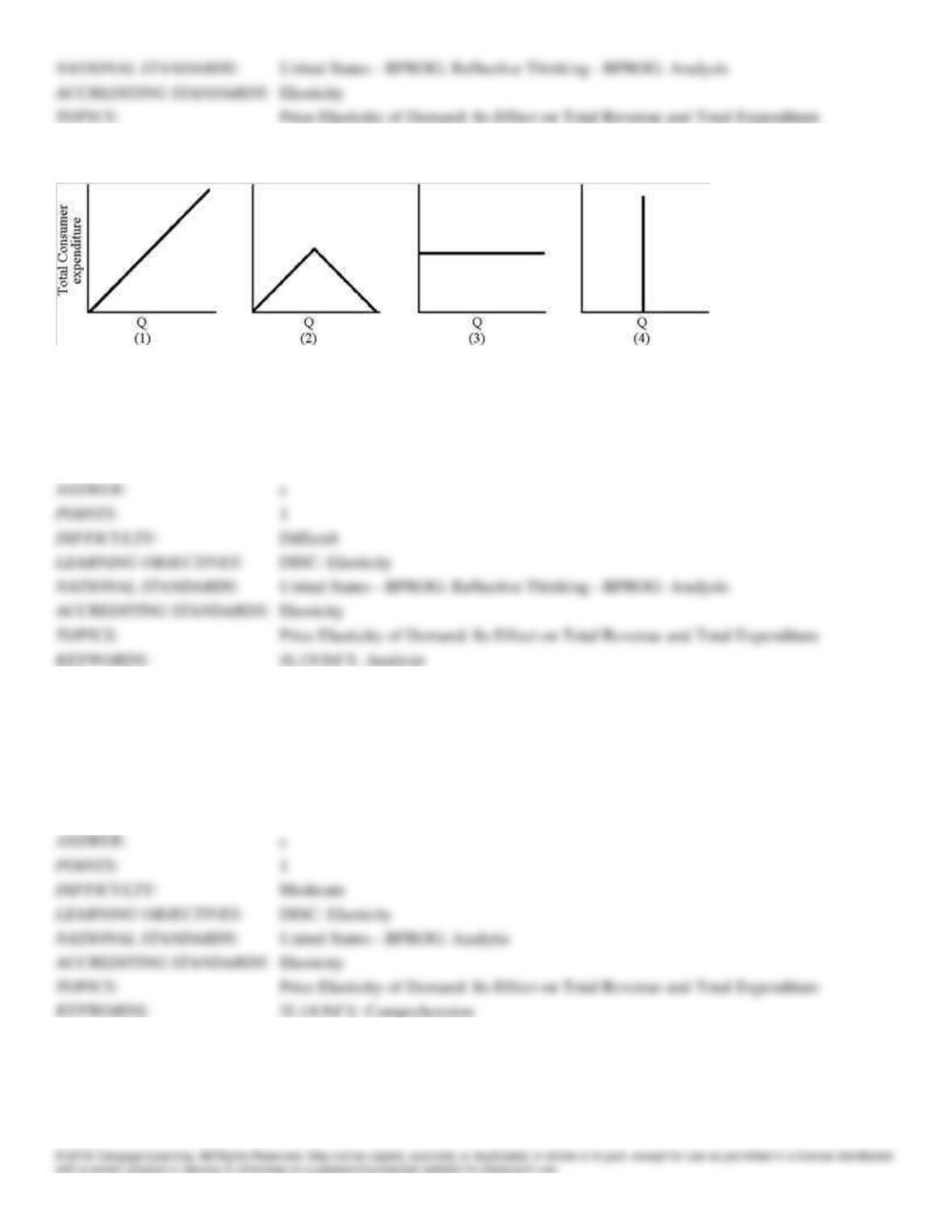
Figure 6-7
125. In Figure 6-7, which total expenditure curve belongs to a demand curve that is unit elastic throughout?
a.
1
b.
2
c.
3
d.
4
1
DISC: Elasticity
United States – BPROG: Reflective Thinking – BPROG: Analysis
Price Elasticity of Demand: Its Effect on Total Revenue and Total Expenditure
126. Julia knows the price elasticity of movie rentals is 3. She knows, therefore, that if she raises her price from $2 to
$2.50, her rentals will drop by approximately
a.
150 percent.
b.
100 percent.
c.
75 percent.
d.
33 percent.
1
DISC: Elasticity
United States – BPROG: Analytic
Price Elasticity of Demand: Its Effect on Total Revenue and Total Expenditure
127. Tele-Com, Inc., the nation’s largest cable TV company, tested the effect of a price reduction for the Disney Channel.
It lowered prices from $10.75 to $7.95 and found that the number of customers more than doubled. This means the
a.
demand curve for the Disney Channel shifted to the right.
b.
supply curve of the Disney Channel shifted to the left.
c.
demand for the Disney Channel is elastic in this price range.
d.
demand for the Disney Channel is inelastic in this price range.
1
DISC: Elasticity
United States – BPROG: Analytic
Price Elasticity of Demand: Its Effect on Total Revenue and Total Expenditure
Figure 6-8
128. Libya sold more crude oil in 1985 than it sold five years earlier, but revenues were 17 percent less. Which graph in
Figure 6-8 is consistent with this set of facts?
a.
1
b.
2
c.
3
d.
4
1
DISC: Elasticity
United States – BPROG: Reflective Thinking – BPROG: Analysis
Price Elasticity of Demand: Its Effect on Total Revenue and Total Expenditure
129. To avoid an increase in the local property tax, Sullivan County, New York, proposed a 2 percent hotel tax, which
presumably would be passed on to tourists. The hotel industry argued that the tax would hurt hotel business. They are
really arguing that
a.
tourist and convention demand is inelastic, so hotel bookings will decline.
b.
tourist and convention demand is very elastic, so hotel bookings will decline.
c.
they would prefer a property tax increase instead.
d.
it is unfair to tax people who do not live in the area.
b
1
DISC: Elasticity
United States – BPROG: Reflective Thinking – BPROG: Analysis
Price Elasticity of Demand: Its Effect on Total Revenue and Total Expenditure
130. Suppose that the supply of insulin is perfectly elastic and the demand for insulin perfectly inelastic. Then the result of
an excise tax would be
a.
a significant increase in government revenue and a significant decrease in the quantity consumed.
b.
a significant decrease in the quantity consumed with no change in government revenue.
c.
a significant increase in government revenue and no change in the quantity consumed.
d.
no increase in government revenue and no change in the quantity consumed.
1
DISC: Elasticity
United States – BPROG: Reflective Thinking – BPROG: Analysis
Price Elasticity of Demand: Its Effect on Total Revenue and Total Expenditure
131. If the marginal cost of producing vanity license plates is virtually zero (by prison inmates with little else to do), then
states would maximize their profits on plate sales at the point on a linear demand curve where
a.
demand is inelastic.
b.
demand is elastic.
c.
demand is unit elastic.
d.
the demand curve crosses the horizontal axis.
1
DISC: Elasticity
United States – BPROG: Reflective Thinking – BPROG: Analysis
Price Elasticity of Demand: Its Effect on Total Revenue and Total Expenditure
132. Would a profit-maximizing firm sell where demand is inelastic?
a.
No, this would not follow the rule of MC = MR.
b.
No, the firm could not profitably raise price.
c.
Yes, the firm could profitably lower price to attract sales.
d.
Yes, in this case there are few substitutes for the good.
1
DISC: Elasticity
United States – BPROG: Reflective Thinking – BPROG: Analysis