International Economics, 9e (Husted/Melvin)
Chapter 6 Tariffs
6.1 Multiple-Choice Questions
1) A country gains from international trade if its post-trade ________ point lies outside its
production possibility frontier.
A) production
B) autarky
C) consumption
D) All of the above
2) ________ gains from trade refer to the situation where, over time, international trade leads to
an outward shift in a country’s production possibility frontier.
A) Static
B) Dynamic
C) Political
D) Outward
3) Ad valorem tariffs are collected as
A) fixed amounts of money per unit traded.
B) a percentage of the price of the product.
C) a percentage of the quantity of imports.
D) All of the above.
4) Specific tariffs are collected as
A) fixed amounts of money per unit traded.
B) a percentage of the price of the product.
C) a percentage of the quantity of imports.
D) All of the above.
5) Most tariffs have
A) only revenue effects.
B) only protective effects.
C) both protective and revenue effects.
D) neither protective nor revenue effects.
6) If Canada imposes a tariff on bananas and if none are grown in Canada, this tariff has
A) only revenue effects.
B) only protective effects.
C) both protective and revenue effects.
D) neither protective nor revenue effects.
7) A prohibitive tariff has
A) only revenue effects.
B) only protective effects.
C) both protective and revenue effects.
D) neither protective nor revenue effects.
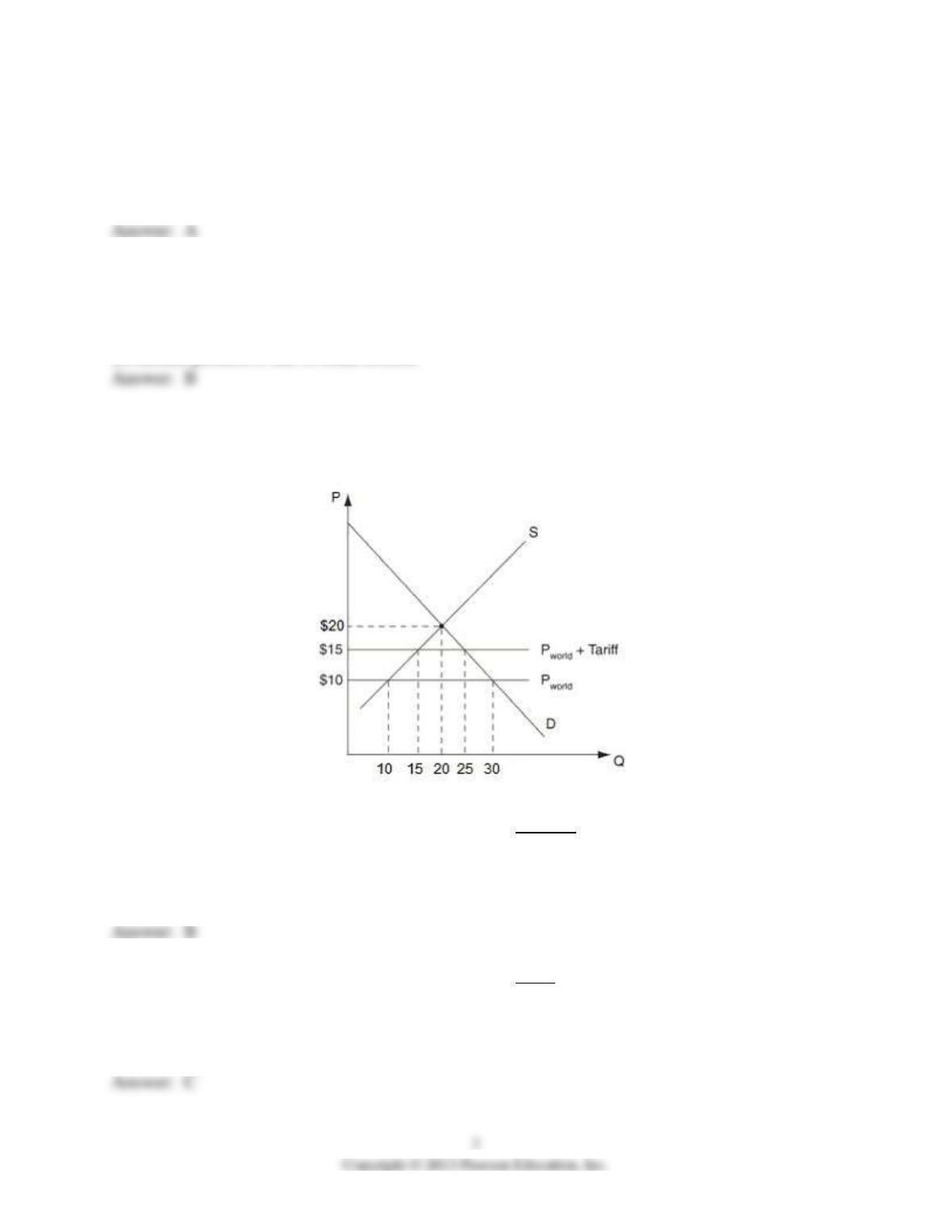
Answer the question(s) below based upon the following diagram. Note that Q is measured in
1,000s.
8) Refer to the figure above. With free trade, the total quantity of imports would equal
A) 10,000 units.
B) 20,000 units.
C) 22,000 units.
D) 30,000 units.
9) Refer to the figure above. With free trade, the total value of imports would equal
A) $10.
B) $100,000.
C) $200,000
D) $300,000.
10) Refer to the figure above. With the tariff, the quantity of imports falls to
A) 10,000 units.
B) 12,000 units.
C) 14,000 units.
D) 22,000 units.
11) Refer to the figure above. With the tariff, the government collects
A) $50,000.
B) $60,000.
C) $100,000.
D) $220,000.
12) Refer to the figure above. The deadweight cost of the tariff equals
A) $10,000.
B) $25,000.
C) $50,000.
D) cannot be calculated without further information.
13) Refer to the figure above. Domestic producers gain ________ because of the tariff.
A) $5
B) $62,500
C) $15
D) $125,000
14) Refer to the figure above. A tariff of ________ would be purely protective.
A) $0
B) $5
C) $8
D) $10
15) The difference between what consumers have to pay for a particular and what they are
willing to pay is known as
A) consumer surplus.
B) producer surplus.
C) deadweight costs.
D) deadweight surplus.
16) A tariff can ________ raise a country’s welfare.
A) never
B) sometimes
C) always
17) If a tariff of $10 has no effect on the world price, the optimal tariff on that product
A) is $10.
B) is zero.
C) is higher than $10.
D) depends upon the amount of government revenue collected.
18) If Brazil imposes a 50% tariff on automobiles and a 25% tariff on motors, the effective rate
of protection on autos is
A) higher than the nominal rate of protection on autos.
B) need more information to answer.
C) lower than the nominal rate of protection on autos.
D) equal to the nominal rate of protection on autos.
19) If a tariff on bikes causes domestic bike prices to rise by 20% and domestic value added in
the domestic bike industry to rise by 30%, then
A) the nominal rate of protection of bikes is 20%.
B) the effective rate of protection of bikes is 30%.
C) the effective rate of protection is higher than the nominal rate.
D) All of the above.
20) In developed countries, tariffs on raw materials tend to be
A) highest of all.
B) higher than on manufactured goods.
C) equal to tariffs on manufactured goods.
D) lower than on manufactured goods.
21) In today’s world, many countries impose tariffs
A) only on imports.
B) only on exports.
C) on both imports and exports.
D) on imports, exports, and nontraded goods.
22) The United States imposes tariffs
A) only on imports.
B) only on exports.
C) on both imports and exports.
D) on imports, exports, and nontraded goods.
23) Tariff levels in developing countries tend to be ________ tariff levels in developed countries.
A) lower than
B) about equal to
C) higher than
D) there is no general pattern
24) The United States charges
A) the same tariff rates on goods from all countries.
B) lower tariff rates on goods from countries with most favored nation status.
C) low or zero tariffs on goods from certain developing countries.
D) Both B and C.
25) Following the imposition of the Smoot-Hawley tariff
A) international trade continued to expand.
B) more than 40 countries imposed higher tariffs of their own.
C) employment in the United States expanded rapidly.
D) Two of the above.
26) Which of the following countries imposes significant tariffs on its agricultural exports?
A) Argentina
B) The U.S.
C) Canada
D) France.
27) As of 2008, with which of the following countries did the U.S. not have a preferential trade
agreement?
A) Mexico.
B) Canada.
C) Russia.
D) Israel.
28) The increase in food prices around the world at the end of the 2000s decade led several
developing countries to impose export tariffs on which of the following exports?
A) Rice.
B) Tomatoes.
C) Oil.
D) Bananas.
6.2 True or False Questions
1) Free trade is better than protection for a small country.
2) Free trade is better than autarky for a small country.
3) A country can never raise its standard of living by imposing a tariff.
4) Tariffs tend to escalate with stages of processing.
5) An increase in the tariff on semiconductors lowers the effective rate of protection of computer
producers.
6) Examples from the United States suggest that the cost to consumers per job saved in highly
protected industries is low.
7) Deadweight costs of tariffs equal the sum of net changes in consumer and producer surplus
brought about by the tariff.
8) Static gains from trade come about because trade causes consumers and producers to face a
different set of prices.
9) All countries tend to have about the same tariff levels.
10) In order to provide alternatives to drug-crop production, the Andean Trade Preference Act
(ATPA) was created, providing Bolivia, Colombia, Ecuador, and Peru tariff free access to U.S.
markets for many goods.
11) The deadweight costs of an export tariff have similar interpretations to those of an import
tariff.
12) Export tariffs are generally supported by business interests.
6.3 Essay Questions
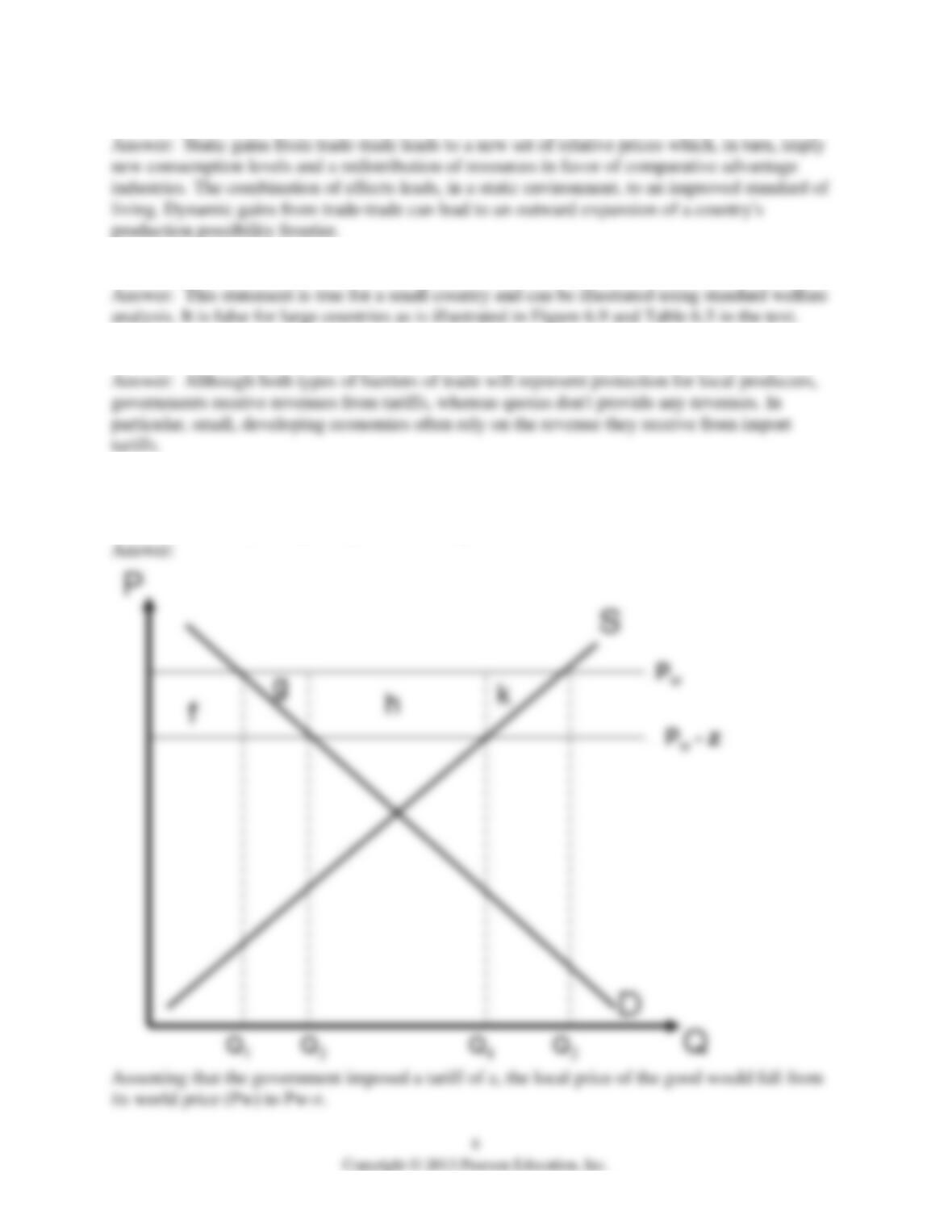
1) Using a demand and supply diagram, illustrate the effects of a tariff on imports. In particular,
show the effects on domestic production, domestic consumption, imports, prices, consumer
welfare, producer welfare, government revenue, and overall economic welfare.
2) Write an essay on the gains from free international trade.
3) Tariffs can never raise a country’s standard of living. True or false? Explain carefully.
4) Why do governments generally prefer to impose tariffs over quotas?
5) Describe with a graph the effects of an export tariff z. Include in your graph the effect on
local prices, exports and local production, as well as the changes in consumer and producer
surplus and corresponding changes in deadweight s.
9