8) Traditionally, Wall Street investment banks had been organized as ________, but by 2000 they had
converted to being ________.
A) partnerships; publicly-traded companies
B) sole proprietorships; partnerships
C) corporations; partnerships
D) partnerships; sole proprietorships
9) The Glass-Steagall Act
A) requires that CEO’s personally certify the accuracy of financial statements.
B) prevented financial firms from being both commercial banks and investment banks.
C) was passed in response to the financial crisis of 2007-2009.
D) all of the above
10) To reduce the principal-agent problem,
A) boards-of-directors can tie the salaries of top management to the profitability of the firm.
B) managers can take on more risk than they disclose to investors.
C) managers can inflate profits on financial statements.
D) managers can hide liabilities by not disclosing them on financial statements.
11) If top managers make good decisions, the firm’s profits will be ________, and the firms assets will be
________.
A) high; small relative to its liabilities
B) high; large relative to its liabilities
C) equal to its revenues; small relative to its liabilities
D) low; large relative to its liabilities
56
12) As a result of the 2007-2009 financial crisis, which two firms became bank holding companies,
allowing them to engage in commercial banking activities?
A) Enron and WorldCom
B) Freddie Mac and Fannie Mae
C) Morgan Stanley and Goldman Sachs
D) Lehman Brothers and Merrill Lynch
13) Richard Causey, former chief accounting officer for Enron, pleaded guilty to falsely reported costs
for Enron that were ________ than they actually were, resulting in reported accounting profits for Enron
that were ________ than their actual level. The financial statements were falsified to mislead investors
about the profitability of the firm.
A) higher; higher
B) lower; higher
C) lower; lower
D) higher; lower
14) Alt-A mortgages are
A) mortgages issued to borrowers who fail to document that their incomes are high enough to afford
their mortgages.
B) mortgages which are bundled together by financial institutions and sold to investors.
C) mortgages issued to borrowers with flawed credit histories.
D) government-backed mortgages issued by Fannie Mae and Freddie Mac.
15) The securitization of mortgages was first carried out by
A) Fannie Mae and Freddie Mac.
B) WorldCom and Enron.
C) Sarbanes-Oxley.
D) the Federal Deposit Insurance Corporation (FDIC).
16) Mortgage-backed securities are similar to bonds in that the investor who buys one receives
A) federal insurance to cover the value of the security.
B) partial ownership of the company that issued the security.
C) dividend payments.
D) regular interest payments.
17) The legislation passed in 2010 that was intended to reform regulation of the financial system was the
A) Wall Street Reform and Consumer Protection Act.
B) Sarbanes-Oxley Act.
C) Glass-Steagall Act.
D) Federal National Mortgage Act.
18) The principal-agent problem is
A) often more severe for partnerships than for corporations.
B) often less severe for partnerships than for corporations.
C) severe for corporations but nonexistent for partnerships.
D) most severe for sole proprietorships.
19) Some economists believe that one factor that caused the financial crisis of 2007-2009 was top
managers of large financial services firms making riskier investments than were in the best interests of
the firms’ shareholders.
20) The Sarbanes-Oxley Act was passed in response to the 2007-2009 financial crisis.
21) The Dodd-Frank Act requires that each member of the board of directors personally certify the
accuracy of financial reports.
22) Mortgage-backed securities are groups of mortgages that are bundled together and sold to investors.
23) As a result of the financial crisis of 2007-2009, Freddie Mac and Fannie Mae were brought under the
direct control of the government.
24) Why did the principal-agent problem for investment banks become more severe following the
repeal of the Glass-Steagall Act in 1999?
25) Why do financial markets depend on accurate accounting and disclosure practices?
26) Why do corporate boards of directors sometimes link top managers’ compensation to the
corporations’ stock prices? How might tying compensation too closely to stock prices create an incentive
for corporate fraud.
6.5 Appendix: Tools to Analyze Firms’ Financial Information
1) A future payment’s present value is
A) the value in today’s dollars of funds to be paid or received today.
B) the value in a future date’s dollars of funds to be paid or received in the future.
C) the value in today’s dollars of funds to be paid or received in the future.
D) the value in a future date’s dollars of funds to be paid or received today.
2) If a dollar today will likely have more purchasing power because of inflation, then a dollar a year
from now ________ a dollar today.
A) will be more valuable than
B) will be less valuable than
C) will have the same value as
D) may be more valuable or less valuable than
3) If a company pays a dividend of $5 to be received one year from now, dividends are expected to
grow at a rate of 8 percent per year for the indefinite future, and the interest rate is 14 percent, the price
of the company’s stock should be ________ per share.
A) $8.00
B) $83.33
C) $227.27
D) $610.00
4) If you want to know the present value of $5,000 received in one year, and the interest rate is 2 percent,
what formula can you use?
A) Present value equals $5,000 times 0.02.
B) Present value equals $5,000 divided by 1.02
C) Present value equals 1.02 divided by $5,000.
D) Present value equals $5,000 times 1.02.
5) The present value of $1,500 received 8 years in the future would be calculated as which of the
following when the interest rate is 3%?
A) 1,500/(1.3)8
B) 1,500/(1.03)8
C) 1,500 × 1.3 × 8
D) 8.03/1,500
6) What is the present value of $960 in one year if the current rate of interest is 6 percent?
A) $676.76
B) $905.66
C) $1,017.60
D) $1,449.46
7) If you own a $1,000 face value bond with one year remaining to maturity and a 7 percent coupon rate
and new bonds are paying 11 percent, what is the most you can get for your old bond?
A) $1,028.85
B) $1,000.00
C) $963.96
D) $952.30
8) If a stock’s dividend is expected to grow at a constant rate of 4 percent in the future and it has just
paid a dividend of $6.00 per share, and you have an alternative investment of equal risk that will earn a
7 percent rate of return, what would you be willing to pay per share for this stock?
A) $6.66
B) $54.55
C) $200.00
D) $208.00
9) On a balance sheet, stockholder’s equity is equal to
A) assets minus liabilities.
B) the total value of outstanding shares of stock.
C) long-term liabilities minus current liabilities.
D) total assets minus goodwill.
10) On a balance sheet, a company’s accounts receivable are listed as
A) current assets.
B) current liabilities.
C) stockholder’s equity.
D) goodwill.
11) How much is a bond that pays $80 in coupon payments for 4 years and $1,000 at the end of the
fourth year worth if the interest rate is 6%?
A) $855.46
B) $1,045.56
C) $1,069.30
D) $1,140.00
12) The longer you have to wait to receive a payment,
A) the greater value it will have to you.
B) the less value it will have to you.
C) the lower the interest rate you will charge on the payment.
D) the more you are willing to discount the payment.
13) Using present value to calculate stock prices is ________ than using present value to calculate bond
prices because ________.
A) less accurate; dividend payments for stocks are known with certainty but coupon payments for
bonds are not
B) less accurate; coupon payments for bonds are known with certainty but dividend payments for
stocks are not
C) more accurate; dividend payments for stocks are known with certainty but coupon payments for
bonds are not
D) more accurate; coupon payments for bonds are known with certainty but dividend payments for
stocks are not
14) If the final expressions in a present value equation used to calculate the price of a bond you are
considering buying are “[$50 / (1 + .08)3] + [$500 / (1 + .08)3]”, which of the following is correct?
A) The face value is $500, the coupon is $50, and the coupon will mature in 3 years.
B) The face value is $50, the interest rate you need is 8 percent, and the coupon will mature in 3 years.
C) The face value is $500, the interest rate you need is 3 percent, and the coupon will mature in 8 years.
D) The coupon is $50, the interest rate you need is 1.08 percent, and the coupon will mature in 3 years.
15) If the final expressions in a present value equation used to calculate the price of a bond you are
considering buying are “[$75 / (1 + .04)6] + [$2,500 / (1 + .04)6]”, which of the following is correct?
A) The face value is $2,500, the coupon is $75, and the coupon will mature in 4 years.
B) The face value is $75, the interest rate you need is 1.04 percent, and the coupon will mature in 6 years.
C) The face value is $2,500, the interest rate you need is 6 percent, and the coupon will mature in 4
years.
D) The coupon is $75, the interest rate you need is 4 percent, and the coupon will mature in 6 years.
16) If the present value equation used to calculate the price of a stock you are considering buying is
“[$12 / (0.05 – 0.02)], which of the following is correct, assuming that dividends will grow at a constant
rate?
A) The stock price is $12, the dividend growth rate is 2 percent, and the interest rate is 5 percent.
B) The dividend is $12 per share, the dividend growth rate is 2 percent, and the interest rate is 5 percent.
C) The stock price is $12, the dividend growth rate is 5 percent, and the interest rate is 3 percent.
D) The dividend is $12 per share, the dividend growth rate is 5 percent, and the interest rate is 2
percent.
17) If the present value equation used to calculate the price of a stock you are considering buying is “[$7
/ (0.04 – 0.03)], which of the following is correct, assuming that dividends will grow at a constant rate?
A) The stock price is $7, the dividend growth rate is 3 percent, and the interest rate is 1 percent.
B) The dividend is $7 per share, the dividend growth rate is 1 percent, and the interest rate is 4 percent.
C) The stock price is $700, the dividend growth rate is 3 percent, and the interest rate is 4 percent.
D) The dividend is $7 per share, the dividend growth rate is 4 percent, and the interest rate is 3 percent.
18) What is the present value of $777 in one year if the current rate of interest is 7 percent?
A) $831.39
B) $726.17
C) $457.06
D) $111.00
19) If you own a $1,000 face value bond with one year remaining to maturity and a 3 percent coupon
rate and new bonds are paying 9 percent, what is the most you can get for your old bond?
A) $917.43
B) $944.95
C) $970.87
D) $1,000
20) If a stock’s dividend is expected to grow at a constant rate of 6 percent in the future and it has just
paid a dividend of $2.50 a share, and you have an alternative investment of equal risk that will earn a 8
percent rate of return, what would you be willing to pay per share for this stock?
A) $2.86
B) $33.13
C) $132.50
D) $200.00
21) If a company pays a dividend of $2 to be received one year from now, dividends are expected to
grow at a rate of 3 percent per year for the indefinite future, and the interest rate is 4 percent, the price
of the company’s stock should be ________ per share.
A) $3.40
B) $28.57
C) $200.00
D) $340.00
22) How much is a bond that pays $40 in coupon payments for 2 years and $1,000 at the end of the
fourth year worth if the interest rate is 4%?
A) $844.56
B) $924.56
C) $1,000
D) $1,123.2
23) Yolanda received a $100 savings bond for her birthday. The bond pays $100 at maturity, which is in
five years. If the interest rate is 3%, the bond has a present value of $86.26.
24) On a balance sheet, stockholders’ equity is listed as an asset.
25) Georgia’s great uncle gave her a $5,000 savings bond as a wedding gift. The bond pays $5,000 at
maturity, which is in 10 years. If the interest rate is 4%, the bond has a present value of $ 3,377.82.
26) The difference between a firm’s revenue and its operating expenses is the firm’s operating income.
27) Why is money you receive at some future date worth less to you than money you receive today?
68
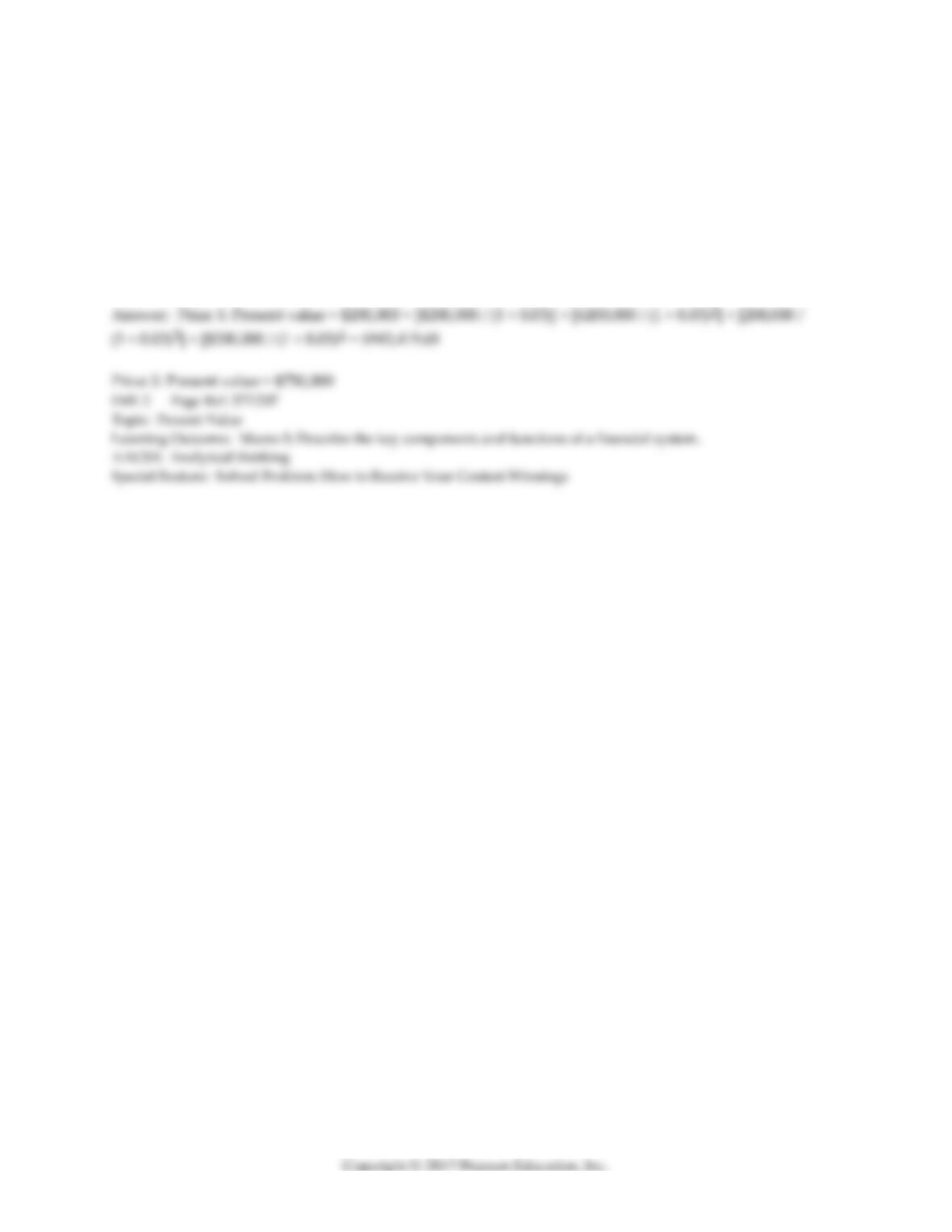
28) Suppose you hit a progressive jackpot on a 25-cent Fortunemaker slot machine in a casino in Las
Vegas and are given the choice of the following prizes:
Prize 1: $200,000 to be received right away, with four additional payments of $200,000 to be received
each year for the next four years.
Prize 2: $750,000 to be received right away.
If the interest rate is 3 percent, what is the present value of each prize?