Price Elasticity of Demand: Its Effect on Total Revenue and Total Expenditure
133. A recent study on enrollment at a liberal arts college concluded that demand elasticity is 0.91. The administration is
considering a tuition increase to help balance the budget. The revenue-maximizing decision is to
a.
decrease tuition, which should boost enrollment enough to balance the budget.
b.
decrease tuition, which would bring in more revenue.
c.
leave tuition as is–an increase would not help balance the budget.
d.
increase tuition, which would bring in more revenue.
Moderate
DISC: Elasticity
United States – BPROG: Reflective Thinking – BPROG: Analysis
Elasticity
Price Elasticity of Demand: Its Effect on Total Revenue and Total Expenditure
134. The local symphony recently raised its price for tickets to their summer concerts in the park. At the end of the
summer season, the symphony was surprised to see that total revenue had actually decreased. The reason was that the
elasticity of demand for tickets was
a.
unit elastic.
b.
inelastic.
c.
elastic.
d.
Not enough information is given.
c
Moderate
DISC: Elasticity
United States – BPROG: Analytic
Elasticity
Price Elasticity of Demand: Its Effect on Total Revenue and Total Expenditure
135. John’s Bait Shop was surprised to learn that when it raised prices by 10 percent, total revenue was unaffected. This is
because the elasticity for bait is
a.
unit elastic.
b.
inelastic.
c.
elastic.
d.
Not enough information is given.
a
Moderate
DISC: Elasticity
United States – BPROG: Analytic
Elasticity
Price Elasticity of Demand: Its Effect on Total Revenue and Total Expenditure
136. If demand is unit elastic, revenue
a.
and price rise and fall together.
b.
rises as price falls.
c.
falls as price rises.
d.
remains constant as price rises or falls.
Easy
DISC: Elasticity
United States – BPROG: Analytic
Elasticity
Price Elasticity of Demand: Its Effect on Total Revenue and Total Expenditure
137. If, as price increases by 10 percent, total revenue decreases by 10 percent demand is
a.
elastic.
b.
unit elastic.
c.
inelastic.
d.
perfectly inelastic.
a
Difficult
DISC: Elasticity
United States – BPROG: Reflective Thinking – BPROG: Analysis
Elasticity
Price Elasticity of Demand: Its Effect on Total Revenue and Total Expenditure
138. When the price of penicillin tablets increases by $5 per dozen, the drug company’s revenue increases by $6 million.
Its elasticity of demand (in absolute terms) must be
a.
zero.
b.
greater than one.
c.
less than one.
d.
infinitely large.
c
Moderate
DISC: Elasticity
United States – BPROG: Reflective Thinking – BPROG: Analysis
Elasticity
Price Elasticity of Demand: Its Effect on Total Revenue and Total Expenditure
139. The demand for Exxon gasoline is ____ the demand for all gasoline.
a.
exactly as elastic as, and of a different slope from
b.
more elastic than
c.
less elastic than
d.
exactly as elastic and of a different slope from
Easy
DISC: Elasticity
United States – BPROG: Reflective Thinking – BPROG: Analysis
Elasticity
What Determines Demand Elasticity?
140. The demand for French Roast coffee is likely to be
a.
elastic.
b.
inelastic.
c.
unit elastic.
d.
perfectly inelastic.
a
Easy
DISC: Elasticity
United States – BPROG: Analytic
Elasticity
What Determines Demand Elasticity?
141. The price elasticity of demand for widgets at any particular price is determined by
a.
whether widgets are luxuries or necessities.
b.
how much of their budgets consumers spend on widgets.
c.
whether there are any good substitutes for widgets.
d.
All of the above are correct.
Easy
DISC: Elasticity
United States – BPROG: Reflective Thinking – BPROG: Analysis
Elasticity
What Determines Demand Elasticity?
142. The demand for potatoes at current prices is likely to be
a.
elastic.
b.
inelastic.
c.
unit elastic.
d.
perfectly elastic.
DISC: Elasticity
United States – BPROG: Analytic
What Determines Demand Elasticity?
143. A 10 percent increase in the cost of restaurant meals, which are a luxury, will most likely
a.
increase the purchase of meals by 10 percent.
b.
increase the purchase of meals by less than 10 percent.
c.
decrease the purchase of meals by more than 10 percent.
d.
decrease the purchase of meals by less than 10 percent.
DISC: Supply and demand
United States – BPROG: Reflective Thinking – BPROG: Analysis
Supply and demand
What Determines Demand Elasticity?
144. If both matches and automobile prices increase by 10 percent, consumers will likely buy
a.
fewer matches and approximately the same quantity of automobiles.
b.
approximately the same quantity of matches and fewer automobiles.
c.
fewer matches and fewer automobiles.
d.
approximately the same quantity of both matches and automobiles.
DISC: Supply and demand
United States – BPROG: Reflective Thinking – BPROG: Analysis
Supply and demand
What Determines Demand Elasticity?
145. A relatively large increase in the cost of electricity would likely
a.
result in a large increase in the use of gas for home use immediately.
b.
cause an immediate large decline in the use of electricity.
c.
increase the use of gas and decrease the use of electricity after a time lapse.
d.
cause an equal reduction in the use of electricity immediately.
DISC: Supply and demand
United States – BPROG: Reflective Thinking – BPROG: Analysis
Supply and demand
What Determines Demand Elasticity?
146. The demand for a new effective drug for the cure of AIDS would most likely be
a.
elastic.
b.
unit elastic.
c.
perfectly elastic.
d.
highly inelastic.
Moderate
DISC: Elasticity
United States – BPROG: Analytic
Elasticity
What Determines Demand Elasticity?
147. Which of the following is more likely be the price elasticity of demand for anti-venom?
a.
highly inelastic
b.
unit elastic
c.
elastic
d.
perfectly elastic
a
Moderate
DISC: Elasticity
United States – BPROG: Analytic
Elasticity
What Determines Demand Elasticity?
148. When OPEC raises the price of petroleum, American expenditures on oil imports increase, suggesting that
a.
the United States’ elasticity of demand for imported oil is greater than one.
b.
the United States’ elasticity of demand for imported oil is less than one.
c.
imported oil and domestically produced oil are complementary goods.
d.
the short-run elasticity of demand for oil is greater than the long-run elasticity.
Easy
DISC: Elasticity
United States – BPROG: Reflective Thinking – BPROG: Analysis
Elasticity
What Determines Demand Elasticity?
149. A decrease in the price of rice from 50 cents to 40 cents a pound increases consumption from 16 to 20 tons a week in
Gainesville and from 160 to 200 tons in the larger city of Miami. The elasticity of demand for rice is
a.
greater in Miami than in Gainesville, even taking into account the population difference.
b.
greater in Gainesville than in Miami in spite of the population difference.
c.
equal in Gainesville and Miami regardless of the population difference.
d.
impossible to compare because of the population difference.
c
Moderate
DISC: Elasticity
United States – BPROG: Reflective Thinking – BPROG: Analysis
Elasticity
What Determines Demand Elasticity?
150. Which of the following goods will have the most inelastic demand at any time?
a.
jewelry
b.
Big Macs
c.
electricity
d.
pork chops
c
Moderate
DISC: Elasticity
United States – BPROG: Reflective Thinking – BPROG: Analysis
Elasticity
What Determines Demand Elasticity?
151. Which of the following goods will have the most elastic demand at any time?
a.
coffee
b.
gasoline
c.
restaurant meals
d.
insulin
c
Moderate
DISC: Elasticity
United States – BPROG: Reflective Thinking – BPROG: Analysis
Elasticity
What Determines Demand Elasticity?
152. The price elasticity of new automobile purchases is about 1.2. This implies that an increase of $1,000 on a $10,000
automobile will
a.
reduce the number of autos sold by approximately 1.2 percent.
b.
increase the consumer expenditures on autos by approximately 1.2 percent.
c.
reduce the number of autos sold by approximately 12 percent.
d.
increase consumer expenditures on autos by approximately 12 percent.
DISC: Elasticity
United States – BPROG: Reflective Thinking – BPROG: Analysis
What Determines Demand Elasticity?
153. A good will tend to be more price elastic if it
a.
is a luxury good.
b.
has no close substitutes.
c.
is a small part of the household budget.
d.
is a necessity.
DISC: Elasticity
United States – BPROG: Analytic
What Determines Demand Elasticity?
154. A study of New York City (NYC) tax rates concluded that taxes on the nonmanufacturing sector should be higher
since that sector has fewer alternatives. Manufacturers are more mobile and may move to avoid higher taxes. This means
that
a.
nonmanufacturing firms have a more elastic demand for NYC locations.
b.
manufacturing firms have an inelastic demand for the NYC locations.
c.
nonmanufacturing firms have relatively inelastic demand for the NYC locations.
d.
nonmanufacturing demand for NYC locations is perfectly elastic.
DISC: Elasticity
United States – BPROG: Analytic
What Determines Demand Elasticity?
155. The price of an airline ticket rises as the amount of time between purchase and flight departure gets smaller. The
airlines base the policy on the assumption that
a.
consumers are not aware of airline prices.
b.
consumer demand is unrelated to prices.
c.
consumer demand becomes more elastic as departure time approaches.
d.
consumer demand becomes less elastic as departure time approaches.
Moderate
DISC: Elasticity
United States – BPROG: Reflective Thinking – BPROG: Analysis
Elasticity
What Determines Demand Elasticity?
156. In 1975, New York City increased regulated taxi fares by 17.5 percent and expected taxi revenue to increase a like
amount. The taxi commission believed taxi demand was
a.
unit elastic.
b.
inelastic.
c.
elastic.
d.
perfectly inelastic.
Moderate
DISC: Elasticity
United States – BPROG: Analytic
Elasticity
What Determines Demand Elasticity?
157. The relationship between a change in consumer income and a resulting change in demand for a good is
a.
demand elasticity.
b.
income elasticity of demand.
c.
cross elasticity of income demand.
d.
supply elasticity.
Moderate
DISC: Elasticity
United States – BPROG: Analytic
Elasticity
Elasticity as a General Concept
158. The elasticity of supply is calculated by
a.
determining the slope of the supply curve.
b.
dividing the absolute change in quantity supplied by the absolute change in price.
c.
dividing the percentage change in quantity supplied by the percentage change in price.
d.
dividing the percentage change in price by the percentage change in quantity demanded.
c
1
Moderate
DISC: Elasticity
United States – BPROG: Reflective Thinking – BPROG: Analysis
Elasticity
Elasticity as a General Concept
Figure 6-9
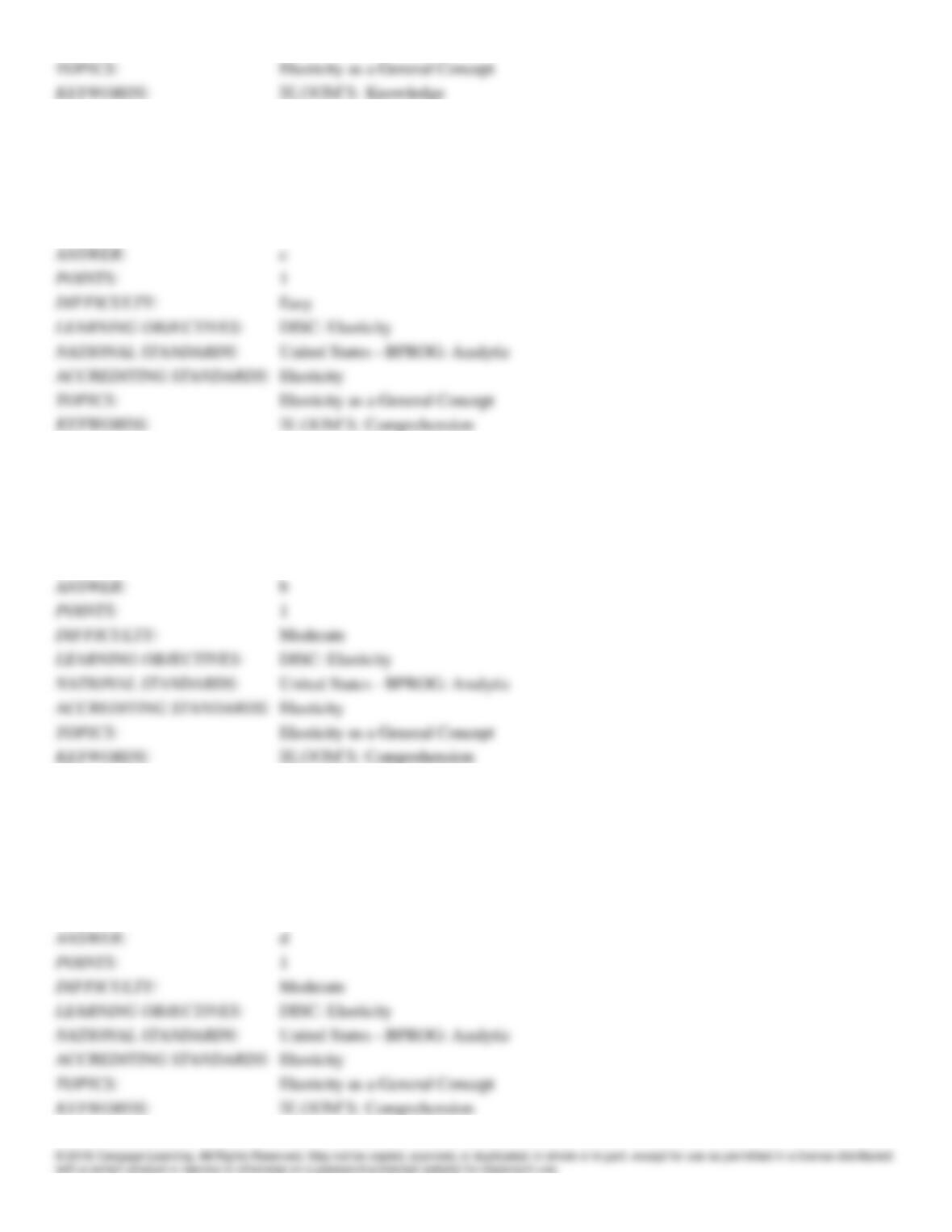
159. In 1983, government price supports raised the price of sugar above its equilibrium value. Which graph in Figure 6-9
illustrates the impact of sugar price supports on the sugar substitute fructose?
a.
1
b.
2
c.
3
d.
4
c
1
Moderate
DISC: Supply and demand
United States – BPROG: Reflective Thinking – BPROG: Analysis
Supply and demand
Elasticity as a General Concept
160. Certain goods are related such that an increase in the price of one good decreases the quantity demanded of the other.
These goods are
a.
complements.
b.
substitutes.
c.
luxury goods.
d.
competing goods.
a
1
Easy
DISC: Supply and demand
United States – BPROG: Analytic
Supply and demand
Elasticity as a General Concept
161. The measure used to determine whether two products are substitutes or complements is called
a.
price elasticity of demand.
b.
income elasticity of demand.
c.
cross elasticity of demand.
d.
inverse elasticity of demand.
c
Easy
DISC: Elasticity
United States – BPROG: Analytic
Elasticity
Elasticity as a General Concept
162. If two goods are complements, their cross elasticity of demand will normally be
a.
zero.
b.
a negative number.
c.
a positive number.
d.
infinity.
Moderate
DISC: Elasticity
United States – BPROG: Analytic
Elasticity
Elasticity as a General Concept
163. The price of coffee rose 50 percent and coffee sales fell 25 percent. Doughnut sales also fell 25 percent. From this
information we can conclude that
a.
demand for coffee is inelastic.
b.
coffee and doughnuts are complements.
c.
the cross elasticity of demand is minus 0.5 percent.
d.
All of the above are correct.
Moderate
DISC: Elasticity
United States – BPROG: Analytic
Elasticity
Elasticity as a General Concept
164. Two economists from Ohio University estimated that the demand curve for kerosene in Indonesia was such that a 10
percent increase in the price reduced the quantity demanded by 2.2 percent and that a 10 percent increase in the price of
electricity increased the demand for kerosene by 1.6 percent. This indicates that (i) the demand for kerosene is price
inelastic and (ii) kerosene and electricity are substitutes. Which of these two statements is correct?
a.
i and ii
b.
i not ii
c.
ii not i
d.
neither i nor ii
DISC: Elasticity
United States – BPROG: Reflective Thinking – BPROG: Analysis
Elasticity as a General Concept
165. The elasticity measure which has been employed by the courts to assess the degree of market competition is
a.
price elasticity of demand.
b.
income elasticity of demand.
c.
cross elasticity of demand.
d.
inverse elasticity of demand.
DISC: Elasticity
United States – BPROG: Analytic
Elasticity as a General Concept
166. If goods X and Y are complements, the
a.
quantities demanded of X and Y tend to move in opposite directions.
b.
quantities demanded of X and Y tend to move in the same direction.
c.
prices of X and Y tend to move in the same direction.
d.
supply curves for X and Y tend to move in the same direction.
DISC: Elasticity
United States – BPROG: Analytic
Supply and demand
Elasticity as a General Concept
167. The definition of cross elasticity of demand for two products X and Y is
a.
percentage change in quantity of X demanded/percentage change in quantity of Y demanded.
b.
percentage change in price of Y/percentage change in quantity of X demanded.
c.
percentage change in price of Y/percentage change in price of X.
d.
percentage change in quantity of X demanded/percentage change in price of Y.
Easy
DISC: Elasticity
United States – BPROG: Reflective Thinking – BPROG: Analysis
Elasticity
Elasticity as a General Concept
168. Cross elasticity of demand for
a.
substitutes will normally be positive.
b.
complements will normally be positive.
c.
substitutes will normally be negative.
d.
complements will normally be infinite.
a
Easy
DISC: Elasticity
United States – BPROG: Reflective Thinking – BPROG: Analysis
Elasticity
169. Chicken and fish are substitutes. Therefore, the cross elasticity of demand between chicken and fish is
a.
negative.
b.
positive.
c.
zero.
d.
Any of the above is possible.
Easy
DISC: Elasticity
United States – BPROG: Reflective Thinking – BPROG: Analysis
Elasticity
Elasticity as a General Concept
170. If the cross elasticity of demand for potato chips and pretzels equals 1.5,
a.
potato chips and pretzels must both be luxury goods.
b.
either potato chips or pretzels must be a luxury good, and both may be luxury goods.
c.
potato chips and pretzels must be substitutes.
d.
potato chips and pretzels must be complements.
c
Easy
DISC: Elasticity
United States – BPROG: Analytic
Elasticity
Elasticity as a General Concept
171. If the price elasticity of supply of doodads equals 0.50 and the price rises by 3 percent, then the quantity supplied of
doodads will rise by ____.
a.
0.50 percent.
b.
1.50 percent.
c.
6.00 percent.
d.
15 percent.
Moderate
DISC: Elasticity
United States – BPROG: Analytic
Elasticity
Elasticity as a General Concept
172. Hot dogs and hot dog buns are found to be related by the cross elasticity of demand. If they are complementary
goods, the cross elasticity will be
a.
positive.
b.
equal to zero.
c.
negative.
d.
unknown.
c
Moderate
DISC: Elasticity
United States – BPROG: Analytic
Elasticity
Elasticity as a General Concept
173. After a $5 million ad campaign, Coca-Cola measured its effectiveness by calculating the cross elasticity of demand
between Coke and Pepsi. A successful campaign would be indicated if the cross elasticity went from
a.
0.9 to 0.5.
b.
0.9 to 1.5.
c.
−0.5 to −0.2.
d.
−0.9 to −1.5.
a