18) When a good is made illegal, which of the following definitely results in the price rising?
A) a much higher fine on sellers than on buyers
B) a much higher fine on buyers than on sellers
C) any fine imposed on both buyers or sellers
D) any fine imposed on buyers
19) Compared to the situation in which a good is legal, making the good illegal and imposing
________ results in less being sold.
A) a much higher fine on sellers than on buyers
B) a much higher fine on buyers than on sellers
C) any fine on either the buyer or the seller
D) all of the above
20) If penalties are imposed on both the buyers and the sellers of illegal goods or services, then
an effect in the market for the illegal good or service would definitely be
A) an increase in the equilibrium price.
B) a decrease in the equilibrium price.
C) a decrease in the equilibrium quantity.
D) an increase in the equilibrium quantity.
21) If the government makes a good illegal and then imposes stiffer penalties on illegal drug
buyers than on sellers, the price of the good ________ and the quantity ________.
A) falls; increases
B) rises; decreases
C) falls; decreases
D) does not change; decreases
22) Suppose penalties are imposed on both buyers and sellers of marijuana, but the cost of
breaking the law to sellers is greater than that to buyers. This measure will ________ the
equilibrium price of marijuana and ________ the equilibrium quantity of marijuana sold.
A) lower; increase
B) raise; increase
C) raise; decrease
D) not change; will decrease
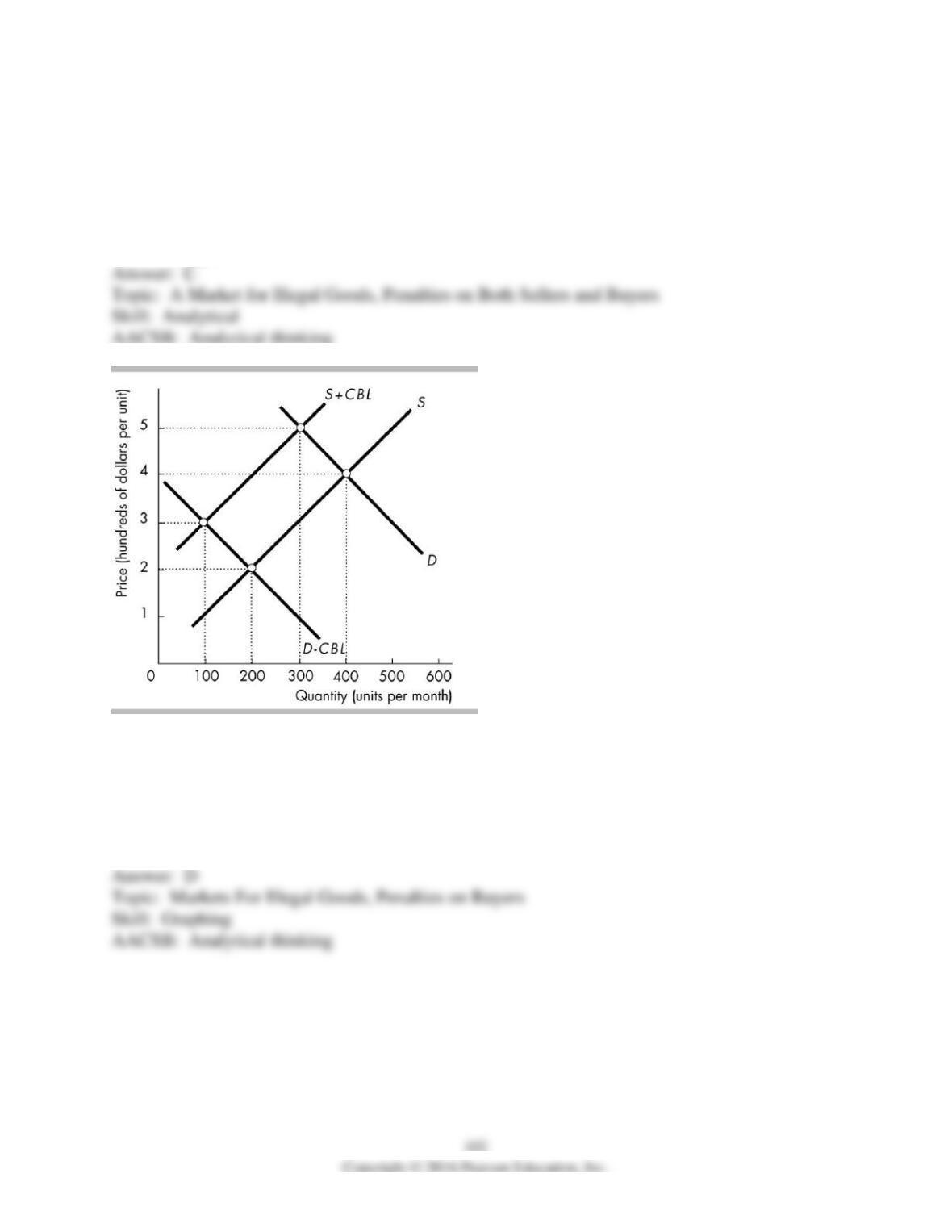
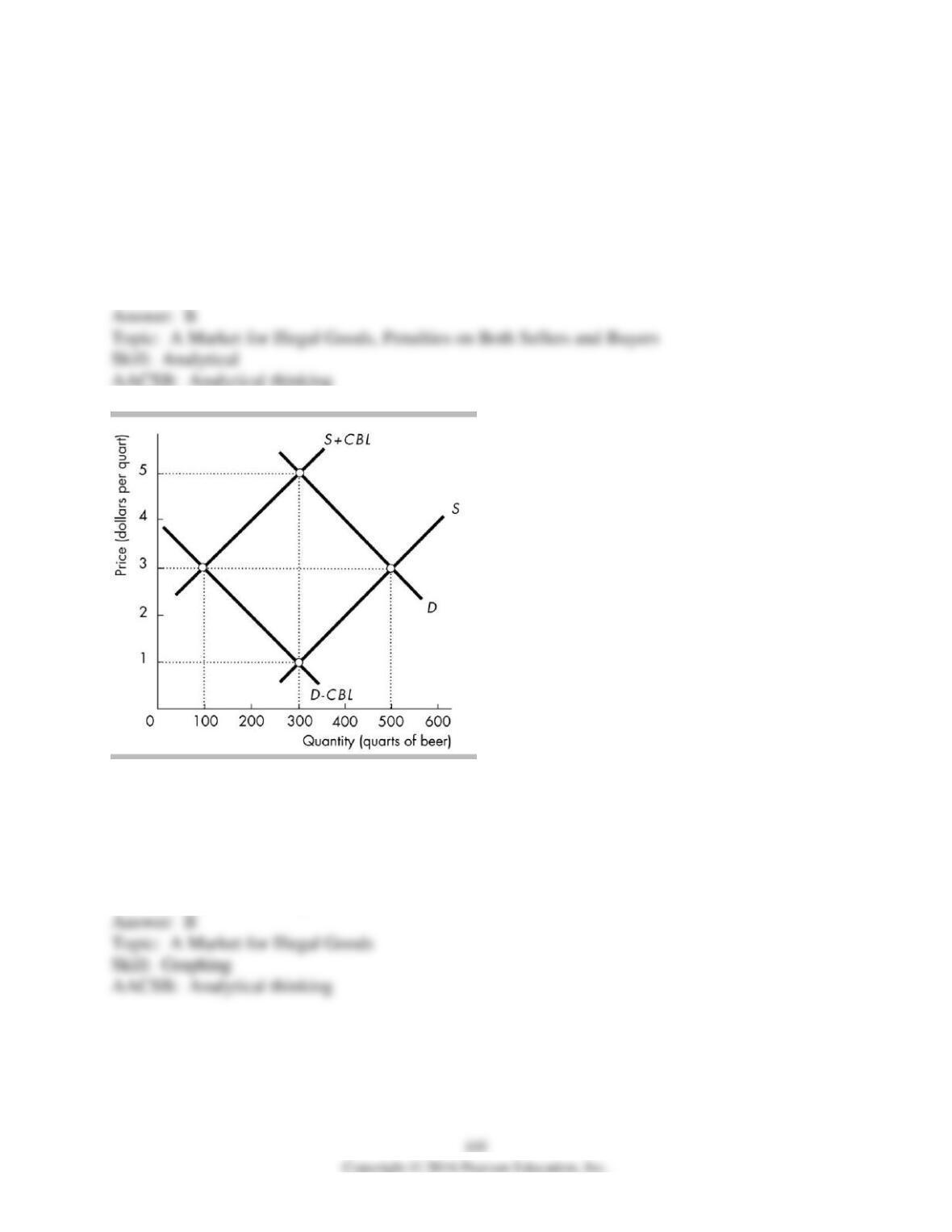
23) In the above figure, CBL is the cost of breaking the law. If it is illegal to buy, but not illegal
to sell, then the price per unit will be
A) $500.
B) $400.
C) $300.
D) $200.
24) In the above figure, CBL is the cost of breaking the law. If it is illegal to sell, but not illegal
to buy, then the price per unit will be
A) $500.
B) $400.
C) $300.
D) $200.
25) In the above figure, CBL is the cost of breaking the law. If the good in the figure is made
illegal and penalties are imposed on both buyers and sellers, then its price per unit
A) will be higher than if it was not illegal.
B) will be lower than if it was not illegal.
C) will be the same as when it was not illegal.
D) cannot be compared with its price when it was legal.
26) In the above figure, CBL is the cost of breaking the law. If it is illegal to buy and sell, then
the price per unit will be
A) $500.
B) $400.
C) $300.
D) $200.
27) In the above figure, CBL is the cost of breaking the law. If it is illegal to buy and sell, then
the quantity of the good bought and sold will be
A) 100.
B) 200.
C) 300.
D) 400.
Price
(dollars per
firework)
Quantity
demanded
(fireworks per
week)
Quantity supplied
(fireworks per
week)
4
220
40
5
200
80
6
180
120
7
160
160
8
140
200
9
120
240
10
100
280
11
80
320
12
60
360
13
40
400
14
20
440
28) The table gives the demand and supply schedules for fireworks on the Island of Big Bang. In
the past, because many deaths have resulted from accidents involving fireworks, the government
has banned fireworks and is enforcing the ban. A $6 a firework penalty on sellers of fireworks
and no penalty on buyers will reduce the number of fireworks bought to ________ a week and
increase the price paid by buyers to ________ a firework.
A) 40; $13
B) 140; $8
C) 80; $11
D) 0; an unknown amount
29) The table gives the demand and supply schedules for fireworks on the Island of Big Bang. In
the past, because many deaths have resulted from accidents involving fireworks, the government
has banned fireworks and is enforcing the ban. A $6 a firework penalty on buyers of fireworks
and no penalty on sellers will reduce the number of fireworks bought to ________ a week and
decrease the price kept by suppliers to ________ a firework.
A) 80; $5
B) 40; $8
C) 0; an unknown amount
D) 140; $3
30) The table gives the demand and supply schedules for fireworks on the Island of Big Bang. In
the past, because many deaths have resulted from accidents involving fireworks, the government
has banned fireworks and is enforcing the ban. A $5 a firework penalty on buyers of fireworks
and a $4 a firework penalty on sellers will reduce the number of fireworks bought to ________ a
week and the price paid by buyers will be ________ a firework.
A) 80; $7
B) 40; $13
C) 0; an unknown amount
D) 160; $11
31) Using the above figure, CBL is the cost of breaking the law. What is the equilibrium price
and quantity if beer is legal?
A) $5 per quart and 300 quarts of beer
B) $3 per quart and 500 quarts of beer
C) $3 per quart and 100 quarts of beer
D) $1 per quart and 300 quarts of beer
32) Suppose the government has declared beer to be an illegal substance and imposes a fine on
any person caught selling a beer. Buying beer, however, remains legal. Using the above figure, in
which CBL is the cost of breaking the law, what is the equilibrium price and quantity with this
new law in effect?
A) $5 per quart and 300 quarts of beer
B) $3 per quart and 500 quarts of beer
C) $3 per quart and 100 quarts of beer
D) $1 per quart and 300 quarts of beer
33) Suppose the government has declared beer to be an illegal substance and has imposed
penalties on any person caught selling a beer. Buying a beer, however, remains legal. Using the
above figure, in which CBL is the cost of breaking the law, beer consumption is decreased by
A) 200 quarts.
B) 300 quarts.
C) 400 quarts.
D) 500 quarts.
34) Suppose the government has declared beer to be an illegal substance and imposes a fine on
anyone caught buying a beer. Selling beer, however, remains legal. Using the above figure, in
which CBL is the cost of breaking the law, what is the equilibrium price and quantity with this
new law in effect?
A) $5 per quart and 300 quarts of beer
B) $3 per quart and 500 quarts of beer
C) $3 per quart and 100 quarts of beer
D) $1 per quart and 300 quarts of beer
35) Suppose the government has declared beer to be an illegal substance and has imposed
penalties on any person caught buying a beer. Selling a beer, however, remains legal. Using the
above figure, in which CBL is the cost of breaking the law, beer consumption is decreased by
A) 200 quarts.
B) 300 quarts.
C) 400 quarts.
D) 500 quarts.
36) Suppose the government has declared beer to be an illegal substance and has imposed equal
penalties on any person caught buying a beer and on any person caught selling a beer. Using the
above figure, in which CBL is the cost of breaking the law, what is the equilibrium price and
quantity with this new law in effect?
A) $5 per quart and 300 quarts of beer
B) $3 per quart and 500 quarts of beer
C) $3 per quart and 100 quarts of beer
D) $1 per quart and 300 quarts of beer
37) Suppose the government has declared beer to be an illegal substance and has imposed equal
penalties on any person caught buying a beer and on any person caught selling a beer. Using the
above figure, in which CBL is the cost of breaking the law, beer consumption is decreased by
A) 200 quarts.
B) 300 quarts.
C) 400 quarts.
D) 500 quarts.
38) Which of the following is a CORRECT statement about markets for prohibited goods?
A) Penalizing sellers of an illegal good decreases supply and penalizing buyers decreases
demand.
B) Penalizing either buyers or sellers of an illegal good decreases the quantity bought.
C) Taxing a good at a sufficiently high rate can achieve the same consumption level as
prohibition.
D) All of the above are correct statements.
39) Rather than prohibiting a good or service, the government might tax it. Imposing such a tax
on a good or service ________ the equilibrium price and ________ the equilibrium quantity.
A) raises; increases
B) raises; decreases
C) lowers; increases
D) lowers; decreases
40) If sanctions are imposed on buyers but NOT on sellers of an illegal good, then the
equilibrium price ________ and the equilibrium quantity ________.
A) rises; increases
B) rises; decreases
C) falls; increases
D) falls; decreases
6 News Based Questions
1) The federal government pays airlines to service small cities in the United States through a
subsidy program called Essential Air Service which was established in 1978 when the airline
industry was deregulated. Most subsidies can’t exceed $200 per passenger. What is NOT an
effect of this subsidy?
A) an increase in price and an increase in quantity produced
B) an increase in supply
C) an increase in marginal cost
D) inefficient overproduction
2) The federal government pays airlines to service small cities in the United States through a
subsidy program called Essential Air Service which was established in 1978 when the airline
industry was deregulated. Most subsidies can’t exceed $200 per passenger. Without this subsidy,
what is TRUE?
A) There would be higher prices and fewer flights.
B) There would be lower prices and fewer flights.
C) There would be an increase in supply.
D) There would be a decrease in demand.
3) The federal government pays airlines to service small cities in the United States through a
subsidy program called Essential Air Service which was established in 1978 when the airline
industry was deregulated. Most subsidies can’t exceed $200 per passenger. What would happen if
the government increased the subsidy to $400 per passenger?
A) There would be a fall in price and increase in quantity produced.
B) Government payments to airlines would decrease.
C) Consumer surplus would decrease.
D) Supply would shift to the left.
4) The Volumetric Ethanol Excise Tax Credit (VEETC) is a tax credit for registered ethanol-
gasoline blenders. Qualified blenders receive $0.51 for each gallon of pure ethanol they blend
into gasoline. VEETC is an example of a
A) subsidy.
B) price floor.
C) price ceiling.
D) quota.
5) The Volumetric Ethanol Excise Tax Credit (VEETC) is a tax credit (which acts like a subsidy)
for registered ethanol-gasoline blenders. Qualified blenders receive $0.51 for each gallon of pure
ethanol they blend into gasoline. What statement is TRUE?
A) With a subsidy, the price paid by consumers will be lower than without a subsidy.
B) Without a subsidy, the quantity produced by blenders will be greater than the quantity
demanded.
C) With a subsidy, the equilibrium quantity produced will be lower than without a subsidy.
D) With a subsidy, production will be efficient.
6) Most of us are dependent on crude oil in some shape or way, whether it’s to power our cars or
to heat our homes in some parts of the country. More than 80 percent of the home heating oil
used in the United States goes to the Northeast. It is suggested that there needs to be government
regulation to make it illegal to charge a very high price for oil. This type of regulation would be a
________.
A) price ceiling
B) price floor
C) shortage regulation
D) tax incidence
7) More than 80 percent of the home heating oil used in the United States goes to the Northeast.
In Vermont, the vast majority of people there use oil to stay warm when it’s cold outside. Richard
Izor heats his home with oil and inquires, “I’d like to see them come in and put a ceiling on the
oil price now before it gets any higher. Why they haven’t done this is more than I can
understand.” Which of the following is NOT likely to occur if such a price ceiling was imposed?
A) There would be a surplus of heating oil.
B) A heating oil shortage may occur.
C) A black market for heating oil may be created.
D) There would be an increase in inefficiency in the heating oil market.
8) One of the best defenses we have against malaria these days comes from a fern-like weed
called wormwood. Fluctuating supply and demand have pushed the plant’s price from $155 per
kilo one year, to over $1000 the next. There is a push to set a price ceiling for the plant. Which of
the following would NOT occur if there was a price ceiling set below the equilibrium price on
wormwood?
A) The wormwood market would be allocatively efficient because its price would not fluctuate.
B) A wormwood shortage might occur.
C) A black market for wormwood may be created.
D) There would be an increase in inefficiency in the wormwood market.
9) The federal minimum wage in 2010 was $7.25. If this wage rate was less than the equilibrium
wage, what is the effect?
A) The minimum wage does not create unemployment.
B) The number of people who want to work at the minimum wage is the same as the number of
available jobs.
C) The number of people who want to work at the minimum wage is greater than the number of
available jobs.
D) Deadweight loss exists.
10) The minimum wage in 2008 was $6.55 cents until July 2008 when it was raised to $7.25. If
the minimum wage in June was below the equilibrium wage and the increased wage in July was
above the equilibrium wage, then
A) firms’ producer surplus was greater in June than in July.
B) unemployment was unaffected by the increase.
C) the deadweight loss was greater in June than in July.
D) employment of low-skilled workers increased in July.
11) “The tax on insulin in the Philippines is anywhere between 10 and 20 percent. If you are rich
and living in the Philippines, this is not a problem, but if you are poor, then insulin becomes
something that you cannot afford.” Why do buyers care so much about a tax on insulin, a vital
daily medicine for those with diabetes?
A) because buyers pay virtually the entire tax on insulin because the demand is almost perfectly
inelastic
B) because sellers increase their profit when there is a tax
C) because more insulin can be provided to those in need
D) because the tax incidence is equal between the buyers and sellers
12) “The tax on insulin in the Philippines is anywhere between 10 and 20 percent. If you are rich
and living in the Philippines, this is not a problem, but if you are poor, then insulin becomes
something that you cannot afford.” If the government places the tax on sellers, what is the most
likely tax incidence?
A) The vast majority of the tax is paid by buyers.
B) The vast majority of the tax is paid by sellers.
C) The tax is split equally between buyers and sellers.
D) Sellers pay all the tax.
13) “The tax on insulin in the Philippines is anywhere between 10 and 20 percent. If you are rich
and living in the Philippines, this is not a problem, but if you are poor, then insulin becomes
something that you cannot afford.” If the government places the tax on sellers, what is the effect
on the supply and demand curves?
A) The demand curve stays the same and the supply curve shifts leftward.
B) The demand curve shifts rightward and the supply curve stays the same.
C) Both the demand and supply curves shift leftward.
D) The demand curve shifts leftward and the supply curve stays the same.
7 Essay Questions
1) In the 1980s, one of the most common sights in the socialist countries, such as the former
Soviet Union and North Korea, were long lines for bread, sugar, and other necessities. These
countries had price ceilings on these necessities. Some of the socialist nations, such as the former
Soviet Union, have moved to a market economy by lifting the price ceilings, while others, such
as North Korea, have retained their price ceilings. What prediction do you make about the
presence (or absence) of long lines today in the former Soviet Union and North Korea? Explain
your answer.
2) In order for a price ceiling to have an effect on the market, must it be set above or below the
equilibrium price? Why?
3) Suppose the government imposes a price ceiling that is lower than the equilibrium price.
Discuss the effect, if any, on the price and quantity if the government later removes the price
ceiling.
4) What are the effects of a rent ceiling set below the equilibrium rent?
5) In the housing market, if a rent ceiling of $600.00 is imposed when the equilibrium rent is
$500.00, why will nothing change?
6) What is the difference between a rent ceiling set below the equilibrium rent and a rent ceiling
set above the equilibrium rent?
7) Explain why in cities such as New York City that have rent ceiling laws, so many people who
work in the city commute from outside the city.
8) Suppose that apartments rent for $1,300 a month in San Francisco, California and $850 a
month in Los Angeles, California. If the state of California passes a state-wide rent ceiling for
apartments of $1,100 a month, what occurs in the two cities?
9) Why do rent ceilings lead to shortages and black markets?
10) What are the major economic effects of rent ceilings?
11) Do rent ceilings result in any deadweight loss?
12) What is a black market and how does it influence the market for rental housing if a rent
ceiling creates a housing shortage? What determines the level of the black market rent?
13) What is search activity and how does it influence consumer surplus when a rent ceiling
creates a housing shortage?
14) What is a minimum wage? What are the effects of a minimum wage set below the
equilibrium wage rate?
15) Is the minimum wage an example of a price floor or a price ceiling? Why?
16) What happens to the quantity of labor supplied, the quantity of labor demanded, and the
number of unemployed workers if the minimum wage rate set above the equilibrium wage is
increased still higher?
17) Will an increase in the minimum wage create more unemployment if the supply and demand
for labor are highly elastic or highly inelastic?
18) Why would an increase in the minimum wage to $15 per hour lead to more unemployment
for teenage and low-skilled workers?
19) We know that the minimum wage causes unemployment. So, why does the government
impose a minimum wage?
20) How does the elasticity of demand for labor affect the deadweight loss from an increase in
the minimum wage? Why?
21) Discuss the inefficiencies created by a price floor.
22) Explain why a price floor set below the equilibrium price is ineffective.
23) Explain how a price floor set above the equilibrium market price for a good can cause a
surplus of that good.
24) “A price floor that is less than the equilibrium price leads to a shortage of the good.” Is this
assertion true or false? Explain your answer.
25) What occurs if a price floor is set above the equilibrium price? What occurs if a price ceiling
is set below the equilibrium price?
26) Compare and contrast a price ceiling and a price floor.
27) How is the incidence of a sales tax between the buyer and the seller determined?