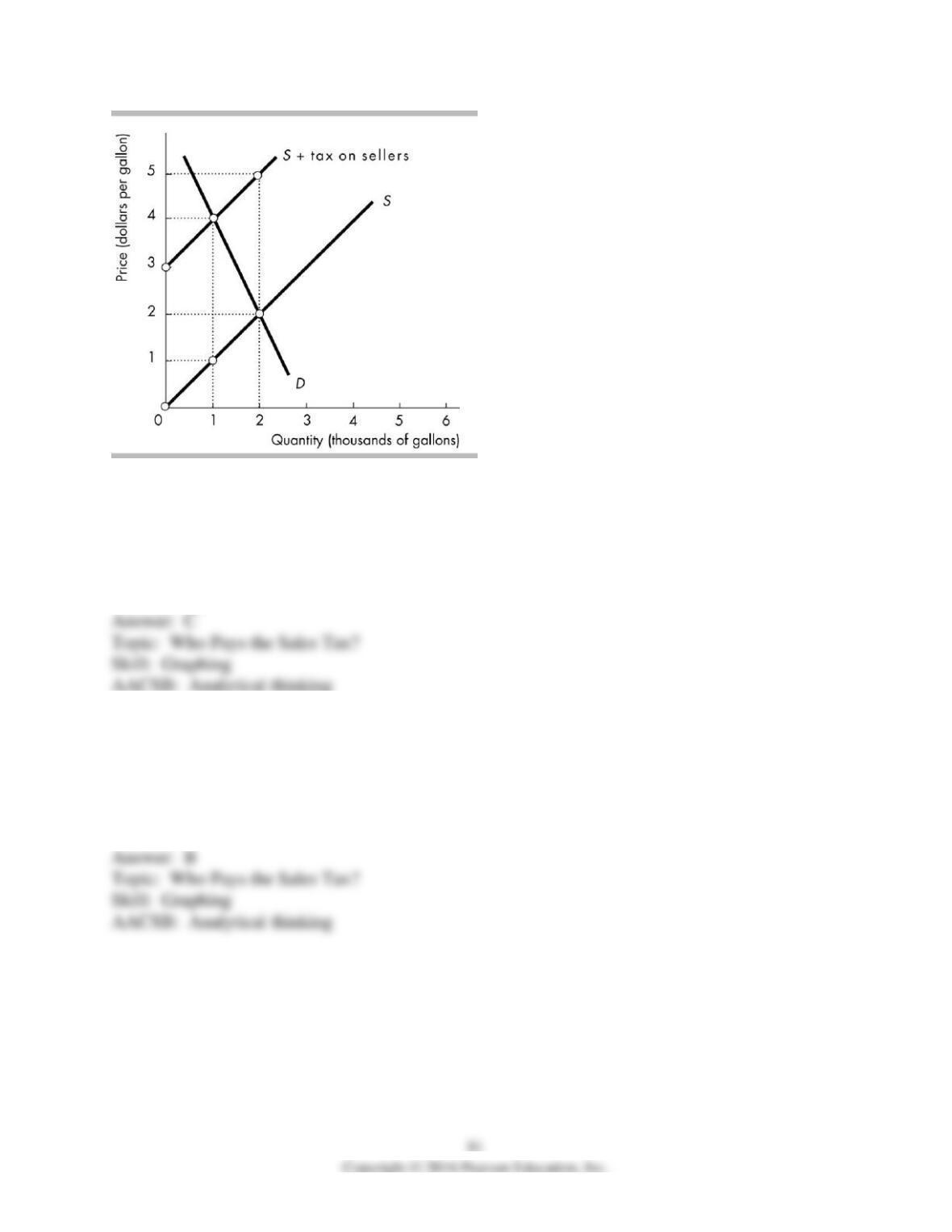
85) The above figure shows the market for anti-freeze. The government imposes the sales tax
shown in the figure on sellers. What is the amount of the tax?
A) $1 per gallon
B) $2 per gallon
C) $3 per gallon
D) $4 per gallon
86) The above figure shows the market for anti-freeze. The government imposes the sales tax
shown in the figure on sellers. How much tax revenue does the government raise from this tax?
A) $2,000
B) $3,000
C) $4,000
D) $6,000
87) The above figure shows the market for anti-freeze. The government imposes the sales tax
shown in the figure on sellers. The sales tax on anti-freeze decreases the quantity of anti-freeze
that automobile owners purchase by
A) 0 gallons.
B) 1000 gallons.
C) 2000 gallons.
D) 3000 gallons.
88) The above figure shows the market for anti-freeze. The government imposes the sales tax
shown in the figure on sellers. Automobile owners would pay a larger part of this tax than what
is shown in the figure if the
A) demand were more elastic.
B) demand were more inelastic.
C) supply were more inelastic.
D) None of the above because the buyers always pay the entire amount of the tax.
89) The above figure shows the market for anti-freeze. The government imposes the sales tax
shown in the figure on sellers. Anti-freeze sellers would pay a larger part of this tax than what is
shown in the figure if the
A) demand were more inelastic.
B) demand curve were steeper.
C) supply were more inelastic.
D) supply were more elastic.
90) The above figure shows the market for anti-freeze. The government imposes the sales tax
shown in the figure on sellers. What is the deadweight loss from this tax?
A) $1,500
B) $3,000
C) $4,500
D) $6,000
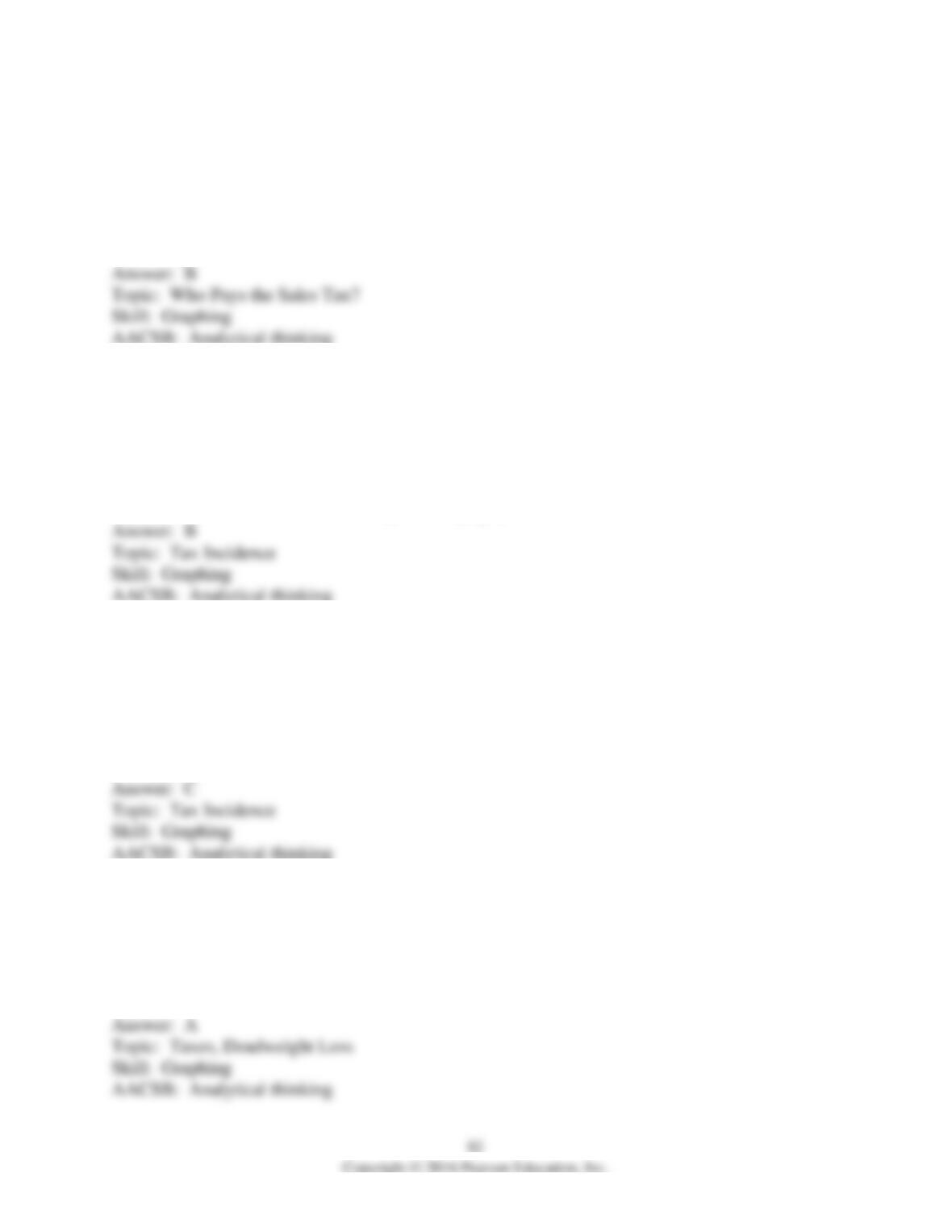
91) The above figure depicts the market for video games. If the government imposed a $3 per
game tax on sellers, what would be the new equilibrium price paid by consumers after the tax?
A) less than $27 per game
B) $27 per game
C) more than $27 per game.
D) More information is needed to determine if the price is more than, less than, or equal to $27
per game.
92) The above figure depicts the market for video games. If the government imposed a $3 per
game tax on sellers, what would be tax revenue?
A) less than $18
B) $18
C) more than $18
D) More information is needed to determine if the tax revenue is more than, less than, or equal to
$18.
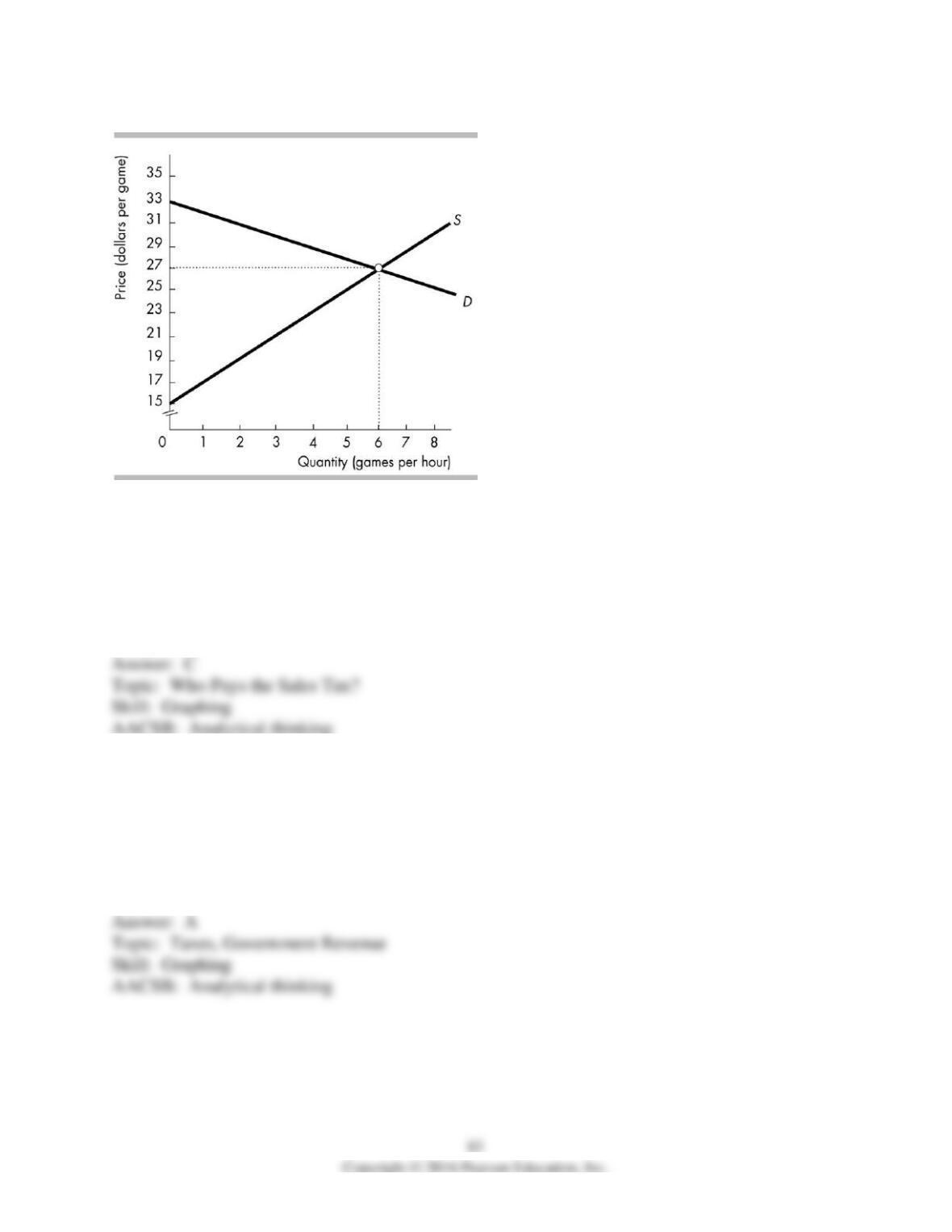
93) Of the $3 per pizza tax illustrated in the above figure, the
A) consumers pay $2 of the $3 per pizza tax.
B) sellers pay $1 of the $3 per pizza tax.
C) government collects $120 thousand in revenue from the pizza tax.
D) All of the above answers are correct.
94) Which of the following is NOT true about the $3 per pizza tax illustrated in the above figure?
A) It decreases consumer surplus by $90 thousand.
B) It decreases producer surplus by $45 thousand.
C) It creates a deadweight loss of $135 thousand.
D) None of the above because they are all true.
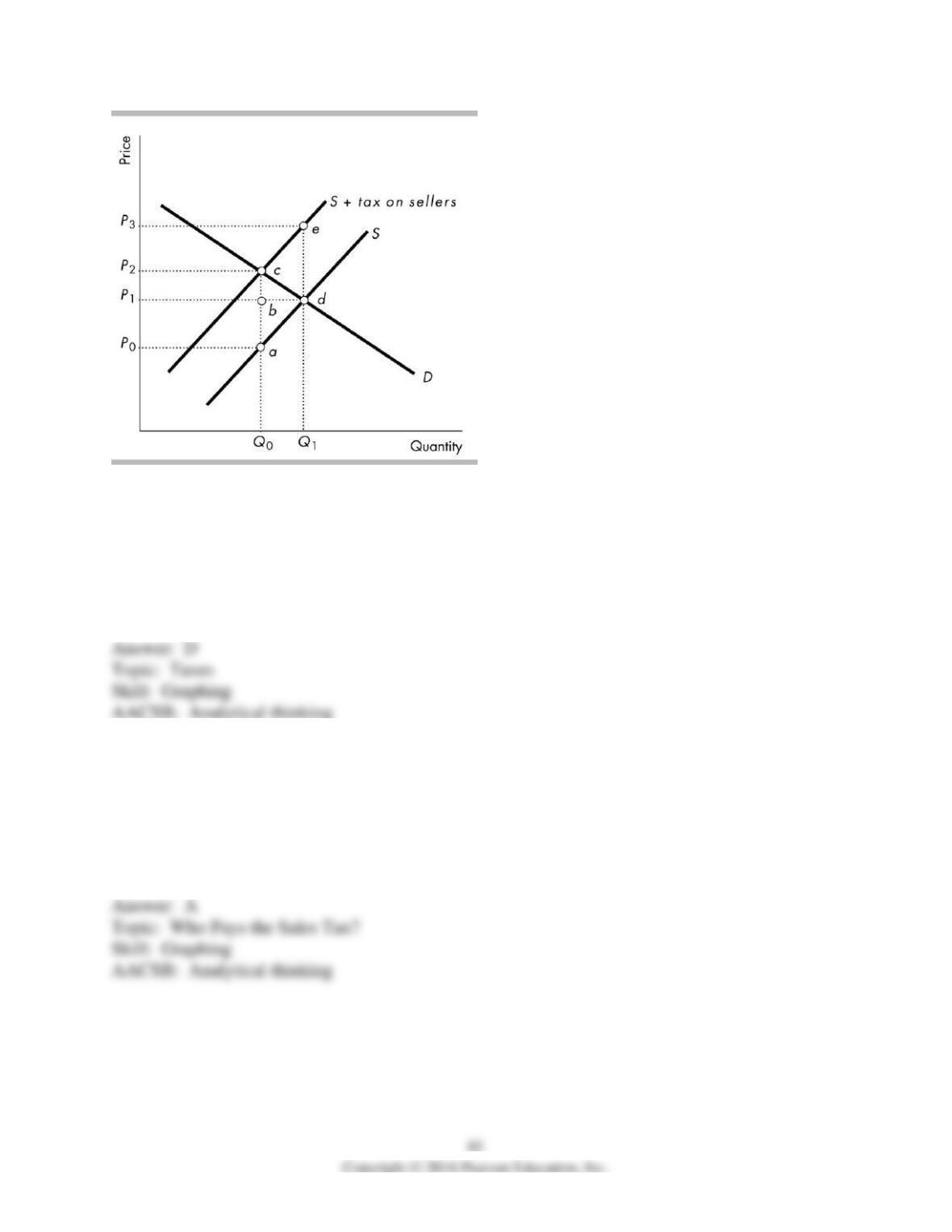
95) To help pay for the cost of sport related injuries, the government imposes a tax on sellers of
all sports equipment. Referring to the above figure, how much tax per unit has the government
imposed?
A) cb
B) db
C) ab
D) ca
96) To help pay for the cost of sport related injuries, the government imposes a tax on sellers of
all sports equipment. The sport equipment producers’ share of this tax would be greater than
shown in the above figure if
A) the demand was more elastic.
B) the demand was more inelastic.
C) the supply was more elastic.
D) Both answers A and C are correct.
97) To help pay for the cost of sport related injuries, the government imposes a tax on sellers of
all sports equipment. The sports equipment consumers’ share of this tax would be greater than
that shown in the above figure
A) only if the demand was more elastic.
B) only if the demand was more inelastic.
C) only if the supply was more elastic.
D) if either the demand was more inelastic or the supply more elastic.
98) To help pay for the cost of sport related injuries, the government imposes a tax on sellers of
all sports equipment. Using the above figure, how much producer surplus is lost from this tax on
sports equipment?
A) abd
B) acd
C) P0P1ba
D) P0P1da
99) To help pay for the cost of sport related injuries, the government imposes a tax on sellers of
all sports equipment. Using the above figure, the area that equals the lost consumer surplus from
this tax on sports equipment is
A) bcd.
B) P1P2cd.
C) P2P3ec.
D) ced.
100) To help pay for the cost of sport related injuries, the government imposes a tax on sellers of
all sports equipment. Using the above figure, how much deadweight loss results from this tax on
sports equipment?
A) cbd
B) ced
C) abd
D) acd
101) To help pay for the cost of sport related injuries, the government imposes a tax on sellers of
all sports equipment. The deadweight loss created by this tax would be greater than shown in the
figure above if
A) the demand were more elastic.
B) the supply were more elastic.
C) neither of the above.
D) both A and B above.
102) To help pay for the cost of sport related injuries, the government imposes a tax on sellers of
all sports equipment. Referring to the above figure, the area that equals the tax revenue the
government raises from this tax on sports equipment is
A) P1P3ed.
B) ecd.
C) P0P2ca.
D) P1P2cb.
103) Which of the following statements is TRUE about taxes?
A) Taxes always create more deadweight loss than do price ceilings and price floors.
B) Taxes decrease both consumer surplus and producer surplus while creating a deadweight loss.
C) Government revenue from a tax is always greater than the loss of producer surplus and
consumer surplus.
D) Both answers A and C are correct.
104) Suppose a tax is imposed on sellers. The more inelastic the demand for the taxed item, the
A) greater the share of the tax paid by sellers.
B) smaller the deadweight loss from the tax.
C) larger the decrease in consumption because of the tax.
D) All of the above answers are correct.
105) Which of the following outcomes is NOT a result of a tax imposed on sellers of gasoline?
A) Supply decreases, a deadweight loss is created, and the price rises.
B) The market becomes less efficient and the government collects the tax revenue.
C) Demand does not change, the price rises, and consumer surplus decreases.
D) Demand decreases, the market becomes more efficient, and the price rises.
106) If the government decreases the tax on cell phones, ________.
A) the deadweight loss decreases
B) the consumer surplus does not change because sellers will not lower the price of a cell phone
C) the number of cell phones purchased does not change
D) the market becomes less efficient because the government collects less tax revenue
107) The government wants to increase its tax revenue and plans to implement an additional
sales tax. The government will raise more tax revenue if it taxes a good with an ________ rather
than a good with an ________.
A) inelastic demand; elastic demand
B) elastic demand; inelastic demand
C) elastic supply; inelastic supply
D) None of the above answers is correct.
108) After a $3 per-unit tax on seeing movies in theaters is imposed, attendance falls from 4,000
a week to 3,000 a week. The revenue from the tax is
A) less than $9,000 a week.
B) $9,000 a week.
C) between $9,000 a week and $12,000 a week.
D) some amount that cannot be calculated without more information.
109) A $10 per-unit tax on cell phones raises the equilibrium price paid by consumers by $5.
Before the tax, 5,000 cell phones were sold per year. The revenue from the tax is
A) zero.
B) positive but less than $50,000 per year.
C) $50,000 per year.
D) more than $50,000 per year.
Price
(dollars per
packet)
Quantity
demanded
(packets per
week)
Quantity
supplied
(packets per
week)
4.00
140
20
4.10
130
40
4.20
120
60
4.30
110
80
4.40
100
100
4.50
90
120
4.60
80
140
4.70
70
160
4.80
60
180
4.90
50
200
5.00
40
220
110) The table gives the demand and supply schedules for cookies. The government now levies a
$0.30 tax on cookies. As a result, the price of a packet of cookies increases by ________ and the
tax revenue collected is ________ a week.
A) $0.20; $24
B) $0.10; $9
C) $0.20; $20
D) $0.30; $30
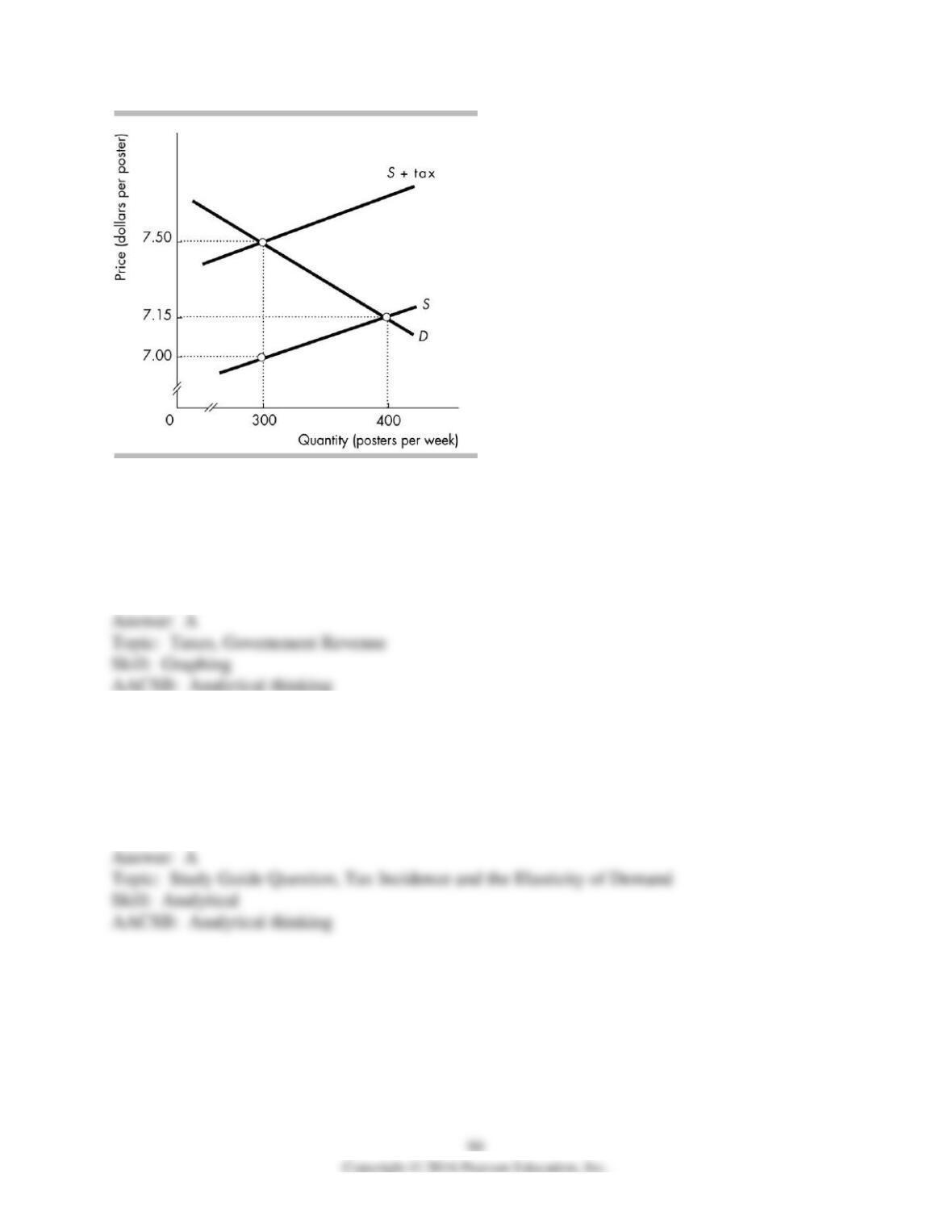
111) The figure illustrates the market for posters. The tax on a poster is ________ and the
government’s tax revenue from the sale of posters is ________ a month.
A) $0.50; $150
B) $0.35; $105
C) $0.35; $200
D) $0.35; $140
112) Suppose the government wants to discourage the use of cigarettes. If it imposes a tax on
cigarettes, the equilibrium quantity falls the most when the elasticity of demand equals
A) 2.00.
B) 1.00.
C) 0.50.
D) 0.
113) Suppose the government imposes a $1 tax on frisbees, and the price of a frisbee paid by
demanders rises by $1.
A) The price rise is consistent with a perfectly elastic supply for frisbees.
B) The price rise is consistent with a perfectly elastic demand for frisbees.
C) The price rise is consistent with a downward-sloping supply curve for frisbees.
D) The price could never rise this much, so this situation cannot happen.
114) The less elastic the supply, the
A) less likely the government is to tax the product.
B) less likely the government is to impose a price ceiling.
C) larger the fraction of any tax imposed on the product that is paid by the suppliers.
D) less elastic the demand.
115) Among the factors that create a deadweight loss and inefficiency are
A) minimum wages, but not taxes.
B) rent ceilings, but not taxes.
C) taxes, but not minimum wages or rent ceilings.
D) minimum wages, rent ceilings, and taxes.
116) In the market for books, initially there are no taxes on books. Books are normal goods. The
government introduces a tax of $4 a book and, at the same time, people’s income fall by $4,000 a
year. Following these two changes, the equilibrium quantity of books
A) decreases.
B) increases.
C) remains unchanged.
D) either increases or decreases. We cannot say which.
4 Production Quotas and Subsidies
1) Governments often intervene in agricultural markets by
A) granting subsidies.
B) setting production quotas that will increase production.
C) setting price floors that reduce prices for buyers.
D) imposing heavy taxes on farm products.
2) To try to help farmers, governments
I. set production quotas.
II. set price ceilings.
A) I and II
B) only II
C) only I
D) neither I nor II
3) If a production quota is set below the equilibrium quantity, at the quota quantity, marginal
benefit is ________ marginal cost and the level of production is ________.
A) greater than; inefficient
B) greater than; efficient
C) less than; inefficient
D) equal to; efficient
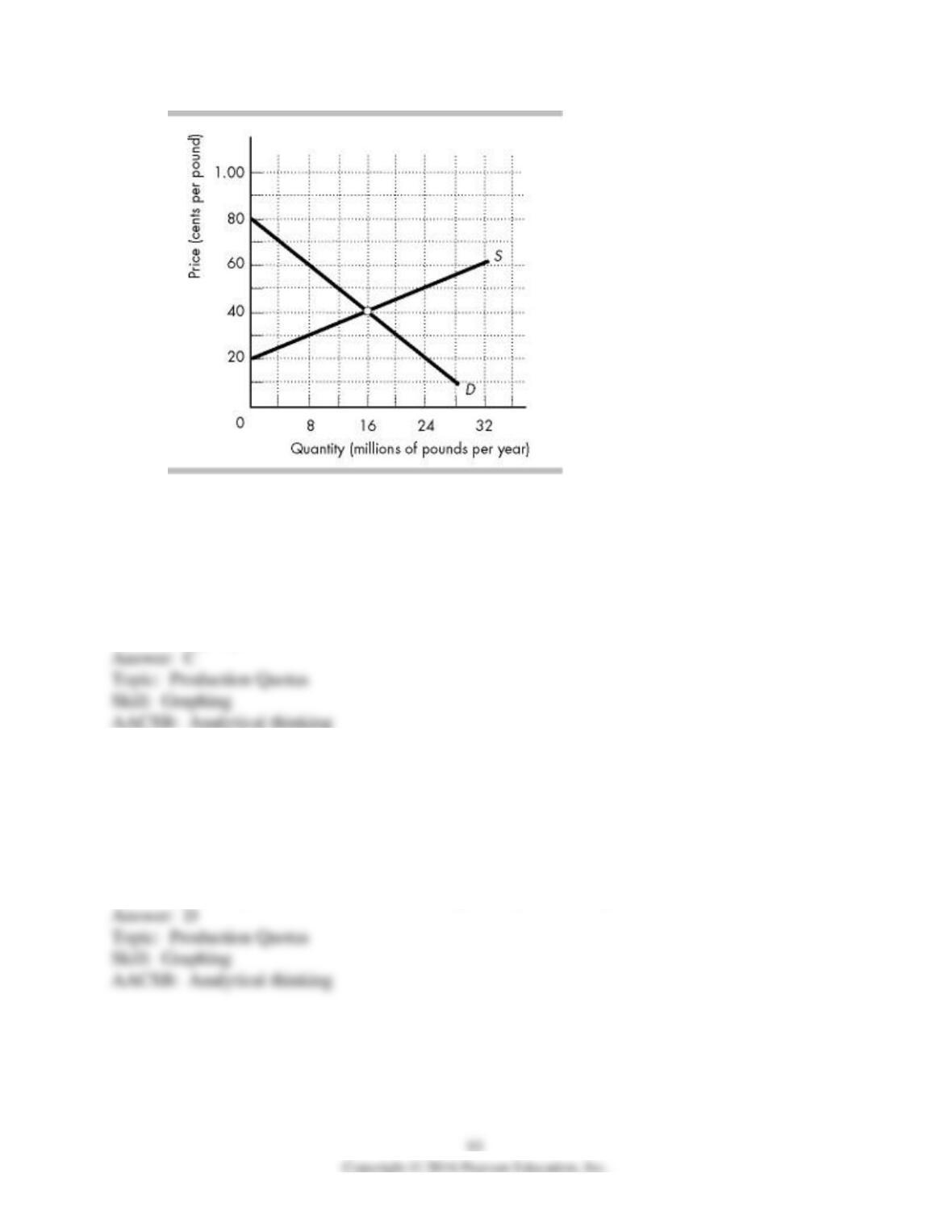
4) The figure above shows the market for cotton in Georgestan. The government regulates the
market with a production quota set at 8 million pounds per year. The price of cotton in
Georgestan is
A) 30 cents per pound.
B) 40 cents per pound.
C) 60 cents per pound.
D) 50 cents per pound.
5) The figure above shows the market for cotton in Georgestan. The government regulates the
market with a production quota set at 8 million pounds per year. The introduction of the quota
has
A) not affected the level of cotton production in Georgestan.
B) increased the production of cotton in Georgestan by 8 million pounds.
C) decreased the production of cotton in Georgestan by 4 million pounds.
D) decreased the production of cotton in Georgestan by 8 million pounds.
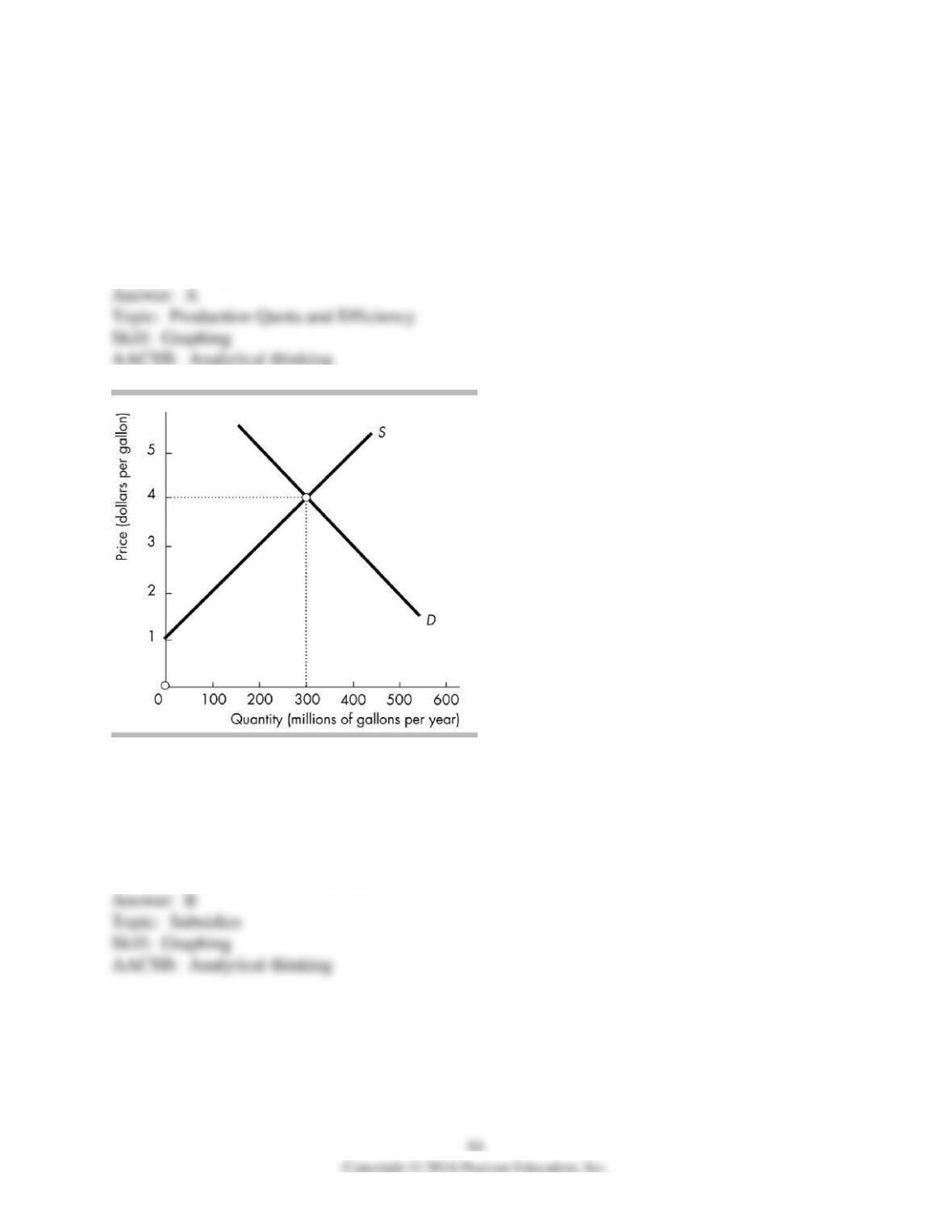
6) The figure above shows the market for cotton in Georgestan. The government regulates the
market with a production quota set at 8 million pounds per year. With the quota in place, the
amount of cotton produced in Georgestan is ________ because the marginal social cost of a
pound of cotton is ________ the marginal social benefit of a pound of cotton.
A) inefficient; less than
B) inefficient; greater than
C) efficient; less than
D) efficient; equal to
7) The figure above shows the market for milk in Cowland. If a subsidy paid to producers of $1
per gallon of milk is introduced, what is the price that consumers pay?
A) $3.00 a gallon
B) between $3.00 and $4.00 per gallon
C) $4.00 a gallon
D) between $4.00 and $5.00 per gallon
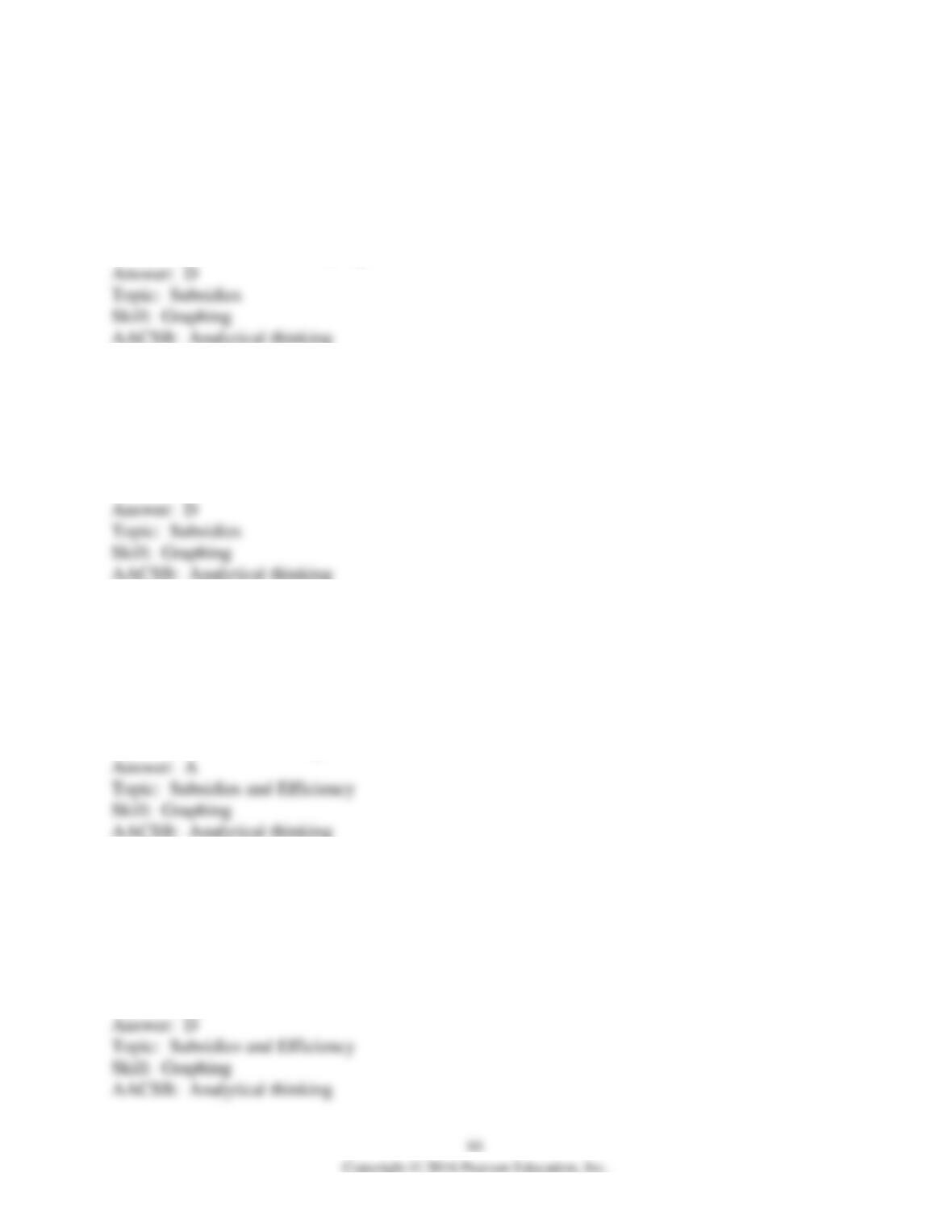
8) The figure above shows the market for milk in Cowland. If a subsidy paid to producers of $1
per gallon of milk is introduced, what is the amount, including the subsidy, that suppliers keep
per gallon?
A) $3.00 a gallon
B) between $3.00 and $4.00 per gallon
C) $4.00 a gallon
D) between $4.00 and $5.00 per gallon
9) The figure above shows the market for milk in Cowland. If a subsidy paid to producers of $1
per gallon of milk is introduced, how many gallons are sold per year?
A) 200 million
B) 400 million
C) 300 million
D) more than 300 million but less than 400 million
10) The figure above shows the market for milk in Cowland. A subsidy paid to producers of $1
per gallon of milk is introduced. If there are no external costs and no external benefits, the
quantity of milk sold is
A) greater than the efficient level of output.
B) less than the efficient level of output.
C) 100 million gallons greater than the efficient level of output.
D) the efficient level of output.
11) The figure above shows the market for milk in Cowland. A subsidy paid to producers of $1
per gallon of milk is introduced. If there are no external costs and no external benefits, the
marginal cost of the last gallon of milk produced is
A) $3.00 a gallon.
B) $3.50 a gallon.
C) $4.00 a gallon.
D) $4.50 a gallon.
12) The figure above shows the market for milk in Cowland. A subsidy paid to producers of $1
per gallon of milk is introduced. If there are no external costs and no external benefits, the
marginal benefit of the last gallon of milk consumed is
A) $3.50 a gallon.
B) $4.00 a gallon.
C) $4.50 a gallon.
D) $5.00 a gallon.
13) An upper limit to the quantity of a good that may be produced in a specific period is called
A) production quota
B) import quota
C) price ceiling
D) price floor
14) A production quota set below the equilibrium quantity creates
A) a decrease in supply
B) a decrease in marginal cost
C) a rise in price
D) inefficient underproduction
E) all of the above
5 Markets for Illegal Goods
1) In general, a fine on selling a product leads to the
A) supply curve shifting rightward.
B) supply curve shifting leftward.
C) demand curve shifting rightward.
D) demand curve shifting leftward.
2) If buyers of illegal goods are punished but sellers are not, then the price ________ and the
equilibrium quantity ________.
A) rises; increases
B) rises; decreases
C) falls; increases
D) falls; decreases
3) If penalties are imposed on the sellers of illegal goods or services, then the equilibrium price
________ and the equilibrium quantity ________.
A) rises; increases
B) rises; decreases
C) falls; increases
D) falls; decreases
4) When a government fines and/or imprisons convicted drug dealers, it is attempting to reduce
the illegal drug trade by shifting the ________ curve for illegal drugs ________.
A) demand; rightward
B) demand; leftward
C) supply; rightward
D) supply; leftward
5) Outlawing the sale of a good shifts the supply curve
A) leftward and lowers the price.
B) leftward and raises the price.
C) rightward and lowers the price.
D) rightward and raises the price.
6) If enforcement is aimed at sellers of an illegal good, its equilibrium price will ________ and
its equilibrium quantity will ________.
A) rise; increase
B) rise; decrease
C) fall; increase
D) fall; decrease
7) When a government fines and/or imprisons persons convicted of using illegal drugs, the
government is attempting to decrease the illegal drug trade by shifting the ________ curve for
illegal drugs ________.
A) demand; rightward
B) demand; leftward
C) supply; rightward
D) supply; leftward
8) In general, a fine on buying a product leads to the
A) supply curve shifting rightward.
B) supply curve shifting leftward.
C) demand curve shifting rightward.
D) demand curve shifting leftward.
9) In general, a fine on smoking cigarettes shifts the ________ curve of cigarettes ________.
A) supply; rightward
B) supply; leftward
C) demand; rightward
D) demand; leftward
10) If enforcement is aimed at buyers of an illegal good, the result will be
A) an increase in the short-run supply of the good.
B) a decrease in the short-run supply of the good.
C) a decrease in demand for the good.
D) an increase in the price of the good.
11) If penalties are imposed only on the buyers of illegal drugs, the equilibrium price of illegal
drugs will ________ and the equilibrium quantity will ________.
A) rise; increase
B) rise; decrease
C) fall; increase
D) fall; decrease
12) If penalties are imposed only on buyers (but not on sellers) of marijuana, the equilibrium
price of marijuana ________, and the equilibrium quantity of marijuana sold ________.
A) rise; increase
B) rise; decrease
C) fall; increase
D) fall; decrease
13) Making the buying and selling of a good illegal shifts the demand curve ________ and shifts
the supply curve ________.
A) rightward; rightward
B) rightward; leftward
C) leftward; rightward
D) leftward; leftward
14) If the penalty on sellers of an illegal good is less than the penalty on buyers of an illegal
good, then supply of the good will ________ by ________ demand and the price of the good will
________.
A) increase; more than; increase
B) decrease; more than; decrease
C) decrease; less than; decrease
D) decrease; the same amount as; remain the same
15) If the same fine is imposed on buyers and sellers of an illegal good so that the cost of
breaking the law is the same for both, then
A) there is more government revenue collected than with an excise tax on the good.
B) there is no deadweight loss in this market because the extra producer surplus will exactly
offset the lost consumer surplus.
C) the supply and demand curves both shift leftward by equal amounts.
D) the equilibrium price of the good definitely increases.
16) When a government imposes penalties on both sellers and buyers of an illegal good, the price
of the good ________ and the quantity ________.
A) falls; decreases
B) falls; might increase, decrease, or not change
C) rises; might increase, decrease, or not change
D) might rise, fall, or not change; decreases
17) If penalties for trading illegal drugs are instituted on both buyers and sellers, the
A) quantity might increase or decrease but the price will rise.
B) price might rise or fall, but the quantity will decrease.
C) price and the quantity will both decrease.
D) price and the quantity will both increase.