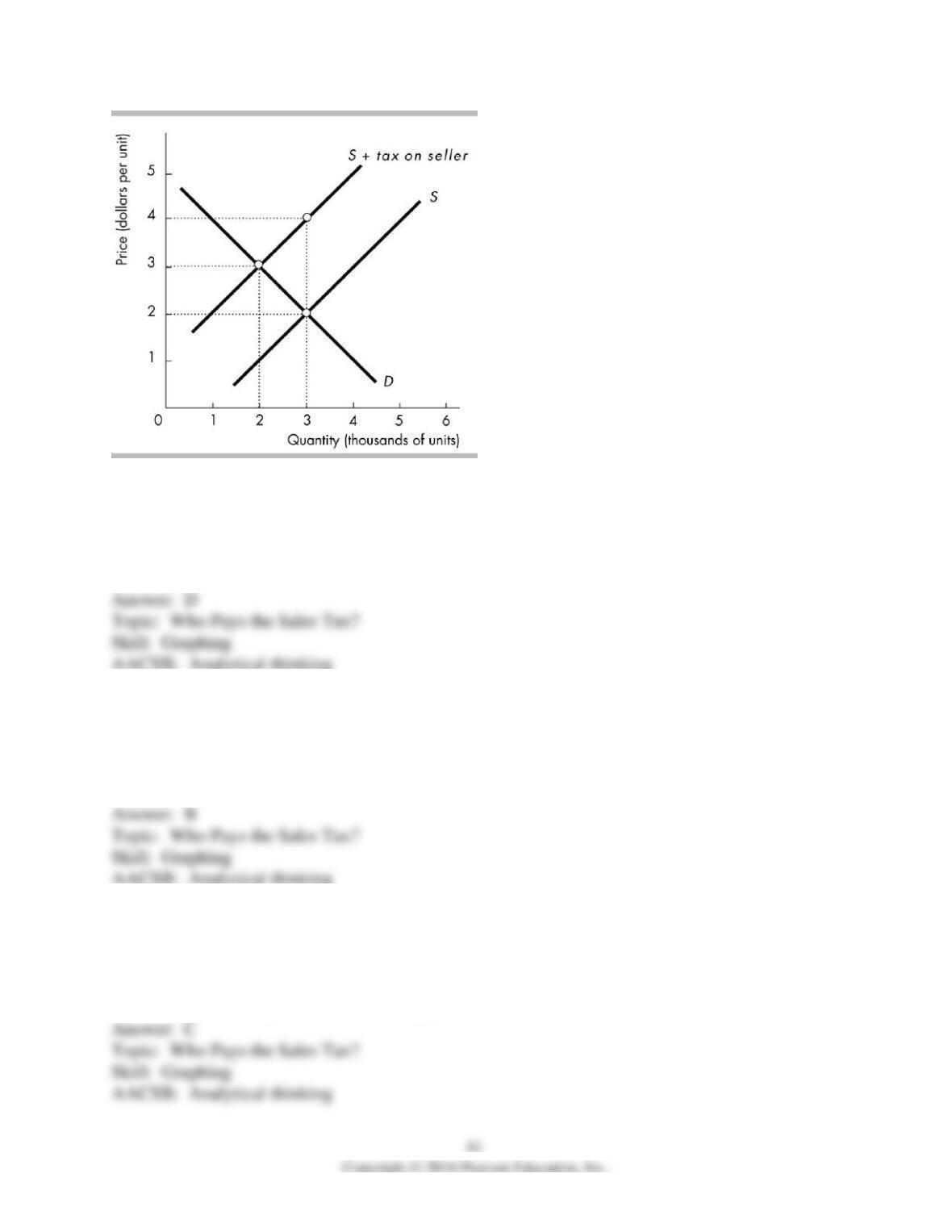
20) In the above figure, the amount of the tax per unit imposed on the sellers is
A) $0.50.
B) $1.00.
C) $1.50.
D) $2.00.
21) In the above figure, the amount of tax revenue is
A) $2,000.
B) $4,000.
C) $6,000.
D) $8,000.
22) In the above figure, the tax incidence is
A) that most of it is paid by the buyers.
B) that most of it is paid by the sellers.
C) split equally so that the buyers and sellers pay the same amount.
D) that neither the buyers nor the sellers pay it.
23) In the above figure, the deadweight loss due to the tax is
A) $1,000.
B) $2,000.
C) $4,000.
D) $8,000.
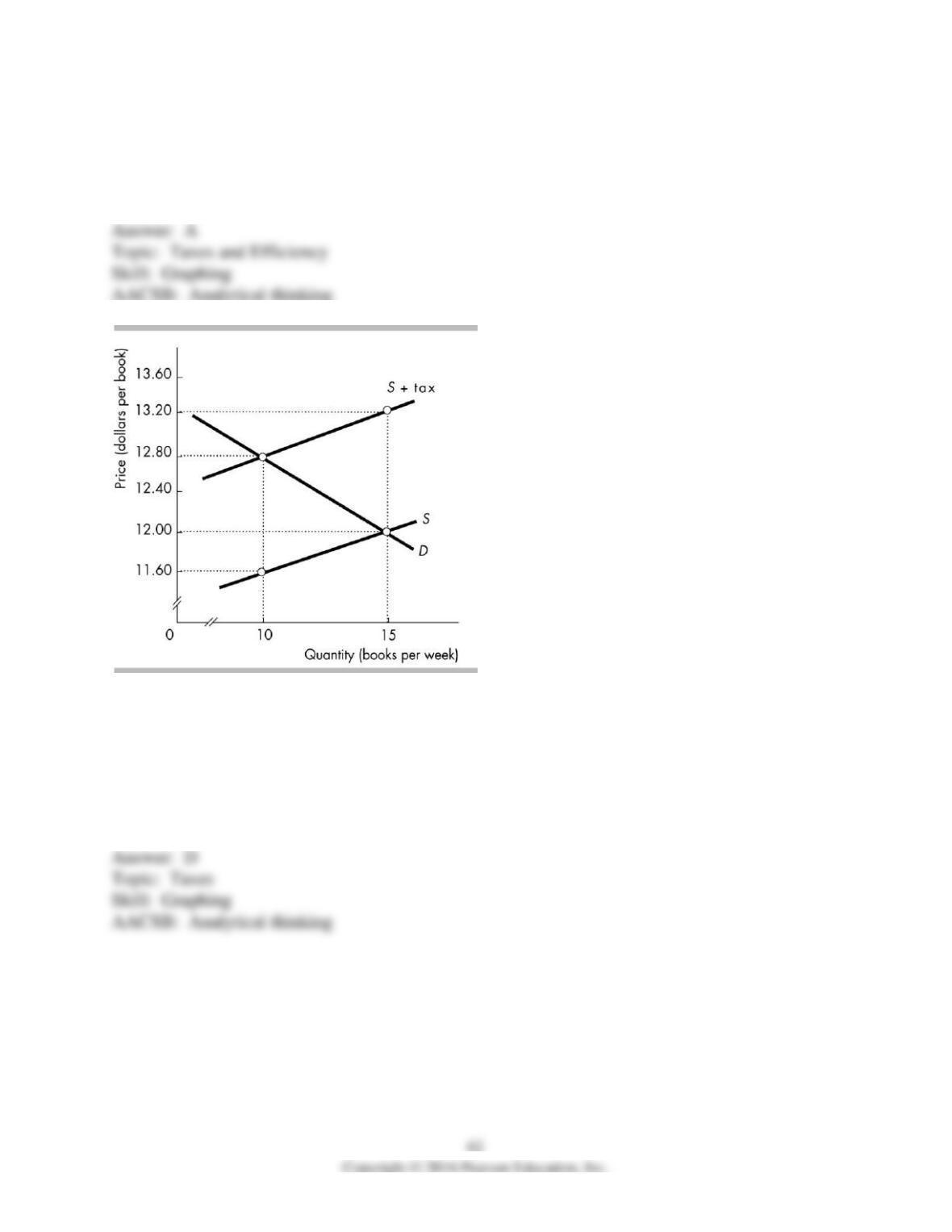
24) The figure shows the market for books before and after a sales tax is introduced. The tax on
books is ________ a book, buyers pay ________ of tax per book, and the government’s tax
revenue is ________ a week.
A) $1.20; $0.80; $128
B) $0.80; $1.20; $12
C) $0.40; $0.40; $4
D) $1.20; $0.80; $12
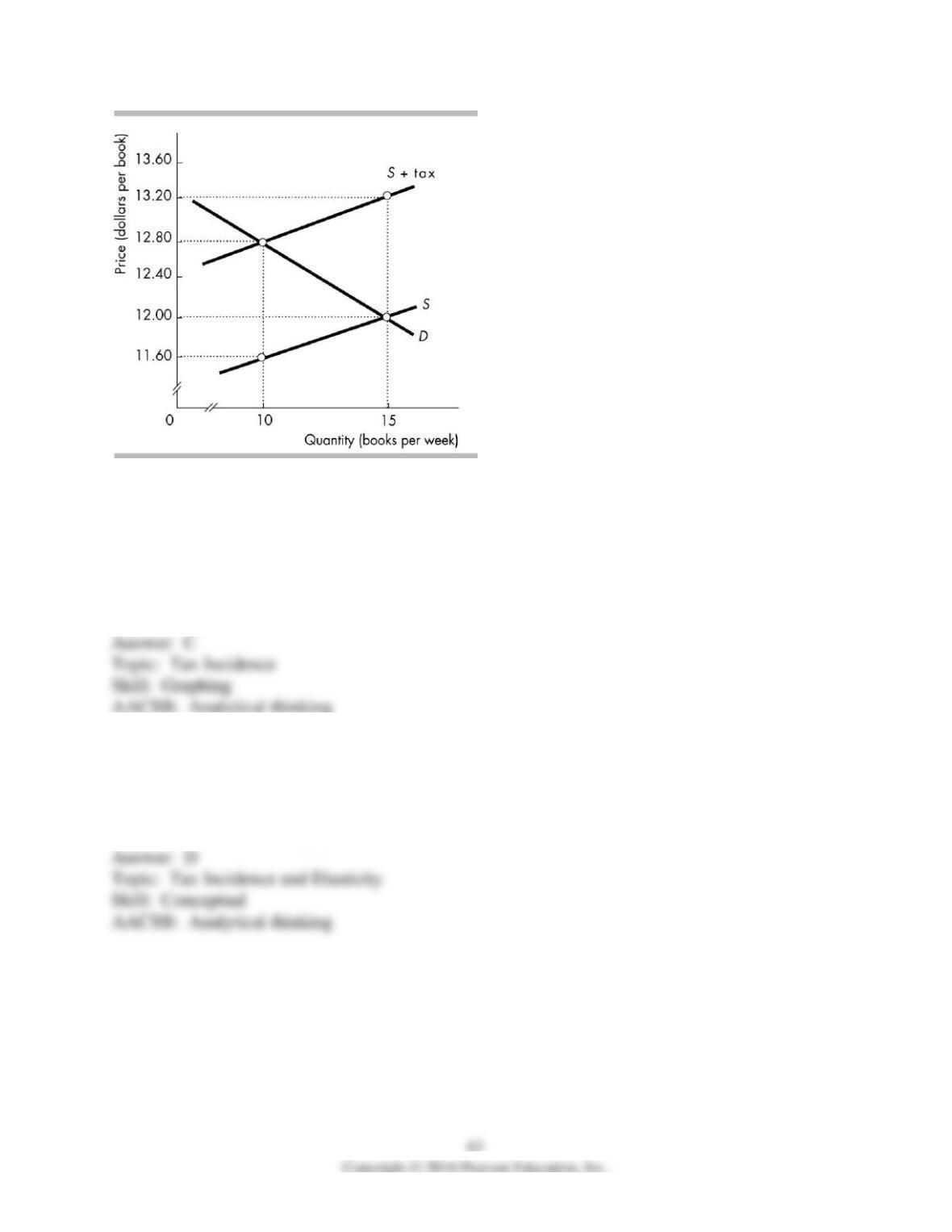
25) The figure shows the market for books before and after a sales tax is introduced. Each week,
the tax creates a deadweight loss of ________, decreases consumer surplus by ________, and
decreases producer surplus by ________.
A) $15; $10; $5
B) $12; $8; $4
C) $3; $10; $5
D) $3; $2; $1
26) The incidence of sales tax is determined by the
A) level of government (for example, local, state, or federal) which imposes the tax.
B) federal government in all cases.
C) greed of the sellers.
D) price elasticities of supply and demand.
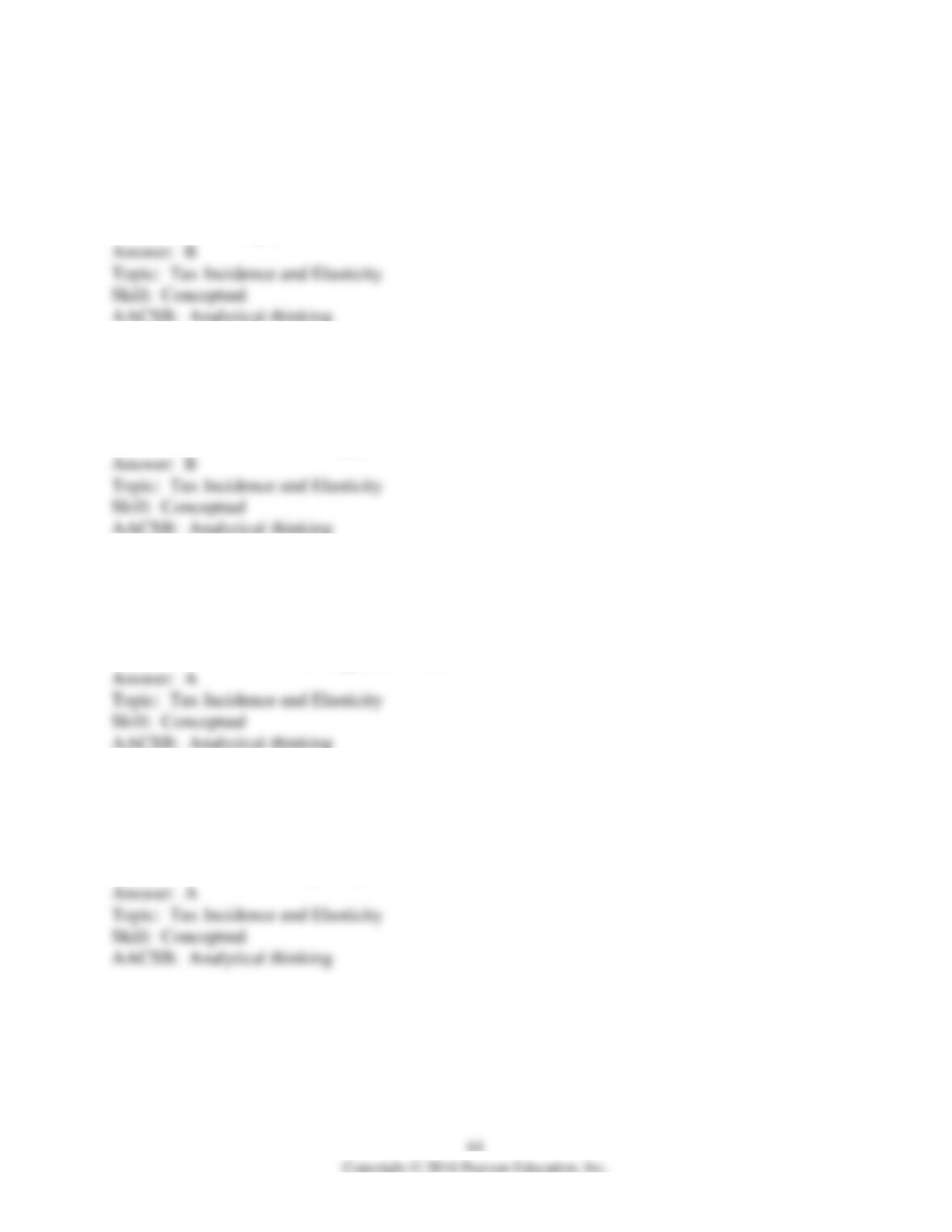
27) The supply of oil is more elastic than the demand for oil. If oil is taxed $10 per barrel, how
will the tax be divided between the buyers and sellers?
A) The sellers will pay more of the tax than the buyers.
B) The buyers will pay more of the tax than the sellers.
C) The sellers and buyers will split the tax evenly.
D) The sellers will pay the entire tax.
28) The amount of a tax paid by the buyers will be larger the
A) more elastic the demand and the more inelastic the supply.
B) more inelastic the demand and the more elastic the supply.
C) more inelastic are both the supply and demand.
D) more elastic are both the supply and demand.
29) The amount of a tax paid by the buyers will be smaller the
A) more elastic the demand and the more inelastic the supply.
B) more inelastic the demand and the more elastic the supply.
C) more inelastic are both the supply and demand.
D) more elastic are both the supply and demand.
30) Suppose a $1 tax is placed on a good. The more elastic the supply of the good, the
A) larger the increase in the after-tax price.
B) smaller the decrease in the quantity sold.
C) less of the tax will be paid by the buyers.
D) more of the tax will be paid by the sellers.
31) The amount of a tax paid by the sellers will be larger the more ________ the demand and the
more ________ the supply.
A) elastic; inelastic
B) inelastic; elastic
C) inelastic; inelastic
D) elastic; elastic
32) The amount of a tax paid by the sellers will be smaller the more ________ the demand and
the more ________ the supply.
A) elastic; inelastic
B) inelastic; elastic
C) inelastic; inelastic
D) elastic; elastic
33) The buyers pay the entire sales tax levied on a good when demand is perfectly ________ or
supply is perfectly ________.
A) elastic; inelastic
B) elastic; elastic
C) inelastic; inelastic
D) inelastic; elastic
34) The sellers pay the entire sales tax levied on a good when demand is perfectly ________ or
supply is perfectly ________.
A) elastic; inelastic
B) elastic; elastic
C) inelastic; inelastic
D) inelastic; elastic
35) Suppose the local government places a sales tax on hotel rooms and that the demand for
these rooms is elastic while the supply is perfectly inelastic. The tax incidence is such that the tax
will be paid by
A) only the consumers.
B) equally by the consumers and the producers.
C) only the producers.
D) the taxpayers.
36) The government imposes a sales tax on hot dogs. The tax would be paid entirely by hot dog
sellers if the
A) supply is perfectly elastic.
B) supply is perfectly inelastic.
C) demand is perfectly inelastic.
D) none of the above.
37) The government imposes a sales tax on hot dogs. The tax would be paid entirely by the hot
dog buyers if the
A) supply is perfectly elastic.
B) supply is perfectly inelastic.
C) demand is perfectly elastic.
D) None of the above answers is correct.
38) Good A has a perfectly inelastic demand and an upward-sloping supply curve. Good B has a
perfectly inelastic supply and a downward-sloping demand curve. If the same sales tax is
imposed on the sellers of both good A and good B, the price paid by
A) buyers of good A rises by more than the price paid by buyers of good B.
B) buyers of good B rises by more than the price paid by buyers of good A.
C) buyers of good A rises by the same amount as the price paid by buyers of good B.
D) More information is needed to determine whether the price paid by buyers of good A rises by
more than, less than, or the same amount as the price paid by buyers of good B.
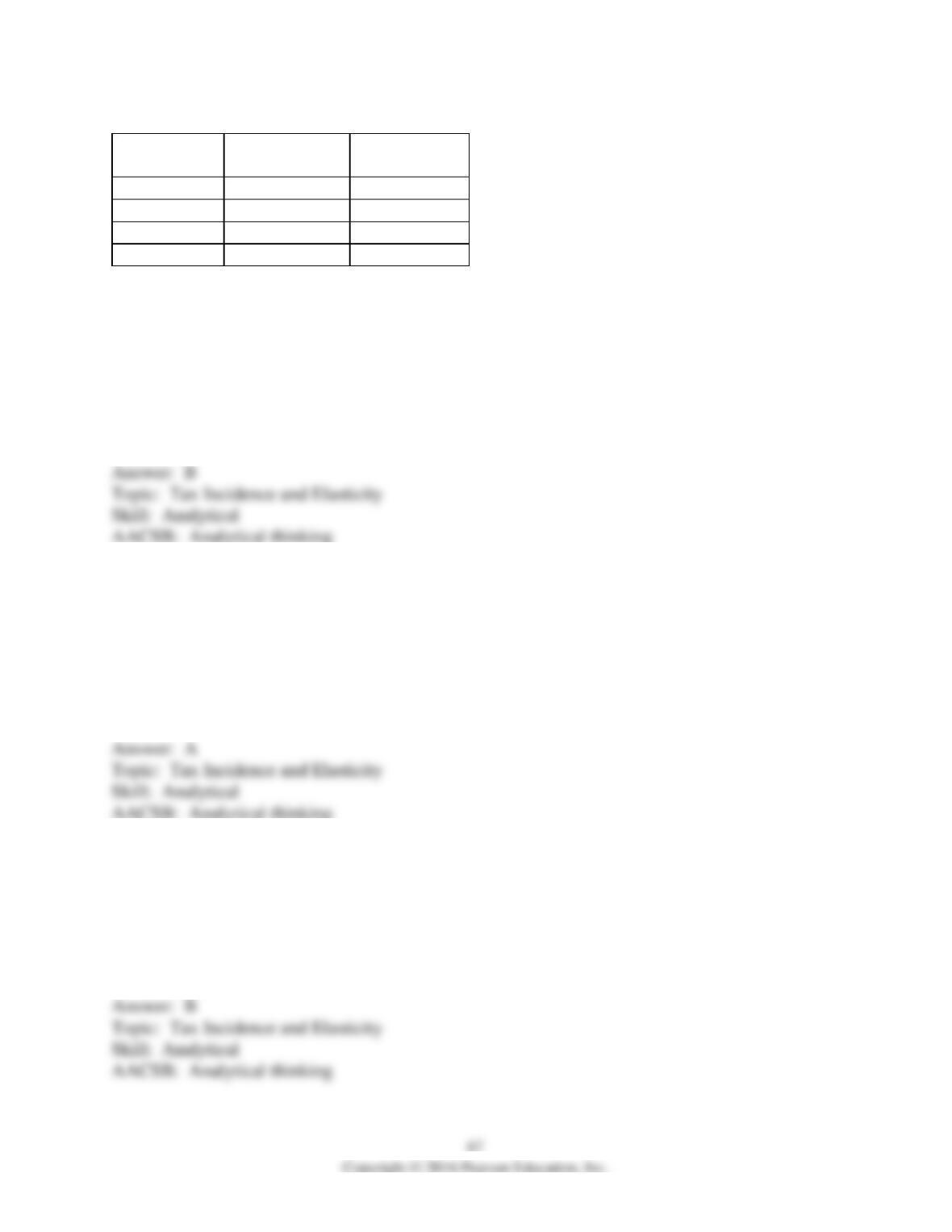
Price elasticity
of supply
Price elasticity
of demand
Hamburgers
1.2
1.8
French fries
1.7
1.4
Pizza
2.0
1.2
Ice cream
1.5
1.6
39) You are in the business of producing and selling hamburgers, french fries, pizza, and ice
cream. The mayor plans to impose a tax on one of these products. Based on the elasticities in the
above table, as a profit-minded business person who seeks to avoid taxes whenever possible,
which good would you most prefer to have taxed?
A) hamburgers
B) pizza
C) French fries
D) ice cream
40) You are in the business of producing and selling hamburgers, french fries, pizza, and ice
cream. The mayor plans to impose a tax on one of these products. Based on the elasticities in the
above table, as a profit-minded business person who seeks to avoid taxes whenever possible,
which good would you least like to have taxed?
A) hamburgers
B) pizza
C) French fries
D) ice cream
41) You are in the business of producing and selling hamburgers, french fries, pizza, and ice
cream. The mayor plans to impose a tax on one of these products. Based on the elasticities in the
above table, on which of these goods would your customers least like to be taxed?
A) hamburgers
B) pizza
C) French fries
D) ice cream
42) You are in the business of producing and selling hamburgers, french fries, pizza, and ice
cream. The mayor plans to impose a tax on one of these products. Based on the elasticities in the
above table, on which of these goods would your customers most prefer to be taxed?
A) hamburgers
B) pizza
C) French fries
D) ice cream
43) The more elastic the demand for a good, the
A) less a sales tax lowers the price paid by buyers.
B) more a sales tax lowers the price paid by buyers.
C) less a sales tax raises the price paid by buyers.
D) more a sales tax raises the price paid by buyers.
44) The elasticity of demand for chocolate chip cookies is 0.6 and the elasticity of supply for
these cookies is 1.9. If a tax is imposed on purchases of chocolate chip cookies, then the
A) consumers would pay more of the tax.
B) producers would pay more of the tax.
C) tax would be equally shared by the consumers and the producers.
D) consumers would pay the entire tax because their demand is less elastic than the producers’
supply.
45) A sales tax is divided so that the
A) buyers pay the full amount if demand is perfectly elastic.
B) buyers pay the full amount if supply is perfectly inelastic.
C) sellers pay the full amount if supply is perfectly elastic.
D) sellers pay the full amount if demand is perfectly elastic.
46) A sales tax is divided so that buyers pay the full amount if
A) demand has unitary elasticity.
B) supply has unitary elasticity.
C) demand is perfectly inelastic.
D) supply is perfectly inelastic.
47) When a tax is imposed on the suppliers of a good or service, then
A) in general, the producers pay all the tax.
B) in general, the consumers pay all the tax.
C) the consumers pay a larger part of the tax as the elasticity of demand for the product becomes
smaller.
D) the consumers pay a larger part of the tax as the elasticity of demand for the product becomes
larger.
48) The more ________, the larger is the amount of the tax on the good that the ________ pays.
A) elastic the demand for a good; buyers
B) inelastic the demand for a good; buyers
C) inelastic the supply of a good; buyers
D) elastic the supply of a good; sellers
49) Which of the following leads to the demanders paying all of a tax?
A) The supply is unit elastic.
B) The supply is perfectly inelastic.
C) The demand is perfectly elastic.
D) The demand is perfectly inelastic.
50) If salt has a ________, then ________ pay most of any tax levied on salt.
A) high elasticity of supply; sellers
B) low elasticity of demand; buyers
C) high elasticity of demand; buyers
D) low elasticity of supply; buyers
51) If demand is perfectly elastic, a sales tax is paid by
A) only the buyers.
B) only the sellers.
C) both the buyers and sellers.
D) None of the above answers is correct.
52) If a tax is imposed in a market in which demand is perfectly inelastic
A) the buyers pay the entire tax.
B) the sellers pay the entire tax.
C) the buyers and the sellers both pay a portion of the tax.
D) neither the buyer nor the seller pays the tax.
53) Consider the market for heart transplants. The demand for a heart transplant is perfectly
inelastic and the supply curve is upward sloping. If a $1,000 tax per transplant tax is imposed on
buyers (the recipients), how will the tax be divided between the buyer and seller?
A) The sellers will pay the entire tax.
B) The buyers will pay the entire tax.
C) The tax will be evenly divided between the sellers and buyers.
D) More information is needed to determine how the tax is split.
54) Consider the market for purple magic markers. The demand for purple magic markers is
perfectly elastic and the supply curve is upward sloping. If sellers of purple magic markers are
taxed $1 per marker, how will the tax be divided between the buyer and seller?
A) The sellers will pay the entire tax.
B) The buyers will pay the entire tax.
C) The tax will be evenly divided between the sellers and buyers.
D) More information is needed to determine how the tax is split.
55) If demand for good is very inelastic and supply for the good is very elastic a sales tax
imposed on sellers will cause the price received by sellers
A) would not change very much.
B) would rise by more than the amount of the tax.
C) would fall by an amount of the tax.
D) would fall by more than the amount of the tax.
56) The government of Healthyland imposes a tax on sellers of salt. The tax is $0.10 per pound.
With no tax, the price of salt is $0.40 per pound. The demand for salt is perfectly inelastic and
the elasticity of supply is 1.5. With the tax, the price of salt paid by buyers in Healthyland is
A) $0.40 per pound.
B) $0.45 per pound.
C) $0.35 per pound.
D) $0.50 per pound.
57) The government of Healthyland imposes a tax on sellers of salt. The tax is $0.10 per pound.
With no tax, the market price of salt is $0.40 per pound. The demand for salt is perfectly
inelastic, and the elasticity of supply is 1.5. With the tax, the price that sellers of salt in
Healthyland receive and keep is
A) $0.40 per pound.
B) $0.35 per pound.
C) $0.45 per pound.
D) $0.50 per pound.
58) The government of Healthyland imposes a tax on sellers of salt. The tax is $0.10 per pound.
With no tax, the price of salt is $0.40 per pound. The demand for salt is perfectly inelastic and
the elasticity of supply is 1.5. How is the salt tax burden shared between buyers and sellers in
Healthyland?
A) Sellers pay the whole tax.
B) Buyers pay the whole tax.
C) Most of the tax is paid by buyers.
D) Most of the tax is paid by sellers.
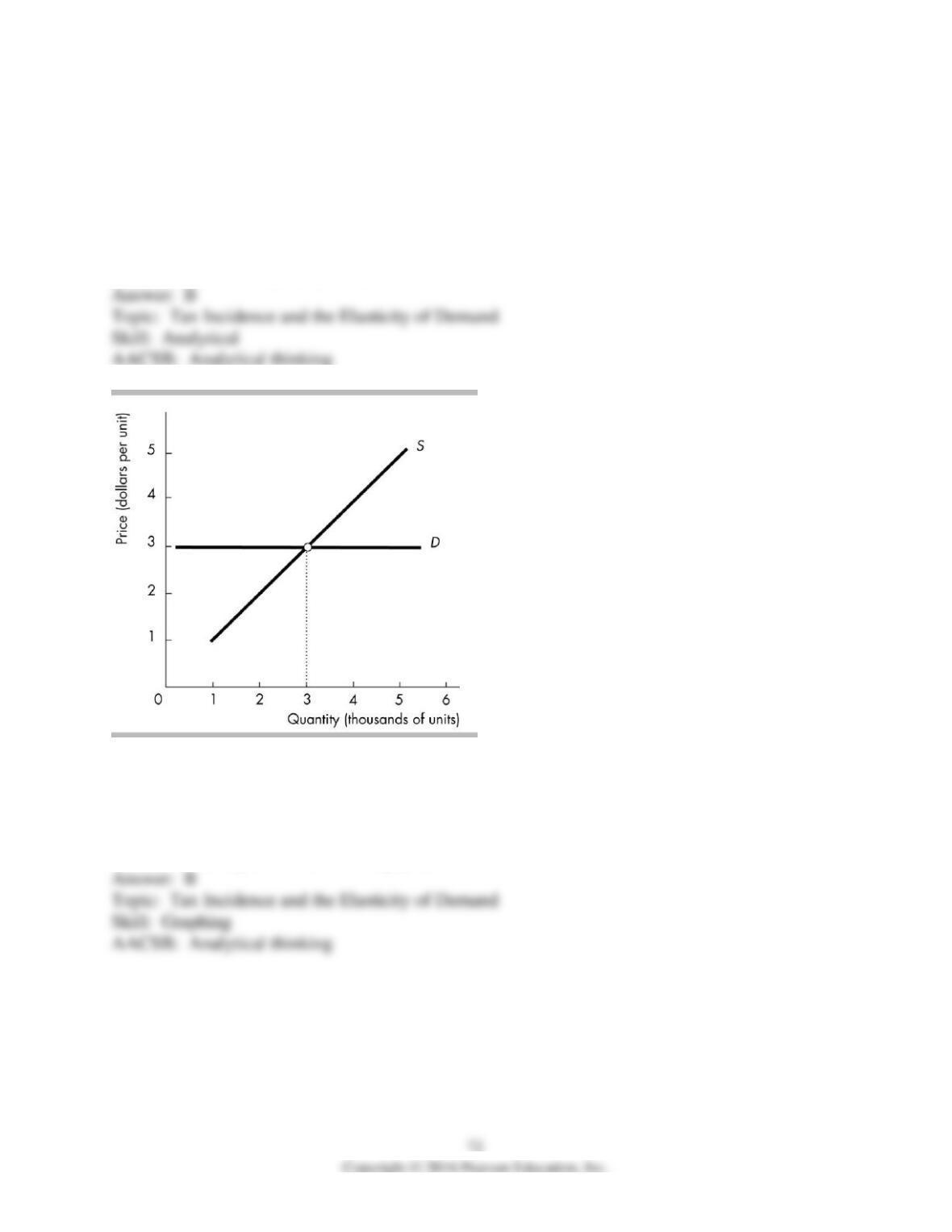
59) In the figure above, imposing a tax on the sellers of the product results in a division in which
A) all of the tax is paid by the buyers.
B) all of the tax is paid by the sellers.
C) the buyers and sellers pay the same amount.
D) neither the buyers nor the sellers pay the tax.
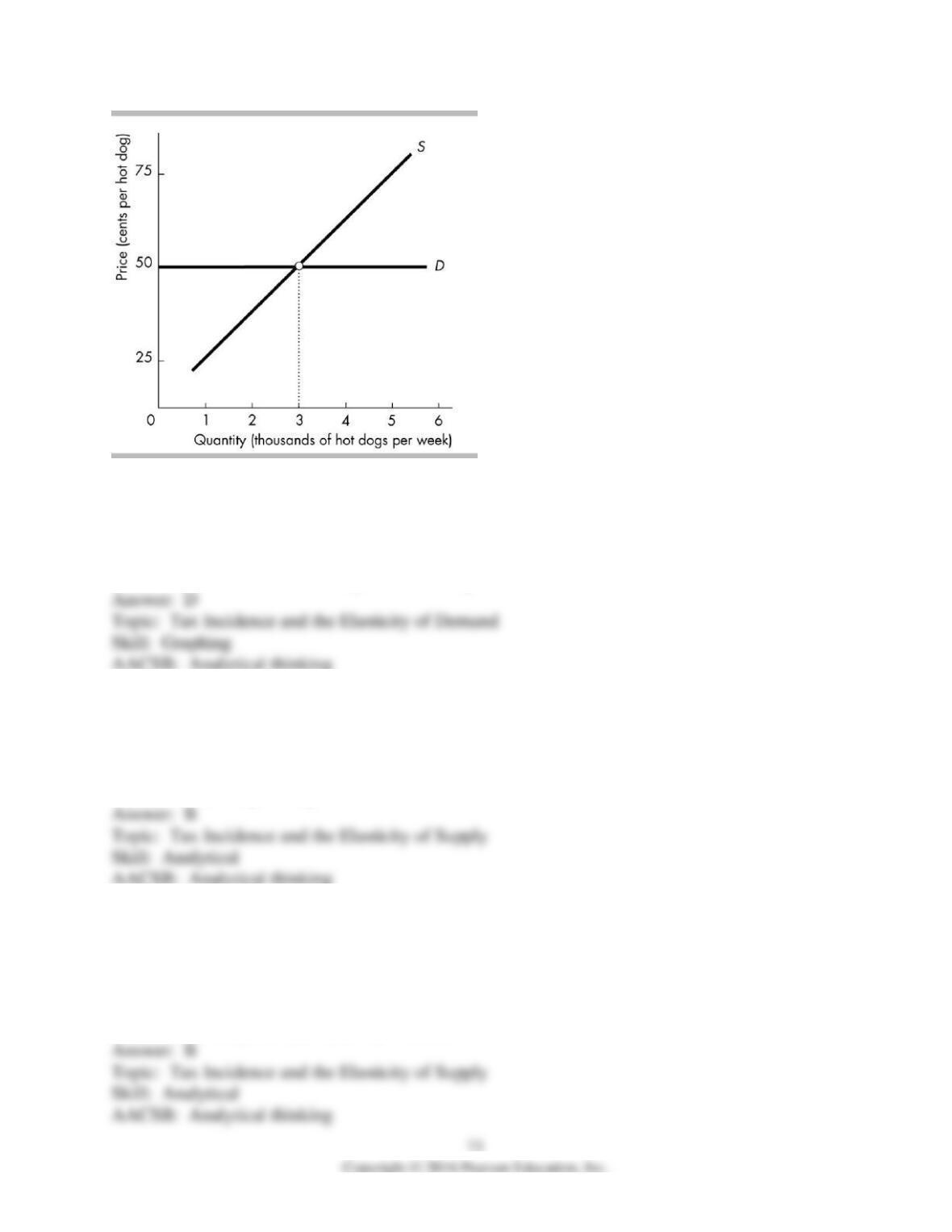
60) In the above figure, the imposition of a $0.25 sales tax on sellers will
A) raise the market price paid by buyers of hotdogs by $0.25.
B) lower the market price paid by buyers of hotdogs by $0.25.
C) raise the market price paid by buyers of hotdogs by $0.125.
D) have no effect on the market price of hot dogs.
61) Which of the following leads to the suppliers paying all of a tax?
A) The supply is perfectly elastic.
B) The supply is perfectly inelastic.
C) The demand is unit elastic.
D) The demand is perfectly inelastic.
62) A good has a downward-sloping demand curve and a perfectly elastic supply. Imposing a
sales tax of $1 per unit on the sellers of the good
A) raises the price paid by demanders by more than $1.00.
B) raises the price paid by demanders by $1.00.
C) raises the price paid by demanders by less than $1.00.
D) does not change the price paid by demanders.
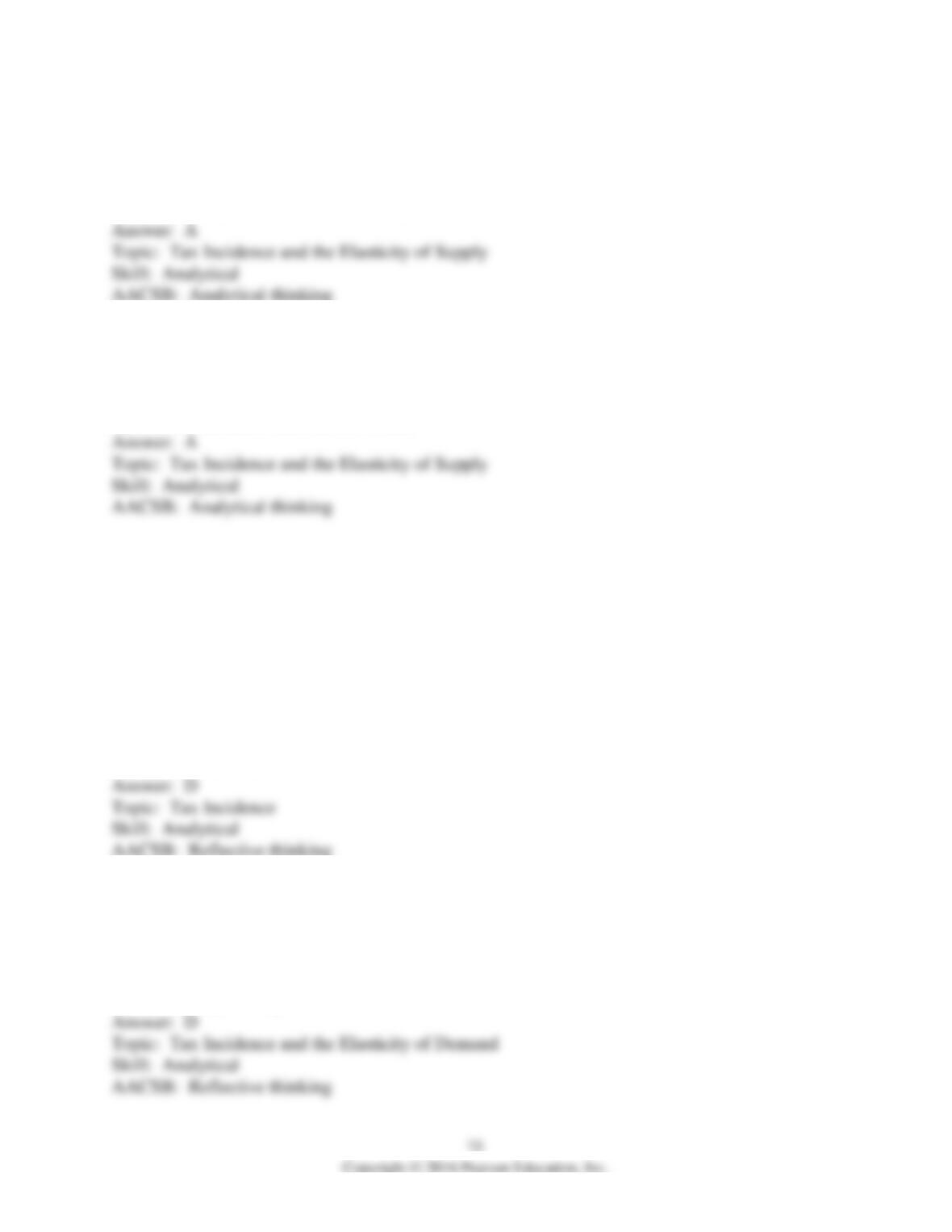
63) A good has a perfectly inelastic supply and a downward sloping demand curve. Imposing a
sales tax of $1 per unit on the sellers of the good
A) raises the price paid by demanders by more than $1.00.
B) raises the price paid by demanders by $1.00.
C) raises the price paid by demanders by less than $1.00.
D) does not change the price paid by demanders.
64) A sales tax will be divided so that
A) the buyers pay the full amount if supply is perfectly inelastic.
B) the sellers pay the full amount if supply is perfectly inelastic.
C) the sellers pay the full amount if supply is perfectly elastic.
D) both buyers and sellers pay some of the tax if supply is perfectly elastic.
65) On Green Island, the demand for pencils is perfectly elastic and the supply of pencils is
perfectly inelastic. If a sales tax on pencils is introduced
A) the tax is split evenly between the buyers and sellers.
B) the buyers pay the entire tax.
C) no one pays the tax.
D) the sellers pay the entire tax.
66) If a tax is imposed on buyers in a market in which supply is perfectly inelastic, the
A) buyers pay the entire tax.
B) sellers pay the entire tax.
C) buyers and the sellers both pay a portion of the tax.
D) neither the buyers nor the sellers pay the tax.
67) If supply is perfectly elastic, a sales tax imposed on sellers is paid by
A) only the buyers.
B) only the sellers.
C) both the buyers and sellers.
D) None of the above answers is correct.
68) If supply is perfectly inelastic, a sales tax imposed on sellers is paid by
A) only the buyers.
B) only the sellers.
C) both the buyers and sellers.
D) None of the above answers is correct.
Two small California cities, Richmond and El Monte, are planning to impose a penny per ounce
tax on sugary drinks. They are being opposed by the soda industry that is vehemently against this
new legislation. (Source: Reuters, September 6, 2012)
69) Assuming the market of soda has a regular downward sloping demand curve and upward
sloping supply curve, the tax will ________ the price paid by buyers and ________ the price
received by sellers.
A) decrease; increase
B) decrease; decrease
C) increase; increase
D) increase; decrease
70) One reason why soda companies are so fervently against this tax might be because they
assume sellers will pay the entire tax. Sellers will pay the entire tax if
A) demand is perfectly inelastic.
B) the price elasticity of demand is between zero and 1.
C) demand is unit elastic.
D) demand is perfectly elastic.
71) One reason why soda companies are so fervently against this tax might be because they
assume sellers will pay the entire tax. Sellers will pay the entire tax if
A) supply is perfectly inelastic.
B) the price elasticity of supply is between zero and 1.
C) supply is unit elastic.
D) supply is perfectly elastic.
72) In the figure above, imposing a tax on the product results in a division in which
A) all of the tax is paid by the buyers.
B) all of the tax is paid by the sellers.
C) the buyers and sellers pay the same amount.
D) neither the buyers nor the sellers pay the tax.
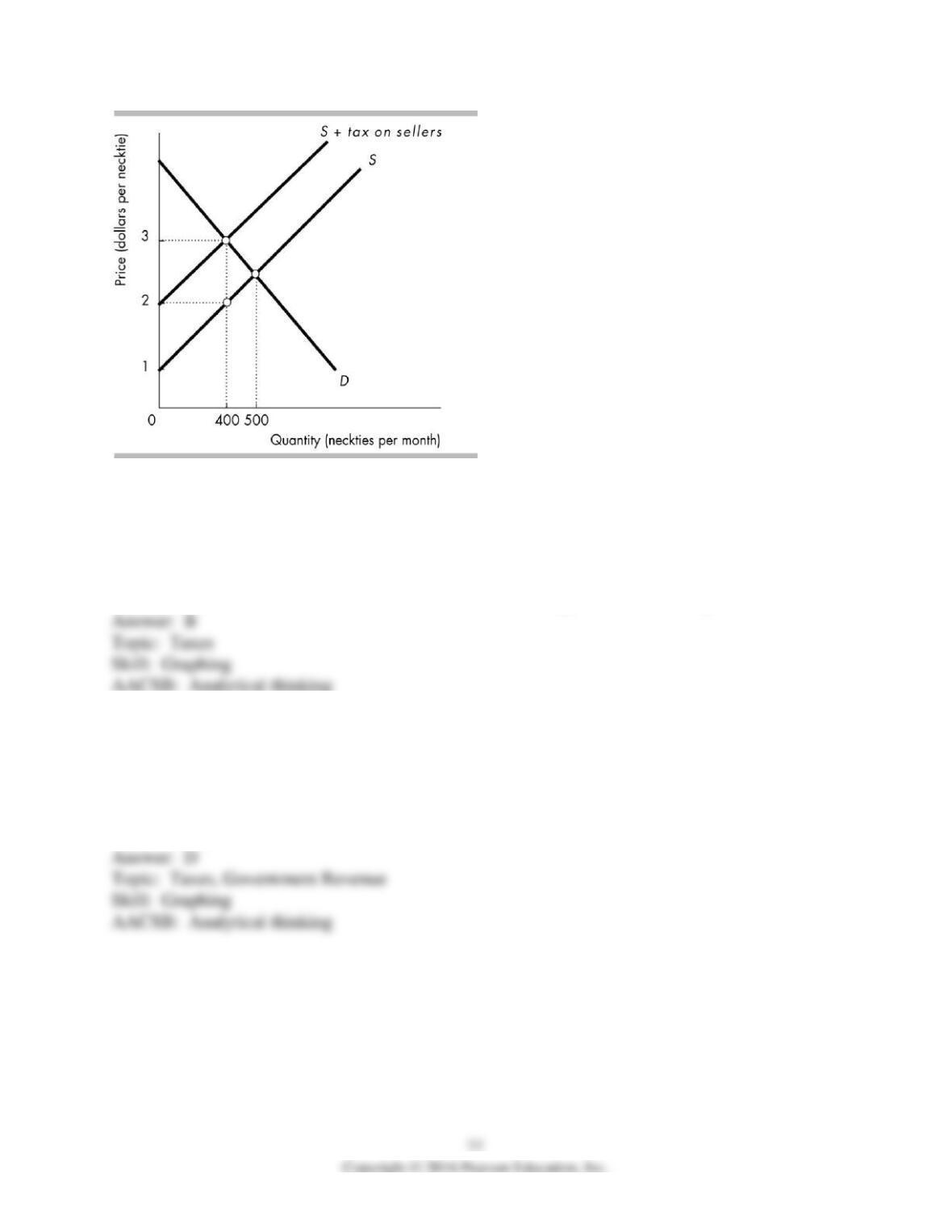
73) The above figure shows the market for neckties. Based on the graph, how much tax per
necktie has been imposed by the government?
A) $1.25 per tie
B) $1.00 per tie
C) $0.75 per tie
D) More information is needed to determine the tax that the government has imposed.
74) The above figure shows the market for neckties after the government has imposed a tax.
How much government revenue is generated by the tax?
A) $1,000.00 per month
B) $800.00 per month
C) $500.00 per month
D) $400.00 per month
75) The above figure shows the market for neckties after the government has imposed a tax.
How much deadweight loss results from this tax?
A) $250.00
B) $200.00
C) $150.00
D) $50.00
76) The above figure shows the market for blouses. The government decides to impose the sales
tax on sellers, as shown in the figure. Using the figure, what is the tax per blouse?
A) $10 per blouse
B) $20 per blouse
C) $30 per blouse
D) $40 per blouse
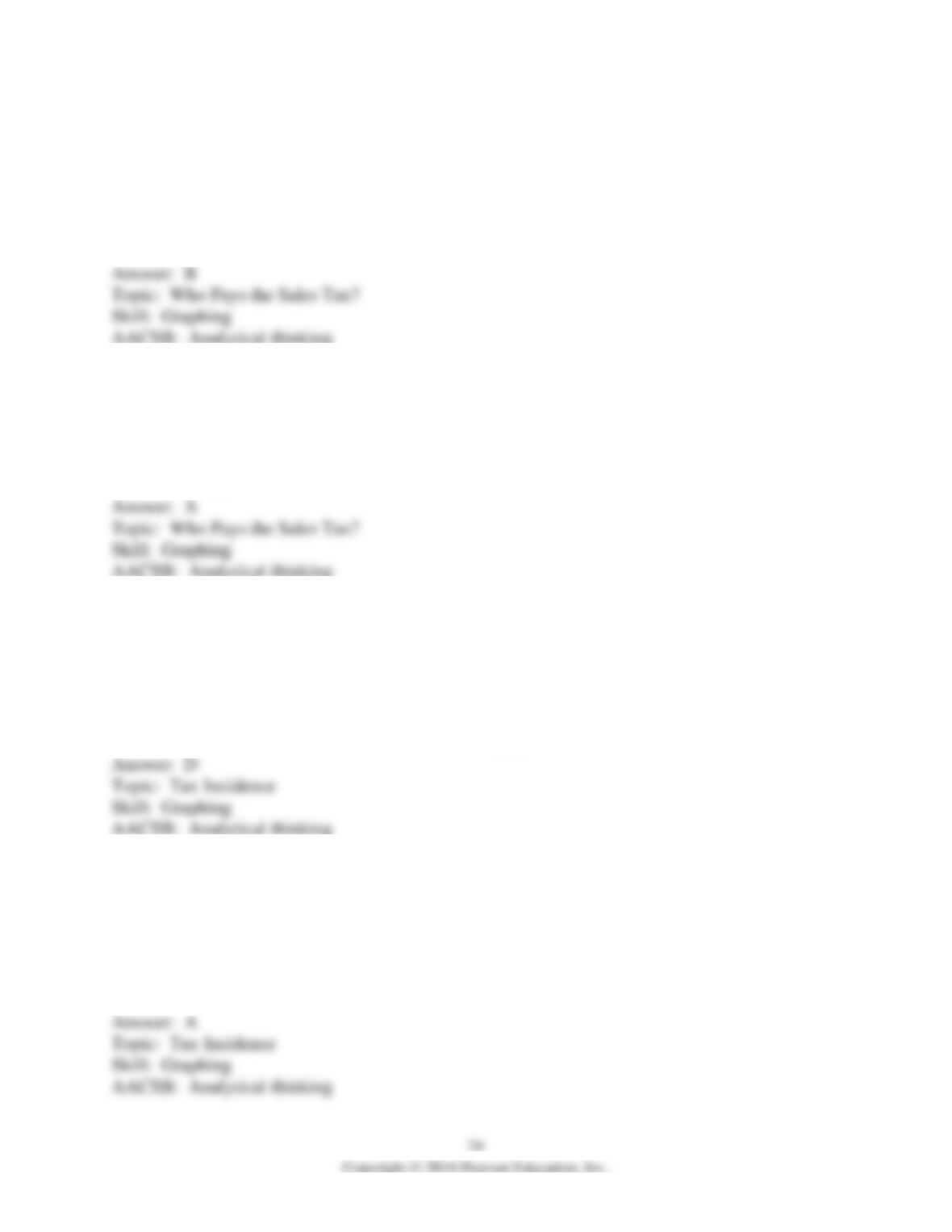
77) The above figure shows the market for blouses. The government decides to impose the sales
tax on sellers, as shown in the figure. Using the figure, how much tax revenue does the
government raise?
A) $20,000
B) $40,000
C) $60,000
D) $80,000
78) The above figure shows the market for blouses. The government decides to impose the sales
tax on sellers, as shown in the figure. The tax decreases consumption by
A) 1,000 blouses.
B) 2,000 blouses.
C) 3,000 blouses.
D) 4,000 blouses.
79) The above figure shows the market for blouses. The government decides to impose the sales
tax on sellers, as shown in the figure. The amount of the tax paid by the buyers would be greater
than shown in the figure
A) only if the demand was more elastic.
B) only if the demand was more inelastic.
C) only if the supply was more elastic.
D) if either the demand was more inelastic or the supply more elastic.
80) The above figure shows the market for blouses. The government decides to impose the sales
tax on sellers, as shown in the figure. The amount of the tax paid by the sellers would be greater
than shown in the figure if
A) the demand was more elastic.
B) the demand was more inelastic.
C) the supply was more elastic.
D) Both answers A and C are correct.
81) The above figure shows the market for blouses. The government decides to impose the sales
tax on sellers, as shown in the figure. The government would raise more tax revenue from this
excise tax if
A) the demand was more inelastic.
B) it places a price ceiling on blouses in addition to the tax.
C) it places a price floor on blouses in addition to the tax.
D) all of the above.
82) The above figure shows the market for blouses. The government decides to impose the sales
tax on sellers, as shown in the figure. What is the deadweight loss?
A) $10,000
B) $20,000
C) $30,000
D) $40,000
83) The above figure shows the market for blouses. The government decides to impose the sales
tax on sellers, as shown in the figure. How much consumer surplus is lost?
A) $10,000
B) $20,000
C) $25,000
D) $40,000
84) The above figure shows the market for blouses. The government decides to impose the sales
tax on sellers, as shown in the figure. How much producer surplus is lost?
A) $10,000
B) $20,000
C) $25,000
D) $40,000