b. potential workers seeking employment.
c. only those workers in jobs that would normally pay less than minimum wage.
d. only those workers in jobs that would normally pay more than minimum wage.
e. no workers.
137. Which of the following is a correct statement about a minimum wage law?
a. It reduces costs for employers.
b. It ensures that anyone who wants a job can get a job with a high enough wage.
c. It causes prices to rise as producers pay more for labor.
d. It is a price ceiling law that makes wages higher than the market equilibrium price.
e. It is a price floor law that forces wages to be lower than the market equilibrium price.
138. Who potentially benefits from a price floor?
a. workers d. renters
b. employers e. consumers
c. no one
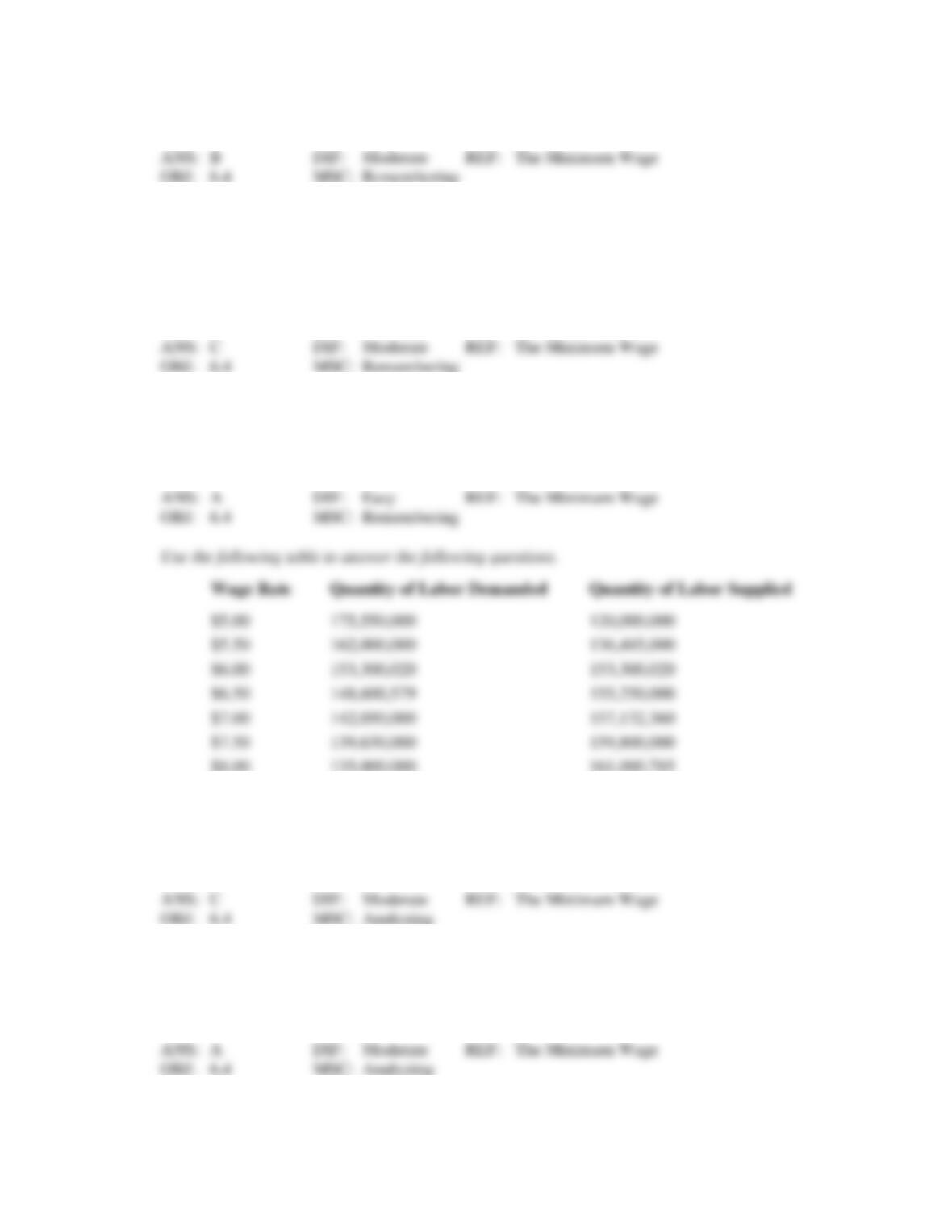
139. At what price level does the labor market reach equilibrium?
a. $5.00 d. $6.50
b. $5.50 e. $7.00
c. $6.00
140. At what price level does the labor market experience its largest shortage?
a. $5.00 d. $7.50
b. $5.50 e. $8.00
c. $6.00
141. At what price level does the labor market experience its largest surplus?
a. $5.00 d. $7.50
b. $5.50 e. $8.00
c. $6.00
142. If a minimum wage is set at $5.50, what is the amount of disequilibrium in the labor market?
a. There would be a labor shortage of 25,515,000.
b. There would be a labor surplus of 25,515,000.
c. There would be neither a shortage nor a surplus.
d. A labor surplus of 25,515,000 would be eliminated because individuals would decide to work
in the illegal black market.
e. A labor surplus of 25,515,000 would increase as individuals find work in the illegal black
market.
143. If a minimum wage is established at $7.50, what would be the amount of disequilibrium in the
labor market?
a. There would be a shortage of labor of 20,170,000.
b. There would be a surplus of labor of 20,170,000.
c. There would be neither a shortage nor a surplus.
d. A labor shortage of 20,170,000 would be eliminated because individuals would decide to work
in the illegal black market.
e. A labor shortage of 20,170,000 would increase as individuals find work in the illegal black
market.
144. How would an economist explain a teenager’s continued unemployment where there exists a
minimum wage?
a. The minimum wage law made it such that the quantity of labor willing to work at that wage
was less than the quantity of labor demanded at that wage.
b. The minimum wage law made it illegal to hire teenagers because they likely would have been
unable to work a minimum number of hours.
c. The minimum wage law made it such that the quantity of labor willing to work at that wage
was greater than the quantity of labor demanded at that wage.
d. The minimum wage law made it such that the market had reached equilibrium.
e. The minimum wage law was nonbinding.
145. What wage system will dominate?
a. The federal government’s minimum wage dominates all states’ minimum wage laws.
b. A state’s minimum wage law will dominate the federal government’s wage law if the state’s
minimum wage is higher.
c. A state’s minimum wage law will dominate the federal government’s wage law since the
Constitution specifies that any provisions not specified in the Constitution are delegated to the
states.
d. The federal government will challenge a state’s minimum wage if the state’s minimum wage is
higher and the federal government wishes to force the state to comply.
e. Poor states can make their own minimum wages lower than the federal government wishes.
146. Why is raising the minimum wage generally ineffective?
a. Most employers purchase labor on the black market, where the binding price floor is not
present.
b. The minimum wage is an amount suggested by the government, and employers are under no
obligation to pay their employees the suggested basic wage.
c. The minimum wage is usually set below the prevailing equilibrium wage and is frequently
nonbinding.
d. Employees are often unconcerned with their wages and care more about the benefits that come
with the job.
e. Most employees who hold low-wage jobs work in the black market, where the binding price
floor doesn’t exist.
147. Which of the following is true, holding all other things constant, when comparing regions that
impose a higher minimum wage to regions that impose a lower minimum wage?
a. In regions with the highest minimum wage, most of the jobs require low skills, and workers
are not productive enough to get paid the higher wage.
b. In regions with the lowest minimum wage, most of the jobs require technical skills and no one
works minimum-wage jobs.
c. In regions with the lowest minimum wage, the price control is nonbinding; in the regions with
the highest minimum wage, the price control is binding.
d. In regions with the lowest minimum wage, the price control is binding; in the regions with the
highest minimum wage, the price control is nonbinding.
e. In regions with the highest minimum wage, the minimum wage law is legally enforced; in
regions with the lowest minimum wage, the law is not strongly enforced.
148. As a politician, you would be more inclined to propose an increase in the minimum wage when
you believe that the new minimum wage would
a. remain below the equilibrium wage and be binding.
b. remain above the equilibrium wage and be binding.
c. remain below the equilibrium wage and be nonbinding.
d. remain above the equilibrium wage and be nonbinding.
e. be equal to the equilibrium wage.
149. In the South African labor market
a. workers celebrated minimum wages above market equilibrium wages.
b. above-market equilibrium wages have been shown to work and keep most workers employed.
c. workers begged the government to allow below-minimum wage factories to stay open,
reasoning that any job is better than no job.
d. despite unemployment, minimum wage laws have made incomes more equal.
e. the minimum wage works because it is nonbinding.
150. In the U.S. sugar market
a. subsidies costs taxpayers $10 billion per year.
b. California grows the most sugarcane in the country.
c. sugar subsidies cause sugar to be cheaper than high-fructose corn syrup.
d. sugar price ceilings cause regular shortages of sugar.
e. U.S. sugarcane is more expensive than in Canada.
SHORT ANSWER
1. When market participants are allowed through their interactions to find the price, there will be
equilibrium where the quantity supplied by buyers equals the quantity supplied by sellers. If this is
the case, why does the government intervene in certain markets by imposing a price floor? Why
does the government intervene in certain markets by imposing a price ceiling? Which market
participant (the buyer or the seller) will lobby the government to secure passage of a binding price
floor? Which one will lobby for a binding price ceiling?
2. Some states and localities have laws that make it illegal to resell event tickets at prices higher than
the original, legal market price. What would be the positive and negative consequences to such a
law?
3. Let’s say that Esther is a politician who promises cheaper gasoline for everyone in the country if
she is elected. Once she is elected, she makes gas cheaper by imposing a price ceiling that is one
full dollar less than the market’s equilibrium price. What would be the reaction of the sellers of
gasoline and of the public to Esther’s price ceiling law? Would she expect to be reelected in the
long run?
4. Explain why a shortage occurs in a market where a binding price ceiling exists. Does a price
ceiling improve the operation of the market?
5. Why is it that price gouging laws (laws intended to place a temporary limit on the price that can be
charged in a time of emergency) do not help those who are affected by the emergency that
triggered the law?
6. What is a black market? Under what conditions does such a market emerge? How do the prices
charged on the black market compare to the conditions that exist in the legal market?
7. If a price ceiling or price floor existed where one lives, would he or she be willing to purchase
products on the black market? What would he or she identify as a consequence to engaging in
transactions on the black market over the short run and the long run?
8. Discuss why any society would want a binding price floor law on a commodity such as corn. Who
would benefit? Who would suffer? If it is the case that more suffering is caused by the presence of
a price floor law, why does it remain in effect?
9. Why are the long-run consequences of a price control different from the short-run consequences of
a price control? Be specific, and consider both price floors and price ceilings in your answer.
10. In a 1973 paper entitled “A Living Wage,” published in Annals of the American Academy of
Political and Social Science (vol. 409: 33–41), Daniel R. Fusfeld from the Department of
Economics at the University of Michigan makes the following statement:
The only effective way to eliminate poverty in the United States is to pay all workers a living wage. As long
as working people labor in jobs in which earnings are inadequate to meet even the poverty standards of
income, their families will remain poor; furthermore, their poverty will be reproduced from one generation to
the next. Our society will continue to suffer from all of the ills associated with poverty: disease, degradation,
crime, hostility and anger. (p. 35)
This essay is a normative assessment of the living (or minimum) wage. In your short-answer essay,
include the following elements:
a. What is the purpose of a living wage?
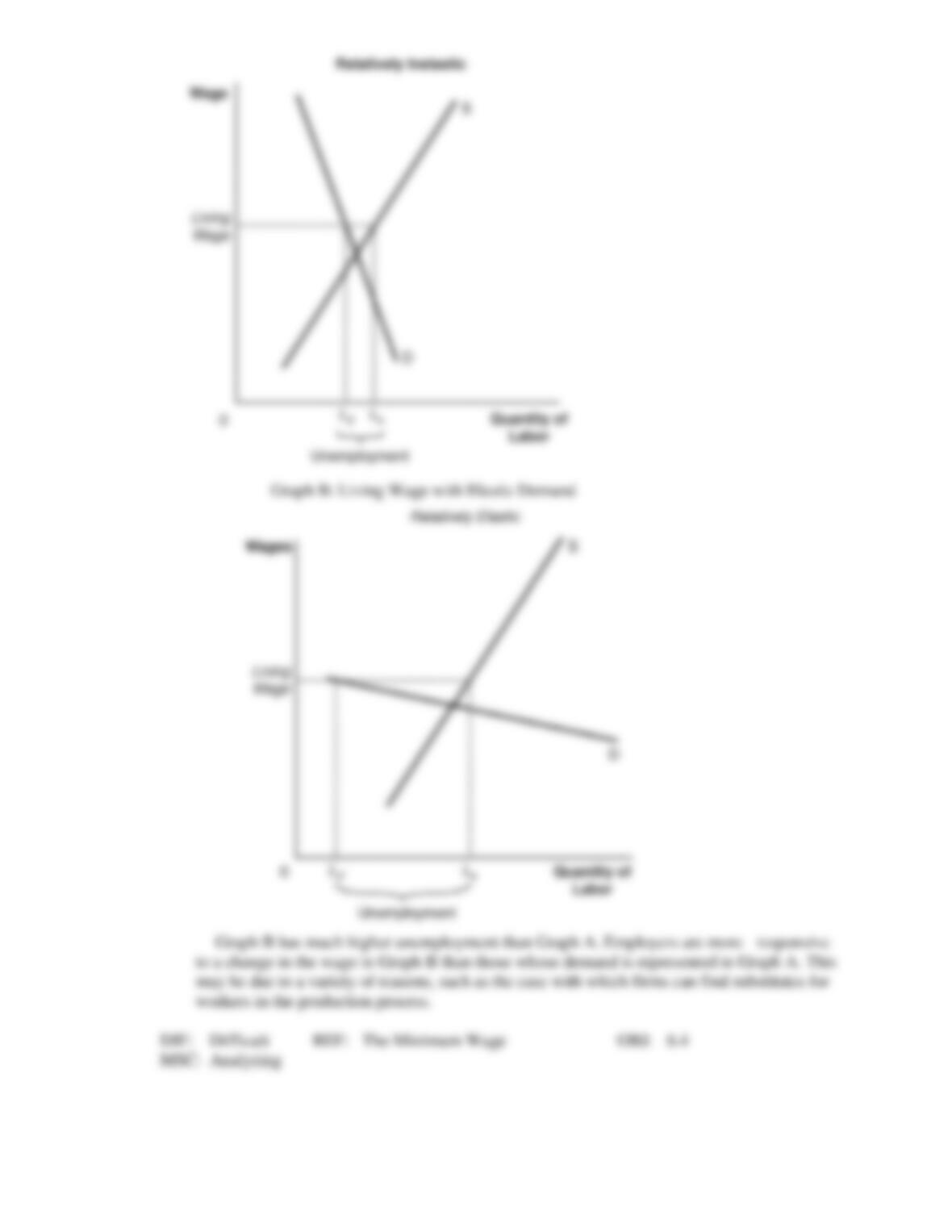
b. Compare and contrast the effects of a living-wage policy set in a labor market where the
demand for workers is relatively price inelastic and one where it is relatively price elastic. Graph
and explain your results.
11. As a voter, why would or wouldn’t someone vote for a referendum calling for an increase in the
minimum wage? What consequences would result from raising the minimum wage?
12. Distinguish between a shortage and scarcity.
13. Consider a competitive market for apples. Demand is given by the relation: Qd = 100 − 6P,
whereas supply is given by the relation Qs = 50 + 4P. Evaluate the free market by finding the
equilibrium price and quantity. Evaluate the market if government intervention imposes a price of
$4, and then evaluate the market if government intervention imposes a price of $6.
14. Explain the term “clearing the market.”
15. How would a free market be characterized?
16. What methods of product allocation might be used when the market for a good is under a price
ceiling?
17. Are price controls based on positive or normative economic thinking? Explain.
18. What reasons are given by government to enact price controls?
19. Why would most economists (and all free-market economists) not favor price controls?
20. If the minimum wage is supposed to be a help to workers, then why don’t lawmakers raise the
minimum wage even more?
21. An election is coming up. The government has decided to curry votes from the cotton-growing
states, so it has determined that the price of cotton is too low.
a. Suppose the government imposes a binding price floor on the cotton market. Draw a market
model, showing the surplus of the market.
b. If the demand for cotton is elastic, why has the revenue in the market for cotton decreased?
c. Suppose the government (via the taxpayers) agrees to buy all the surplus at the price floor. For
each market participant, consumers, producers, taxpayers, and government, explain who gains
and loses, and why.
22. If a good is subject to a binding price ceiling and one purchases it on the black market, what can
one expect to happen to the availability of the good over time?
23. Compare the actions of buyers and sellers in price-controlled (price ceilings and floors) markets in
the long run.