c. They cause producers to overproduce products during a time of disaster.
d. They act as a binding price floor in a time of disaster.
e. They cause a surplus in the product during a time of disaster.
89. If the local government tells gas stations that they are not allowed to change the price of gas for
three weeks during hurricane season, what will be the consequence?
a. Gas stations will be unable to sell all the gas they want at the temporary price ceiling price.
b. Consumers will be unable to buy all the gas they want at the temporary price ceiling price.
c. The supply curve for gas will increase and shift to the right.
d. The demand curve for gas will increase and shift to the right.
e. Equilibrium in the gas market will be achieved.
90. The town of Fairness has a law stating that wages should be high enough to ensure that all people
can afford to buy enough food for their families. The law that sets wages would be an example of a
a. minimum wage law. d. black market price.
b. fair wage law. e. ration price.
c. price ceiling.
91. A consequence of either a price ceiling or a price floor is
a. a market surplus.
b. an unwanted market allocation.
c. a market shortage.
d. better organization of resource allocation, resulting in more efficiency.
e. Price floors and price ceilings cannot have an identical outcome.
92. ________ is a real-life example of a price floor.
a. A minimum wage law d. A black market price
b. Rent control e. A price
c. A price gouging law
93. An economic advisory committee is split on a decision on how to react to an export ban by Mexico
of avocados. Isaac wants to put a price ceiling on avocados to ensure an adequate demand; Flora
wants to put a price floor on avocados to ensure an adequate supply. April claims that doing
nothing is the best response. Who understands economics the best?
a. Isaac
b. Flora
c. April
d. none of them, since none of these policies will organize this disrupted market
e. Any of the responses will work under the proper circumstances.
94. The minimum wage law is an example of a
a. price floor.
b. price ceiling.
c. law that requires quantity demanded to equal quantity supplied.
d. law that allows individual employers and employees to make free decisions.
e. law that sets the minimum number of hours that an employee must work for wages during the
week.
95. Of the following cause-and-effect relationships, which is the most likely that induced a price floor
on the market for soybeans?
a. Government-funded economists have determined that a price floor is good for society, and
Congress enacted legislation for it.
b. Major consumers and producers in the soybean market have formed an association that has
determined that a price floor would increase profits and lobbied Congress for legislation to enact it.
c. Producers of soybeans know a price floor will protect their profits and they lobbied Congress
for legislation to enact it.
d. Consumers of soybeans know a price floor will protect their profits and they lobbied Congress
for legislation to enact it.
e. Agricultural workers know a price floor will protect their jobs and they lobbied Congress for
legislation to enact it.
96. What will happen in a market where a binding price floor is removed?
a. The products sold will become scarcer.
b. There will be upward pressure on the prices.
c. There will be downward pressure on the prices.
d. The price or quantity of the product sold in the legal market will not change.
e. There will be increased pressure to buy and sell the good on the black market.
97. Why is it often difficult to remove a binding price floor after it exists?
a. in general, because consumers benefit from the lower prices and would lobby their elected
officials to keep the price control
b. in general, because consumers benefit from higher quality products and would lobby their
elected officials to keep the price control
c. in general, because consumers benefit from larger products and would lobby their elected
officials to keep the price control
d. in general, because sellers benefit from higher prices and would lobby their elected officials to
keep the price control
e. in general, because it has little effect on the market price and people forget about it
98. Why are binding price floor laws passed?
a. They make goods less expensive.
b. They make goods available to the largest number of customers.
c. They encourage producers to produce goods in the most cost-efficient fashion.
d. They help producers receive higher prices for products sold in the legal market.
e. They discourage the formation of illegal black markets.
99. Which of the following is an accurate statement about the consequence of a binding price floor?
a. Binding price floors do not allow sellers to receive a higher price if they sell the product in the
legal market.
b. Binding price floors encourage the formation of a black market.
c. Binding price floors discourage the formation of a black market.
d. Binding price floors create a shortage of the product.
e. Binding price floors cause consumers to want to purchase more of the product in the legal
market.
100. Do all sellers benefit from a binding price floor?
a. No. A binding price floor benefits only some sellers because not all are able to sell as much as
they would like in the legal market.
b. Yes. A binding price floor benefits all sellers because it allows all sellers to sell as much as
they produce on the legal market.
c. No. A binding price floor doesn’t benefit any sellers because sellers will be unwilling to sell
any of their products.
d. No. A binding price floor benefits only some sellers because the price is initially higher but
then eventually decreases to the equilibrium price.
e. No. A binding price floor doesn’t benefit any buyers because buyers are unwilling to purchase
any of the products at a price lower than the equilibrium.
101. If Lucy were a politician, why would she find it difficult to remove a binding price floor?
a. because it greatly benefits firms, and they would spend a lot of money to lobby against the
law’s repeal
b. because it greatly benefits all consumers, who are also voters
c. because it greatly benefits society as a whole, with all consumers able to buy as much as firms
produce
d. because it is not difficult to remove; the legal market price or quantity are not affected
e. because it greatly benefits the government, which receives additional tax revenue as a result
102. As a seller of a product subject to a binding price floor, Makayla would be better off in which of
the following situations?
a. Makayla would be better off under a binding price floor because she would be able to sell all
that she produces at a higher price.
b. Makayla would be better off under a binding price floor because she would be able to sell
goods that are smaller and cost less to produce.
c. Makayla would be better off under a binding price floor because she would be able to sell
goods of lower quality, which cost less to produce.
d. Makayla would be better off under a binding price floor because she could sell any of the
resulting surplus to the government.
e. There is no scenario where a seller is better off when selling a good that is subject to a binding
price floor.
103. Suppose Anthony lives in a community with no price controls. What would he expect to happen if
his town borders a community where there is a binding price floor on most products?
a. Prices in the legal market in the community with a binding price floor would fall.
b. There would be smaller surpluses in the community with a binding price floor.
c. More consumers would purchase the product in the community without a price floor.
d. The black market in the community with a binding price floor would be larger.
e. Sales of the product in the community with a binding price floor would increase.
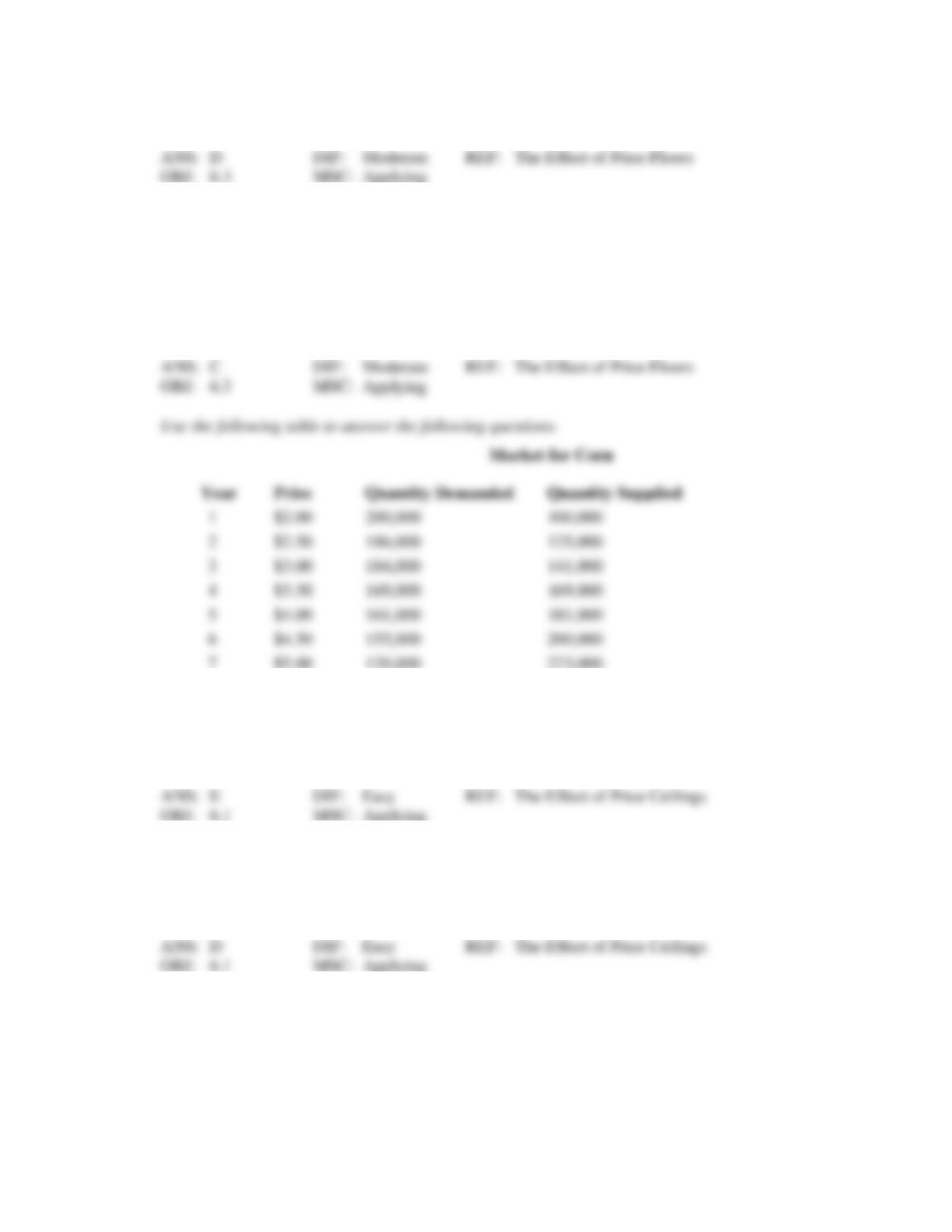
104. What would be the equilibrium quantity in the market for corn?
a. 223,000 d. 200,000
b. 3.5 e. 169,000
c. 103,000
105. What would be the equilibrium price in the market for corn?
a. $2.00 d. $3.50
b. $5.00 e. $4.50
c. $4.00
106. If the price ceiling for corn is $2.50, what amount and type of disequilibrium would be present in
the market for corn?
a. There would be neither a shortage nor a surplus.
b. There would be a surplus of 61,000.
c. There would be a shortage of 61,000.
d. There would be a shortage of 186,000.
e. There would be a shortage of 125,000.
107. If the price floor for corn is set at $5.00, what amount and type of disequilibrium will be present in
the market for corn?
a. There will be no shortage or surplus.
b. There will be a shortage of 103,000.
c. There will be a surplus of 103,000.
d. There will be a surplus of 223,000.
e. There will be a surplus of 120,000.
108. What will be the amount of government expenditure required if a price floor for corn is set at $4.50
and the government agrees to purchase the amount of disequilibrium?
a. $202,500 d. $10,000
b. $45,000 e. $900,000
c. no government payment required
109. If a price floor is imposed at $15 per unit when the equilibrium market price is $12, there will be
a. no surplus or shortage. d. a downward pressure on prices.
b. a surplus. e. an upward pressure on prices.
c. a shortage.
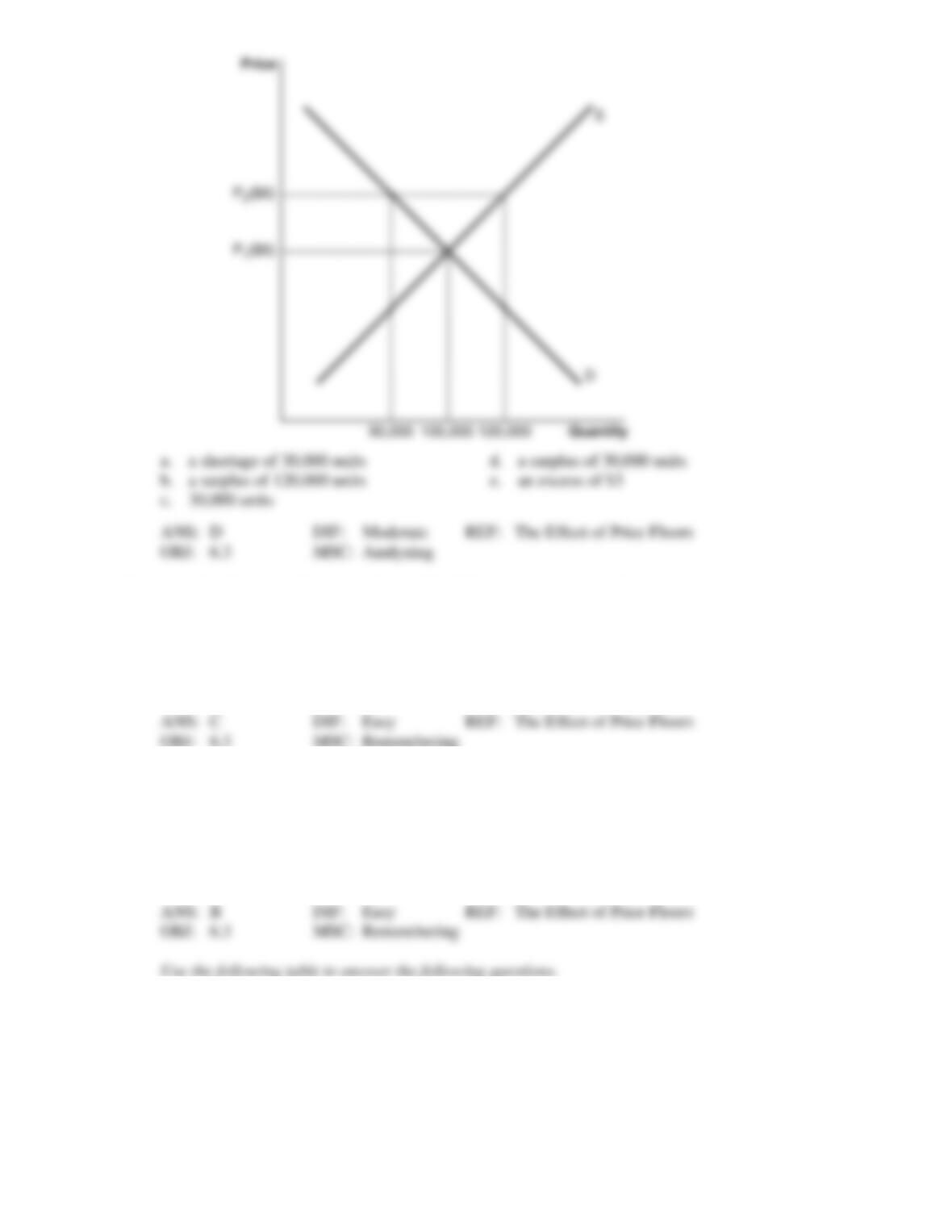
110. The government has imposed a price control for many agricultural products in an effort to support
farmers. In the case of price floor P2 in the accompanying figure, how much of a disequilibrium in
quantity exists?
111. A nonbinding price floor has which of the following consequences?
a. There will be downward pressure on prices until quantity demanded equals quantity supplied.
b. There will be upward pressure on prices until quantity demanded equals quantity supplied.
c. There are no consequences to a nonbinding price floor.
d. The quantity demanded will always exceed the quantity supplied.
e. The quantity demanded will always be smaller than the quantity supplied.
112. What will happen in a market where a nonbinding price floor is removed?
a. The products sold will become more plentiful.
b. The price or quantity of the product sold on the legal market will not change.
c. There will be upward pressure on the prices.
d. There will be downward pressure on the prices.
e. There will be increased pressure to buy and sell the good on the black market.
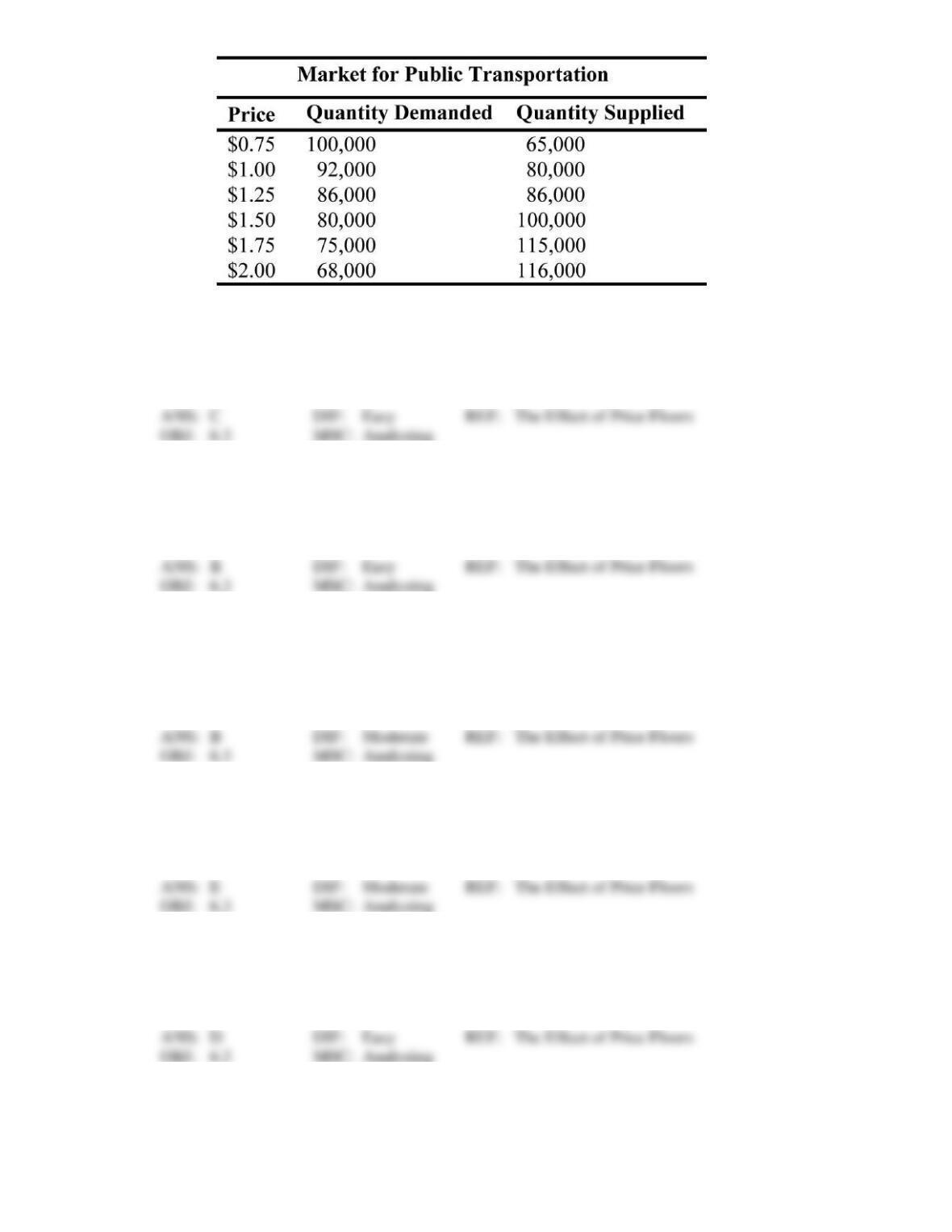
113. What is the equilibrium price in the market for public transportation?
a. $0.75 d. $1.50
b. $1.00 e. $1.75
c. $1.25
114. What is the equilibrium quantity in the market for public transportation?
a. 100,000 d. 116,000
b. 86,000 e. 0 (zero)
c. 75,000
115. What is the quantity demanded when the price floor is $0.75 in the market for public
transportation?
a. 100,000 d. 116,000
b. 86,000 e. 0 (zero)
c. 75,000
116. What is the surplus when the price floor is $0.75 in the market for public transportation?
a. 100,000 d. 116,000
b. 86,000 e. 0 (zero)
c. 75,000
117. What is the surplus when the price floor is $1.75 in the market for public transportation?
a. 100,000 d. 40,000
b. 86,000 e. 0 (zero)
c. 75,000
118. Suppose Dawn lives in a community with no price controls. What would she expect to happen if
her town borders a community where there is a nonbinding price floor on most products?
a. The products sold will become more plentiful.
b. The products sold will become less plentiful.
c. There will be upward pressure on the prices.
d. There will be downward pressure on the prices.
e. The price and the quantity sold in the community without a nonbinding price floor will be the
same as the price and quantity in the community with a nonbinding price floor.
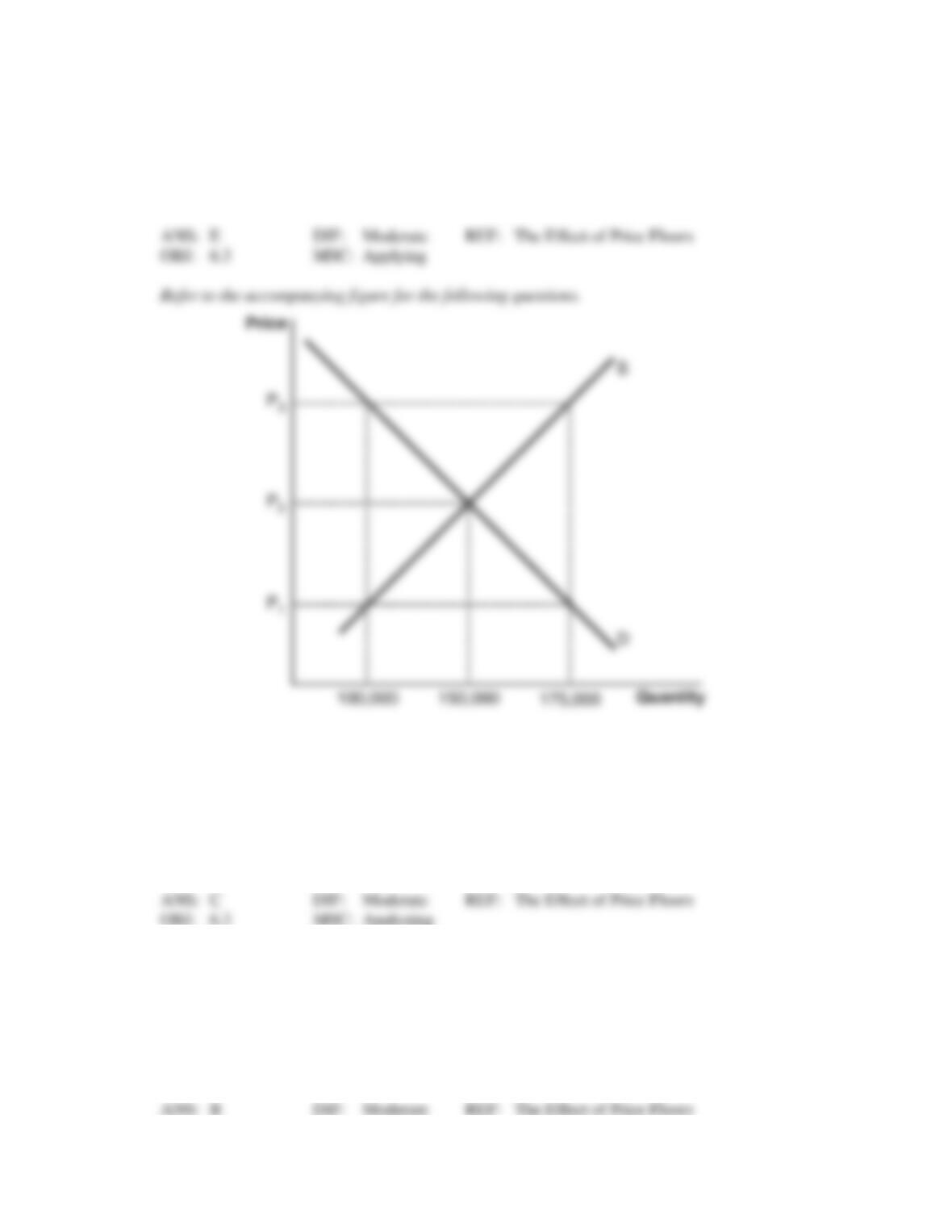
119. The accompanying figure describes the market for gasoline in a local community. If the
government were to place a price floor at P1, predict the resulting surplus or shortage.
a. There would be a shortage of 75,000 units.
b. There would be a surplus of 75,000 units.
c. There would be neither a shortage nor a surplus.
d. There would be a shortage of 150,000 units.
e. There would be a surplus of 150,000 units.
120. The accompanying figure describes the market for gasoline in a local community. If the
government were to place a price floor at P3, what would be the resulting surplus or shortage?
a. There would be a shortage of 75,000 units.
b. There would be a surplus of 75,000 units.
c. There would be neither a shortage nor a surplus.
d. There would be a shortage of 150,000 units.
e. There would be a surplus of 150,000 units.
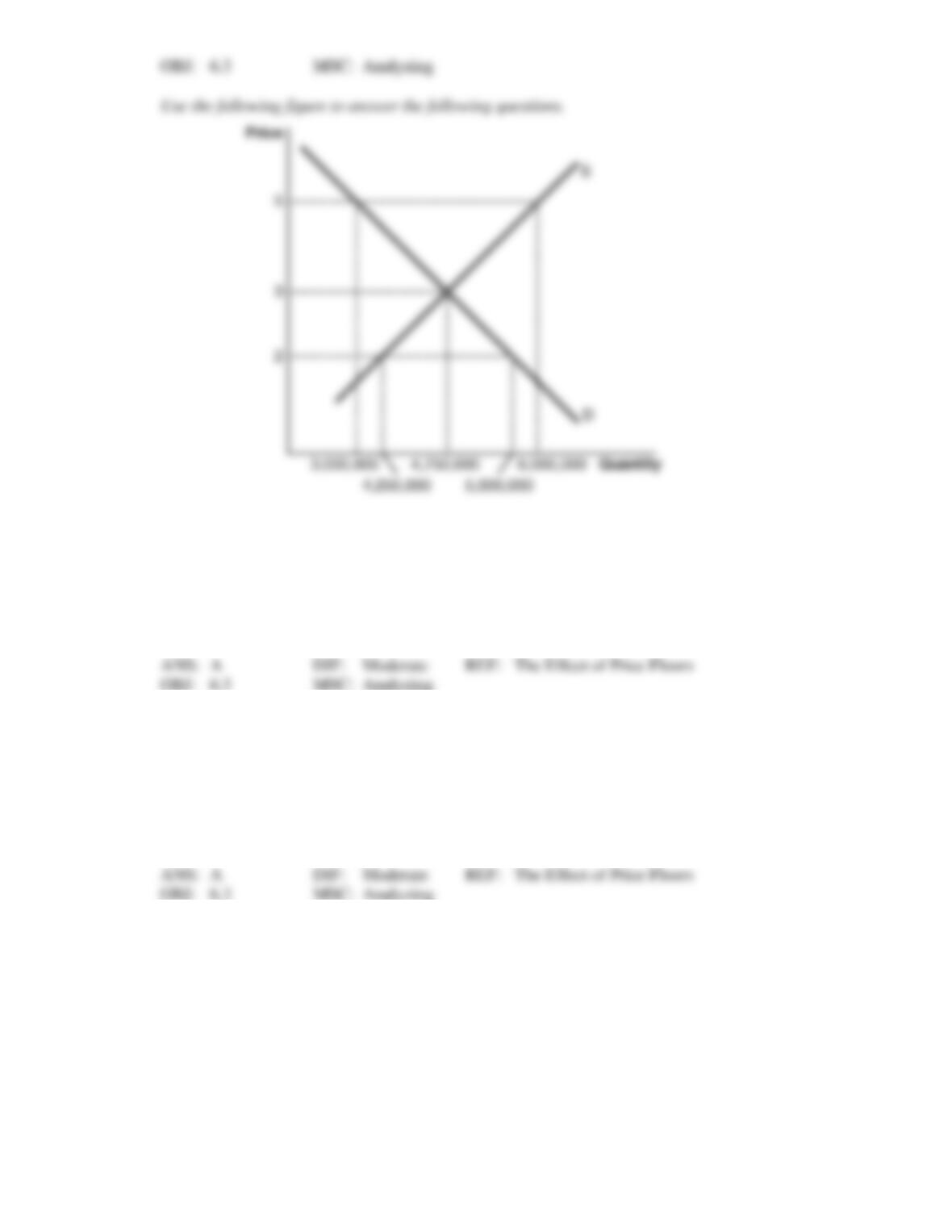
121. If the government imposes a price floor on wheat at $5, predict the amount of disequilibrium.
a. There will be a surplus of 3,000,000.
b. There will be a shortage of 3,000,000.
c. There will be neither a shortage nor a surplus.
d. There will be a surplus of 2,000,000.
e. There will be a shortage of 2,000,000.
122. If the government imposes a price floor on wheat at $5 and agrees to purchase any surpluses, how
much will the government be forced to spend?
a. $15,000,000
b. $3,000,000
c. $10,000,000
d. $25,000,000
e. nothing because there would be no surplus
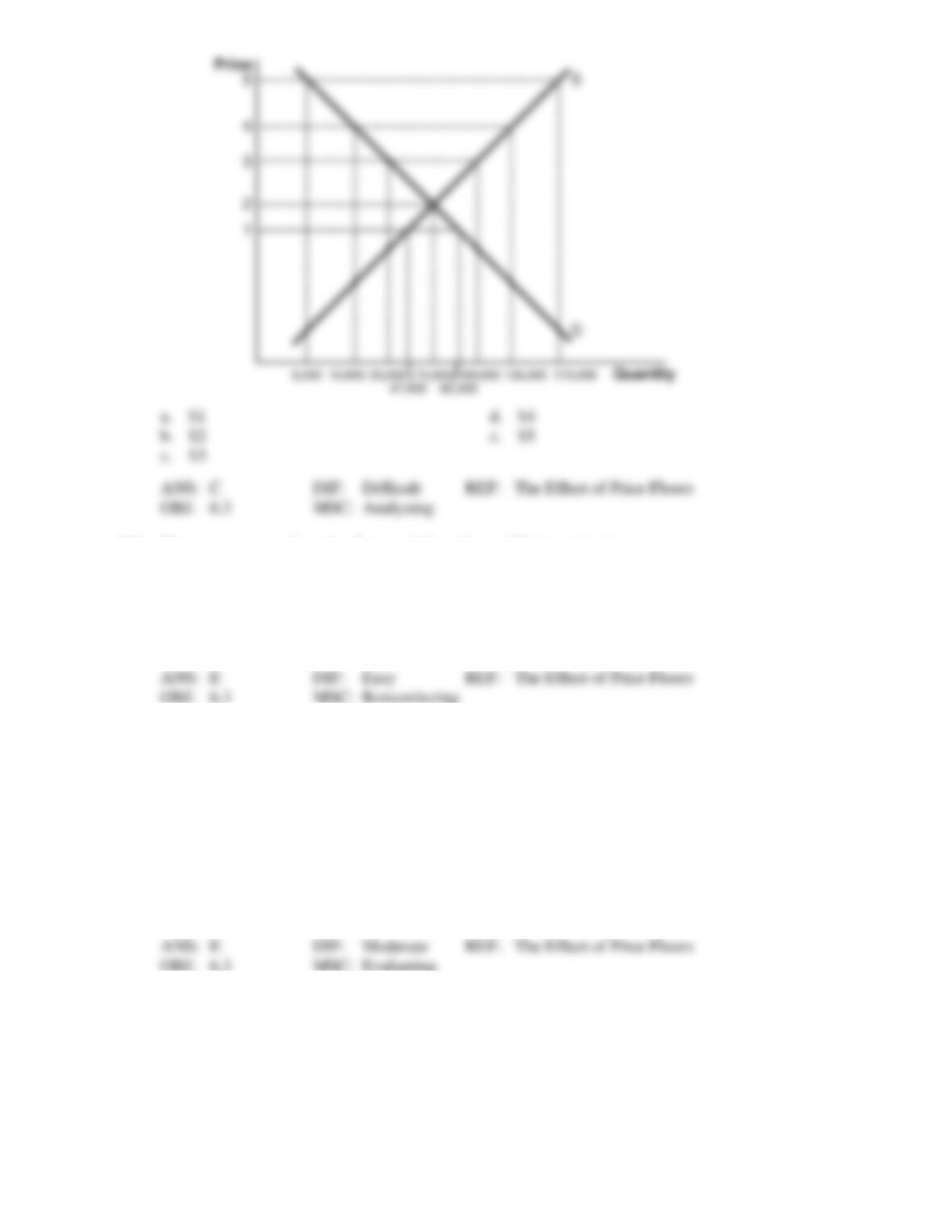
123. Refer to the accompanying figure. If the government has a budget of $300,000 to purchase surplus
shampoo, what is the maximum possible floor price that could be imposed?
124. The consequence of a price floor set below the equilibrium price is
a. a surplus, where the quantity demanded exceeds the quantity supplied.
b. a shortage, where the quantity demanded exceeds the quantity supplied.
c. a surplus, where the quantity supplied exceeds the quantity demanded.
d. a shortage, where the quantity supplied exceeds the quantity demanded.
e. nothing; the price floor will have no impact on the quantity demanded or the quantity supplied.
125. Victor is a senator from Kansas who wants to help farmers. He has worked to encourage the
passage of a law that would impose a binding price floor on wheat. What would he expect his
critics to say?
a. The binding price floor will discourage farmers from planting wheat and they will plant other
crops instead.
b. The binding price floor will encourage consumers to eat too much wheat.
c. The binding price floor will discourage farmers from using the most productive farming
methods available.
d. The binding price floor will cause a shortage of wheat.
e. The binding price floor will cause a surplus of wheat that farmers will be unable to sell.
126. As the time frame shifts from the short run to the long run, what happens to producers who are
subject to a binding price floor?
a. They are increasingly willing to substitute away from producing the good, and the supply
curve becomes less elastic.
b. There are no changes, and their elasticity of supply remains unchanged.
c. They are increasingly willing to substitute away from producing the good, and the supply
curve becomes more elastic.
d. They are less willing to substitute away from producing the good, and the supply curve
becomes less elastic.
e. They are less willing to substitute away from the good, and the supply curve becomes more
elastic.
127. As the time frame shifts from the short run to the long run, what happens to consumers who are
subject to a binding price floor?
a. They are increasingly willing to substitute away from the good, and the demand curve
becomes less elastic.
b. There are no changes, and elasticity remains unchanged.
c. They are less willing to substitute away from the good, and the demand curve becomes less
elastic.
d. They are increasingly willing to substitute away from the good, and the demand curve
becomes more elastic.
e. They are less willing to substitute away from the good, and the demand curve becomes more
elastic.
128. Why does a surplus that occurs under a binding price floor increase over time?
a. Demand becomes more elastic.
b. Demand becomes more inelastic.
c. Demand and supply both become more elastic.
d. Demand and supply both become more inelastic.
e. Demand becomes more elastic, but supply becomes more inelastic.
129. If a good is subject to a binding price floor and someone purchases it on the black market, what
would he or she expect to happen to the price over time?
a. The black market price will rise over time as the supply curve becomes more elastic and the
demand curve becomes more inelastic.
b. The black market price will fall over time as both the supply and demand curves become more
inelastic.
c. The black market price will rise over time as the demand curve becomes more elastic and the
supply curve becomes more inelastic.
d. The black market price will fall over time as both the supply and demand curves become more
elastic.
e. The black market price will not change over time.
130. If a good is subject to a binding price floor and someone purchases it on the black market, what
would he or she expect to happen to the availability of the good over time?
a. The availability of the good will fall over time as the supply curve becomes more elastic and
the demand curve becomes more inelastic. (The surplus of the good will fall.)
b. The availability of the good will fall over time as both the supply and demand curves become
more elastic. (The surplus of the good will fall.)
c. The availability of the good will rise over time as both the supply and demand curves become
more elastic. (The surplus of the good will rise.)
d. The availability of the good will fall over time as the demand curve becomes more elastic and
the supply curve becomes more inelastic. (The surplus of the good will fall.)
e. The availability of the good will not change over time.
131. Suppose Lewis lives in a community with no price controls. What would he expect will happen if
his town borders a community where there is a binding price floor on most products?
a. Prices in the legal market in the community with a binding price floor will rise.
b. Prices in the legal market in the community with a binding price floor will fall.
c. There will be surpluses in the community with a binding price floor.
d. More consumers will purchase the product in the community with the price floor.
e. The black market in his community will be larger than the black market in the community with
the binding price floor.
132. What is the long-run consequence of a price floor law?
a. A surplus will continue to exist and will grow larger over time.
b. A surplus will continue to exist and will grow smaller over time.
c. A shortage will continue to exist and will grow larger over time.
d. A shortage will continue to exist and will grow smaller over time.
e. The amount of the surplus will not change.
133. Refer to the accompanying figure, which shows both short-run and long-run demand and supply
curves. If there is a $x binding price floor imposed on a pharmaceutical drug, what will be the
amount of the disequilibrium in the short run?
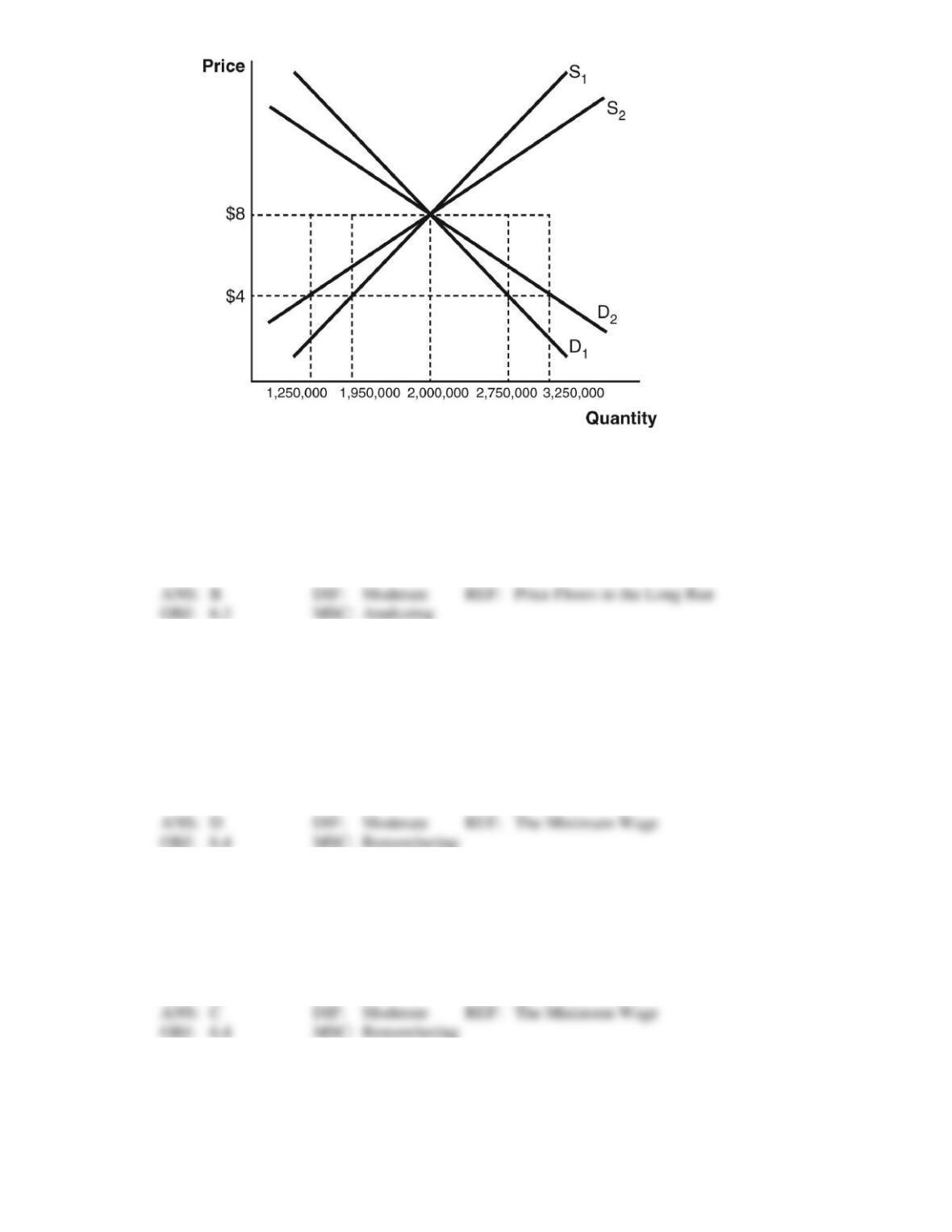
a. There will be a surplus of 1,500,000 units.
b. There will be a surplus of 800,000 units.
c. There will not be a surplus; there will be a shortage.
d. There will be a surplus of 2,000,000 units.
e. There will be a surplus of 500,000 units.
134. Which of the following is a correct statement?
a. Rent control and the minimum wage are both illustrations of price floors.
b. Rent control is an illustration of a price floor and the minimum wage is an illustration of a
price ceiling.
c. Rent control and the minimum wage are neither illustrations of price floors nor price ceilings.
d. Rent control is an illustration of a price ceiling and the minimum wage is an illustration of a
price floor.
e. Rent control and the minimum wage are both illustrations of price ceilings.
135. A binding minimum wage will increase the income of
a. all workers.
b. potential workers seeking employment.
c. only those workers in jobs that would normally pay less than minimum wage.
d. only those workers in jobs that would normally pay more than minimum wage.
e. no workers.
136. A binding minimum wage will decrease the income of
a. all workers.