71. A reason given why the CPI overstates the cost of living is it
A) only measures the effects of inflation on the poor.
B) makes no attempt to ascertain what average people buy.
C) makes no attempt to update the market basket.
D) updates the market basket infrequently thereby missing the steep price decline in the
early adoption period.
72. A reason given why the CPI overstates the cost of living is that the
A) CPI only measures the effects of inflation on the poor.
B) CPI makes no attempt to ascertain what average people buy.
C) CPI makes no attempt to update the market basket.
D) BLS audits prices in the same types of stores, rather than shift to cheaper outlets.
73. In the 1970s and 1980s Wal-Mart entered several markets outside of its home base of
Arkansas. As a result it brought lower prices on a variety of goods. That the Bureau of Labor
Statistics did not send its shoppers into these new stores until there was a new survey led to
the CPI
A) overstating inflation because they were missing “when people shop”.
B) understating inflation because they were missing “when people shop”.
C) overstating inflation because they were missing “where people shop”.
D) understating inflation because they were missing “where people shop”.
74. In the 1990s and 2000s Wal-Mart entered the grocery sector in several U.S. cities and as a
result it brought lower prices on food. That the Bureau of Labor Statistics did not send its
shoppers into these new stores in a timely fashion led to the CPI
A) overstating inflation because they were missing “when people shop”.
B) understating inflation because they were missing “when people shop”.
C) overstating inflation because they were missing “where people shop”.
D) understating inflation because they were missing “where people shop”.
75. DVD writers allow people to record TV shows in a high quality format. They entered the
market in 2002 at a price of $1000. By 2003 they were under $500. By the time they had
become part of the CPI market basket they are likely to be less than $250. Economists will
argue that this type of issue
A) leads to the CPI overstating the rate of inflation.
B) leads to the CPI understating the rate of inflation.
C) is well handled the by the BLS as they determine the CPI.
D) is irrelevant to CPI calculations.
76. Suppose people on diets buy the bulk of the ground chicken and ground turkey sold in the
U.S. and they use either interchangeably as a substitute in recipes for ground beef. If the
price of ground turkey rises and the price of ground chicken does not the then CPI will
A) understate inflation because of the issue of substitution.
B) overstate inflation because of the issue of substitution.
C) overstating inflation because of the issue of missing “where people shop”.
D) understating inflation because of the issue of missing “where people shop”.
77. The magnitude of the annual overstatement of the CPI is approximately
A) one-tenth of one percentage point.
B) one-half of one percentage point.
C) one percentage point.
D) five percentage point.
78. One of the consequences of the overstatement of the CPI is that
A) Social Security taxes are higher than they would otherwise be.
B) personal income taxes are higher than they would otherwise be.
C) Social Security payments are lower than they would otherwise be.
D) the poverty line is lower than it would otherwise be.
79. One of the consequences of the overstatement of the CPI is that
A) Social Security taxes are lower than they would otherwise be.
B) personal income taxes are lower than they would otherwise be.
C) Social Security payments are lower than they would otherwise be.
D) the poverty line is lower than it would otherwise be.
80. One of the consequences of the overstatement of the CPI is that
A) Social Security taxes are lower than they would otherwise be.
B) personal income taxes are higher than they would otherwise be.
C) Social Security payments are higher than they would otherwise be.
D) the poverty line is lower than it would otherwise be.
81. One of the consequences of the overstatement of the CPI is that
A) the poverty line is higher than it would otherwise be.
B) personal income taxes are higher than they would otherwise be.
C) Social Security payments are lower than they would otherwise be.
D) Social Security taxes are lower than they would otherwise be.
82. Over the years the consequences of the biased-measurement of the CPI
A) increase linearly.
B) decrease steadily.
C) increase exponentially.
D) decrease dramatically.
83. The consumer price index is computed by
A) the Bureau of Price Indexes.
B) Health and Human Services.
C) the Bureau of Labor Statistics.
D) the White House Office of Management and Budget.
84. The political problems associated with fixing the CPI are that
A) personal income taxes would rise.
B) benefits to the poor would rise.
C) Social Security taxes would rise.
D) Social Security benefits would rise.
85. The political problems associated with fixing the CPI are that
A) personal income taxes would fall.
B) benefits to the poor would fall.
C) Social Security taxes would rise.
D) Social Security benefits would rise.
86. The political problems associated with fixing the CPI are that
A) personal income taxes would fall.
B) benefits to the poor would rise.
C) Social Security taxes would rise.
D) Social Security benefits would fall.
87. Estimates of the overstatement of cost of living by the CPI suggest the magnitude of the
overstatement is roughly
A) 5.0 percentage points.
B) 0.3 percentage points.
C) 1.0 percentage points.
D) 0.1 percentage points.
88. If the CPI were fixed then the fact that it is wrong by 0.8 percentage points means that over a
ten year period it is wrong by
A) 1.1 percentage points.
B) between 1.1 and 11 percentage points .
C) 11 percentage points.
D) more than 11 percentage points.
89. A CPI miscalculation that overstates its increase by 0.8 percentage points will cause
A) the price of goods to rise.
B) the price of services rise.
C) the personal exemption to rise too slowly.
D) the personal exemption to rise too quickly.
90. A CPI miscalculation that overstates its increase by 0.8 percentage points will cause
A) the price of goods to rise.
B) the price of services rise.
C) Social Security’s Maximum Taxable Earnings to rise too slowly.
D) Social Security’s Maximum Taxable Earnings to rise too quickly.
91. A CPI miscalculation that overstates its increase by 0.8 percentage points will cause
A) the price of goods to rise.
B) the poverty line to rise too slowly.
C) the price of services rise.
D) the poverty line to rise too quickly.
92. A CPI miscalculation that overstates its increase by 0.8 percentage points will cause
A) the price of goods to rise.
B) standard deduction to rise too slowly.
C) the price of services rise.
D) standard deduction to rise too quickly.
93. A CPI miscalculation that overstates its increase by 0.8 percentage points will cause
A) the price of goods to rise.
B) the price of services rise.
C) tax brackets cutoffs to rise too slowly.
D) tax brackets cutoffs to rise too quickly.
94. Because the CPI overstates the rate of inflation, Cost of Living Adjustments for wages that
are based on it will
A) cause these wages to rise more slowly that they otherwise would.
B) cause these wages to rise more quickly that they otherwise would.
C) be correct.
D) never have to account for this to get it right.
95. If the inflation rate turns out to be greater than was is expected to be, the clear winners are
A) lenders.
B) borrowers.
C) people on fixed incomes.
D) businesses.
96. If the inflation rate turns out to be less than was is expected to be, the clear winners are
A) lenders.
B) borrowers.
C) people on fixed incomes.
D) businesses.
97. If the inflation rate turns out to be greater than was is expected to be, the clear losers are
A) lenders.
B) borrowers.
C) people on incomes adjusted by a COLA.
D) businesses.
98. If the inflation rate turns out to be less than was is expected to be, the clear losers are
A) lenders.
B) borrowers.
C) people on incomes adjusted by a COLA.
D) businesses.
99. Inflation, whether or not it is expected, hurts
A) lenders.
B) borrowers.
C) people on fixed incomes.
D) businesses.
100. The reason that the expected inflation rate matters in determining the impact on borrowers
or lenders is that
A) interest rates depend on expected inflation, rather than actual inflation.
B) interest rates depend on actual inflation, rather than expected inflation.
C) higher interest rates mean higher payments.
D) lower interest rates mean lower payments.
101. The “core rate” of inflation
A) adds in food and energy to the price index.
B) removes food and energy from the price index.
C) only includes the price of food and energy in the price index.
D) is a price index associate with the important things people buy.
102. The annualized monthly CPI numbers are
A) more volatile than the Core CPI.
B) less Volatile than the Core CPI.
C) different, but no more or less volatile than the Core CPI.
103. The Personal Consumption Expenditures Index
A) strips out the cost of food and energy.
B) also includes producer prices (like the cost of iron ore).
C) includes all goods and services people buy (not just what “average” people buy).
D) only includes food and energy.
104. The Core Personal Consumption Expenditures Index
A) strips out the cost of food and energy from the PCE.
B) also includes producer prices (like the cost of iron ore).
C) includes all goods and services people buy (not just what “average” people buy).
D) only includes food and energy.
105. The Federal Reserve is most concerned with
A) the CPI.
B) the PCE.
C) the Core PCE.
D) the PPI.
106. Suppose there are only two goods (Good A and Good B) and the average person buys 4 of
Good A in a year and 3 of Good B. If, in the base year, the Price of Good A is $5 and the
Price of Good B is $10, and in the next year the Price of Good A is $6 and the Price of Good
B is $9, one problem with the CPI way of calculating inflation is
A) it understates the importance of Good A in the budget.
B) it understates the importance of Good B in the budget.
C) it fails to recognize that people will substitute (to some degree) Good B for Good A and
therefore overstates the degree of inflation.
D) it fails to recognize that people will substitute (to some degree) Good B for Good A and
therefore understates the degree of inflation.
107. Suppose there are only two goods (Good A and Good B) and the average person buys 4 of
Good A in a year and 3 of Good B. If, in the base year, the Price of Good A is $5 and the
Price of Good B is $10, and in the next year the Price of Good A is $4 and the Price of Good
B is $12, one problem with the CPI way of calculating inflation is
A) it understates the importance of Good A in the budget.
B) it understates the importance of Good B in the budget.
C) it fails to recognize that people will substitute (to some degree) Good A for Good B and
therefore overstates the degree of inflation.
D) it fails to recognize that people will substitute (to some degree) Good A for Good B and
therefore understates the degree of inflation.
108. Suppose there are only two goods (Good A and Good B) and the average person buys 4 of
Good A in a year and 3 of Good B. If, in the base year, the Price of Good A is $5 and the
Price of Good B is $10, and in the next year the Price of Goods A and B both increase by 5%
at the same stores but new business starts to sell B for $9 what is the problem with the CPI
way of calculating inflation that is apparent
A) it understates the importance of Good A in the budget.
B) it understates the importance of Good B in the budget.
C) it fails to recognize that people will start to buy Good B in the new store and therefore the
CPI overstates the degree of inflation.
D) it fails to recognize that people will start to buy Good B in the new store and therefore the
CPI understates the degree of inflation.
109. Suppose there are only two goods (Good A and Good B) and the average person buys 4 of
Good A in a year and 3 of Good B. If, in the base year, the Price of Good A is $5 and the
Price of Good B is $10, and in the next year the Price of Goods A and B both increase by 5%
at the same stores but Good A is much less likely to make you sick than it had been, what is
the problem with the CPI way of calculating inflation that is apparent
A) it understates the importance of Good A in the budget.
B) it understates the importance of Good B in the budget.
C) it fails to recognize the quality increase in Good A and therefore the CPI overstates the
degree of inflation.
D) it fails to recognize the quality increase in Good A therefore the CPI understates the
degree of inflation.
110. One problem with using Real Gross Domestic Product as a measure of social welfare is that
A) it fails to count home production.
B) it fails to count services, a growing part of the economy.
C) it double, triple, and sometimes quadruple counts goods that are produced in stages.
D) it fails to account for imports, a growing part of the economy.
111. One of the reasons that Real Gross Domestic Product is not synonymous with social welfare
is
A) people substitute between goods.
B) things produced by people under 18 are not counted.
C) domestic production (cooking, laundry and such) are not counted.
D) quality has remained steady.
112. One of the reasons that Real Gross Domestic Product is not synonymous with social welfare
is
A) people substitute between goods.
B) things produced by people under 18 are not counted.
C) it ignores the value of leisure.
D) quality has remained steady.
113. One of the reasons that Real Gross Domestic Product is not synonymous with social welfare
is
A) people substitute between goods.
B) things produced by people under 18 are not counted.
C) it treats all spending the same (spending on military hardware is treated the same as
spending on education).
D) quality has remained steady.
114. One of the reasons that Real Gross Domestic Product is not synonymous with social welfare
is
A) people substitute between goods.
B) things produced by people under 18 are not counted.
C) environmental quality is ignored.
D) quality has remained steady.
115. One of the reasons that Real Gross Domestic Product is not synonymous with social welfare
is
A) people substitute between goods.
B) things produced by people under 18 are not counted.
C) the underground economy (unreported and illegal income and sales) is not counted.
D) quality has remained steady.
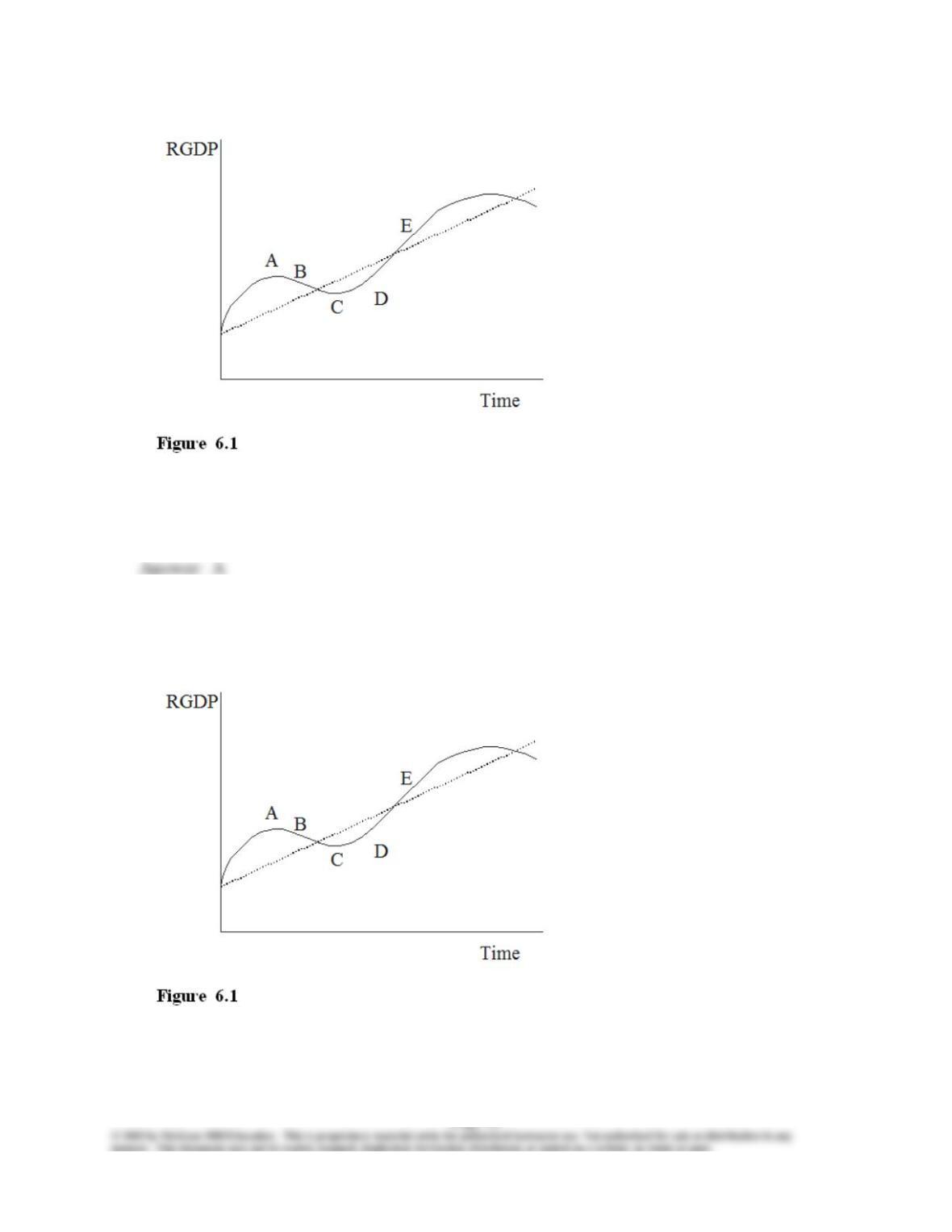
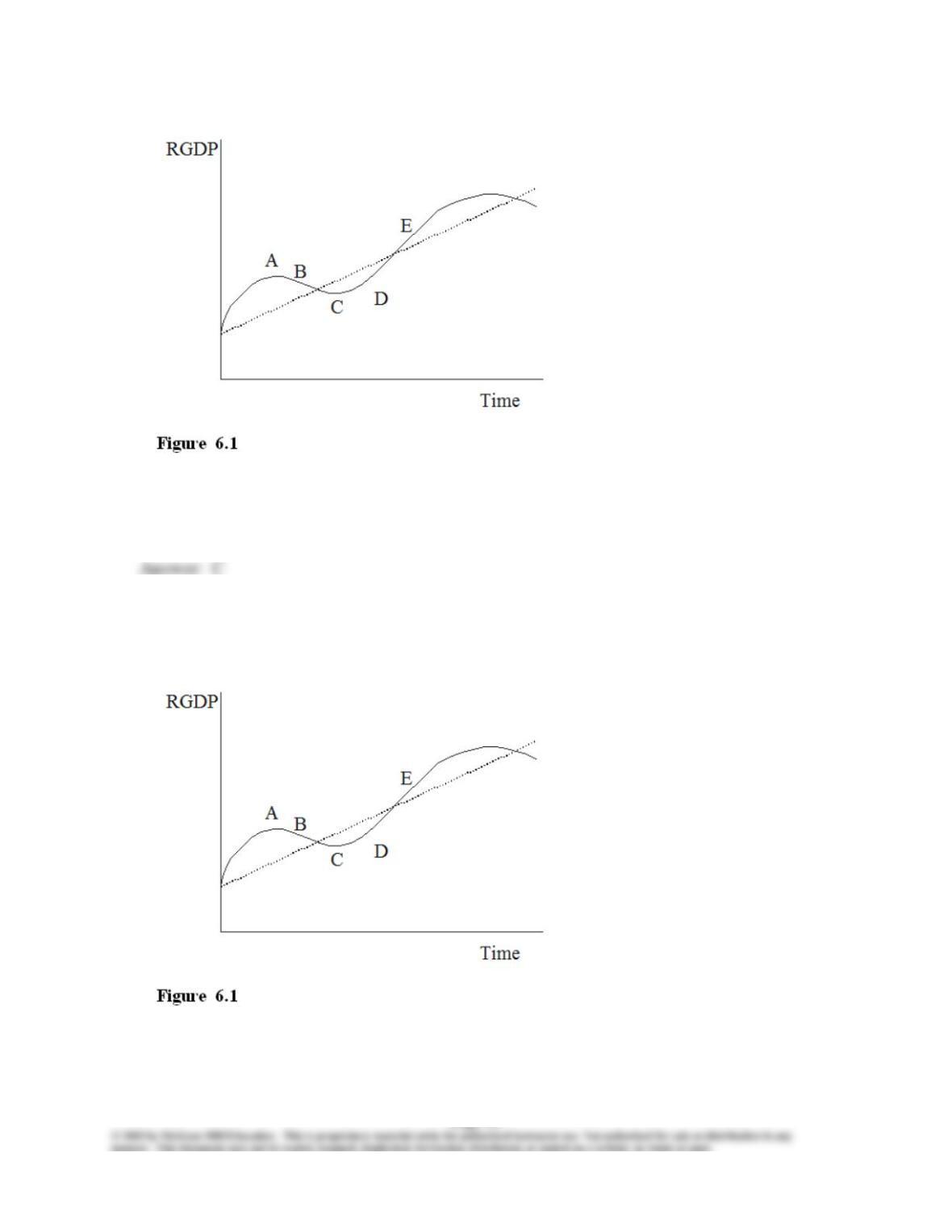
116. In Figure 6.1, which area represents a peak?
A) A
B) B
C) C
D) D
117. In Figure 6.1, which area represents a recession?
A) A
B) B
C) C
D) D
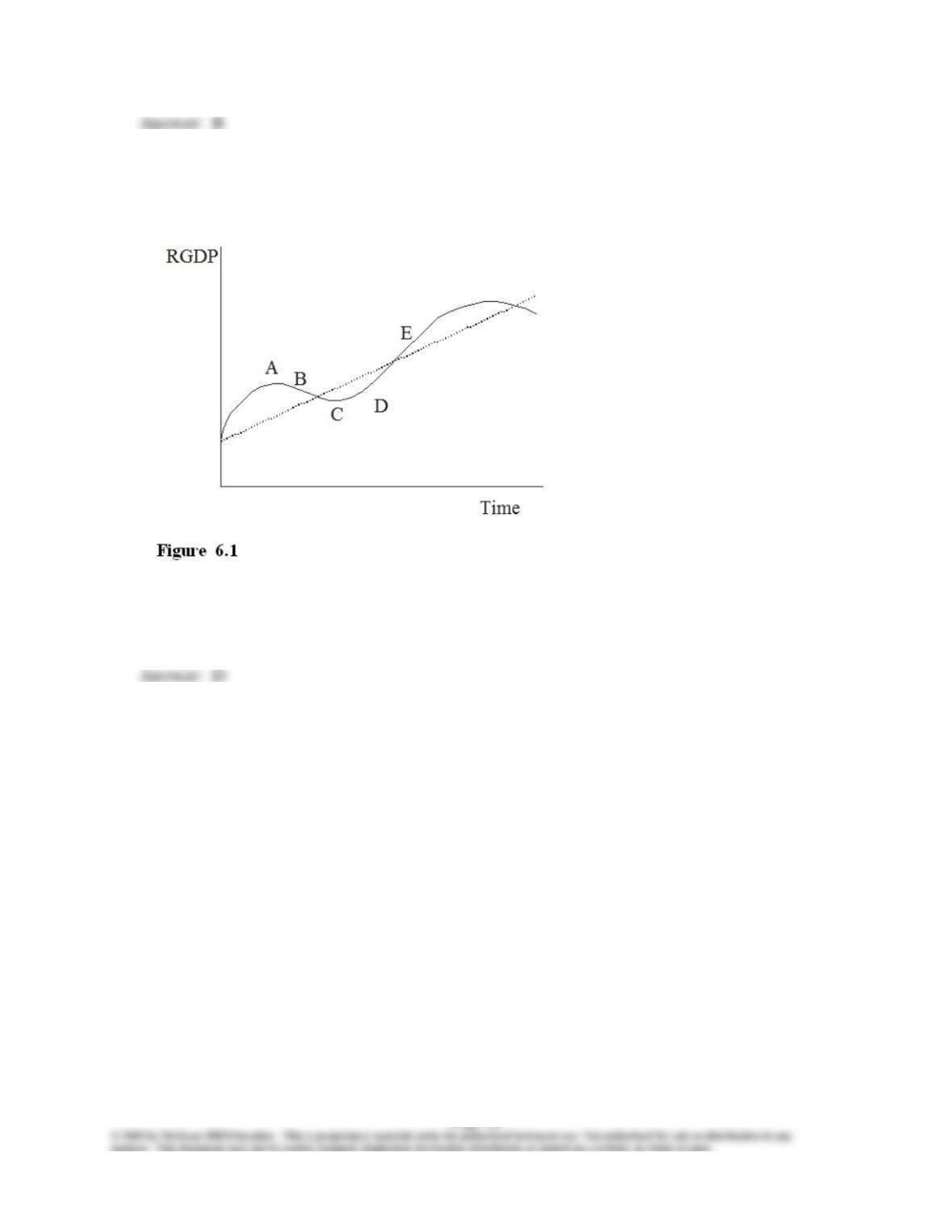
118. In Figure 6.1, which area represents an expansion?
A) A
B) C
C) D
D) E
119. In Figure 6.1, which area represents a trough?
A) A
B) B
C) C
D) D
120. In Figure 6.1, which area represents a recovery?
A) A
B) B
C) C
D) D