Chapter 6: Interest Rates
55.
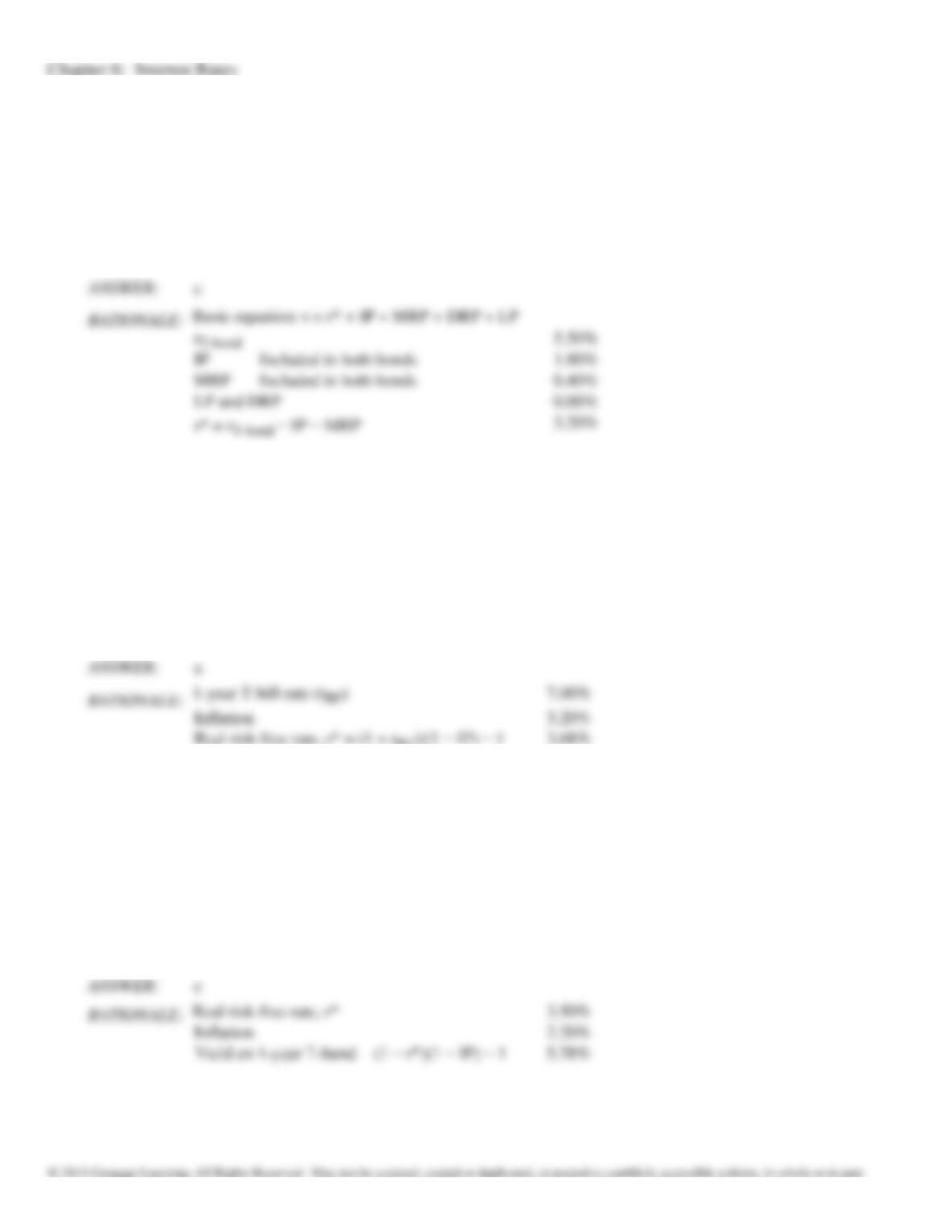
Suppose 1-year T-bills currently yield 7.00% and the future inflation rate is expected to be constant at 3.20%
per
year. What is the real risk-free rate of return, r*? Disregard any cross-product terms, i.e., if averaging is
required,
use the arithmetic average.
a. 3.80%
b. 3.99%
c. 4.19%
d. 4.40%
e. 4.62%
56.
Suppose the real risk-free rate is 3.50% and the future rate of inflation is expected to be constant at 2.20%.
What
rate of return would you expect on a 1-year Treasury security, assuming the pure expectations theory is
valid?
Disregard cross-product terms, i.e., if averaging is required, use the arithmetic average.
a. 5.14%
b. 5.42%
c. 5.70%
d. 5.99%
e. 6.28%
57.
Suppose the real risk-free rate is 2.50% and the future rate of inflation is expected to be constant at 4.10%.
What
rate of return would you expect on a 5-year Treasury security, assuming the pure expectations theory is
valid?
Disregard cross-product terms, i.e., if averaging is required, use the arithmetic average.
a. 5.38%
b. 5.66%
c. 5.96%
d. 6.27%
e. 6.60%
58.
The real risk-free rate is 3.05%, inflation is expected to be 2.75% this year, and the maturity risk premium is
zero.
Ignoring any cross-product terms, what is the equilibrium rate of return on a 1-year Treasury bond?
a. 5.51%
b. 5.80%
c. 6.09%
d. 6.39%
e. 6.71%
59.
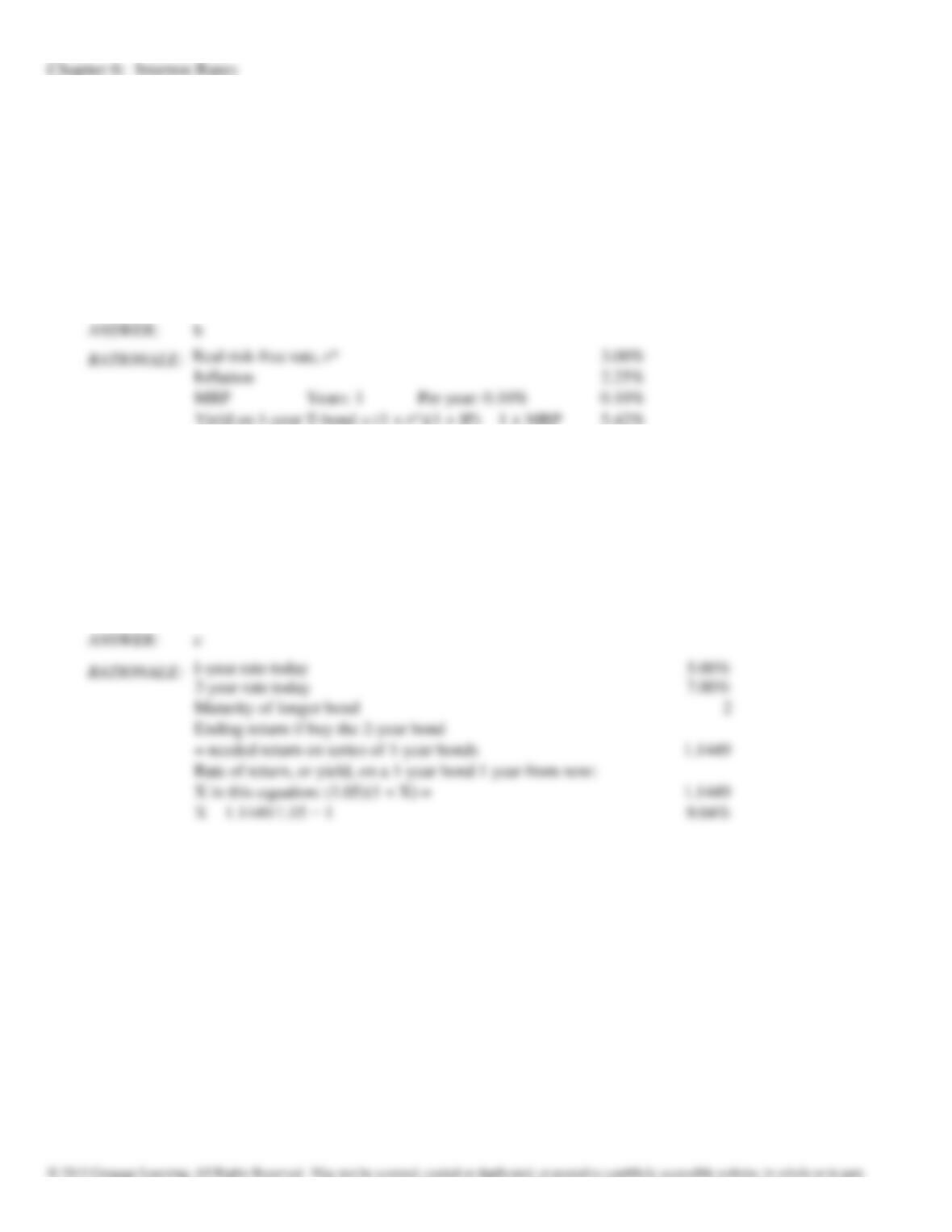
Suppose the real risk-free rate is 3.00%, the average expected future inflation rate is 2.25%, and a maturity risk
premium of 0.10% per year to maturity applies, i.e., MRP = 0.10%(t), where t is the number of years to
maturity.
What rate of return would you expect on a 1-year Treasury security, assuming the pure expectations
theory is NOT
valid? Disregard cross-product terms, i.e., if averaging is required, use the arithmetic average.
a. 5.08%
b. 5.35%
c. 5.62%
d. 5.90%
e. 6.19%
60.
Suppose the real risk-free rate is 4.20%, the average expected future inflation rate is 3.10%, and a maturity risk
premium of 0.10% per year to maturity applies, i.e., MRP = 0.10%(t), where t is the number of years to
maturity,
hence the pure expectations theory is NOT valid. What rate of return would you expect on a 4-year
Treasury
security? Disregard cross-product terms, i.e., if averaging is required, use the arithmetic average.
a. 6.60%
b. 6.95%
c. 7.32%
d. 7.70%
e. 8.09%
61.
The real risk-free rate is 3.55%, inflation is expected to be 3.15% this year, and the maturity risk premium is
zero.
Taking account of the cross-product term, i.e., not ignoring it, what is the equilibrium rate of return on a
1-year
Treasury bond?
a. 5.840%
b. 6.148%
c. 6.471%
d. 6.812%
e. 7.152%
62.
Suppose the yield on a 10-year T-bond is currently 5.05% and that on a 10-year Treasury Inflation Protected
Security (TIPS) is 2.15%. Suppose further that the MRP on a 10-year T-bond is 0.90%, that no MRP is
required on
a TIPS, and that no liquidity premium is required on any T-bond. Given this information, what is
the expected rate of
inflation over the next 10 years? Disregard cross-product terms, i.e., if averaging is
required, use the arithmetic
average.
a. 1.81%
b. 1.90%
c. 2.00%
d. 2.10%
e. 2.21%
63.
Suppose the rate of return on a 10-year T-bond is 6.55%, the expected average rate of inflation over the next 10
years is 2.0%, the MRP on a 10-year T-bond is 0.9%, no MRP is required on a TIPS, and no liquidity premium
is
required on any Treasury security. Given this information, what should the yield be on a 10-year TIPS?
Disregard
cross-product terms, i.e., if averaging is required, use the arithmetic average.
a. 2.97%
b. 3.13%
c. 3.29%
d. 3.47%
e. 3.65%
64.
Suppose 10-year T-bonds have a yield of 5.30% and 10-year corporate bonds yield 6.75%. Also, corporate
bonds
have a 0.25% liquidity premium versus a zero liquidity premium for T-bonds, and the maturity risk
premium on both
Treasury and corporate 10-year bonds is 1.15%. What is the default risk premium on
corporate bonds?
a. 1.08%
b. 1.20%
c. 1.32%
d. 1.45%
e. 1.60%
65.
If 10-year T-bonds have a yield of 6.2%, 10-year corporate bonds yield 8.5%, the maturity risk premium on all
10-year bonds is 1.3%, and corporate bonds have a 0.4% liquidity premium versus a zero liquidity premium for
T-bonds,
what is the default risk premium on the corporate bond?
a. 1.90%
b. 2.09%
c. 2.30%
d. 2.53%
e. 2.78%
66.
Koy Corporation’s 5-year bonds yield 7.00%, and 5-year T-bonds yield 5.15%. The real risk-free rate is r* =
3.0%,
the inflation premium for 5-year bonds is IP = 1.75%, the liquidity premium for Koy’s bonds is LP =
0.75% versus
zero for T-bonds, and the maturity risk premium for all bonds is found with the formula MRP =
(t − 1) × 0.1%,
where t = number of years to maturity. What is the default risk premium (DRP) on Koy’s
bonds?
a. 5.94%
b. 6.60%
c. 7.26%
d. 7.99%
e. 8.78%
67.
Keys Corporation’s 5-year bonds yield 6.20% and 5-year T-bonds yield 4.40%. The real risk-free rate is r* =
2.5%,
the inflation premium for 5-year bonds is IP = 1.50%, the liquidity premium for Keys’ bonds is LP =
0.5% versus
zero for T-bonds, and the maturity risk premium for all bonds is found with the formula MRP = (t
− 1) × 0.1%,
where t = number of years to maturity. What is the default risk premium (DRP) on Keys’ bonds?
a. 1.17%
b. 1.30%
c. 1.43%
d. 1.57%
e. 1.73%
68.
Kay Corporation’s 5-year bonds yield 6.20% and 5-year T-bonds yield 4.40%. The real risk-free rate is r* =
2.5%,
the inflation premium for 5-year bonds is IP = 1.50%, the default risk premium for Kay’s bonds is DRP
= 1.30%
versus zero for T-bonds, and the maturity risk premium for all bonds is found with the formula MRP
= (t − 1) ×
0.1%, where t = number of years to maturity. What is the liquidity premium (LP) on Kay’s bonds?
a. 0.36%
b. 0.41%
c. 0.45%
d. 0.50%
e. 0.55%
69.
Niendorf Corporation’s 5-year bonds yield 8.00%, and 5-year T-bonds yield 4.80%. The real risk-free rate is r*
=
2.75%, the inflation premium for 5-year bonds is IP = 1.65%, the default risk premium for Niendorf’s bonds
is DRP = 1.20% versus zero for T-bonds, and the maturity risk premium for all bonds is found with the formula
MRP = (t −1) × 0.1%, where t = number of years to maturity. What is the liquidity premium (LP) on
Niendorf’s bonds?
a. 1.31%
b. 1.46%
c. 1.62%
d. 1.80%
e. 2.00%
70.
Kern Corporation’s 5-year bonds yield 7.30% and 5-year T-bonds yield 4.10%. The real risk-free rate is r* =
2.5%,
the default risk premium for Kern’s bonds is DRP = 1.90% versus zero for T-bonds, the liquidity
premium on Kern’s
bonds is LP = 1.3%, and the maturity risk premium for all bonds is found with the formula
MRP = (t − 1) × 0.1%,
where t = number of years to maturity. What is the inflation premium (IP) on all 5-year
bonds?
a. 1.20%
b. 1.32%
c. 1.45%
d. 1.60%
e. 1.68%
71.
Crockett Corporation’s 5-year bonds yield 6.35%, and 5-year T-bonds yield 4.75%. The real risk-free rate is r*
=
3.60%, the default risk premium for Crockett’s bonds is DRP = 1.00% versus zero for T-bonds, the liquidity
premium
on Crockett’s bonds is LP = 0.90% versus zero for T-bonds, and the maturity risk premium for all
bonds is found
with the formula MRP = (t − 1) × 0.1%, where t = number of years to maturity. What inflation
premium (IP) is built
into 5-year bond yields?
a. 0.68%
b. 0.75%
c. 0.83%
d. 0.91%
e. 1.00%
72.
Kelly Inc’s 5-year bonds yield 7.50% and 5-year T-bonds yield 4.90%. The real risk-free rate is r* = 2.5%, the
default risk premium for Kelly’s bonds is DRP = 0.40%, the liquidity premium on Kelly’s bonds is LP = 2.2%
versus
zero on T-bonds, and the inflation premium (IP) is 1.5%. What is the maturity risk premium (MRP) on
all 5-year
bonds?
a. 0.73%
b. 0.81%
c. 0.90%
d. 0.99%
e. 1.09%
73.
Kop Corporation’s 5-year bonds yield 6.50%, and T-bonds with the same maturity yield 4.40%. The default
risk
premium for Kop’s bonds is DRP = 0.40%, the liquidity premium on Kop’s bonds is LP = 1.70% versus
zero on T-bonds, the inflation premium (IP) is 1.50%, and the maturity risk premium (MRP) on 5-year bonds is
0.40%. What is
the real risk-free rate, r*?
a. 2.04%
b. 2.14%
c. 2.26%
d. 2.38%
e. 2.50%
74.
5-year Treasury bonds yield 5.5%. The inflation premium (IP) is 1.9%, and the maturity risk premium (MRP)
on 5-year T-bonds is 0.4%. There is no liquidity premium on these bonds. What is the real risk-free rate, r*?
a. 2.59%
b. 2.88%
c. 3.20%
d. 3.52%
e. 3.87%
75.
Suppose 1-year T-bills currently yield 7.00% and the future inflation rate is expected to be constant at 3.20%
per
year. What is the real risk-free rate of return, r*? The cross-product term should be considered, i.e., if
averaging is
required, use the geometric average.
a. 3.68%
b. 3.87%
c. 4.06%
d. 4.26%
e. 4.48%
76.
Suppose the real risk-free rate is 3.50% and the future rate of inflation is expected to be constant at 2.20%.
What
rate of return would you expect on a 1-year Treasury security, assuming the pure expectations theory is
valid?
Include cross-product terms, i.e., if averaging is required, use the geometric average.
a. 5.21%
b. 5.49%
c. 5.78%
d. 6.07%
e. 6.37%
77.
Suppose the real risk-free rate is 3.00%, the average expected future inflation rate is 2.25%, and a maturity risk
premium of 0.10% per year to maturity applies, i.e., MRP = 0.10%(t), where t is the years to maturity. What
rate of
return would you expect on a 1-year Treasury security, assuming the pure expectations theory is NOT
valid? Include
the cross-product term, i.e., if averaging is required, use the geometric average.
a. 5.15%
b. 5.42%
c. 5.69%
d. 5.97%
e. 6.27%
78.
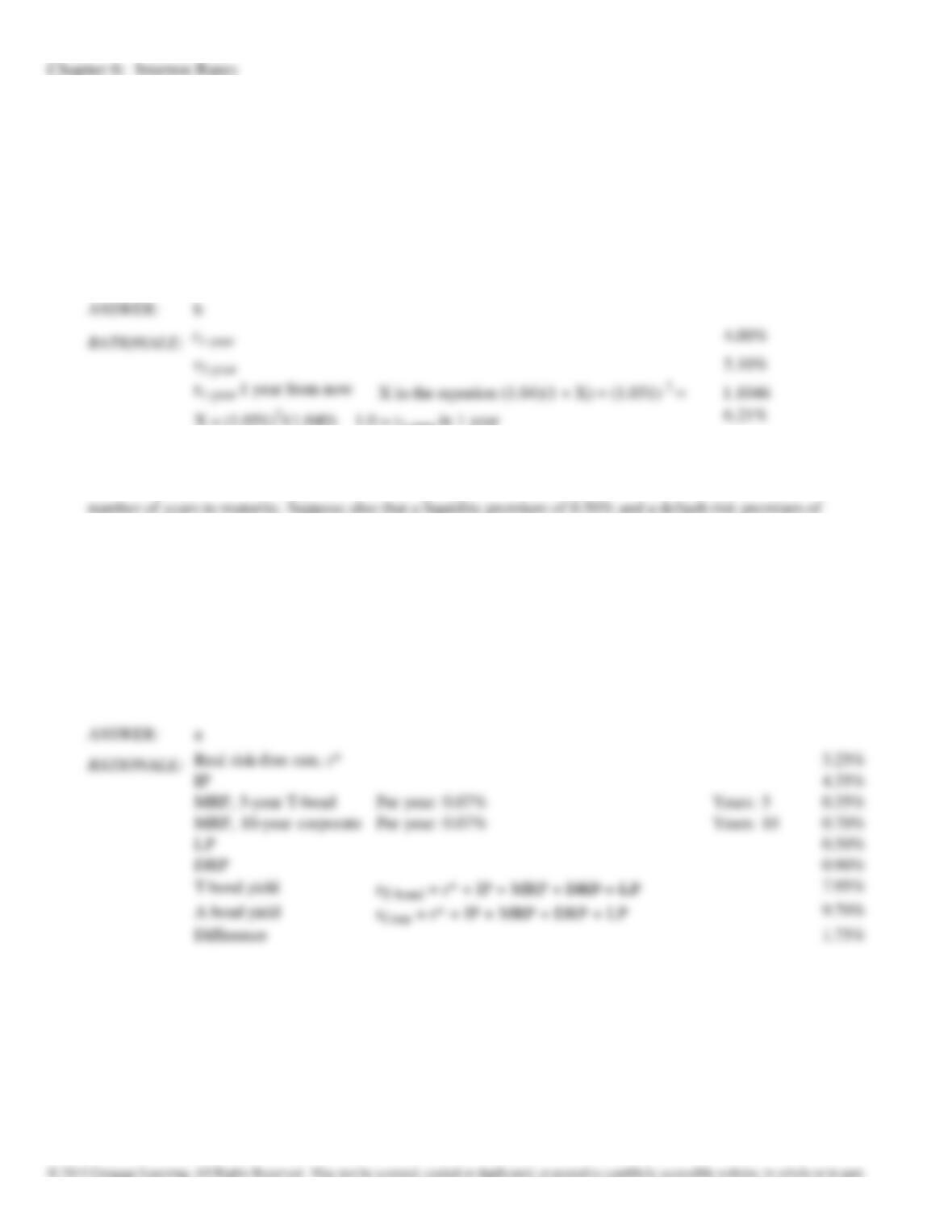
Suppose the interest rate on a 1-year T-bond is 5.0% and that on a 2-year T-bond is 7.0%. Assuming the pure
expectations theory is correct, what is the market’s forecast for 1-year rates 1 year from now?
a. 7.36%
b. 7.75%
c. 8.16%
d. 8.59%
e. 9.04%
79.
Suppose 1-year Treasury bonds yield 4.00% while 2-year T-bonds yield 5.10%. Assuming the pure
expectations
theory is correct, and thus the maturity risk premium for T-bonds is zero, what is the yield on a 1–
year T-bond
expected to be one year from now?
a. 5.90%
b. 6.21%
c. 6.52%
d. 6.85%
e. 7.19%
80.
Suppose the real risk-free rate is 3.25%, the average future inflation rate is 4.35%, and a maturity risk premium
of
0.07% per year to maturity applies to both corporate and T-bonds, i.e., MRP = 0.07%(t), where t is the
0.90% apply to A-
rated corporate bonds but not to T–bonds. How much higher would the rate of return be on a
10-year A-rated
corporate bond than on a 5-year Treasury bond? Here we assume that the pure expectations
theory is NOT valid.
Disregard cross-product terms, i.e., if averaging is required, use the arithmetic average.
a. 1.75%
b. 1.84%
c. 1.93%
d. 2.03%
e. 2.13%
81.
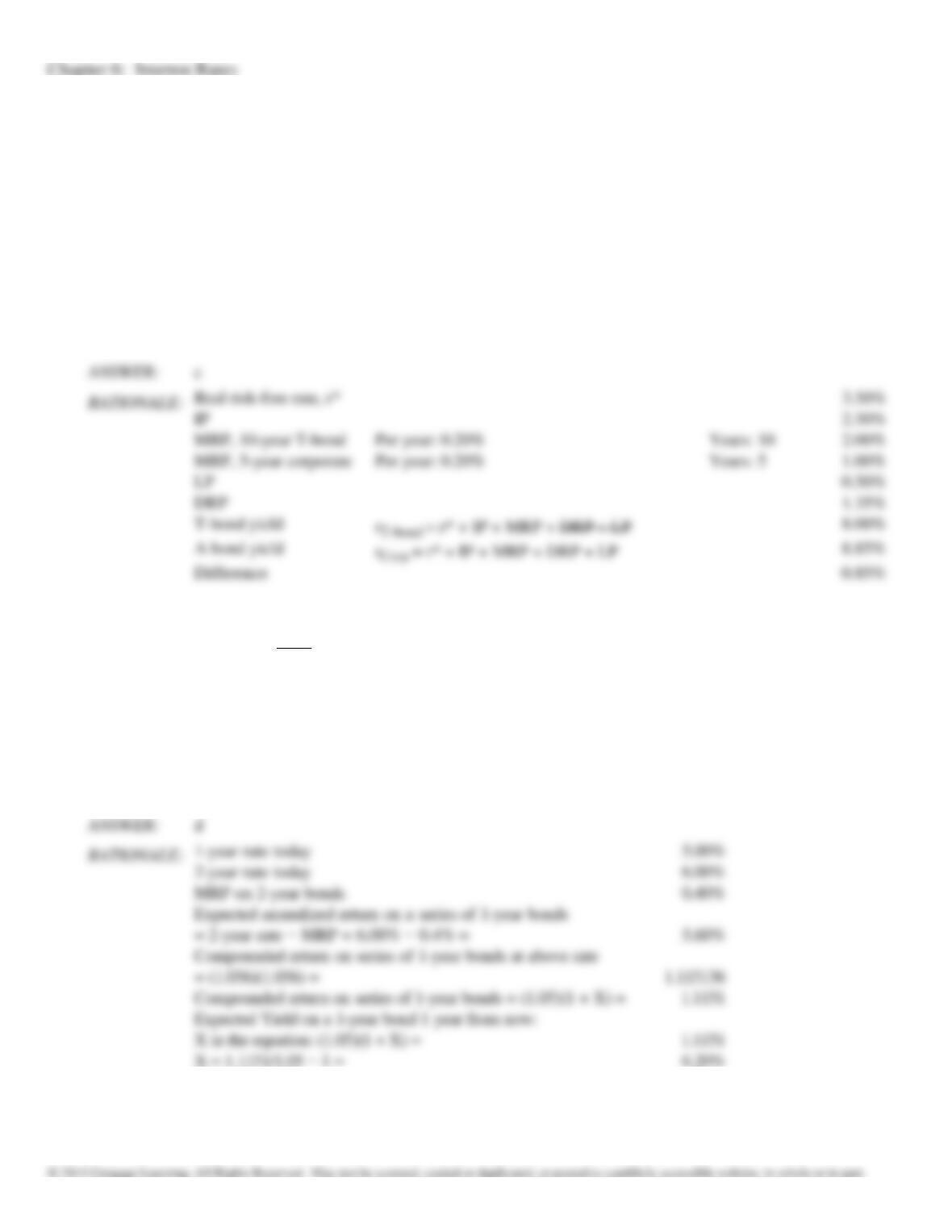
Suppose the real risk-free rate is 3.50%, the average future inflation rate is 2.50%, a maturity premium of
0.20% per
year to maturity applies, i.e., MRP = 0.20%(t), where t is the number of years to maturity. Suppose
also that a
liquidity premium of 0.50% and a default risk premium of 1.35% applies to A-rated corporate
bonds. What is the
difference in the yields on a 5-year A-rated corporate bond and on a 10-year Treasury bond?
Here we assume that
the pure expectations theory is NOT valid, and disregard any cross-product terms, i.e., if
averaging is required, use
the arithmetic average.
a. 0.77%
b. 0.81%
c. 0.85%
d. 0.89%
e. 0.94%
82.
Suppose the interest rate on a 1-year T-bond is 5.00% and that on a 2-year T-bond is 6.00%. Assume that the
pure
expectations theory is NOT valid, and the MRP is zero for a 1-year T-bond but 0.40% for a 2-year bond.
What is
the yield on a 1-year T-bond expected to be one year from now?
a. 5.32%
b. 5.60%
c. 5.89%
d. 6.20%
e. 6.51%