Chapter 06 – Every Macroeconomic Word You Ever Heard: Gross Domestic Product, Inflation, Unemployment,
Recession, and Depression
96. If the inflation rate turns out to be less than was is expected to be, the clear winners are
A) lenders.
B) borrowers.
C) people on fixed incomes.
D) businesses.
97. If the inflation rate turns out to be greater than was is expected to be, the clear losers are
A) lenders.
B) borrowers.
C) people on incomes adjusted by a COLA.
D) businesses.
98. If the inflation rate turns out to be less than was is expected to be, the clear losers are
A) lenders.
B) borrowers.
C) people on incomes adjusted by a COLA.
D) businesses.
99. Inflation, whether or not it is expected, hurts
A) lenders.
B) borrowers.
C) people on fixed incomes.
D) businesses.
100. The reason that the expected inflation rate matters in determining the impact on borrowers
or lenders is that
A) interest rates depend on expected inflation, rather than actual inflation.
B) interest rates depend on actual inflation, rather than expected inflation.
C) higher interest rates mean higher payments.
D) lower interest rates mean lower payments.

Chapter 06 – Every Macroeconomic Word You Ever Heard: Gross Domestic Product, Inflation, Unemployment,
Recession, and Depression
101. The “core rate” of inflation
A) adds in food and energy to the price index.
B) removes food and energy from the price index.
C) only includes the price of food and energy in the price index.
D) is a price index associate with the important things people buy.
102. The annualized monthly CPI numbers are
A) more volatile than the Core CPI.
B) less Volatile than the Core CPI.
C) different, but no more or less volatile than the Core CPI.
103. The Personal Consumption Expenditures Index
A) strips out the cost of food and energy.
B) also includes producer prices (like the cost of iron ore).
C) includes all goods and services people buy (not just what “average” people buy).
D) only includes food and energy.
104. The Core Personal Consumption Expenditures Index
A) strips out the cost of food and energy from the PCE.
B) also includes producer prices (like the cost of iron ore).
C) includes all goods and services people buy (not just what “average” people buy).
D) only includes food and energy.
105. The Federal Reserve is most concerned with
A) the CPI.
B) the PCE.
C) the Core PCE.
D) the PPI.

Chapter 06 – Every Macroeconomic Word You Ever Heard: Gross Domestic Product, Inflation, Unemployment,
Recession, and Depression
106. Suppose there are only two goods (Good A and Good B) and the average person buys 4 of
Good A in a year and 3 of Good B. If, in the base year, the Price of Good A is $5 and the
Price of Good B is $10, and in the next year the Price of Good A is $6 and the Price of Good
B is $9, one problem with the CPI way of calculating inflation is
A) it understates the importance of Good A in the budget.
B) it understates the importance of Good B in the budget.
C) it fails to recognize that people will substitute (to some degree) Good B for Good A and
therefore overstates the degree of inflation.
D) it fails to recognize that people will substitute (to some degree) Good B for Good A and
therefore understates the degree of inflation.
107. Suppose there are only two goods (Good A and Good B) and the average person buys 4 of
Good A in a year and 3 of Good B. If, in the base year, the Price of Good A is $5 and the
Price of Good B is $10, and in the next year the Price of Good A is $4 and the Price of Good
B is $12, one problem with the CPI way of calculating inflation is
A) it understates the importance of Good A in the budget.
B) it understates the importance of Good B in the budget.
C) it fails to recognize that people will substitute (to some degree) Good A for Good B and
therefore overstates the degree of inflation.
D) it fails to recognize that people will substitute (to some degree) Good A for Good B and
therefore understates the degree of inflation.
108. Suppose there are only two goods (Good A and Good B) and the average person buys 4 of
Good A in a year and 3 of Good B. If, in the base year, the Price of Good A is $5 and the
Price of Good B is $10, and in the next year the Price of Goods A and B both increase by
5% at the same stores but new business starts to sell B for $9 what is the problem with the
CPI way of calculating inflation that is apparent
A) it understates the importance of Good A in the budget.
B) it understates the importance of Good B in the budget.
C) it fails to recognize that people will start to buy Good B in the new store and therefore
the CPI overstates the degree of inflation.
D) it fails to recognize that people will start to buy Good B in the new store and therefore
the CPI understates the degree of inflation.

Chapter 06 – Every Macroeconomic Word You Ever Heard: Gross Domestic Product, Inflation, Unemployment,
Recession, and Depression
109. Suppose there are only two goods (Good A and Good B) and the average person buys 4 of
Good A in a year and 3 of Good B. If, in the base year, the Price of Good A is $5 and the
Price of Good B is $10, and in the next year the Price of Goods A and B both increase by
5% at the same stores but Good A is much less likely to make you sick than it had been,
what is the problem with the CPI way of calculating inflation that is apparent
A) it understates the importance of Good A in the budget.
B) it understates the importance of Good B in the budget.
C) it fails to recognize the quality increase in Good A and therefore the CPI overstates the
degree of inflation.
D) it fails to recognize the quality increase in Good A therefore the CPI understates the
degree of inflation.
110. One problem with using Real Gross Domestic Product as a measure of social welfare is that
A) it fails to count home production.
B) it fails to count services, a growing part of the economy.
C) it double, triple, and sometimes quadruple counts goods that are produced in stages.
D) it fails to account for imports, a growing part of the economy.
111. One of the reasons that Real Gross Domestic Product is not synonymous with social welfare
is
A) people substitute between goods.
B) things produced by people under 18 are not counted.
C) domestic production (cooking, laundry and such) are not counted.
D) quality has remained steady.
112. One of the reasons that Real Gross Domestic Product is not synonymous with social welfare
is
A) people substitute between goods.
B) things produced by people under 18 are not counted.
C) it ignores the value of leisure.
D) quality has remained steady.
Chapter 06 – Every Macroeconomic Word You Ever Heard: Gross Domestic Product, Inflation, Unemployment,
Recession, and Depression
113. One of the reasons that Real Gross Domestic Product is not synonymous with social welfare
is
A) people substitute between goods.
B) things produced by people under 18 are not counted.
C) it treats all spending the same (spending on military hardware is treated the same as
spending on education).
D) quality has remained steady.
114. One of the reasons that Real Gross Domestic Product is not synonymous with social welfare
is
A) people substitute between goods.
B) things produced by people under 18 are not counted.
C) environmental quality is ignored.
D) quality has remained steady.
115. One of the reasons that Real Gross Domestic Product is not synonymous with social welfare
is
A) people substitute between goods.
B) things produced by people under 18 are not counted.
C) the underground economy (unreported and illegal income and sales) is not counted.
D) quality has remained steady.
Chapter 06 – Every Macroeconomic Word You Ever Heard: Gross Domestic Product, Inflation, Unemployment,
Recession, and Depression
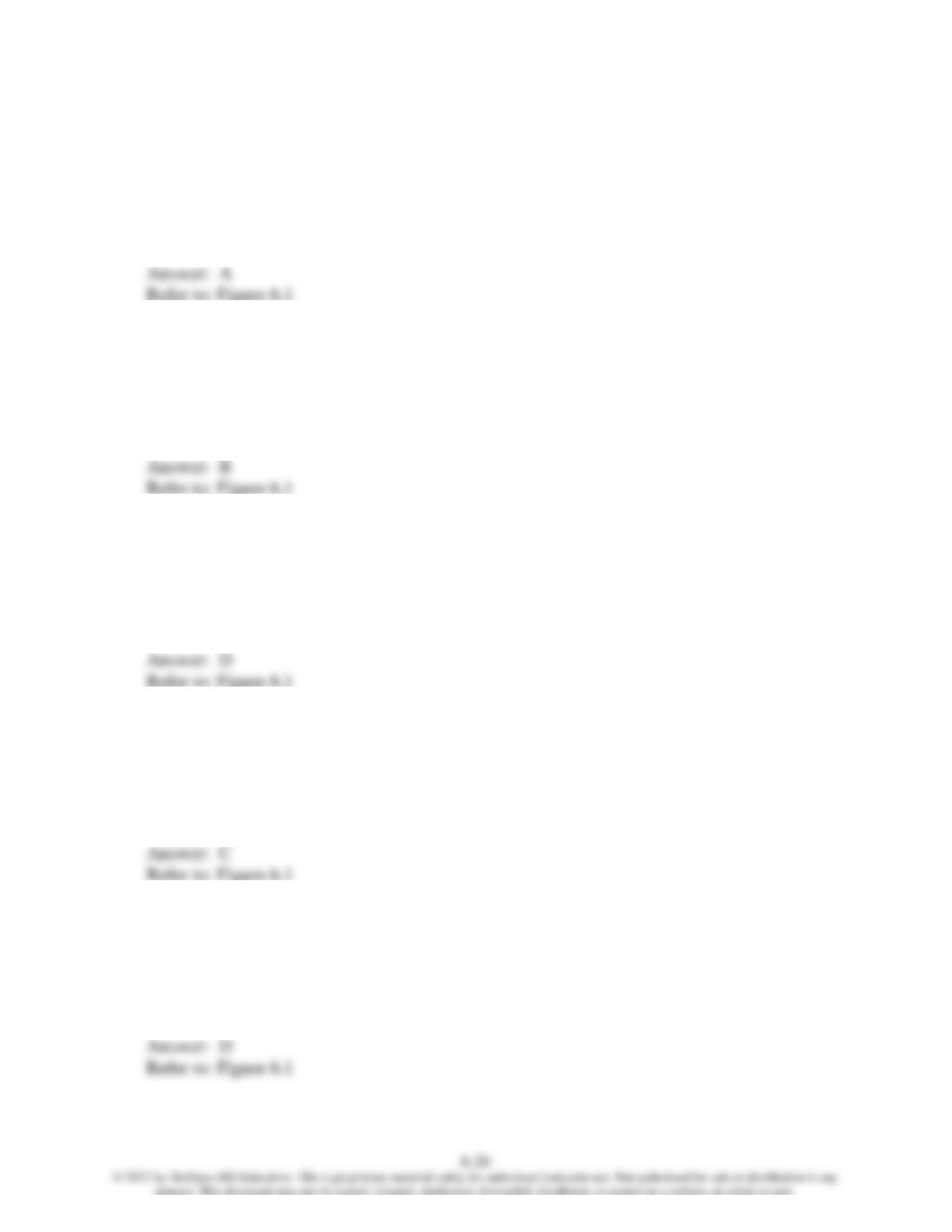
116. In Figure 6.1, which area represents a peak?
A) A
B) B
C) C
D) D
117. In Figure 6.1, which area represents a recession?
A) A
B) B
C) C
D) D
118. In Figure 6.1, which area represents an expansion?
A) A
B) C
C) D
D) E
119. In Figure 6.1, which area represents a trough?
A) A
B) B
C) C
D) D
120. In Figure 6.1, which area represents a recovery?
A) A
B) B
C) C
D) D
Chapter 06 – Every Macroeconomic Word You Ever Heard: Gross Domestic Product, Inflation, Unemployment,
Recession, and Depression
121. The period of growth from a trough that brings Real GDP back to its previous peak is called
a
A) recession.
B) recovery.
C) expansion.
122. The period of growth from the level of the previous peak to a new peak in Real GDP is
called a
A) recession.
B) recovery.
C) expansion.
123. The period of negative growth in Real GDP is called a
A) recession.
B) recovery.
C) expansion.
124. If Real GDP contracted by more than 10%, economists would label that a
A) Recession.
B) Expansion.
C) Recovery.
D) Depression.
125. A double-dip recession occurs when
A) a recession is twice as long as a typical recession.
B) a recession results in twice the reduction in Real GDP as a typical recession.
C) shortly after coming out of a recession, the economy falls back into another one.
D) a recession results in twice the increase in unemployment as a typical recession.
126. Economic contractions during the period from 1950 to 2007
A) were deeper (in terms of Real GDP) than prior contractions.
B) produced larger increases in unemployment than did prior contractions.
C) were shorter than prior contractions.
D) were more frequent than prior contractions.

Chapter 06 – Every Macroeconomic Word You Ever Heard: Gross Domestic Product, Inflation, Unemployment,
Recession, and Depression
127. Economic contractions during the period from 1950 to 2007
A) were deeper (in terms of Real GDP) than prior contractions.
B) produced larger increases in unemployment than did prior contractions.
C) were longer than prior contractions.
D) were less frequent than prior contractions.
128. Since the end of World War II, the rate of growth during expansions
A) has been rising.
B) has been falling.
C) is about what it was prior to World War II.
D) constant.
129. The period from 1984-2007 has been labeled
A) the Great Depression.
B) the Great Moderation.
C) the Great Slow Down.
D) the Great Recession.
130. The recession of 2007-2009 has been
A) typical of post-World War II recessions.
B) one of (if not) the worst post-World War II recession.
C) less severe than most post-World War II recessions.
131. A depression is different from a recession in that
A) a recession is much worse.
B) a depression is much worse.
C) a recession has inflation and a depression does not.
D) a depression has inflation and a recession does not.
132. As women entered the force in the 1950s through the 1990s, the
A) unemployment rate steadily rose.
B) unemployment rate steadily fell.
C) labor for participation rate steadily fell.
D) labor for participation rate steadily rose.

Chapter 06 – Every Macroeconomic Word You Ever Heard: Gross Domestic Product, Inflation, Unemployment,
Recession, and Depression
133. As the baby boom starts to retire, you would expect to see the
A) unemployment rate steadily rise.
B) unemployment rate steadily fell.
C) labor for participation rate steadily fell.
D) labor for participation rate steadily rise.
134. The highest post World War II unemployment rate occurred
A) in 1974.
B) in 1982.
C) in 2001.
D) in 2009.
135. Which of the following can make the unemployment rate fall?
A) An increase in the number of people who are looking for work.
B) A decrease in the number of people who are looking for work.
C) An increase in the number of people with jobs.
D) A decrease in the number of people who are looking for work and an increase in the
number of people with jobs.
136. Which of the following can make the unemployment rate rise?
A) A decrease in the number of people who are looking for work.
B) An increase in the number of people who are looking for work.
C) A decrease in the number of people with jobs.
D) An increase in the number of people who are looking for work and an decrease in the
number of people with jobs.
137. If the unemployment rate falls because the number of people not working but searching for
work falls, economists would attribute this to the
A) fallacy of composition.
B) encouraged worker effect.
C) discouraged worker effect.
D) none of the options are correct.

Chapter 06 – Every Macroeconomic Word You Ever Heard: Gross Domestic Product, Inflation, Unemployment,
Recession, and Depression
138. If the unemployment rate rises because the number of people not working but searching for
work rises, economists would attribute this to the
A) fallacy of composition.
B) encouraged worker effect.
C) discouraged worker effect.
D) none of the options are correct.
139. If a person is laid-off from a job and told that they will be brought back as soon as the
economy picks up and demand for their product rises, then economists call this person
A) underemployed.
B) structurally unemployed.
C) frictionally unemployed.
D) cyclically unemployed.
140. If a person is unemployed because their industry has moved to another country, economists
refer to the person as
A) underemployed.
B) structurally unemployed.
C) frictionally unemployed.
D) cyclically unemployed.
141. A 15 year old that wants a job but can’t find one is
A) underemployed.
B) unemployed.
C) not counted at all.
D) cyclically unemployed.
142. In 2005, General Motors announced a 20% reduction in its staffing levels and the closure of
many assembly plants. Those laid off as a result would likely be classified as
A) seasonally unemployed.
B) frictionally unemployed.
C) cyclically unemployed.
D) structurally unemployed.

Chapter 06 – Every Macroeconomic Word You Ever Heard: Gross Domestic Product, Inflation, Unemployment,
Recession, and Depression
143. With 125 million people working, 8 million out of work and looking for work, and 147
million neither working nor looking for work the unemployment rate would be
A) 6.4% (8/125)*100%.
B) 2.9% (8/(125+8+147)*100%.
C) 6.0% (8/(125+8)*100%.
D) 55.5% (8+147)/(125+8+147)*100%.
144. With 125 million people working, 8 million out of work and looking for work, and 147
million neither working nor looking for work, the “discouraged worker effect” would be
illustrated by people in the
A) 125 million losing their jobs.
B) 8 million giving up in their search for work.
C) 147 million seeking and attaining employment.
D) 147 million seeking but not attaining employment.
145. With 125 million people working, 8 million out of work and looking for work, and 147
million neither working nor looking for work, the “encouraged worker effect” would be
illustrated by people in the
A) 125 million losing their jobs.
B) 8 million ending their search for work.
C) 147 million seeking and attaining employment.
D) 147 million seeking but not attaining employment.
146. With 125 million people working, 8 million out of work and looking for work, and 147
million neither working nor looking for work, “underemployment” would be illustrated by
A) 125 million losing their jobs.
B) 8 million ending their search for work.
C) part of the 125 million holding part time jobs when they were qualified for only part-
time jobs.
D) part of the 125 million holding part time jobs when they were qualified for full-time
jobs.

Chapter 06 – Every Macroeconomic Word You Ever Heard: Gross Domestic Product, Inflation, Unemployment,
Recession, and Depression
147. With 125 million people working, 8 million out of work and looking for work, and 147
million neither working nor looking for work, “underemployment” would be illustrated by
A) 125 million losing their jobs.
B) 8 million ending their search for work.
C) part of the 125 million holding low-skill jobs when they were qualified for only low-
skill jobs.
D) part of the 125 million holding low-skill jobs when they were qualified for high-skill
jobs.
148. Which of the following can make the unemployment rate fall?
A) An increase in the number of people neither working nor looking for work.
B) A decrease in the number of people who are looking for work.
C) An increase in the number of people with jobs.
D) A decrease in the number of people who are looking for work and an increase in the
number of people with jobs.
149. Which of the following can make the unemployment rate rise?
A) A decrease in the number of people neither working nor looking for work.
B) An increase in the number of people who are looking for work.
C) A decrease in the number of people with jobs.
D) An increase in the number of people who are looking for work and a decrease in the
number of people with jobs.
150. If the unemployment rate falls because the number of people not working but searching for
work falls, economists would attribute this to the
A) fallacy of composition.
B) discouraged worker effect.
C) encouraged worker effect.
D) none of the above
151. If the unemployment rate rises because the number of people not working but searching for
work rises, economists would attribute this to the
A) fallacy of composition.
B) discouraged worker effect.
C) encouraged worker effect.
D) none of the options are correct.

Chapter 06 – Every Macroeconomic Word You Ever Heard: Gross Domestic Product, Inflation, Unemployment,
Recession, and Depression
152. To an economist a “market basket” is made up of
A) the goods average people buy and the quantities in which they buy them.
B) the goods people should buy and the quantities they should buy them in.
C) only things like cars and not services like cell phone service.
D) the goods and services people will buy next year.
153. A price index
A) is a mechanism to compare all prices in two different years.
B) is the ratio of the price of a market basket in one year to the price of the market basket in
the previous year times 100.
C) is the ratio of the price of a market basket in one year to the price of the market basket in
a base year times 100.
D) is a mechanism to compare all prices in two different years and the ratio of the price of a
market basket in one year to the price of the market basket in the previous year times
100.
154. The inflation rate is
A) the percentage increase in the price index from one year to the next.
B) the percentage increase in the price index from the base year.
C) the price index in one year minus the price index in the previous year.
D) the percentage increase in the price index from one year to the next as well as the price `
index in one year minus the price index in the previous year.
155. Real Gross Domestic Product is Gross Domestic Product
A) after eliminating sales of intangible things like services.
B) adjusted for inflation.
C) adjusted for changes in interest rates.
D) adjusted for the impact of pollution.
156. If a person is laid-off from a job and told that they will be brought back as soon as the
economy picks up and demand for their product rises, then economists call this person.
A) underemployed.
B) frictionally unemployed.
C) structurally unemployed.
D) cyclically unemployed.

Chapter 06 – Every Macroeconomic Word You Ever Heard: Gross Domestic Product, Inflation, Unemployment,
Recession, and Depression
157. If a person is unemployed because their industry has moved to another country, economists
refer to the person as
A) underemployed.
B) frictionally unemployed.
C) structurally unemployed.
D) cyclically unemployed.
158. A 15 year old that wants a job but can’t find one is
A) underemployed.
B) not included at all in the unemployment rate.
C) unemployed.
D) cyclically unemployed.
159. Of these, economists consider this the worst
A) inflation of 5%.
B) recession.
C) deflation of 5%.
D) depression.
160. On a graph of real gross domestic product over time, recessions appear as
A) relatively short and shallow drops on an otherwise increasing path.
B) long, sharp declines on an otherwise increasing path.
C) the dips on a path that increases and decreases equally.
D) the periods where the rate of grow, while still positive, slows.
161. The BLS has recently made explicit adjustments in its CPI calculations to control for
A) consumer electronics quality improvement issue.
B) food safety quality issues.
C) substitution between goods.
D) purchase location adjustments.

Chapter 06 – Every Macroeconomic Word You Ever Heard: Gross Domestic Product, Inflation, Unemployment,
Recession, and Depression
162. The BLS has recently made explicit adjustments in its CPI calculations to control for
A) issues relating to the frequency of market basket updates.
B) food safety quality issues.
C) substitution between goods.
D) purchase location adjustments.
163. The device used by the BLS to adjust the market basket more frequently while still retaining
the ability to make inflation calculations is
A) chain-mail indexing.
B) envelop indexing.
C) chain-based indexing.
D) automatic indexing.
164. The adjustments made recently by the BLS to mitigate the overstatement of the cost-of-
living by the CPI
A) completely eliminated the problem.
B) over compensated for the problem.
C) reduced the estimated overstatement from 1.1% to .8%.
D) had no impact on the problem.
165. 1A price index based upon the items purchased by firms is the
A) PCE.
B) CPI.
C) core PCE.
D) Producer Price Index.
166. 101. A consumer price index that has had the impact of food and energy prices removed is
the
A) PCE.
B) CPI.
C) core CPI.
D) Producer Price Index.

Chapter 06 – Every Macroeconomic Word You Ever Heard: Gross Domestic Product, Inflation, Unemployment,
Recession, and Depression
167. When estimating GDP using the income approach, aggregate income is adjusted by
A) subtracting depreciation.
B) subtracting net income earned abroad.
C) adding net income earned abroad.
D) subtracting indirect business taxes.
168. When estimating GDP using the income approach, aggregate income is adjusted by
A) adding depreciation.
B) adding net income earned abroad.
C) subtracting indirect business taxes.
D) subtracting depreciation.
169. When estimating GDP using the income approach, aggregate income is adjusted by
A) adding net income earned abroad.
B) subtracting depreciation.
C) subtracting indirect business taxes.
D) adding indirect business taxes.
170. If members of the labor force who had been classified as “unemployed” fail to find a
suitable job and stop looking for work, their decision tends to make the unemployment rate
A) decrease as the labor force decreases.
B) decrease as the labor force increases.
C) increase as the labor force decreases.
D) increase as the labor force increases.
171. When recent college graduates begin looking for their first professional work in June, the
unemployment rate
A) decreases as the labor force increases.
B) increases as the labor force increases.
C) decreases as the labor force decreases.
D) increases as the labor force decreases.

Chapter 06 – Every Macroeconomic Word You Ever Heard: Gross Domestic Product, Inflation, Unemployment,
Recession, and Depression
172. Traditionally, a recession of defined by declining Real GDP over a period of at least
A) one calendar quarter.
B) one calendar year.
C) two consecutive calendar quarters.
D) two consecutive calendar years.
173. In the recession of 2007-2009, the National Bureau of Economic Research’s Business Cycle
Dating Committee
A) applied the traditional definition of a recession, marking the beginning in late 2007.
B) applied the traditional definition of a recession, but marking the beginning only in early
2009.
C) ignored the traditional definition of a recession, claiming that no recession had in fact
occurred.
D) ignored the traditional definition of a recession, marking the beginning in late 2007.
174. An educated guess at what the price of some good might be, based upon its characteristics,
is called
A) an hedonic price.
B) a manufacturer’s suggested retail price (MSRP).
C) an inflated price.
D) a market equilibrium price.
175. One major source of difficulty in measuring inflation arises because
A) prices of newly-introduced products typically are held constant after the introductory
period.
B) BLS employees can obtain only hedonic prices from retailers.
C) improvements in product quality are usually associated with increased prices.
D) the BLS currently can afford to update its market basket only once every ten years.
176. If GDP is $10 trillion, Personal Consumption Expenditure is $6.5 trillion, Gross Private
Investment is $2.0 trillion, and Government Consumption and Investment Expenditures
together are $2.0 trillion
A) Net Exports are $0.5 trillion.
B) Depreciation is $0.5 trillion.
C) Indirect Business Taxes are $0.5 trillion.
D) Net Exports are -$0.5 trillion.

Chapter 06 – Every Macroeconomic Word You Ever Heard: Gross Domestic Product, Inflation, Unemployment,
Recession, and Depression
177. The GDP Deflator is different than the CPI in that
A) the GDP deflator includes everything while the CPI only includes what average people
buy.
B) the GDP deflator doesn’t include food and energy prices.
C) the CPI includes things businesses buy while the GDP deflator does not.
D) the CPI is chain-based.
178. The GDP Deflator is different than the CPI in that
A) the GDP deflator uses last year’s prices and the present year’s production whereas the
CPI uses present prices.
B) the GDP deflator doesn’t include food and energy prices.
C) the CPI includes things businesses buy while the GDP deflator does not.
D) the CPI is chain-based.
179. The data on Real GDP shows that
A) real GDP rises and falls. It has tended to rise and fall equally and has remained roughly
constant over time.
B) real GDP rises and falls. It has tended to rise for longer periods and more quickly than it
has fallen and therefore has risen through time.
C) real GDP rises and falls. It has tended to fall for longer periods and more quickly than it
has risen and therefore has fallen through time.
D) Real GDP growth is almost exactly constant
180. One of the reasons that Real Gross Domestic Product is not synonymous with social welfare
is
A) people substitute between goods.
B) things produced by people under 18 are not counted.
C) domestic production (cooking, laundry and such) are not counted.
D) quality has remained steady.
181. One of the reasons that Real Gross Domestic Product is not synonymous with social welfare
is
A) people substitute between goods.
B) things produced by people under 18 are not counted.
C) it ignores the value of leisure.
D) quality has remained steady.

Chapter 06 – Every Macroeconomic Word You Ever Heard: Gross Domestic Product, Inflation, Unemployment,
Recession, and Depression
182. One of the reasons that Real Gross Domestic Product is not synonymous with social welfare
is
A) people substitute between goods.
B) things produced by people under 18 are not counted.
C) it treats all spending the same (spending on military hardware is treated the same as
spending on education).
D) quality has remained steady.
183. One of the reasons that Real Gross Domestic Product is not synonymous with social welfare
is
A) people substitute between goods.
B) things produced by people under 18 are not counted.
C) environmental quality is ignored.
D) quality has remained steady.
184. One of the reasons that Real Gross Domestic Product is not synonymous with social welfare
is
A) people substitute between goods.
B) things produced by people under 18 are not counted.
C) the underground economy (unreported and illegal income and sales) is not counted.
D) quality has remained steady.