17) With capital on the vertical axis and labor on the horizontal axis, vertical isoquants imply that
A) capital and labor are perfect substitutes.
B) capital and labor must be used together in a certain proportion.
C) capital is not productive.
D) labor is not productive.
18) The marginal rate of technical substitution always equals
A) the slope of the total product curve.
B) the ratio of the marginal products of inputs.
C) the change in output due to a change in the amount of one input.
D) the distance between two isoquants.
For the following, please answer “True” or “False” and explain why.
19) Unlike indifference curves, isoquants can intersect.
20) If inputs into production cannot be substituted for each other but have to be employed in fixed
proportions, isoquants are straight, downward–sloping lines.
21) Suppose that additional units of capital affect the marginal productivity of labor. This is not
unrealistic. Word processors increase the marginal productivity of secretaries. On the other hand, robotic
equipment can completely replace a worker and, thereby, lower the marginal productivity of labor. Given
this possibility, determine the conditions under which isoquants will not be convex (i.e.: concave).
22) Suppose the production function for T-shirts can be represented as q = L0.25 K0.75. Show that the
isoquants for this function are convex.
23) Suppose the production function for T-shirts can be represented as q = L0.25 K0.75. When K = 1 and q
= 2, what is the slope of the isoquant? If there is insufficient information to answer the question, describe
what information is needed.
24) Find the Marginal Rate of Technical Substitution for the following production functions:
a. q = L0.5K0.5
b. q = L0.5 + K0.5
c. q = min{K,L}
d. q = L + K
25) In Sewei’s lawnmowing business, in order to produce each mowed lawn, Sewei must hire exactly one
unit of capital (a lawnmower) and exactly one unit of labor. Describe the elasticity of substitution
between labor and capital.
26) Justin’s bank employs tellers and ATMs. Both are able to serve clients in the exact same way and
therefore are perfect substitutes. Describe the elasticity of substitution between the two inputs.
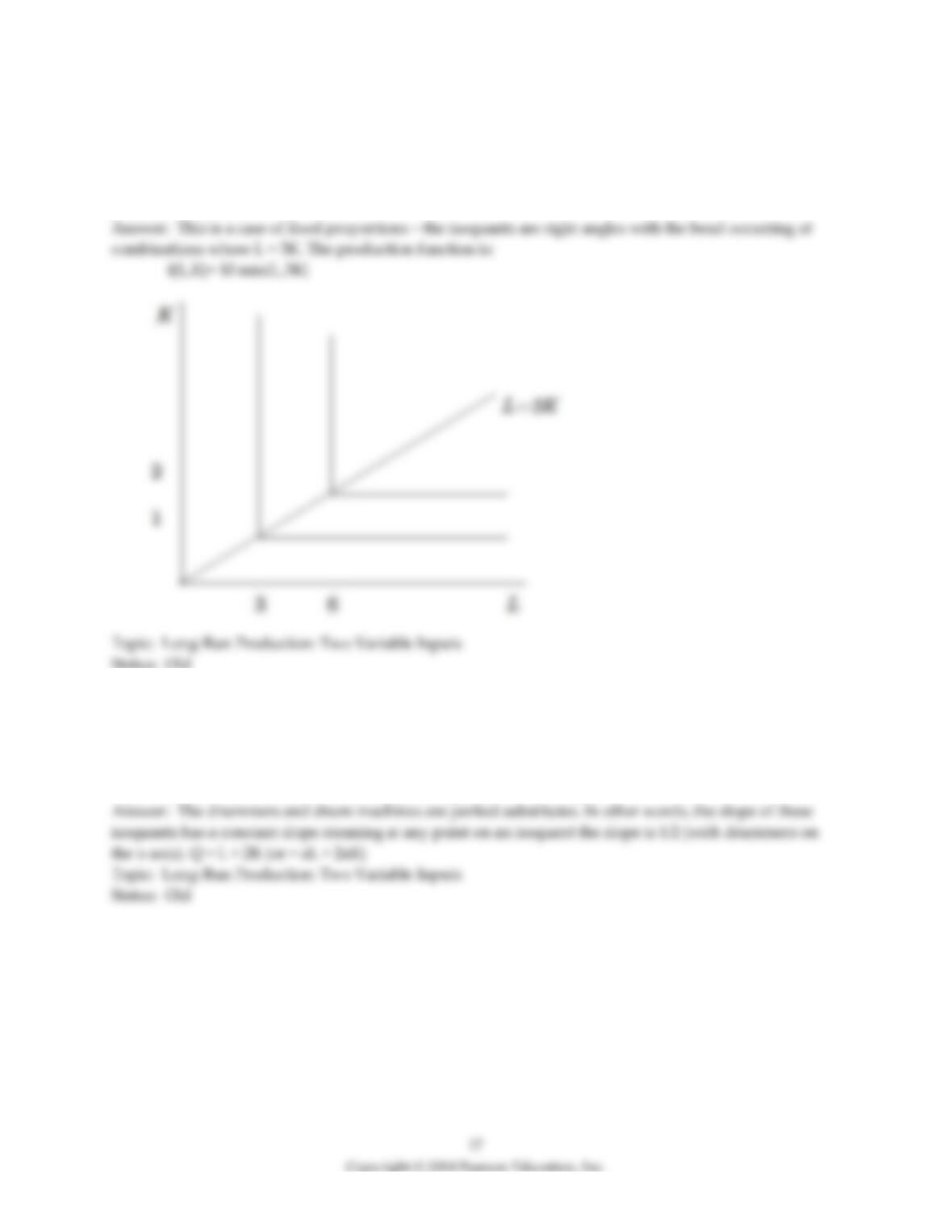
27) Mr. Roche purchases a firm that produces widgets by employing machines and workers. Each
machine requires exactly three workers to operate. Without three workers, the machine will not work,
and any additional worker above three will just stand there doing nothing. When operated this way, the
machine produces 30 widgets an hour. Draw some isoquants for this technology and determine the
production function.
28) JC’s music production company provides artists with studio time and a backing band to record with.
In providing the rhythm track, JC can employ drum machines or drummers. Regardless of the quantity of
output JC produces, he can substitute two drummers with one drum machine—drum machines tire out
less quickly). Draw a few isoquant lines (with numbers) reflecting this production function for the
rhythm track. Determine the function representing this production process.

6.5 Returns to Scale
1) Returns to scale refers to the change in output when
A) all inputs increase proportionately.
B) labor increases holding all other inputs fixed.
C) capital equipment is doubled.
D) specialization improves.
2) Decreasing returns to scale may occur as increasing the amount of inputs used
A) increases specialization.
B) always increases the amount of output produced.
C) may cause coordination difficulties.
D) increases efficiency.
3) Let the production function be q = ALaKb. Returns to scale are equal to
A) a ∗ b.
B) a + b.
C) La + Kb.
D) A ∗ L.
4) Let the production function be q = ALaKb. The function exhibits increasing returns to scale if
A) a + b = 1.
B) a + b > 1.
C) a + b < 1.
D) Cannot be determined with the information given.
5) Let the production function be q = ALaKb. The function exhibits decreasing returns to scale if
A) a + b = 1.
B) a+ b > 1.
C) a + b < 1.
D) Cannot be determined with the information given.

6) Let the production function be q = ALaKb. The function exhibits constant returns to scale if
A) a + b = 1.
B) a + b > 1.
C) a + b < 1.
D) Cannot be determined with the information given.
7) Suppose the production of VCRs can be represented by the following production function:
q = L0.4 K0.4. Which of the following statements is (are) TRUE?
A) The production function has decreasing returns to scale.
B) The marginal productivity of labor falls as labor increases in the short run.
C) Capital and labor can be substituted for one another.
D) All of the above.
8) Suppose the production of VCRs can be represented by the following production function:
q = L0.4 K0.4. Which of the following statements is TRUE?
A) The production function has decreasing returns to scale.
B) The production function has increasing returns to scale.
C) The production function has constant returns to scale.
D) Returns to scale vary with the level of output.
9) Suppose the production of VCRs can be represented by the following production function:
q = L0.4 K0.4. The firm currently produces q1 units. If all inputs doubled, the new level of output will
equal
A) 20.4 q1.
B) 20.8 q1.
C) 0.8 q1.
D) 1.6 q1.
10) Returns to scale is a concept that operates
A) only in the short run.
B) only in the long run.
C) in both the long run and the short run.
D) in either the long run or the short run but never both.
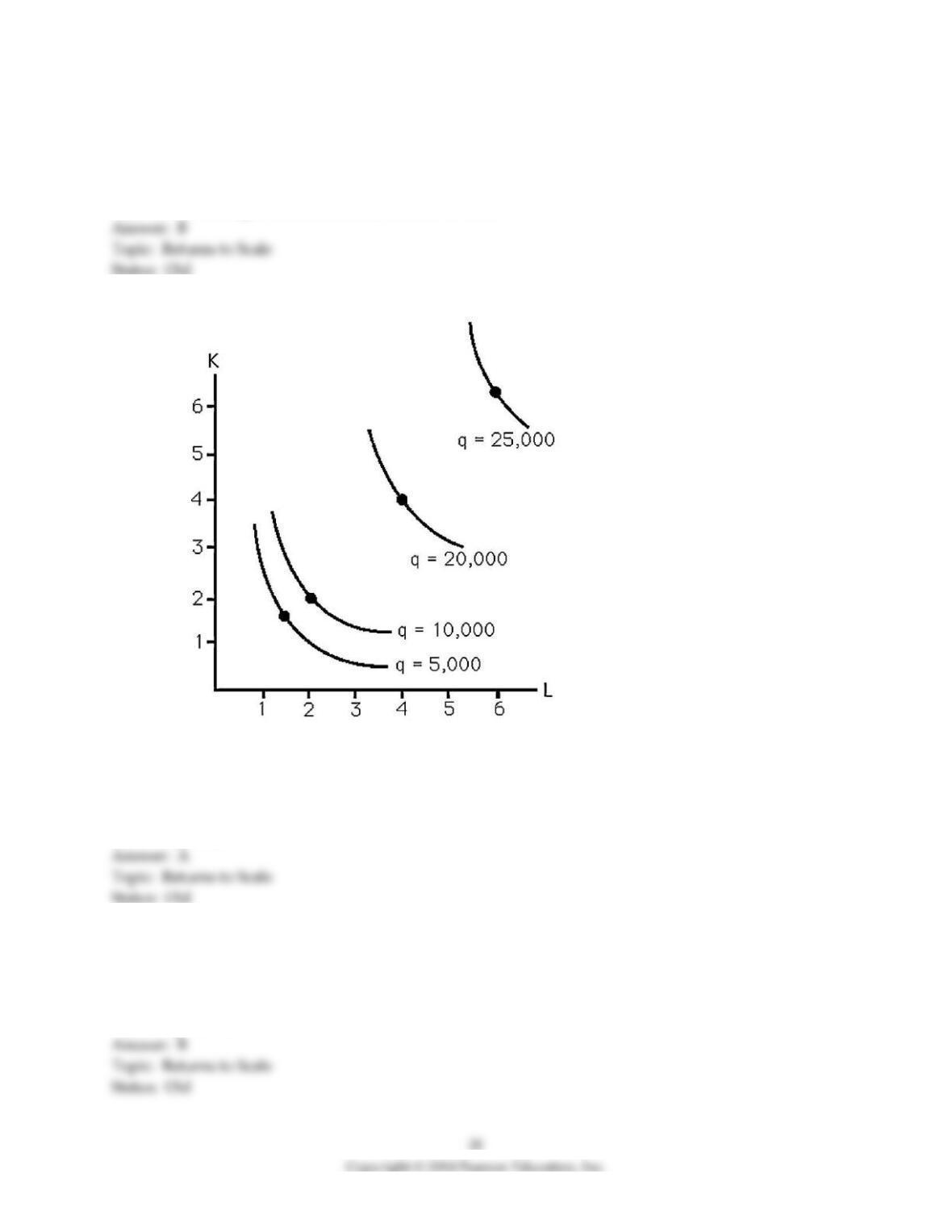
11) The above figure shows the isoquants for producing steel. Increasing returns to scale are
A) present when producing less than 10,000 tons.
B) present when producing less than 20,000 tons.
C) present when producing less than 30,000 tons.
D) never present.
12) The above figure shows the isoquants for producing steel. Decreasing returns to scale are
A) present when producing more than 10,000 tons.
B) present when producing more than 20,000 tons.
C) present when producing more than 30,000 tons.
D) never present.

13) The above figure shows the isoquants for producing steel. Constant returns to scale are
A) present when producing less than 10,000 tons.
B) present when producing between 10,000 and 20,000 tons.
C) present when producing more than 20,000 tons.
D) never present.
14) The above figure shows the isoquants for producing steel. When producing more than 20,000 tons
there are
A) increasing returns to scale.
B) decreasing returns to scale.
C) constant returns to scale.
D) economies of scale.
15) The above figure shows the isoquants for producing steel. When producing less than 10,000 tons there
are
A) increasing returns to scale.
B) decreasing returns to scale.
C) constant returns to scale.
D) diseconomies of scale.
16) The above figure shows the isoquants for producing steel. When producing between 10,000 and
20,000 tons there are
A) increasing returns to scale.
B) decreasing returns to scale.
C) constant returns to scale.
D) economies of scale.
17) The returns to scale of the production function Q = 50 L0.4 K0.2 are
A) 50.
B) .6.
C) .8.
D) 500.6.
18) The production function Q = 0.8X + 0.6Y exhibits
A) increasing return to scale.
B) decreasing returns to scale.
C) constant returns to scale.
D) economies of scale.
For the following, please answer “True” or “False” and explain why.
19) Cobb-Douglas production functions can never possess varying returns to scale.
20) A firm may express increasing, constant and decreasing returns to scale for various levels of output.
21) Show that increasing returns to scale can co-exist with diminishing marginal productivity. To do so,
provide an example of a production function with IRTS and diminishing marginal returns.
22) Suppose the production function for T-shirts can be represented as q = L0.25 K0.75. Show that the
production function has constant returns to scale.
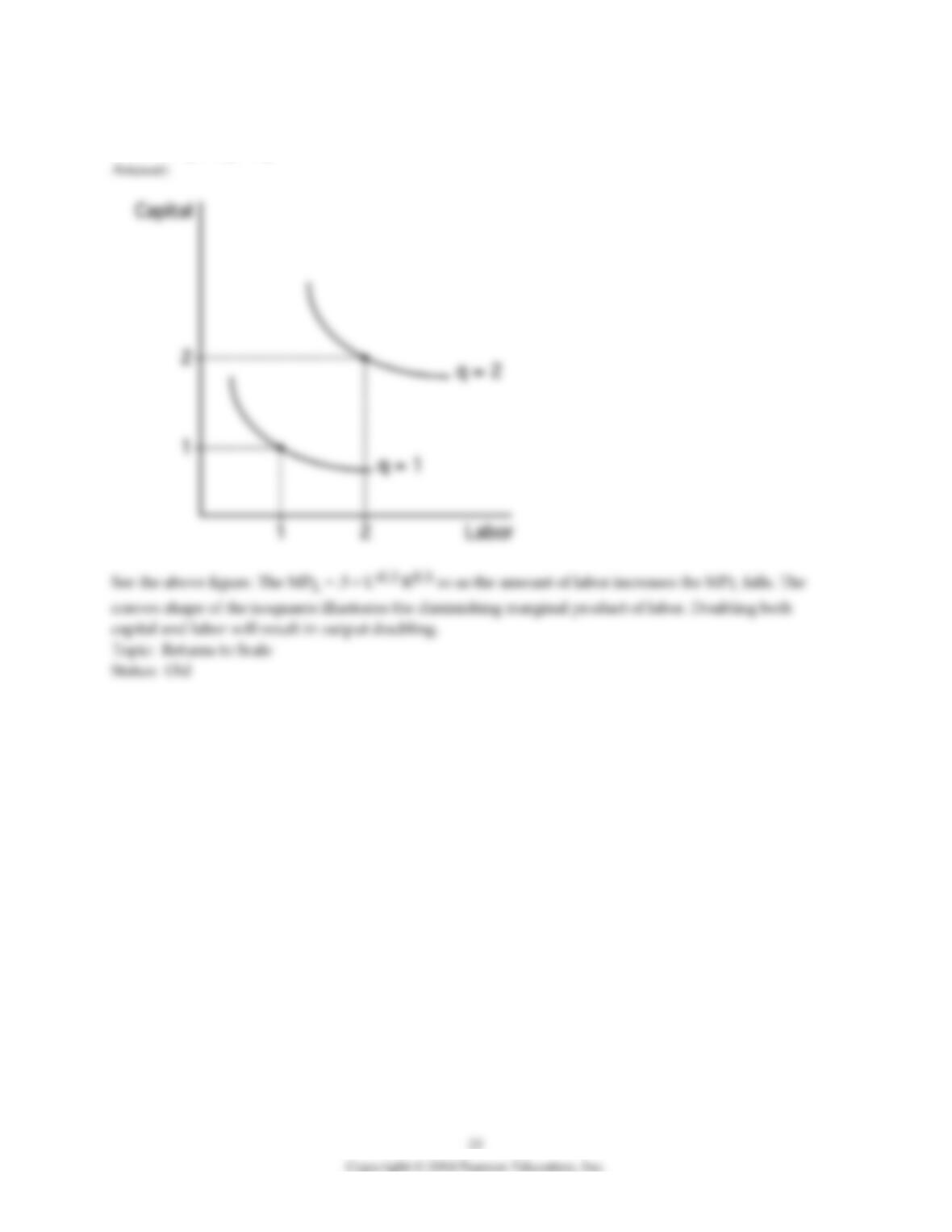
23) Provide a graph and an explanation to show that the production function Q = L0.5 K0.5 has
diminishing marginal product of labor but has constant returns to scale.
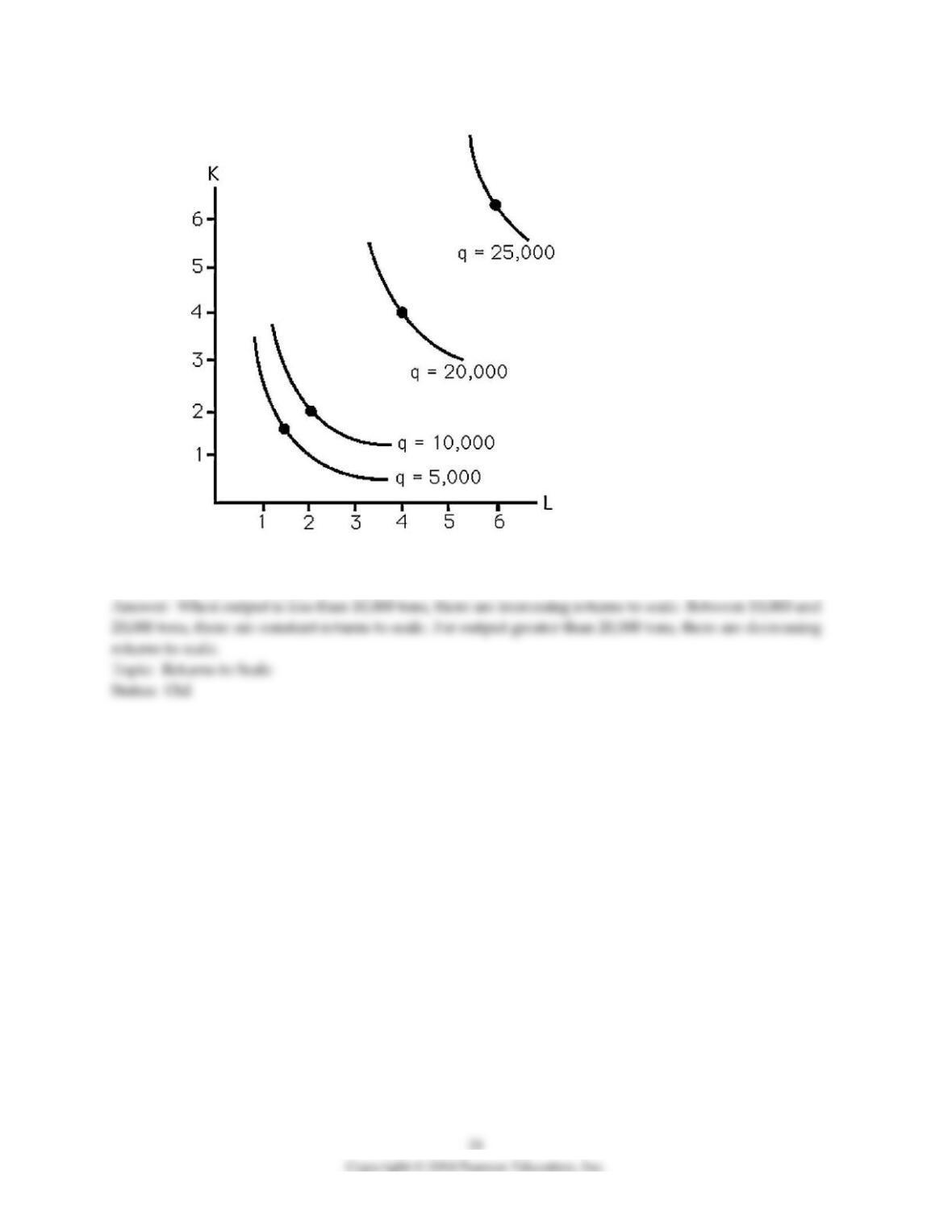
24) The above figure shows the isoquants for the production of steel. In which regions of production are
there increasing, decreasing, and constant returns to scale?
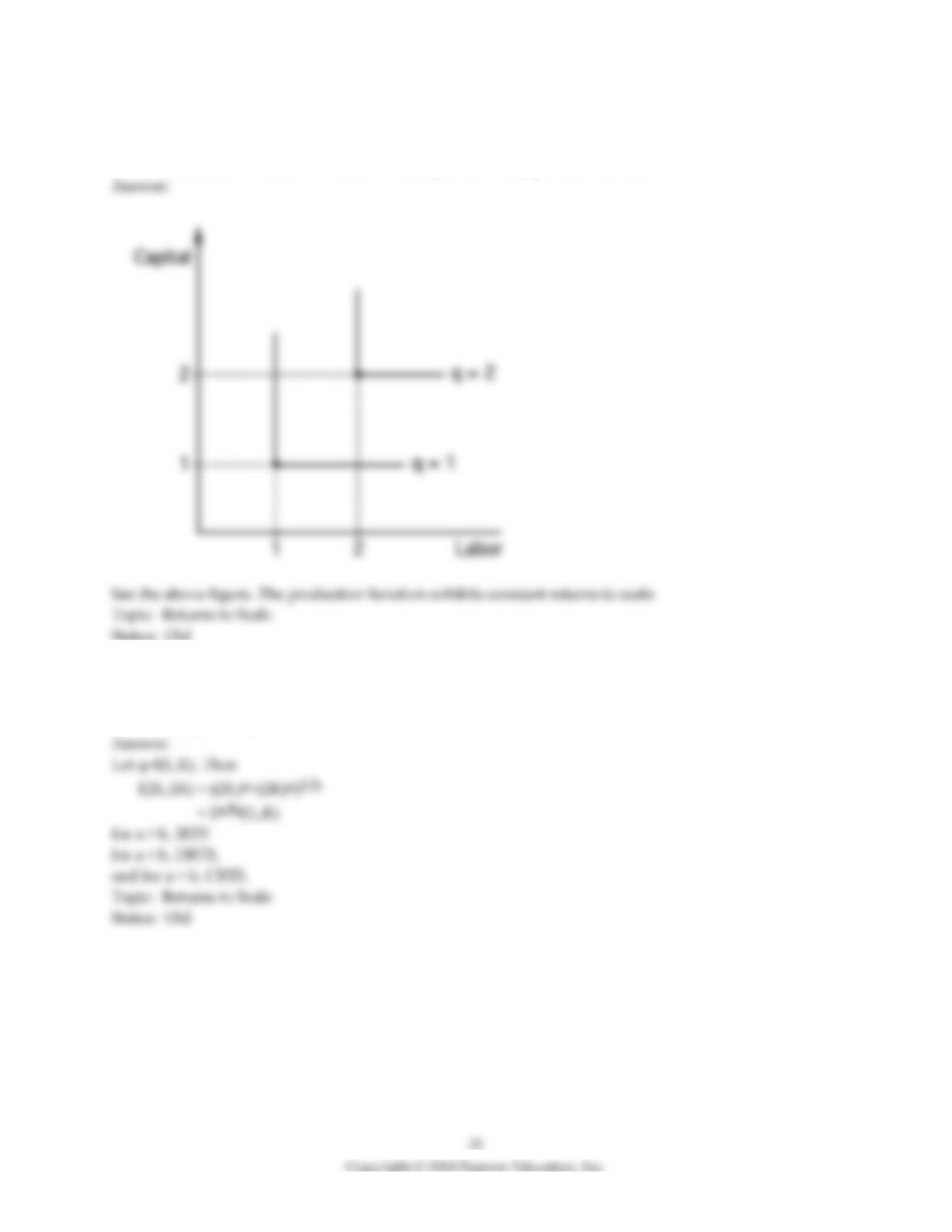
25) Production occurs using the fixed-proportion combination of one worker for every one unit of capital.
Draw the isoquants for this production function. After one unit of output is produced, does this
production function exhibit constant, increasing, or decreasing returns to scale?
26) For what values of a and b will the following production function exhibit increasing, decreasing or
constant returns to scale?
q = (La + Ka)1/b
26
27) A firm has the following production function:
q = (L1/3 + K1/3)3
a. Determine the returns to scale for this function.
b. Determine the MRTS.
c. Determine the Elasticity of Substitution.
6.6 Productivity and Technical Change
1) Joey’s lawncutting service recently traded in its push mowers for gasoline–powered mowers. Joey still
requires one worker per lawnmower; however, more grass is now cut in the same amount of time as
before. This is an example of
A) labor-saving technical change.
B) non-neutral technical change.
C) neutral technical change.
D) organizational change.
2) Suppose the production function for a certain device is q = L + K. If a labor-saving technical change has
occurred, which of the following could be the new production function?
A) q = L + 5K
B) q = 5 ∗ (L + K)
C) q = 5L + K
D) All of the above are possible.
3) Suppose the production function for a certain device is q = L + K. If neutral technical change has
occurred, which of the following could be the new production function?
A) q = L + 5K
B) q = 5 ∗ (L + K)
C) q = 5L + K
D) All of the above are possible.
4) Albert’s Pretzel Baking Company used to have four workers who were each in charge of making their
own pretzels from start to finish. Now, one worker mixes the dough, another shapes it, the third puts the
unbaked pretzels into the oven and the fourth removes the finished product. Output has doubled. This is
an example of
A) neutral technical change.
B) labor-saving technical change.
C) an organizational innovation.
D) economies of scale.
5) Over a five-year span, the ABC Co. reduced the amount of labor it hired. At the same time, the
marginal productivity of labor increased. Which of the following COULD explain this observation?
A) the law of diminishing marginal returns
B) labor saving technical change
C) organizational innovation
D) All of the above.
6) The implementation of the assembly line is an example how
A) changes in the organization of production improve productivity.
B) neutral technical change improves productivity.
C) non-neutral technical change can decrease productivity.
D) labor saving technical change increases economy-wide unemployment.
7) Dell computers has increased production efficiency by
A) producing output with fewer inputs.
B) expanding the amount of inputs used.
C) outsourcing production.
D) relying on decreasing returns to scale.
8) Changing how production is organized cannot result in changes in productivity.
9) Suppose firms A and B each make T-shirts. Firm A‘s production function is q = L0.5 K0.5. Firm B’s
production function is q = 1.2 ∗ L0.5 K0.5. If the two firms each hire the same amounts of capital and
labor, compare the two firms in terms of APL and MPL.
10) Explain how firms that each produce as efficiently as they can, may not be equally productive.