Microeconomics: Theory and Applications with Calculus, 3e (Perloff)
Chapter 6 Firms and Production
6.1 The Ownership and Management of Firms
1) Economists typically assume that the owners of firms wish to
A) produce efficiently.
B) maximize sales revenues.
C) maximize profits.
D) All of the above.
2) An organization that converts inputs (like Labor, Capital etc.) into output is called a
A) firm.
B) sole proprietorship.
C) corporation.
D) All of the above.
3) Efficient production occurs if a firm
A) cannot produce its current level of output with fewer inputs.
B) given the quantity of inputs, cannot produce more output.
C) maximizes profit.
D) All of the above.
4) Limited liability is a benefit to
A) sole proprietorships.
B) partnerships.
C) corporations.
D) All of the above.
5) A firm where owners are usually not managers and not personally liable for the firms’ debts is a
A) sole proprietorship.
B) general partnership.
C) corporation.
D) None of above.
For the following, please answer “True” or “False” and explain why.
6) Only corporations benefit from limited liability.
7) When do we mean by efficient production?
6.2 Production
1) Which of the following statements best describes a production function?
A) the maximum profit generated from given levels of inputs
B) the maximum level of output generated from given levels of inputs
C) all levels of output that can be generated from given levels of inputs
D) all levels of inputs that could produce a given level of output
2) With respect to production, the short run is best defined as a time period
A) lasting about six months.
B) lasting about two years.
C) in which all inputs are fixed.
D) in which at least one input is fixed.

3) In the long run, all factors of production are
A) variable.
B) fixed.
C) materials.
D) rented.
4) Joey cuts grass during the summer. He owns one lawn mower. For him, the short run is equal to
A) the amount of time it takes to acquire more customers.
B) the amount of time it takes to hire an additional employee.
C) the amount of time it takes to hire an additional employee and buy another lawn mower.
D) the amount of time it takes to mow one lawn.
5) Joey cuts grass during the summer. He rents a lawn mower from his dad. Which of the following
statements best illustrates the difference between the short run and the long run for Joey?
A) Joey’s friends say they will help him, but when he calls them, they say they have other things to do.
B) When Joey acquires more customers, he responds by working more hours. Next year, he will buy a
lawn mower and split the work with his brother.
C) Some customers pay Joey immediately; others wait till the following week.
D) Joey has had to turn away some customers because he is already too busy.
6) Automobile manufacturers view the assembly-line workers as
A) capital services.
B) labor services.
C) materials.
D) None of above.
7) For De Beers, the diamond company, diamond mines are ________ for their production.
A) capital services
B) labor services
C) materials
D) None of above.
For the following, please answer “True” or “False” and explain why.
8) The length of the short-run is the same for all firms.
9) Explain why labor might not always be a variable input.
6.3 Short-Run Production: One Variable and One Fixed Input
1) Homer’s Donut Shoppe has the production function q = 10L + 20L2 – 5L3. The marginal product of
labor is
A) MP = 10 + 40L –15L2
B) MP = 10 + 20L –5L2
C) MP = 10L
D) MP = 10 + 20L
2) Homer’s Donut Shoppe has the production function q = 10L +20L2 – 5L3. The average product of labor
is
A) AP = 10 + 20L – 5L2
B) AP = 10 + 40L – 15L2
C) AP = 10L
D) AP = 10 + 20L
3) If the average productivity of labor equals the marginal productivity of labor, then
A) the average productivity of labor is at a maximum.
B) the marginal productivity of labor is at a maximum.
C) Both A and B above.
D) Neither A nor B above.

4) The Average Product of Labor is
A) the change in total product resulting from an extra unit of labor, holding other factors constant.
B) the ratio of output to the number of workers used to produce that output.
C) the amount of output that can be produced by a given amount of labor.
D) equal to the marginal product of labor when the average product is increasing.
5) Total Product is
A) the change in total product resulting from an extra unit of labor, holding other factors constant.
B) the ratio of output to the number of workers used to produce that output.
C) the amount of output that can be produced by a given amount of labor.
D) equal to the marginal product of labor when the average product is increasing.
6) Total product is maximized where
A) average product is maximized.
B) marginal product is maximized.
C) average product is equal to 0.
D) marginal product is equal to 0.
7) The Marginal Product of Labor is
A) the change in total product resulting from an extra unit of labor, holding other factors constant.
B) the ratio of output to the number of workers used to produce that output.
C) the amount of output that can be produced by a given amount of labor.
D) equal to the marginal product of labor when the average product is increasing.
8) Average productivity will fall as long as
A) marginal productivity is falling.
B) it exceeds marginal productivity.
C) it is less than marginal productivity.
D) the number of workers is increasing.

9) If the marginal productivity of labor is constant for all levels of output, then the average productivity
of labor
A) is constant.
B) equals the marginal productivity of labor.
C) Both A and B above.
D) Either A or B above but not both.
10) Joey cuts lawns during the summer. Let q equal the number of acres mowed per day, and let L equal
the number of hours worked per day. Joey never works more than eight hours per day, and during that
time his short-run production function is q = 0.2 ∗ L. Which of the following statements is FALSE?
A) Joey’s marginal productivity equals his average productivity.
B) Joey’s marginal productivity diminishes by 0.2 for each additional hour worked.
C) Joey’s average productivity is constant.
D) Joey’s marginal productivity is constant.
11) At any given point on the curve, the slope of the total product curve always equals
A) the ratio of the marginal product and the average product.
B) the change in input divided by the change in output.
C) the average product of the input.
D) the marginal product of the input.
12) If marginal productivity is increasing, then total product is
A) increasing at an increasing speed.
B) increasing at a constant speed.
C) increasing at a decreasing speed.
D) decreasing at an increasing speed.
13) When diminishing marginal returns set in, total product will
A) increase at an increasing speed.
B) increase at a decreasing speed.
C) decrease at an increasing speed.
D) decrease at a decreasing speed.

14) The slope of the line from the origin to a given point on the curve equals
A) the increase in output.
B) the change in input divided by the change in output.
C) the average product of the input.
D) the marginal product of the input.
15) Which of the following statements best summarizes the law of diminishing marginal returns?
A) In the short run, as more labor is hired, output diminishes.
B) In the short run, as more labor is hired, output increases at a diminishing rate.
C) In the short run, the amount of labor a firm will hire diminishes as output increases.
D) As more labor is hired, the length of time that defines the short run diminishes.
16) Which situation is most likely to exhibit diminishing marginal returns to labor?
A) a factory that obtains a new machine for every new worker hired
B) a factory that hires more workers and never increases the amount of machinery
C) a factory that increases the amount of machinery and holds the number of worker constant
D) None of these situations will result in diminishing marginal returns to labor.
17) Thomas Malthus’ prediction of mass starvation resulting from diminishing marginal returns has not
been fulfilled because
A) the law of diminishing marginal returns did not hold in this case.
B) Malthus ignored other factors like technological change.
C) relative to Malthus’ day, a larger percentage of today’s labor works in the agricultural sector.
D) All of the above.
For the following, please answer “True” or “False” and explain why.
18) Were it not for the law of diminishing marginal returns, we could grow the world’s food supply from
a flowerpot.
19) A firm operating with diminishing total returns cannot be profit maximizing.
20) The actual time length of the short run is determined by when diminishing marginal returns start.
21) If marginal productivity is decreasing as more labor is hired, then average productivity must be
decreasing as well.
22) At low levels of production, marginal productivity of labor increases as labor increases. At high levels
of production, marginal productivity of labor decreases as labor increases. Are these two statements
contradictory? Explain.
23) Explain the difference between diminishing returns to labor and diminishing marginal returns to
labor.
24) Each additional worker produces two extra units of output until the first three units are produced for
some production function. After the third unit is produced each additional worker produces one extra
unit of output. What are the total product of labor, average product of labor and marginal product of
labor for the first five units of production associated with this production function?
25) Consider the following short-run production function: q = 5L2 – 1/3 L3. At what level of L do
diminishing marginal returns begin? At what level of L do diminishing returns begin?
26) Describe the relationship between marginal productivity and average productivity. Use calculus or a
graph to support your answer.
27) Suppose the production function for T-shirts can be represented as q = L0.25 K0.75. Show that the
marginal productivity of labor diminishes in the short run.
28) Blowdryer businessman Max Power is starting a new hairdryer business. Max estimates his
production function to be q=KL0.5. Max has 60 units of capital (K=60). Derive Max’s MP and AP of labor
for the current level of capital.
29) A small firm in Indonesia has the following estimated production function:
ln(q) = 10 + 2.6ln(L) – 0.4(ln(L))2
Derive the firm’s marginal and average product of labor as functions of q and L. What is the elasticity of
output with respect to labor?
30) Ed’s building company has the following production function
q = 20L – L2
where q is the number of houses built and L is the quantity of labor Ed employs.
a. Derive the MP and AP.
b. For what values of L is the MP>0? For what values of L is the MP diminishing?
c. Draw the MP and AP on a graph.
6.4 Long-Run Production: Two Variable Inputs
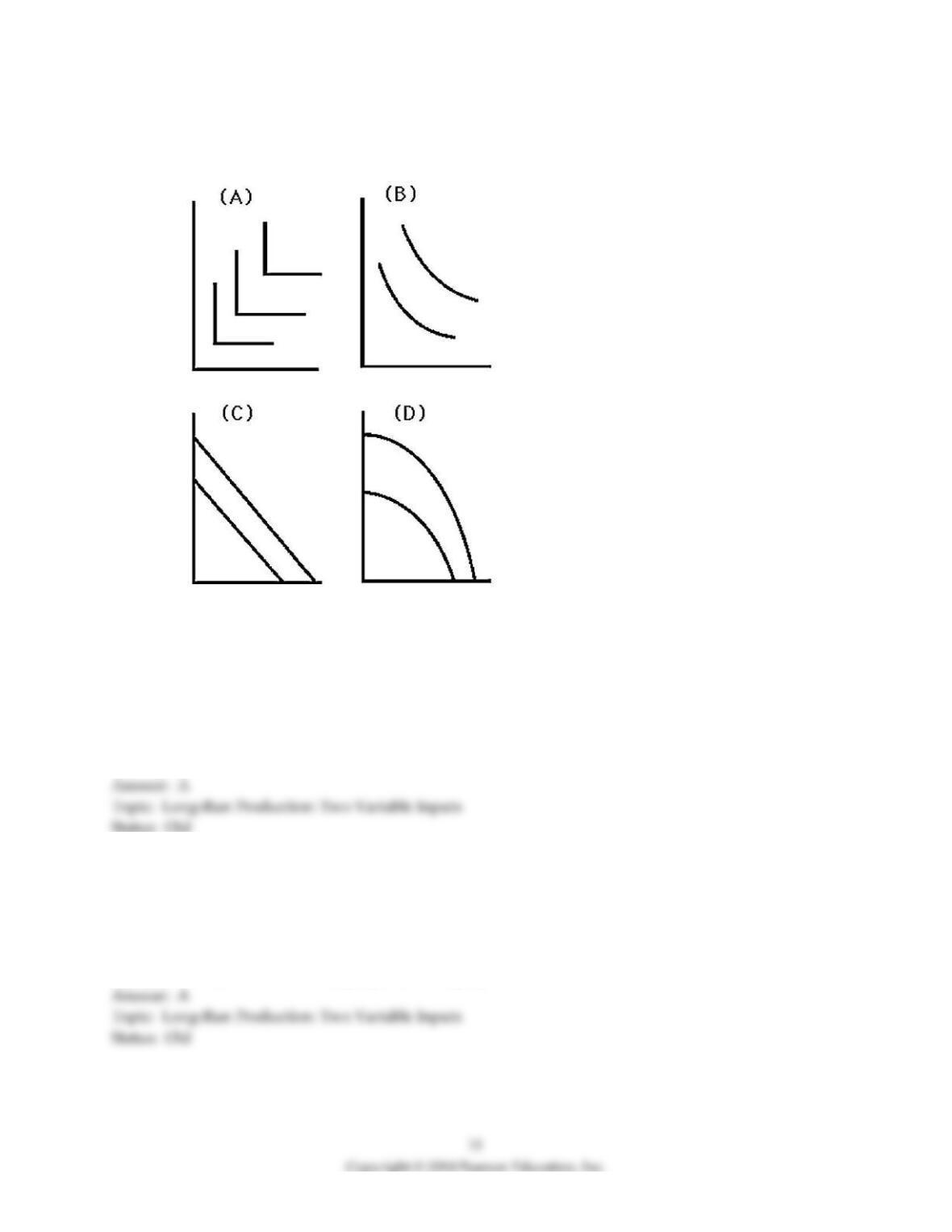
1) At Joey’s Lawncutting Service, a lawn mower cannot cut grass without a laborer. A laborer cannot cut
grass without a lawn mower. Which graph in the above figure best represents the isoquants for Joey’s
Lawncutting Service when capital per day is on the vertical axis and labor per day is on the horizontal
axis?
A) Graph A
B) Graph B
C) Graph C
D) Graph D
2) In the above figure, Graph D with Capital on the vertical axis and labor on the horizontal axis implies
that
A) the marginal product of labor is increasing as more labor is employed.
B) the marginal product of labor is decreasing as more labor is employed.
C) the capital and labor are perfect substitutes.
D) capital and labor have to be employed in fixed proportions.

3) The production function for hamburgers can be written as q = 0.1X + 0.1Y, where X is Canadian ground
beef and Y is U.S. beef, both measured in pounds. Which graph in the figure best represents the isoquants
for the hamburger production when U.S. ground beef is on the vertical axis and Canadian ground beef is
on the horizontal axis?
A) Graph A
B) Graph B
C) Graph C
D) Graph D
4) At Joey’s Lawncutting Service, the production function is represented as: q = min(m, l), where q is the
quantity of lawns mowed. The inputs are m, the lawn mower, and l, the laborer. Which graph in the
above figure best represents the isoquants for Joey’s Lawncutting Service when capital per day is on the
vertical axis and labor per day is on the horizontal axis?
A) Graph A
B) Graph B
C) Graph C
D) Graph D
5) Lectures in microeconomics can be delivered either by an instructor (labor) or a movie (capital) or any
combination of both. Each minute of the instructor’s time delivers the same amount of information as a
minute of the movie. Which graph in the above figure best represents the isoquants for lectures in
microeconomics when capital per day is on the vertical axis and labor per day is on the horizontal axis?
A) Graph A
B) Graph B
C) Graph C
D) Graph D
6) Lectures in microeconomics can be delivered either by an instructor (labor) or a movie (capital) or any
combination of both. Yet the it gets harder and harder to substitute more movies for an instructor the
more movies are already used. Which graph in the above figure best represents the isoquants for lectures
in microeconomics when capital per day is on the vertical axis and labor per day is on the horizontal axis?
A) Graph A
B) Graph B
C) Graph C
D) Graph D

13
7) Which graph in the above figure represents the isoquants where, as the amount of labor used increases
and the amount of capital used decreases, the marginal product of labor rises when capital per day is on
the vertical axis and labor per day is on the horizontal axis?
A) Graph A
B) Graph B
C) Graph C
D) Graph D
8) To say that isoquants are convex is to say that
A) the marginal rate of technical substitution falls as labor increases.
B) capital and labor are perfect substitutes.
C) labor, but not capital, is subject to the law of diminishing marginal returns.
D) there are constant returns to scale.
9) One way to explain the convexity of isoquants is to say that
A) as labor increases and capital decreases, MPL rises while MPK falls.
B) as labor increases and capital decreases, MPL falls while MPK rises.
C) as labor increases and capital decreases, MPL and MPK both fall.
D) as labor increases and capital decreases, MPL and MPK both rise.
10) An isoquant represents levels of capital and labor that
A) have constant marginal productivity.
B) yield the same level of output.
C) incur the same total cost.
D) All of the above.
11) Suppose the production of paved roadways can be represented as q = L0.5 + K0.5. Which of the
following statements is (are) TRUE?
A) Labor is subject to diminishing marginal productivity in the short run.
B) Labor and capital are imperfect substitutes.
C) The isoquants for paved roadways are convex.
D) All of the above.

12) L-shaped isoquants imply that production requires that the inputs
A) are perfect substitutes.
B) are imperfect substitutes.
C) cannot be used together.
D) must be used together in a certain proportion.
13) Isoquants that are downward-sloping straight lines imply that the inputs
A) are perfect substitutes.
B) are imperfect substitutes.
C) cannot be used together.
D) must be used together in a certain proportion.
14) Isoquants that are downward-sloping straight lines exhibit
A) an increasing marginal rate of technical substitution.
B) a decreasing marginal rate of technical substitution.
C) a constant marginal rate of technical substitution.
D) a marginal rate of technical substitution that cannot be determined.
15) The slope of an isoquant tells us
A) how much output increases when both inputs are increased.
B) the increase in MPL when capital increases.
C) the decrease in capital necessary to keep output constant when labor increases by one unit.
D) the decrease in capital necessary to keep MPL constant when labor increases by one unit.
16) The steeper an isoquant is,
A) the greater is the marginal productivity of labor relative to that of capital.
B) the greater is the substitutability between capital and labor.
C) the greater is the need to keep capital and labor in fixed proportions.
D) the greater is the level of output.