Chapter 06 – Consumer Behavior (+ Appendix)
6-1
CHAPTER 6
Consumer Behavior (+ Appendix)
A. Short-Answer, Essays, and Problems
1. Describe the law of diminishing marginal utility. On what assumptions is this law based?
2. What is the difference between total utility and marginal utility?
3. Can marginal utility be negative? Briefly explain with an example.
4. Fill in the following table on the total and marginal utilities of a certain product A. Use your results to
answer the following questions.
Units of
product A Total utility Marginal utility
0 0
1 20 _____
2 35 _____
3 _____ 10
4 _____ 5
5 _____ 0
6 45 _____
7 35 _____
8 _____ −15
(a) Graph both the total utility and marginal utility curves together on the same graph.
(b) Explain the shape of both of the curves.
(c) Identify the point where utility is maximized on both curves. Discuss the reasoning behind each value.
5. (Consider This) Why does a newspaper dispenser open to a stack of newspapers and essentially “trusts” a
consumer to take just one copy whereas a soft drink vending machine does not “trust” consumers and
dispenses one can for each purchase?
6. Describe how marginal utility and demand are related.
7. Give a brief description of the law of diminishing marginal utility and use it to explain the downward slope
of the demand curve.
8. What are the four dimensions of the typical consumer’s situation?
9. Explain the utility maximizing rule for two products in words and using algebra.
10. Why is it not sufficient to just compare the marginal utility of two goods when maximizing utility?
11. Assume that a consumer purchases a combination of products A and B. The MUa is 5 and the Pa is $5.
The MUb is 6 and the Pb is $6. What should this consumer do to maximize utility?
12. Assume that a consumer purchases a combination of products Y and Z. The MUy is 50 and the Py is $25.
The MUz is 20 and the Pz is $5. What should this consumer do to maximize utility?
Chapter 06 – Consumer Behavior (+ Appendix)
6-2
13. Columns 1 through 3 in the table below show the marginal utility which a particular consumer would get
by purchasing various quantities of products A, B, and C.
Unit of product (1)
Marginal utility, A (2)
Marginal utility, B (3)
Marginal utility, C
First 18 39 12
Second 16 36 10
Third 14 33 9
Fourth 12 30 8
Fifth 10 27 7
Sixth 8 24 5
Seventh 6 21 3
If the prices of A, B, and C are $2, $3, and $1, respectively, and the consumer has $26 to spend on these
three products, what combination of the three products should be purchased in order to maximize utility?
14. The table below shows the marginal utility a costumer would get by purchasing various quantities of A, B,
and C. The product prices for A, B, and C are $3, $2, and $1 respectively. The consumer has $20 to spend
on the three products.
Unit of product (1)
Marginal utility, A (2)
Marginal utility, B (3)
Marginal utility, C
First 30 22 12
Second 27 20 10
Third 24 18 8
Fourth 21 16 6
Fifth 18 14 4
Sixth 15 12 2
(a) 5 units of A, 6 units of B, and 4 units of C.
(b) 2 units of A, 5 units of B, and 4 units of C.
(c) 3 units of A, 4 units of B, and 3 units of C.
(d) 4 units of A, 3 units of B, and 2 units of C.
15. A consumer finds only three products, X, Y, and Z, are for sale. The amount of utility which their
consumption will yield is shown in the table below. Assume that the prices of X, Y, and Z are $10, $2, and
$8, respectively, and that the consumer has an income of $74 to spend.
Chapter 06 – Consumer Behavior (+ Appendix)
6-3
Chapter 06 – Consumer Behavior (+ Appendix)
6-4
Product X Product Y Product Z
Quantity
Utility Marginal
Utility
per $
Quantity
Utility Marginal
Utility
per $
Quantity
Utility Marginal
Utility
per $
1 42 _____ 1 14 _____ 1 32 _____
2 82 _____ 2 26 _____ 2 60 _____
3 118 _____ 3 36 _____ 3 84 _____
4 148 _____ 4 44 _____ 4 100 _____
5 170 _____ 5 50 _____ 5 110 _____
6 182 _____ 6 54 _____ 6 116 _____
7 182 _____ 7 56.4 _____ 7 120 _____
(a) Complete the table by computing the marginal utility per dollar for successive units of X, Y, and Z to
one or two decimal places.
Chapter 06 – Consumer Behavior (+ Appendix)
6-5
(b) How many units of X, Y, and Z will the consumer buy when maximizing utility and spending all
income? Show this result using the utility maximization formula.
(c) Why would the consumer not be maximizing utility by purchasing 2 units of X, 4 units of Y, and 1 unit
of Z?
16. A consumer has an income of $24 to spend each day. The only two goods the consumer is interested in
purchasing are goods A and B. The marginal-utility schedules for these two goods are shown in the table
below. The price of B does not change and is $2. The marginal utility per dollar from B is also shown in
the table. But the price of A varies as shown in the table. The marginal utility per dollar from A when the
price of A is $8 and $4 is shown in the following table.
Good A Good B
Quantity MU MU/$8 MU/$4 MU MU/$2
1 48 6 12 24 12
2 32 4 8 15 8
3 24 3 6 12 6
4 16 2 4 8 4
5 8 1 2 6 3
6 4 0.5 1 4 2
Complete the table below to show how much of A the consumer will buy each week at each of the two
possible prices of A. Also, show how much B will be demanded when the price of A changes.
Price of A Quantity of A demanded Price of B Quantity of B demanded
$8.00 _____ $2.00 _____
4.00 _____ 2.00 _____
17. Explain the income and substitution effects and use the concepts to describe what happens when the price
of a product decreases.
18. What are two related effects that combine to make a consumer able and willing to buy more of a specific
product at a lower price than a higher price? Explain the logic of both effects.
19. A student asserts in class that the income and substitution effects lead to a decrease in the consumption of a
normal good when the price decreases. Do you agree with the statement? Explain using an example.
20. Assume that a person only purchases two goods, food and clothing, and has a fixed budget constraint. Both
goods are normal goods. If the price of food decreases, what will happen to the consumption of clothing
based on the income effect?
21. In a typical month, a family buys six bags of candy bars as snacks when the price of a bag costs $4.00.
When the price of the candy bars falls to $3.00 a bag, the family buys seven bags of candy bars a month.
When the price of a bag of candy bars rises to $6.00, the family buys three bags a month. Answer these
questions: (a) How did the fall in the price affect real income in terms of bags of candy bars? (b) How did
the rise in the price affect real income in terms of bags of candy bars? [Hint: How many bags of candy bars
could the family buy in situation (a) and in situation (b) without changing the amount they spend on candy
bars in a typical month?]
22. How can the utility-maximizing rule be used to explain the substitution and income effect?
23. A vice president of a company argues that the president of the company should raise workers’ wages if the
president wants less absenteeism. The president says that wages probably should be cut so that the workers
could not afford to miss so much work. Evaluate the two views using the income and substitution effects in
your analysis.
24. Use marginal-utility analysis to explain why the growing popularity of iPods over portable digital CD
player.
25. Why would an ounce of gold be priced higher than an ounce of coffee beans, even though coffee is
generally considered more essential than gold? Explain the paradox in terms of marginal and total utility.
Chapter 06 – Consumer Behavior (+ Appendix)
6-6
26. Is the following quotation consistent with the theory of consumer behavior? “The yield on time spent
working increases as the result of economic growth. Productivity per hour rises. This means that the time
allocation which has represented equilibrium at our previous income level is disrupted. The yield on time
devoted to other activities must also be raised. We are aware that time in production becomes increasingly
scarce with economic growth. What we will now claim in addition to this is that changes in the use of time
will occur, so that the yield on time in all other activities is brought into parity with the yield on working
time. In other words, economic growth entails a general increase in the scarcity of time.” (From: Staffan
Linder, The Harried Leisure Class)
27. A person has a basic choice between eating meals at home and eating meals in a restaurant. The cost of the
food that is eaten at home is $10 per meal. The cost of a restaurant meal is $20. It takes two hours to eat a
meal at home (including preparation time and cleanup time). It takes one hour of time to eat a meal in a
restaurant. The marginal utilities of the home meal and the restaurant meal are the same. The person
values time at $12 per hour. What does the theory of consumer behavior suggest the rational consumer will
decide to do: eat at home or in a restaurant? Answer by first excluding the value of time from the decision.
Then include the value of time in the decision.
28. How does the pricing of medical care in the United States affect the quantity consumed?
29. Meaning well, your grandmother gives you a new wool sweater for your birthday that she knitted herself.
You, however, hate wearing wool. What is the utility problem that you face? What can you do to remedy
the problem?
30. What are the basic differences between behavior economics and traditional economic theory about
consumer behavior?
31. What three facts about people form the basis for prospect theory?
32. Use prospect theory to explain why a cereal maker faced with a cost increase would prefer to reduce the
size of the box of cereal rather than increase its price to offset the cost increase.
33. How do framing effects affect perceptions of gains or losses? Give an example based on a wage increase
of 7 percent for a worker and a wage increase of 11 percent for co–workers.
34. Explain the phenomenon of “anchoring” and give an example of it based on a student receiving a good
grade on a test and a resulting consumer purchase.
35. Provide an explanation from behavior economics for why people tend to buy overpriced warranties for
large consumer purchases such as a large-screen TVs.
36. A college student paid $50 at the bookstore for a textbook that she uses for a semester. She could sell it
back to the bookstore for $40 but decides to keep it. Another student sees the textbook and asks if he could
buy it for use next semester. She agrees to sell him the book, but only if he pays $60 for it. Describe how
the endowment effect can explain this situation.
37. (Last Word) Describe, using behavioral economic theory, how recent legislation has increased employees’
retirement contributions.
Chapter 06 – Consumer Behavior (+ Appendix)
6-7
B. Answers to Short-Answer, Essays, and Problems
1. Describe the law of diminishing marginal utility. On what assumptions is this law based?
2. What is the difference between total utility and marginal utility?
3. Can marginal utility be negative? Briefly explain with an example.
negative marginal utility for this pizza consumer. [text: E pp. 117-119; MI pp. 117-119]
4. Fill in the following table on the total and marginal utilities of a certain product A. Use your results to
answer the following questions.
Units of
product A Total utility Marginal utility
0 0
1 20 _____
2 35 _____
3 _____ 10
4 _____ 5
5 _____ 0
6 45 _____
7 35 _____
8 _____ −15
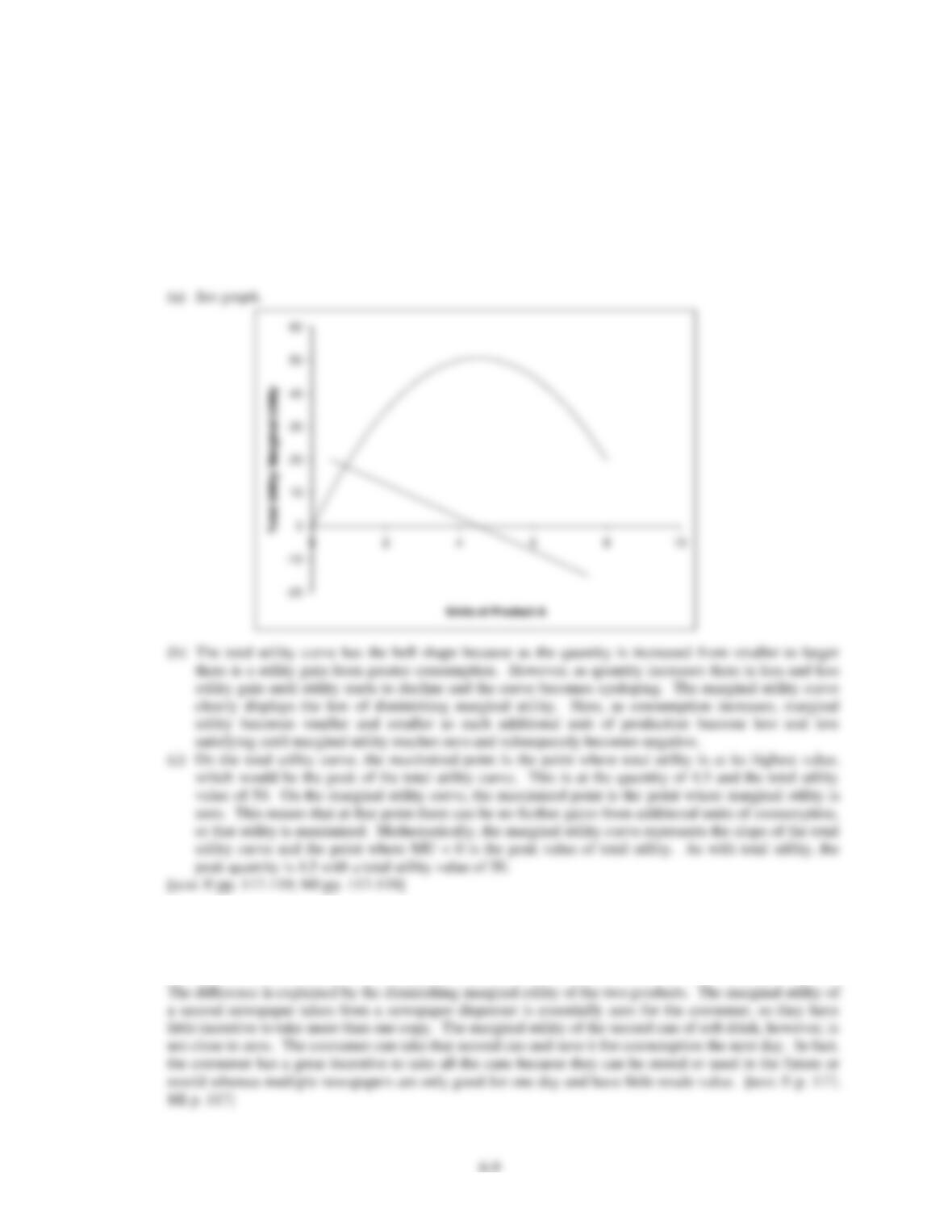
(a) Graph both the total utility and marginal utility curves together on the same graph.
(b) Explain the shape of both of the curves.
(c) Identify the point where utility is maximized on both curves. Discuss the reasoning behind each value.
Chapter 06 – Consumer Behavior (+ Appendix)
6-8
Chapter 06 – Consumer Behavior (+ Appendix)
Units of
product A Total utility Marginal utility
0 0
1 20 20
2 35 15
3 45 10
4 50 5
5 50 0
6 45 −5
7 35 −10
8 20 −15
5. (Consider This) Why does a newspaper dispenser open to a stack of newspapers and essentially “trusts” a
consumer to take just one copy whereas a soft drink vending machine does not “trust” consumers and
dispenses one can for each purchase?
Chapter 06 – Consumer Behavior (+ Appendix)
6. Describe how marginal utility and demand are related.
7. Give a brief description of the law of diminishing marginal utility and use it to explain the downward slope
of the demand curve.
8. What are the four dimensions of the typical consumer’s situation?
9. Explain the utility maximizing rule for two products in words and using algebra.
10. Why is it not sufficient to just compare the marginal utility of two goods when maximizing utility?
Chapter 06 – Consumer Behavior (+ Appendix)
6-11
11. Assume that a consumer purchases a combination of products A and B. The MUa is 5 and the Pa is $5.
The MUb is 6 and the Pb is $6. What should this consumer do to maximize utility?
12. Assume that a consumer purchases a combination of products Y and Z. The MUy is 50 and the Py is $25.
The MUz is 20 and the Pz is $5. What should this consumer do to maximize utility?
13. Columns 1 through 3 in the table below show the marginal utility which a particular consumer would get
by purchasing various quantities of products A, B, and C.
Unit of product (1)
Marginal utility, A (2)
Marginal utility, B (3)
Marginal utility, C
First 18 39 12
Second 16 36 10
Third 14 33 9
Fourth 12 30 8
Fifth 10 27 7
Sixth 8 24 5
Seventh 6 21 3
If the prices of A, B, and C are $2, $3, and $1, respectively, and the consumer has $26 to spend on these
three products, what combination of the three products should be purchased in order to maximize utility?
14. The table below shows the marginal utility a costumer would get by purchasing various quantities of A, B,
and C. The product prices for A, B, and C are $3, $2, and $1 respectively. The consumer has $20 to spend
on the three products.
Unit of product (1)
Marginal utility, A (2)
Marginal utility, B (3)
Marginal utility, C
First 30 22 12
Second 27 20 10
Third 24 18 8
Fourth 21 16 6
Fifth 18 14 4
Sixth 15 12 2
(a) 5 units of A, 6 units of B, and 4 units of C.
(b) 2 units of A, 5 units of B, and 4 units of C.
(c) 3 units of A, 4 units of B, and 3 units of C.
(d) 4 units of A, 3 units of B, and 2 units of C.
Chapter 06 – Consumer Behavior (+ Appendix)
6-12
15. A consumer finds only three products, X, Y, and Z, are for sale. The amount of utility which their
consumption will yield is shown in the table below. Assume that the prices of X, Y, and Z are $10, $2, and
$8, respectively, and that the consumer has an income of $74 to spend.
Chapter 06 – Consumer Behavior (+ Appendix)
6-13
Chapter 06 – Consumer Behavior (+ Appendix)
6-14
Product X Product Y Product Z
Quantity
Utility Marginal
Utility
per $
Quantity
Utility Marginal
Utility
per $
Quantity
Utility Marginal
Utility
per $
1 42 _____ 1 14 _____ 1 32 _____
2 82 _____ 2 26 _____ 2 60 _____
3 118 _____ 3 36 _____ 3 84 _____
4 148 _____ 4 44 _____ 4 100 _____
5 170 _____ 5 50 _____ 5 110 _____
6 182 _____ 6 54 _____ 6 116 _____
7 182 _____ 7 56.4 _____ 7 120 _____
(a) Complete the table by computing the marginal utility per dollar for successive units of X, Y, and Z to
one or two decimal places.
(b) How many units of X, Y, and Z will the consumer buy when maximizing utility and spending all
income? Show this result using the utility maximization formula.
(c) Why would the consumer not be maximizing utility by purchasing 2 units of X, 4 units of Y, and 1 unit
of Z?
Chapter 06 – Consumer Behavior (+ Appendix)
6-15