Chapter 6: The Analysis of Costs
MULTIPLE CHOICE
1. An example of implicit costs is the:
a.
bad-debt liabilities arising out of excessive sales on credit.
b.
wages paid to the owners’ children.
c.
opportunity cost of owner-supplied capital and labor that is not recognized by accountants.
d.
prices paid for purchased inputs.
e.
the alternative uses for money that could be borrowed.
2. The opportunity cost doctrine says that opportunity costs:
a.
and economic costs differ by the amount of implicit costs.
b.
should always be greater than explicit costs.
c.
should usually be greater than explicit costs.
d.
and the firm’s production costs determine the firm’s economic cost of production.
e.
can never be properly figured by accountants.
3. The opportunity cost of a firm’s inputs:
a.
depends on who supplies them to the firm.
b.
includes implicit costs but does not include explicit costs.
c.
includes explicit costs but does not include implicit costs.
d.
should not concern anyone but economists.
e.
is the value of the inputs in their most highly valued alternative use.
4. Gerry works 40 hours a week managing Gerry’s Market, without drawing a salary. He could earn $600
a week doing the same work for Jean. Gerry’s Market owes its bank $100,000, and Gerry has invested
$100,000 of his own money. If Gerry’s accounting profits are $1,000 per week while the interest on
his bank debt is $200 per week, his economic profits are:
a.
$0 per week.
b.
$200 per week.
c.
$400 per week.
d.
$800 per week.
e.
$1,000 per week.
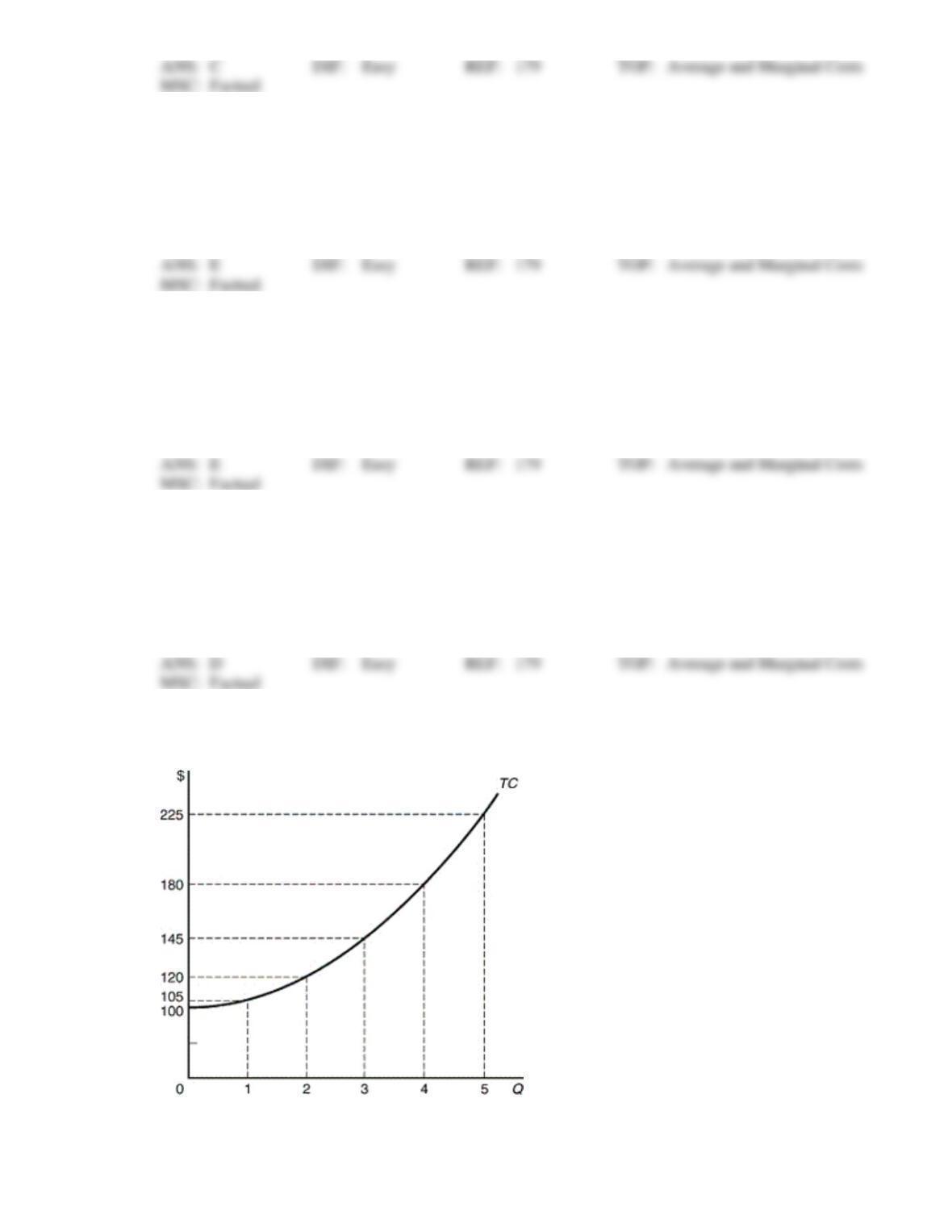
5. The following figure represents the short-run total cost function for the Fidget Company, which
produces widgets. The fixed costs are:
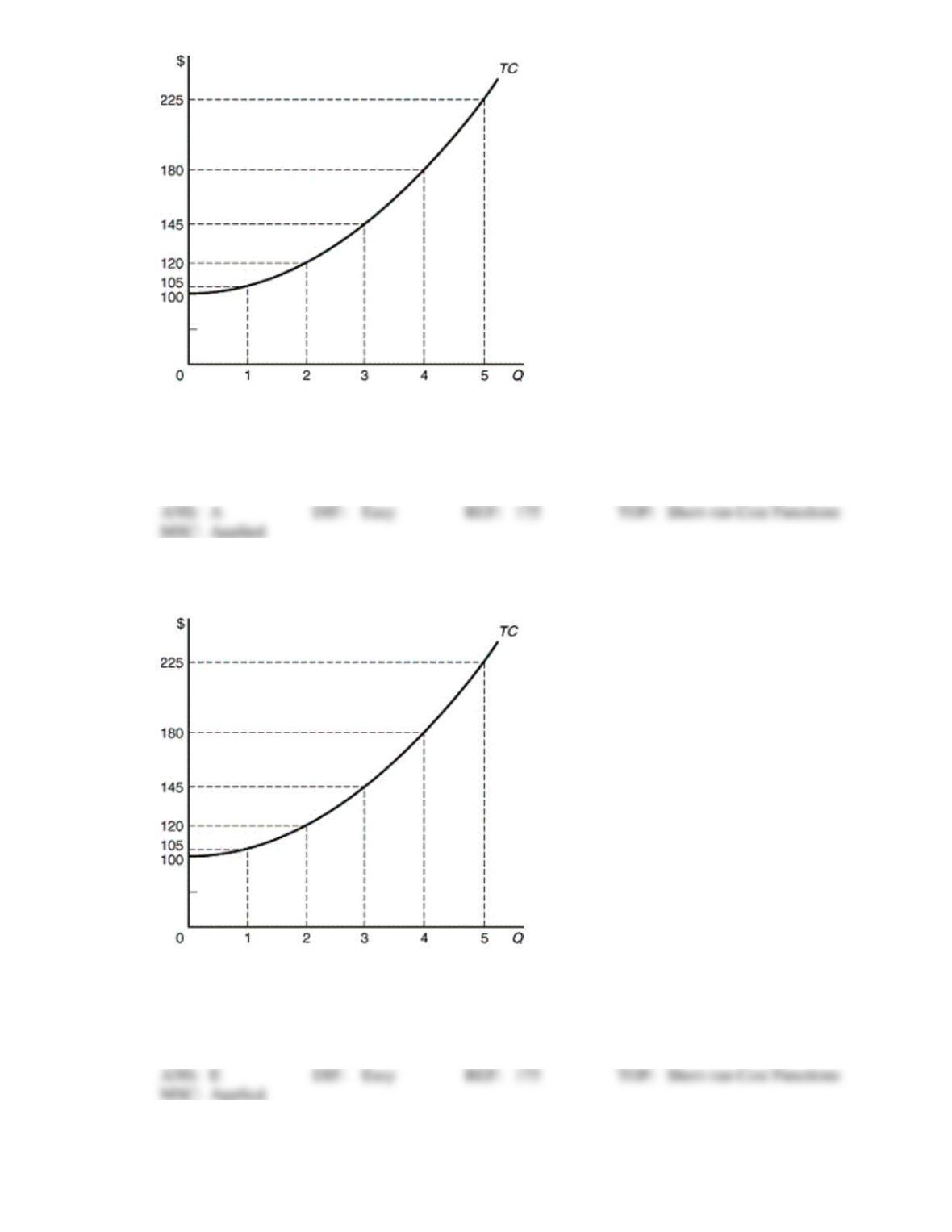
a.
FC = $100.
b.
FC = 10Q.
c.
FC = 5Q2.
d.
FC = $500.
e.
not estimable from the information given.
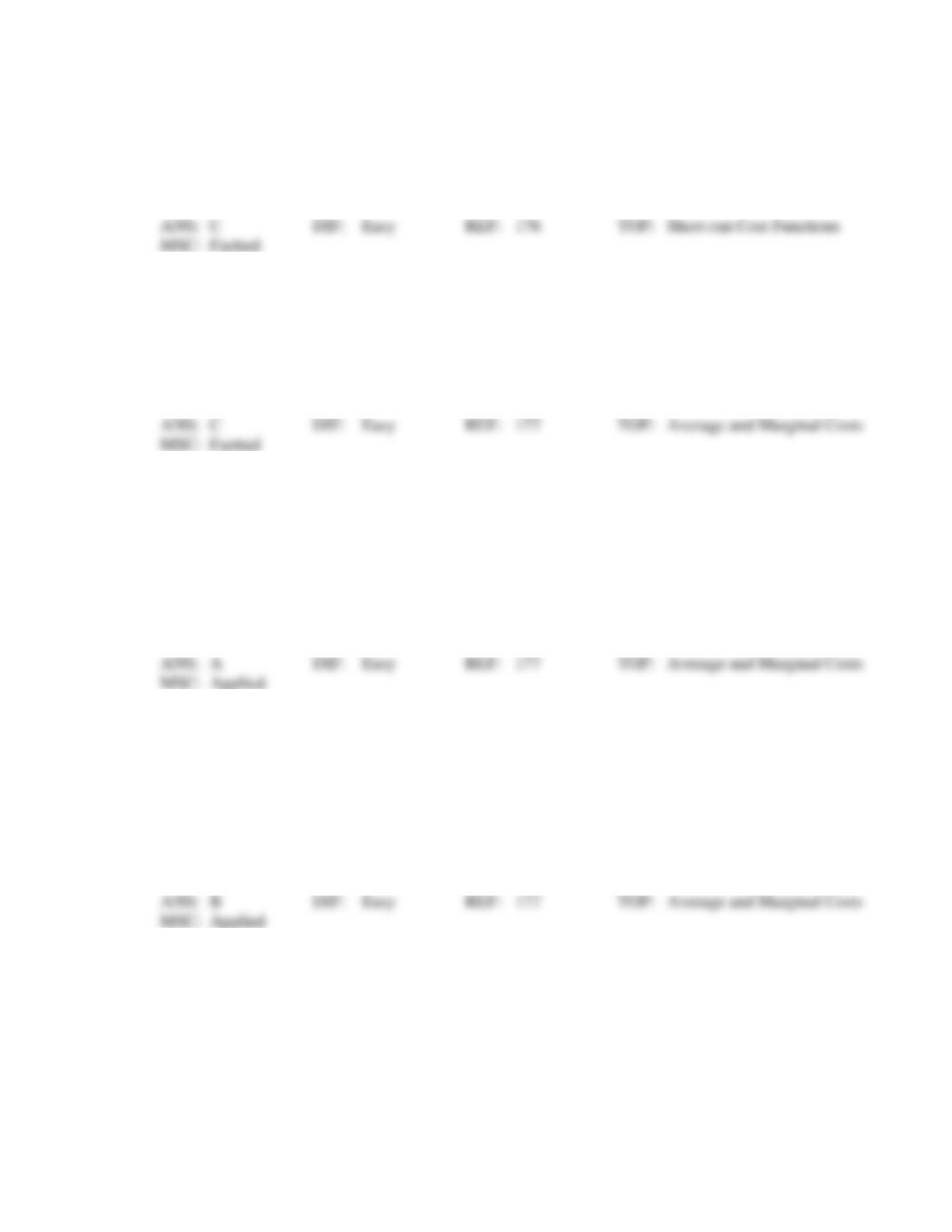
6. The following figure represents the short-run total cost function for the Fidget Company, which
produces widgets. The equation for the total cost function is:
a.
TC = 100.
b.
TC = 10Q.
c.
TC = 5Q2.
d.
TC = 100Q.
e.
TC = 100 + 5Q2.
7. If average variable cost is increasing with increases in output, total fixed cost will:
a.
increase with increases in output.
b.
decrease with increases in output.
c.
remain unchanged with increases in output.
d.
increase initially and then decrease with increases in output.
e.
decrease initially and then increase with increases in output.
8. Average fixed cost is equal to the:
a.
difference between marginal cost and average variable cost.
b.
difference between marginal cost and average total cost.
c.
difference between average total cost and average variable cost.
d.
total fixed cost divided by the minimum efficient scale.
e.
total variable cost divided by the minimum efficient scale.
9. Ramblin’ Randy’s Dude Ranch’s daily total cost of accommodating overnight guests is given by TC =
100 + 5Q. On the basis of this information, the average fixed cost, when there are 25 overnight guests,
is:
a.
$4.
b.
$5.
c.
$6.
d.
$7.
e.
$9.
10. Down and Out Co. operates an executive placement service for corporate executives displaced by
corporate restructuring. Its monthly total cost of cases is given by TC = 25Q1/2 + 2,500; the average
cost at a caseload of 25 attempted placements per month is:
a.
$100.
b.
$105.
c.
$200.
d.
$205.
e.
$225.
11. Teal Talkies, a manufacturer of designer cell phones, has determined that its total cost of production is
TC = 1,000 + 500Q –1 + 15Q2. At 5 units of output, the firm’s average cost is:
a.
$330.
b.
$130.
c.
$200.
d.
$295.
e.
$300.
12. If total cost is given by TC = a + bQ – cQ2 + dQ3, then average variable cost is minimized at
units of output.
a.
Q* = a/2d
b.
Q* = b/2d
c.
Q* = c/3d
d.
Q* = c/2d
e.
Q* = d/2c
13. Loco Pony Adventures rents clowns and ponies for children’s birthday parties. If the annual total cost
of furnishing entertainment is given by TC = 0.5Q2 + 25Q + 1,000, the average variable cost of
catering to 30 birthday parties is:
a.
$25.00.
b.
$25.50.
c.
$26.50.
d.
$30.00.
e.
$40.00.
14. Average variable cost is equal to the:
a.
change in total variable cost divided by the change in output levels.
b.
total variable cost divided by the level of output.
c.
marginal cost divided by the average product of the variable input.
d.
marginal cost divided by the marginal product of the variable input.
e.
total variable cost divided by the change in output levels.
15. Short-run marginal cost eventually increases with increasing output because:
a.
eventually marginal returns will diminish.
b.
not all variable inputs increase at the same rate.
c.
diseconomies of scale usually set in immediately.
d.
of diseconomies of scope.
e.
eventually diseconomies of scale set in.
16. If there is only one variable input, average variable cost can be defined as the:
a.
output’s price divided by the input’s average product.
b.
output’s price divided by the input’s marginal product.
c.
price of the variable input divided by its average product.
d.
price of the variable input divided by its marginal product.
e.
price of the variable input multiplied by its marginal product.
17. The addition to total cost resulting from the addition of the last unit of output is known as:
a.
marginal product.
b.
average product.
c.
average variable cost.
d.
average total cost.
e.
marginal cost.
18. When average total cost is at its minimum:
a.
average variable cost is declining with increases in output.
b.
average variable cost plus average fixed cost is declining with increases in output.
c.
average total cost is equal to average variable cost.
d.
marginal cost is equal to average variable cost.
e.
marginal cost is equal to average total cost.
19. When average variable cost is at its minimum:
a.
average total cost is increasing with increases in output.
b.
average variable cost plus average fixed cost is increasing with increases in output.
c.
average total cost is equal to average variable cost.
d.
marginal cost is less than average total cost.
e.
marginal cost is greater than average total cost.
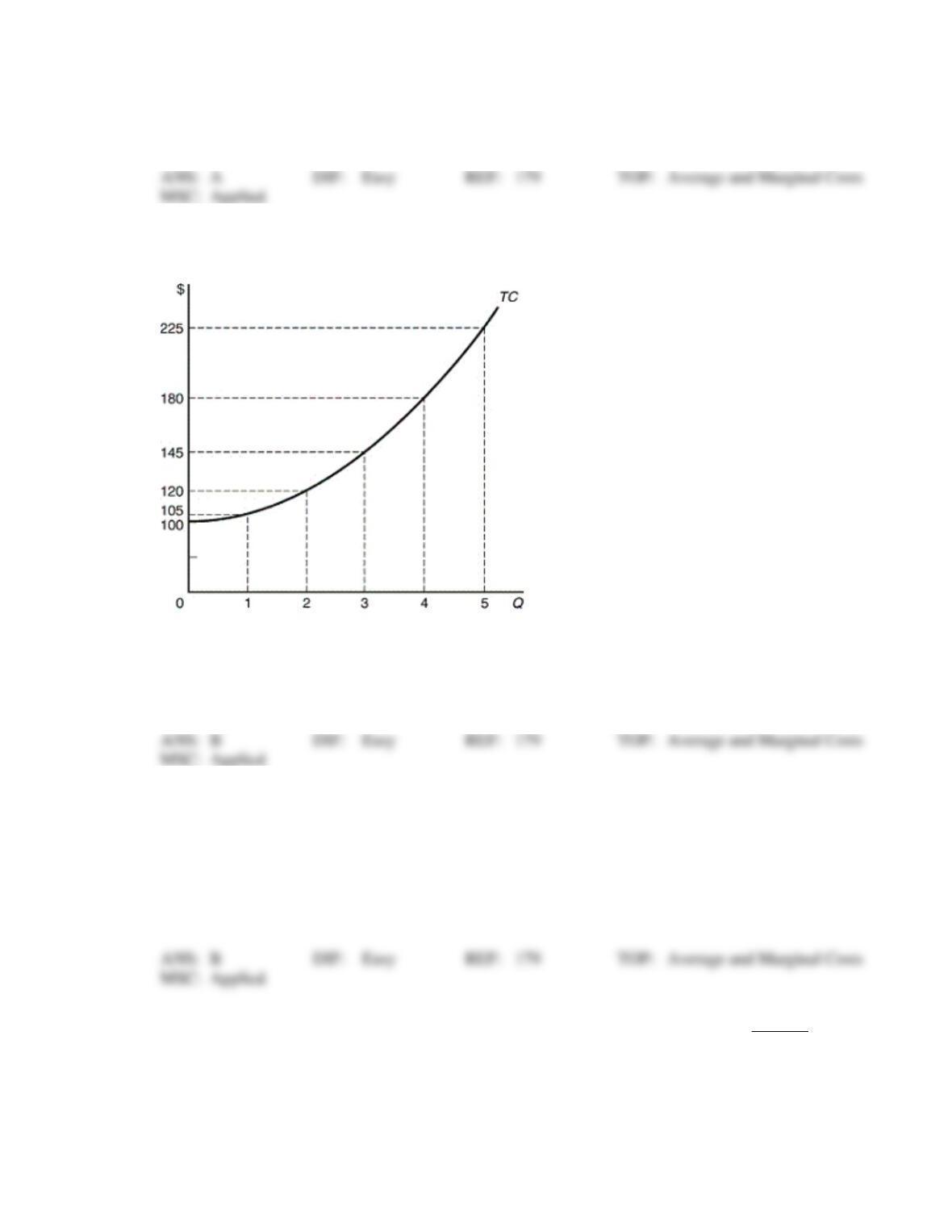
20. The following figure represents the short-run total cost function for the Fidget Company, which
produces widgets. When output is 25, average fixed cost is:
a.
$4.
b.
$25.
c.
$625.
d.
$3,125.
e.
none of the above.
21. The following figure represents the short-run total cost function for the Fidget Company, which
produces widgets. The equation for the marginal cost function is:
a.
MC = 100.
b.
MC = 10Q.
c.
MC = 10Q2.
d.
MC = 100Q.
e.
MC = 100 + 5Q2.
22. The weekly total cost of baking pies at Tasty Tortes is given by TC = 0.01Q1.5. Tasty’s marginal cost
of producing 10,000 pies a week is:
a.
$1.00.
b.
$1.50.
c.
$2.00.
d.
$2.50.
e.
$4.50.
23. If total cost is given by TC = 10Q – 5Q2 + 0.1Q3, then average cost is minimized at units of
output.
a.
0.5.
b.
0.01.
c.
50.
d.
25.
e.
0.1.
24. If total cost is given by TC = a + bQ – cQ2 + dQ3, then marginal cost is minimized at units of
output.
a.
Q* = a/2d
b.
Q* = b/2d
c.
Q* = c/2d
d.
Q* = b/3d
e.
Q* = c/3d
25. Pace’s total cost of producing CO2 cartridges is given by TC = 0.5X 3 – 24X 2 + 144X. The level of
output that minimizes average total cost is:
a.
12 cartridges.
b.
10 cartridges.
c.
18 cartridges.
d.
20 cartridges.
e.
24 cartridges.
26. Marginal cost is equal to the:
a.
change in total variable cost divided by the change in output.
b.
total variable cost divided by the level of output.
c.
price of the input divided by the average product of the variable input.
d.
price of the input divided by the total product of the variable input.
e.
total variable cost divided by the change in output levels.
27. Leisure Enterprise’s total cost of producing speedboats is given by TC = 10Q3 – 4Q2 + 25Q + 500. On
the basis of this information, the marginal cost of producing the 25th speedboat is:
a.
$1,700.
b.
$6,050.
c.
$18,575.
d.
$18,775.
e.
$19,075.
28. If Hilltop Turf Farm’s total cost of producing acres of sod is TC = 0.2Q2 + 120Q + 5,000, the marginal
cost of producing the 50th acre of sod is:
a.
$110.
b.
$120.
c.
$130.
d.
$140.
e.
$150.
29. Whenever average variable cost is declining with increases in output:
a.
marginal cost is always declining as average total cost declines.
b.
average total cost at first decreases and then increases with output.
c.
marginal cost is always declining as average total cost increases.
d.
marginal cost at first decreases and then increases with output.
e.
marginal cost at first increases and then decreases with output.
30. If a firm is choosing cost-minimizing combinations of inputs, marginal cost can be defined as the price
of any:
a.
input divided by its average product.
b.
variable input divided by its average product.
c.
fixed input divided by its average product.
d.
variable input divided by its marginal product.
e.
fixed input divided by its marginal product.
31. Bringing Up Baby (BUB) produces step-by-step manuals for child rearing. If BUB’s total cost of
producing manuals is given by TC = 0.004Q3 – 0.1Q2 + 0.5Q + 250, the marginal cost of producing the
50th manual is:
a.
$5.50.
b.
$20.50.
c.
$20.95.
d.
$21.50.
e.
$21.95.
32. Why Can’t We Be Friends? operates a conflict settlement service for distressed couples. If it has no
fixed costs and its monthly average variable cost of cases is given by AVC = 2.5Q + 500, the marginal
cost at a caseload of 50 attempted reconciliations per month is:
a.
$500.
b.
$550.
c.
$600.
d.
$625.
e.
$750.
33. The long run is a time period during which:
a.
all inputs are semivariable.
b.
all inputs except capital and entrepreneurship are variable.
c.
average variable costs are strictly less than average total cost.
d.
all inputs are quasivariable.
e.
all inputs are variable.
34. Minimum efficient scale is the output at which:
a.
long-run average cost is first minimized.
b.
long-run average cost first equals long-run marginal cost.
c.
short-run average cost equals long-run average cost for the first time.
d.
short-run marginal cost equals long-run marginal cost for the first time.
e.
diseconomies are first overcome and then economies of scale set in.
35. The Wilson Corporation produces output according to Q = 4(KL)1/2, where K is the amount of capital
used and L is the amount of labor employed. If capital costs $2 per unit and labor costs $8 per unit,
Wilson’s minimized long-run average total cost is:
a.
$2.
b.
$2Q.
c.
$10.
d.
$10Q.
e.
$22.
36. Wagner Machine Tool produces output according to Q = 4(KL)1/2, where K is the amount of capital
used and L is the amount of labor employed. Capital costs $2 per unit, and Wagner is constrained in
the short run to use 16 units of capital. If labor costs $8 per unit, Wagner’s minimized short-run
marginal cost at an output of 48 is:
a.
$3.00.
b.
$3.50.
c.
$4.00.
d.
$4.50.
e.
$5.00.
37. The long-run average cost curve slopes downward if there are:
a.
some factors without diminishing marginal returns.
b.
economies of scope in the management of multiplant operations.
c.
economies of scale.
d.
diseconomies of scope in the management of multiplant operations.
e.
no factors without diminishing marginal returns.
38. The long-run average cost curve slopes upward if there are:
a.
some factors without diminishing marginal returns.
b.
diseconomies of scope in the management of multiplant operations.
c.
economies of scale.
d.
diseconomies of scale.
e.
no factors without diminishing marginal returns.
39. A short-run average cost curve is tangent to the long-run average cost curve at the quantity where:
a.
the fixed plant size would have been optimal.
b.
short-run marginal cost is minimized.
c.
short-run marginal cost is equal to average cost.
d.
short-run average cost is minimized.
e.
long-run average cost is minimized.
40. Where long-run average cost equals short-run average cost:
a.
short-run average cost is minimized.
b.
long-run average variable cost equals short-run average variable cost.
c.
long-run average cost equals long-run marginal cost.
d.
long-run average cost is minimized.
e.
long-run marginal cost equals short-run marginal cost.
41. Economies of scale are said to exist whenever:
a.
the learning curve is upward-sloping.
b.
increases in output bring about higher output.
c.
increases in output bring about higher input prices.
d.
the elasticity of total cost with respect to output is greater than 1.
e.
the long-run average cost curve is downward-sloping.
42. Long-run average cost equals long-run marginal cost whenever:
a.
the production function exhibits constant returns to scale.
b.
fixed costs are zero.
c.
no factor always has increasing marginal returns.
d.
the cost of capital is near zero.
e.
long-run marginal cost is at its minimum.
43. Framjam Sports Equipment produces basketballs at its factory in Kentucky and soccer balls at its
factory in Illinois. At its current annual rate of production, the cost of producing basketballs is $70,000
and the cost of producing soccer balls is $45,000. If the firm consolidates production at a single
location, the annual cost of production will be $100,000. What is the degree of economies of scope in
this case?
a.
15.
b.
0.25.
c.
0.15.
d.
0.85.
e.
None of the above.
44. Framjam Sports Equipment produces basketballs at its factory in Kentucky and soccer balls at its
factory in Illinois. At its current annual rate of production, the cost of producing basketballs is $80,000
and the cost of producing soccer balls is $45,000. If the firm consolidates production at a single
location, the annual cost of production will be $100,000. What is the degree of economies of scope in
this case?
a.
5.
b.
4.
c.
0.75.
d.
0.25.
e.
None of the above.
45. Economies of scope exist when it is cheaper to produce:
a.
with a large fixed plant and equipment.
b.
at increasing rates of output.
c.
given quantities of two different products together than to produce the same quantities
separately.
d.
given quantities of two different products separately than to produce the same quantities
together.
e.
using more than one technique.
46. Break-even analysis usually assumes:
a.
marginal revenue is declining with output.
b.
all costs are variable.
c.
managers wish to minimize fixed costs.
d.
marginal costs are increasing with output.
e.
average variable costs are constant.
47. Lot’s Wife Manufacturing produces rear–view video systems for buses. The firm’s cost function is TC
= 2,000 + 120Q. If the systems sell for $145, what is the break-even rate of production?
a.
200.
b.
120.
c.
80.
d.
55.
e.
None of the above.
48. Bill’s Mechanical Devices Inc. produces robots for the automotive industry. If its average variable
costs are given by AVC = 25, its fixed costs are $2,500, and it charges $75 a robot, what is Bill’s
break-even level of output?
a.
25 robots.
b.
33.3 robots.
c.
50 robots.
d.
75 robots.
e.
100 robots.
49. Hedge Fun is a landscaping firm that specializes in topiary. It contracts with the owners of 125 local
homes and provides its service at an annual fee of $1,300. Its average variable cost is $800, and its
annual fixed cost is $28,000. What is the break-even level of output?
a.
125.
b.
87.
c.
63.
d.
56.
e.
None of the above.
50. Trudeau’s Body Shop incurs total costs given by TC = 2,400 + 100Q. If the price it charges for a paint
job is $120, what is its break-even level of output?
a.
20 paint jobs.
b.
40 paint jobs.
c.
60 paint jobs.
d.
90 paint jobs.
e.
120 paint jobs.
51. Brandy’s Restaurant estimates that its total cost of providing Q meals per month is given by TC =
6,000 + 2Q. If Brandy charges $4 per meal, what is its break-even level of output?
a.
1,000 meals.
b.
1,500 meals.
c.
2,000 meals.
d.
2,500 meals.
e.
3,000 meals.
52. If price is below average total cost but above average variable cost, the break-even level of output:
a.
is greater than the profit-maximizing level of output.
b.
is zero.
c.
can’t be calculated since losses will be earned at each level of output including the
profit-maximizing level.
d.
approaches infinity.
e.
equals the profit-maximizing level of output.
53. Hedge Fun is a landscaping firm that specializes in topiary. It contracts with the owners of 125 local
homes and provides its service at an annual fee of $1,300. Its average variable cost is $800, and its
annual fixed cost is $28,000. What is the degree of operating leverage?
a.
2.7.
b.
2.1.
c.
1.8.
d.
1.3.
e.
None of the above.
54. Hedge Fun is a landscaping firm that specializes in topiary. It contracts with the owners of 140 local
homes and provides its service at an annual fee of $1,300. Its average variable cost is $900, and its
annual fixed cost is $28,000. What is the degree of operating leverage?
a.
0.5.
b.
1.
c.
1.5.
d.
2.
e.
2.5.