CHAPTER 6: Price Controls
MULTIPLE CHOICE
1. Why do government leaders impose price controls?
a. They are trying to promote the formation of black markets.
b. They are trying to ensure that the market reaches equilibrium.
c. They are trying to ensure that all consumers are able to purchase a specific product.
d. They are trying to ensure that a social goal is satisfied.
e. They are trying to increase the demand curve.
2. Government officials who impose price controls
a. understand that their action causes a trade-off: giving up fairness to get efficiency.
b. understand that their action will induce a better achievement of the gains from trade.
c. understand that their action is supported by most economists, and hence best for society.
d. might not understand that their action causes confusion in the price signaling mechanism that
directs the allocation of resources.
e. might not understand that their action will not get them the votes they seek.
3. Price controls can be traced back as far as
a. ancient Babylon of 4,000 years ago.
b. ancient Greece of 2,500 years ago
c. ancient Rome of 2,000 years ago.
d. ancient Egypt of 3,000 years ago.
e. recent times, since organized markets under organized government and legal systems are
necessary to effectively impose such controls.
4. Many states have laws that limit the maximum amount of interest that a lender can charge a
borrower. Such a law is an example of a(n)
a. equilibrium price. d. black market price.
b. price ceiling. e. ration price.
c. price floor.
5. The town of Fairness has a law that says that wages should be high enough to ensure that all
people can afford to buy enough food to feed their families. The law that sets food prices low
enough to meet these requirements would be an example of a
a. minimum wage law. d. black market price.
b. fair wage law. e. ration price.
c. price ceiling.
6. What is a black market?
a. It is an illegal market that emerges when binding and nonbinding price controls are in place.
b. It is an illegal market that emerges when binding price ceilings are in place.
c. It is an illegal market that emerges when binding price floors are in place.
d. It is an illegal market that emerges when only binding price ceilings and binding price floors
are in place.
e. It is an illegal market that emerges when no price controls are present.
7. A market where exchanges occur despite price regulations is called a(n) ________ market.
a. hidden d. prohibited
b. noncompetitive e. outlaw
c. black
8. A consequence of either a price ceiling or a price floor is
a. a nonbinding price control.
b. a market surplus.
c. a market shortage.
d. waiting lines.
e. Price floors and price ceilings cannot have an identical outcome.
9. If a store sells a good at the market price, even though the government authorities have set the
maximum price that can be charged for it, the store is selling the good in a(n)
a. black market for a market price that is higher.
b. black market for a market price that is lower.
c. effort to eliminate a surplus of the good.
d. legal market for a market price that is higher.
e. legal market for a market price that is lower.
10. If a store sells a good at the market price, even though the government authorities have set the
minimum price that can be charged, the store is selling the good in a(n)
a. black market for a market price that is higher.
b. black market for a market price that is lower.
c. effort to eliminate a surplus of the good.
d. legal market for a market price that is higher.
e. legal market for a market price that is lower.
11. A binding price ceiling will have which of the following consequences?
a. There will be downward pressure on prices until quantity demanded equals quantity supplied.
b. There will be upward pressure on prices until quantity demanded equals quantity supplied.
c. There are no consequences to a binding price ceiling.
d. The quantity demanded will always exceed the quantity supplied.
e. The quantity demanded will always be smaller than the quantity supplied.
12. Why are binding price ceiling laws passed?
a. They make goods more expensive (and profitable) for firms.
b. They encourage sellers to produce more of a good.
c. They encourage producers to sell higher-quality products.
d. They permit customers to obtain higher-quality products.
e. They make a good less expensive for those customers who are able to purchase the good in the
legal market.
13. What will happen in a market where a binding price ceiling is removed?
a. There will be downward pressure on the price in the legal market.
b. The products sold will improve in quality and become more plentiful.
c. Sellers will face a reduced incentive to sell the product.
d. Buyers will find the good more difficult to obtain in the legal market.
e. There will be increased pressure to buy and sell the good on the black market.
14. Why do shortages develop under a binding price ceiling?
a. It encourages sellers to produce more of the product.
b. It encourages buyers to purchase less of the product.
c. It makes the price so low that the quantity demanded exceeds the quantity supplied in the legal
market.
d. It makes the price so low that the quantity demanded exceeds the quantity supplied on the
black market.
e. It encourages sellers to increase the quality of the products they sell, which in turn increases
the quantity demanded.
15. Why does a surplus exist under a binding price floor?
a. It encourages sellers to produce less of the product.
b. It encourages buyers to purchase more of the product.
c. It makes the price so high that the quantity supplied exceeds the quantity demanded in the
legal market.
d. It makes the price so low that the quantity demanded exceeds the quantity supplied on the legal
market.
e. It discourages sellers from increasing the quality of the products they sell, which in turn
increases the quantity demanded.
16. Do all buyers benefit from a binding price ceiling?
a. Yes. A binding price ceiling benefits all buyers because it allows them to obtain the good in
the legal market.
b. No. A binding price ceiling benefits only some buyers because not all are able to obtain the
good in the legal market.
c. No. A binding price ceiling benefits no buyers because sellers are unwilling to sell any of their
products.
d. No. A binding price ceiling benefits only some buyers because, although the price is initially
lower, it eventually increases to the equilibrium price.
e. No. A binding price ceiling benefits no buyers because they are unwilling to buy any of the
products at a price higher than the equilibrium.
17. Which of the following is an accurate statement about the consequence of a binding price ceiling?
a. Binding price ceilings do not allow consumers to pay a lower price for the product in the legal
market.
b. Binding price ceilings encourage the formation of a black market.
c. Binding price ceilings discourage the formation of a black market.
d. Binding price ceilings create a surplus of the product.
e. Binding price ceilings cause consumers to purchase more of the product in the legal market.
18. Why would a politician find it difficult to remove a binding price ceiling?
a. because it greatly benefits firms, and they would spend a lot of money to lobby against the
law’s repeal
b. because it greatly benefits government, which receives additional tax revenue as a result
c. because it greatly benefits all consumers, and they are also voters
d. because it greatly benefits some consumers who are also voters
e. because it greatly benefits society as a whole, with all consumers able to buy as much as firms
produce
19. Mortimer loves sushi. He loves sushi so much that he asks his congressional representative to work
for passage of a binding price ceiling law. Who would be affected by this law and how?
a. Sellers would benefit from such a law because they would receive a higher price for their
products.
b. Consumers would benefit from such a law because prices would be lower and all would be
able to purchase sushi cheaply.
c. Consumers would benefit from such a law because the sushi would be made of higher-quality
fish, and each serving would be larger than it had been with no binding price ceiling in place.
d. Some consumers would benefit from such a law because prices for sushi would be lower for
those able to buy it in the legal market.
e. Sellers would benefit from such a law because they would be able to sell higher-quality sushi
and thus capture a larger share of the market.
20. What would be the quantity demanded if a price ceiling is set at $150?
a. 500 d. 1,350
b. 1,850 e. 260
c. 240
21. What would be the quantity supplied if a price ceiling is set at $400?
a. 600 d. 3,000
b. 240 e. 2,400
c. 0
22. What would be the equilibrium quantity for flat-screen TVs?
a. 240 d. 1,400
b. 140 e. 1,600
c. 24
23. What would be the quantity demanded if a price floor is set at $300?
a. 900 d. 1,100
b. 200 e. 2,000
c. 240
24. What would be the quantity demanded if a price floor is set at $100?
a. 240 d. 1,400
b. 2,100 e. 700
c. 0
25. What would be the quantity demanded if a price ceiling is set at $1,000?
a. 500 d. 13,900
b. 54,100 e. 21,474
c. 68,000
26. What would be the quantity supplied if a price ceiling is set at $2,000?
a. 100 d. 21,474
b. 154,100 e. 18,000
c. 27,900
27. What would be the equilibrium price for used cars?
a. $100 d. $1,541
b. $154,100 e. $72
c. $21,474
28. What would be the equilibrium quantity for used cars?
a. 100 d. 1,541
b. 154,100 e. 153,900
c. 21,474
29. What would be the quantity supplied if a price floor is set at $2,000?
a. 9,900 d. 1,541
b. 200 e. 18,000
c. 27,900
30. What would be the quantity supplied if a price floor is set at $100?
a. 100 d. 21,474
b. 154,100 e. 1,300
c. 1,541
31. What would be the quantity demanded if a price ceiling is set at $20?
a. 90 d. 165
b. 45 e. 305
c. 265
32. What would be the quantity supplied if a price ceiling is set at $50?
a. 90 d. 165
b. 35 e. 75
c. 265
33. What would be the equilibrium price for hardcover books?
a. $100 d. $35
b. $45 e. $11
c. $385
34. What would be the equilibrium quantity for hardcover books?
a. 100 d. 35
b. 45 e. 11
c. 385
35. What would be the quantity supplied if a price floor is set at $50?
a. 90 d. 165
b. 45 e. 75
c. 265
36. What would be the quantity supplied if a price floor is set at $20?
a. 90 d. 165
b. 45 e. 305
c. 265
37. Setting a price ceiling below the equilibrium price can result in
a. a surplus, where the quantity demanded exceeds the quantity supplied.
b. a shortage, where the quantity demanded exceeds the quantity supplied.
c. a surplus, where the quantity supplied exceeds the quantity demanded.
d. a shortage, where the quantity supplied exceeds the quantity demanded.
e. no impact on the quantity demanded or on the quantity supplied.
38. Which of the following is an accurate statement about the consequence of nonbinding price
ceilings?
a. They prevent the seller from receiving the equilibrium price.
b. They require the seller to advertise the product at the equilibrium price.
c. They create a surplus in the legal market.
d. They do not change the quantity of goods bought or sold in the legal market.
e. They increase the quantity demanded of the good in question.
39. What will happen in a market where a nonbinding price ceiling is removed?
a. There will be downward pressure on the price in the legal market.
b. The products sold will improve in quality and become more plentiful.
c. Sellers will face a reduced incentive to sell the products.
d. The price and quantity will not change in the legal market.
e. There will be increased pressure to buy and sell the goods on the black market.
40. If a price ceiling is imposed at $15 per unit when the equilibrium market price is $12, there will be
a. no surplus or shortage. d. a downward pressure on prices.
b. a surplus. e. an upward pressure on prices.
c. a shortage.
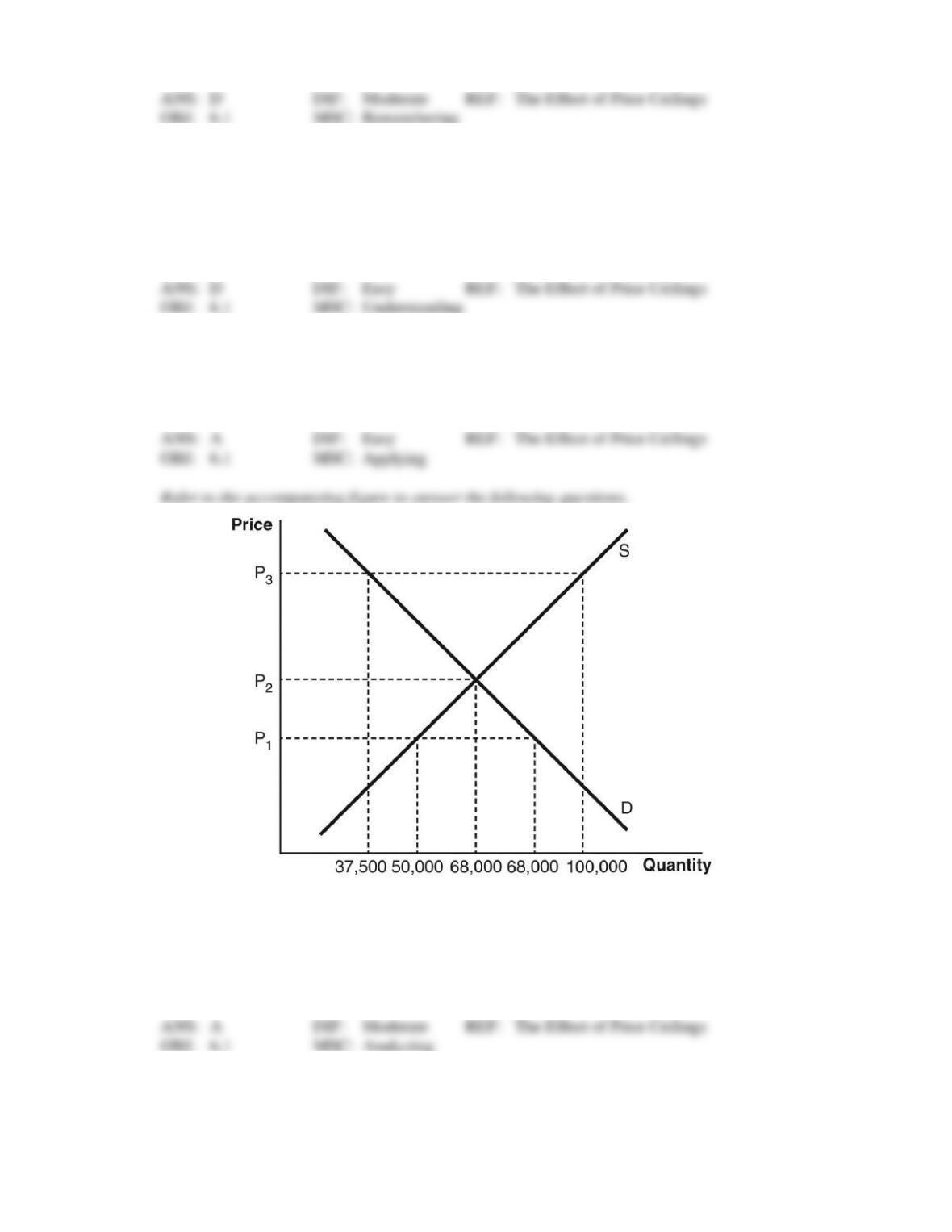
41. The market is currently at market equilibrium. If a binding price ceiling of P1 is imposed, by how
much would the quantity demanded change?
a. It would increase by 12,000 units. d. It would increase by 30,500 units.
b. It would decrease by 30,500 units. e. It would increase by 30,000 units.
c. It would decrease by 12,000 units.
42. The market is currently at market equilibrium. If a binding price ceiling of P1 is imposed, by how
much would the quantity supplied change?
a. It would increase by 32,000 units. d. It would decrease by 30,000 units.
b. It would decrease by 18,000 units. e. It would decrease by 32,000 units.
c. It would decrease by 30,500 units.
43. At the price of the binding price floor, by how much would the quantity supplied change from the
market equilibrium?
a. The quantity supplied would increase by 32,000 units.
b. The quantity supplied would decrease by 18,000 units.
c. The quantity supplied would increase by 30,500 units.
d. The quantity supplied would decrease by 30,500 units.
e. The quantity supplied would decrease by 32,000 units.
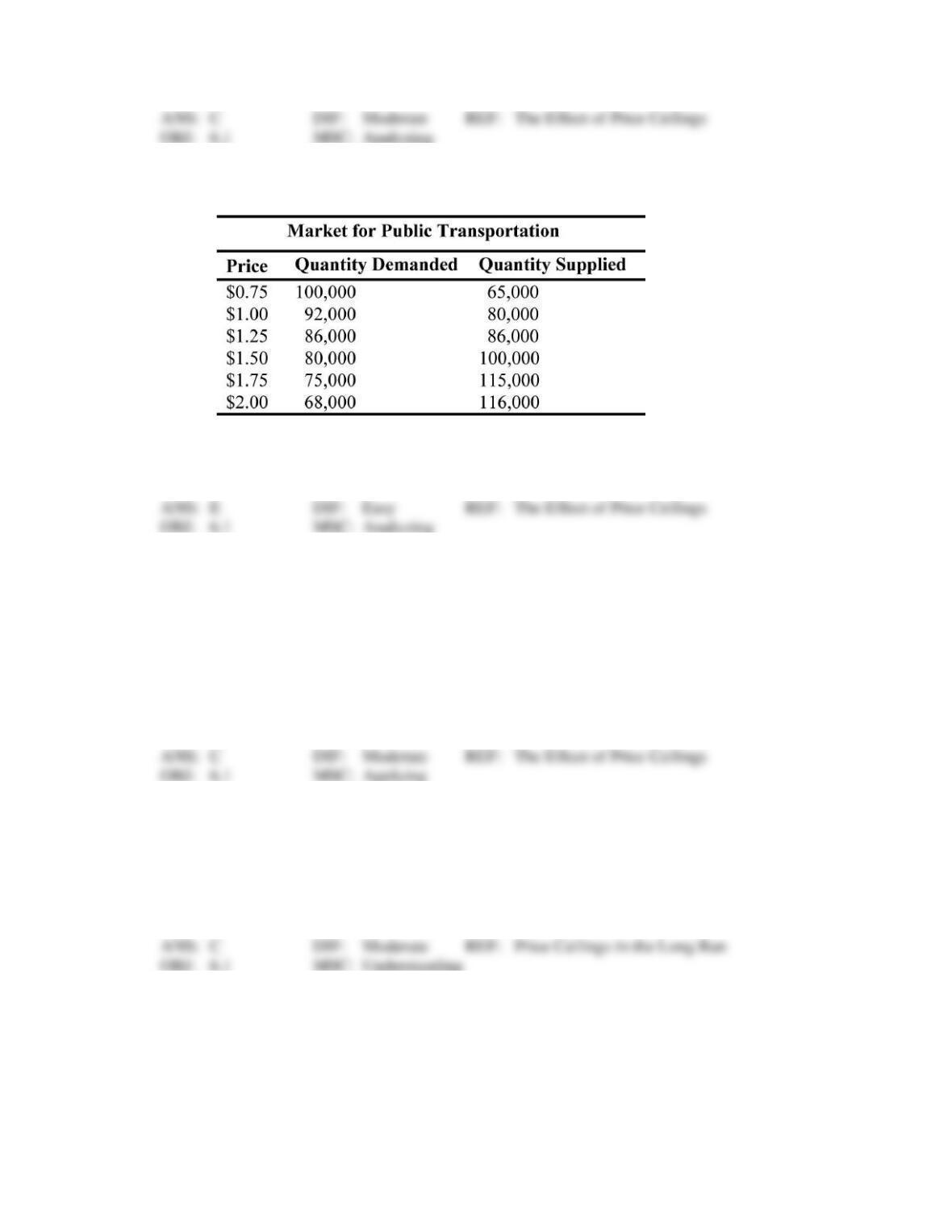
44. If there is a $60 price ceiling imposed on a textbook, what will be the disequilibrium amount?
a. There will be a shortage of 800,000 textbooks.
b. There will be a surplus of 800,000 textbooks.
c. There will be neither a shortage nor a surplus.
d. There will be a shortage of 2,600,000 textbooks.
e. There will be a shortage of 400,000 textbooks.
45. If there is a $180 price ceiling imposed on a textbook, what will be the disequilibrium amount?
a. There will be a shortage of 1,500,000 units.
b. There will be a shortage of 800,000 units.
c. There will not be a shortage.
d. There will be a shortage of 3,000,000 units.
e. There will be a shortage of 450,000 units.
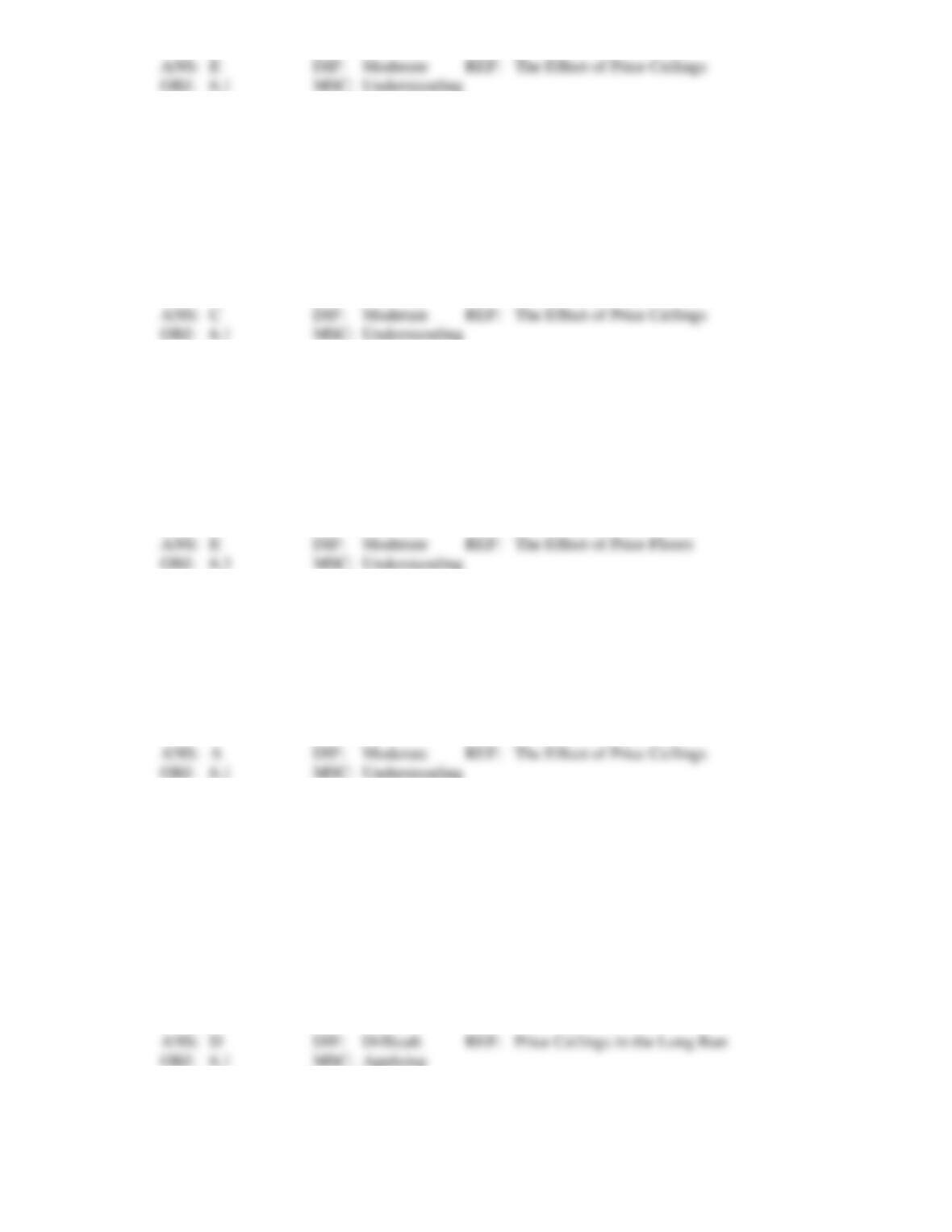
46. What is the amount of the shortage or surplus in the market for public transportation when the
price ceiling is $1.75?
a. 100,000 d. 40,000
b. 86,000 e. 0 (zero)
c. 75,000
47. Suppose Kate lives in a community with no price controls. What could she expect will happen if
her town borders a community where there is a nonbinding price ceiling on most products?
a. Legal market prices will rise in the community with a binding price ceiling.
b. Legal market prices will fall in the community with a binding price ceiling.
c. The price and the quantity sold in the community without a nonbinding price ceiling will be
the same as the price and quantity in the community with a nonbinding price ceiling.
d. There will be more shortages in the community with a binding price ceiling.
e. The black market in the community with a binding price ceiling will not be strong because
consumers will simply purchase the product in the community that has no price ceiling.
48. Why does a shortage that occurs under a binding price ceiling increase over time?
a. Demand becomes more elastic.
b. Demand becomes more inelastic.
c. Demand and supply both become more elastic.
d. Demand and supply both become more inelastic.
e. Demand becomes more elastic, but supply becomes more inelastic.
49. One would expect there to be many customers for a black market good when the opportunity cost
of finding the good under a
a. binding price floor is high. d. binding price ceiling is low.
b. binding price floor is low. e. binding price ceiling is high.
c. nonbinding price ceiling is high.
50. What is the incentive to create a black market when a binding price ceiling exists?
a. A black market emerges because sellers have a surplus that they need to sell.
b. A black market emerges because sellers want a market where they can sell lower-quality
products.
c. A black market emerges because sellers want a market where they can sell higher-quality
products at higher prices.
d. A black market does not emerge because sellers are content to sell at the lower price.
e. A black market emerges because buyers who have a low opportunity cost are seeking out the
product.
51. What is the incentive to create a black market when a binding price floor exists?
a. A black market emerges because buyers are frustrated with shortages of the product.
b. A black market emerges because sellers have an incentive to charge a higher price on the
illegal market.
c. A black market emerges because sellers want a market where they can sell higher-quality
products.
d. A black market does not emerge; the price will eventually fall to the equilibrium price.
e. A black market emerges because sellers need a way to dispose of surplus product.
52. What would you expect the consequences of size and quality to be for a product sold under a
binding price ceiling?
a. Both the quality and the size of the product will decrease.
b. The quality of the product will increase but the size of the product will decrease.
c. Both the quality and the size of the product will increase.
d. The quality of the product will decrease but the size of the product will increase.
e. Neither the quality nor the size of the product will be affected.
53. If a good is subject to a binding price ceiling and you purchase it on the black market, what do you
expect to happen to the price over time?
a. The black market price will rise over time as the supply curve becomes more elastic and the
demand curve becomes more inelastic.
b. The black market price will fall over time as both the supply and demand curves become more
inelastic.
c. The black market price will rise over time as the demand curve becomes more elastic and the
supply curve becomes more inelastic.
d. The black market price will fall over time as both the supply and demand curves become more
elastic.
e. The black market price will not change over time.
54. If a good is subject to a binding price ceiling and Anna purchases it on the black market, what can
she expect to happen to the availability of the good over time?
a. The availability of the good will rise over time as the supply curve becomes more elastic and
the demand curve becomes more inelastic. (The shortage of the good will fall.)
b. The availability of the good will fall over time as both the supply and demand curves become
more elastic. (The shortage of the good will fall.)
c. The availability of the good will fall over time as both the supply and demand curves become
more elastic. (The shortage of the good will rise.)
d. The availability of the good will rise over time as the demand curve becomes more elastic and
the supply curve becomes more inelastic. (The shortage of the good will fall.)
e. The availability of the good will not change over time.
55. Let’s say that Lewis has a friend who was caught illegally buying a good on the black market.
When the judge asks him to describe his friend’s motivation as a buyer, which of the following
would most likely be his reply?
a. My friend bought the good on the black market because a binding price floor had created a
shortage in the legal market and my friend really needed the good.
b. My friend bought the good on the black market because a price ceiling caused the price to be
lower on the black market.
c. My friend bought the good on the black market because a nonbinding price floor had created a
shortage on the legal market and my friend really needed the good.
d. My friend bought the good on the black market because a binding price floor made the good
too expensive to purchase on the legal market and it was cheaper on the black market.
e. My friend bought the good on the black market because a nonbinding price floor made the
good too expensive to purchase on the legal market and it was cheaper on the black market.
56. Let’s say that Alisha has a friend who was caught illegally selling a good on the black market.
When the judge asks her to describe her friend’s motivation as a seller, which of the following
would most likely be her reply?
a. My friend sold the good on the black market because a binding price floor had created a
shortage in the legal market and my friend was performing a public service by making the good
available.
b. My friend sold the good on the black market because a nonbinding price ceiling caused the
price to be lower on the black market.
c. My friend sold the good on the black market because a nonbinding price floor had created a
shortage in the legal market and my friend was performing a public service by making the good
available.
d. My friend sold the good on the black market because a nonbinding price floor made the good
too expensive to purchase in the legal market and it was cheaper on the black market.
e. My friend sold the good on the black market because a binding price floor resulted in a surplus
of the product in the legal market and he needed to get rid of the surplus.
57. Refer to the accompanying figure. At what price would there be the LEAST pressure to form a
black market?
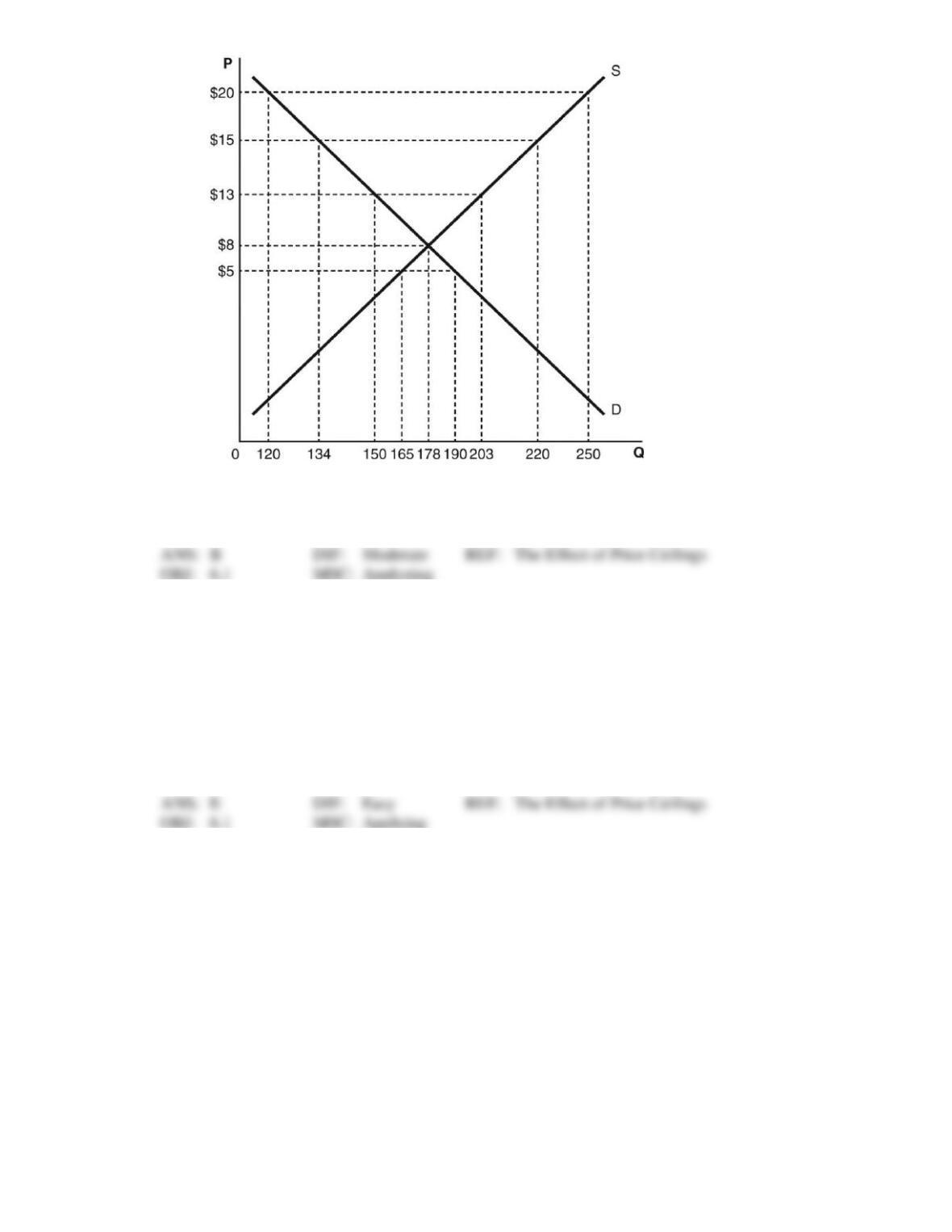
a. $5 d. $15
b. $8 e. $20
c. $13
58. One strategy someone might use to be elected mayor of a university town is to place a binding
price ceiling on rent for student apartments. What will happen if he or she gets elected and is able
to pass such a law?
a. The price ceiling will increase the number of apartments available for rent.
b. The price ceiling will cause the demand curve to shift.
c. The price ceiling will cause the supply curve to shift.
d. The price ceiling will decrease the number of students who want to rent an apartment.
e. The price ceiling will cause students to sleep in their cars or to move in with their friends
because they won’t be able to find places to live.
59. In some countries, a binding price ceiling is placed on prescription medicines. What would
someone expect the prescription medicine market to be like in these countries?
a. The legal maximum price would mean that all consumers are able to receive the medicines
they need at prices they can afford.
b. The legal maximum price would mean that pharmaceutical companies face an incentive to sell
more prescription medicines in that country.
c. The legal maximum price would mean that it is unlikely that an illegal and dangerous black
market for prescription drugs will form in that country.
d. The legal maximum price would mean that pharmaceutical companies face an incentive to
develop new prescription medicines.
e. The legal maximum price would mean that not all consumers will have access to prescription
medicines.
60. Roland is the president of the United States. In an attempt to make prescription drug prices
cheaper, he has imposed a binding price ceiling on drugs. What would he expect his critics to say?
a. The binding price ceiling will encourage companies to overproduce drugs and will result in
waste.
b. The binding price ceiling will discourage patients from obtaining the drugs they need.
c. The binding price ceiling will increase the likelihood that consumers will obtain needed drugs
on the black market.
d. The binding price ceiling will cause firms to spend too many resources on the research and
development of new drugs.
e. The binding price ceiling will cause firms to spend too much time making a drug without any
flaws.
61. Katherine is the president of the United States. In an attempt to make gasoline prices cheaper, she
has imposed a binding price ceiling on gas. What would she expect her critics to say?
a. The binding price ceiling will encourage oil companies to deplete the resource too quickly.
b. The binding price ceiling will discourage individuals from using their personal automobiles to
commute to work or school.
c. The binding price ceiling will cause firms to minimize their spending on the research and
development of alternatives to gasoline.
d. The binding price ceiling will increase the likelihood that customers obtain needed gasoline on
the black market.
e. The binding price ceiling will cause firms to produce only gasoline of the highest quality.
62. Suppose Solomon lives in a community with no price controls. What do you expect will happen if
his town borders a community where there is a binding price ceiling on most products?
a. Prices in the legal market in the community with a binding price ceiling will rise.
b. Prices in the legal market in the community with a binding price ceiling will fall.
c. There will be shortages in the community with a binding price ceiling.
d. More consumers will purchase products in the community with the price ceiling.
e. The black market in his community will be larger than the black market in the community with
the binding price ceiling.
63. What is the long-run consequence of a price ceiling law?
a. A surplus will continue to exist and will grow larger over time.
b. A surplus will continue to exist and will grow smaller over time.
c. A shortage will continue to exist and will grow larger over time.
d. A shortage will continue to exist and will grow smaller over time.
e. The amount of the surplus will not change.
64. How do consumers who are subject to a binding price ceiling respond as the time frame shifts from
the short run to the long run?
a. Consumers are increasingly willing to substitute away from the good, and their elasticity of
demand becomes less elastic.
b. There are no changes, and elasticity remains unchanged.
c. Consumers are increasingly willing to substitute away from the good, and their elasticity of
demand becomes more elastic.
d. Consumers are less willing to substitute away from the good, and their elasticity of demand
becomes less elastic.
e. Consumers are less willing to substitute away from the good, and their elasticity of demand
becomes more elastic.
65. How do producers who are subject to a binding price ceiling respond as the time frame shifts from
the short run to the long run?
a. Producers are increasingly willing to substitute away from producing the good, and their
elasticity of supply becomes less elastic.
b. There are no changes, and elasticity of supply remains unchanged.
c. Producers are increasingly willing to substitute away from producing the good, and their
elasticity of supply becomes more elastic.
d. Producers are less willing to substitute away from producing the good, and their elasticity of
supply becomes less elastic.
e. Producers are less willing to substitute away from the good, and their elasticity of supply
becomes more elastic.
66. Refer to the accompanying figure, which shows both short-run and long-run demand and supply
curves. If there is a $4 binding price ceiling imposed on a pharmaceutical drug, what will be the
amount of the disequilibrium in the short run?
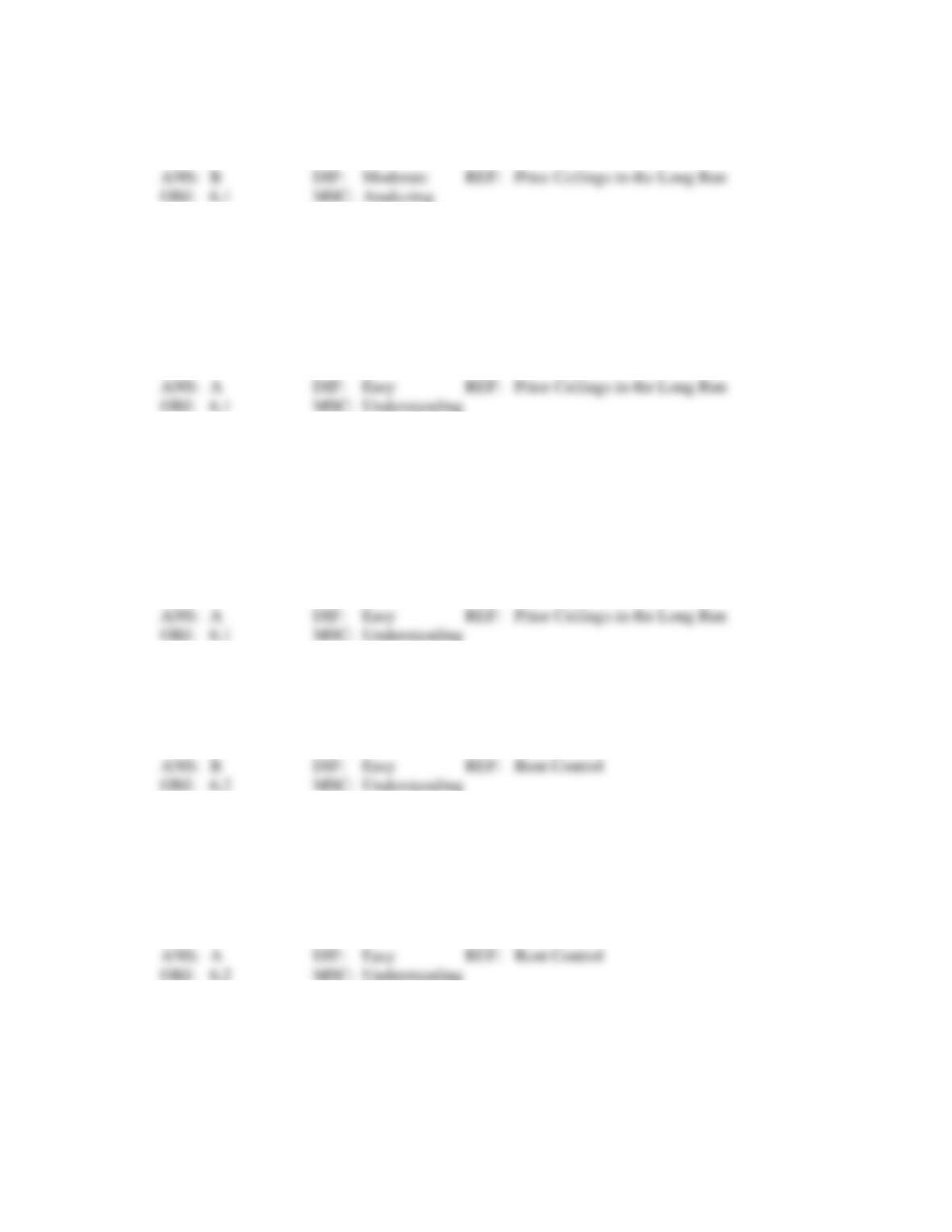
a. There will be a shortage of 1,500,000 units.
b. There will be a shortage of 800,000 units.
c. There will not be a shortage; there will be a surplus.
d. There will be a shortage of 2,000,000 units.
e. There will be a shortage of 500,000 units.
67. What will an individual do differently as a buyer in the black market in the long run?
a. He or she will substitute away from the product.
b. He or she will substitute toward the product.
c. When a binding price floor exists, he or she will be willing to pay a higher price.
d. When a binding price ceiling exists, he or she will be willing to pay a lower price.
e. What he or she does as a buyer in the long run will be no different from what he or she does in
the short run.
68. What will an individual do differently as a seller in the black market in the long run?
a. He or she will substitute away from producing the product.
b. He or she will substitute toward producing the product.
c. When there exists a binding price floor, he or she will be able to sell the good at a higher price.
d. When there exists a binding price ceiling, he or she will be able to sell the good at a lower
price.
e. What he or she does as a seller in the long run will be no different from what he or she does in
the short run.
69. A real-life, long-run example of a binding price ceiling is
a. a minimum wage law. d. a black market price.
b. rent control. e. a ration price.
c. a price gouging law.
70. The long-run effects of rent control support one of the five foundations of economics, namely, that
a. people respond to incentives.
b. society faces a trade-off between homelessness and rent control.
c. one must give up something in order to get something else.
d. social planners must think marginally in allocating housing.
e. exchange makes everyone better off.
71. The usual stated political goal of rent control is
a. to conduct social engineering via economic rules.
b. to pander to real estate landlords by assuring them a low occupancy rate.
c. to pander to the low income voters by assuring them enough living space.
d. to assist the low income at a cost to society, in convenient, affordable housing.
e. prices that allow rationing to the highest bidder.
72. Which of the following is NOT a mechanism for allocating housing in rent-controlled areas?
a. ethnicity d. bribes/kickbacks
b. waiting lists e. political favors
c. price
73. Price gouging laws are an example of
a. rules for keeping market prices low enough for buyers to afford the product.
b. a price ceiling.
c. rules to prevent a market shortage.
d. rules to prevent black market pricing.
e. prices to allow rationing to the highest bidder.
74. The economic entity most likely to engage in price gouging is
a. the manufacturer of the product, such as a Honda generator.
b. a national big-box store, such as Target or Walmart.
c. a local, regular supplier of the product.
d. an individual or business who has a supply of the product somewhere else.
e. a local resident who wants to get rid of his or her own product.
75. Price gouging laws will usually result in ________ the product in the distressed market.
a. more supply of
b. more local business start-ups to supply
c. government setting up an agency to regulate supply of
d. more Craigslist postings for
e. more demand than supply of
76. Refer to the accompanying figure. If there is a $700 government-imposed price antigouging law
imposed on generators, how will the market be affected in the short run?
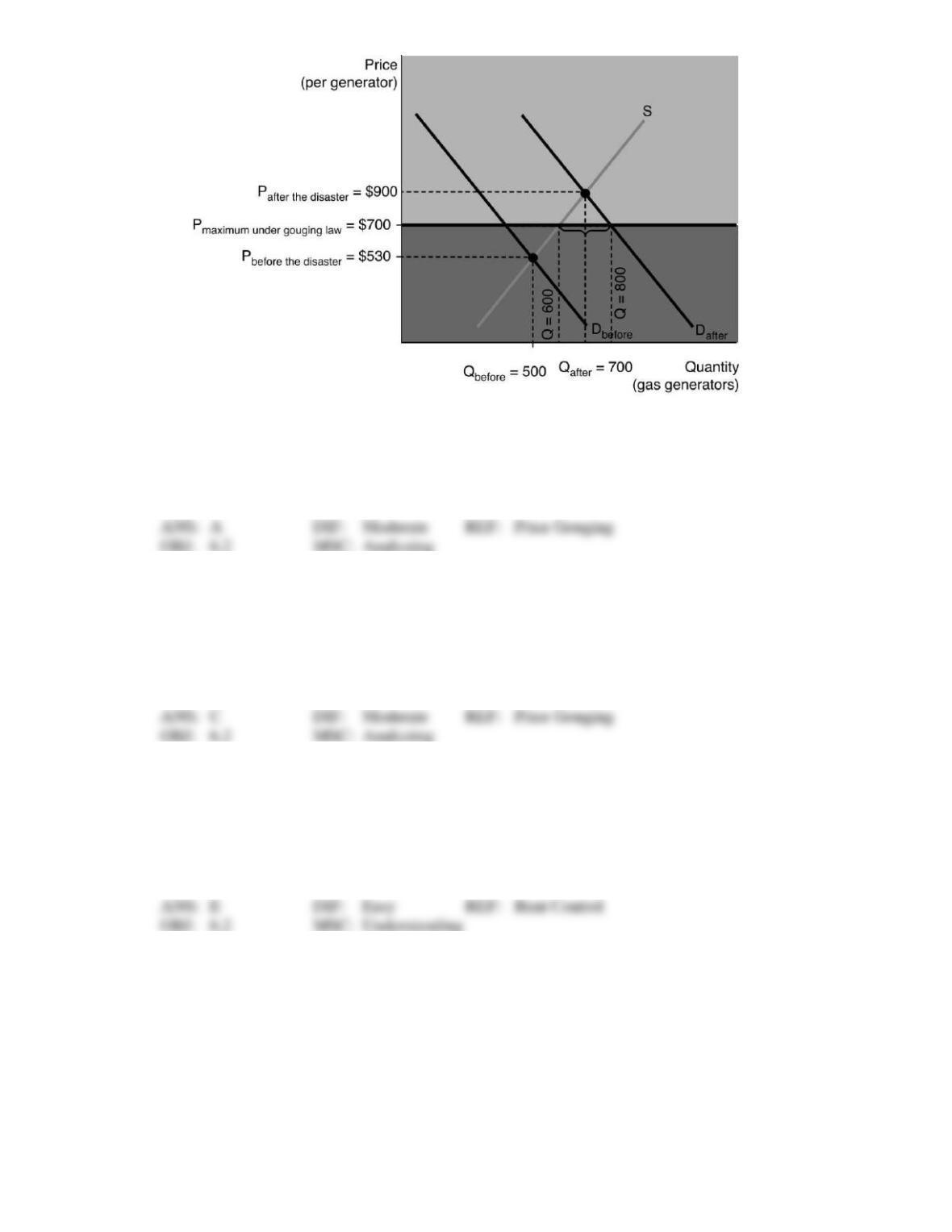
a. There will be a shortage of 200 generators.
b. There will be a shortage of 100 generators.
c. The government will intervene and order a surplus of 100 generators.
d. Price gougers will enter the market and provide a surplus of 100 generators.
e. No changes will occur in the market, since anti-price-gouging laws are now in effect.
77. Price gouging laws
a. are necessary and proper to prevent predatory pricing on victims of disasters.
b. keep distressed markets in equilibrium by maintaining “normal” prices.
c. restrict entrepreneurial behavior and consumer choice.
d. are enacted to encourage government-sponsored relief efforts.
e. have little effect on distressed markets and thus are irrelevant.
78. An example of a binding price ceiling is ________ the equilibrium price.
a. a minimum wage law that is set above
b. rent control that is set above
c. a black market that sets the price below
d. a minimum wage law that is set below
e. rent control that is set below
79. Which is a correct statement about a rent control law?
a. A rent control law is a price floor law that makes apartments cheaper to rent but discourages
property owners from renting out apartments.
b. A rent control law encourages property owners to convert offices and condos into apartments.
c. A rent control law reduces housing shortages.
d. A rent control law encourages landlords to rent out apartments.
e. A rent control law is a price ceiling law that makes apartments cheaper to rent but discourages
property owners from renting out apartments.
80. Apartment rent control in New York City is an example of
a. government intervention to ensure a market equilibrium is reached.
b. a subsidy for landlords.
c. a nonbinding price floor.
d. a binding price ceiling.
e. a black market.
81. Which of the following would be true in a city with rent-controlled apartments?
a. Homelessness is reduced.
b. Landlords face a greater incentive to provide housing.
c. Apartments are of higher quality.
d. Rents for those fortunate enough to find an apartment are lower than rents in nearby cities that
lack rent controls.
e. It is more difficult for the landlord to find a tenant willing to rent the apartment.
82. At what price level does the apartment market reach equilibrium?
a. $1,500 d. $1,650
b. $1,550 e. $1,700
c. $1,600
83. At what price level does the apartment market experience its largest shortage?
a. $1,500 d. $1,750
b. $1,550 e. $1,800
c. $1,700
84. At what price level does the apartment market experience its largest surplus?
a. $1,500 d. $1,750
b. $1,550 e. $1,800
c. $1,700
85. If rent control is established at $1,550, what would be the amount of disequilibrium in the
apartment market?
a. There would be a shortage of 28,990 apartments.
b. There would be a surplus of 28,990 apartments that is reduced, over time, as individuals rent
apartments in the illegal black market.
c. There would be neither a shortage nor a surplus.
d. There would be a surplus of 28,990 apartments that is eliminated through individuals renting
apartments in the illegal black market.
e. There would be a surplus of 28,990 apartments that increases as houses and condominiums are
converted into apartments.
86. If rent control is established at $1,750, what would be the amount of disequilibrium in the
apartment market?
a. There would be a shortage of 23,500 apartments.
b. There would be a surplus of 23,500 apartments that is reduced, over time, as individuals rent
apartments in the illegal black market.
c. There would be neither a shortage nor a surplus.
d. There would be a surplus of 23,500 apartments that is eliminated through individuals renting
apartments in the illegal black market.
e. There would be a surplus of 23,500 apartments that increases as houses and condominiums are
converted into apartments.
87. Imagine you find yourself in a heat wave and your air conditioner has broken. Unable to find a
new one at the store because of a price gouging law, you purchase an air conditioner on the black
market. What role did the price gouging law have?
a. It increased the willingness of firms to supply air conditioners when they were out of stock at
the stores.
b. It increased consumer demand for air conditioners.
c. It decreased the incentive of individuals to supply the good on the black market.
d. It had no effect on consumers or firms in this situation.
e. It increased the incentive of individuals to supply the good on the black market.
88. Jamie, an economics student, was just named Miss Florida, based in part on her answer to the
question of why price gouging laws should be relaxed in that state. Jamie won because she gave
which of the following answers?
a. They prevent customers who are willing to pay higher prices for needed products from doing
so during a time of disaster.
b. They cause consumers to consume more of certain products during a time of disaster.