Chapter 6
Every Macroeconomic Word You Ever Heard: Gross Domestic
Product, Inflation, Unemployment, Recession and Depression
Multiple Choice
1. The reason that only final sales are counted in GDP is
A) to avoid double counting goods that are sold so as to be resold.
B) to not count production in other countries.
C) because the government can’t get records on intermediate sales.
D) to simplify the computation and no other reason.
2. One subject of study for macroeconomics is
A) inflation.
B) monopoly.
C) perfect competition.
D) the shape of an individual’s demand curve.
3. One subject of study for macroeconomics is
A) unemployment.
B) monopoly.
C) perfect competition.
D) the shape of an individual’s demand curve.
4. One subject of study for macroeconomics is
A) economic growth.
B) monopoly.
C) perfect competition.
D) the shape of an individual’s demand curve.
5. In measuring Gross Domestic Product, goods produced by foreign firms in the United States
are
A) counted, and so are goods produced by American firms in foreign countries.
B) counted, but goods produced by American firms in foreign countries are not counted.
C) not counted, but goods produced by American firms in foreign countries.
D) not counted, and goods produced by American firms in foreign countries are also not
counted.
6. Gross Domestic Product is counted using two methods: one which counts all the ways
people _____ money and another which counts all the ways people _____ money.
A) earn; spend
B) spend; save
C) earn; save
D) loan; borrow
7. How does GDP deal with a Ford produced in Mexico?
A) It is fully counted.
B) It is not counted at all.
C) It is partially counted.
D) Is counted at twice the value
8. How does GDP deal with a Toyota produced in Kentucky?
A) It is fully counted.
B) It is not counted at all.
C) It is partially counted.
D) Is counted at twice the value
9. How does GDP account for something that was produced for sale in one year and sold in the
next year
A) It is counted in the first year and anything that happens latter does not count.
B) It is counted in the second year.
C) It is counted as an addition to inventory (which is in business investment) in the year it.
was produced and the markup is counted in the year in which it is sold.
D) It is counted twice
10. Suppose an apple pie sells at a grocery store is for $5. Suppose that the grocery store
purchased it from a baking company for $4. Suppose the baking company paid $2 for
ingredients, $1 for labor, and made $1 in profit. What is the GDP contribution of the pie?
A) It is $4.
B) It is $5.
C) It is $11.
D) It is $12.
11. Suppose a 1 pound steak sells at a grocery store is for $7. Suppose that the grocery store
purchased it from a butcher for $4. Suppose the butcher bought cattle from farmers for $2 per
sellable pound and paid their labor approximately $1 for pound of sellable beef labor, and
made $1 in profit. What is the GDP contribution of the steak?
A) It is $4.
B) It is $7.
C) It is $11.
D) It is $15.
12. Suppose a DVR is bought from China for $200 and sold in the US for $250. GDP will count
this
A) as nothing.
B) as a net of $50 ($250 sale minus $200 import).
C) as $200.
D) as $250.
13. Suppose a Boeing 777 is sold to a Chinese company for $250 million and resells it to a Hong
Kong airline for $251 million. GDP will count this as
A) as nothing.
B) as $250 million.
C) as $251 million.
D) as $451 million.
14. The reason that only final sales count in GDP is to
A) make it easier to do the accounting.
B) avoid double counting.
C) undervalue labor.
D) overvalue capital.
15. Which of these goods will not be counted in GDP
A) the Ford manufactured in the US and sold in Canada.
B) the Ford manufactured in Mexico and sold in Mexico.
C) the Ford manufactured in the US in last year and sold in the US this year.
D) the spark plug sold by an auto parts store to go into a Ford when the original wears out.
16. GDP can be calculated using
A) either the ways people earn money or the ways people spend money.
B) the way people spend money (but not the way people earn money).
C) the way people earn money (but not the way people spend money).
D) the difference between the way people earn money and the way they spend it.
17. The expenditures approach to GDP equals
A) Employee Compensation + Profit + Net Property Income + Indirect Business Taxes +
Depreciation – Income Earned Abroad.
B) Consumption + Gross Investment + Government Purchases + Net Exports.
C) Consumption + Net Investment (Gross Investment-Depreciation) + Government
Purchases + Net Exports.
D) Employee Compensation – Profit – Net Property Income – Indirect Business Taxes-
Depreciation – Income Earned Abroad.
18. The income approach to GDP equals
A) Employee Compensation + Profit + Net Property Income + Indirect Business Taxes +
Depreciation – Income Earned Abroad.
B) Consumption + Gross Investment + Government Purchases + Net Exports.
C) Consumption + Net Investment (Gross Investment-Depreciation) + Government
Purchases + Net Exports.
D) Employee Compensation – Profit – Net Property Income – Indirect Business Taxes –
Depreciation – Income Earned Abroad.
19. Inflation is measured using _________ in a price index.
A) the absolute increase
B) a multi-year weighted average increase
C) the percentage year-to-year increase
D) logarithm adjusted absolute increase
20. If a market basket was defined in 2014 and it cost $10,000 to purchase the items in that
basket in 2014, while it cost $11,000 to purchase those identical goods in 2015, then the base
year is
A) 2013.
B) 2014.
C) 2015.
D) none of these.
21. If a market basket was defined in 2014 and it cost $10,000 to purchase the items in that
basket in 2014, while it cost $11,000 to purchase those identical goods in 2015, then the price
index for the base year is
A) 100.
B) (10000/11000)*100=90.9.
C) (11000/10000)*100=110.
D) none of these
22. If a market basket was defined in 2014 and it cost $10,000 to purchase the items in that
basket in 2014, while it cost $11,000 to purchase those identical goods in 2015, then the price
index for 2015 is
A) 100.
B) (10000/11000)*100=90.9.
C) (11000/10000)*100=110.
D) unknown given this data.
23. If a market basket was defined in 2014 and it cost $10,000 to purchase the items in that
basket in 2014, while it cost $11,000 to purchase those identical goods in 2015, then the
inflation rate from 2013 to 2014 is
A) (100-100)/100*100%=0%.
B) (100-90.9)/100*100%=9.1%.
C) (110-100)/100*100%=10%.
D) unknown given this data.
24. If a market basket was defined in 2014 and it cost $10,000 to purchase the items in that
basket in 2014, while it cost $11,000 to purchase those identical goods in 2015, then the
inflation rate from 2014 to 2015 is
A) (100-100)/100*100%=0%.
B) (100-90.9)/100*100%=9.1%.
C) (110-100)/100*100%=10%.
D) unknown given this data.
25. If a market basket was defined in 2014 and it cost $10,000 to purchase the items in that
basket in 2014, while it cost $12,000 to purchase those identical goods in 2015, then the price
index for the base year is
A) 100.
B) (10000/12000)*100=83.33.
C) (12000/10000)*100=120.
D) unknown given this data.
26. If a market basket was defined in 2014 and it cost $10,000 to purchase the items in that
basket in 2014, while it cost $12,000 to purchase those identical goods in 2015, then the price
index for 2015 is
A) 100.
B) (10000/12000)*100=83.33.
C) (12000/10000)*100=120.
D) unknown given this data.
27. If a market basket was defined in 2014 and it cost $10,000 to purchase the items in that
basket in 2014, while it cost $12,000 to purchase those identical goods in 2015, then the
inflation rate from 2005 to 2006 is
A) (100-100)/100*100%=0%.
B) (100-83.3)/100*100%=16.7%.
C) (120-100)/100*100%=20%.
D) unknown given this data.
28. If a market basket was defined in 2014 and it cost $10,000 to purchase the items in that
basket in 2014, while it cost $12,000 to purchase those identical goods in 2015, then the
inflation rate from 2006 to 2007 is
A) (100-100)/100*100%=0%.
B) (100-83.3)/100*100%=16.7%.
C) (120-100)/100*100%=20%.
D) unknown given this data
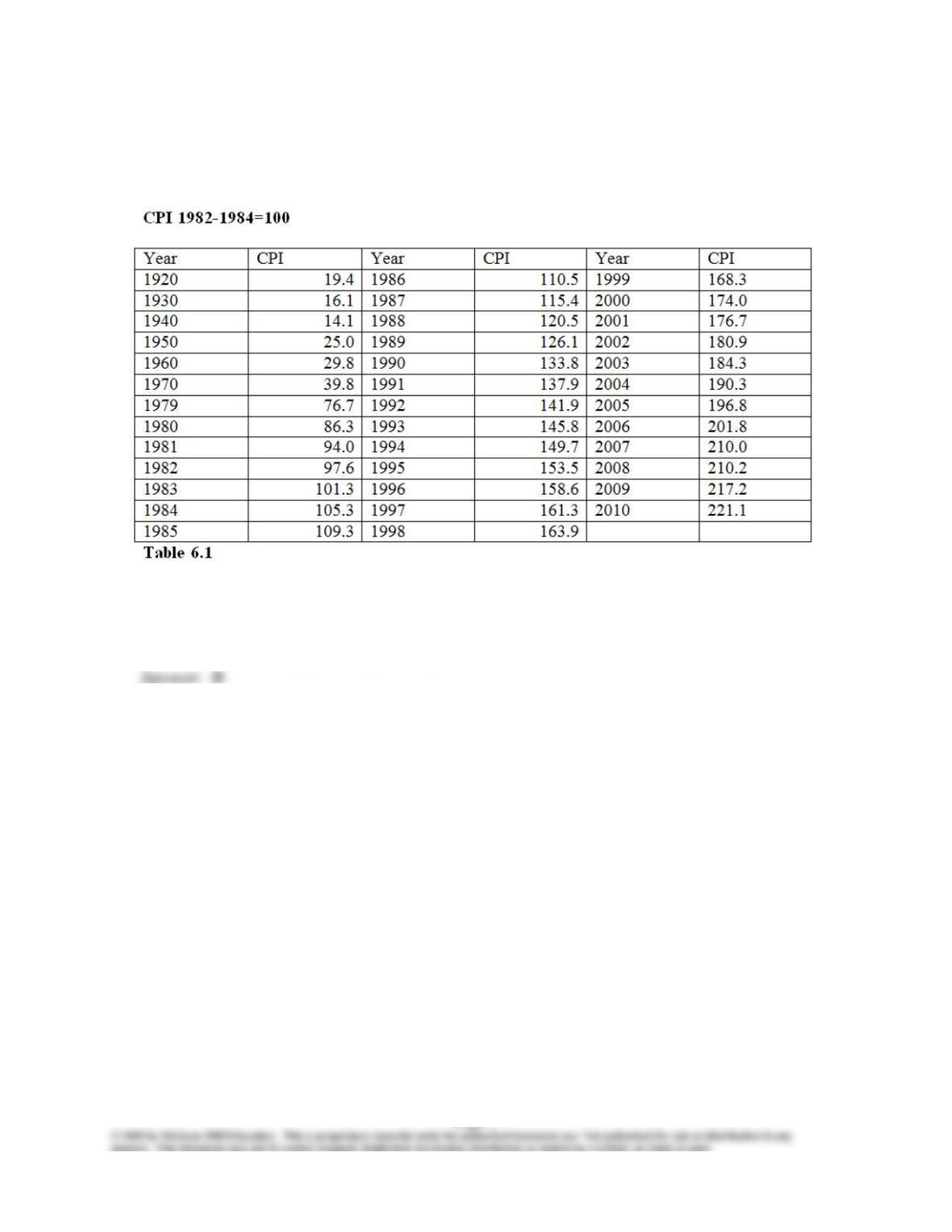
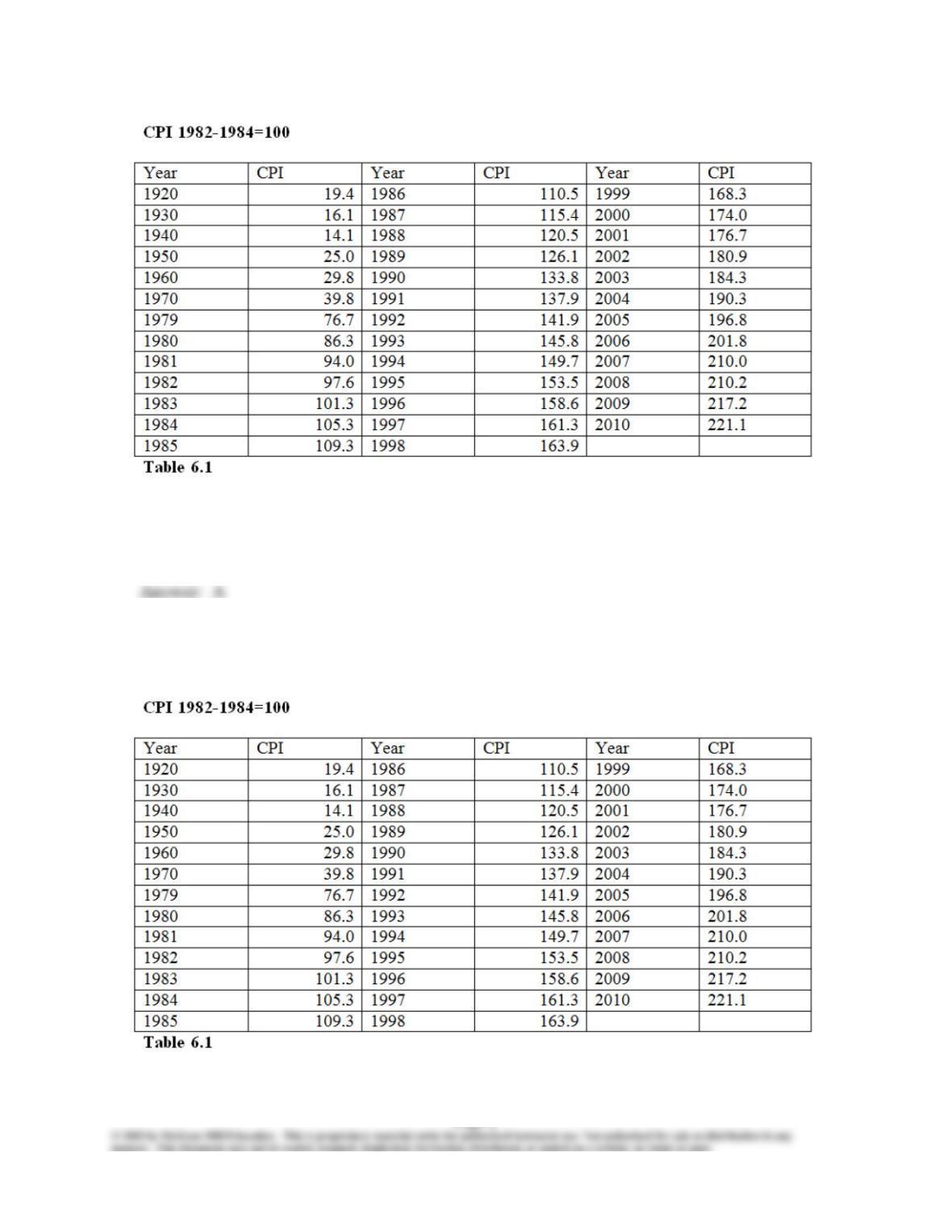
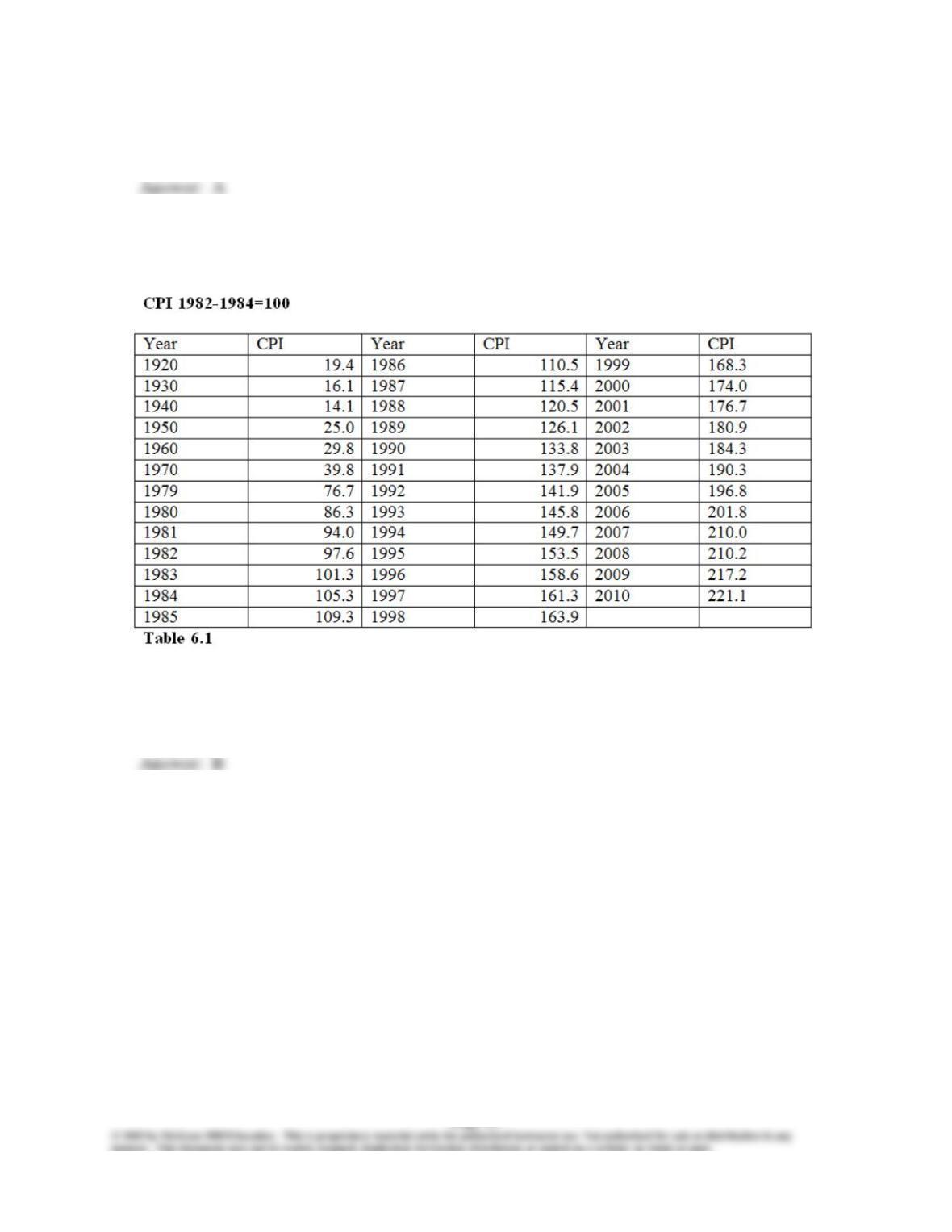
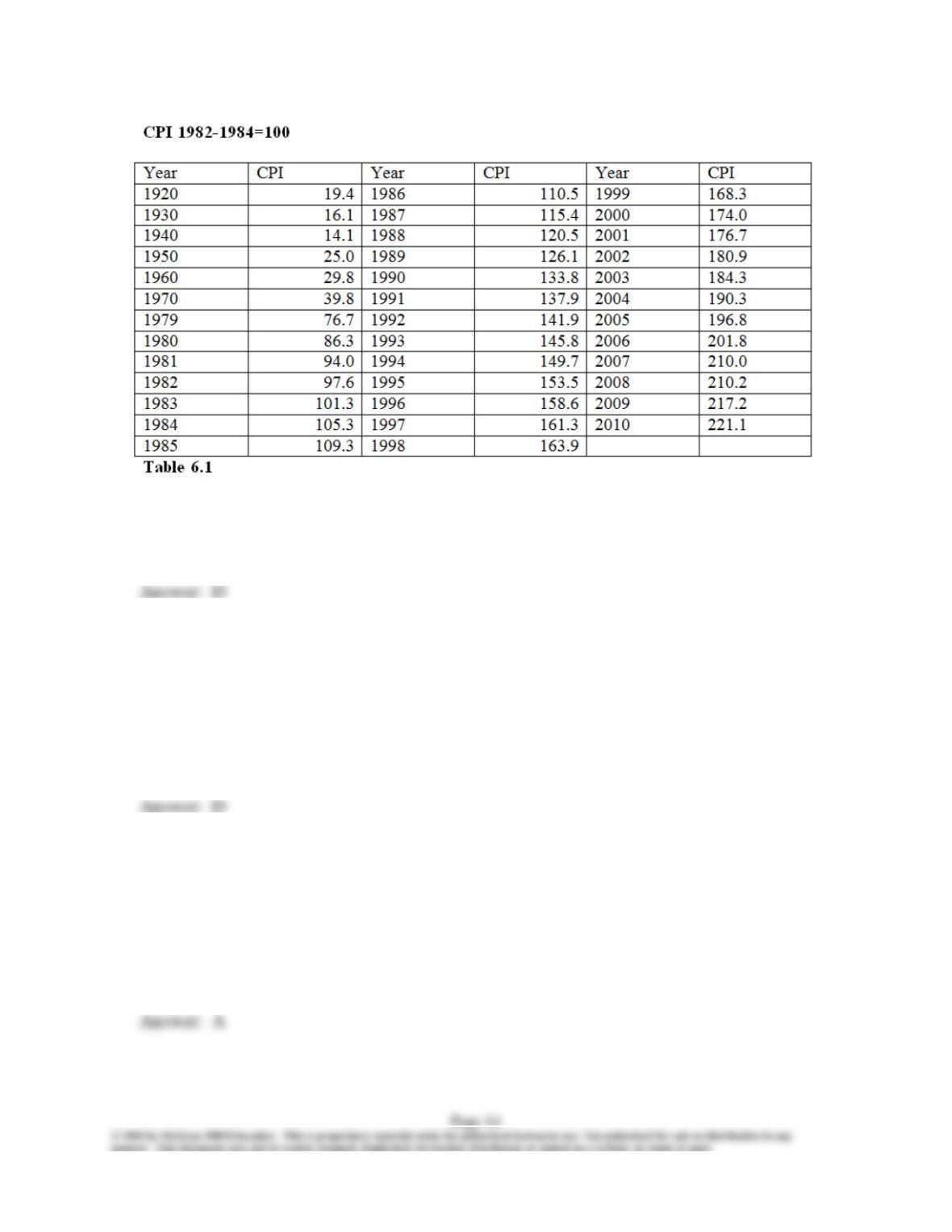
29. Using Table 6.1, the inflation rate for 1999 would be
A) 68.3% (168.3-100).
B) 2.7% (((168.3-163.9)/163.9)*100 %).
C) 4.4% (168.3-163.9).
D) 3.0% (174-163.9)/(2*163.9)*100%).
30. Using Table 6.1, from the 1982-1984 base to 2002, prices increased
A) 80.9%.
B) 80.9 times.
C) by 80.9 dollars per week on monthly bills.
D) 180.9%.
31. Using Table 6.1, the inflation rate for 2000 would be
A) 74.0% (174.0-100).
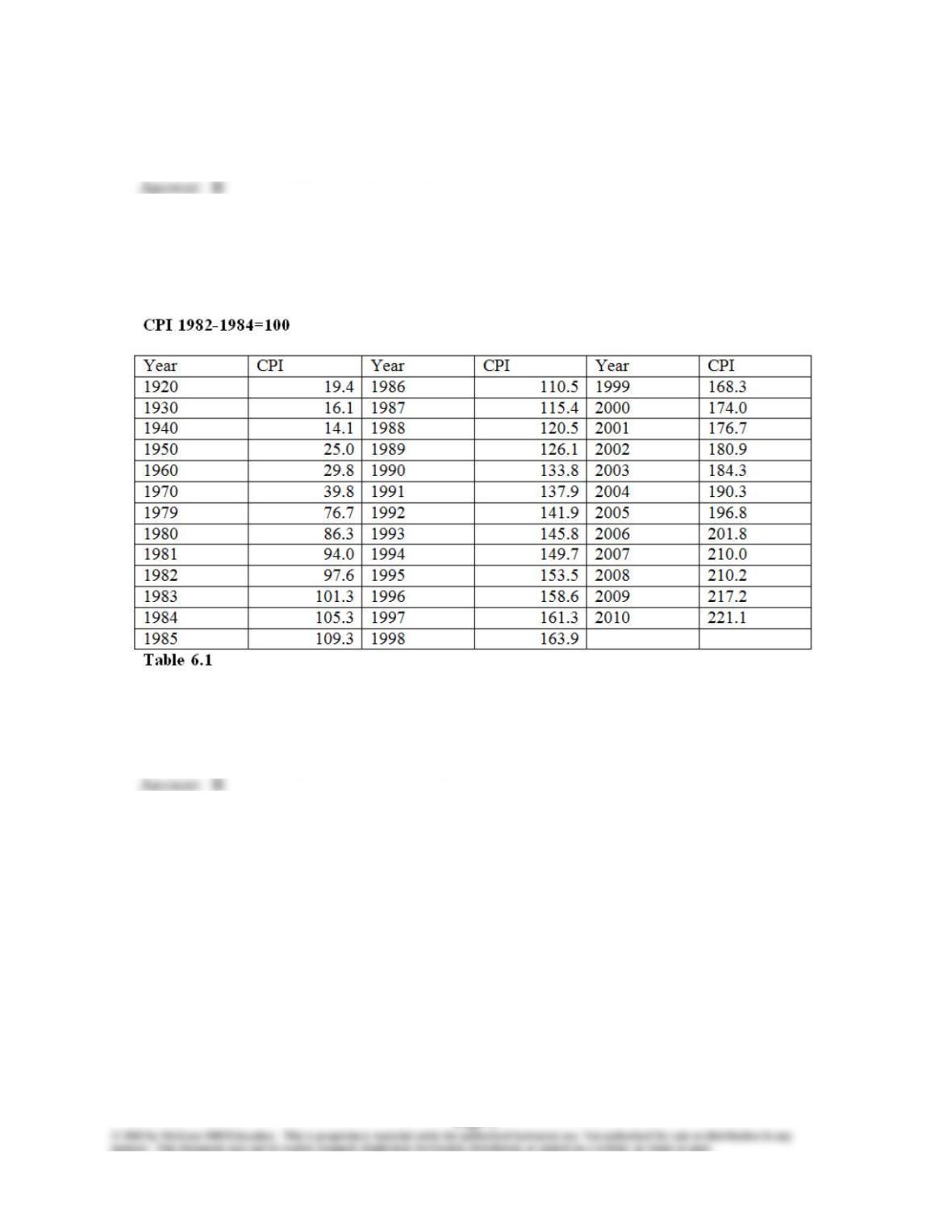
B) 3.3% (((174.0-168.3)/168.3)*100 %).
C) 5.7% (174.0-168.3).
D) 3.1% (174-163.9)/(2*163.9)*100%).
32. Using Table 6.1, the inflation rate for 2001 would be
A) 76.7% (176.7-100).
B) 1.6% (((176.7-174.0)/174.0)*100 %).
C) 2.7% (176.7-174.0).
D) 2.0% (180.9-174.0)/(2*174.0)*100%).
33. Using Table 6.1, the inflation rate for 2002 would be
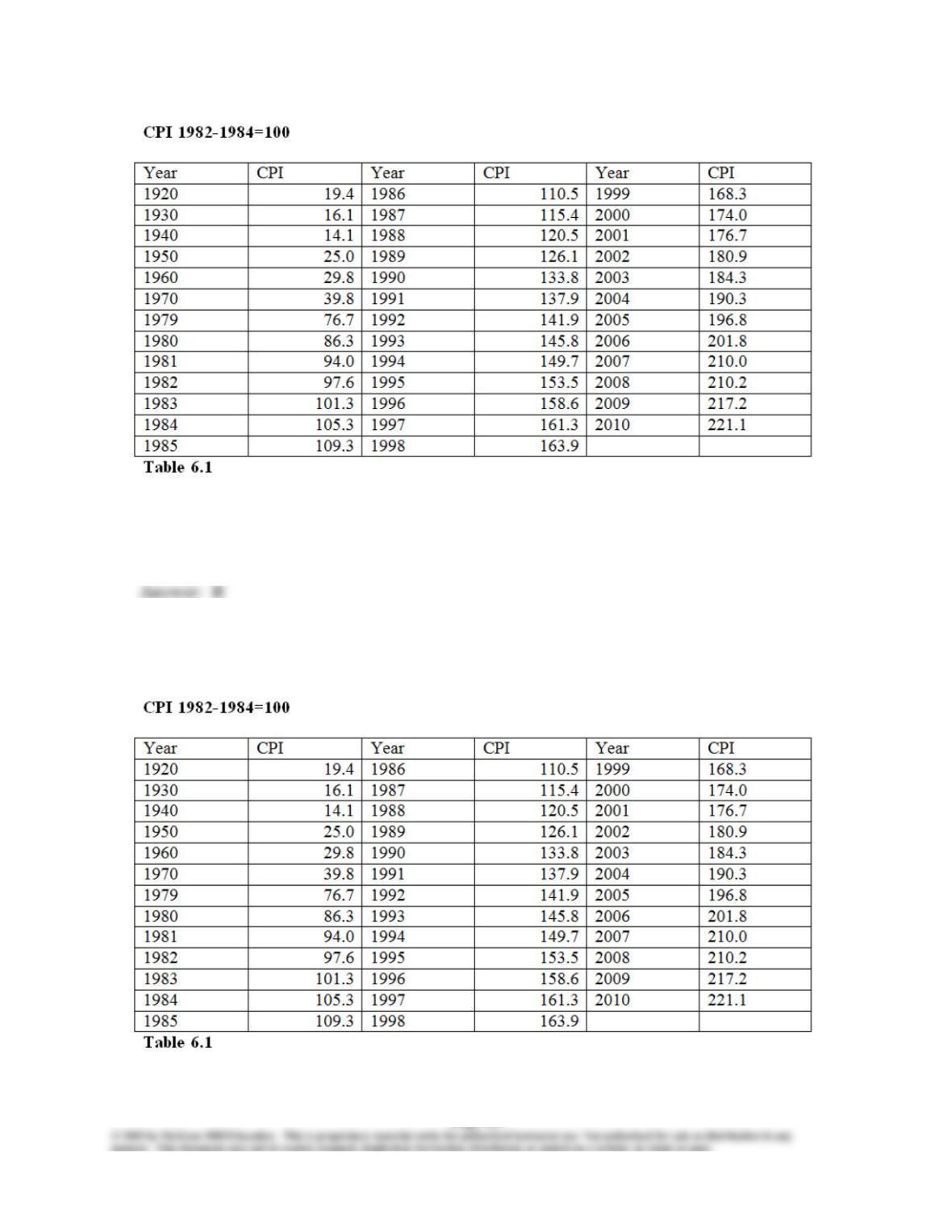
A) 80.9% (180.9-100).
B) 2.4% (((180.9-176.7)/176.7)*100 %).
C) 4.2% (180.9-176.7).
D) 2.2% (184.3-176.7)/(2*176.7)*100%).
34. Using Table 6.1, the inflation rate for 2003 would be
A) 84.3% (184.3-100).
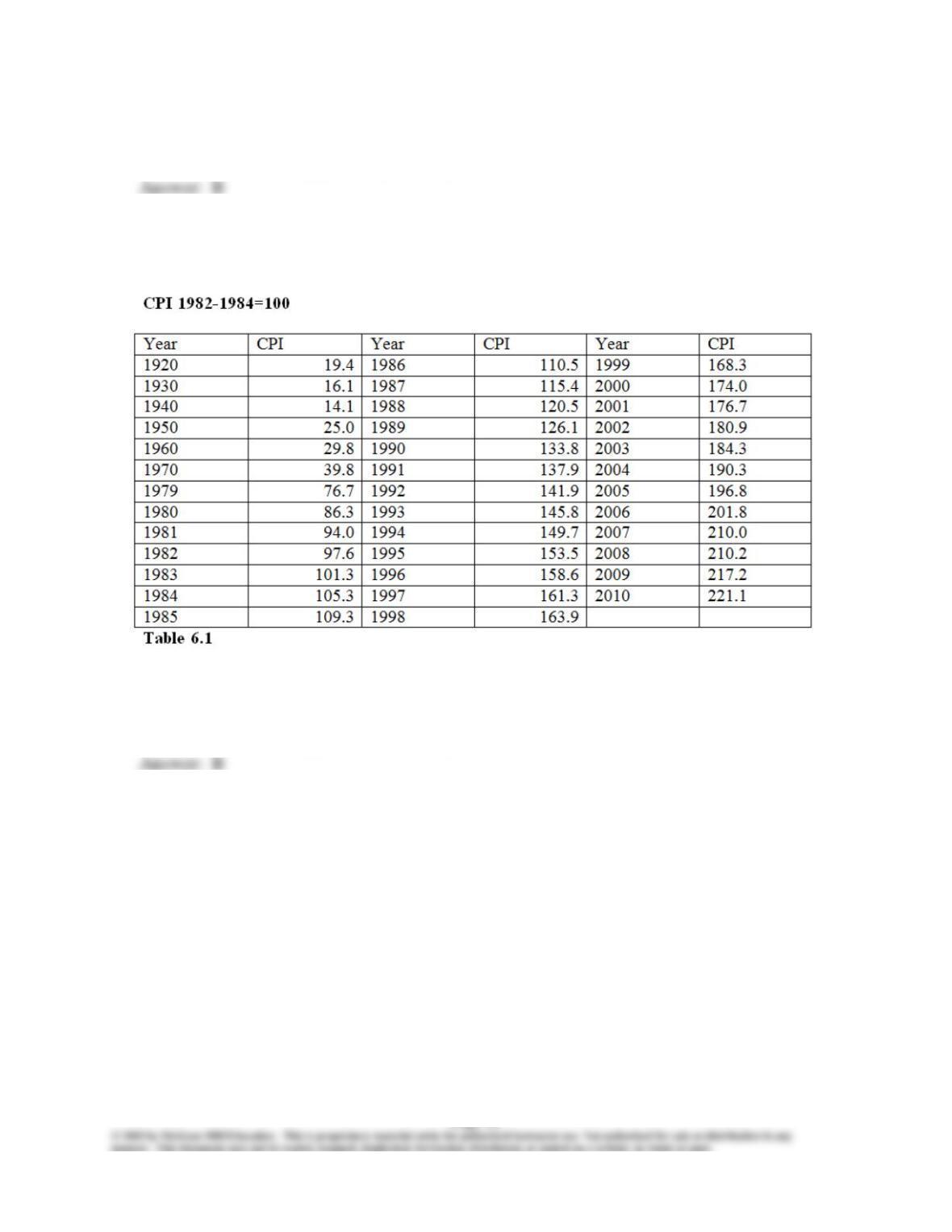
B) 1.9% (((184.3-180.9)/180.9)*100 %).
C) 4.4% (184.3-180.9).
D) 3.0% (190.3-180.9)/(2*180.9)*100%).
35. Using Table 6.1, the inflation rate for 2004 would be
A) 90.3% (190.3-100).
B) 3.3% (((190.3-184.3)/184.3)*100 %).
C) 6.0% (190.3-184.3).
D) 2.6% (190.3-180.9)/(2*180.9)*100%).
36. Using Table 6.1, from the 1982-1984 base to 2003, prices increased
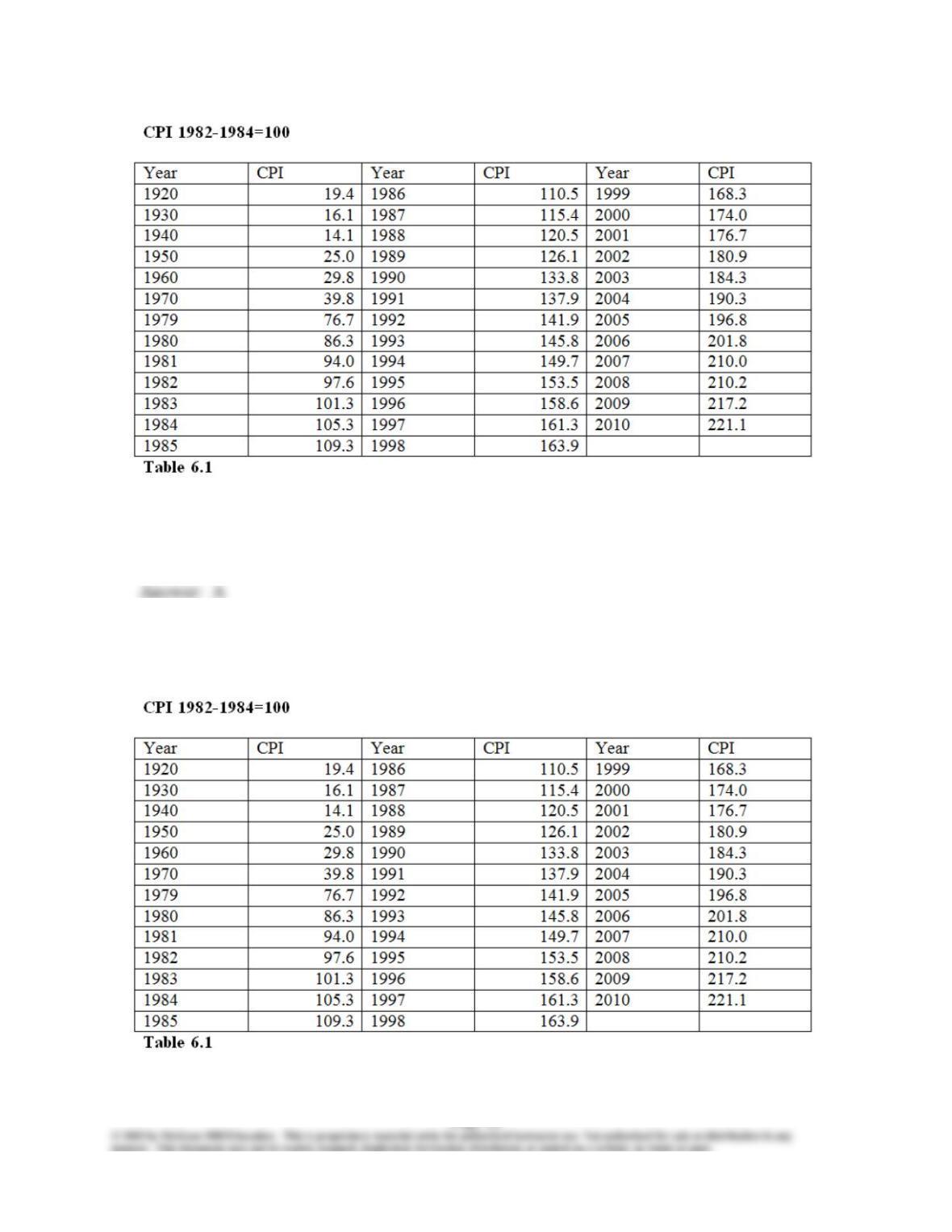
A) 84.3%.
B) 84.3 times.
C) by 84.3 dollars per week on monthly bills.
D) 184.3%.
37. Using Table 6.1, from the 1982-1984 base to 2004, prices increased
A) 90.3%.
B) 90.3 times.
C) by 90.3 dollars per week on monthly bills.
D) 190.3%.
38. Using Table 6.1, from the 1982-1984 base to 2010, prices increased
A) 221.1%.
B) 121.1%.
C) by 121.1 dollars per week on monthly bills.
D) 121.1 times.
39. Using Table 6.1, were there to have been deflation during this time period you would have
seen
A) a slower rate of increase in the CPI.
B) a stationary CPI.
C) a more rapid rate of increase in the CPI.
D) a decrease in the CPI.
40. Suppose there are only two goods (Good A and Good B) and the average person buys 4 of
Good A in a year and 3 of Good B. If the Price of Good A is $5 and the Price of Good B is
$10, the price of the market basket
A) is 100.
B) is 20.
C) is 30.
D) is 50.
41. Suppose this is the base year and there are only two goods (Good A and Good B) and the
average person buys 4 of Good A in a year and 3 of Good B. If the Price of Good A is $5 and
the Price of Good B is $10, the price index
A) is 100.
B) is 20.
C) is 30.
D) is 50.
42. Suppose there are only two goods (Good A and Good B) and the average person buys 4 of
Good A in a year and 3 of Good B. If, in the base year, the Price of Good A is $5 and the
Price of Good B is $10, and in the next year the Price of Good A is $6 and the Price of Good
B is $9, the price index in the second of the two years
A) is 51.
B) is 100.
C) is 101.
D) is 102.
43. Suppose there are only two goods (Good A and Good B) and the average person buys 4 of
Good A in a year and 3 of Good B. If, in the base year, the Price of Good A is $5 and the
Price of Good B is $10, and in the next year the Price of Good A is $6 and the Price of Good
B is $9, the inflation that occurred in the second year is
A) is 51%.
B) is 100%.
C) is 1%.
D) is 2%.
44. Suppose there are only two goods (Good A and Good B) and the average person buys 8 of
Good A in a year and 6 of Good B. If the Price of Good A is $8 and the Price of Good B is
$6, the price of the market basket
A) is 100.
B) is 64.
C) is 36.
D) is 50.
45. Suppose this is the base year and there are only two goods (Good A and Good B) and the
average person buys 8 of Good A in a year and 6 of Good B. If the Price of Good A is $8 and
the Price of Good B is $6, the price index
A) is 100.
B) is 64.
C) is 36.
D) is 50.
46. Suppose there are only two goods (Good A and Good B) and the average person buys 8 of
Good A in a year and 6 of Good B. If, in the base year, the Price of Good A is $8 and the
Price of Good B is $6, and in the next year the Price of Good A is $10 and the Price of Good
B is $5, the price index in the second of the two years
A) is 10.
B) is 100.
C) is 110.
D) is 120.
47. Suppose there are only two goods (Good A and Good B) and the average person buys 4 of
Good A in a year and 3 of Good B. If, in the base year, the Price of Good A is $5 and the
Price of Good B is $10, and in the next year the Price of Good A is $6 and the Price of Good
B is $9, the inflation that occurred in the second year is
A) is 50%.
B) is 100%.
C) is 10%.
D) is 20%.
48. Suppose there are two good types (Type 1 and Type 2) and suppose the weights for the types
are 80% for Type 1 and 20% for Type 2. Suppose the Price Index for Type 1 is 125 and the
Price Index for Type 2 is 120. The overall price index is
A) is 116.
B) is 122.5.
C) is 124.
D) is 128.
49. Suppose there are two good types (Type 1 and Type 2) and suppose the weights for the types
are 60% for Type 1 and 40% for Type 2. Suppose the Price Index for Type 1 is 200 and the
Price Index for Type 2 is 150. The overall price index is
A) Is 140.
B) Is 175.
C) Is 180.
D) Is 350.
50. Suppose there are two good types (Type 1 and Type 2) and suppose the weights for the types
are 70% for Type 1 and 30% for Type 2. Suppose the Price Index for Type 1 is 200 and the
Price Index for Type 2 is 100. The overall price index is
A) is 140.
B) is 150.
C) is 170.
D) is 300.
51. Suppose the price of gasoline has increased from $3 per gallon to $4 per gallon at the same
time that the overall price index increased from 200 to 300 then you know that the inflation
adjusted price of gasoline has
A) increased.
B) decreased.
C) remained constant.
52. Suppose the price of gasoline has increased from $3 per gallon to $4 per gallon at the same
time that the overall price index increased from 200 to 250 then you know that the inflation
adjusted price of gasoline has
A) increased.
B) decreased.
C) remained constant.
53. Suppose the price of gasoline has increased from $3 per gallon to $4 per gallon at the same
time that the overall price index increased from 200 to 266.66 then you know that the
inflation adjusted price of gasoline has
A) increased.
B) decreased.
C) remained constant.
54. Suppose the price of gasoline has increased from $2 per gallon to $4 per gallon at the same
time that the overall price index increased from 200 to 250 then you know that the inflation
adjusted price of gasoline has
A) increased.
B) decreased.
C) remained constant.
55. Suppose the price of gasoline has increased from $2 per gallon to $4 per gallon at the same
time that the overall price index increased from 200 to 450 then you know that the inflation
adjusted price of gasoline has
A) increased.
B) decreased.
C) remained constant.
56. Suppose the price of gasoline has increased from $2 per gallon to $4 per gallon at the same
time that the overall price index increased from 200 to 400 then you know that the inflation
adjusted price of gasoline has
A) increased.
B) decreased.
C) remained constant.
57. In early 2005, inflation increased unexpectedly due to an increase oil prices. This helped
A) borrowers.
B) lenders.
C) people on fixed incomes.
D) workers.
58. Deflation occurs only when
A) some prices fall but average prices still rise.
B) all prices for all goods fall.
C) the average price level (CPI) falls.
D) the average price level increases but at a slower rate than before.
59. Economists consider deflation
A) to be generally healthy for the economy.
B) to be a normal part of the economy, not necessarily healthy or unhealthy.
C) dangerous, as it can lead to a depression.
D) to be no better and no worse than inflation.
60. With deflation people will
A) buy goods earlier than they had originally planned.
B) feel compelled to borrow money.
C) delay their purchases of goods in hopes prices will fall further.
D) see their paycheck rise as bosses seek to reward high performers.
61. Economists generally believe that relative to the true cost of living, the CPI
A) is perfectly measured.
B) overstates it by a factor of 2 (meaning that inflation is really only half as bad as the
government states).
C) overstates it by a difference of about .8% (meaning that an official inflation rate of 1.8%
is really only about 1%).
D) understates it by a factor of 2 (meaning that inflation is actually twice as bad as the
government states).
62. The Consumer Price Index (CPI) is a heavily criticized measure of inflation because
A) the government does nothing to fix its known deficiencies.
B) it consistently understates the increase in the cost-of-living.
C) it consistently overstates the increase in the cost-of-living.
D) the government constantly makes adjustments in it without warrant.
63. Which of the following is not a reason that the CPI overstates the cost of living?
A) There are too frequent updates of the market basket.
B) Quality improvements are not adequately incorporated.
C) The location of typical purchases is not adequately updated.
D) The tendency to substitute to nearly equivalent goods is not adequately accounted for.
64. Which of the following is not a reason that the CPI overstates the cost of living?
A) There are too infrequent updates of the market basket.
B) Quality improvements are not adequately incorporated.
C) The location of typical purchases is not adequately updated.
D) Substitution into nearly-equivalent goods is assumed to be more common than it is.
65. According to the Bureau of Labor Statistics, the Consumer Price Index was
A) always intended to measure increases in the cost of living and does precisely that.
B) never intended to measure increases in the cost of living and no one uses it that way.
C) never intended to measure increases in the cost of living but many use it that way.
D) only intended to measure increases in the cost of living for a small segment of society.
66. The majority of economists believe that the Consumer Price Index
A) overstates the increase in the cost of living.
B) understates the increase in the cost of living.
C) precisely measures the increase in the cost of living.
D) overstates the increase in the cost of living in some years and understates it in others.
67. A reason given why the CPI overstates the cost of living is it
A) only measures the effects of inflation on the poor.
B) makes no attempt to ascertain what average people buy.
C) makes no attempt to update the market basket.
D) makes no attempt to control for substitution to cheaper goods.
68. A reason given why the CPI overstates the cost of living is it
A) only measures the effects of inflation on the poor.
B) makes no attempt to ascertain what average people buy.
C) makes no attempt to update the market basket.
D) makes no attempt to control for the fact that sales often occur on holidays.
69. A reason given why the CPI overstates the cost of living is it
A) only measures the effects of inflation on the poor.
B) makes no attempt to ascertain what average people buy.
C) makes no attempt to update the market basket.
D) makes no attempt to control for quality improvements except in consumer goods
70. A reason given why the CPI overstates the cost of living is it
A) only measures the effects of inflation on the poor.
B) makes no attempt to ascertain what average people buy.
C) makes no attempt to update the market basket.
D) inadequately deals with updates in product lines for existing goods.