76) A subsidy is sometimes used by government to correct the problems associated with
A) negative externalities.
B) positive externalities.
C) internal benefits.
D) external benefits.
77) The funds that polluters pay that gives them the right to discharge into the air or water a
certain amount of pollution are
A) special subsidies.
B) regulation fees.
C) external costs.
D) effluent fees.
78) The purpose of an effluent fee is to
A) reduce the amount produced of a good and to raise the market price.
B) correct for pollution while keeping the price of the good the same as before the correction.
C) reward people producing externalities.
D) encourage producers to keep the quantity produced the same while lowering the price.
79) The purpose of an effluent fee imposed on a firm is
A) to increase output of its product by increasing the resources allocated to production.
B) to increase output of its product by reducing the resources allocated to production.
C) to reduce output by increasing production costs thereby reducing resources used.
D) none of the above
80) An effluent fee is more effective when imposed on
A) the firm or producer of the product which generates pollution.
B) the consumer of the product.
C) neither the producer nor the consumer of the product.
D) the supplier of the raw material used by the firm.
81) An effluent fee is a
A) subsidy given to the producer of a positive externality.
B) charge to a polluter that gives the right to discharge pollution into the air.
C) fine imposed on a polluter for dumping illegal pollution.
D) charge for a public good.
82) A possible solution to the problems of external benefits is
A) to tax those receiving the extra benefits.
B) production of the good by government.
C) effluent fees.
D) to restrict the amount of the good through direct government regulation.
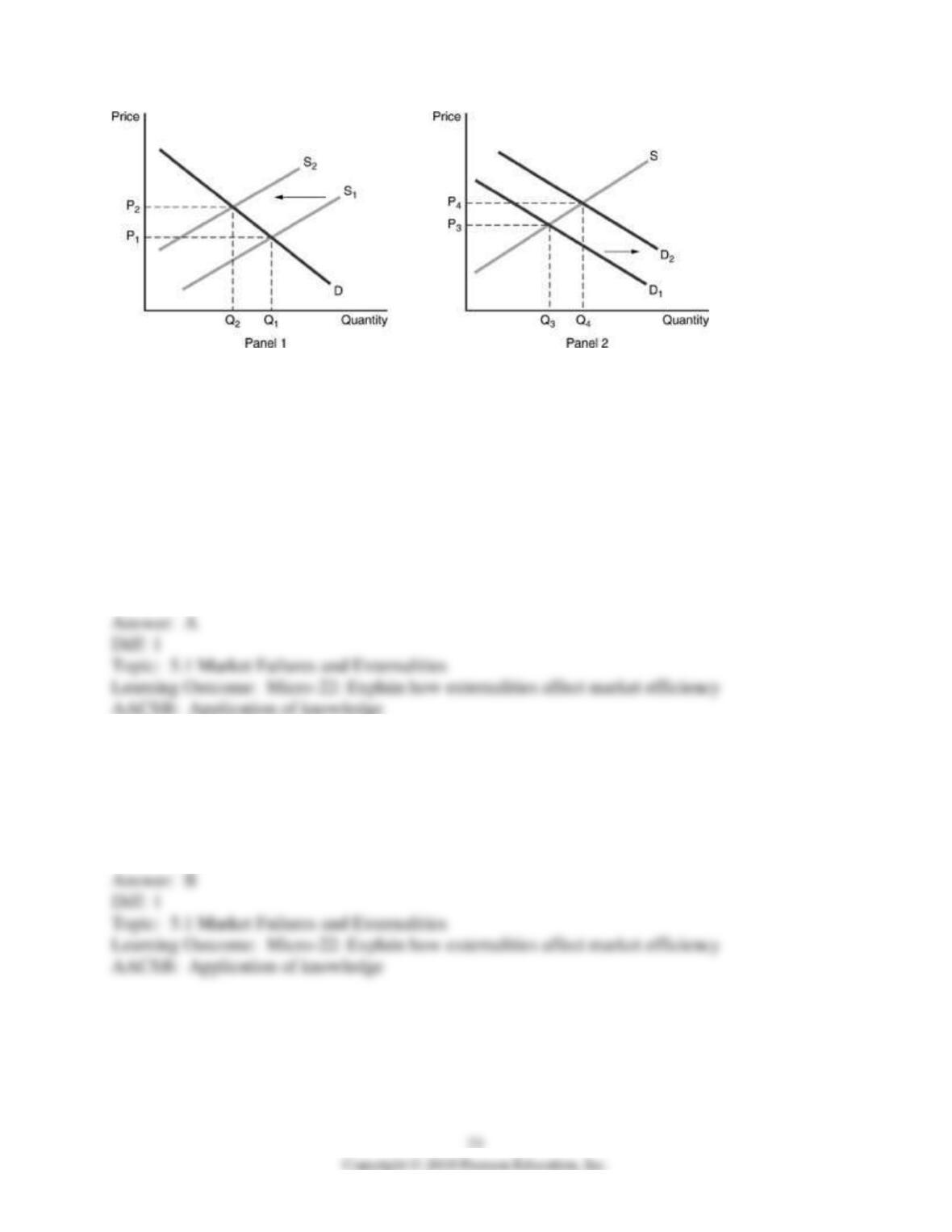
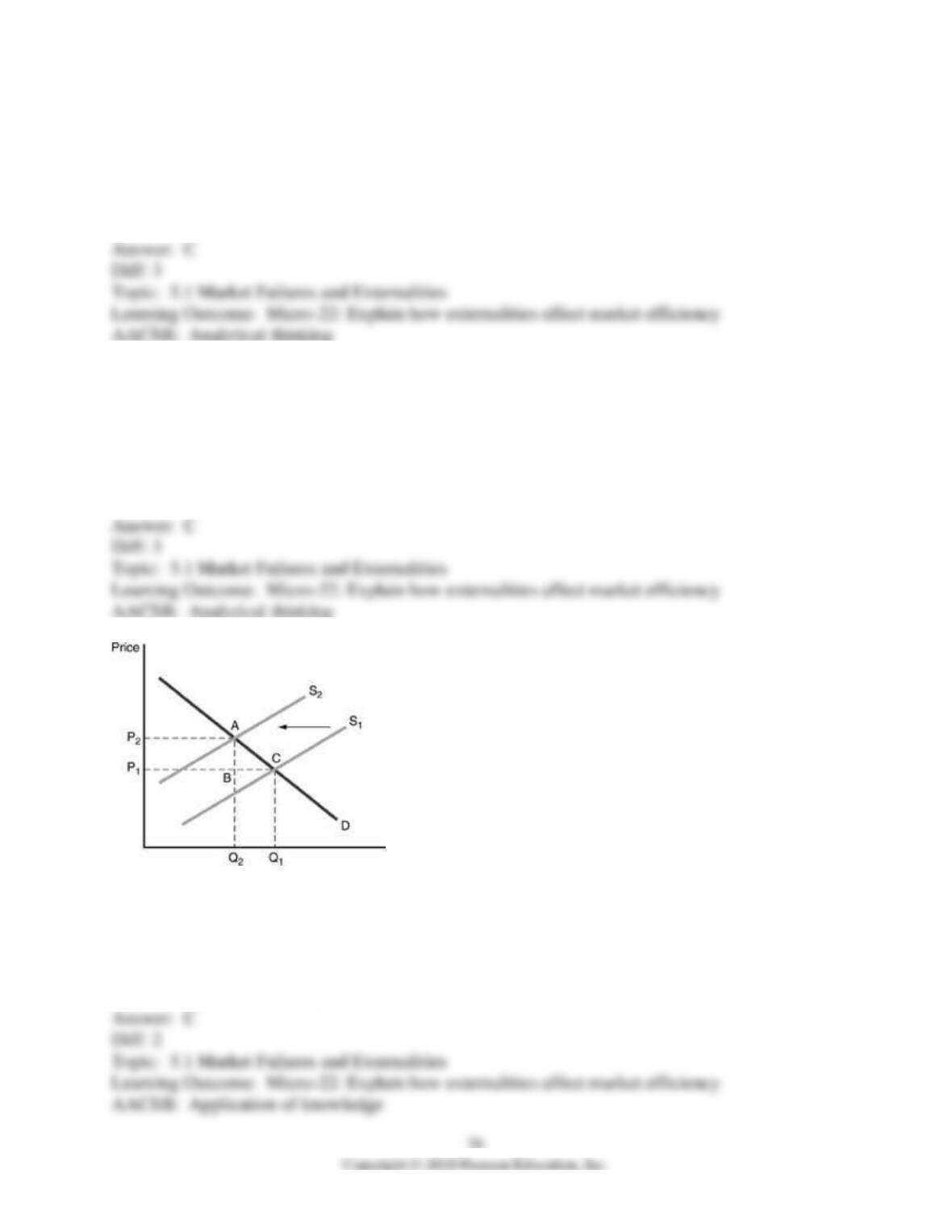
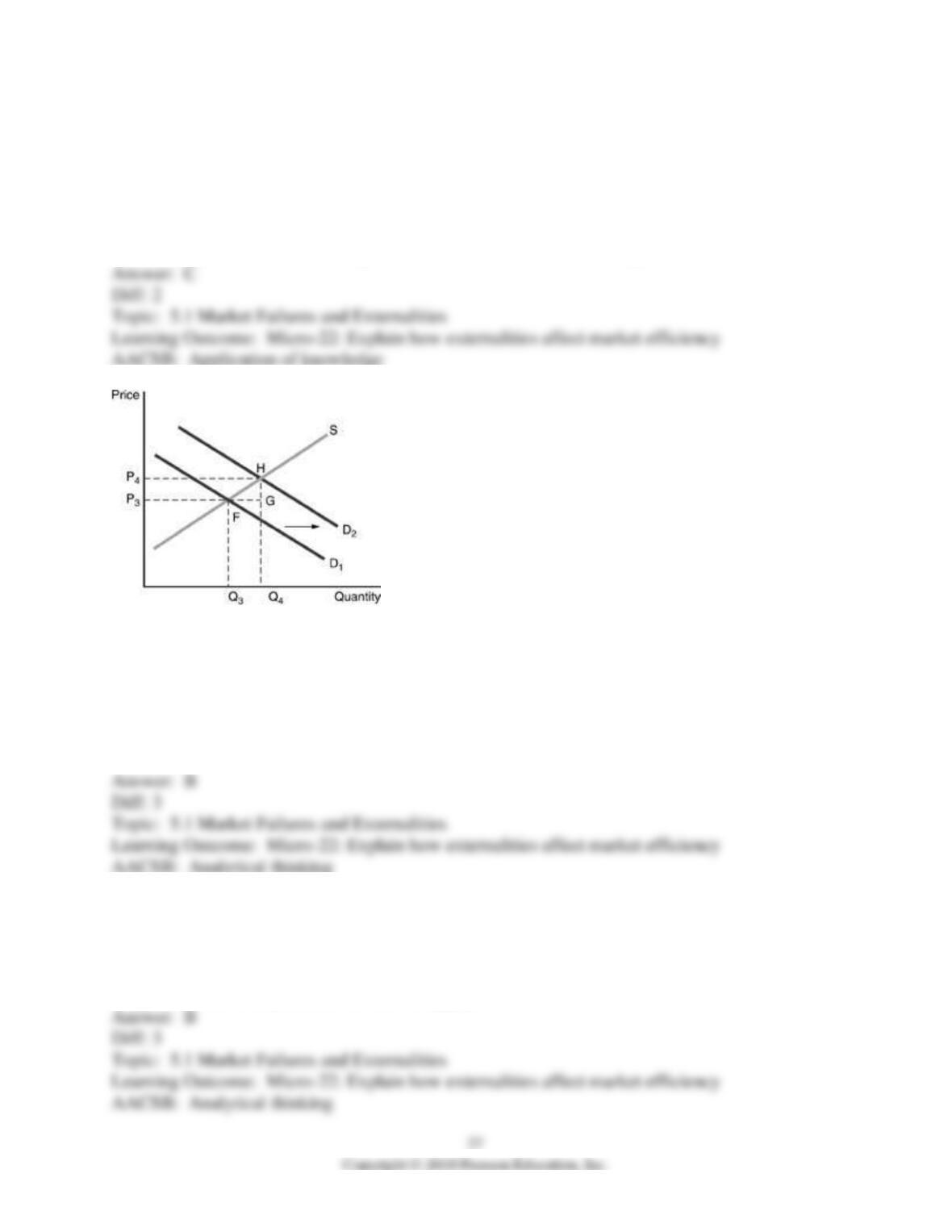
A shift from S1 to S2 reflects the change that happens when a negative externality is taken
into account. A shift from D1 to D2 reflects the change that happens when a positive
externality is taken into account.
83) Refer to the above figures. Which of the panels would be consistent with the situation in
which external costs exist?
A) Panel 1
B) Panel 2
C) Panels 1 and 2
D) neither panel
84) Refer to the above figures. Which of the panels would be consistent with the situation in
which external benefits exist?
A) Panel 1
B) Panel 2
C) Panels 1 and 2
D) neither panel
85) Refer to the above figures. A negative externality exists that has not been corrected. Price
and quantity will be
A) P1 and Q1.
B) P2 and Q2.
C) P3 and Q3.
D) P4 and Q4.
86) Refer to the above figures. A positive externality exists that has not been corrected. Price and
quantity will be
A) P1 and Q1.
B) P2 and Q2.
C) P3 and Q3.
D) P4 and Q4.
87) Refer to above figures. Prior to the shift of the curves, which panel and which curve involve
the existence of negative externality?
A) Panel 1 and S1
B) Panel 1 and S2
C) Panel 2 and D1
D) Panel 2 and D2
88) Refer to the above figures. A negative externality existed but has been corrected. Price and
quantity will be
A) P1 and Q1.
B) P2 and Q2.
C) P3 and Q3.
D) P4 and Q4.
89) Refer to the above figures. If a positive externality that existed becomes corrected, price and
quantity will become
A) P1 and Q1.
B) P2 and Q2.
C) P3 and Q3.
D) P4 and Q4.
90) Refer to the above figures. An external cost exists. This will lead to a(n)
A) underproduction equal to Q1 minus Q2.
B) overproduction equal to Q4 minus Q3.
C) underproduction equal to Q4 minus Q3.
D) overproduction equal to Q1 minus Q2.
91) Refer to the above figures. An external benefit exists. This will lead to a(n)
A) underproduction equal to Q1 minus Q2.
B) overproduction equal to Q4 minus Q3.
C) underproduction equal to Q4 minus Q3.
D) overproduction equal to Q1 minus Q2.
92) Refer to the above figures. Externalities exist in both panels. After correcting for the
externalities the prices should be
A) P1 and P3.
B) P1 and P4.
C) P2 and P4.
D) P2 and P3.
93) Refer to the above figure. An external cost exists. The amount of that cost is represented by
A) P2.
B) Q1.
C) the vertical distance between point A and the supply curve S1.
D) the distance between C and A.
94) Refer to above figure in which negative externality existed. The government imposes a $1.00
pollution tax on the producer. Supply shifts leftward.
A) This tax will be shifted entirely to the consumer.
B) This tax will be borne entirely by the producer.
C) The amount of the tax shifted to the consumer depends on the consumer’s reaction.
D) The tax will be divided into equal amounts between consumer and producer.
95) Refer to the above figure. An external benefit exists. The amount of that benefit is
represented by
A) P4.
B) the vertical distance between D1 and D2.
C) the distance between G and F.
D) P3.
96) If the government wishes to correct the existence of a negative externality, it could
A) grant subsidies to consumers to stimulate demand.
B) impose a tax on the producers to reduce supply.
C) impose taxes on consumers to stimulate demand.
D) grant subsidies to producers to reduce supply.
28
97) Graphically, the presence of an external cost that is ignored by producers can be shown as
A) a market supply curve to the left of the market supply curve for where the producers have to
pay for the external cost.
B) a market supply curve to the right of the market supply curve for which the producers have to
pay for the external cost.
C) a market supply curve the same as the market supply curve for which the producers have to
pay for the external cost.
D) the absence of a market supply curve.
98) The government might provide a subsidy when
A) a negative externality exists.
B) an effluent fee has been unsuccessful.
C) it wants to increase the amount of a good consumed.
D) it wants to transform a negative externality into a positive externality.
99) In graphical form, the presence of an external benefit that is ignored by consumers can be
shown as
A) a market demand curve to the left of the market demand curve for which the consumers take
the external benefit into account.
B) a market demand curve to the right of the market demand curve for which the consumers take
the external benefit into account.
C) a market demand curve the same as the market demand curve for which the consumers take
the external benefit into account.
D) the absence of a market demand curve.
100) All of the following are ways that the government can correct for positive externalities
EXCEPT
A) by subsidizing the consumption of the good.
B) producing the good itself.
C) by regulation.
D) by assessing an effluent fee.
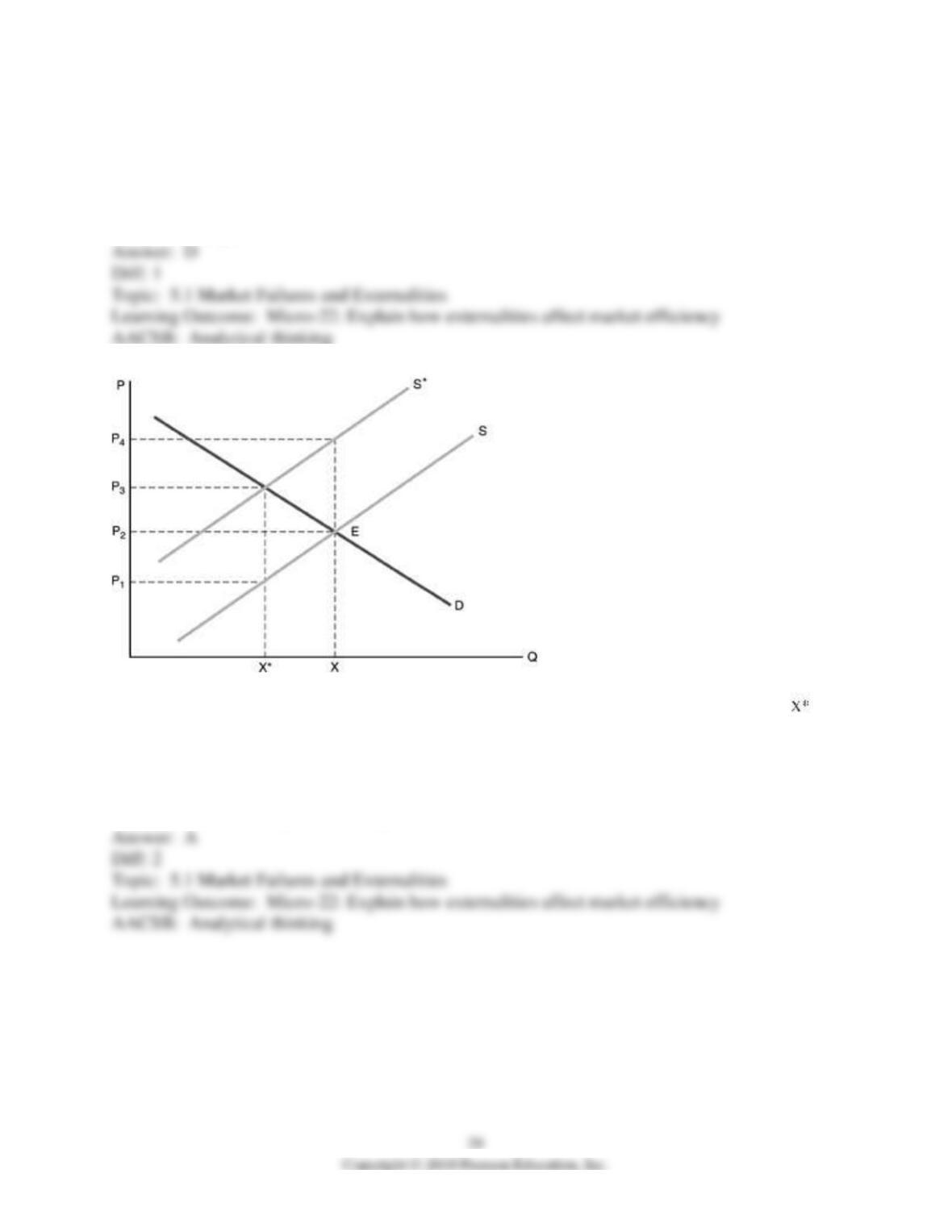
101) In the above figure, market equilibrium at point E yields the quantity X. The quantity is
the socially optimal quantity. Point E indicates that currently there is
A) a negative externality.
B) a positive externality.
C) a public good.
D) a positive externality with subsidy.
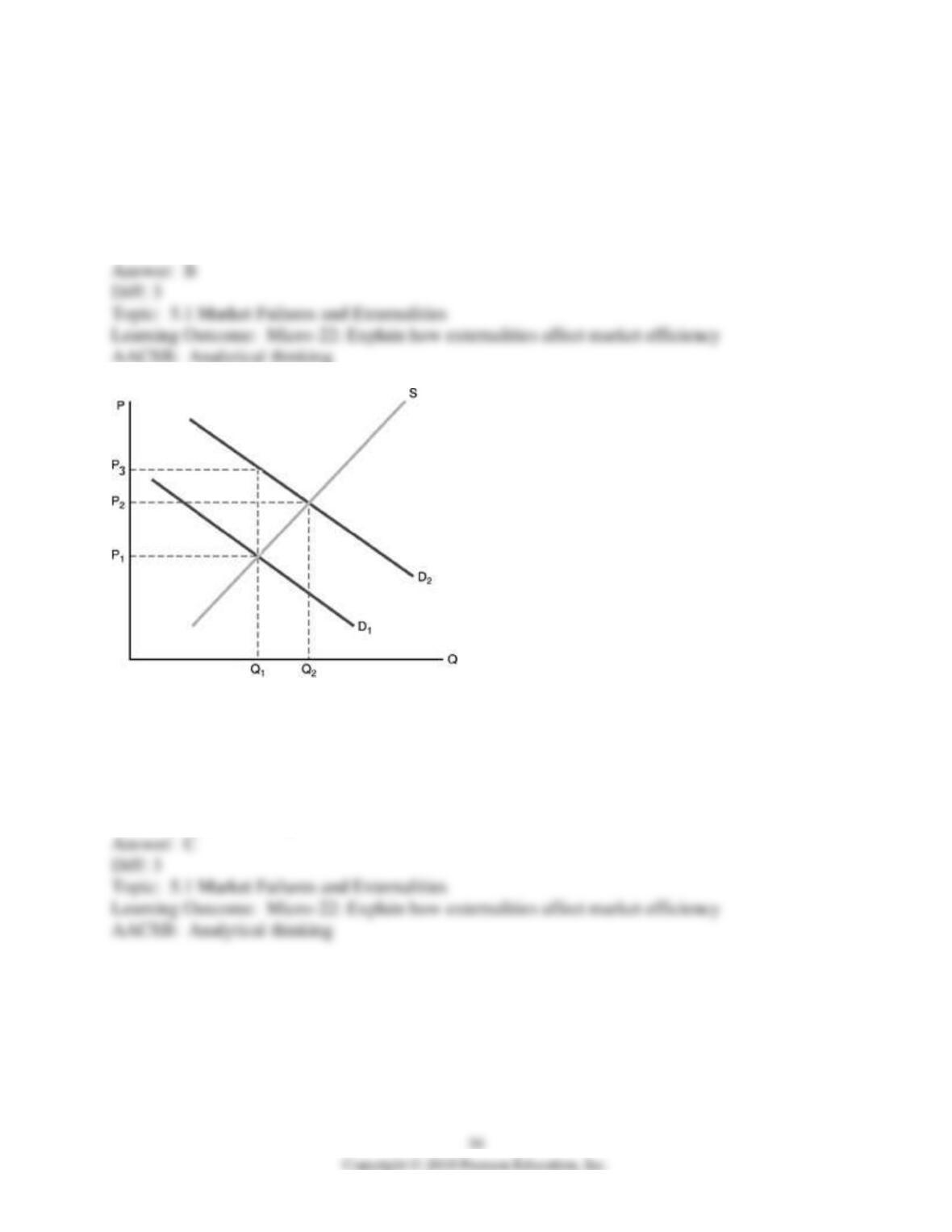
102) In the above figure, market equilibrium at point E yields the quantity X. The quantity X* is
socially optimal amount. The government can achieve the optimal outcome by
A) setting the price at P1.
B) establishing a tax of P3 – P1 per unit of the good sold.
C) establishing a tax of P3 – P2 per unit of the good sold.
D) setting the price at P4.
103) Refer to the above figure. The market equilibrium quantity is Q1. Point Q2 represents the
optimal amount of production. This indicates that there is
A) a public good which should be produced.
B) regressive taxation of the product.
C) a positive externality.
D) a negative externality.
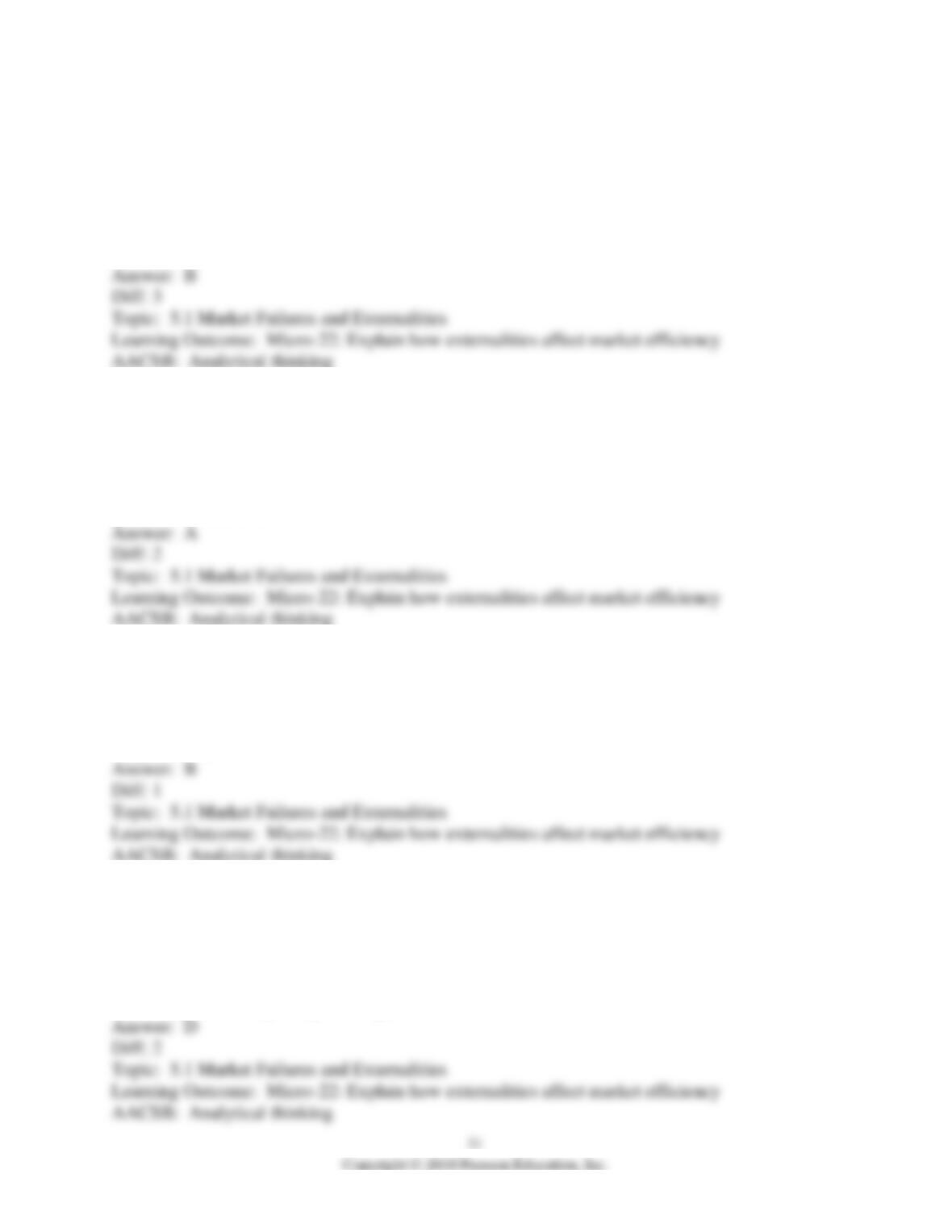
104) Refer to the above figure. The market equilibrium quantity is Q1. Point Q2 represents the
optimal amount of production. The government can achieve the optimal outcome by
A) setting the price at P3.
B) providing a per-unit subsidy to consumers equal to P3 – P1.
C) providing a per-unit subsidy to consumers equal to P2 – P1.
D) establishing a tax equal to P2 – P1 per unit of the good sold.
105) In a free market system, competition generates economic efficiency only when
A) individuals take into account the full opportunity cost of their actions.
B) consumers are motivated by a sense of the greater good, not their own self-interest.
C) firms are motivated by a sense of the greater good, not their desire for profit.
D) economic decisions are taken out the hands of individuals and placed in the hands of
government officials.
106) Costs that spill over to third parties are called
A) opportunity costs.
B) external costs.
C) variable costs.
D) public costs.
107) What would happen in a free market system when production of a good generates negative
externalities?
A) There is a shortage of the good.
B) There is a surplus of the good.
C) The equilibrium quantity of the good is less than the efficient amount.
D) The equilibrium quantity of the good is more than the efficient amount.
108) A firm that produces chemical solvents creates some air pollution because of the emissions
from its manufacturing facilities. A tax is imposed on the firm, equal to the costs of
environmental damage caused by a unit of the emissions. What is the result?
A) The quantity of chemical solvents produced now will be the efficient amount.
B) Demand for the chemical solvents will increase.
C) Demand for the chemical solvents will decrease.
D) Consumers of the chemical solvents will be willing to pay the full amount of the tax, and so
the quantity produced will be unaffected.
109) Positive externalities arise when
A) an unprofitable firm is shut down.
B) a profitable firm is regulated.
C) tax rates are reduced.
D) production of a good generates benefits that spill over to third parties.
110) When does a subsidy that benefits consumers result in a more efficient allocation of a
resource?
A) when the good being produced or consumed is not scarce
B) when the good being produced or consumed generates a negative externality
C) when the good being produced or consumed generates a positive externality
D) when the equilibrium price of the good is one that consumers don’t like
111) An externality is
A) a third-party benefit or cost that is associated with the production of a good.
B) when external forces such as war or flood affect the market.
C) government intervention in the markets.
D) transaction costs.
112) When there is an external benefit, the unregulated market
A) overproduces the good or service.
B) underproduces the good or service.
C) reaches the most efficient solution.
D) maximizes public welfare.
113) When there is an external cost, the unregulated market
A) overproduces the good or service.
B) underproduces the good or service.
C) reaches the most efficient solution.
D) minimizes public welfare.
114) Inoculations of children against infectious diseases are
A) an example of an external benefit.
B) an example of an external cost.
C) dangerous for society.
D) an example of a public good.
115) When a person throws a cigarette out of a car window and starts a brush fire, this is
A) an example of an external benefit.
B) an example of an external cost.
C) an example of a public good.
D) an example of market power.
116) The government corrects for externalities in all of the following ways EXCEPT
A) taxes.
B) regulation.
C) lobbying.
D) subsidies.
117) A situation in which the market system allocates too few resources to the production of a
given activity is known as
A) market allocation.
B) market failure.
C) market efficiency.
D) market signaling.
118) When a firm produces a product that creates external costs
A) the firm produces a level of output larger than would be produced without the external cost.
B) the firm produces a level of output smaller than would be produced without the external cost.
C) the firm produces a level of output which would be the same as it would produce without the
external cost.
D) the market provides the efficient level of output even with the existence of the external cost.
119) If external benefits are taken into account in the market
A) the demand curve would shift to the left.
B) the supply curve would shift to the left.
C) the demand curve would shift to the right.
D) the supply curve would become vertical.
120) “Second-hand” smoke is an often cited disadvantage of allowing smoking in restaurants. In
economics, “second-hand” smoke is referred to as a(n)
A) capital good.
B) externality.
C) economic cost.
D) negative investment.
121) Graphically, the effects of an external benefit can be shown as
A) a leftward shift of the market demand curve.
B) a leftward shift of the market supply curve.
C) a downward movement along the market demand curve.
D) a rightward shift of the market demand curve.
122) If a producer were forced to absorb the cost of a spillover from the production of a good,
this would likely cause the supply curve for the good to
A) shift out.
B) shift to the left.
C) shift to the right.
D) None of the above are correct.
123) Which of the following might be considered a positive externality?
A) the pollination of an orange grove due to bees kept by a nearby beekeeper
B) individuals who did not get the flu, yet did not receive a flu shot when those around them did
receive the shot
C) better fishing resulting from increased lake temperatures generated by the nearby power plant
D) All of the above are correct.
124) Which of the following might be a method that the government could use to correct a
negative externality?
A) an effluent fee on waste from the production of goods that create negative externalities
B) government subsidies to producers of goods that create negative externalities
C) financing additional production of goods that create negative externalities
D) encouraging overallocation of resources of production of goods that create negative
externalities
125) Which of the following might be a method that the government could use to promote the
production of a good that generates positive externalities?
A) subsidies
B) regulations
C) financing additional production
D) All of the above are correct.
126) Graphically, the effect of a government subsidy on a good is shown as
A) a leftward shift of the market demand curve.
B) a rightward shift of the market demand curve.
C) a downward movement along the market demand curve.
D) no change to the market demand curve.
127) Market failure means that
A) the strike organized by unionized employees fails to achieve its goal.
B) too many outdated products are offered for sale in the local supermarket.
C) there is overallocation or underallocation of resources to certain economic activity.
D) an unexpectedly harsh winter shuts down a factory.
128) An economic activity in which benefits or costs affect third parties is called
A) a public good.
B) a third-party good.
C) the exclusion principle.
D) an externality.
129) One way of addressing the associated market failure that generates both private costs and
external costs is for this activity to be
A) left alone.
B) taxed.
C) subsidized.
D) banned.
130) External costs can be defined as
A) the cost associated with private production, but partially borne by society.
B) the sum of all private production costs.
C) the cost of running the federal government.
D) the cost of providing all public goods and services.
131) When government intervenes in the production process because external costs exist, it
typically attempts to shift the industry’s
A) demand curve to the right.
B) demand curve to the left.
C) supply curve to the right.
D) supply curve to the left.
132) When government intervenes in the production process because external benefits exist, it
typically attempts
A) to impose a tax on each unit produced.
B) to shift the market’s demand curve to the left.
C) to shift the market’s demand curve to the right.
D) to shift the market’s supply curve to the left.
133) Whether an externality is positive or negative, it is always
A) evaluated by the Supreme Court of the United States.
B) evaluated by the government.
C) evaluated by the impact on the third party.
D) judged by the profitability of the firm producing the product.
134) An effluent fee is an example of
A) a government policy to correct for an external benefit.
B) a government policy to promote the production of a product with an external cost.
C) a government policy to promote the production of a product with an external benefit.
D) a government policy to correct for an external cost.
135) An example of a negative externality created in the market system would be
A) poverty.
B) unemployment.
C) a change in one consumer’s tastes and preferences.
D) water pollution.
136) All of the following generate positive externalities EXCEPT
A) public health programs.
B) a lower marginal tax rate for a household’s income.
C) requiring proof of inoculation before entering college.
D) requiring proof of inoculation before entering elementary school.
137) One way that the government encourages the production of a good with positive
externalities is to offer
A) an effluent fee.
B) a market to pollute.
C) a subsidy.
D) a pollution tax.
138) If the production of ukuleles creates a negative externality that is NOT corrected for by the
government, the equilibrium quantity of ukuleles is
A) higher than optimal.
B) lower than optimal.
C) efficient.
D) at a optimal level.
139) Explain what economic efficiency is. How does a price system lead to economic efficiency?
140) What is market failure? How can the government correct market failure?