CHAPTER 5: THE TIME VALUE OF MONEY
1. The amount of simple interest is equal to the product of the principal times times .
a. (1 + rate per time period), the number of time periods
b. (1 + rate per time period), (the number of time periods – 1)
c. rate per time period, the number of time periods
d. rate per time period, (the number of time periods – 1)
2. The present value of a single amount can be represented as
a. PV0 = FVn(PVIFi,n)
b. PV0 = FVn(PVIFAi,n)
c. PV0 = FVn[1/(1 + i)n]
d. a and c
3. The basic future value equation is given by
a. FVn = PV0(PVIFi,n)
b. FVn = PV0(FVIFAi,n)
c. FVn = PV0(1/(1 + i)n)
d. FVn = PV0(FVIFi,n)
4. The process of finding present values is frequently called
a. annualizing
b. compounding
c. discounting
d. leasing
5. The values shown in ordinary annuity tables (either present value or compound value) can be adjusted to the
annuity due form by the ordinary annuity interest factor by .
a. dividing, (1 + i)
b. dividing, (1 + i)n
c. multiplying, (1 + i)
d. multiplying, (1 + i)n

6. A(n) is a financial instrument that agrees to pay an equal amount of money per period into the indefinite
future (i.e. forever).
a. annuity
b. annuity due
c. sinking fund
d. perpetuity
7. Finding the discounted current value of $1,000 to be received at the end of each of the next 5 years requires
calculating the
a. future value of an annuity
b. future value of an annuity due
c. present value of an annuity
d. present value of an annuity due
8. Finding the compound sum of $1,000 to be received at the beginning of each of the next 5 years requires
calculating the
a. future value of an annuity
b. present value of an annuity
c. future value of an annuity due
d. present value of an annuity due
9. When using a present value of an annuity table (e.g., Table IV at the back of the book),
a. payments are assumed to be made at the beginning of each period
b. PVIFA factors decrease with an increase in the interest rate
c. PVIFA factors increase with an increase in the number of periods
d. b and c only
10. When using a future value of an annuity table (e.g., Table III at the back of the book),
a. payments are assumed to be made at the end of each period
b. FVIFA factors increase with an increase in the interest rate
c. FVIFA factors increase with an increase in the number of periods
d. all of these

Chapter 5: The Time Value of Money
11. An annuity due is one in which
a. payments or receipts occur at the end of each period.
b. payments or receipts occur at the beginning of each period.
c. payments or receipts occur forever.
d. cash flows occur continuously.
12. You have just won a $5 million lottery to be received in twenty annual equal payments of $250,000. What
will happen to the present value of your winnings if the interest rate increases during the next 20 years?
a. it will be worth less
b. it will be worth more
c. it will not change
d. it will increase during the first ten years
13. You have just calculated the present value of the expected cash flows of a potential investment. Management
thinks your figures are too low. Which of the following actions would improve the present value of your cash
flows?
a. extend the cash flows over a longer period of time
b. increase the discount rate
c. decrease the discount rate
d. extend the cash flows over a longer period of time, and decrease the discount rate
14. If the present value of a given sum is equal to its future value, then
a. the discount rate must be very high
b. there is no inflation
c. the discount rate must be zero
d. none of the answers is correct
15. Using the “Rule of 72,” about how long will it take a sum of money to double in value if the annual interest
rate is 9 percent?
a. 9 years
b. 7 years
c. 8 years
d. 10 years

Chapter 5: The Time Value of Money
16. The present value of an ordinary annuity is the
a. sum of the present value of a series of equal periodic payments
b. future value of an equal series of payments
c. receipt of equal cash flows for a specified amount of time
d. sum of the future value of an equal series of payments
17. When a loan is amortized over a five year term, the
a. rate of interest is reduced each year
b. amount of interest paid is reduced each year
c. payment is reduced each year
d. balance is paid as a balloon payment in the fifth year
18. Annuity due calculations are especially important when dealing with
a. term loans
b. lease contracts
c. capital investments
d. capital recovery problems
19. The more frequent the compounding the
a. greater the present value
b. greater the amount deposited
c. greater the effective interest rate
d. lesser the future value
20. The effective rate of interest will always be the nominal rate.
a. greater than
b. equal to
c. less than
d. equal to or greater than

Chapter 5: The Time Value of Money
21. is interest that is paid not only on the principal, but also on any interest earned but not withdrawn during
earlier periods.
a. basic interest
b. simple interest
c. future interest
d. compound interest
22. Which of the following is worth more?
a. Future value of an ordinary annuity of PMT dollars per year for n years discounted at i percent.
b. Future value of an annuity due of PMT dollars per year for n years discounted at i percent.
c. Both are worth the same amount.
d. Cannot be determined from the information given.
23. The annual effective rate of interest (ieff ) is a function of:
a. the annual nominal rate of interest (inom)
b. the number of compounding intervals per year (m)
c. the number of years (n)
d. both the nominal rate of interest and the number of compounding periods per year.
24. More frequent compounding results in future values and present values than less frequent
compounding at the same interest rate.
a. higher, higher
b. lower, higher
c. higher, lower
d. lower, lower
25. The present value of a(n) is determined by dividing the annual cash flow by the interest rate.
a. annuity
b. annuity due
c. perpetuity
d. lease

Chapter 5: The Time Value of Money
26. An annuity that begins more than 1 year in the future is referred to as a(n) .
a. perpetuity
b. annuity due
c. uneven annuity
d. deferred annuity
27. The of a perpetual stream of equal, annual returns (PMT) discounted at i% per year is equal to .
a. present value; PMT/i
b. present value; PMT × i
c. future value; PMT/i
d. future value; PMT × i
28. Annuity due calculations are most common when dealing with:
a. cash dividends
b. loan repayments
c. lease contracts
d. interest payments
29. The payment or receipt of a series of equal cash flows per period, at the end of each period, for a specified
amount of time is called a(n):
a. annuity due
b. perpetuity
c. ordinary annuity
d. simple interest
30. The difference between an ordinary annuity and an annuity due is:
a. the interest rate
b. the timing of the payments
c. the amount of the payments
d. the number of periods
Chapter 5: The Time Value of Money
31. is the return earned by someone who has forgone current consumption.
a. the present value
b. principle
c. an annuity
d. interest
32. Determine how much $1,000 deposited in a savings account paying 8% (compounded annually) will be worth after
5 years.
a. $5,526
b. $784
c. $1,400
d. $1,469
33. The earnings of Omega Supply Company have grown from $2.00 per share to $4.00 per share over a nine
year time period. Determine the compound annual growth rate.
a. 11.1%
b. 8%
c. 22.2%
d. 100%
34. Mr. Moore is 35 years old today and is beginning to plan for his retirement. He wants to set aside an equal amount
at the end of each of the next 25 years so that he can retire at age 60. He expects to live to the maximum age of
80 and wants to be able to withdraw $25,000 per year from the account on his 61st through 80th birthdays. The
account is expected to earn 10 percent per annum for the entire period of time. Determine the size of the annual
deposits that must be made by Mr. Moore.
a. $212,850
b. $23,449
c. $2,164
d. $8,514
Chapter 5: The Time Value of Money
35. Comet Powder Company has purchased a piece of equipment costing $100,000. It is expected to generate a
ten– year stream of benefits amounting to $16,273 per year. Determine the rate of return Comet expects to
earn from this equipment.
a. 16.3%
b. 62.7%
c. 10%
d. 20%
36. Determine how much you would be willing to pay for a bond that pays $60 annual interest indefinitely and
never matures (i.e., a perpetuity), assuming you require an 8 percent rate of return on this investment.
a. $480
b. $743
c. $1,000
d. $750
37. Air Atlantic (AA) has been offered a 3-year old jet airliner under a 12-year lease arrangement. The lease requires
AA to make annual lease payments of $500,000 at the beginning of each of the next 12 years. Determine the
present value of the lease payments if the opportunity cost of funds is 14 percent.
a. $2,830,000
b. $13,635,500
c. $6,000,000
d. $3,226,200
38. If you invest $10,000 in a 4-year certificate of deposit (CD) paying 10 percent interest compounded annually,
determine how much the CD will be worth at the end of 4 years.
a. $13,600
b. $45,730
c. $14,640
d. $15,958
Chapter 5: The Time Value of Money
39. You sold 100 shares of stock today for $30 per share that you paid $20 for 6 years ago. Determine the average
annual rate of return on your investment, assuming the stock paid no dividends.
a. 25%
b. 8.33%
c. 150%
d. 7%
40. Your grandparents put $1,000 into a savings account for you when you were born 20 years ago. This account has
been earning interest at a compound rate of 7 percent. What is its value today?
a. $3,870
b. $1,967
c. $3,026
d. $3,583
41. Baggos has seen their EPS increase from $0.30 to $3.16 in seven years. What has been the growth rate of
Baggos’s EPS?
a. about 30%
b. about 40%
c. about 20%
d. about 10%
42. You have just won a $50,000 bond that pays no interest and matures in 20 years. If the discount rate is 10%, what
is the present value of your bond?
a. $7,450
b. $8,175
c. $8,900
d. $1,490
Chapter 5: The Time Value of Money
43. BB&C bank has agreed to lend you $30,000 today, but you must repay $42,135 in 3 years. What rate is the bank
charging you?
a. 10%
b. 11%
c. 12%
d. 13%
44. The Florida lottery agrees to pay the winner $250,000 at the end of each year for the next 20 years. What is the
future value of this lottery if you plan to put each payment in an account earning 9 percent?
a. $2.28 million
b. $12.79 million
c. $14.32 million
d. $5.00 million
45. Billy Bob has decided to put $2,400 a year (at the end of each year) into an IRA over his 40 year working life
and then retire. What will Billy have if the account will earn 10 percent compounded annually?
a. $394,786
b. $23,470
c. $1,062,223
d. $810,917
46. Jane wants to have $200,000 in an account in 20 years. If her account earns 11 percent per annum over the
accumulation period, how much must she save per year (end of year) to have the $200,000?
a. $25,116
b. $3,115
c. $10,000
d. $3,492
Chapter 5: The Time Value of Money
47. Many IRA fund managers argue that investors should invest at the beginning of the year rather than at the end.
What is the difference to an investor who invests $2,000 per year at 11 percent over a 30 year period?
a. $43,785
b. $36,189
c. $54,244
d. There is no difference
48. An insurance company offers you an end of year annuity of $48,000 per year for the next 20 years. They claim
your return on the annuity is 9 percent. What should you be willing to pay today for this annuity?
a. $429,600
b. $438,144
c. $408,672
d. $398,144
49. New Jersey Mutual has offered you a single premium annuity that will pay you $12,000 per year (end of year)
for the next 15 years. If you must pay $109,296 today for this annuity, what is your expected rate of return?
a. 8%
b. 9%
c. 7%
d. 10%
50. Columbia Bank & Trust has just given you a $20,000 term loan to pay for a new concrete mixer. The loan
requires five equal annual end of the year payments. If the loan provides the bank with a 12 percent return,
what will be your annual payments?
a. $5,548
b. $3,148.12
c. $6,000
d. $1,666.67
Chapter 5: The Time Value of Money
51. Idlewild Bank has granted you a seven year loan for $50,000. If your seven annual end of the year payments are
$11,660.45, what is the rate of interest Idlewild is charging?
a. 14%
b. 23%
c. 12.6%
d. 11%
52. Your firm, New Sunrise, has just leased a $28,000 BMW for you. The lease requires six beginning of the year
payments that will fully amortize the cost of the car. What is the amount of the payments if the interest rate is 12
percent?
a. $6,810.99
b. $7,766.99
c. $6,423.74
d. $6,081.25
53. The lease on a new office requires an immediate payment of $24,000 plus $24,000 per year at the end of each of
the next 10 years. At a discount rate of 14 percent, what is the present value of this stream of lease payments?
a. $130,872
b. $149,194
c. $142,710
d. $264,000
54. Alabama Power has preferred stock that pays an annual dividend of $9.44. If the security has no maturity, what is
its value to an investor who wishes to obtain a 9 percent rate of return?
a. $84.96
b. $104.89
c. $95.34
d. $94.40
Chapter 5: The Time Value of Money
55. Designs Now is opening a showcase office to display and sell its computer designed poster art. Designs expects
cash flows to be $120,000 in the first year, $180,000 in the second year, $240,000 in the third year. If Designs uses
11 percent as its discount rate, what is the present value of the cash flows?
a. $429,720
b. $457,620
c. $456,000
d. $424,820
56. In six years, your daughter will be going to college. You wish to have a fund that will provide her $10,000 per year
(end of year) for each of her four years in college. How much must you put into that fund today if the fund will
earn 10 percent in each of the 10 years?
a. $29,744.65
b. $29,783.76
c. $17,878.80
d. $21,651.10
57. What is the future value of a $10,000 college tuition fund if the nominal rate of interest is 12 percent compounded
monthly for five years?
a. $17,623.42
b. $18,170
c. $16,105.10
d. $16,122.26
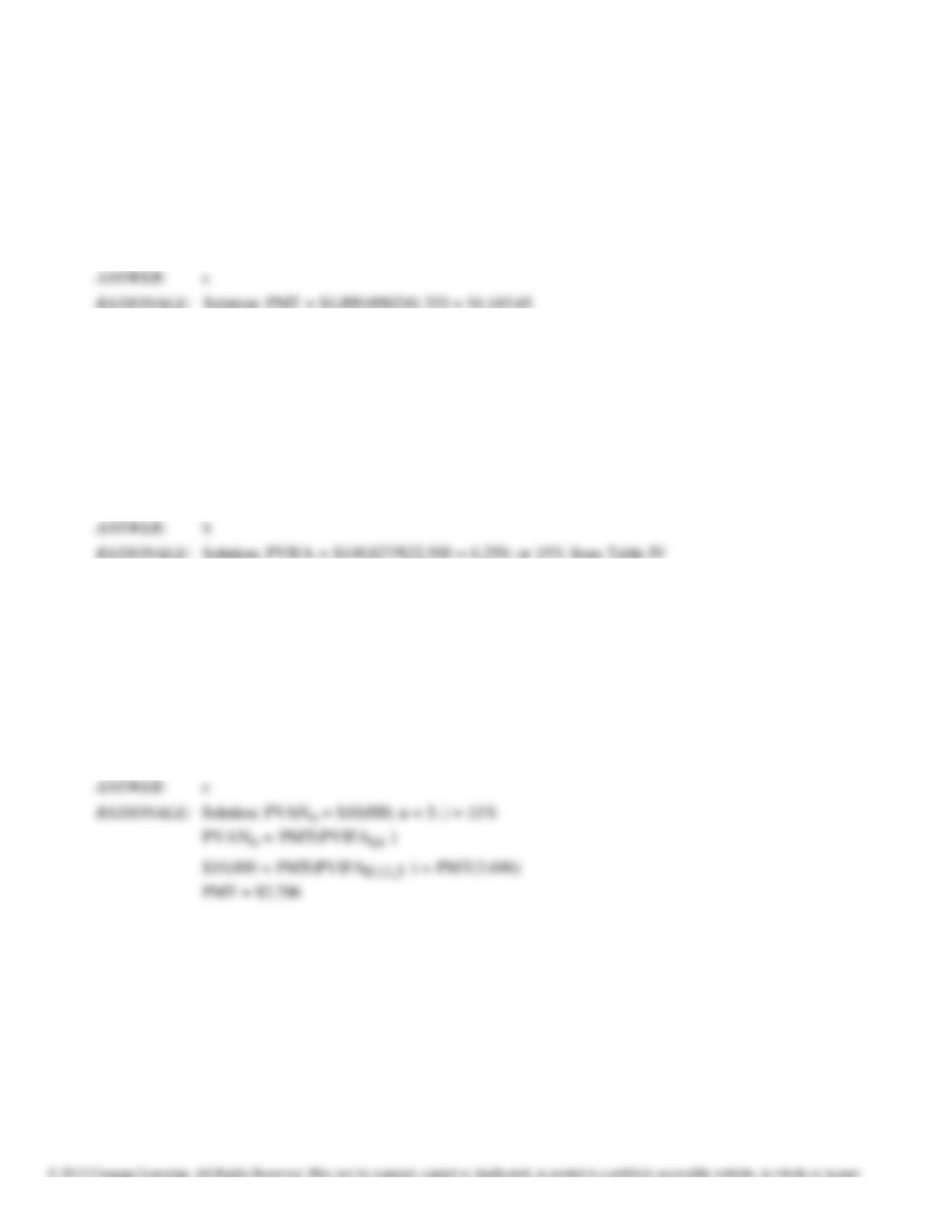
58. What is the effective rate of interest on a CD that has a nominal rate of 9.5 percent with interest compounded
monthly?
a. 9.92%
b. 9.74%
c. 10.02%
d. 9.86%
Chapter 5: The Time Value of Money
59. John is 25 years old and wishes to retire in 30 years. His plan is to invest in a mutual fund earning a 12 percent
annual return and have a $1 million retirement fund at age 55. How much must he invest at the end of each year
to achieve this goal?
a. $7,499.96
b. $5,024.60
c. $4,143.65
d. $33,333.33
60. Joe Brady just won a $450,000 lottery in Pennsylvania. Instead of receiving a lump sum, he found that he would
receive $22,500 annually (end of year) for 20 years. Joe is 75 years old and wants his money now. He has been
offered $140,827 to sell his ticket. What rate of return is the buyer expecting to make if Joe accepts the offer?
a. less than 1%
b. 15%
c. 18%
d. 12%
61. A bank has agreed to loan you $10,000 at 11% for 5 years. You are required to make equal, annual, end–of–year
payments that include both principal and interest on the outstanding balance. Determine the amount of these
annual payments (to the nearest dollar).
a. $2,000
b. $3,100
c. $2,706
d. $1,100
Chapter 5: The Time Value of Money
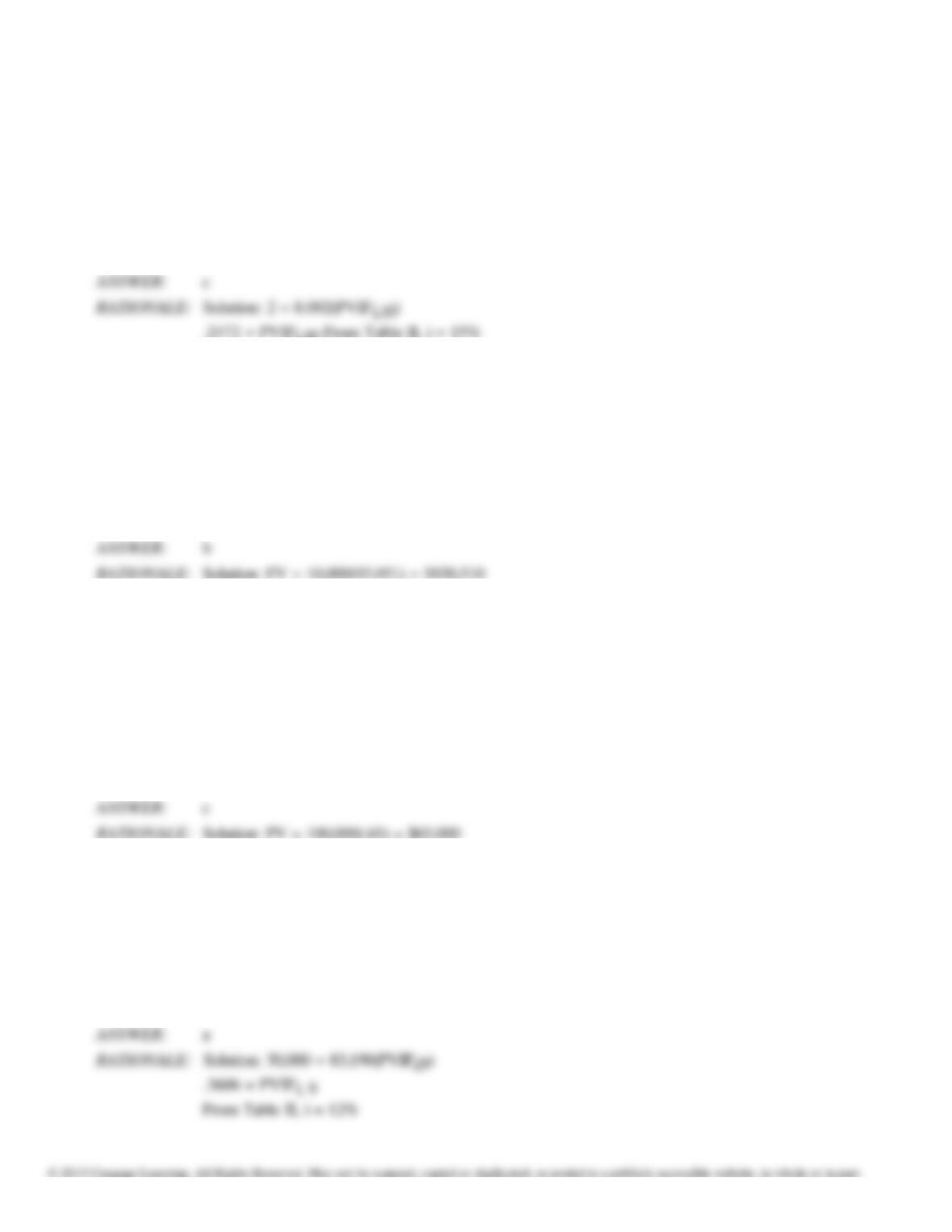
62. Sales for Triad Inc. have grown from $2 million to $8.092 million in 10 years. What is the implied growth
rate of sales for Triad?
a. 24.72%
b. 4.05%
c. 15.0%
d. 12.2%
63. If you invest the $10,000 you receive at graduation (age 22) in a mutual fund that averages a 12% annual
return, how much will you have at retirement in 40 years?
a. $909,090
b. $930,510
c. $783,879
d. $510,285
64. Five years after an accident, you received $100,000 to pay the medical expenses incurred at the time of the
accident. What is the present value (at the time of the accident) of the payment? Assume interest rates are
9%.
a. $153,900
b. $68,100
c. $65,000
d. $70,800
65. You purchased a piece of property for $30,000 nine years ago and sold it today for $83,190. What was
your rate of return on your investment?
a. 12%
b. 11%
c. 10%
d. 9%
Chapter 5: The Time Value of Money
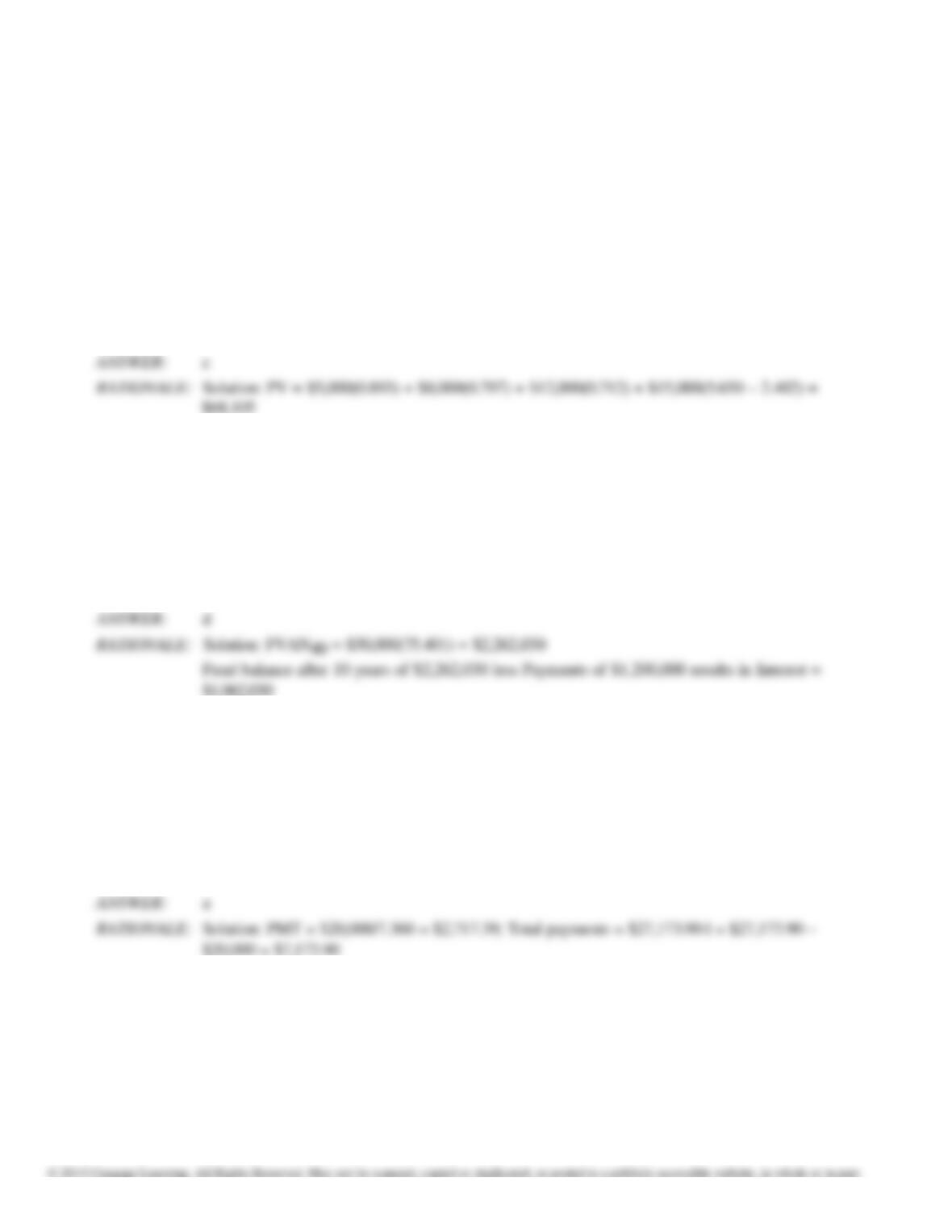
66. What is the most you should pay to receive the following cash flows if your required rate of return is 12 percent?
Year 1
$5,000
Year 2
$8,000
Year 3
$12,000
Year 4-10
a. $58,580
$15,000
b. $104,135
c. $68,105
d. $40,000
67. Seebee makes quarterly (end of period) payments of $30,000 into a pension fund earning 12 percent per year
compounded quarterly for 10 years. How much interest will they have earned in 10 years?
a. $2,262,030
b. $2,105,880
c. $905,880
d. $1,062,030
68. John borrowed $20,000 to finance his college education. If the finance charge on the loan is 6 percent, and he
will pay off the loan in 10 equal, annual, end of year payments, how much total interest will he pay?
a. $7,173.90
b. $2,717.39
c. $12,000.00
d. $25,924.23