13
10) According to Irving Fisher, velocity ________.
A) is determined by the way banks alone conduct transactions
B) equals the number of transactions times the average price per transaction all divided by total
money balances
C) can change very quickly on short notice
D) all of the above
E) none of the above
11) The quantity theory of money ________.
A) is formulated in terms of aggregate output because the nominal value of transactions is
difficult to measure
B) assumes that the nominal value of transactions are a constant portion of aggregate output
C) assumes velocity is constant in the short run
D) all of the above
E) none of the above
12) The quantity theory of money ________.
A) is formulated in terms of aggregate output because the nominal value of transactions is
difficult to measure
B) tells us how much money is held for a given amount of nominal spending
C) implicitly tells us the quantity of money that people want to hold
D) all of the above
E) none of the above
13) The quantity theory of money tells us that real money balances are proportional to income,
since ________.
A) velocity is assumed constant in the short run
B) the supply and demand of money are equal in equilibrium
C) changes in the quantity of money lead to proportional changes in the price level
D) all of the above
E) none of the above
14) From the equation of exchange, if both nominal income and the quantity of money (M) have
tripled, while the price level (P) has increased by 50 percent and velocity (V) remains constant,
then real output (Y) ________.
A) also triples
B) increases by 50 percent
C) doubles
D) decreases by 50 percent
E) none of the above
15) From the equation of exchange, if both nominal income and the quantity of money (M) have
doubled, while the price level (P) has decreased by 50 percent and velocity (V) remains constant,
then real output (Y) ________.
A) also doubles
B) triples
C) quadruples
D) decreases by 50 percent
E) none of the above
16) From the equation of exchange, if both real income (Y) and the quantity of money (M)
double and the price level (P) remains constant, then velocity (V) ________ and nominal income
________.
A) remains constant; doubles
B) doubles; remains constant
C) doubles; doubles
D) decreases by 50 percent; quadruples
E) none of the above
17) In the quantity theory of money, which of these variables is endogenous?
A) the price level
B) the velocity of money
C) real output
D) the money supply
E) none of the above
18) In the quantity theory of money, the assumption that aggregate output is fixed is based on the
view that ________.
A) wages and prices are perfectly flexible in the long run
B) the velocity of money is constant in the short run
C) the demand for real money balances is proportional to income
D) changes in the quantity of money lead to proportional changes in the price level
E) none of the above
19) The quantity theory of money ________.
A) is used by classical economist to explain how changes in the quantity of money lead to
proportional changes in the price level
B) gives mathematical grounding for the view that a country’s central bank determines the
general price level through control of the money supply
C) implies that changes in the money supply have no long run impact on real variables
D) all of the above
E) none of the above
20) The quantity theory of money ________.
A) is used by classical economists to explain how frequent changes in velocity lead to infrequent
changes in the price level
B) gives mathematical grounding for the view that a country’s central bank determines the
general price level through control of the money supply
C) implies that changes in the money supply never have an impact on real variables
D) all of the above
E) none of the above
21) The proposition that changes in the money supply have no long-run effect on real variables is
known as the ________.
A) classical dichotomy
B) quantity theory of money
C) neutrality of money
D) Fisher effect
E) none of the above
22) The proposition that the amount of goods and services produced in an economy in the long
run is not affected by the price level is known as the ________.
A) neutrality of money
B) classical dichotomy
C) quantity theory of money
D) Fisher effect
E) none of the above
23) The proposition that the velocity of money is fairly constant in the long run is known as the
________.
A) neutrality of money
B) classical dichotomy
C) quantity theory of money
D) Fisher effect
E) none of the above
24) The quantity theory of money ________.
A) implies that inflation equals the ratio of the growth rates of the money supply and of real
income
B) provides central banks with a tool to prevent the rate of inflation from fluctuating
C) implies that, in the long run, changes in the money supply will be matched by changes in real
income
D) all of the above
E) none of the above
25) The quantity theory of money ________.
A) focuses mainly on the close link between short run fluctuations in velocity and the price level
B) works very well for the U.S. but it does not hold empirically for other countries in the long
run
C) provides a long run theory of inflation because it is based on the assumption that prices and
wages are fully flexible
D) all of the above
E) none of the above
17
26) The quantity theory of money ________.
A) suggests that inflation is always and everywhere a monetary phenomenon which has been
shown to always be supported by the data
B) validates the classical assumption that wages and prices are completely flexible in the short
run
C) provides a better description of short run fluctuations in inflation and money growth than the
link between these variables in the long run
D) all of the above
E) none of the above
27) How have financial innovations such as direct deposit of paychecks, electronic payment of
bills, and automated teller machines (ATMs) affected the velocity of money and the demand for
real money balances?
28) Suppose Y = 100, P = 80, and V = 3.2. If Y rises to 105, and the inflation rate is 10 percent,
what is the new value of M?
18
5.5 Hyperinflation
1) Hyperinflation typically ________.
A) describes periods of extreme price increases of over 50% per month or 1,000% per year
B) is a result of extreme periods of money growth that tend to come from large fiscal imbalances
C) affects both poor and developed economies
D) all of the above
E) none of the above
2) Hyperinflation typically ________.
A) describes periods of extreme price increases of over 10% per year
B) is a result of extreme periods of money growth that tend to come from large fiscal imbalances
C) affects low-income economies, but is rare among more-developed economies
D) all of the above
E) none of the above
3) The direct cause of the hyperinflation that plagued Zimbabwe in the 2000s is ________.
A) printing of too much money by the central bank
B) government expenditures greatly above revenues
C) outlawing of price increases on many commodities
D) allowing the use of foreign currencies
E) the issuance of a $100 billion bank note
4) The root cause of the hyperinflation that plagued Zimbabwe in the 2000s is ________.
A) printing of too much money by the central bank
B) government expenditures greatly above revenues
C) outlawing of price increases on many commodities
D) allowing the use of foreign currencies
5) The main reason that hyperinflation renders a currency worthless is that ________.
A) the government cannot print money fast enough to keep up with the rising prices
B) laws against raising prices are easily evaded
C) reducing government expenditures is politically unpopular
D) the government’s “official” inflation rate is always a gross understatement
E) as soon as inflation seems out of control, everyone knows that the currency will soon lose
whatever value it has today
5.6 Inflation and Interest Rates
1) The real interest rate ________ inflation ________.
A) is unaffected in the long run by; because of the classical dichotomy
B) moves one for one with expected; in the long run
C) always increases with; but because of the Fisher effect lower expected inflation ensues
D) all of the above
E) none of the above
2) The real interest rate ________ inflation ________.
A) subtracted from the nominal rate yields expected; according to the Fisher equation
B) moves one for one, in the long run, with expected; according to the classical dichotomy
C) always increases with; but because of the Fisher effect lower expected inflation ensues
D) all of the above
E) none of the above
3) The Fisher effect ________.
A) comes from combining the Fisher equation and the classical dichotomy
B) predicts that in the long run nominal rates will rise with increases in expected inflation
C) shows that in high inflation we typically see high nominal interest rates
D) all of the above
E) none of the above
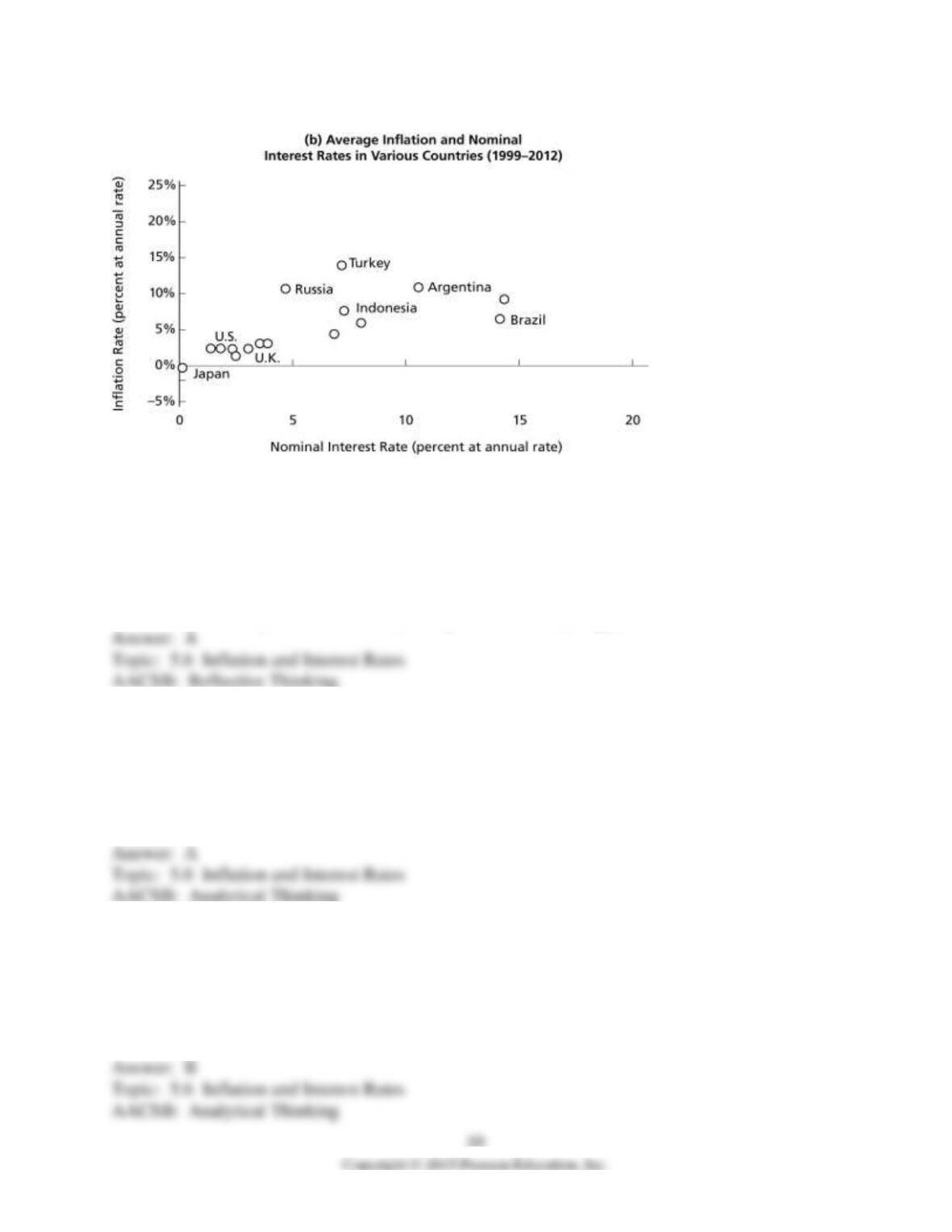
Figure 5.1
4) Figure 5.1 provides support for the Fisher effect, by ________.
A) displaying a positive relationship between the inflation rate and the nominal interest rate
B) showing how developed economies like the U.S. and Japan have less inflation than economies
like Turkey and Indonesia
C) focusing on short-run fluctuations, rather than long run averages
D) plotting observed, rather than expected inflation
E) showing that output is unaffected by changes in the money supply
5) According to Figure 5.1, the real interest rate is relatively high in ________.
A) Brazil
B) Turkey
C) Argentina
D) Japan
E) Indonesia
6) According to Figure 5.1, the real interest rate is relatively low in ________.
A) Brazil
B) Turkey
C) Argentina
D) Japan
E) Indonesia
7) During the Great Inflation of the 1970s, (a) the growth rates of M1 and M2 were higher than
previously, and (b) the growth rate of M2 was much higher than the growth rate of M1. Explain
how the high inflation of the decade relates to each of these facts.
5.7 The Cost of Inflation
1) Inflation ________.
A) is costly because the classical dichotomy may not always hold
B) that is anticipated (or expected) can be costly
C) is costly for many reasons but chief among them is that inflation makes it more difficult to
plan for the future
D) all of the above
E) none of the above
2) With increases in inflation demand for money that does not earn a return decreases. Carrying
less cash in our pockets means higher ________.
A) shoe-leather costs
B) menu costs
C) capital gain tax bills
D) all of the above
E) none of the above
3) With high inflation ________.
A) stock market investors are always worse off than consumers and households
B) producers are always worse off than consumers
C) creditors are always worse off than debtors
D) all of the above
E) none of the above
22
4) Inflation might lead to ________ because ________.
A) lower demand for stocks; of tax distortions
B) lower demand for cash; money does not typically yield interest
C) uncertain or uneven demand for goods; higher fluctuations in relative prices make it harder
for consumers to compare among goods and make rational consumption decisions
D) all of the above
E) none of the above
5) Inflation might lead to ________ because ________.
A) higher demand for stocks; as the price level increases so do stock prices
B) higher production costs; businesses have to advertise more often due to faster price revisions
C) lower transaction costs; we would hold less cash
D) all of the above
E) none of the above
6) Inflation ________.
A) is more costly when it is anticipated than when it comes as a surprise
B) makes it more difficult to plan for the future, whether it is a surprise or not
C) induces distortions in the money and goods market but not the labor market
D) all of the above
E) none of the above
7) Inflation leads to ________.
A) increased variability of relative prices only when it is anticipated
B) increased variability of relative prices only when it is unanticipated
C) increased variability of relative prices whether inflation is anticipated or not
D) lower variability of the general price level only when it is very high
E) none of the above
8) Inflation may impose little, if any, cost on the economy, if ________.
A) laws against excessive price increases are enforced effectively
B) the government subsidizes menu costs
C) price increases are fully anticipated
D) the Fisher effect holds true
E) the rate of price increase is so slow that people do not feel compelled to alter their behavior
9) Inflation interferes with the functions of money. Which of the three functions is impaired,
even when the inflation rate is quite low? Considering higher rates of inflation, which function is
affected next? Which function of money is the last to suffer substantial damage from inflation?
10) How might inflation, even if fully anticipated, prevent the classical dichotomy from holding,
even in the long run?
11) Unanticipated inflation always benefits somebody, so the overall cost cannot be higher than
it is for anticipated inflation. Comment.