39) According to the textbook, what are the two key political functions of government in a
market economy?
40) How does a government-sponsored good differ from a public good?
41) Is there any common characteristic shared by government-inhibited goods and government-
sponsored goods? Explain briefly.
5.4 Public Spending and Transfer Programs
1) As a share of total national income, government spending generally has
A) been constant over the last 50 years.
B) increased over the last 50 years.
C) decreased over the last 50 years.
D) increased until 20 years ago, and then decreased steadily.
2) Social Security and Medicare are examples of
A) capitalism.
B) free market functions.
C) market failures.
D) governmental interventions.
3) According to your text, which of the following represents the largest source of tax receipts for
the Federal government?
A) sales taxes
B) individual income taxes
C) corporate income taxes
D) property taxes
4) Government payment of a per-unit subsidy for health care services causes
A) the health care market supply curve to shift upward.
B) the health care market demand curve to shift downward.
C) a reduction in the price that health care service providers receive for each unit of care
provided.
D) an increase in the quantity of health care services demanded above the quantity demanded in
the absence of the subsidy.
5) Recipients of Medicare tend to demand a greater quantity of low-value, high-cost services
because
A) the services are readily available.
B) recipients are coerced into demanding such services.
C) the government mandates that they demand such services.
D) the services are heavily subsidized.
6) The current Medicare system is designed so that it actually encourages
A) cost reductions.
B) higher costs of medical services.
C) higher costs only for surgeries.
D) lower drug costs for recipients.
7) Government payment of a per-unit subsidy for health care services causes the out-of-pocket
price that consumers pay for care to be
A) less than the price that health care providers receive for providing care.
B) greater than the price that health care providers receive for providing care.
C) greater than the market clearing price without the subsidy.
D) equal to zero.
8) Compared with the market clearing price of a health care service covered by Medicare, the
Medicare program pays a ________ price to health care providers and charges a ________ price
to consumers.
A) lower, lower
B) lower, higher
C) higher, lower
D) higher, higher
9) The goal of Medicare is to
A) help the poor and indigent pay their hospital bills.
B) prevent poverty in urban cities.
C) subsidize medical expenses for the elderly.
D) subsidize costs incurred by doctors.
10) Subsidies paid to the health care industry for Medicare patients are paid by
A) Congress.
B) the Teamsters union.
C) current taxes.
D) the Federal Reserve.
11) Public education is priced below market price largely as a result of
A) government subsidy programs.
B) under-funded public education.
C) rising test scores by students.
D) taxpayers who contribute little to the funding of public education.
12) All of the following are major sources for financing public education EXCEPT
A) income taxes.
B) sales taxes.
C) property taxes.
D) government fees.
13) When state and local governments provide public schools with a per-unit subsidy to provide
educational services, the price that the schools providing these services receive is
A) less than the price that consumers pay to receive educational services.
B) less than the amount of the per-unit subsidy that the schools receive.
C) greater than the market clearing price without the subsidy.
D) equal to zero.
14) According to your text, one reason for flat or falling achievement scores even in the face of
substantially higher education subsidies may be that
A) the additional funds are being siphoned off by dishonest school board members.
B) some of the funds are going to social services rather than to enhance learning activities.
C) students are so unmotivated that no amount of spending will ever improve scores.
D) most parents do not support the schools or their children’s educational activities.
15) One reason the Medicare system costs so much is
A) the amount of medical services is determined by the equilibrium of supply and demand.
B) the supply of medical services does not respond to price changes.
C) supply and demand analysis does not apply.
D) beneficiaries are entitled to receive services for which the per-unit cost exceeds their own
personal out-of-pocket payment.
16) Which of the following is a major reason why the Medicare program is in such financial
trouble?
A) Workers are not paying enough into the program.
B) The government set reimbursement rates too high.
C) Because medical services are subsidized by the government, both consumption by the elderly
and the cost of services have increased.
D) There is a shortage of medical school applicants.
17) The major economic effect of Medicare subsidies is
A) that the number of physicians has decreased since compensation is low.
B) to increase the price of medical services and reduce the quantity demanded.
C) to increase the price of medical services and increase the quantity demanded.
D) to lower the price of medical services and reduce the quantity demanded.
18) Medicare subsidies will cause people to
A) perceive the price they pay per unit of medical services to be lower than the price received by
the provider.
B) perceive the price they pay per unit of medical services to be higher than the price received by
the provider.
C) perceive the price they pay per unit of medical services to be exactly equal to the price
received by the provider.
D) demand fewer services.
19) Medicare subsides will cause people to
A) consume less medical services than in the absence of the subsidies.
B) consume more medical services than in the absence of the subsidies.
C) consume the same amount medical services as they would if there were no subsidies.
D) be sicker because of inferior care.
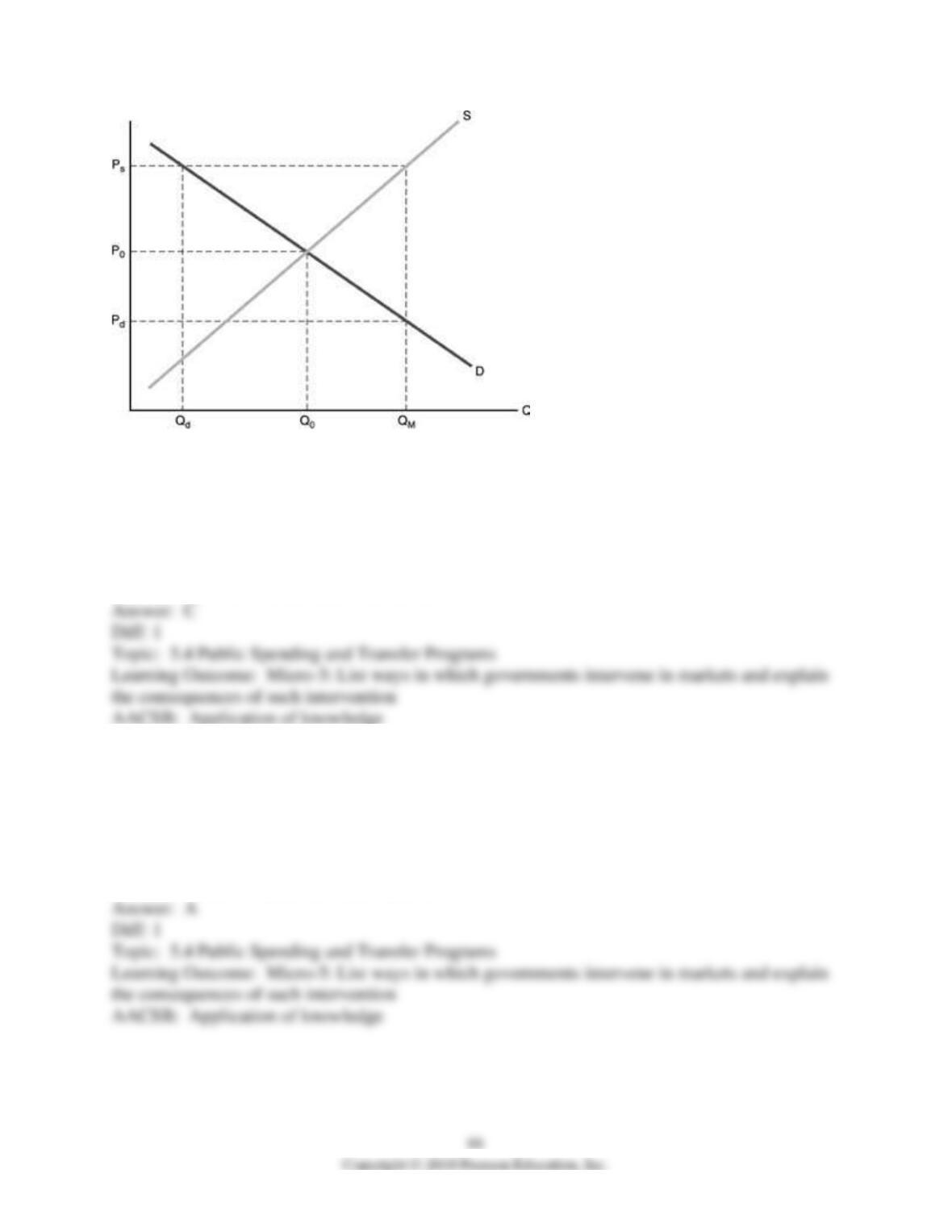
20) Refer to the above figure. Medicare subsidies have increased the price of medical services to
Ps. The perceived price on the part of consumers is
A) Ps.
B) P0.
C) Pd.
D) undetermined without more information.
21) Refer to the above figure. Medicare subsidies have increased the price of medical services to
Ps. The quantity demanded of medical services is
A) QM.
B) Q0.
C) Qd.
D) undetermined without more information.
22) In the above figure, the total dollar amount of the Medicare subsidies provided by the
government is equal to
A) the difference between Ps and P0 multiplied by QM.
B) the difference between Ps and Pd multiplied by QM.
C) the difference between P0 and Pd multiplied by Qd.
D) the difference between Ps and Pd multiplied by Q0.
23) Refer to the above figure. Medicare subsidies have increased the price of medical services to
Ps. Which of the following statements is TRUE about the effect the Medicare subsidy has had on
the consumption of medical services?
A) The amount of medical services provided has decreased from Q0 to Qd as a result of the
subsidy.
B) The amount of medical services provided has increased from Q0 to QM as a result of the
subsidy.
C) The amount of medical services provided has increased from Qd to QM as a result of the
subsidy.
D) The amount of medical services provided has remained unchanged as a result of the subsidy.
24) In the above figure, if a Medicare subsidy that had previously been paid by the government
has now been eliminated, the result will be
A) an increase in the price received by producers, from P0 to Ps.
B) a decrease in the price received by producers, from Ps to P0.
C) an increase in the price paid by consumers, from P0 to Ps.
D) a decrease in the price paid by consumers, from Ps to P0.
25) Refer to the above figure. In the absence of a subsidy,
A) Qd would be demanded and QM would be supplied.
B) the price Pd would be charged and quantity QM demanded.
C) the quantity Qo and price Po would prevail in the market.
D) None of the above is correct.
26) The funding of public education is
A) a private program.
B) a subsidy program.
C) done by voluntary contributions.
D) provided by Social Security.
27) Which of the following statements about public education is TRUE?
A) Over the last 40 years, there has been an increase in spending for public education, while
there has not been a significant increase in performance.
B) Over the last 40 years, there has been a decrease in public spending for public education,
while there has not been a significant increase in performance.
C) Most of the increases in public spending on public education have gone into programs that
have increased student learning.
D) Over the last 40 years there has been no decline in any of the measures of student
performance in public education.
28) If the government pays a per-unit subsidy to the producer of a service, we would expect to
see a(n)
I. increase in the quantity demanded.
II. decrease in the out-of-pocket price paid by consumers.
III. increase in the quantity supplied by producers.
A) I only
B) both I and II only
C) both II and III only
D) I, II, and III
29) Over the past 50 years, there has been an increase in spending on public education without a
noticeable improvement in student performance. One explanation given by economists on why
student performance has not improved is that
A) not enough funds have been spent on public education.
B) schools are providing high-priced services that are not valued by parents.
C) the quantity of educational services has not increased beyond the pre-subsidy equilibrium.
D) too much competition for educational services.
30) In public education, the value of the services provided is
A) greater than the value that parents and students place on the services.
B) equal to the value that parents and students place on the services.
C) less than the value that parents and students place on the services.
D) zero since they are a public good.
31) Measures of student performance have not increased even though per-pupil government
subsidies have increased because
A) there is a need for more funds to be spent.
B) we have declining enrollment in public schools.
C) parents and children value the last unit of educational services received more than the cost.
D) parents and children value the last unit of educational services received less than the cost.
32) By subsidizing the provision of public education, the government
A) generates an increase in the quantity of educational services demanded.
B) pushes the per-unit price that consumers pay for educational services below the market
clearing price.
C) pushes the per-unit price that producers of educational services receive above the market
clearing price.
D) all of the above.
33) Government outlays include all of the following EXCEPT
A) dividend payments.
B) spending on the military.
C) electricity for the Capital Building.
D) letterhead stationery.
34) Government spending as a percent of national income
A) peaked during the Reagan administration.
B) peaked during World War II.
C) has been steadily climbing since 1850.
D) has been almost constant this century.
35) The largest spending category for state governments is
A) welfare.
B) health care.
C) education.
D) highway construction.
36) What effect have Medicare subsidies had on the consumption of medical services?
A) The consumption of medical services has been unaffected, because people don’t consider the
financial cost when seeking services related to their health.
B) The consumption of medical services has been unaffected, because government restrictions
have prevented patients from seeking a level of care above and beyond what they would choose
if they had to pay for medical treatment out of pocket.
C) The consumption of medical services has increased because Medicare subsidies give people
the incentive to seek more care than they would otherwise.
D) The effect cannot be measured because it is difficult to quantify the amount of resources
devoted to our health care system.
37) How have some patients been harmed by Medicare reimbursement caps?
A) They have been discharged from the hospital too soon, so that the hospital can cut costs.
B) They have been kept in the hospital too long, so that the hospital can get a higher
reimbursement amount.
C) They have had to undergo unnecessary procedures, so that the hospital can get a higher
reimbursement amount.
D) They have had to wait too long for essential procedures.
38) Public schools
A) allow students to get an education without incurring any opportunity cost.
B) provide education at a price below the market price.
C) provide education at a price above the market price.
D) have done a better job of educating their students in science, math, reading, and writing as the
subsidies they receive have increased over the years.
39) Economically speaking, the design of Medicare
A) encourages the consumption of medical services.
B) discourages the consumption of medical services.
C) helps to decrease the cost of care to non-Medicare patients.
D) discourages the provision of medical services.