26) Health insurance markets have a problem with insuring people who are “poor health risks” while
many people who are “good health risks” do not buy insurance. This problem is an example of
A) moral hazard.
B) adverse selection.
C) market signaling.
D) asymmetric information.
27) Because of the ________ of vaccinations, economic efficiency would be improved if more people
were vaccinated.
A) negative externality
B) positive externality
C) moral hazard
D) adverse selection
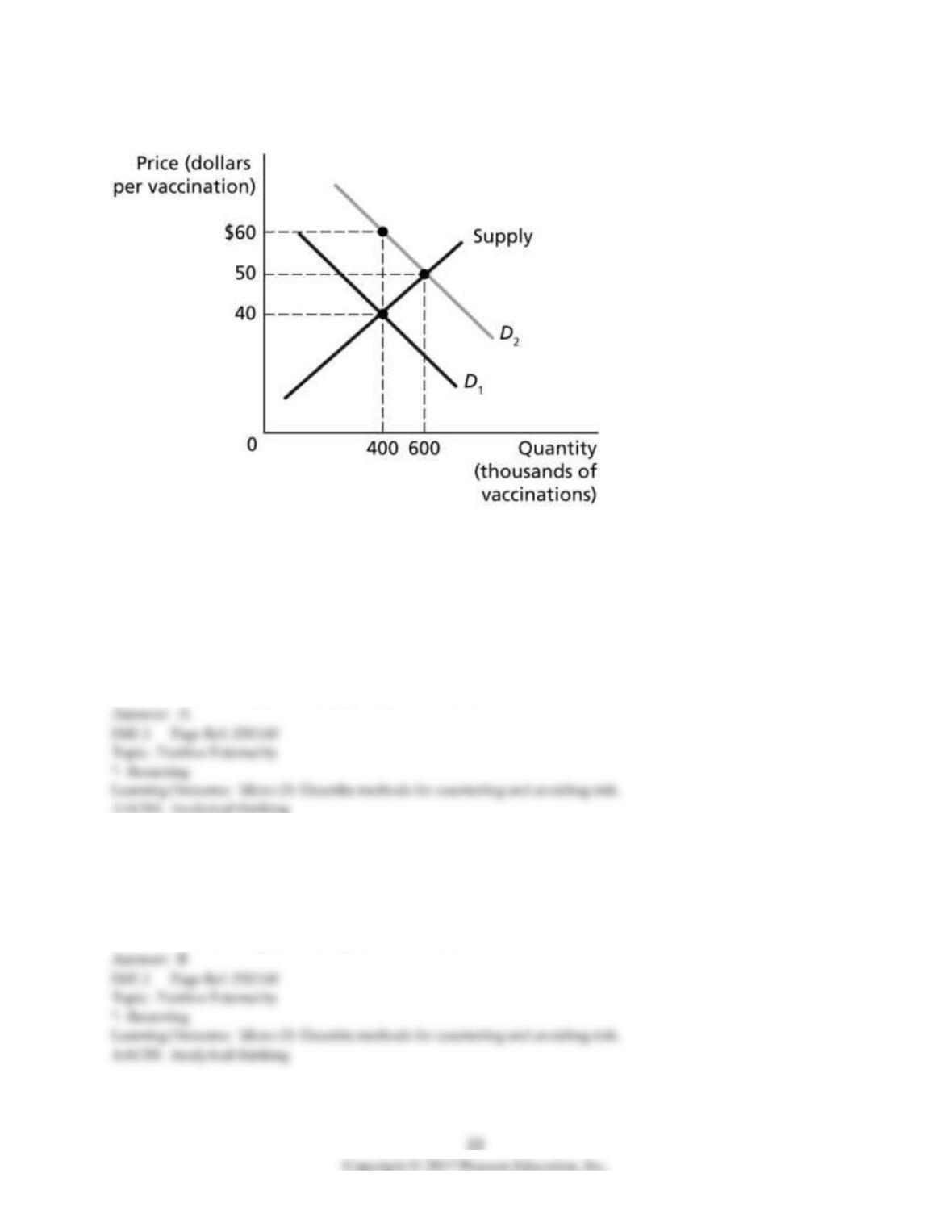
Figure 5-1
Figure 5-1 represents the market for vaccinations. Vaccinations are considered a benefit to society, and
the figure shows both the marginal private benefit and the marginal social benefit from vaccinations.
28) Refer to Figure 5-1. Marginal private benefit is represented by which curve?
A) D1
B) D2
C) Supply
D) All of the above represent marginal private benefit.
29) Refer to Figure 5-1. Marginal social benefit is represented by which curve?
A) D1
B) D2
C) Supply
D) All of the above represent marginal social benefit.
30) Refer to Figure 5-1. The market equilibrium price is
A) $60.
B) $50.
C) $40.
D) < $40.
31) Refer to Figure 5-1. The market equilibrium quantity is ________ thousand vaccinations.
A) 200
B) 400
C) 600
D) > 600
32) Refer to Figure 5-1. The efficient equilibrium price is
A) $60.
B) $50.
C) $40.
D) < $40.
33) Refer to Figure 5-1. The efficient equilibrium quantity is ________ thousand vaccinations.
A) 200
B) 400
C) 600
D) > 600
34) Refer to Figure 5-1. At the efficient equilibrium,
A) economic surplus is maximized.
B) economic surplus is minimized.
C) economic surplus is zero.
D) economic surplus is negative.
35) Refer to Figure 5-1. At the market equilibrium,
A) the marginal cost is equal to the marginal benefit.
B) the marginal cost is greater than the marginal benefit.
C) the marginal cost is less than the marginal benefit.
D) the marginal cost is zero.
36) Refer to Figure 5-1. At the market equilibrium, the deadweight loss is equal to
A) $0.
B) $500,000.
C) $1,000,000.
D) $2,000,000.
37) Some economists have argued that certain characteristics of the delivery of health care justify
government intervention. One of these characteristics is
A) health care is a public good.
B) health care is nonrivalrous and nonexcludable.
C) health care generates negative externalities.
D) health care generates positive externalities.
38) Under current tax law individuals do not pay taxes on health insurance benefits they receive from
their employers. As a result,
A) the federal government spends more than it receives in tax revenue.
B) individuals are encouraged to want generous health coverage that reduces their incentives to cut
costs.
C) the quality of health care provided is less than it would be if benefits were taxed.
D) politicians are encouraged to raise income and payroll taxes.
39) Adverse selection is a situation in which one party to an economic transaction has less information
than the other party.
40) One consequence of adverse selection in the market for used cars is that most used cars sold will be
lemons.
41) Insurance companies use deductibles and coinsurance to reduce moral hazard.
42) Under current U.S. tax laws, individuals do not pay taxes on health insurance benefits they receive
from their employers.
43) The situation in which one party to a transaction takes advantage of knowing more than the other
party to the transaction is known as adverse selection.
44) A doctor pursuing the interests of his patients rather than his own interests is an example of the
principal-agent problem.
45) Adverse selection refers to the actions people take after they have entered into a transaction that
make the other party to the transaction worse off.
46) In a market with positive externalities, the market equilibrium price will be greater than the efficient
equilibrium price.
47) In a market with positive externalities, the market equilibrium quantity will be less than the efficient
equilibrium quantity.
48) Vaccinations tend to result in a negative externality.
49) College education tends to result in a positive externality because the recipient receives the full
benefit of the education.
50) What is asymmetric information?
51) Two key consequences of asymmetric information are adverse selection and moral hazard. Define
each concept, provide one example of each, and explain how the two concepts differ.
52) Suppose you see a 2012 Ford Mustang GT advertised in the local newspaper for $15,000. If you
knew the car was reliable, you would be willing to pay $17,000 for it. If you knew the car was
unreliable, you would only be willing to pay $12,000 for it. Under what circumstances should you buy
the car?
53) How do adverse selection and moral hazard affect the market for insurance?
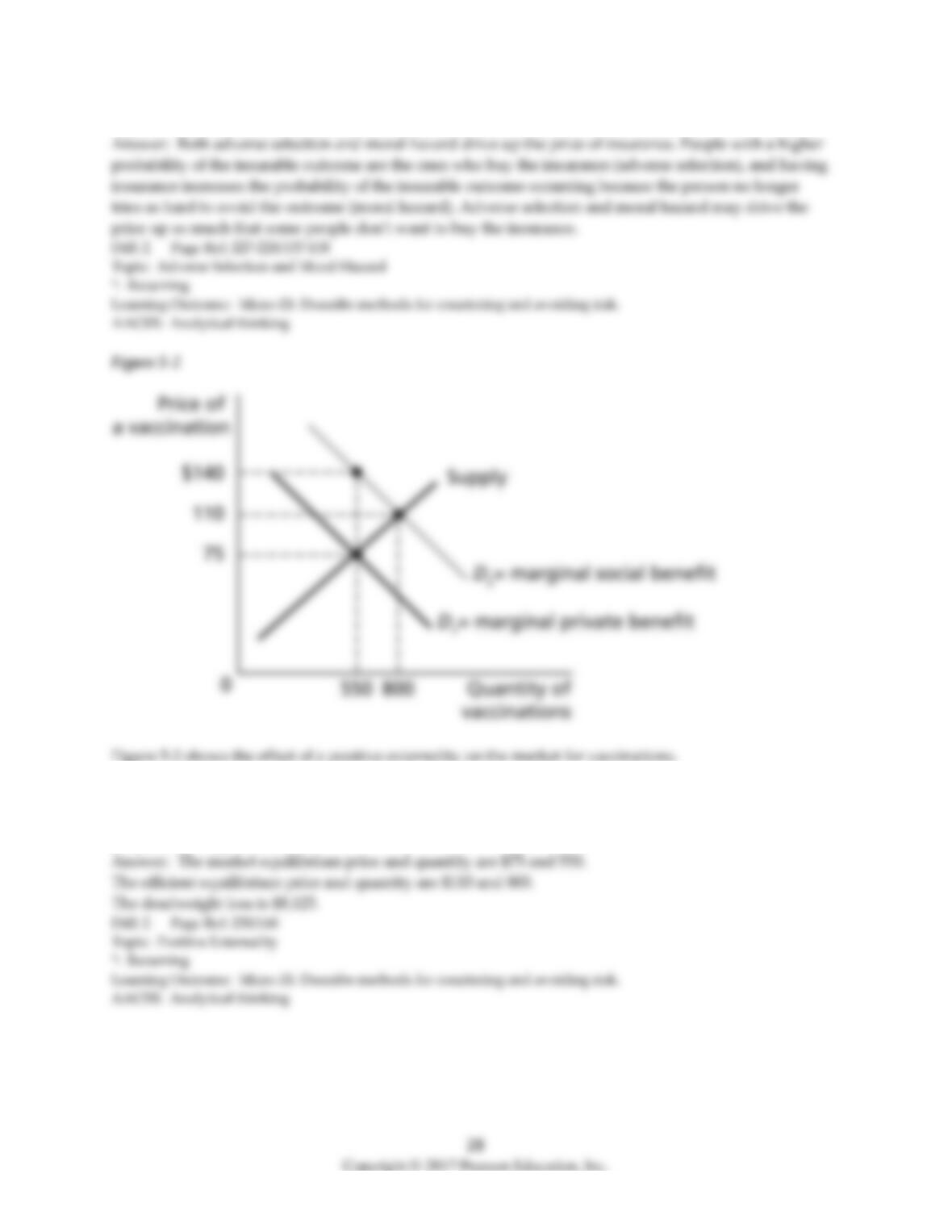
54) Refer to Figure 5-2. On the above graph, identify the market equilibrium price and quantity, the
efficient equilibrium price and quantity, and the value of the deadweight loss resulting from too few
people receiving vaccinations.
5.4 The Debate over Health Care Policy in the United States
1) In 2015, health care’s share of gross domestic product in the United States was about
A) 6.5 percent.
B) 18 percent.
C) 45 percent.
D) 62.5 percent.
2) In the United States, out-of-pocket spending on health care per person
A) has been rising since 1965.
B) has been falling since 1965.
C) has remained fairly steady since 1965.
D) fell from 1965 through 1995, then began to rise from 1995 to the present.
3) Compared to the United States, health care spending per person in other high-income countries has
been
A) growing at a slower rate.
B) growing at a faster rate.
C) growing at approximately the same rate.
D) declining at approximately the same rate.
4) By the year 2015, health care spending on Medicare, Medicaid, and other U.S. government programs
as a percentage of GDP had reached a level of
A) 2.2 percent.
B) 6 percent.
C) 17.5 percent.
D) 21.5 percent.
5) In 1960, out-of-pocket spending on health care in the United States was
A) 2.2 percent.
B) 6 percent.
C) 48 percent.
D) 64 percent.
6) Federal and state governments in the United States pay for ________ of health care spending.
A) less than 10 percent
B) approximately 34 percent
C) just over half
D) more than 80 percent
7) The Congressional Budget Office estimates that ________ account(s) for less than 1 percent of health
care costs in the United States.
A) the aging population
B) uninsured patients receiving treatment in hospital emergency rooms that could have been provided
less expensively at doctor’s offices
C) the payments to settle malpractice lawsuits and the premiums doctors pay for malpractice insurance
D) advances in medical technology
8) ________ account(s) for between 1 and 4 percent of health care costs in the United States.
A) The aging population
B) Uninsured patients receiving treatments at hospital emergency rooms that could have been provided
less expensively at doctor’s offices
C) The payments to settle malpractice lawsuits and the premiums doctors pay for malpractice insurance
D) Advances in medical technology
9) Growth in labor productivity in the economy as a whole has been ________ labor productivity in
health care.
A) approximately equal to
B) slightly faster than
C) almost twice as slow as
D) more than twice as fast as
10) Of the following, the most rapid rise in health care costs in the United States can be attributed to
A) the cost of malpractice insurance.
B) the cost to treat uninsured patients.
C) slow growth in labor productivity in health care.
D) the cost of malpractice lawsuit settlements.
11) ________ tended to increase spending on health care in the United States.
A) The aging of the U.S. population, rather than advances in medical technology, has
B) Advances in medical technology, rather than the aging of the U.S. population, has
C) The aging of the U.S. population, as well as advances in medical technology, have
D) Neither the aging of the U.S. population, nor advances in medical technology, have
12) In the United States, health care spending on people ________ is six times greater than on people
________.
A) under age 3; over age 65
B) aged 18 to 24; 25 to 44
C) over age 65; aged 18 to 24
D) over age 65; aged 25 to 44
13) The number of people receiving Medicare is expected to grow to 74 million by the year
A) 2105.
B) 2020.
C) 2025.
D) 2075.
14) The Congressional Budget Office estimates that ________ of the increase in federal spending on
Medicare and Medicaid over the next 75 years will be due to increases in the cost of providing health
care.
A) very little
B) less than half
C) most
D) all
15) In the United States, consumers usually pay less than the true cost of medical treatment because of
A) adverse selection.
B) rising insurance premiums.
C) third-party payers.
D) rising insurance deductibles.
33
16) Because consumers who have insurance provided by their employers usually only pay a deductible
for a visit to the doctor’s office, they ________ of health care services than they would if they paid a
price that better represented the true cost of providing the service.
A) demand a larger quantity
B) demand a smaller quantity
C) supply a larger quantity
D) supply a smaller quantity
17) Doctors have ________ incentive to control their costs when consumers ________ for a visit to the
doctor’s office.
A) more; only pay a deductible
B) less; only pay a deductible
C) less; pay entirely out of pocket
D) more; have a third-party payer that pays
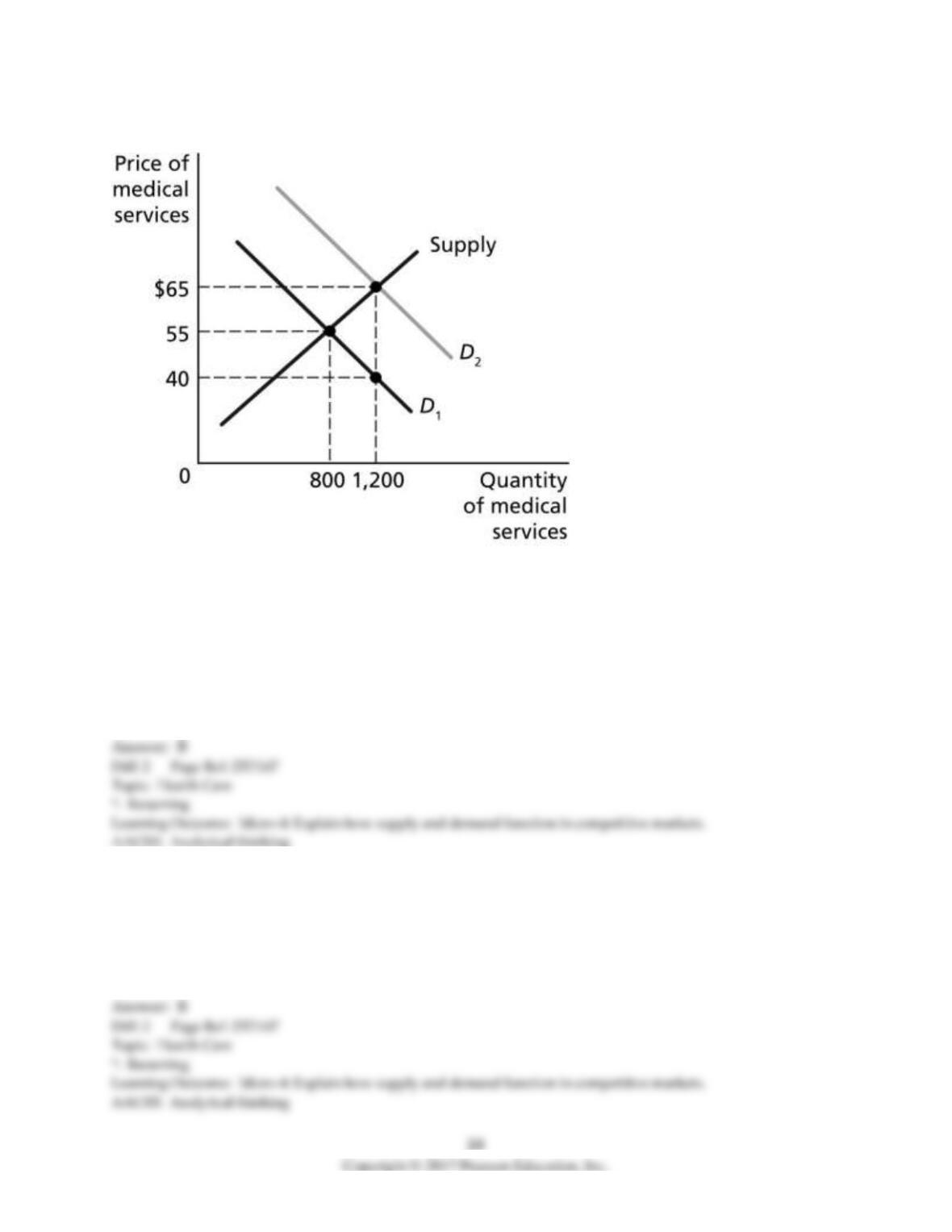
Figure 5-3
Figure 5-3 represents the market for medical services with and without insurance, and the effect of a
third-party payer system on the demand for medical services.
18) Refer to Figure 5-3. If consumers paid the full price of medical services, the price they would pay is
A) $40.
B) $55.
C) $65.
D) > $65.
19) Refer to Figure 5-3. If consumers paid the full price of medical services, the equilibrium quantity
would be
A) 400.
B) 800.
C) 1,200.
D) > 1,200.