Economics Today, 19e (Miller)
Chapter 5 Public Spending and Public Choice
5.1 Market Failures and Externalities
1) Which of the following terms describes the situation in which all resources are able to move to
to highest-valued uses via voluntary exchange?
A) government intervention
B) a market failure
C) economic efficiency
D) an externality
2) Market failure occurs when
A) a good is too expensive for the market to provide.
B) an unrestrained market economy leads to too few or too many resources going to a specific
economic activity.
C) one good is superior to another and drives it out of the market.
D) the stock market experiences a very large loss.
3) Consumers are sovereign when
A) prices are decided by sellers.
B) a few consumers exercise coercion on sellers and other consumers.
C) they can prevent market failure.
D) they have the freedom to decide what they wish to purchase.
4) Market failures
A) prevent the price system from attaining economic efficiency.
B) result in quantities and prices that are socially desirable.
C) strengthen economic efficiency by forcing unprofitable firms to close.
D) weaken the argument for government intervention in the economy.
5) A market failure likely occurs when
A) the consumption of a good generates an effect on third parties.
B) firm production lacks an externality on third parties.
C) consumers are sovereign but firms are not sovereign.
D) there is no much competition in a market.
6) Which of the following is a benefit of the price system?
A) the existence of positive externalities
B) the production of public goods
C) Consumers have what they want since politicians and business managers decide what is to be
produced.
D) the freedom of consumers to decide what they want to purchase
7) Which of the following statements is NOT true about the price system?
A) The price system allows resources to flow from low-valued uses to high-valued uses.
B) Firms have total control over what consumers can buy.
C) Individuals have freedom to purchase what they want.
D) The price system allows for economic efficiency.
8) Market failures
A) are usually caused by government interference in the economy.
B) prevent the price system from attaining economic efficiency.
C) encourage people to purchase more of a good than they really want.
D) encourage businesses to produce more of a good than they really want to.
9) When there are too few or too many resources going to an economic activity
A) a public good exists.
B) a market failure exists.
C) consumer sovereignty exists.
D) scarcity of resources no longer exists.
10) The price system allocates resources efficiently EXCEPT when
A) consumers decide they want more of a good.
B) resources are utilized to produce the highest-valued goods and services.
C) voluntary exchange exists.
D) the production of a good affects parties other than its buyers and sellers.
11) When market failures occur
A) the invisible hand will correct for the market failures.
B) the price system will correct the market failures.
C) buyers and sellers will correct the market failures.
D) the government can step in to correct the market failures.
12) Market failures occur when
A) externalities exist.
B) economic efficiency increases.
C) there is an increase in demand.
D) there is a change in quantity demanded.
13) When the price system fails to generate an efficient allocation of resources
A) the market will always correct it.
B) consumers will spend less.
C) business will produce more.
D) too few or too many goods will be produced.
14) An example of a market failure is
A) a firm is dumping toxic waste that is making people sick.
B) when not everyone who wants to see a major league football game can.
C) when there is an increase in gasoline demand and a shortage develops.
D) when the market prices of some vehicles are too high for some buyers.
15) Market failures include all of the following EXCEPT
A) buyers pay for all the costs involved in the production of goods and services.
B) public goods.
C) positive externalities.
D) negative externalities.
16) A situation in which a market economy leads to too few or too many resources going to a
particular economic activity is known as
A) competition.
B) excessive competition.
C) destructive competition.
D) a market failure.
17) In its most ideal form, a price system allows
A) firms to act in such a way that they eliminate scarcity.
B) consumers to satisfy all their wants.
C) resources to move from lower-valued uses to higher-valued uses through voluntary exchange.
D) government policy makers to allocate resources to the uses which they consider to be in the
best interests of society.
18) Market failure occurs when
A) the price system fails to generate an efficient allocation of resources.
B) the price system fails to generate an equal distribution of income.
C) the price system fails to generate an equal distribution of wealth.
D) the price system allows consumers to make their own decisions.
19) A price system is considered to be efficient when
A) it fails to have the goods that consumers want.
B) an underground market develops.
C) all resources are allocated to the highest-valued uses.
D) firms produce more than what consumers want.
20) When misallocation of resources for production of a good results in spillover effects on third
parties, there is a
A) market failure.
B) government failure.
C) legislative failure.
D) productive failure.
21) A situation in which a benefit or a cost associated with an economic activity spills over to
third parties is called
A) a public good.
B) a merit good.
C) an externality.
D) the free-rider problem.
22) An example of third parties in the market of automobiles is
A) a pedestrian that is affected by the polluted air from automobiles.
B) a seller of an automobile.
C) a buyer of an automobile.
D) None of the above belongs to third parties.
23) An externality can best be defined as
A) a party not directly involved in a transaction.
B) a consequence of a transaction that spills over to affect third parties.
C) a right of an owner to use and exchange property.
D) a cost associated with the production of one more unit of output.
24) All of the following illustrate how government can correct for positive externalities EXCEPT
A) subsidies.
B) regulation.
C) government financing and production.
D) charging effluent fees.
25) Which of the following leads to an underallocation of resources to a specific economic
activity?
A) external costs
B) external benefits
C) marginal costs
D) effluent benefits
26) A result of a positive externality in the production of a good is that
A) the price system will over-allocate resources to the production of that good or service.
B) the price system will under-allocate resources to the production of that good or service.
C) the market supply will be too high.
D) the market demand will be too high.
27) Which of the following is an example of a negative externality?
A) There is an increase in injuries to pedestrians caused by accidents resulting from electronic
billboards distracting drivers.
B) The opening of a new shopping mall increases the business of nearby restaurants.
C) A consumer pays a higher price than another consumer does for the same product.
D) Consumers pay a sales tax in addition to the price of a product.
28) Suppose that one firm produces a product that results in negative external costs to society.
This information suggests that
A) resources are under-allocated to the firm.
B) the equilibrium market price of the product includes the external costs borne by society.
C) resources are over-allocated to the firm.
D) at the market price, quantity demanded is less than quantity supplied.
29) When an external cost exists in the production of a good, firms tend to
A) under-produce the good since society pays these costs.
B) over-produce the good.
C) keep production constant throughout the year.
D) under-allocate resources to the production of the good.
30) If production of an item results in negative external costs, then
A) the market price is below the socially preferred price that reflects the external costs.
B) the market price is above the socially preferred price that reflects the external costs.
C) market forces will always correct the problem.
D) the market quantity is too low from society’s point of view.
31) Which of the following will LEAST likely generate positive external effects to society?
A) education
B) a novel
C) health care
D) requiring drivers to undergo a test for alcohol consumption
32) Suppose that the market price of good A equals the firm’s cost of producing that good, but it
does not reflect any costs imposed on society. Which of the following is FALSE?
A) The good is priced too low.
B) An external benefit is associated with good A.
C) Resources are over-allocated in the production of good A.
D) Too much of good A is being produced.
33) When a good causes positive external benefits to accrue to third parties, an unfettered market
will
A) under-allocate resources to the good causing the benefit.
B) over-allocate resources to the good causing the benefit.
C) cause the equilibrium quantity, established before the benefit is taken into account, to be
produced more efficiently.
D) eliminate such goods.
34) Society is likely to over-allocate resources to produce goods that
A) are public goods.
B) are merit goods.
C) generate positive externalities.
D) generate negative externalities.
35) Which of the following often involves positive external benefits?
A) water pollution
B) drunken driving
C) inoculation programs
D) tobacco smoking
36) A negative externality is a situation in which
A) there is a spillover of benefits.
B) a cost associated with an economic activity is borne by a third party.
C) a firm is paying in excess of the total costs of producing a good.
D) none of the above.
37) When a paper producer pollutes the air, economists argue that there is
A) efficiency, if production is at its maximum level.
B) a positive externality.
C) an external cost.
D) a cost paid solely by the firm.
38) An external cost, such as the cost generated by pollution, is
A) a cost paid by consumers of the product.
B) a cost paid by producers of the product.
C) a cost paid by a third party or by society at large.
D) not a true opportunity cost of production.
39) Pollution is caused by a market failure, in an industry in which there is
A) unemployment.
B) an over-allocation of resources in production.
C) excess demand.
D) excessive cost borne by the firm.
40) A negative externality such as pollution can be corrected by
A) a subsidy to producers.
B) a tax on producers.
C) a subsidy to consumers.
D) a stimulus to production.
41) An externality exists when
A) goods are sold in specific geographic locations.
B) some of the benefits or costs associated with a good are borne by third parties.
C) the government taxes a good.
D) the government subsidizes a good.
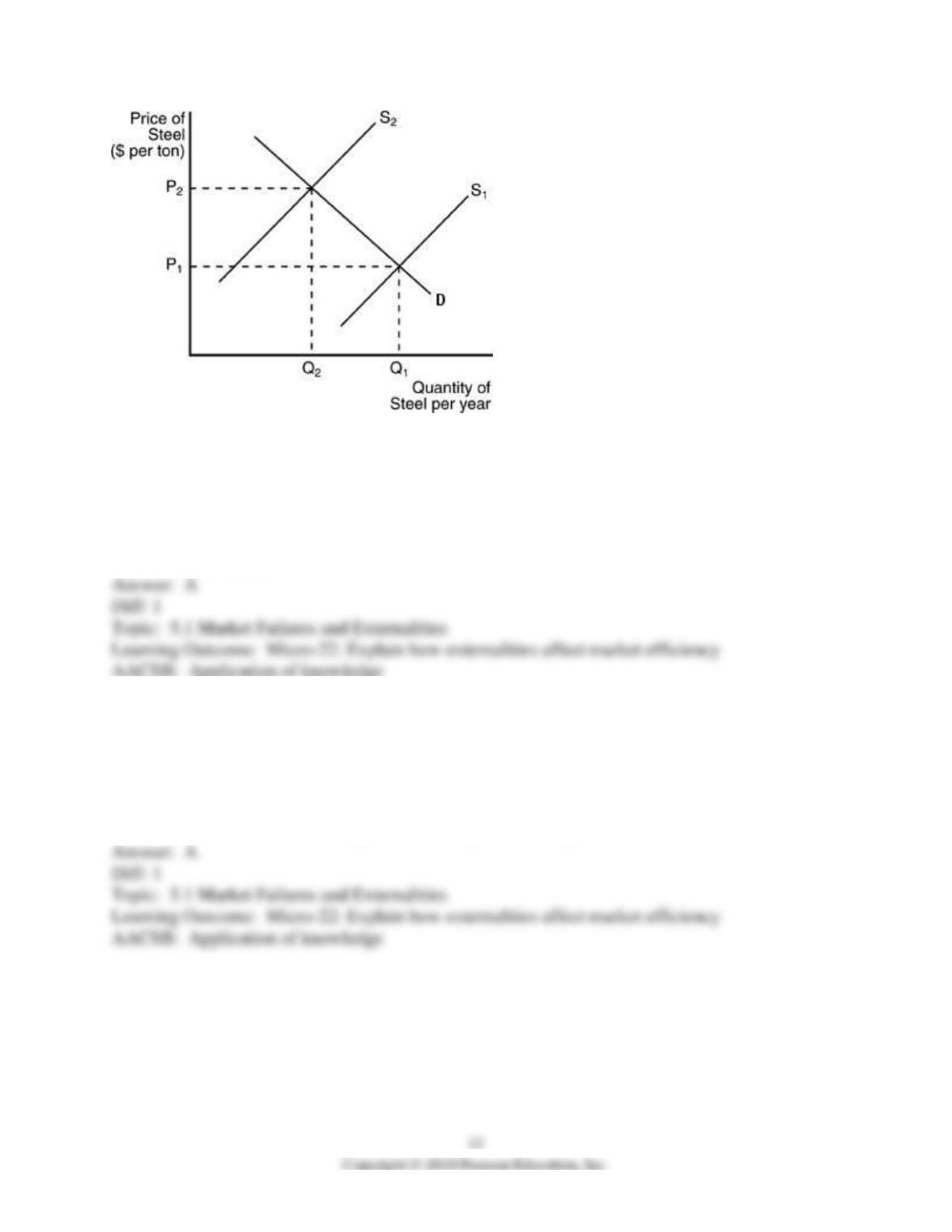
42) According to the above figure, if steel mills ignore the cost of pollution, the equilibrium
quantity of steel will most likely be
A) Q1.
B) Q2.
C) Q2 – Q1.
D) none of the above.
43) According to the above figure, if steel mills ignore the cost of pollution, then the supply
curve will
A) shift from S1 to S2.
B) shift from S2 to S1.
C) remain at S1.
D) shift either to the left or the right, but it is impossible to say without more information.
44) According to the above figure, if steel mills are charged an effluent fee in order to bear the
cost of pollution, what happens to the equilibrium price and equilibrium quantity?
A) They are unchanged.
B) They change from P1 and Q1 to P2 and Q2.
C) They change from P2 and Q2 to P1 and Q1.
D) The equilibrium price increases from P1 and P2, but the equilibrium quantity is unchanged.
45) Suppose that a per-unit subsidy is granted to each individual who consumes a product
providing external benefits to society at large. Each individuals demand curve will shift
________, and the market demand curve for the product will shift ________.
A) to the right; to the right
B) to the right; to the left
C) to the left; to the left
D) to the left; to the right
46) The No-Good Company produces goods that provide damages to society-at-large. If
consumers of No-Good’s products fail to take external benefits into account
A) the demand curve will be too far to the left.
B) the supply curve will be too far to the left.
C) the demand curve will be too far to the right.
D) the supply curve will be too far to the right.
47) Government can correct for negative externalities by
A) decreasing taxes.
B) increasing taxes or regulation.
C) allowing the market system to correct the problem.
D) decreasing the costs to those responsible for the externality.
48) In graphical form,the effect of imposing a tax on a good is shown as
A) a leftward shift of the market supply curve.
B) a rightward shift of the market supply curve.
C) a downward movement along the market supply curve.
D) no change to the market supply curve.
49) If the production of a product results in significant external costs, an appropriate government
policy might be to
A) subsidize the production of the good.
B) tax producers and thus shift the supply curve to the left.
C) tax consumers’ incomes and thus shift the demand curve to the left.
D) subsidize consumers since the good is being under-consumed.
50) An effluent fee
A) is a reward to companies using production methods that create positive externalities.
B) is also called a pollution subsidy.
C) gives a firm the right to pollute if it pays a tax on what it discharges.
D) is intended to influence the market by increasing supply and decreasing price.
51) To correct for the underproduction of products with positive externalities, the government
must
A) provide the incentives for the private sector to produce and consume the good.
B) provide tougher regulations on the industry.
C) increase taxes on the industry.
D) fine the industry.
52) Assume the production of a good gives rise to external benefits. The government may
increase efficiency by
A) subsidizing consumption of the good.
B) requiring all producers of the good to be licensed.
C) taxing production of the good.
D) imposing taxes on the good.
53) When the production of one good spills benefits over to third parties, the government should
consider all of the following EXCEPT
A) subsidizing the consumption of the good.
B) subsidizing the production of the good.
C) creating tax incentives to encourage more consumption.
D) taxing the production or consumption of the good.
54) A government action that can help correct positive externalities is
A) a tax on producers of the good that provides external benefits.
B) a subsidy to consumers of the good that provides external benefits.
C) an effluent fee charged to producers of the good that provides external benefits.
D) regulations aimed at reduced production by sellers of the good that provides external benefits.
55) A government subsidy is typically used
A) to correct a negative externality.
B) to provide a government-inhibited good.
C) to reduce inflation.
D) to correct a positive externality.
56) A subsidy is sometimes used by the government to correct the problems associated with
A) negative externalities.
B) positive externalities.
C) public goods.
D) monopolies.
57) When costs spill over to third parties, there is a(n)
A) cost overrun.
B) excessive competition.
C) negative externality.
D) government subsidy.
58) Which of the following is NOT an example of a negative externality?
A) inoculation against disease
B) pollution
C) playing a boom box loudly in a crowded park
D) rush hour traffic
59) Which of the following is an example of a positive externality?
A) something obtainable at a zero price
B) a lower crime rate for a community in which residents receive more education
C) increased purchases of landscaping services by a homeowner that boost a neighbor’s property
value
D) a discount for consumers buying in large quantity
60) A paint firm has just announced that it will be building a new plant in a small town that is
currently experiencing a high level of unemployment. The new plant will create 500 new jobs in
the area and will occupy unused land at the edge of town. The plant will also dump some
harmful chemicals into the town’s river. From an economic standpoint this dumping of chemicals
A) is unimportant since the firm is reducing the unemployment in the region.
B) creates a negative externality.
C) is the production of a public good.
D) creates a positive externality.
61) Which of the following is an example of a positive externality?
A) a neighbor’s flower garden that you enjoy seeing
B) traffic congestion
C) an increased supply of chocolate lowers chocolate prices for all consumers
D) pollution
62) Which of the following is NOT an example of an externality?
A) A cookie company emits a wonderful aroma in the air that makes people smile.
B) The neighbor’s wind chimes interfere with your sleep.
C) A firm lays off 100 workers.
D) Cancer-causing chemicals are dumped into the drinking water supply of a city.
63) Many beach-goers leave plastic bottles on beaches instead of putting them in trash cans. This
is an example of a
A) public good.
B) positive externality.
C) neutral externality.
D) negative externality.
64) Safe Bank has an outside display which has the time and temperature that is always correct.
This is an example of
A) an interference in the workings of the price system.
B) a breakdown in communication between the bank and its customers.
C) a negative externality.
D) a positive externality.
65) Which of the following is an example of a negative externality?
A) A person buys a car that is a lemon.
B) A worker is injured on the job.
C) A new restaurant’s success causes another to go out of business.
D) A large wind turbine in a house’s backyard ruins the view of other homeowners.
66) Markets tend to overallocate resources to the production of a good when
A) there are negative externalities.
B) there are positive externalities.
C) there are public goods produced.
D) equilibrium occurs.
67) Markets tend to underallocate resources to the production of a good when
A) there are negative externalities.
B) there are positive externalities.
C) there are public goods produced.
D) equilibrium occurs.
68) Which of the following statements is NOT true of external benefits?
A) External benefits lead to an underallocation of resources to the production of the good that
has the external benefit.
B) External benefits lead to a price in the market that is too high.
C) External benefits lead to too few of the goods that have the external benefit being produced.
D) External benefits are a good thing for the allocation of resources because people are getting
something at no cost.
69) Which of the following statements is TRUE of external costs?
A) External costs should not be corrected since people will bear the costs whether they are
corrected or not.
B) There are no good ways to correct for the external costs.
C) When external costs exist, the price of the good will be deceptively low leading to an
overallocation of resources.
D) External costs should only be corrected for if the correction will not increase the market price.
70) When negative externalities exist, the private market equilibrium represents a
A) market price which is too low and a market quantity which is too low.
B) market price which is too low and a market quantity which is too high.
C) market price which is too high and a market quantity which is too low.
D) market price which is too high and a market quantity which is too high.
71) When positive externalities exist, the private market equilibrium represents a
A) market price which is too low and a market quantity which is too low.
B) market price which is too low and a market quantity which is too high.
C) market price which is too high and a market quantity which is too low.
D) market price which is too high and a market quantity which is too high.
72) Orchards provide services to beekeepers because the bees use the pollen to make honey. This
is an example of
A) a positive externality, and too many orchards exist in society.
B) a positive externality, and too few orchards exist in society.
C) a negative externality, and too many orchards exist in society.
D) a negative externality, and too few orchards exist in society.
73) To correct for negative externalities, the government
A) should allow the price system do the correction.
B) can impose a tax.
C) can provide a subsidy to consumers.
D) should create a public good.
74) To correct for positive externalities the government
A) should allow the price system to do the correction.
B) can impose a tax.
C) can give a subsidy.
D) should create a public good.
75) A tax is sometimes used by government to correct the problems associated with
A) negative externalities.
B) positive externalities.
C) internal benefits.
D) external benefits.