Macroeconomics, 9e (Abel/Bernanke/Croushore)
Chapter 5 Saving and Investment in the Open Economy
5.1 Balance of Payments Accounting
1) Which of the following transactions would not be included in the current account of the home
country?
A) A consumer good is imported into the home country.
B) A home country resident makes a deposit in a foreign bank.
C) A foreign student pays tuition to a university in the home country.
D) A home country resident receives income on his or her foreign assets.
2) Net exports of goods are known as
A) the balance of payments.
B) the merchandise trade balance.
C) the current account.
D) the financial account.
3) If a country’s merchandise exports exceed its merchandise imports it has a
A) trade surplus.
B) trade deficit.
C) current account surplus.
D) current account deficit.
4) If France has a trade deficit, then
A) imports into France exceed exports from France.
B) exports from France exceed imports into France.
C) imports into the United States from France exceed exports from the United States into France.
D) imports into France from the United States exceed exports from France into the United States.
5) If all international factor payment flows are investment income, then net investment income
from abroad equals
A) net exports.
B) the current account balance.
C) the trade balance.
D) net income from abroad.
6) If the United States donates footballs to Japan, how is the transaction recorded on the U.S.
balance of payments accounts?
A) Decline in merchandise trade; increase in financial account
B) Decline in financial account; increase in merchandise trade
C) Decline in net unilateral transfers; increase in merchandise trade
D) Decline in merchandise trade; increase in net unilateral transfers
7) If the United States sells computers to Russia, and uses the proceeds to buy shares of stock in
Russian companies, the U.S. trade balance ________ and the U.S. financial account balance
________.
A) rises; rises
B) rises; falls
C) falls; falls
D) falls; rises
8) The current account balance consists of
A) the trade balance plus the services balance.
B) net exports of goods and services, minus net unilateral transfers.
C) net exports of goods and services, plus net income from abroad, plus net unilateral transfers.
D) net exports of goods and services, plus net income from abroad, plus net unilateral transfers,
minus the financial account balance.
9) The difference between the current account balance and net exports is
A) the capital account.
B) net unilateral transfers plus net factor payments from abroad.
C) adjustments in net foreign assets.
D) income receipts from foreign assets.
10) If a U.S. firm buys tulips from a Dutch firm and the Dutch firm uses the dollars it gets to buy
U.S. stocks, the U.S. trade balance ________ and the U.S. financial account ________.
A) rises; rises
B) rises; falls
C) falls; falls
D) falls; rises
11) If a U.S. company imports 10 Toyotas from Japan at $15,000 each, and the Japanese
company buys airline tickets on a U.S. airline with the money, how does this affect the U.S.
balance of payments accounts?
A) Decline in merchandise trade; increase in financial account
B) Decline in financial account; increase in merchandise trade
C) Decline in merchandise trade; increase in services
D) Decline in services; increase in merchandise trade
12) Suppose a wealthy Canadian donates $10 million to charities in Mexico. Mexican net exports
________ and the current account balance ________.
A) fall; rises
B) rise; rises
C) are unchanged; is unchanged
D) fall; is unchanged
13) If a French company exports $2 million of machinery to Italy and French tourists spend $2
million at Italian beaches, the French merchandise trade balance ________, and the French
financial account balance ________.
A) rises; rises
B) rises; is unchanged
C) is unchanged; is unchanged
D) is unchanged; rises
14) If a French company sells 1000 gallons of Perrier to a U.S. company at 5 euros per gallon,
and uses the money to buy stock in a Spanish cork company, how does this affect the French
balance of payments accounts?
A) Decrease in financial account; increase in merchandise trade
B) Decrease in merchandise trade; increase in financial account
C) Decrease in net investment income from abroad; increase in financial account
D) Decrease in merchandise trade; increase in net income from abroad
15) If a Japanese company sells 200 VCRs to a French company and uses the money to buy U.S.
government bonds, the Japanese merchandise trade balance ________, and the Japanese
financial account balance ________.
A) rises; rises
B) rises; falls
C) falls; falls
D) falls; rises
16) Which of the following would be part of the nation’s current account?
A) An old house purchased by an American in Italy
B) The purchase of a U.S. Treasury bond by a foreigner
C) The interest an American earns on a British bond
D) A factory built by the Japanese in the United States
17) A country has a current account surplus if
A) the value of its exports exceeds the value of its imports, assuming net income from foreign
assets and net unilateral transfers have a value of zero.
B) the value of its net exports of services exceeds the value of its net exports of goods.
C) it receives more income from foreign assets than it pays to foreigners for foreign-owned
domestic assets.
D) its capital inflows exceed its capital outflows.
18) Which of the following would be part of the nation’s financial account?
A) A night club show seen by an American in Mexico City
B) A dividend from a British equity owned by an American
C) A payment to the Philippine government for the use of military bases in their country
D) One hundred shares of British Petroleum stock purchased by an American
19) If a French company exports $2 million of machinery to Italy and French tourists spend $2
million at Italian beaches, the Italian current account balance ________, and the Italian financial
account balance ________.
A) rises; rises
B) rises; is unchanged
C) is unchanged; is unchanged
D) is unchanged; rises
20) The balance of payments equals
A) the sum of the current account and the financial account.
B) the current account minus net unilateral transfers.
C) net investment income from abroad.
D) the net increase in a country’s official reserve assets.
21) A negative value for the U.S. official reserve assets line in the balance of payments accounts
means that
A) U.S. residents have sold more gold to foreigners than they bought.
B) U.S. residents bought more gold from foreigners than they sold.
C) the U.S. central bank has increased its holdings of foreign reserve assets.
D) the U.S. central bank has decreased its holdings of foreign reserve assets.
22) If the Federal Reserve buys $3 billion worth of Japanese yen and sells $5 billion of euros,
how does this affect the balance of payments?
A) Falls by $2 billion
B) Rises by $2 billion
C) Rises by $3 billion
D) Falls by $5 billion
23) If the Federal Reserve buys $3 billion worth of Japanese yen, $6 billion of euros, and sells $5
billion of British pounds, how does this affect the balance of payments?
A) Falls by $4 billion
B) Rises by $4 billion
C) Rises by $9 billion
D) Falls by $5 billion
24) Suppose the current account shows debits of $5.3 billion and credits of $4.7 billion. The
current account balance is ________, and the financial account balance is ________.
A) +$0.6 billion; -$0.6 billion
B) +$0.6 billion; +$0.6 billion
C) -$0.6 billion; -$0.6 billion
D) -$0.6 billion; +$0.6 billion
25) A financial account surplus necessarily implies
A) a balance of payments surplus.
B) a current account surplus.
C) a current account deficit.
D) an increase in the nation’s official reserve assets.
26) If the United States had a financial account deficit of $50 billion, we could say the United
States had
A) net imports of $50 billion.
B) net foreign borrowing of $50 billion.
C) acquired net foreign assets of $50 billion.
D) a current account deficit of $50 billion.
27) A country’s financial account balance decreases if
A) its current account balance increases.
B) its income payment inflows on foreign assets decrease.
C) its domestic residents working abroad reduce the income they send home to their families.
D) foreigners increase their purchases of its existing assets.
28) If a country has a current account surplus, it also has
A) a financial account surplus.
B) an increase in its official reserve assets.
C) a balance of payments deficit.
D) an increase in its holding of net foreign assets.
29) If there are no net factor payments from abroad and no unilateral transfers, net exports of $10
billion is the same as
A) a current account deficit of $10 billion.
B) a financial account surplus of $10 billion.
C) net acquisition of foreign assets of $10 billion.
D) net foreign borrowing of $10 billion.
30) An economic benefit of capital outflows is that they
A) create future income payment inflows.
B) increase domestic investment.
C) reduce domestic saving.
D) reduce domestic unemployment.
31) The United States became a net debtor because
A) it ran consistently large current account deficits.
B) it ran consistently large current account surpluses.
C) it lent a lot to people in foreign countries.
D) it provided much foreign aid to other countries.
32) A friend claims that the United States is a net international debtor. The best way of testing
this claim is to see whether
A) U.S. foreign liabilities exceeded U.S. foreign income.
B) U.S. receipts from foreign assets exceeded U.S. payments to foreign owners of U.S. assets.
C) U.S. official reserve assets were positive or negative.
D) the United States ran a balance of payments surplus or deficit last year.
33) Suppose output is $35 billion, government purchases are $10 billion, desired consumption is
$15 billion, and desired investment is $6 billion. Net foreign lending would be equal to
A) -$4 billion.
B) -$2 billion.
C) $2 billion.
D) $4 billion.
34) Assuming no change in the effective tax rate on capital, a decrease in the government budget
deficit will reduce the current account deficit if and only if the decrease in the budget deficit
A) reduces desired national saving.
B) increases desired national saving.
C) reduces desired national investment.
D) increases desired national investment.
35) Assume that an increase in Costa Rica’s government budget deficit reduced desired national
saving by 10 million colon. Assuming Costa rice is a small open economy, you would expect the
government’s action to
A) increase the current account balance by exactly 10 million colon.
B) increase the current account balance by less than 10 million colon.
C) reduce the current account balance by exactly 10 million colon.
D) reduce the current account balance by more than 10 million colon.
36) An increase in a small open economy’s government budget deficit that reduces national
saving and the current account balance causes an
A) increase in desired saving.
B) increase in the world real interest rate.
C) increase in exports.
D) increase in absorption.
37) In a large open economy like the United States, an increased government budget deficit
which reduces national saving
A) reduces investment and improves the current account balance.
B) reduces investment and reduces the current account balance.
C) has no effect on investment, but reduces the current account balance.
D) has no effect on either investment or the current account balance.
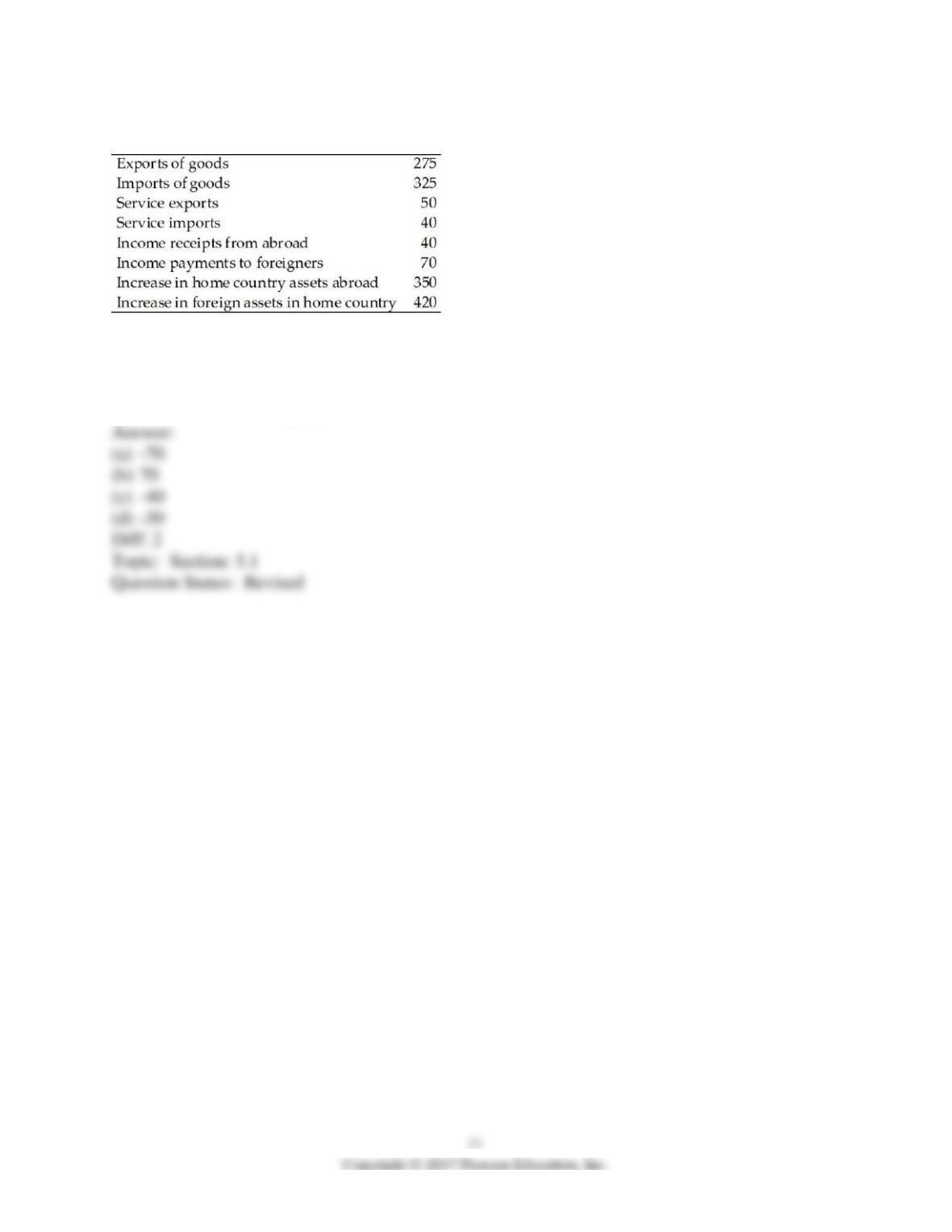
38) Suppose a country has the following balance of payments data.
(a) Calculate the current account balance.
(b) Calculate the financial account balance.
(c) Calculate the trade balance.
(d) Calculate net factor payments.
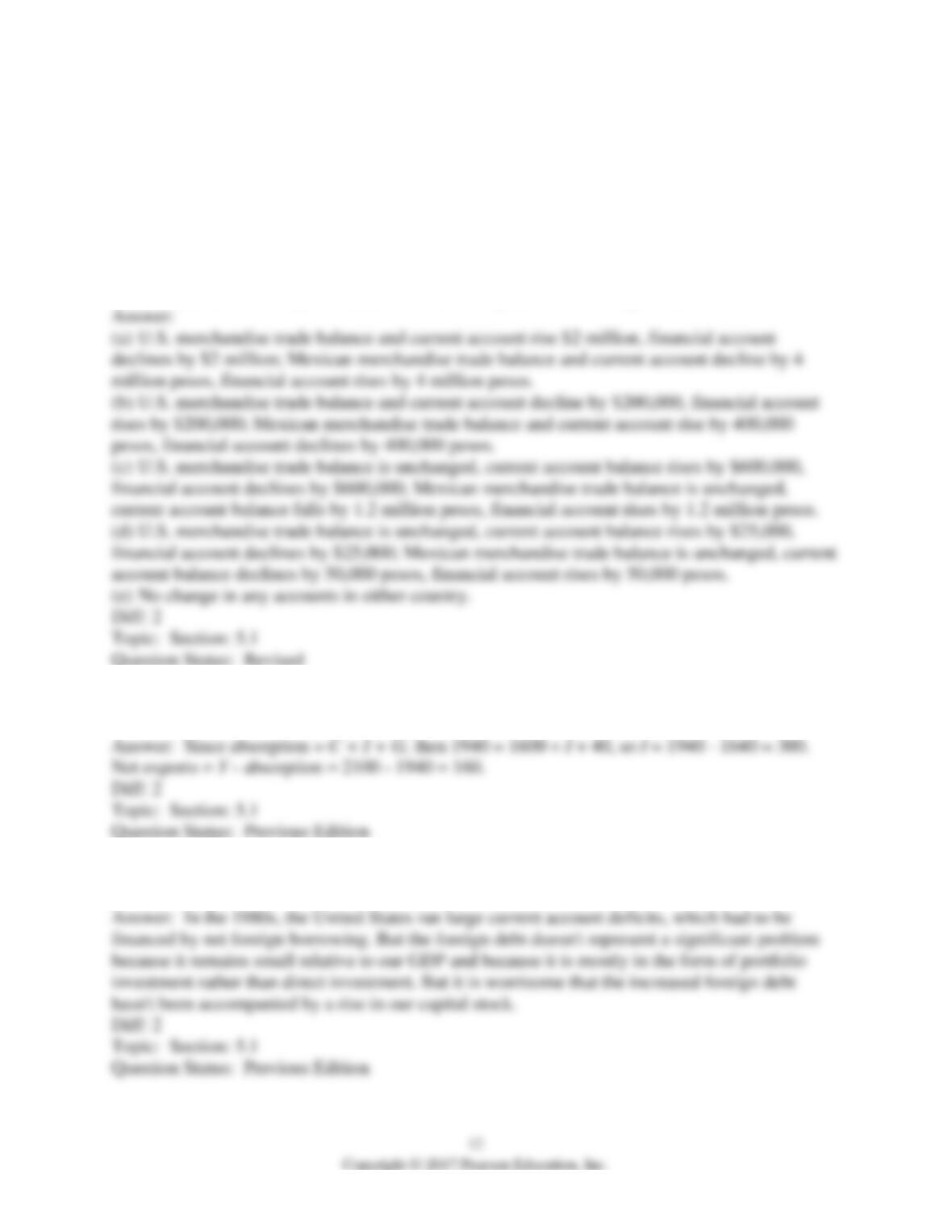
39) Suppose a country has the following balance of payments data.
(a) Calculate the current account balance.
(b) Calculate the financial account balance.
(c) Calculate the trade balance.
(d) Calculate net factor payments.
40) For each of the following transactions, explain what happens to the merchandise trade
balance, current account balance, and financial account balance in both the United States and
Mexico. The exchange rate is 2 Mexican pesos per U.S. dollar.
(a) A Mexican firm spends 4 million pesos to buy radiology equipment from a U.S. firm.
(b) A U.S. firm buys 20,000 sombreros at 20 pesos each.
(c) Mexican computer firms send 200 programmers to universities in the United States, paying
tuition and expenses of $3000 each.
(d) A Mexican entrepreneur gives 50,000 pesos to the United Way of San Antonio, Texas.
(e) Mexican investors buy $10 million worth of 30-year U.S. Treasury bonds.
41) Suppose an economy has output of 2100, government spending of 40, consumption of 1600,
and absorption of 1940. Calculate the equilibrium values of investment and net exports.
42) How did the United States become a net debtor in the 1980s? Is our foreign debt a significant
problem? Explain.
5.2 Goods Market Equilibrium in an Open Economy
1) In goods market equilibrium in an open economy,
A) the desired amount of exports must equal the desired amount of imports.
B) the desired amount of exports must equal the desired amount of imports less the amount lent
abroad.
C) the desired amount of national saving must equal the desired amount of domestic investment.
D) the desired amount of national saving must equal the desired amount of domestic investment
plus the amount lent abroad.
2) The goods market equilibrium condition in an open economy shows that
A) NX = Sd – Id.
B) Sd = NX – Id.
C) Sd = Id – NX.
D) Sd = Id.
3) In goods market equilibrium in an open economy,
A) the desired amount of exports must equal the desired amount of imports.
B) the desired amount of exports must equal the desired amount of imports less the amount lent
abroad.
C) the desired amount of national saving must equal the desired amount of domestic investment.
D) the desired amount of national saving must equal the desired amount of domestic investment
plus the current account balance.
4) Total spending by domestic residents, businesses, and governments is called
A) investment.
B) net domestic purchases.
C) absorption.
D) GDP.
5) Absorption refers to
A) the total amount of imports purchased by a country.
B) the net amount of imports purchased by a country.
C) total spending by domestic residents, businesses, and governments.
D) GDP less desired consumption, desired investment, and government purchases.
6) Suppose output is $1000 billion, government purchases are $200 billion, desired consumption
is $700 billion, and desired investment is $150 billion. Net foreign lending would be equal to
A) -$150 billion.
B) -$50 billion.
C) $50 billion.
D) $150 billion.
7) Suppose output is $35 billion, government purchases are $10 billion, desired consumption is
$15 billion, and net exports are $4 billion. Then desired investment equals
A) $2 billion.
B) $4 billion.
C) $6 billion.
D) $8 billion.
8) Suppose output is $35 billion, government purchases are $10 billion, desired consumption is
$15 billion, and desired investment is $6 billion. Desired savings is equal to
A) $2 billion.
B) $10 billion.
C) $14 billion.
D) $16 billion.
9) Suppose output is $35 billion, government purchases are $10 billion, desired consumption is
$15 billion, and desired investment is $6 billion. Absorption is equal to
A) $25 billion.
B) $31 billion.
C) $35 billion.
D) $39 billion.
10) Suppose output is $440 billion, government purchases are $40 billion, desired consumption
is $320 billion, and net exports are $35 billion. Then desired investment equals
A) $20 billion.
B) $30 billion.
C) $35 billion.
D) $45 billion.
11) Suppose output is $440 billion, government purchases are $40 billion, desired consumption
is $320 billion, and net exports are $35 billion. Absorption is equal to
A) $405 billion.
B) $420 billion.
C) $435 billion.
D) $440 billion.
12) Suppose output is $35 billion, government purchases are $10 billion, consumption is $15
billion, and net exports are $4 billion. Assume net factor payments equal 0.
(a) Calculate the equilibrium amount of investment. Show your work.
(b) Calculate the equilibrium amount of absorption. Show your work.
(c) Calculate the equilibrium amount of the financial account balance. Show your work.
5.3 Saving and Investment in a Small Open Economy
1) An economy is considered a small open economy if it
A) is too small to affect the world real interest rate.
B) has GDP less than 1% of world GDP.
C) doesn’t trade internationally.
D) has a zero trade balance.
2) In a saving—investment diagram for a small open economy
A) the saving curve is vertical at some fixed level of output.
B) the saving curve is horizontal at some fixed interest rate.
C) the real interest rate is fixed at the world real interest rate.
D) equilibrium requires that Sd = Id.
3) A small open economy has a current account balance of zero. A rise in the world real interest
rate causes
A) a current account surplus.
B) a financial account surplus.
C) net borrowing from abroad.
D) absorption to exceed income.
4) A small open economy has a current account balance of zero. A rise in its investment demand
causes
A) a current account surplus.
B) a financial account deficit.
C) income to exceed absorption.
D) net borrowing from abroad.
5) A small open economy increases its investment demand. This causes the world real interest
rate to ________ and the country’s current account balance to ________.
A) rise; fall
B) remain unchanged; rise
C) rise; rise
D) remain unchanged; fall
6) A small open economy reduces its desired saving. This causes the world real interest rate to
________ and the country’s current account balance to ________
A) fall; fall
B) remain unchanged; rise
C) fall; rise
D) remain unchanged; fall
7) A small open economy increases its desired saving. This causes the world real interest rate to
________ and the country’s current account balance to ________.
A) fall; fall
B) remain unchanged; rise
C) fall; rise
D) remain unchanged; fall
8) When a temporary beneficial supply shock hits a small open economy, it causes the current
account to ________ and investment to ________.
A) fall; fall
B) rise; remain unchanged
C) fall; remain unchanged
D) rise; fall
9) When future labor income falls in a small open economy, it causes the current account to
________ and investment to ________.
A) fall; rise
B) rise; remain unchanged
C) fall; remain unchanged
D) rise; rise
10) If there is an increase in the future marginal product of capital in a small open economy, it
causes the current account to ________ and saving to ________.
A) fall; rise
B) rise; remain unchanged
C) fall; remain unchanged
D) rise; rise
11) If there is a decrease in taxes on business firms in a small open economy, it causes the
current account to ________ and the equilibrium amount of saving to ________.
A) fall; fall
B) rise; remain unchanged
C) fall; remain unchanged
D) rise; fall
12) If there is an increase in taxes on business firms in a small open economy, it causes the
current account to ________ and the equilibrium quantity of saving to ________.
A) fall; fall
B) rise; remain unchanged
C) fall; remain unchanged
D) rise; fall
19
13) If a freeze destroys much of the crop of an agricultural nation, then
A) the desired investment curve would shift to the left.
B) the desired investment curve would shift to the right.
C) net foreign lending would increase.
D) net foreign lending would decrease.
14) The best weather in a decade has given Australia a bumper wheat crop. Australia is a small
open economy. Based on this information alone, you would expect that
A) desired investment would decrease.
B) desired investment would increase.
C) the current account would increase.
D) the current account would decrease.
15) Consider a small open economy with desired national saving of Sd = 200 + 10,000rw and
desired investment of Id = 1000 – 5000rw. If rw = 0.05, then net exports equal
A) 100.
B) 50.
C) -50.
D) -100.
16) Consider a small open economy with desired national saving of Sd = 200 + 10,000rw and
desired investment of Id = 1000 – 5000rw. If rw = 0.05, and output = 5000, then absorption
equals
A) 5100.
B) 5050.
C) 4950.
D) 4900.