c.
Decision makers in the market are motivated by self-interest, whereas, political decision
makers are primarily motivated by the desire to help others.
d.
Public goods tend to be undersupplied through the market since it is difficult for potential
suppliers to withhold such goods from nonpaying consumers, while the government can
use taxes to overcome this problem.
99. A car sells at different prices at different dealerships in a local market. If a consumer has imperfect
information about the price of a car at each dealership, he should
a.
always gather all available information about prices.
b.
gather information about prices until the expected marginal benefit of more information
equals the marginal cost of gathering it.
c.
gather information about prices only if it can be gathered without cost.
d.
ignore information about prices because it is irrelevant to making an “optimally imperfect”
decision.
100. In which of the following markets are information problems likely to be most serious?
a.
used cars
b.
groceries
c.
toothpaste
d.
compact discs
101. In which of the following markets are information problems likely to be most serious?
a.
automotive repair service
b.
magazines
c.
toothpaste
d.
pencils
102. Sellers will tend to be most concerned with customer satisfaction when
a.
it is difficult for the customer to evaluate product quality.
b.
they depend on repeat customers for most of their business.
c.
they sell primarily to tourists.
d.
they are a monopoly protected from competition by government licensing.
103. Which of the following statements is true regarding potential information problems faced by
consumers?
a.
Sellers have little incentive to inform customers about their products.
b.
The market provides consumers with a strong incentive to acquire information.
c.
Information problems tend to be most problematic for items consumers purchase
regularly.
d.
In markets, people make all decisions with full information.
104. Which of the following most clearly indicates why the franchiser of a product has a strong incentive to
monitor the quality of the product among all of the franchised sellers?
a.
The franchiser has a monopoly on the sale of products in his industry.
b.
If quality is not maintained, the franchiser will be limited in his ability to sell other
franchises and collect franchise fees.
c.
If quality is not maintained, the government will prohibit future sales of the franchises.
d.
Franchisers do not gain financially by maintaining quality, but they generally maintain
quality anyway because they are consumers as well as producers.
105. When consumers cannot tell the difference at the time of sale between high-quality products and those
with defects, strong sales of the low-quality products will tend to depress price and drive the
high-quality products from the market. Economists call this
a.
the curse of advertising.
b.
the imperfect information problem.
c.
the brand name problem.
d.
an open-access resource.
106. Manny’s Bar-n-Grill is next door to a franchised fast-food restaurant near a busy freeway exit.
Essentially, the menus, food quality, atmosphere, and service are equal at the two restaurants.
Nevertheless, the nationally franchised restaurant can attract more customers, even though its prices
are higher. This situation
a.
indicates that people are irrational because it never makes sense to pay a higher price when
a product is cheaper elsewhere.
b.
is one in which the national franchise provides uninformed consumers with valuable
information that reduces their risk of being unsatisfied with the purchase.
c.
reflects the greater elasticity of supply for food at Manny’s Bar-n-Grill relative to the
nationally franchised restaurant.
d.
is inconsistent with the basic postulates that underlie the economic way of thinking.
107. Market failure will most likely arise from poor information when the product is
a.
a repeat-purchase item.
b.
easily evaluated on inspection.
c.
often purchased from the same seller.
d.
unlikely to be purchased from the same seller in the future.
108. An item purchased often by the same buyer is known as a
a.
frequent transaction good.
b.
repeat-purchase item.
c.
free rider good.
d.
public good.
109. Brand names such as “Nabisco” or “Sony”
a.
raise the cost of goods because they require advertising to make consumers aware of the
brand name and, therefore, generally increase the price of products to consumers without
producing any benefit to them.
b.
generally convey little information about a product to consumers.
c.
benefit consumers by assuring them of a known quality level when they buy a product that
they have little previous first-hand knowledge about.
d.
provide the most value to consumers for goods that are repeat-purchase items.
110. When market failure is present,
a.
democratic political decision-making can be counted on to improve the efficiency of
resource allocation.
b.
market allocation will achieve idealized economic efficiency.
c.
the conditions implied by idealized efficient allocation of resources will be absent, but it
does not follow that political action will improve the situation.
d.
democratic political decision-making will never be able to improve the efficiency of
resource allocation.
111. A sound legal system that protects individuals and their property,
a.
cannot be expected until markets are already working well.
b.
is vital to the smooth operation of markets.
c.
is normally found in most economies of the world.
d.
is helpful for the rich, but harmful to the economic well-being of others.
112. When there is reason to think that the existing structure of incentives will cause individuals in the
market to act in ways that are inconsistent with ideal economic efficiency, economists say that
a.
market failure is present.
b.
democratic political decision-making will lead to the ideal efficient outcome.
c.
government action, however well intended, cannot improve the situation.
d.
government failure is present.
113. The economic way of thinking indicates that government action will
a.
never improve on the allocation of resources through markets.
b.
always improve on the results of markets if the political process is democratic.
c.
reflect the actions of political decision-makers seeking to advance the public interest,
rather than their own personal interests.
d.
can either improve the well-being of the general public, or harm it, depending on the
circumstances.
114. “Government failure” exists when political decision-makers choose actions that
a.
seek efficient outcomes rather than fair outcomes.
b.
seek fair outcomes rather than efficient outcomes.
c.
conflict with efficient allocation of resources.
d.
conflict with the outcome favored by the majority of voters.
115. “Government failure” is present when
a.
constitutional restrictions block government action that is favored by the majority of
voters.
b.
political decision-makers try to serve the general public rather than their personal interest.
c.
the structure of incentives encourages political decision-makers to undertake actions that
conflict with the efficient allocation of resources.
d.
the political decision-makers are motivated by something other than good intentions; if
they have good intentions, political action will allocate resources efficiently.
Figure 5-1
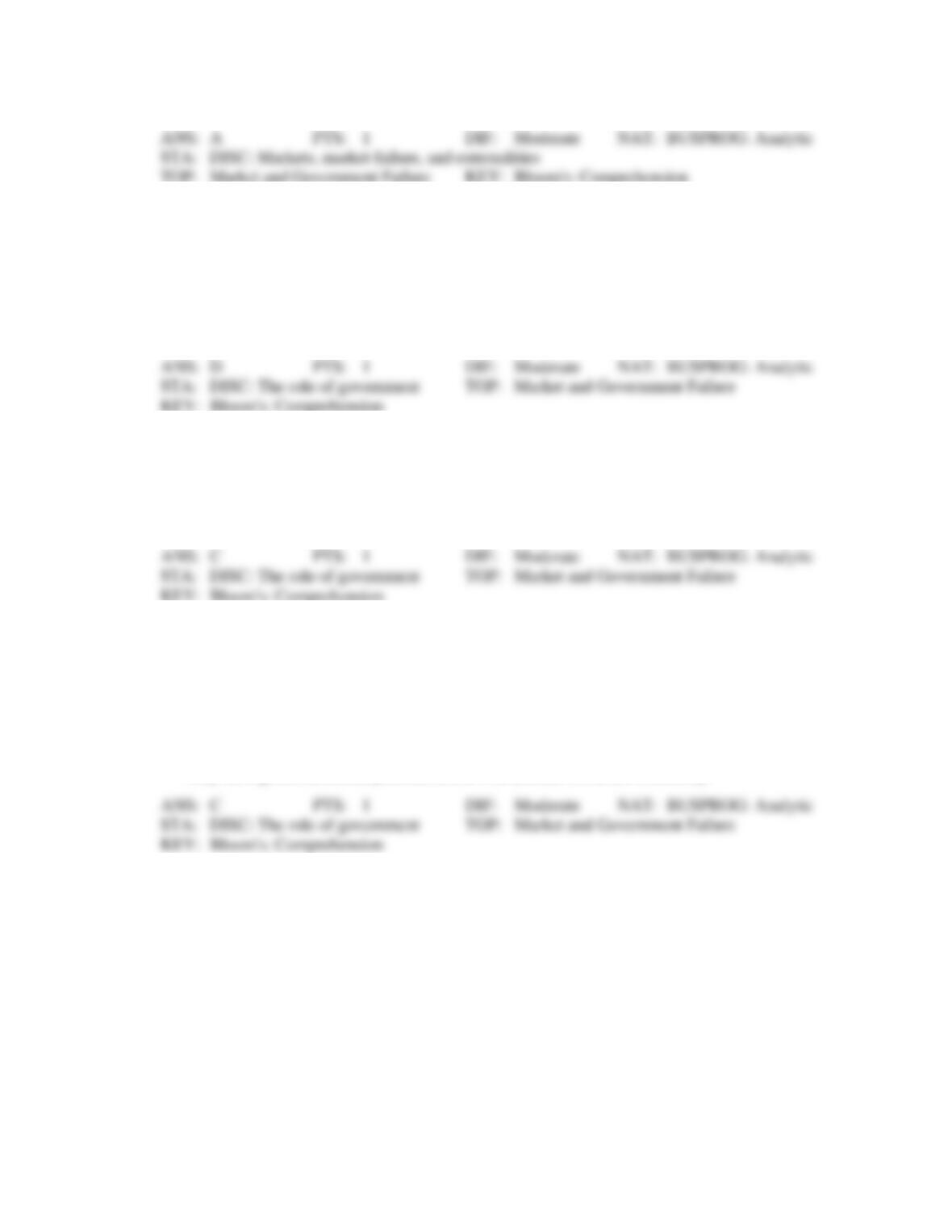
116. In Figure 5-1, S1 and D illustrate the demand and supply for a product if it were produced in a normal
competitive market. Which of the following would be true if the firms in the industry were instead able
to get government licensing restrictions to limit competition in the market?
a.
The restricted market supply would be S3, resulting in a lower price and a higher than
efficient level of output.
b.
The restricted market supply would be S3, resulting in a higher price and a less than
efficient level of output.
c.
The restricted market supply would be S2, resulting in a lower price and a higher than
efficient level of output.
d.
The restricted market supply would be S2, resulting in a higher price and a less than
efficient level of output.
Use the figure below to answer the following question(s).
Figure 5-2
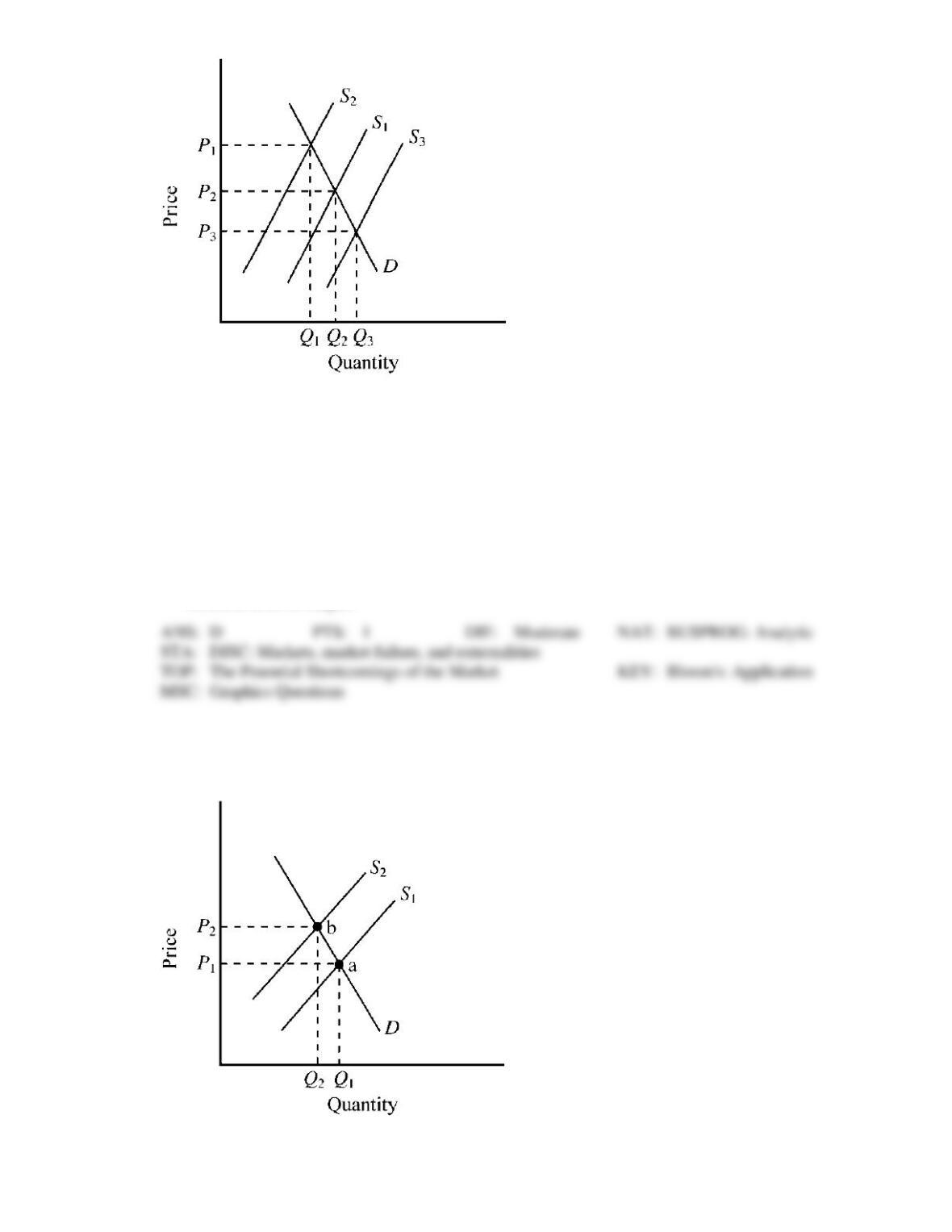
117. Figure 5-2 illustrates the market for a product that generates an external cost. S1 is the private market
supply curve, while S2 is the supply curve including the external cost. Which of the following is true?
a.
Relative to economic efficiency, output of the good will be too large and the price too low.
b.
Relative to economic efficiency, output of the good will be too large and the price too
high.
c.
Relative to economic efficiency, output of the good will be too small and the price too
low.
d.
Relative to economic efficiency, output of the good will be too small and the price too
high.
118. Figure 5-2 illustrates the market for a product that generates an external cost. S1 is the private market
supply curve, while S2 is the supply curve including the external cost. Which of the following is true?
a.
Point a illustrates the competitive private market outcome, while point b illustrates the
outcome consistent with economic efficiency.
b.
Point b illustrates the competitive private market outcome, while point a illustrates the
outcome consistent with economic efficiency.
c.
The competitive private market outcome is consistent with the conditions for economic
efficiency.
d.
The good will tend to be undersupplied relative to the conditions for economic efficiency.
Use the figure below to answer the following question(s).
Figure 5-3
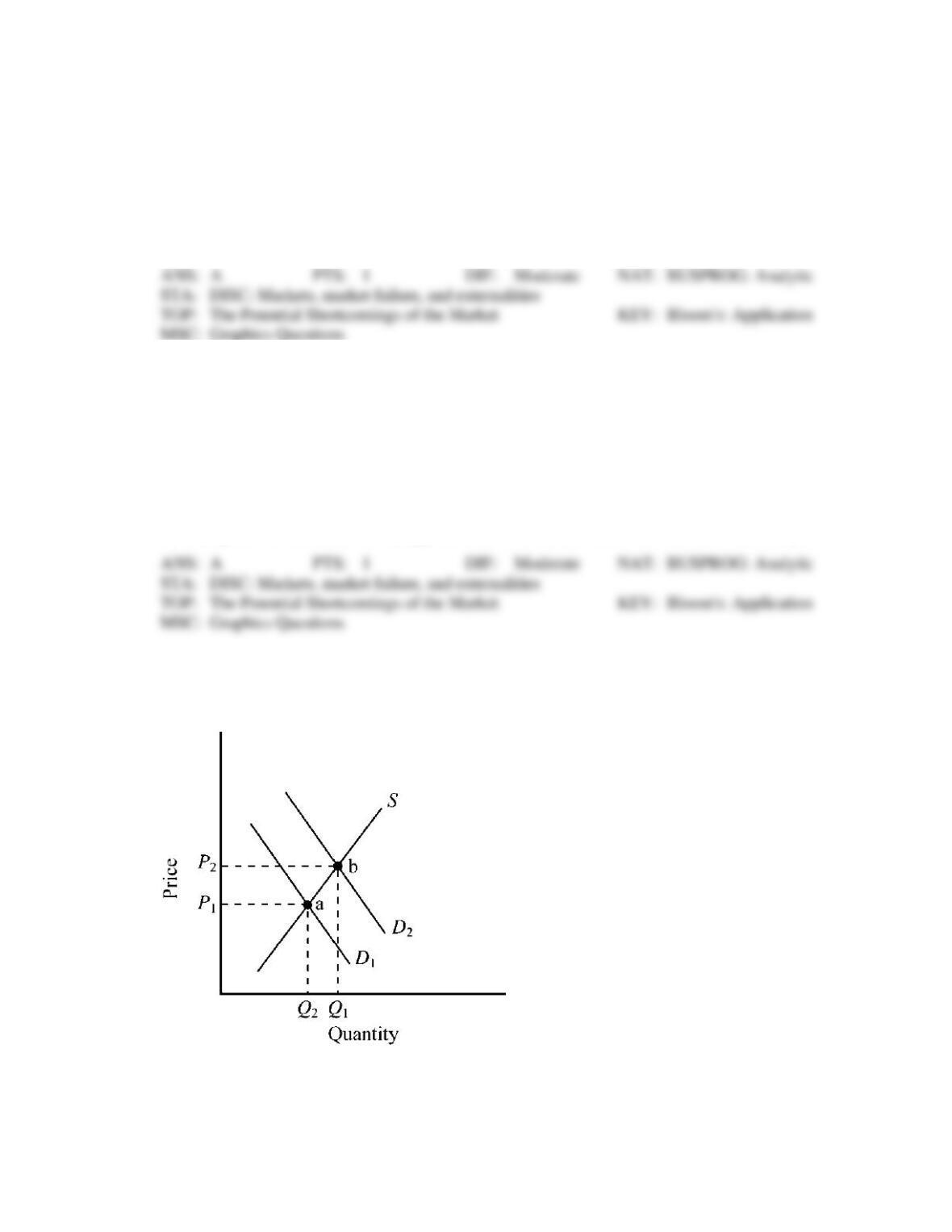
119. Figure 5-3 illustrates the market for a product that generates an external benefit. D1 is the private
market demand curve, while D2 is the demand curve including the external benefit. Which of the
following is true?
a.
Relative to economic efficiency, output of the good will be too large and the price too low.
b.
Relative to economic efficiency, output of the good will be too large and the price too
high.
c.
Relative to economic efficiency, output of the good will be too small and the price too
low.
d.
Relative to economic efficiency, output of the good will be too small and the price too
high.
120. Figure 5-3 illustrates the market for a product that generates an external benefit. D1 is the private
market demand curve, while D2 is the demand curve including the external benefit. Which of the
following is true?
a.
Point a illustrates the competitive private market outcome, while point b illustrates the
outcome consistent with economic efficiency.
b.
Point b illustrates the competitive private market outcome, while point a illustrates the
outcome consistent with economic efficiency.
c.
The competitive private market outcome is consistent with the conditions for economic
efficiency.
d.
The good will tend to be oversupplied relative to the conditions for economic efficiency.
Figure 5-4
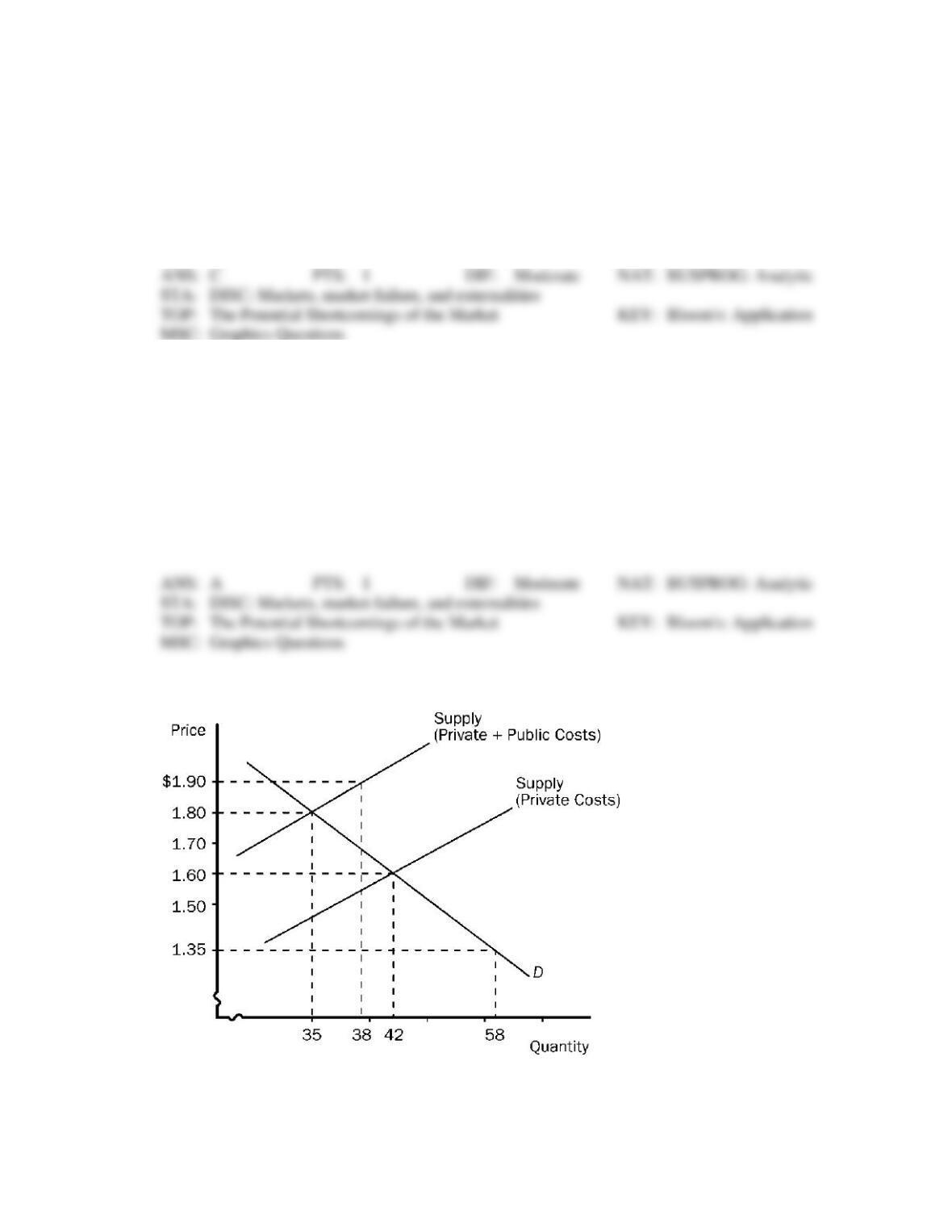
121. Refer to Figure 5-4. The figure illustrates an industry that generates
a.
external benefits.
b.
external costs.
c.
no externalities.
d.
economies of scale.
122. Refer to Figure 5-4. The inefficient equilibrium price and quantity are
a.
$1.90 and 38 units, respectively.
b.
$1.80 and 35 units, respectively.
c.
$1.60 and 42 units, respectively.
d.
$1.35 and 58 units, respectively.
123. Refer to Figure 5-4. The efficient price and quantity are
a.
$1.90 and 38 units, respectively.
b.
$1.80 and 35 units, respectively.
c.
$1.60 and 42 units, respectively.
d.
$1.35 and 58 units, respectively.
124. Refer to Figure 5-4. If the government uses a pollution tax, how much of a tax must be imposed on
each unit of production?
a.
$1.90
b.
$1.80
c.
$1.60
d.
$0.30
125. Which one of the following would reduce the efficiency of the market process?
a.
promoting competitive markets
b.
protecting persons from fraud and theft
c.
providing a stable monetary environment
d.
protecting consumers by imposing legally mandated price ceilings
126. It is difficult for the market process to provide public goods because
a.
private firms generally cannot undertake large-scale projects.
b.
it will be difficult to get potential consumers to pay for such goods because there is not a
direct link between payment for and receipt of the good.
c.
consumers do not really want public goods, even though such goods are best for them.
d.
individuals are generally made worse off by the production of public goods.
127. Which of the following are ways in which the private market provides consumers with valuable
information to help them make better decisions?
a.
brand names
b.
franchising
c.
private sector certification firms and consumer report magazines
d.
all of the above
128. Which of the following are the four major factors that may undermine the ability of the invisible hand
to produce market efficiency?
a.
externalities, private goods, poorly informed buyers or sellers, lack of competition
b.
public goods, externalities, lack of competition, poorly informed buyers or sellers
c.
competition, poorly informed buyers or sellers, externalities, public goods
d.
public goods, lack of competition, well-informed buyers and sellers, externalities
129. Which of the following activities is least likely to give rise to external costs or benefits?
a.
spraying to control mosquitos in your backyard
b.
driving one’s car during rush hour
c.
inoculating your children during a flu epidemic
d.
buying a hamburger and eating it for lunch
130. Driving your automobile in Los Angeles during the rush hour causes externalities because
a.
it adds congestion and pollution from auto exhaust, reducing the welfare of others.
b.
gasoline is scarce and you must pay for it.
c.
gasoline is a public good.
d.
your actions will benefit others even though you will be unable to charge them for the
service.
131. Criteria of ideal economic efficiency requires that (I) all actions generating more social benefit than
cost be undertaken and (II) no actions generating more social cost than social benefit be undertaken.
a.
Both I and II are true.
b.
Both I and II are false.
c.
I is true; II is false.
d.
II is true; I is false.
132. Which of the following “goods” is the best example of a pure public good?
a.
highways
b.
national defense
c.
mail delivery
d.
welfare programs
133. In the absence of government intervention, goods with external costs tend to be
a.
overproduced.
b.
underproduced.
c.
efficiently produced.
d.
offset by goods generating external benefits.
134. The absence of well-defined and enforceable private property rights often
a.
causes people to work together for the common good.
b.
improves society because it avoids the selfish actions of private property owners.
c.
causes difficulties for society due to externalities.
d.
brings about efficiency by providing incentives to conserve resources.
135. The major distinction between private and public goods is that
a.
private goods are goods produced by private firms whereas public goods are goods
produced by government—the public sector.
b.
unlike private goods, public goods are nonexcludable—it is difficult or impossible to
prevent nonpaying customers from receiving the good.
c.
unlike private goods, public goods are nonrival in consumption—the consumption of a unit
by one person does not detract from the amount available to others.
d.
both b and c are correct.
136. New products provide a classic case of the consumer information problem. However, in some cases
consumers partially solve the problem by trusting the “brand name” of the producer of the new
product. Because firms spend millions of dollars advertising and maintaining their brand names, the
likelihood of a “brand name” firm intentionally selling a dangerous or shoddy new product is
a.
high because big firms are always after a quick dollar.
b.
high because their brand name is a communal property right.
c.
low because big firms do not make mistakes.
d.
low because the firm with a brand name has a lot to lose if word spreads about bad
consumer experiences.
137. A public good is defined as a good with which of the following characteristics?
a.
non-rivalry, rivalry
b.
excludability, rivalry
c.
non-rivalry, non-excludability
d.
rivalry, non-excludability
138. Which of the following correctly describes an external benefit resulting from an individual’s purchase
of a winter flu shot?
a.
The flu shot is cheaper than the cost of treatment when you get the flu.
b.
The income of doctors increases when you get the flu shot.
c.
The flu shot reduces the likelihood of others catching the flu.
d.
The flu shot reduces the likelihood you will miss work as the result of sickness; therefore,
you will earn more income.
139. Which of the following would be a protective function of government?
a.
providing national defense
b.
welfare programs and income redistribution
c.
mail delivery
d.
all of the above
140. Consider two goods—one that generates external benefits and another that generates external costs. A
competitive market economy would tend to produce too
a.
much of both goods.
b.
little of both goods.
c.
much of the good that generates external benefits and too little of the good that generates
external cost.
d.
little of the good that generates external benefits and too much of the good that generates
the external cost.
141. Externalities are due to which of the following?
a.
poorly defined or enforced private property rights
b.
individuals not caring sufficiently about the welfare of others
c.
the choice of a capitalist, rather than socialist, economy
d.
poor information on the part of buyers and sellers
142. The problem created when it is difficult to exclude nonpaying customers is called the
a.
consumption-payment link problem.
b.
free-rider problem.
c.
public sector dilemma.
d.
asymmetric information problem.
143. General agreement exists that the legitimate economic functions of government include
a.
protection against invasions from a foreign power.
b.
provision of goods that cannot easily be provided through markets.
c.
the maintenance of a framework of rules within which people can interact peacefully with
one another.
d.
all of the above.
144. Which of the following best explains why making air travel completely safe is not efficient?
a.
After some level of safety is reached, making airplanes even safer is not worth the
opportunity cost that would be incurred.
b.
Because one can’t put a price on human life, airplane safety generally doesn’t matter
economically.
c.
The benefit from additional airplane safety will generally rise as airplanes are made safer,
more than offsetting the opportunity cost involved.
d.
The question is misleading—making airplanes safer is always efficient.
145. The English philosopher John Locke argued that
a.
only when we think about both marginal benefits and marginal costs can we realize there
are alternate ways of pursuing objectives.
b.
there should be a protective function and a productive function of government.
c.
people own themselves as well as the fruits of their labor and thus the role of government
is to protect these natural rights of individuals.
d.
Competition is vital to the proper operation of the pricing mechanism.
146. Which of the following is most consistent with the idea that if it’s worth doing, it’s worth doing
imperfectly?
a.
When Noelle cleaned her apartment, she didn’t clean under the refrigerator.
b.
Nick is so disorganized that he spends 15 minutes every day trying to find his glasses.
c.
The senator stated, “No price is too high to save a life!”
d.
Ford’s new policy is to make every car completely safe.
147. Which of the following would be a protective function of government?
a.
legal enforcement of contracts and rules against fraud
b.
undertaking income redistribution
c.
providing national parks
d.
providing a stable monetary system
148. As more and more resources are dedicated to an activity
a.
the benefits will increase proportionately.
b.
the benefits will become smaller and smaller while the costs will rise.
c.
the demand for that activity will increase.
d.
the costs will be offset by the benefits received from the activity.
149. The standard economists use to assess whether an activity should be undertaken is
a.
majority vote
b.
the marginal benefit assessment.
c.
the gold standard
d.
economic efficiency.
150. Because the benefits derived from an activity decline as it is expanded, it is generally wise to
a.
undertake all actions that generate benefits.
b.
expend the smallest possible amount of resources on this type of activity.
c.
avoid any activity with this characteristic.
d.
stop the activity before perfection is reached..
151. Which of the following is a true statement regarding why the government produces public goods?
a.
Public goods are valued highly by some but not by the majority.
b.
Because of the electoral system, the public sector tends towards producing those goods
that help politicians get elected.
c.
Some goods should be produced whether they are economically efficient or not.
d.
Because it is difficult to exclude those who do not pay for public goods.
152. Suppose that the producers of copper are permitted to emit harmful pollutants, free of charge, into the
air. How will the price and output of copper products in a competitive market compare with their
values under conditions of ideal economic efficiency?
a.
The price will be too high, and the output will be too large.
b.
The price will be too low, and the output will be too large.
c.
The price will be too low, and the output will be too small.
d.
The price will be too high, and the output will be too small.
153. Which of the following provides an example of an externality?
a.
a paper pulp mill releasing pollution into the atmosphere
b.
persons driving during a busy rush hour
c.
a drunk driver operating a car on a public highway
d.
all of the above
154. Which of the following provides the best example of a public good?
a.
elementary and secondary education
b.
residential trash pickups provided by a local government
c.
an unscrambled television signal
d.
the medical services provided by a local hospital
155. Which of the following is true of public goods?
a.
They can only be supplied by the government.
b.
They will tend to be supplied efficiently by the private sector when markets are
competitive.
c.
It is difficult to establish a one-to-one link between payment and receipt of such goods.
d.
From an efficiency standpoint, private markets will tend to supply an excessively large
amount of public goods.
156. Markets provide the efficient amount of a good or service when
a.
externalities are present.
b.
monopoly exists.
c.
public goods are present.
d.
competition is present and externalities and public goods are absent.
157. The “free rider problem” occurs in connection with
a.
private goods.
b.
both public and private goods.
c.
goods that are not scarce.
d.
public goods.
158. If the construction of a new elementary school would create $5 million worth of benefits for citizens
and cost $7 million to construct, then using the criterion of economic efficiency, the school
a.
should be built.
b.
should not be built.
c.
results in a substantial improvement to the welfare of society.
d.
should be built if it passes by a majority vote.
ESSAY
159. National defense is considered a public good because there appears to be no limits to the
nonrivalry-in-consumption characteristic, and exclusion of nonpayers is impossible. Are there any
other goods that so perfectly meet both public goods criteria?
160. After spending $400,000 to build your dream home, you recently discovered that after less than one
year the foundation is cracking. Further investigation reveals that the contractor used substandard
concrete. Is there a role for the public sector in this situation?
161. How does the text define economic efficiency? Is this an absolute or a relative definition? Would
another type of definition be preferable? Why or why not?
162. Sam lives next to The Party Pub and its outdoor “beer garden” that features live music. An economics
major, Sam considers this a positive externality. Dave, another economics student, lives next to The
Party Pub too, but he considers the music a negative externality. Which student, if either, is correct?
Why?
ANS:
163. Is your economics textbook a public or private good? If you conclude that it is a private good, why do
we have copyright laws?
ANS:
164. Is education a public good? Focus on whether it meets the two criteria for being a public good.
165. Why is a stable monetary system essential for the smooth operation of a market system? What would
an unstable monetary system be like? Why isn’t a barter economy just as efficient as an economy with
money?
ANS:
166. A hilly, public golf course is often used by sledders in the winter. One of the sledders was quoted as
saying, “This is public property, so we have just as much a right to be on these hills as anyone else.
Besides, when it snows, golfers can’t use the course anyway. Sledding doesn’t harm anything.” Is he
correct? Why or why not?
167. Anne has just purchased a new house in a lovely neighborhood. Her neighbors are friendly and even
brought her house-warming gifts. Anne, however, has a problem. Her neighbors have cats, and Anne
hates cats. Even though the city has a law requiring all outdoor pets to be on a leash, her neighbors
ignore it, and the cats roam all over Anne’s property. How would an economist describe this situation?
Is there anything Anne can do?
168. Sparkle-Bright toothpaste is a new product that advertises it will give you fresh breath and shiny, white
teeth. You buy a tube for $1.99, and after brushing, you have both bad breath and dull teeth. Is there a
role for the public sector in this situation?
ANS: