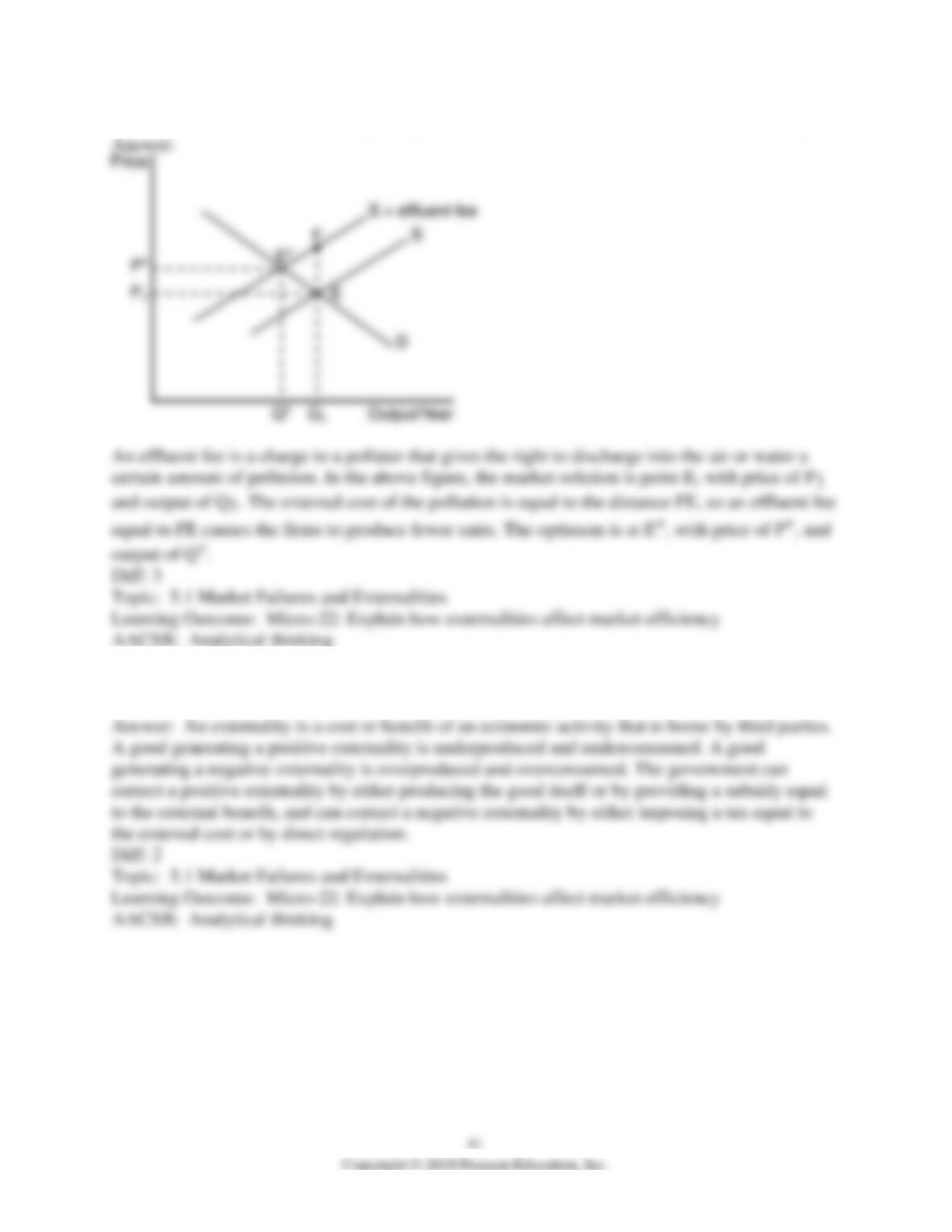
141) What is an effluent fee? Graphically, show how an effluent fee can correct an externality.
142) What is an externality? How do positive and negative externalities differ in their effects?
How can government action correct positive and negative externalities?
143) Explain why an external cost leads to an over-allocation of resources to the production of a
good.
144) Explain why an external benefit leads to an under-allocation of resources to the production
of a good.
145) What is the consequence of a positive externality in a market? What is the consequence of a
negative externality? Why those consequences occur?
5.2 The Other Economic Functions of Government
1) The economic functions of government differ from the political functions of government in
that
A) the economic functions are carried out by the federal government, while the political
functions are carried out by state and local governments.
B) the economic functions include policies that affect income redistribution, while the political
functions involve things that affect the way exchange is carried out.
C) the economic functions involve things that affect the way exchange is carried out while the
political functions include policies that affect income redistribution.
D) the economic functions are carried out by state and local governments, while the political
functions are carried out by the federal government.
2) Public goods are
A) rival and exclusive.
B) rival, but not exclusive.
C) exclusive, but not rival.
D) neither exclusive nor rival.
3) In the United States, which of the following is NOT a generally accepted economic function
of government?
A) providing public goods
B) distributing consumer goods
C) ensuring economy-wide stability
D) promoting competition in the marketplace
4) The economic role of the legal system might best be described as
A) promoting the productive efficiency of competitive markets.
B) identifying and producing public goods.
C) establishing the “rules of the game” and acting as a referee when disputes arise among market
participants.
D) identifying and producing merit goods.
5) Which of the following is NOT an economic function of the U.S. government?
A) promoting competition
B) providing public goods
C) promoting price stability
D) encouraging production of government-inhibited goods
6) Which of the following is NOT an economic function of government?
A) providing a legal system
B) ensuring economic stability
C) providing government-inhibited goods
D) promoting competition
7) Which of the following statements is TRUE?
A) Government spending as a percent of total national income has continuously decreased since
the 1950s.
B) Transfer payments are money payments made by the government for which no goods or
services are currently received.
C) Education is the largest category of federal government expenditures.
D) Transfers in kind include Welfare, Social Security, and unemployment insurance benefits.
8) In the United States, the idea that the federal government should undertake actions to stabilize
business activity
A) was established in the Declaration of Independence.
B) is a relatively new idea that developed in the years during and after the Great Depression.
C) has been around since the early 1700s.
D) developed during World War I.
9) The legal system in the United States tends
A) to support monopolies.
B) to actively discourage unionization.
C) to discourage the entry of new firms into industries.
D) to promote competition.
10) The U.S. legal system mainly engages in activities that
A) are dedicated to producing private goods.
B) focus on income redistribution.
C) involve defining and protecting property rights.
D) focus on producing public goods.
11) Federal antitrust laws in the United States are intended to
A) promote competition by prohibiting monopolies.
B) promote income equality.
C) create new monopolies.
D) create only government-owned organizations.
12) To protect the competitive economic system by restricting the formation of monopolies, the
government has passed and enforced
A) rationing systems.
B) antitrust laws.
C) the imposition of taxes on certain goods.
D) zoning laws.
13) Federal antitrust laws in the United States are enforced
A) solely by the Federal Trade Commission.
B) solely by the Department of Justice.
C) by the Department of Justice and by the Federal Trade Commission.
D) by the Department of Commerce.
14) Which of the following does NOT describe the intended purpose of the antitrust laws of the
United States?
A) to promote competition within the economic system
B) to reduce the power of monopolies
C) to prohibit certain economic activities that promote trade
D) to restrict the formation of monopolies
15) U.S. antitrust laws view monopolies as undesirable because
A) monopolies restrain trade and promote inefficiencies.
B) monopolies create inferior products.
C) monopolies produce only capital goods.
D) monopolies produce only cheap, low quality goods.
16) The purpose of antitrust legislation is
A) to reduce unemployment.
B) to reduce the power of monopoly.
C) to increase the power of monopoly.
D) to maximize employment for a given price level.
17) A firm that has a great deal of control over the price of a good is said
A) to function in a black market.
B) to create an externality.
C) to have monopoly power.
D) to be in an antitrust position.
18) Which one of the following is NOT a characteristic of public goods?
A) They are indivisible.
B) It is difficult to charge people on the basis of how much they use.
C) Public goods can be used by increasing numbers of people at no additional cost.
D) Public goods are subject to the principle of rival consumption.
19) When a Canadian citizen enjoys military protection in Canada without contributing to the
cost of Canada’s defense budget, then
A) this Canadian citizen is a free rider.
B) Canada is a free rider.
C) this citizen receives no benefits if Canada is attacked.
D) Canada’s defense budget will run out of funds.
20) Which of the following is an example of the free-rider problem?
A) a neighbor who refuses to help pay for a street light that is intended to help reduce crime
B) a student who refuses to buy a college catalog
C) a law enforcement officer who receives a uniform from the police department
D) a fast food employee who is provided food at work
21) Public goods are
A) any goods or services produced by the government.
B) provided to additional users at no additional cost.
C) provided only by the capitalistic system.
D) provided only by the communist system.
22) The principal feature of private goods is that
A) they cannot be rented or purchased.
B) consumption by one person reduces the quantity available to others.
C) no one can be excluded from consumption of the product.
D) externality problems associated with their production are always negative.
23) One characteristic of a public good is that it
A) is available for consumption by only a few individuals at any particular time.
B) always eliminates the free-rider problem.
C) can be consumed simultaneously by many individuals.
D) can be easily subdivided into small units.
24) Which of the following would be best classified as a private good?
A) a missile defense system
B) police force
C) radio frequency
D) clothing
25) Public goods are unlikely to be provided by the private sector because
A) the production of the good creates negative externalities.
B) no one can be excluded from the consumption of the good.
C) the consumption of the good creates negative externalities.
D) the exclusion principle does not apply to public goods.
26) The free-rider problem is encountered when
A) someone benefits from the consumption of a public good without paying his or her full share.
B) all individuals who consume a public good pay for it.
C) all goods consumed and produced are private goods.
D) all individuals are willing to pay for what they consume.
27) In the absence of government
A) public goods are likely to be overprovided.
B) market failure is less likely to occur.
C) public goods are likely to be underprovided.
D) the free-rider problem is more likely to occur.
28) The opportunity cost of providing a public good to an additional individual is
A) infinite.
B) zero.
C) impossible to determine.
D) high because of the exclusion principle.
29) Private goods are those goods
A) that violate the principle of rival consumption.
B) for which no public market exists.
C) that can only be consumed by one individual at a time.
D) to which the non-exclusion principle applies.
30) Which of the following goods is NOT subject to the free-rider problem?
A) a public park
B) the local police force
C) public fireworks
D) a mass transit system
31) The distinguishing characteristic of private goods is that
A) the principle of rival consumption does not apply to them.
B) their use is exclusive to the people who purchase them.
C) they can be sold but not rented.
D) they can be sold or rented, but not borrowed.
32) A fundamental aspect of public goods is that they
A) are just like private goods EXCEPT that everybody wants to consume the same amount.
B) have positive externalities.
C) are characterized by the principle of rival consumption.
D) can be consumed jointly by many people simultaneously.
33) Which of the following is an example of a public good?
A) Amtrak rail transport services
B) services of the U.S. Post Office
C) the provision of medical care
D) the provision of national defense
34) Public goods are characterized by the free-rider problem because
A) no one can be excluded from the benefits of public goods once they are produced.
B) public goods are usually things that people really do not want to consume.
C) public goods are characterized by the principle of rival consumption.
D) public goods can easily be subdivided into small units.
35) Which of the following types of goods is subject to the free-rider problem?
A) a private good
B) a public good
C) a product that creates a positive externality
D) a product that creates a negative externality
36) Which of the following is best characterized as a public good?
A) a public library
B) a church
C) primary education
D) police protection
37) Public goods are basically
A) rival in consumption.
B) nonrival in consumption.
C) depletable in consumption.
D) nondepletable in consumption.
38) Which event was most important in promoting the belief that the U.S. government should
work to ensure economy-wide stability?
A) World War II
B) the Civil Rights Movement
C) the California Gold Rush
D) the Great Depression
39) What are the three goals of the Employment Act of 1946?
A) keep the peace, improve public education, and protect the environment
B) improve the education system, provide more job training, and expand the number of
government jobs
C) full employment, price stability, and economic growth
D) full employment, better schools, and lower income taxes
40) The Employment Act of 1946 reflects which one of the following functions of government?
A) providing a legal system
B) improving economy-wide stabilization
C) correcting externalities
D) providing public goods
41) Which law specifically mandated the federal government’s responsibility for economy-wide
stability?
A) the Employment Act of 1946
B) the Sherman Act of 1890
C) the Glass-Steagall Act of 1933
D) the Volcker Act of 1960
42) The economic functions of government include
A) determining prices.
B) setting wages in the public sector.
C) protecting property rights.
D) welfare.
43) All of the following are economic functions of the government EXCEPT
A) providing a legal system.
B) determining the wage rate for most jobs.
C) promoting competition in the market.
D) providing public goods.
44) The economic functions of the government deal with
A) discouraging smoking in youths.
B) making sure supply equal demand.
C) promoting economic efficiency.
D) excess demand.
45) Providing public goods is a(n)
A) economic function of government.
B) political function of government.
C) economic and political function of government.
D) price system function.
46) The political functions of government differ from the economic functions of government in
that
A) the political functions relate to income distribution while the economic functions relate to the
way exchange is carried out.
B) the political functions are performed at the federal government while the economic functions
are at the state and local government levels.
C) the political functions involve elections and the court systems while the economic functions
involve taxation and transfers.
D) the President deals with the economic functions while Congress deals with the political
functions.
47) The difference between the economic and political functions of government is that
A) the economic function is concerned with the Federal Taxation system while the political
function is not.
B) the economic function is concerned with correcting for market failures while the political
function is not.
C) the economic function is concerned with the reallocation of income while the political
function is not.
D) the economic function encourages merit goods while the political function discourages
demerit goods.
48) The provision of a legal system is an important economic function of the government
because
A) lawyers and judges tend to be high-income people.
B) people need to feel safe when they go to work.
C) the legal system affects how exchange takes place through its enforcement of contracts.
D) the legal system affects the distribution of income through its awarding of damages in
accident claims.
49) Which of the following legal subjects is most concerned with the economic function of the
legal system?
A) criminal law
B) public goods
C) antitrust legislation
D) civil rights
50) The government tries to protect the competitive economic system by passing and enforcing
A) price controls.
B) tariff legislation.
C) antitrust laws.
D) building codes and zoning laws.
51) A government agency charged with enforcing antitrust laws is
A) the Federal Reserve Board.
B) the National Labor Relations Board.
C) the Council of Economic Advisors.
D) the Federal Trade Commission.
52) Private goods are goods
A) that carry a price.
B) for which price is greater than zero.
C) for which the more one person has the less is available for someone else.
D) that are produced by the government.
53) All of the following are characteristics of public goods EXCEPT
A) public goods can be used by more people at no additional cost.
B) the good can be consumed by everyone at the same time without reducing what is available
for anyone else.
C) the exclusion principle.
D) the goods are perfectly divisible.
54) Public goods are desired because
A) people want and value them but the private sector will not make them available.
B) we want the government to spend our tax dollars.
C) they came in small units.
D) they make supply equal to demand for private goods.
55) An example of a public good is
A) software produced by Microsoft.
B) housing subsidies.
C) the car I own.
D) the fire department.
56) The distinguishing characteristic of a public good is
A) noncompetitive production.
B) durability.
C) exclusivity.
D) nonrival consumption.
57) Which of the following statements is TRUE about the difference between a public and
private good?
A) Both public and private goods are owned by individuals but public goods can be shared while
private goods cannot be shared.
B) The government produces private goods while corporations produce public goods.
C) Consumption of a private good by one person reduces the amount available for others while
the consumption of a public good does not reduce the amount available for others.
D) Resources are used to produce private goods but are not used to produce public goods.
58) The difference between a private good and a public good is that
A) private goods are government-sponsored goods while public goods are government-inhibited
goods.
B) externalities are always created in the production process but not in the production of public
goods.
C) private goods make us happy while public goods do not.
D) the exclusion principle applies to a private good but not to a public good.
59) Which of the following is an example of a public good?
A) flood control
B) post office
C) health care
D) welfare
60) A lighthouse that serves a dangerous coastal area is built. The lighthouse cost $1 million to
build and serves 100 ships a month. If the shipping in the area increases so that 200 ships pass by
a month, the increase in additional costs of providing the light to these new ships is
A) $1 million.
B) $100,000.
C) $5,000.
D) $0.
61) A free rider is someone who
A) hops on the bus without paying the correct bus fare.
B) enjoys the trees I have planted and does not compensate me for them.
C) creates a negative externality.
D) buys a ticket for a movie.
62) The free-rider problem is
A) the use of private goods in one state by residents of another state.
B) the incentive that people have to avoid paying for a public good.
C) the incentive that people have once they are receiving welfare to keep getting welfare.
D) that people cannot be forced to accept public goods.
63) In the spring, I enjoy the fragrance coming from my neighbors’ flowers. The fragrance is is
an example of
A) a negative externality.
B) a private good.
C) the need for antitrust legislation.
D) a free rider problem.