20) Refer to Figure 5-3. With insurance and a third-party payer system, what price do doctors receive for
medical services?
A) $40
B) $55
C) $65
D) > $65
21) Refer to Figure 5-3. With insurance and a third-party payer system, what price do consumers pay for
medical services?
A) $40
B) $55
C) $65
D) > $65
22) Refer to Figure 5-3. With insurance and a third-party payer system, the equilibrium quantity of
medical services is
A) 400.
B) 800.
C) 1,200.
D) > 1,200.
23) Refer to Figure 5-3. The efficient price of medical services is
A) $40.
B) $55.
C) $65.
D) > $65.
24) Refer to Figure 5-3. The efficient quantity of medical services is
A) 400.
B) 800.
C) 1,200.
D) > 1,200.
25) Refer to Figure 5-3. With insurance and a third-party payer system, what is the amount of the
deadweight loss?
A) $0
B) $2,500
C) $5,000
D) $24,000
26) If an employee receives health insurance through his or her employer, the employer
A) still withholds contributions for Medicare and Medicaid from the employee’s paycheck.
B) still withholds contributions for Medicare, but not Medicaid, from the employee’s paycheck.
C) still withholds contributions for Medicaid, but not Medicare, from the employee’s paycheck.
D) is no longer required to withhold contributions for Medicare or Medicaid from the employee’s
paycheck.
27) Which of the following is not part of the “individual mandate” provision of the Patient Protection
and Affordable Care Act (ACA)?
A) Individuals are allowed to opt out of the insurance program if they can prove they have no serious
health issues.
B) In 2016, fines for not having health insurance are the greater of $695 per person or 2.5 percent of
income.
C) Individuals who do not acquire health insurance will be subject to a fine.
D) With limited exceptions, every resident of the United States is required to have health insurance that
meets certain basic requirements.
28) The provision of the Patient Protection and Affordable Care Act (ACA) which states that, with
limited exceptions, every resident of the United States must have health insurance that meets certain
basic requirements is the ________ provision.
A) employer mandate
B) state health insurance marketplaces
C) individual mandate
D) regulation of health insurance
29) Which of the following is not part of the “state health insurance marketplaces” provision of the
Patient Protection and Affordable Care Act (ACA)?
A) Each state is required to establish an Affordable Insurance Exchange.
B) Small businesses with fewer than 50 employees are exempt from being required to participate in the
program.
C) Low-income individuals are eligible for tax credits to offset the costs of buying health insurance.
D) None of the above are a part of the “state health insurance marketplaces” provision.
30) The provision of the Patient Protection and Affordable Care Act (ACA) which states that every firm
with more than 200 full-time employees must offer health insurance to its employees and must
automatically enroll them in the plan is the ________ provision.
A) employer mandate
B) state health insurance marketplaces
C) individual mandate
D) regulation of health insurance
31) Which of the following is not part of the “regulation of health insurance” provision of the Patient
Protection and Affordable Care Act (ACA)?
A) Individuals with pre-existing medical conditions are able to acquire health insurance.
B) All policies must provide coverage for dependant children up to age 26.
C) Lifetime dollar maximums on coverage are prohibited.
D) Limits on the size of deductibles and on waiting periods before coverage takes effect have been
eliminated.
32) The provision of the Patient Protection and Affordable Care Act (ACA) which states that insurance
companies are required to participate in a high-risk pool that will insure individuals with pre-existing
medical conditions who have been unable to buy health insurance for at least six months is the ________
provision.
A) employer mandate
B) state health insurance marketplaces
C) individual mandate
D) regulation of health insurance
33) Which of the following is not part of the “taxes” provision of the Patient Protection and Affordable
Care Act (ACA)?
A) Pharmaceutical firms and health insurance firms pay new taxes.
B) Investors earning more than $200,000 pay a new tax on their investment income.
C) Beginning in 2018, all taxes on employer-provided health insurance plans will be reduced or
eliminated.
D) Workers earning more than $200,000 pay higher Medicare payroll taxes.
34) The Congressional Budget Office estimates that the Patient Protection and Affordable Care Act
(ACA) will increase government spending
A) by about $2 trillion over 10 years.
B) by more than the additional taxes and fees enacted under the law will bring in.
C) by less than $50 billion over the next decade.
D) by more than $20 trillion dollars over the next 5 years.
35) The Patient Protection and Affordable Care Act (ACA) is scheduled ________, at which point more
than 30 million additional individuals are expected to have health care coverage.
A) to be phased in over the next 20 years
B) to be fully implemented by 2019
C) to be phased out by 2015
D) to be completely in place in 2016
36) Some economists and policymakers who are in favor of government-provided health care believe
that providing health care will
A) generate additional moral hazard.
B) create negative externalities.
C) reduce asymmetric information.
D) generate more adverse selection.
37) Economists who support market-based reforms for health care believe that increased competition
among providers of health care would
A) decrease costs but decrease economic efficiency.
B) decrease costs and increase economic efficiency.
C) increase costs but increase economic efficiency.
D) increase costs and decrease economic efficiency.
38) Lower deductibles for employer-provided health care will tend to shift the ________ curve for
medical services to the ________.
A) demand; left
B) demand; right
C) supply; left
D) supply; right
39) A decrease in the availability of lower-cost drugs will tend to shift the ________ curve for medical
services to the ________.
A) demand; left
B) demand; right
C) supply; left
D) supply; right
40) A goal of ________ is to give patients an incentive to pay more attention to the prices of medical
services. This would tend to increase economic efficiency by decreasing the costs of medical services.
A) the Patient Protection and Affordable Care Act (ACA)
B) market-based reforms of the health care system
C) government-provided health care
D) socialized medicine
41) Most employees ________ on the value of health insurance provided by employers, and most people
________ when buying individual health insurance policies.
A) pay taxes; get a tax break
B) pay taxes; do not get a tax break
C) do not pay taxes; get a tax break
D) do not pay taxes; do not get a tax break
42) About ________ of pharmaceutical patents are issued to U.S. firms.
A) 10 percent
B) one-half
C) two-thirds
D) 90 percent
43) About ________ of research on new medicines is carried out in the United States.
A) 10 percent
B) one-half
C) two-thirds
D) 90 percent
44) Economists John Cogan, Glenn Hubbard, and Daniel Kessler have estimated that ________ the tax
preference for employer-provided health insurance would reduce spending by people enrolled in these
programs by 33 percent.
A) enacting
B) doubling
C) cutting in half
D) repealing
45) The individual mandate provision of the ACA requires
A) every U.S. resident to have health insurance.
B) every U.S. company to provide health insurance to its employees.
C) every employed person to pay for his or her own health insurance.
D) every private insurance company to provide free health care to its current policy holders.
46) Replacing employment-based health care with a government-run system could reduce employers
payments for their workers insurance, but the amount that they would have to pay in overall
compensation
A) would remain essentially unchanged.
B) would dramatically increase.
C) would fall to zero.
D) would dramatically decrease.
Article Summary
The Center for Medicare and Medicaid Services (CMS) projects that between 2014 and 2022, over $2.7
trillion will be spent for private insurance overhead and administering government health programs,
including more than $270 billion in new administrative costs for the Affordable Care Act, which
averages to $1,375 per newly insured person every year, or almost one-quarter of the total federal
government expenditures for the program. Government programs account for over $100 billion of the
increase in overhead, and most of that will go to private Medicaid HMOs, which will account for 59
percent of total Medicaid administrative costs in 2022.
Source: David Himmelstein and Steffie Woolhandler, “ The Post-Launch Problem: The Affordable
Care Act’s Persistently High Administrative Costs,” healthaffairs.org, May 27, 2015.
47) Refer to the Article Summary. The article discusses the rising administrative costs of health care.
Even if private insurance companies were more efficient and brought administrative costs down,
consumers would ________ the full cost of medical treatment. This would result in the market
equilibrium price and quantity of medical services being ________ than the efficient equilibrium price
and quantity.
A) pay less than; less than
B) pay more than; less than
C) pay more than; more than
D) pay less than; more than
48) The rising cost of uninsured patients receiving treatment at hospital emergency rooms is one of the
leading causes of the increase in health care spending as a percentage of GDP in the United States.
49) “Cost disease” refers to the tendency for high productivity in the service sector to lead to lower costs
in those industries.
50) Under the Patient Protection and Affordable Care Act (ACA), individuals who do not have health
insurance will be subject to a fine.
51) Under the Patient Protection and Affordable Care Act (ACA), every company with more than 200
employees must offer health insurance to its employees and must automatically enroll them in the plan.
52) Those who favor changes in the market for health care that would make it more like the markets for
other goods and services favor what are generally known as market-based reforms.
53) In most circumstances, employees pay taxes on the value of health insurance their employers
provide them.
54) If consumers paid the full price of medical services instead of using health insurance and third-party
payers to cover part of the cost, the quantity of medical services provided would decrease.
55) The Congressional Budget Office estimates that the additional taxes and fees enacted under the
ACA will not even cover half of the true cost of the ACA.
56) In the United States, health care spending as a percentage of GDP has declined since 1965.
57) As a percentage of GDP, health care spending on Medicare and Medicaid is expected to double over
the next 40 years unless health care costs begin to grow at a slower rate.
58) In what ways do economists and policymakers who believe that the federal government should
have a larger role in the health care system criticize the Patient Protection and Affordable Care Act
(ACA)?
59) In what ways do economists and policymakers who believe that market-based reforms are the key
to improving the health care system criticize the Patient Protection and Affordable Care Act (ACA)?
60) What are two reasons why employees would prefer for their employer to pay for their health
insurance rather than receiving increased wages and paying for their own health insurance?
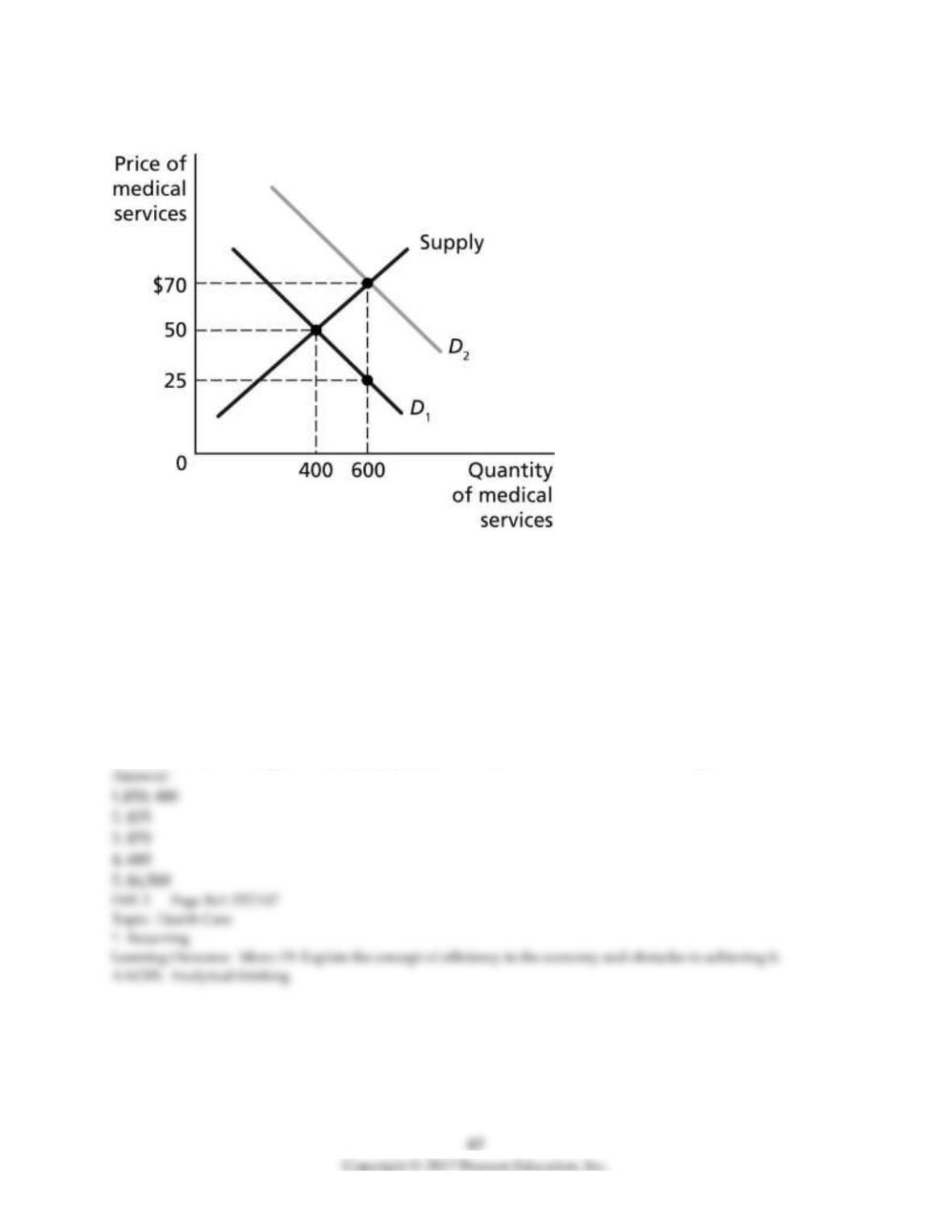
Figure 5-4
Figure 5-4 represents the supply and demand for medical services with and without a third-party payer.
61) Refer to Figure 5-4. Answer the following questions:
1. What would be the equilibrium price and quantity if consumers had to pay the full price of medical
services?
2. With insurance acting as a third-party payer, what price will consumers pay for medical service?
3. With insurance acting as a third-party payer, what price will doctors receive for medical service?
4. With insurance acting as a third-party payer, what will be the equilibrium quantity of medical
services?
5. With insurance acting as a third-party payer, what will be the value of the deadweight loss?