10) Jason hires Maria to tutor him in economics. Jason is willing to pay $30 for the first hour of
tutoring, $25 for the second, $20 for the third, $15 for the fourth, and $10 for the fifth. Maria has
an opportunity cost per hour of $6 for the first, $9 for the second, $12 for the third, $15 for the
fourth, and $18 for the fifth. What will be the equilibrium quantity of hours tutored and the
equilibrium price? Explain why this quantity and price is the equilibrium. What is Jason’s
consumer surplus and what is Maria’s producer surplus?
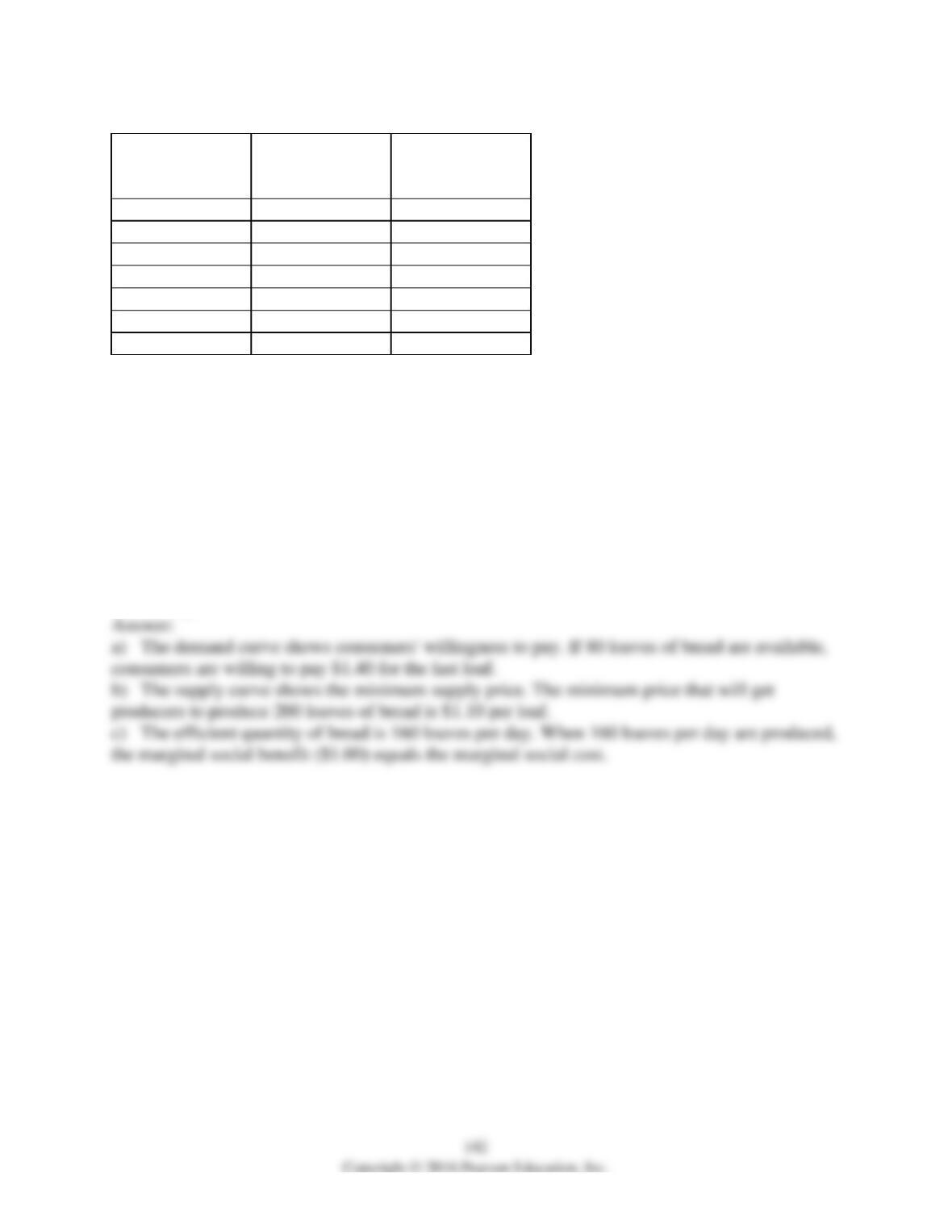
Price
(dollars per loaf)
Quantity
demanded
(loaves per day)
Quantity supplied
(loaves per day)
0.60
240
0
0.80
200
80
1.00
160
160
1.20
120
240
1.40
80
320
1.60
40
400
1.80
0
480
11) The table above gives the demand and supply schedules for bread. Assume that the only
people who benefit from bread are the people who consume it and the only people who bear the
cost of bread are the people who produce it.
a) What is the maximum price that consumers are willing to pay for the 80th loaf of bread?
b) What is the minimum price that producers are willing to accept to produce 200 loaves of
bread?
c) What is the efficient quantity of bread?
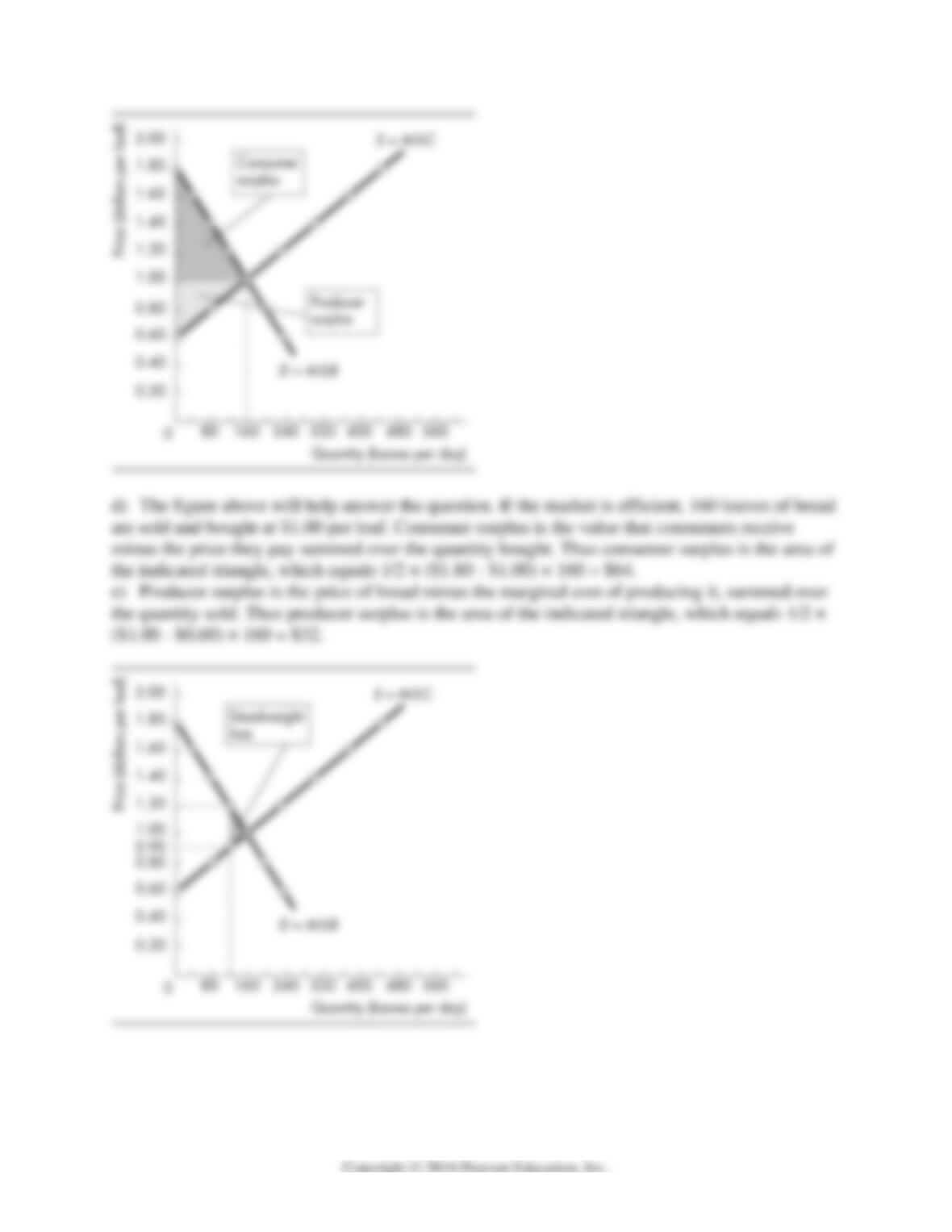
d) If the market is efficient, what is the consumer surplus?
e) If the market is efficient, what is the producer surplus?
f) If one firm owns all the bread outlets and sells 120 loaves per day, what is the deadweight
loss (if any)?
143
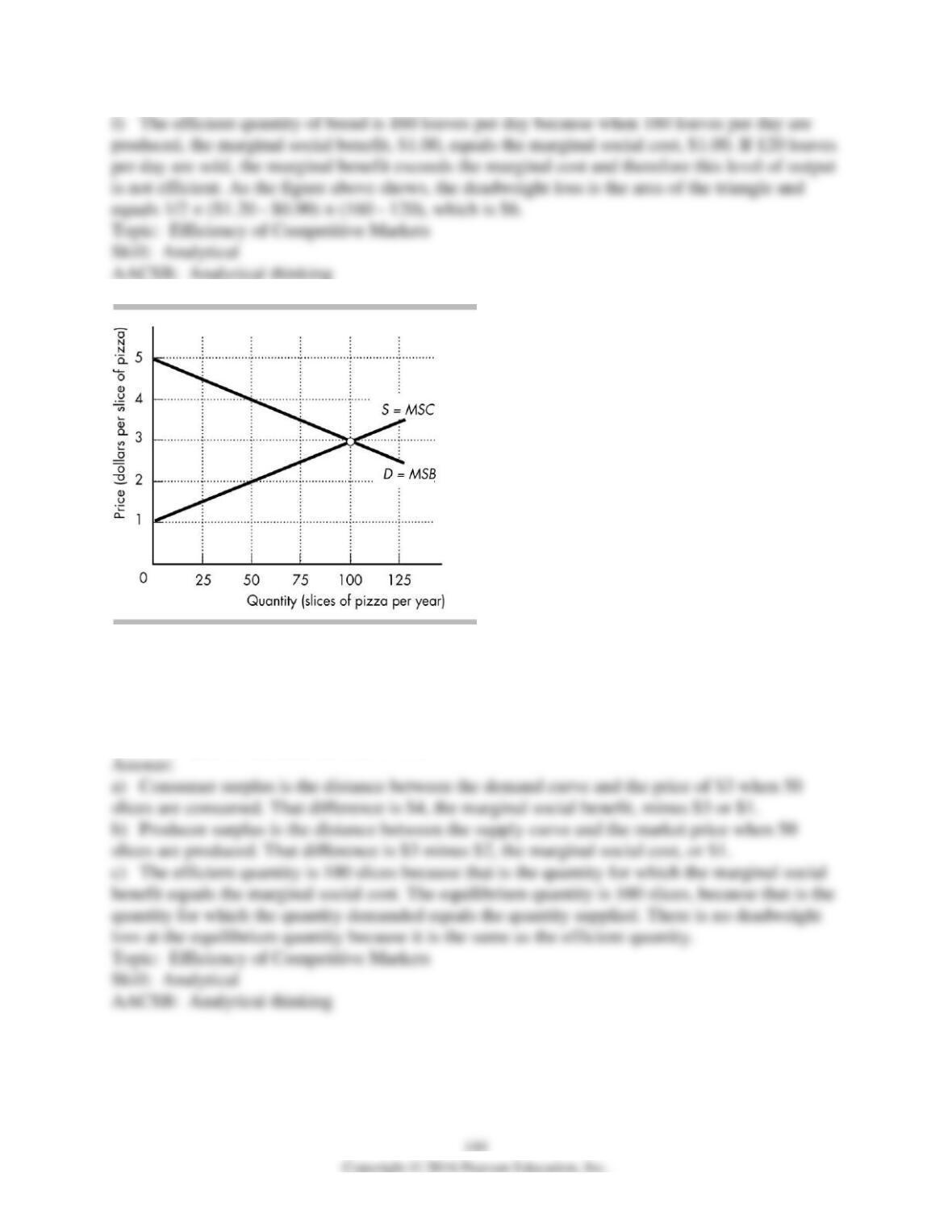
12) The figure above shows the market for pizza.
a) If the price of a slice of pizza is $3, what is the consumer surplus of the 50th slice?
b) If the price of a slice of pizza is $3, what is the producer surplus of the 50th slice?
c) What is the efficient quantity? What is the equilibrium quantity? What is the deadweight loss
when the equilibrium quantity is produced?
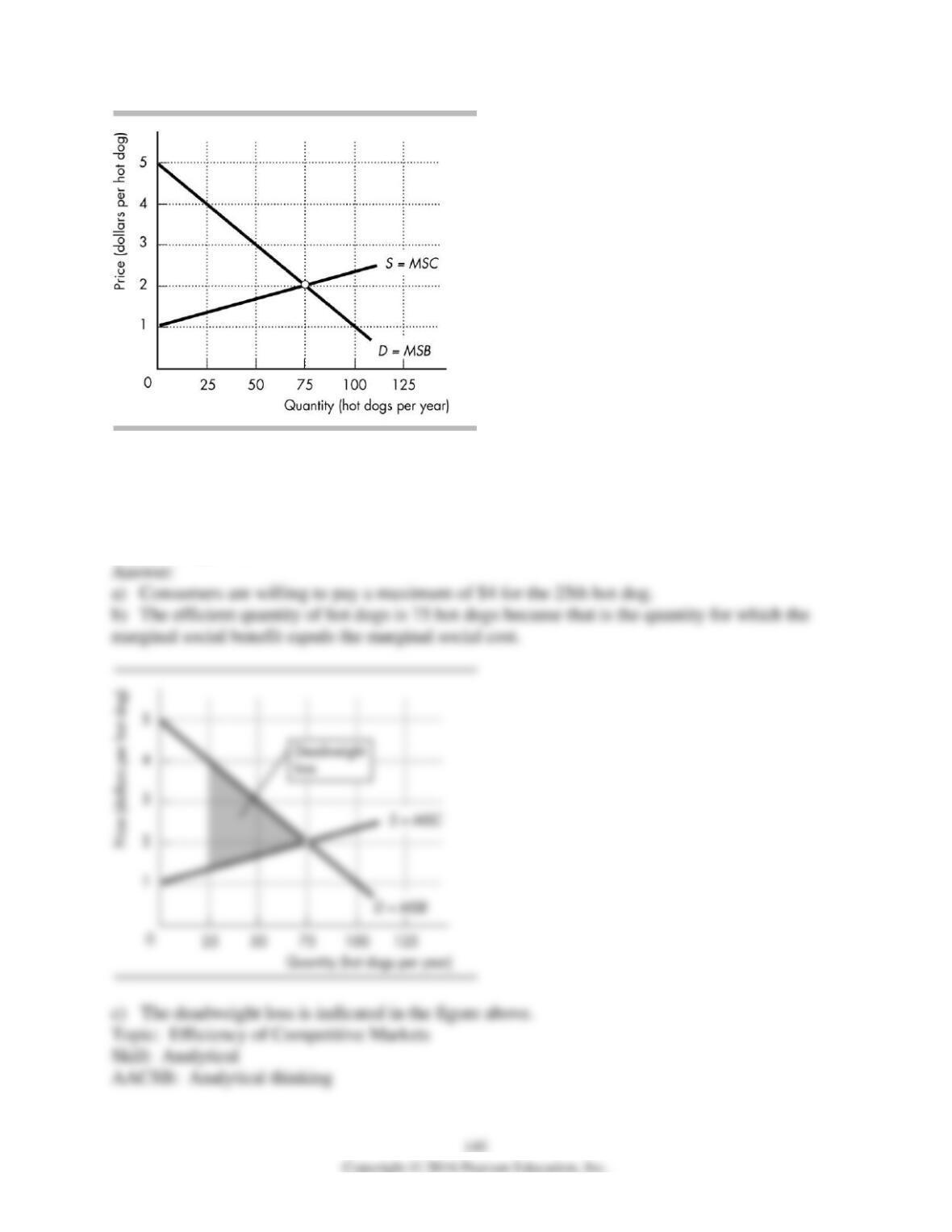
13) The figure above shows the market for hot dogs.
a) What is the maximum price consumers are willing to pay for the 25th hot dog?
b) What is the efficient quantity?
c) Suppose that the production was limited to 25 hot dogs. In the figure, indicate the amount of
the deadweight loss.
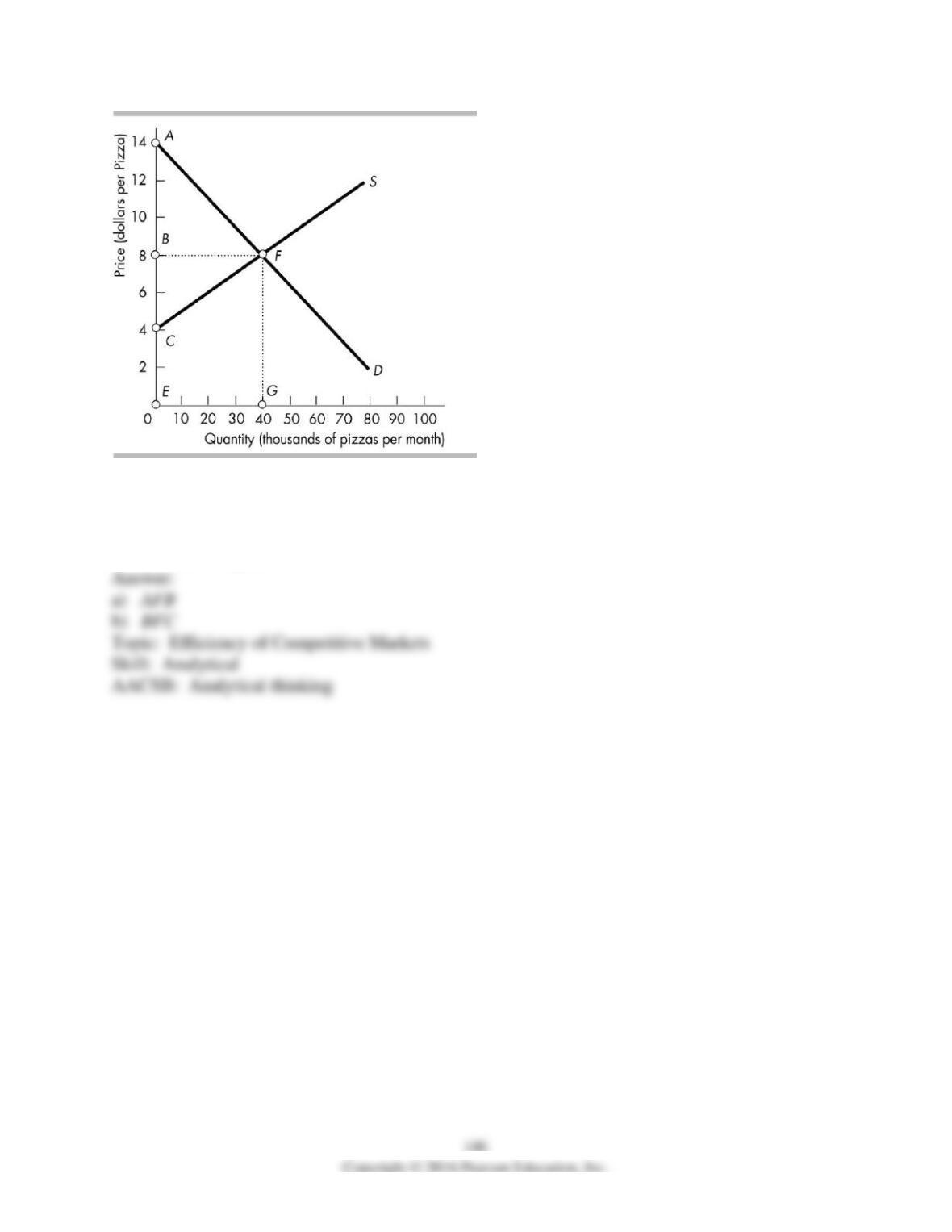
14) The figure above shows the market supply and market demand curves for pizza. If the
market is at its equilibrium, what area in the graph above represents:
a) consumer surplus?
b) producer surplus?
15) Jason wants to hire Maria to tutor him in economics. Jason is willing to pay $30 for the first
hour of tutoring, $25 for the second, $20 for the third, $15 for the fourth, and $10 for the fifth.
Maria has an opportunity cost per hour of $6 for the first, $9 for the second, $12 for the third,
$15 for the fourth, and $18 for the fifth. The initial equilibrium price for tutoring is $15 an hour
and hence Maria tutors Jason for 4 hours. Now, Maria realizes that she is the only economics
tutor because all the other tutors have graduated. Because she is the only tutor, she has a
monopoly and, as a monopolist, Maria decides to charge a price of $25 instead of $15 an hour.
a) At the price of $25 an hour, how many hours will Maria tutor Jason?
b) At the initial equilibrium price of $15 an hour, what was Jason’s total consumer surplus and
Maria’s total producer surplus?
c) At the price of $25 an hour, what is Jason’s total consumer surplus and Maria’s total producer
surplus?
d) How does the sum of Jason’s consumer surplus plus Maria’s producer surplus compare at the
initial equilibrium price of $15 an hour (part b) and at the new price of $25 an hour (part c)?
Comment on any difference.
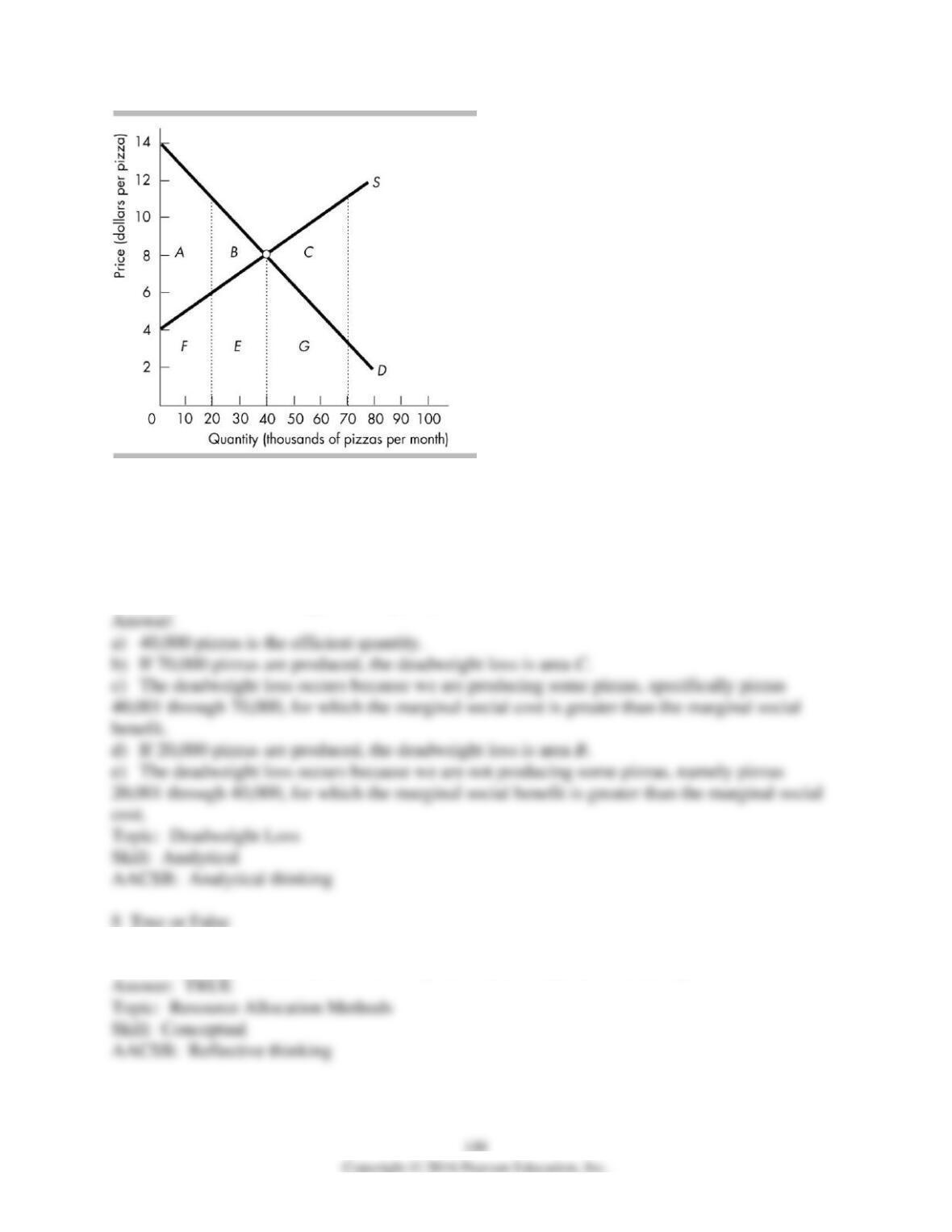
16) The figure above shows the market supply and market demand for pizza.
a) What is the efficient quantity of pizzas?
b) If 70,000 pizzas are produced, what area represents the deadweight loss?
c) Why does the deadweight loss in part (b) occur?
d) If 20,000 pizzas are produced, what area represents the deadweight loss?
e) Why does the deadweight loss in part (d) occur?
1) Command system allocates resources by the order of someone in authority.
2) The value of one more unit of a good or service is its marginal benefit.
3) The opportunity cost to the consumer of purchasing and consuming one more unit of a good is
called the marginal benefit.
4) The opportunity cost to the firm of producing one more unit of output is also called marginal
cost.
5) If the marginal social benefit of pizza exceeds the marginal social cost of pizza, the economy
is producing the efficient quantity of pizza.
6) If the marginal social cost exceeds the marginal social benefit for the last pair of shoes
produced, then the economy is producing more than the efficient amount.
7) If the marginal social benefit exceeds the marginal social cost of producing the next kilowatt
hour of electricity, then it is efficient to produce as many kilowatt hours as possible.
8) If the marginal social cost of a television exceeds the marginal social benefit of a television, it
would increase society’s total surplus to decrease production of televisions.
9) As long as production is such that marginal social benefit is greater than marginal social cost,
an efficient outcome occurs.
10) Consumer surplus is the value of a good minus the cost of producing it, summed over the
quantity bought.
11) Buyers receive a consumer surplus when the price exceeds the marginal benefit.
12) Consumers don’t always have to pay the maximum price they are willing to pay.
13) Marginal cost is the minimum price that producers must receive to induce them to produce
another unit of a good or service.
14) The producer surplus on a unit of output is the difference between the market price and the
opportunity cost of producing it.
15) Producer surplus is the price of a good minus the opportunity cost of producing it, summed
over the quantity produced.
16) If the hot dog vendors at Yankee Stadium are earning a producer surplus on each hot dog
they sell, then baseball fans cannot be gaining any consumer surplus on the hot dogs they buy.
17) Although the efficient quantity to produce of any good is located where marginal social
benefit and marginal social cost are equal, there will usually be other quantities where the sum of
consumer and producer surplus are greater.
18) In a competitive equilibrium, the total consumer surplus must equal the total producer
surplus.
19) When the efficient quantity of output is being produced and sold, the deadweight loss is
maximized.
20) If the marginal social benefit of ice cream curve shifts rightward because people now like ice
cream better than before, the marginal social cost curve of ice cream will shift leftward.
21) Market failure is the situation in which a market delivers an inefficient outcome.
22) A competitive market is always efficient.
23) One of the obstacles to efficiency is monopoly.
24) When there are external costs of production, such as when electric utilities burn coal, a
competitive market will produce an inefficient level of output.