16) The annual Great Sofa Round-up is a collaborative event between Colorado State University
and the City of Fort Collins aims to help students and neighbors get rid of unwanted furniture,
while giving people in need access to inexpensive sofas. Suppose on the day of the Round-up,
your friends take their couches to the main parking lot on campus where the Round-up is held.
Raj will not sell his couch for less than $30, Emily will not sell her couch for less than $50, Nara
will not sell her couch for less than $20, Sergio just wants to get rid of his couch and he is
willing to give it away for free. At the Round-up, potential buyers think that all the couches
available are basically the same and they are willing to buy a couch for $50. What is the value of
Nara’s producer surplus?
A) $30
B) $50
C) $20
D) $10
17) The annual Great Sofa Round-up is a collaborative event between Colorado State University
and the City of Fort Collins aims to help students and neighbors get rid of unwanted furniture,
while giving people in need access to inexpensive sofas. Suppose on the day of the Round-up,
your friends take their couches to the main parking lot on campus where the Round-up is held.
Raj will not sell his couch for less than $30, Emily will not sell her couch for less than $50, Nara
will not sell her couch for less than $20, Sergio just wants to get rid of his couch and he is
willing to give it away for free. At the Round-up, potential buyers think that all the couches
available are basically the same and they are willing to buy a couch for $50. What is the value of
the market producer surplus?
A) $100
B) $200
C) $120
D) $50
18) The annual Great Sofa Round-up is a collaborative event between Colorado State University
and the City of Fort Collins aims to help students and neighbors get rid of unwanted furniture,
while giving people in need access to inexpensive sofas. Suppose on the day of the Round-up,
your friends take their couches to the main parking lot on campus where the Round-up is held.
Raj will not sell his couch for less than $30, Emily will not sell her couch for less than $50, Nara
will not sell her couch for less than $20, Sergio just wants to get rid of his couch and he is
willing to give it away for free. At the Round-up, potential buyers think that all the couches
available are basically the same and they are willing to buy a couch for $25. Who will sell their
couch and what is the value of the market producer surplus?
A) Nara and Sergio; $30
B) Nara and Sergio; $5
C) Raj and Emily; $30
D) Emily, Nara, and Sergio; $25
19) Hummel is a line of figurines based on the artistic style of German nun Maria Innocentia
Hummel and have become a collector’s item. The Hummel figurines are almost uniformly “cute.”
Lukas, Felix, Anya, and Hannah sell Hummel figurines through the internet. Their willingness to
sell price for one figurine is: Lukas $240, Felix $180, Anya $150, Hannah $130. Suppose the
price of a Hummel figurine is $150, what is Felix’s producer surplus?
A) Felix would not sell his figurine.
B) $180
C) $150
D) $30
20) Hummel is a line of figurines based on the artistic style of German nun Maria Innocentia
Hummel and have become a collector’s item. The Hummel figurines are almost uniformly “cute.”
Lukas, Felix, Anya, and Hannah sell Hummel figurines through the internet. Their willingness to
sell price for one figurine is: Lukas $240, Felix $180, Anya $150, Hannah $130. Suppose the
price of a Hummel figurine is $150, who will sell their figurine?
A) Anya and Hannah
B) Lukas, Felix, and Anya
C) Felix, Anya, and Hannah
D) Hannah
21) In May 2008, Switzerland co-hosted the international soccer tournament Euro 2008. At that
time, the Swiss potato industry association had been warning there could be a fry shortage
because there was a potato shortage. The shortage meant that in the French fry market
A) the price for French fries would be higher.
B) the price for French fries would be lower.
C) if the efficient quantity of fries is produced, total surplus would be minimized.
D) if the inefficient quantity of fries is produced, total surplus would be maximized.
22) Bill Gates is the world’s second richest person whose net worth is estimated at $54 billion.
The idea that Bill Gates marginal utility for his 54 billionth dollar is less than someone else’s
1000th dollar is the
A) “Utilitarian” principle.
B) “Big Tradeoff” principle.
C) “Make the Poorest as Well Off as Possible” principle.
D) “Equity” principle.
23) Meat at the supermarket has contributed to increase in food prices in 2010, and high feed and
fuel prices mean that steak will likely cost a lot more this fall. The price of feed has increased 50
percent and hay has doubled from two years ago. Based on this information, which of the
following is TRUE in the market for beef?
A) Consumer surplus will decrease.
B) Producer surplus will increase.
C) Equilibrium price will decrease.
D) Equilibrium quantity will increase.
24) Meat at the supermarket has contributed to increase in food prices in 2010, and high feed and
fuel prices mean that steak will likely cost a lot more this fall. The price of feed has increased 50
percent and hay has doubled from two years ago. Based on this information, which of the
following is NOT true in the market for beef?
A) The consumer surplus will decrease.
B) The equilibrium quantity will increase.
C) The total surplus will decrease.
D) The equilibrium price will increase.
1) What is allocative efficiency?
2) What is the relationship between the marginal social benefit of milk and marginal social cost
of milk when the efficient quantity of milk is produced?
3) Is the marginal benefit someone receives from a good or service the same as the price the
person pays? Explain your answer.
4) “A demand curve is the same as a marginal cost curve.” Is this statement correct or incorrect?
Explain your answer.
5) What is the relationship between the marginal social benefit curve and the market demand
curve. Explain.
6) Which curve is the same as the market demand curve? Why are the curves the same?
7) What is consumer surplus?
8) A new car in the dealer’s showroom had a sticker price of $35,900. Sally liked the car but
decided she would pay no more than $32,000 for it, otherwise she would do without it. After
haggling with the dealer, she purchased the car for $31,500. Did she gain any consumers
surplus? If so, how much? If not, why not?
9) If the demand for a good does not change, how will an increase in the price of that good affect
the consumer surplus from it?
10) What is the marginal cost of a good?
11) What other curve is the same as the market supply curve? Why are the curves the same?
12) What is producer surplus?
13) “If the price of a ticket to Sea World exceeds the marginal cost of the ticket by $13, a
producer surplus exists for Sea World.” Is this statement true or false?
14) What is the significance of the concepts “consumer surplus” and “producer surplus”?
15) Can both producer surplus and consumer surplus exist at the same time in a particular
market?
16) “If the marginal social benefit of a car exceeds the marginal social cost of a car, we are
producing too many cars.” True or false? Explain.
17) When less than the efficient amount of a good is produced, how does the marginal social
benefit of the last unit produced compare to its marginal social cost?
18) Why is a competitive market efficient?
19) When economists refer to “the invisible hand,” what do they mean?
20) Explain how the invisible hand delivers an efficient market outcome.
21) “If there is an inefficient level of nursing care in South America, a deadweight loss exists.” Is
this statement true or false?
22) What are some of the potential obstacles that can prevent a market from reaching the
efficient outcome? Briefly define each obstacle.
23) Explain the difference between the “fair rules” and the “fair results” guidelines for
competitive market fairness.
24) What are the two views of fairness? How does each view redistribution of income from the
rich to the poor?
25) How can a person argue that health care services in America are provided efficiently, but not
fairly?
26) Often politicians assert that a price, such as the price of gasoline or the rent for an apartment,
is too high and that it is unfair for these prices to be so high. If these products are traded in
competitive markets, what fairness rule are politicians using? Why?
27) What approach to fairness argues in favor of government policies that redistribute income so
that there is more equality of income?
28) Explain the utilitarianism principle. How is it deficient?
29) What is the “big tradeoff”?
30) Why do societies face a tradeoff between the size of the economic pie and the degree of
equality with which it is shared?
31) Why does the problem of the big tradeoff arise when the government engages in the process
of redistributing income using taxes and transfers?
32) Explain the modified version of utilitarianism proposed in the book entitled “A Theory of
Justice,” by the philosopher John Rawls and its relationship to the “big tradeoff.”
33) Explain the principle “Make the poorest as well off as possible.” Who proposed it?
34) Bill Gates is a founder of Microsoft and the world’s richest individual. Suppose Microsoft
sells more software and Mr. Gates acquires another billion dollars in wealth. Simultaneously,
suppose a burglar whose income is well below average broke into Bill Gates’ house and stole a
million dollars’ worth of antiques. Using the “it’s not fair if the rules aren’t fair” approach to
fairness, is Mr. Gates’ acquisition of additional wealth fair? Is the (poor) thief’s acquisition fair?
35) According to the “fair rules” view of fairness, are taxes fair? Explain.
7 Numeric and Graphing Questions
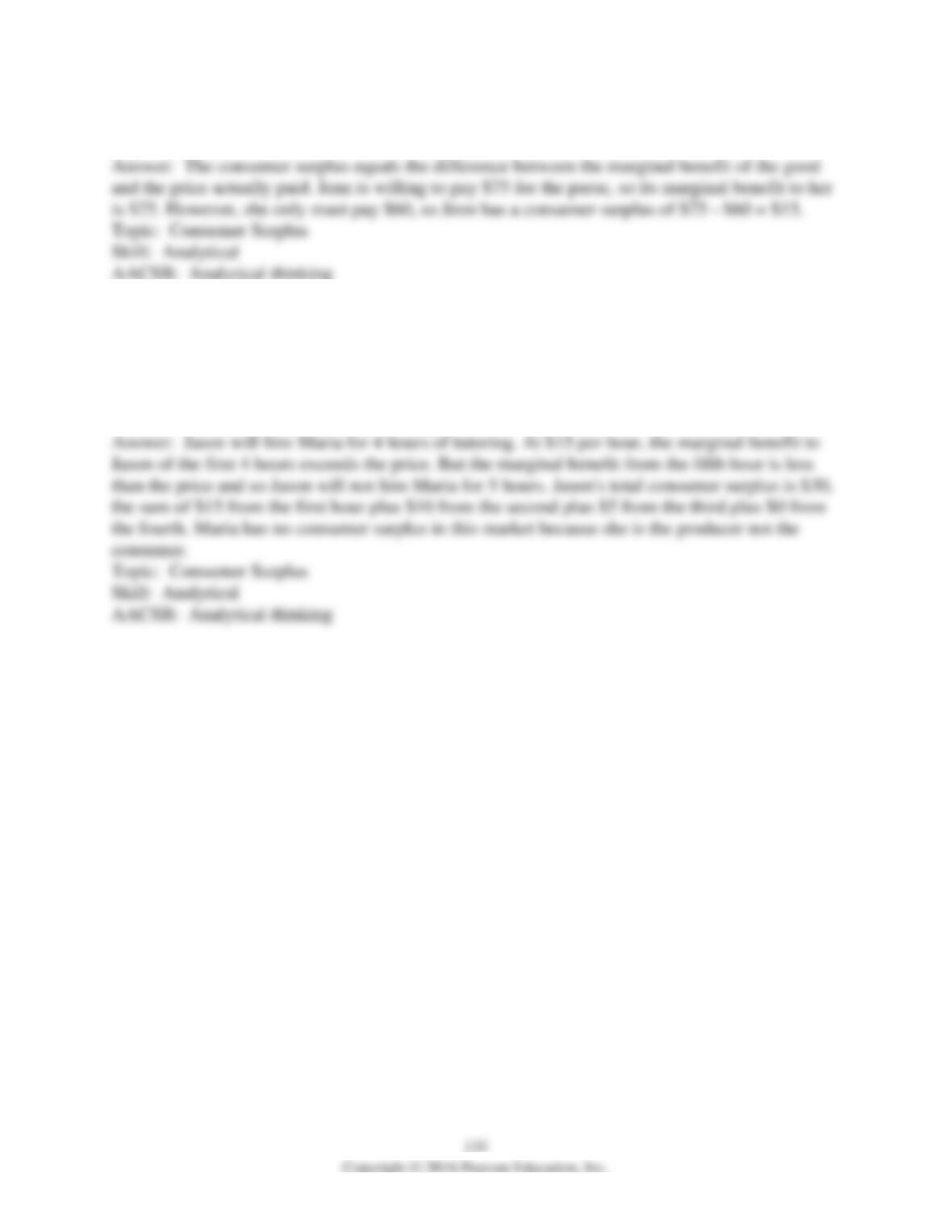
1) The figure shows the demand curve for hotel rooms at a local resort.
a) If the hotel charges $120 per night, how many rooms will they rent?
b) If there are only 40 rooms available, how much are customers willing to pay for a room?
c) If 60 rooms are available, how much are customers willing to pay?
d) What do the dollars in your answer to part (c) represent?
2) Jenn is willing to pay $75 for a purse and the purse’s price is $60. What is Jenn’s consumer
surplus?
3) Jason needs help getting ready for the next test in his economics course and would like to hire
Maria, an economics tutor to help him. Jason is willing to pay $30 for the first hour of tutoring,
$25 for the second, $20 for the third, $15 for the fourth, and $10 for the fifth. The equilibrium
price for tutoring is $15 per hour. For how many hours of tutoring will Jason hire Maria? Why
this amount of hours? What is Jason’s consumer surplus, if any, from the tutoring? What is
Maria’s consumer surplus from the tutoring?
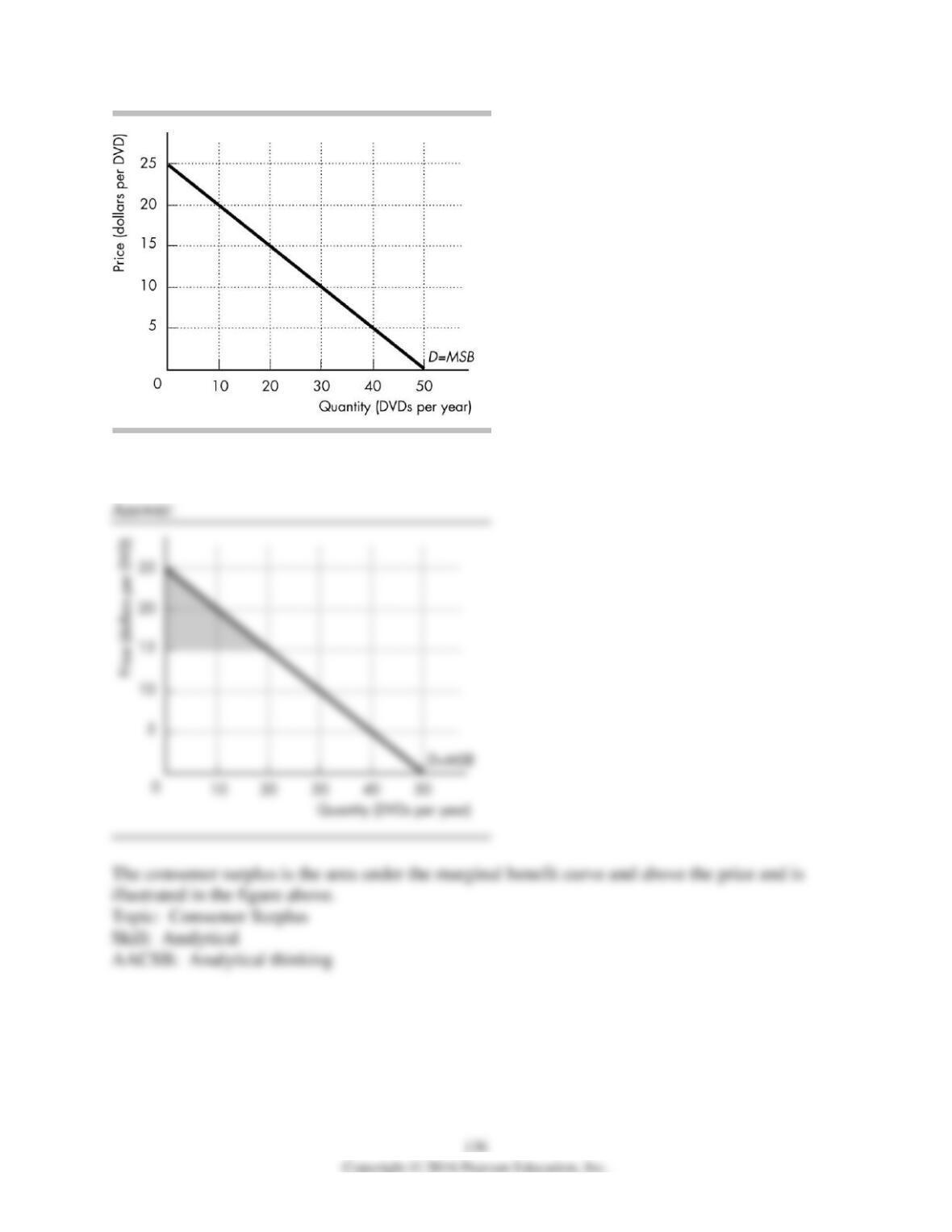
4) The figure above shows the demand curve for DVDs. Use it to illustrate the consumer surplus
if the price of a DVD is $15.
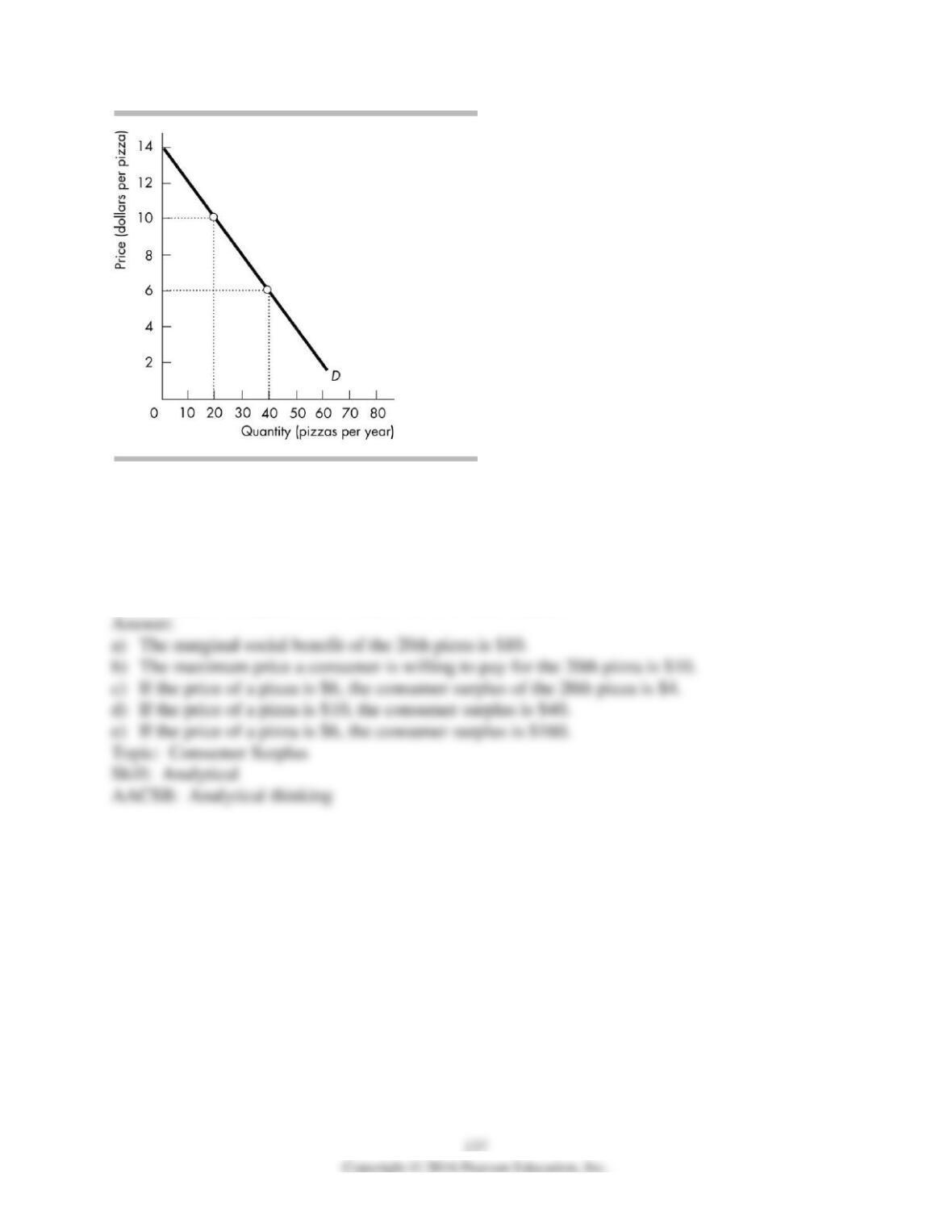
5) The figure above shows the market demand curve for pizza.
a) What is the marginal social benefit of the 20th pizza?
b) What is the maximum price a consumer is willing to pay for the 20th pizza?
c) If the price of a pizza is $6, what is the consumer surplus of the 20th pizza?
d) If the price of a pizza is $10, what is the consumer surplus?
e) If the price of a pizza is $6, what is the consumer surplus?
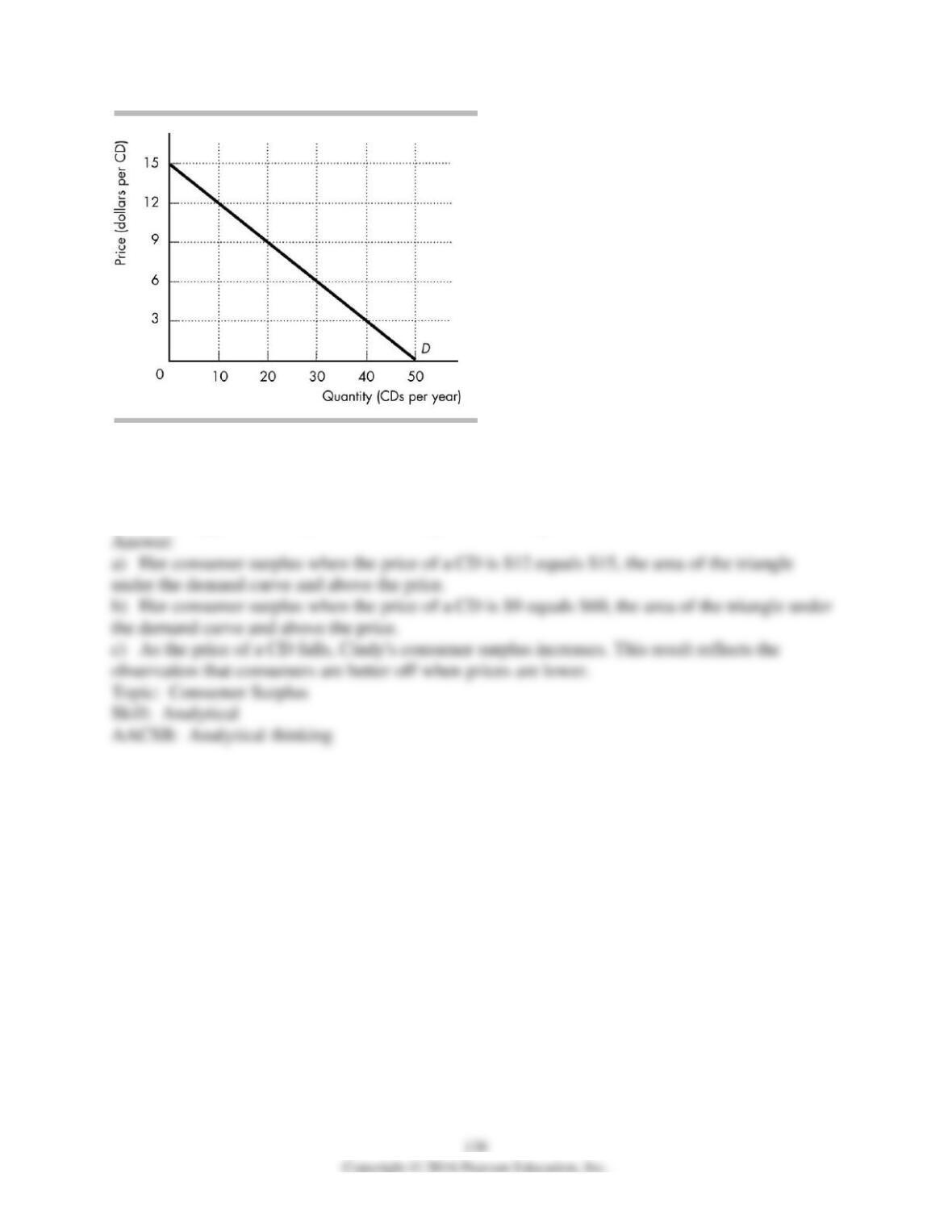
6) The figure above shows Cindy’s demand for CDs per year.
a) What is Cindy’s total consumer surplus if the price of a CD is $12?
b) What is Cindy’s total consumer surplus if the price of a CD is $9?
c) What happens to Cindy’s consumer surplus when the price of a CD falls?
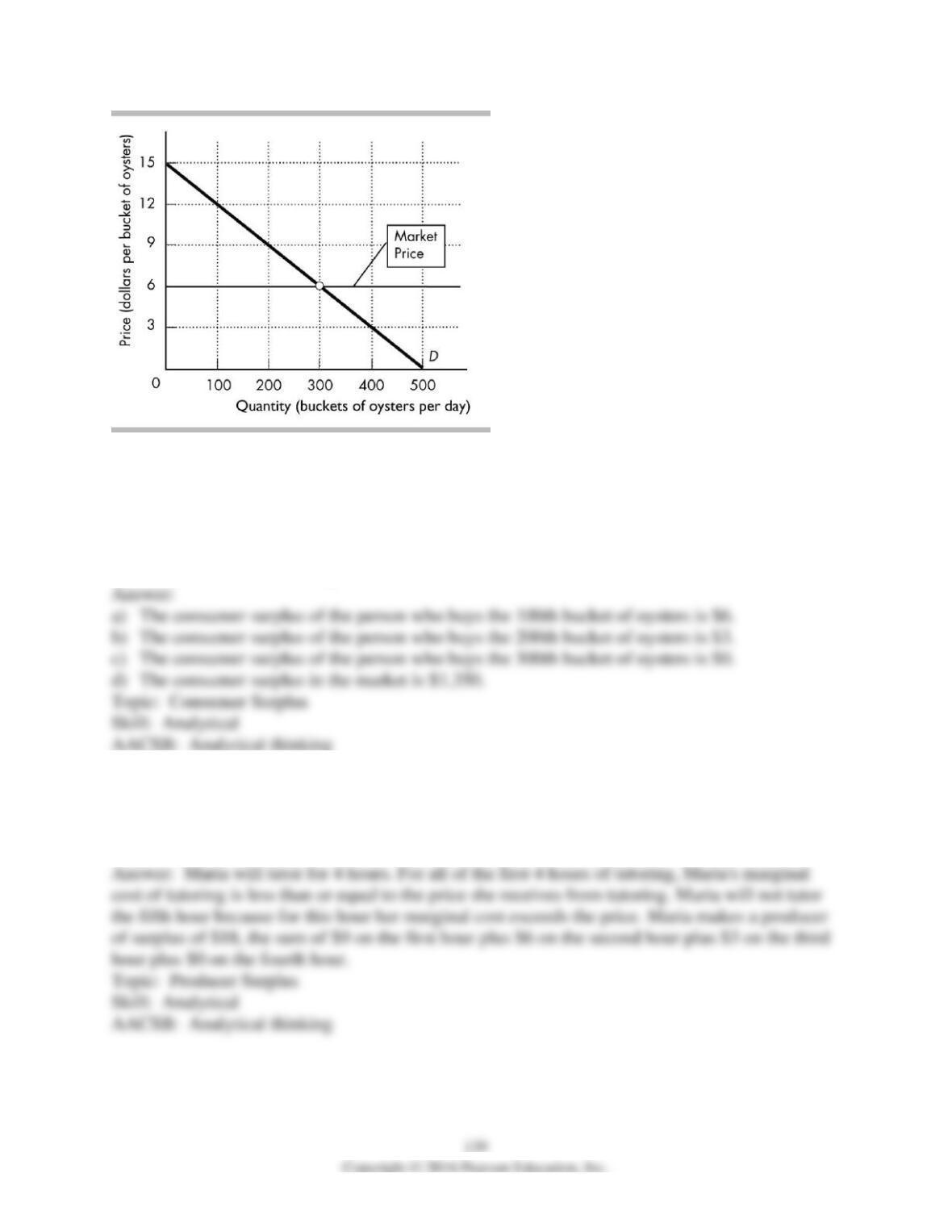
7) The diagram above depicts the market demand for, and market price of, buckets of raw oysters
in Orlando.
a) What is the consumer surplus of the person who buys the 100th bucket of oysters?
b) What is the consumer surplus of the person who buys the 200th bucket of oysters?
c) What is the consumer surplus of the person who buys the 300th bucket of oysters?
d) What is the consumer surplus in the market?
8) Maria helps tutor students taking economics. The equilibrium price for tutoring is $15 per
hour. Maria has determined her opportunity cost per hour to be $6 for the first, $9 for the second,
$12 for the third, $15 for the fourth, and $18 for the fifth. How many hours will Maria tutor?
Why this amount of hours? What, if any, is Maria’s producer surplus?
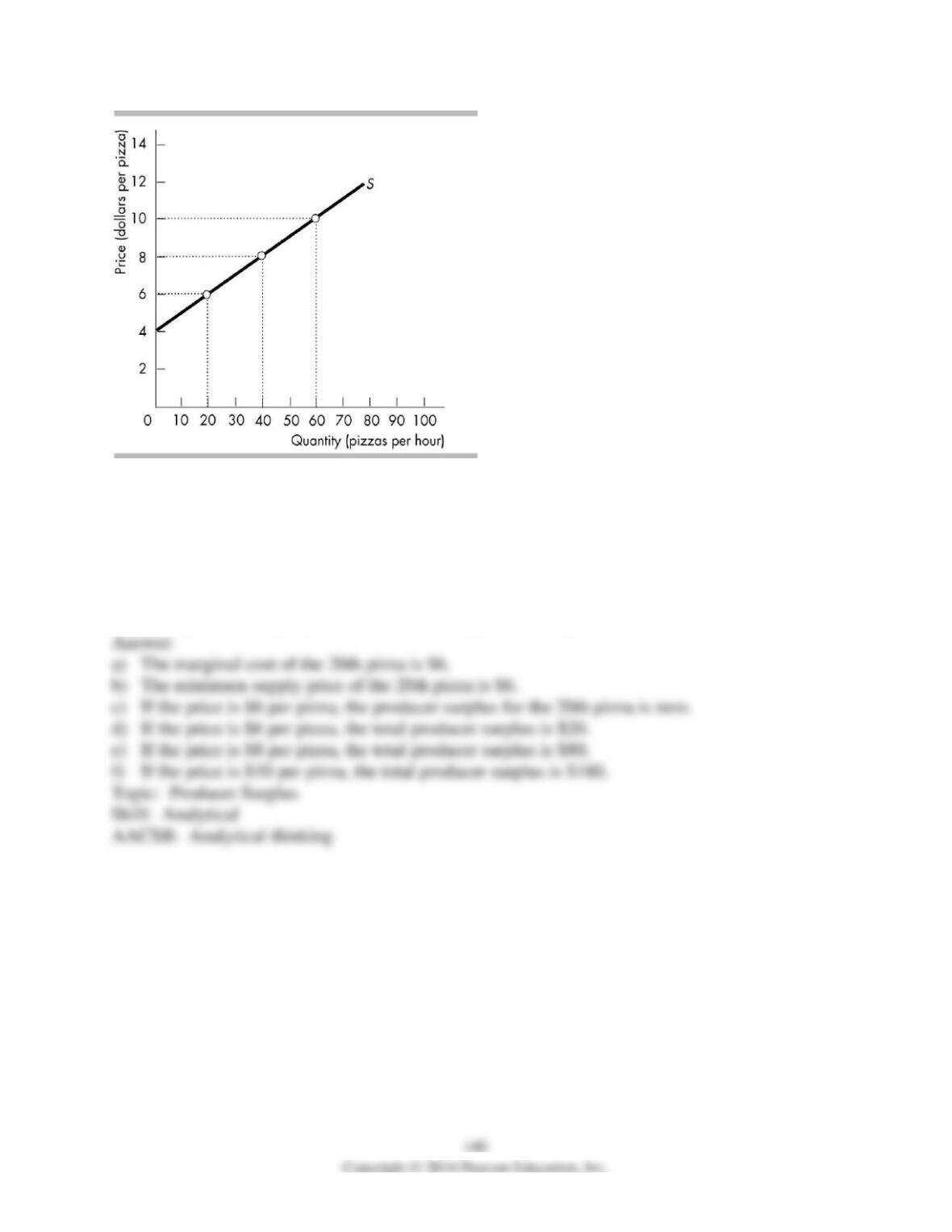
9) The figure above shows the market supply curve for pizzas.
a) What is the marginal social cost of the 20th pizza?
b) What is the minimum supply price of the 20th pizza?
c) If the price is $6 per pizza, what is the producer surplus for the 20th pizza?
d) If the price is $6 per pizza, what is the total producer surplus?
e) If the price is $8 per pizza, what is the total producer surplus?
f) If the price is $10 per pizza, what is the total producer surplus?