175) In the above figure, if the price is $1.25 per gallon of milk and 5 million gallons are
produced and consumed, then the consumer surplus is ________ and the producer surplus is
________.
A) $3.125 million; $3.125 million
B) $12.5 million; $12.5 million
C) $6.25 million; $6.25 million
D) None of the above answers are correct.
176) In the above figure suppose there is only one milk producer who chooses to restrict milk
production to two million gallons per day. What is the size of the deadweight loss? (Hint: It is
equal to the triangular area of consumer and producer surplus that is lost because of the reduction
in output.)
A) $12.5 million
B) $6.25 million
C) $2.25 million
D) none of the above
177) In the above figure, suppose the government subsidizes the production of milk so that milk
production increases to 8 million gallons per day. What is the size of the deadweight loss? (Hint:
It is equal to the triangular area of negative consumer and producer surplus that results when
output exceeds the efficient level.)
A) $12.5 million
B) $6.25 million
C) $4.50 million
D) $2.25 million
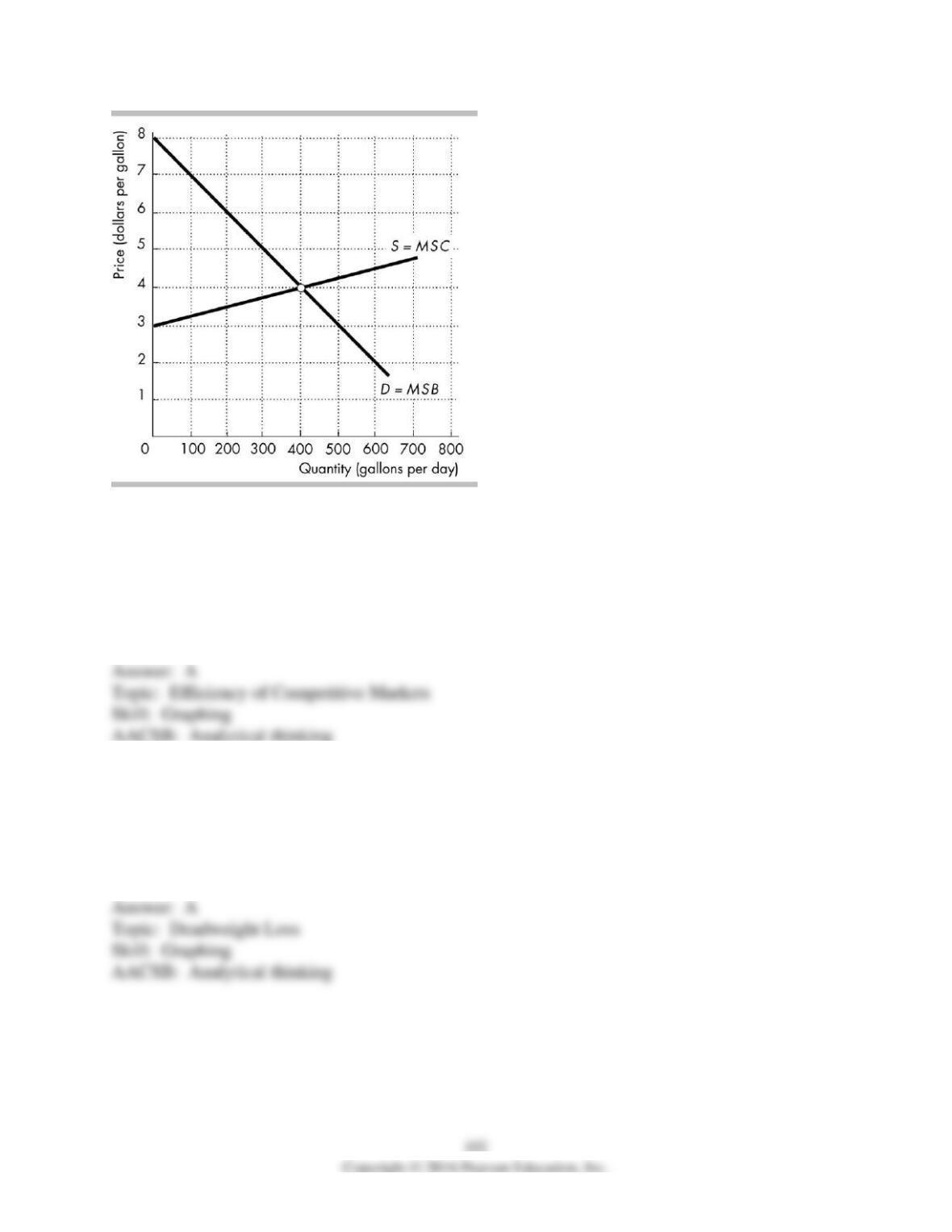
The figure shows the competitive market for milk.
178) In the figure above, when the market is in equilibrium, what is the total surplus?
A) $1,000
B) $800
C) $200
D) $1,600
179) In the figure above, when the quantity of milk produced is 300 gallons per day, what is the
deadweight loss?
A) $62.50
B) $125
C) $200
D) $937.50
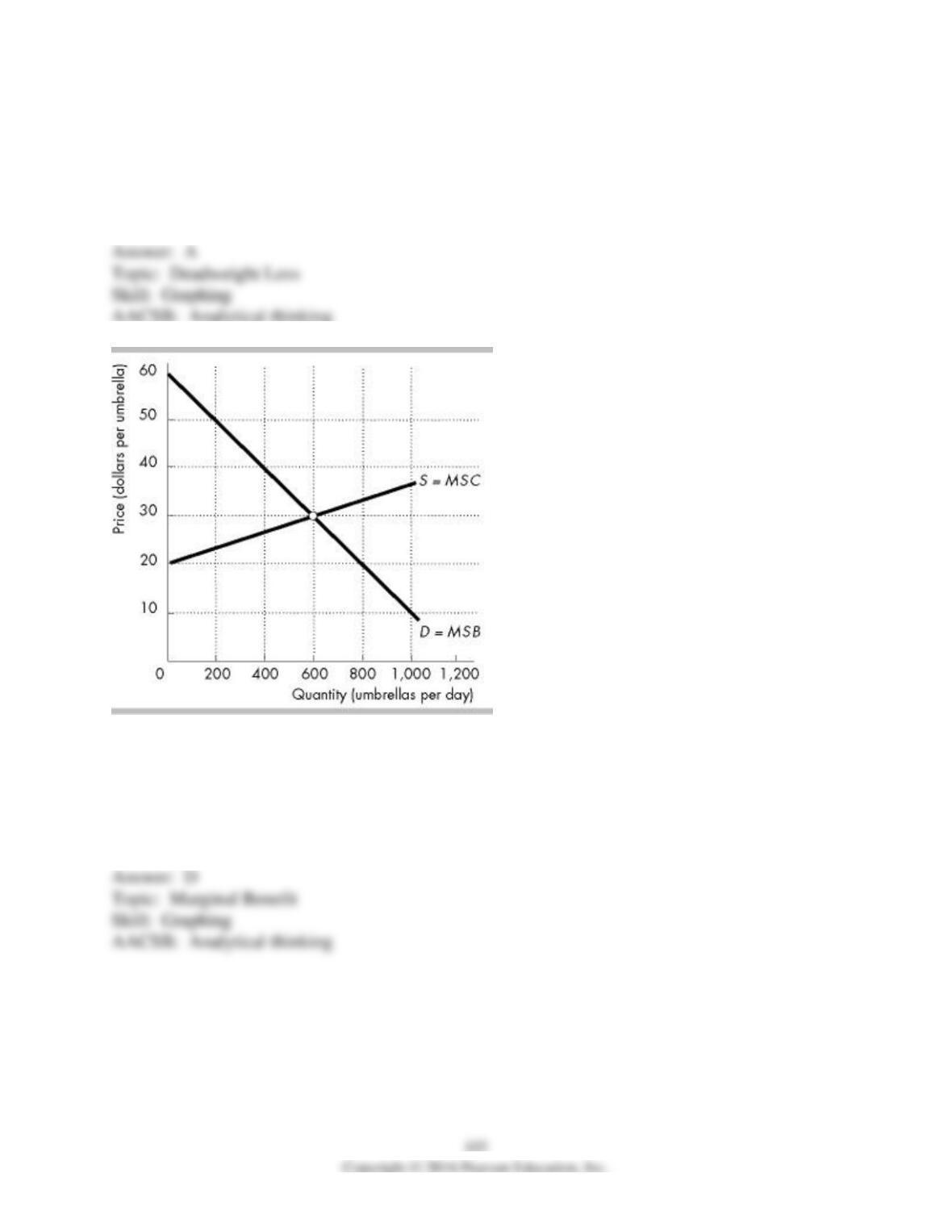
180) In the figure above, when the quantity of milk produced is 600 gallons per day, what is the
deadweight loss?
A) $250
B) $125
C) $500
D) $50
181) The figure above shows the market for umbrellas in Sunville. What is the marginal social
benefit that Sunville consumers receive from the 200th umbrella bought?
A) $23.33
B) $30.00
C) $26.67
D) $50.00
182) The figure above shows the market for umbrellas in Sunville. When the market for
umbrellas in Sunville is in equilibrium, what is the consumer surplus?
A) $30
B) $9,000
C) $18,000
D) $16,000
183) The figure above shows the market for umbrellas in Sunville. When the market for
umbrellas in Sunville is in equilibrium, what is the total deadweight loss?
A) $2,000
B) $800
C) $0
D) 600 umbrellas
184) The figure above shows the market for umbrellas in Sunville. When the market for
umbrellas in Sunville is in equilibrium, what is the producer surplus?
A) $3,000
B) $1,000
C) $10
D) $600
185) The figure above shows the market for umbrellas in Sunville. When the market for
umbrellas in Sunville is in equilibrium, what is the total surplus?
A) $0
B) $12,000
C) $24,000
D) $16,000
186) The figure above shows the market for umbrellas in Sunville. Suppose the quantity of
umbrellas currently traded in Sunville is 199 per day. If one more umbrella is sold, the total
surplus in Sunville will
A) decrease by $26.67.
B) increase by $26.67.
C) increase by $50.00.
D) not change.
187) The figure above shows the market for umbrellas in Sunville. Suppose one firm owns all
umbrella stores in Sunville and charges $40 per umbrella. In this situation, the market for
umbrellas is
A) efficient, with no deadweight loss but also no surplus.
B) inefficient, with a deadweight loss of $2,666.67.
C) inefficient, with a deadweight loss of $1,333.33.
D) efficient, generating a total surplus of more than $10,000.
188) A deadweight loss is created
A) only if the last unit produced has a marginal social benefit greater than its marginal social
cost.
B) only if the last unit produced has a marginal social cost greater than its marginal social
benefit.
C) only if the last unit produced has a marginal social benefit equal to its marginal social cost.
D) if for the last unit produced, marginal social cost is greater than its marginal social benefit or
if its marginal social benefit is greater than its marginal social cost.
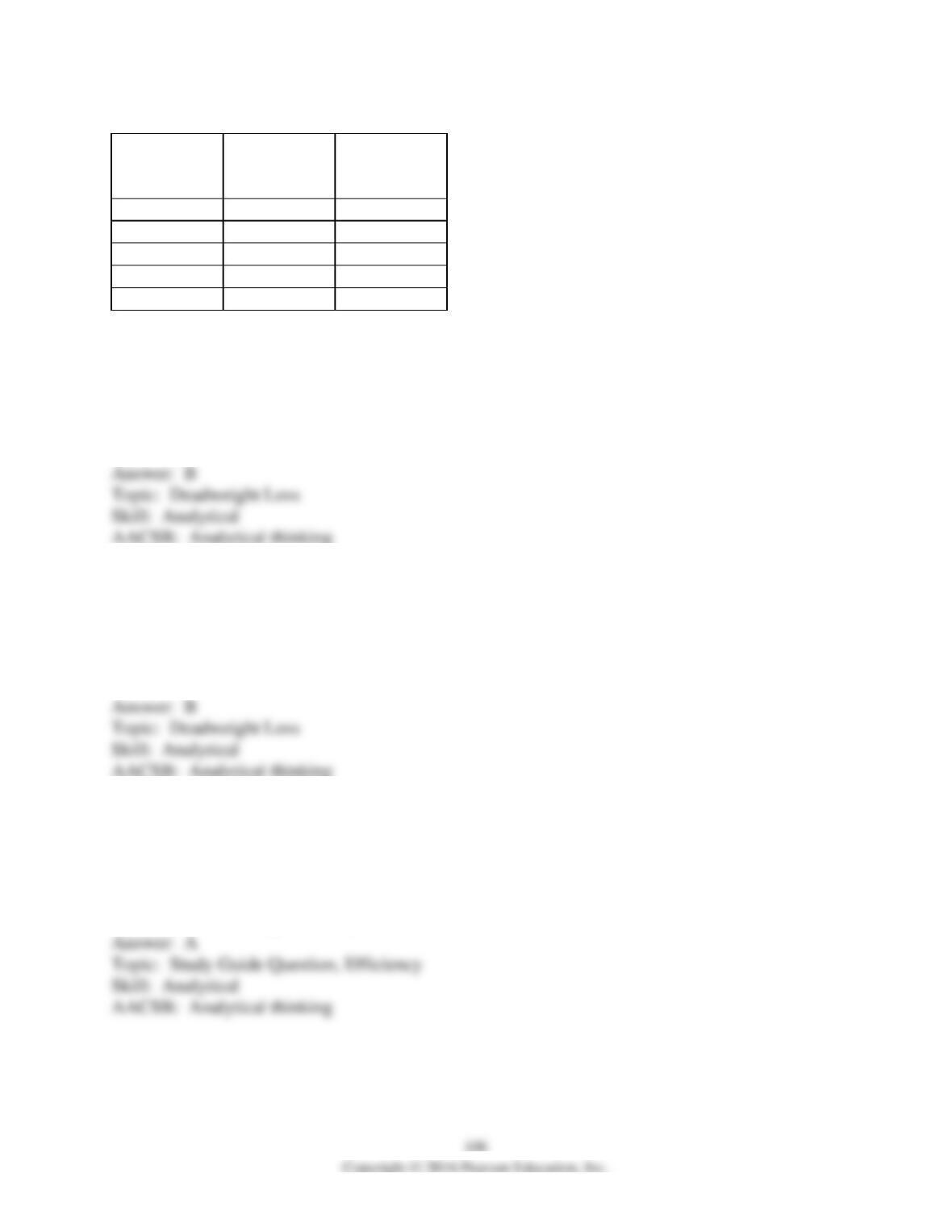
Price
(dollars per
umbrella)
Quantity
demanded
Quantity
supplied
0
90
0
10
80
0
20
40
40
30
20
80
40
0
120
189) In the table above, if there are 80 umbrellas produced, the deadweight loss from the 80th
umbrella is
A) $10.
B) $20.
C) $30.
D) $40.
190) In the table above, the deadweight loss is zero when ________ umbrellas are produced and
sold.
A) 20
B) 40
C) 60
D) 80
191) Suppose the marginal cost of producing a good falls so that the marginal social cost curve
shifts downward. Then the efficient quantity to produce of that product
A) increases.
B) does not change.
C) decreases.
D) could increase, stay the same, or decrease.
192) Suppose consumers decide they value a product more highly than before. Then the efficient
quantity to produce of that product ________.
A) increases
B) does not change
C) decreases
D) perhaps changes, but without more information the direction of the change cannot be told
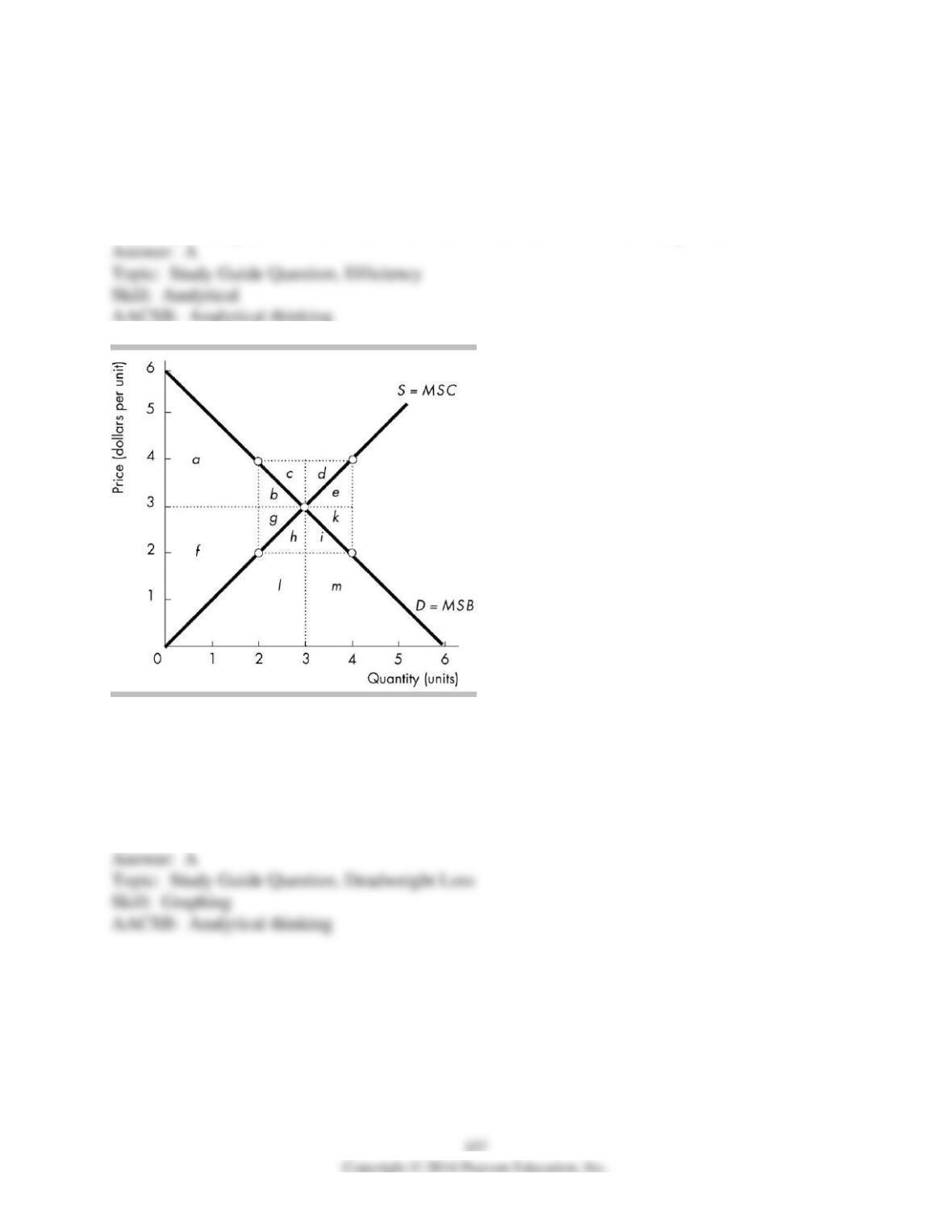
193) In the figure above, if the quantity is restricted to 2, then the deadweight loss in this market
equals
A) b + g.
B) c + d.
C) e + k.
D) h + i.
194) A deadweight loss
A) is possible only if the good is underproduced but is not possible if the good is overproduced.
B) subtracts only from producer surplus.
C) is a loss to consumers and a gain to producers.
D) is a loss inflicted on the entire society.
195) Which of these is NOT a potential source of inefficiency?
A) external benefits
B) increasing marginal costs
C) monopoly
D) subsidies
4 Is the Competitive Market Fair?
1) Using the “It’s not fair if the result isn’t fair” principle of fairness, an income tax designed to
transfer wealth from the rich to the poor
A) increases efficiency and equity.
B) increases efficiency and does not affect equity.
C) decreases efficiency and increases equity.
D) decreases efficiency and equity.
2) The principle that states that we should strive to achieve the greatest happiness for the greatest
number is called
A) the big tradeoff.
B) the symmetry principle.
C) utilitarianism.
D) efficiency.
3) According to Utilitarian principles first discussed in the nineteenth century, fairness implies
A) equality of income.
B) equality of opportunity.
C) winner takes all.
D) maximizing consumption.
4) Utilitarianism is a principle whose goal is ________.
A) the greatest happiness for the greatest number
B) the greatest pay for the greatest number
C) equal pay for equal work
D) equal happiness for all workers
5) Which of the following CORRECTLY defines utilitarianism?
A) Cost will increase if production increases.
B) The difference between what a consumer is willing to pay and what actually has to be paid.
C) Society should strive to achieve the greatest good for the greatest number.
D) Equality will not result in efficient outcomes.
6) Utilitarianism is the idea that only
A) competition brings efficiency.
B) efficiency brings equality.
C) income equality is fair.
D) efficiency is fair.
7) Utilitarianism argues that
A) Only equality brings efficiency.
B) There is a tradeoff between equality and efficiency.
C) The result is fair if the rules are fair.
D) The competitive market is fair.
8) Which of the following ideas describes the concept of “utilitarianism”?
I. Utilitarianism gained popularity in the 1930s.
II. Utilitarians believed that a society should use only competitive markets to allocate resources.
III. Utilitarians claimed that taking money from rich people and giving it to poorer people would
make the economy more fair.
A) III only
B) II only
C) I and II
D) I, II and III
9) Adam makes $25,000 per year and Bob makes $45,000 a year, and they both have the same
marginal benefit curve. According to the utilitarian view, if a dollar is transferred from Bob to
Adam, then
A) the change in Adam’s marginal benefit plus the change in Bob’s marginal benefit is negative.
B) Adam’s marginal benefit increases by more than Bob’s marginal benefit decreases.
C) the change in Adam’s marginal benefit plus the change in Bob’s marginal benefit equals zero.
D) Adam’s marginal benefit decreases by more than Bob’s marginal benefit increases.
10) Utilitarianism is based on the argument that
A) the greater a person’s income, the smaller is the marginal benefit of a dollar.
B) by transferring a dollar from a millionaire to a poor person, more is lost than gained.
C) taxing people’s income from employment makes them work less.
D) a dollar taken from a rich person does not end up as a dollar in the hands of a poorer person.
11) One of the problems associated with the utilitarianism is that it does not recognize that
A) taxing those with higher incomes results in less work effort.
B) each individual receives a different marginal benefit from a dollar’s worth of income.
C) equity is achieved when there is no poor and no rich.
D) similar individuals should be treated the same.
12) One problem with the concept of utilitarianism is that
A) there is a cost to transferring income from the rich to the poor.
B) there are increasing marginal costs.
C) there are decreasing marginal benefits.
D) markets cannot adjust to income redistribution.
13) One problem with the utilitarian principle is that it ignores
A) increasing marginal costs.
B) decreasing marginal benefits.
C) the costs of making income transfers.
D) poor people.
14) The big tradeoff is a tradeoff between
A) efficiency and fairness.
B) consumer surplus and producer surplus.
C) taxes and subsidies.
D) price ceilings and price floors.
15) Which of the following arguments support the proposition that society should accept at least
some income inequality?
A) Income redistribution will require taxation, causing inefficiently low levels of labor supply
and saving, thus decreasing the size of the economic pie.
B) Administrative costs associated with income redistribution imply that low-income people
receive less than $1 for each dollar taken from high-income people.
C) Income redistribution programs divert skilled labor and capital to tax compliance activities
and away from production of goods and services that people value.
D) All of the above answers are correct because all support the proposition that society should
accept some income inequality.
16) Suppose the government considers placing a tax on business profits o that businesses
decrease their production and generate a deadweight loss. Revenues from the tax would be used
to boost the incomes of the poor. The decision to levy the tax implies that in this case, the
government
A) values people but not business.
B) values efficiency more than its view of fairness.
C) profits from taxes.
D) values its view of fairness more than efficiency.
17) A modified version of utilitarianism proposed by John Rawls states that
A) the distribution of the economic pie is fair if the rules are fair.
B) the distribution of the economic pie is fair if it achieves the greatest happiness for the greatest
number of people.
C) the fair distribution of the economic pie is the one that makes the poorest person as well off as
possible.
D) goods may be transferred from one person to another only by voluntary exchange.
18) According to John Rawls, the fair distribution of income is the one that
A) makes the poorest person as well off as possible.
B) makes the average person as well off as possible.
C) results in equal income for all society members.
D) is based on fair rules.
19) The requirement that people in similar situations be treated similarly is called
A) the big tradeoff.
B) the symmetry principle.
C) utilitarianism.
D) efficiency.
20) The symmetry principle states that
A) the poorest person must be made as well off as possible.
B) income should be transferred from the rich to the poor up to the point of complete equality.
C) resources should be common property.
D) people in similar situations must be treated similarly.
21) The symmetry principle is the requirement that
A) people in similar situations be treated similarly.
B) Society’s income be distributed symmetrically among its members.
C) the poorest 20 percent of households should receive the same total income as the richest 10
percent of households.
D) the average person be made as well off as possible.
22) The symmetry principle in economics means that
A) all individuals must have similar outcomes.
B) all similar individuals must be treated similarly.
C) individuals must have opposite outcomes.
D) similar individuals must have similar outcomes.
23) Which of the following is inconsistent with Robert Nozick’s view of fairness as expressed in
his book Anarchy, State, and Utopia?
A) Everything that is valuable must be owned by individuals and that the state must ensure that
theft is prevented.
B) The only legitimate way a person can acquire property is to buy it.
C) The requirement that all people should have equal outcomes.
D) None of the above answers is correct because all the answers express thoughts consistent with
Nozick’s view.
24) Robert Nozick asserts that fairness and efficiency result if
A) there are price ceilings in the market.
B) there are external benefits and external costs in the market.
C) voluntary exchange occurs.
D) public goods are provided by government.
25) Competitive markets with no external costs or benefits and no government price ceilings,
floors, taxes or subsidies ________ efficient. According to the “It’s not fair if the rules aren’t fair”
idea of fairness, competitive markets ________ fair.
A) are; are
B) are; are not
C) are not; are
D) are not; are not
26) Susan thinks the only fair outcome is one in which she has three slices of pizza a week.
Susan is using a(n) ________ concept of fairness.
A) “it’s not fair if the result isn’t fair”
B) “it’s not fair if the rules aren’t fair”
C) “big tradeoff”
D) “Novak principle”
27) The assertion that if resources are allocated efficiently, they also are allocated fairly is made
by
A) all utilitarians.
B) John Rawls, who proposed making the poorest as well off as possible.
C) Robert Nozick, who believes that equality of opportunity is fair.
D) all economists who understand the big tradeoff.
5 News Based Questions
1) American Idol is a popular television program where contestants compete to win a $1 million
record deal. To determine the winner, fans either dial the number or send a text message
indicating their favorite contestant. The contestant with the highest number of texts and phone
calls wins. What is the scarce resource in this example?
A) $1 million record deal
B) television ratings
C) phone calls and text messages
D) fans
2) American Idol is a popular television program where contestants compete to win a $1 million
record deal. To determine the winner, fans either dial the number or send a text message
indicating their favorite contestant. The contestant with the highest number of texts and phone
calls wins. How is the scarce resource in this example allocated?
A) majority rule
B) command
C) contest
D) personal characteristics
3) Colorado State University allocates 10,000 tickets for each home game to students at no cost.
Students are required to stand in line and prove they are a full time student to receive a free
ticket. How is the scarce resource in this example allocated?
A) first-come, first-served
B) market price
C) contest
D) lottery
4) Colorado State University allocates 10,000 tickets for each home game to students at no cost.
Students are required to stand in line and prove they are a full time student to receive a free
ticket. Community members can purchase season tickets or tickets to an individual game. How
are football tickets allocated to community members?
A) market price
B) command
C) first-come, first-served
D) personal characteristics
5) At the beginning of World War II, a rationing system was established in the United States.
Ration stamps or cards were issued for a variety of commodities such as canned milk and
gasoline. Canned milk was only available to babies and small children. In this example, canned
milk was allocated through
A) personal characteristics.
B) market price.
C) majority rule.
D) first-come, first-served.
6) At the beginning of World War II, a rationing system was established in the United States.
Ration stamps or cards were issued for a variety of commodities such as canned milk and
gasoline. To receive a gasoline ration card, a person had to certify a need for gas. The ration
cards ranged from the most limited A card which only allowed 3 to 4 gallons per week to the
most generous X card, which allowed the carrier to buy an unlimited amount of gasoline. A
government entity, the War Price and Rationing Board, decided who received and A or an X
card. Gasoline cards were allocated through
A) command.
B) market price.
C) majority rule.
D) force.
7) The Wii is a wildly popular home video game console released by Nintendo. The Wii system
was first available in the U.S. in November, 2006 and has sold more than 30 million units as of
August 2010. The Wii retails for $199. Suppose Ahmed is willing to pay $230, Lana is willing to
pay $175, and Bodie is willing to pay $300 for a Wii. Who will purchase a Wii?
A) Ahmed and Bodie
B) Ahmed
C) Lana
D) Ahmed, Bodie, and Lana
8) The Wii is a wildly popular home video game console released by Nintendo. The Wii system
was first available in the U.S. in November, 2006 and has sold more than 30 million units as of
August 2010. The Wii retails for $199. Suppose Ahmed is willing to pay $230, Lana is willing to
pay $175, and Bodie is willing to pay $300 for a Wii. What is the value of Ahmed’s consumer
surplus?
A) $31
B) $280
C) $249
D) No consumer surplus is generated because Ahmed will not buy the Wii.
9) The Wii is a wildly popular home video game console released by Nintendo. The Wii system
was first available in the U.S. in November, 2006 and has sold more than 30 million units as of
August 2010. The Wii retails for $199. Suppose Ahmed is willing to pay $230, Lana is willing to
pay $175, and Bodie is willing to pay $300 for a Wii. What is the value of Lana’s consumer
surplus?
A) No consumer surplus is generated because Lana will not buy the Wii.
B) $249
C) $225
D) $24
10) The Wii is a wildly popular home video game console released by Nintendo. The Wii system
was first available in the U.S. in November, 2006 and has sold more than 30 million units as of
August 2010. The Wii retails for $199. Suppose Ahmed is willing to pay $230, Lana is willing to
pay $175, and Bodie is willing to pay $300 for a Wii. If these three are the only consumers in the
market, what is the value of the market consumer surplus?
A) $132
B) $855
C) $630
D) $498
11) Fitness is a magazine for women about health and exercise. Fitness offers year subscriptions
for $12 on their website. Jess, Ania, Mandy, and Chloe exercise together and each enjoy reading
Fitness. Jess is willing to pay $10, Ania is willing to pay $16, Mandy is willing to pay $24, and
Chloe is willing to pay $12 for a subscription to the magazine. Who will subscribe to the
magazine?
A) Ania, Mandy, and Chloe
B) Jess, Ania, Mandy, and Chloe
C) Jess, Ania, and Chloe
D) Mandy and Chloe
12) Fitness is a magazine for women about health and exercise. Fitness offers year subscriptions
for $12 on their website. Jess, Ania, Mandy, and Chloe exercise together and each enjoy reading
Fitness. Jess is willing to pay $10, Ania is willing to pay $16, Mandy is willing to pay $24, and
Chloe is willing to pay $12 for a subscription to the magazine. What is the value of Ania’s
consumer surplus?
A) $4
B) $16
C) $12
D) $6
13) Fitness is a magazine for women about health and exercise. Fitness offers year subscriptions
for $12 on their website. Jess, Ania, Mandy, and Chloe exercise together and each enjoy reading
Fitness. Jess is willing to pay $10, Ania is willing to pay $16, Mandy is willing to pay $24, and
Chloe is willing to pay $12 for a subscription to the magazine. What is the value of Chloe’s
consumer surplus?
A) $0
B) $12
C) $10
D) Chloe will not purchase the magazine.
14) Fitness is a magazine for women about health and exercise. Fitness offers year subscriptions
for $12 on their website. Jess, Ania, Mandy, and Chloe exercise together and each enjoy reading
Fitness. Jess is willing to pay $10, Ania is willing to pay $16, Mandy is willing to pay $24, and
Chloe is willing to pay $12 for a subscription to the magazine. What is the value of market
consumer surplus?
A) $16
B) $52
C) $40
D) $12
15) The annual Great Sofa Round-up is a collaborative event between Colorado State University
and the City of Fort Collins aims to help students and neighbors get rid of unwanted furniture,
while giving people in need access to inexpensive sofas. Suppose on the day of the Round-up,
your friends take their couches to the main parking lot on campus where the Round-up is held.
Raj will not sell his couch for less than $30, Emily will not sell her couch for less than $50, Nara
will not sell her couch for less than $20, Sergio just wants to get rid of his couch and he is
willing to give it away for free. At the Round-up, potential buyers think that all the couches
available are basically the same and they are willing to buy a couch for $50. Who will sell their
couch?
A) Raj, Emily, Nara, and Sergio
B) Raj, Nara, and Sergio
C) Emily, Nara, and Sergio
D) Emily