Chapter 5: The Value of Money
151.
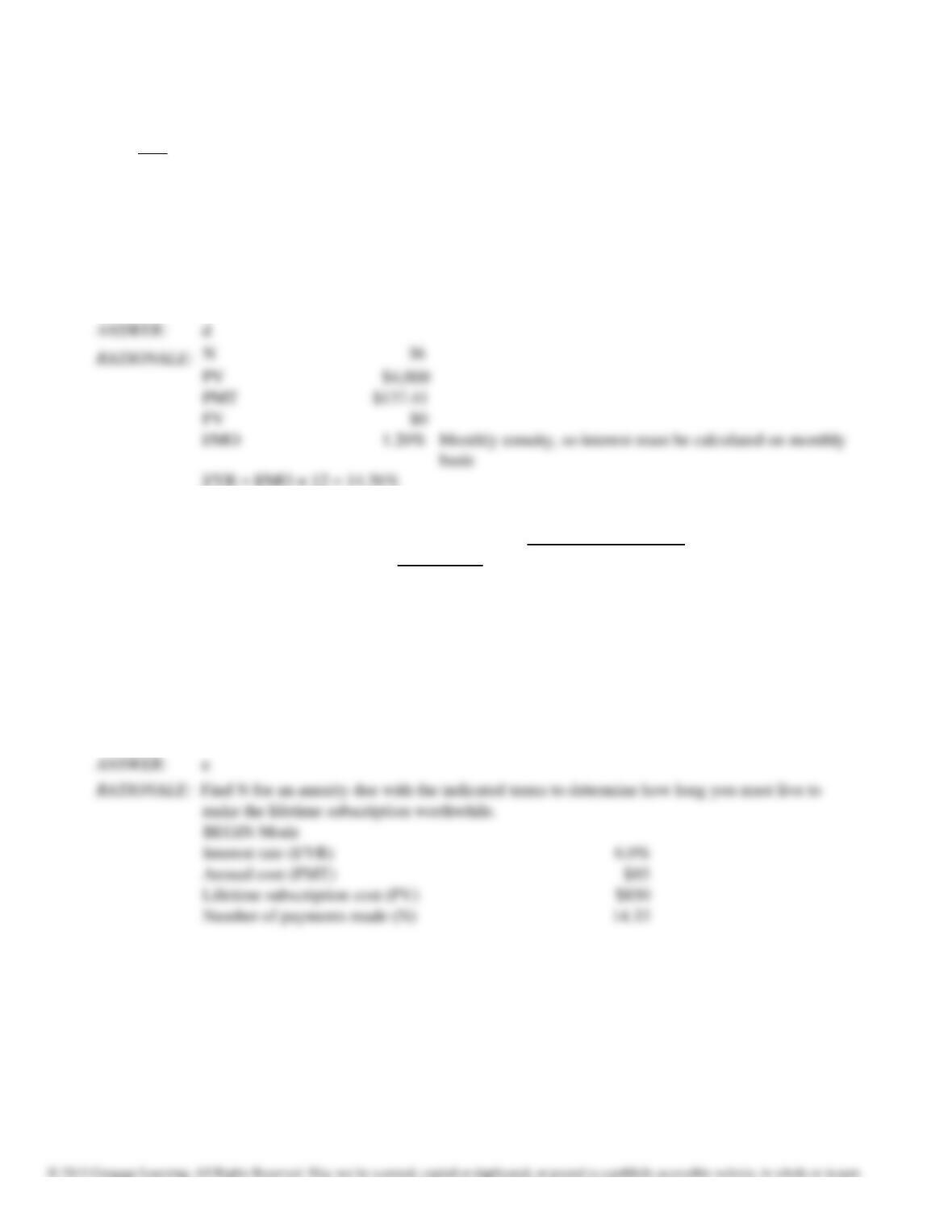
Your child’s orthodontist offers you two alternative payment plans. The first plan requires a $4,000
immediate up-
front payment. The second plan requires you to make monthly payments of $137.41, payable
at the end of each
month for 3 years. What nominal annual interest rate is built into the monthly payment
plan?
a. 12.31%
b. 12.96%
c. 13.64%
d. 14.36%
e. 15.08%
152.
Your subscription to Investing Wisely Weekly is about to expire. You plan to subscribe to the magazine for the
rest
of your life, and you can renew it by paying $85 annually, beginning immediately, or you can get a
lifetime
subscription for $850, also payable immediately. Assuming that you can earn 6.0% on your funds and
that the
annual renewal rate will remain constant, how many years must you live to make the lifetime
subscription the better
buy?
a. 7.48
b. 8.80
c. 10.35
d. 12.18
e. 14.33
153.
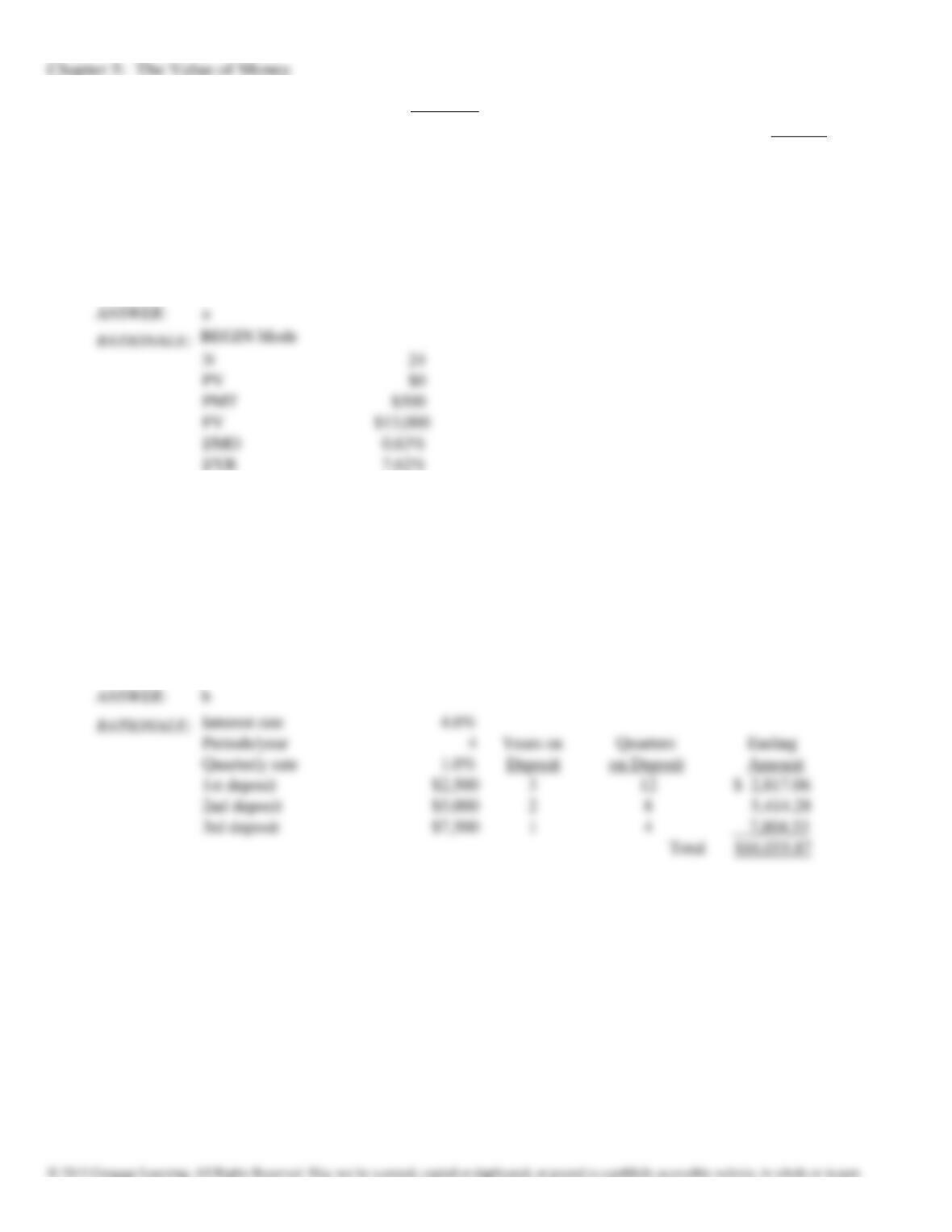
You agree to make 24 deposits of $500 at the beginning of each month into a bank account. At the end of the
24th month, you will have $13,000 in your account. If the bank compounds interest monthly, what nominal
annual interest
rate will you be earning?
a. 7.62%
b. 8.00%
c. 8.40%
d. 8.82%
e. 9.26%
154.
You just deposited $2,500 in a bank account that pays a 4.0% nominal interest rate, compounded quarterly. If
you
also add another $5,000 to the account one year (4 quarters) from now and another $7,500 to the account
two
years (8 quarters) from now, how much will be in the account three years (12 quarters) from now?
a. $15,234.08
b. $16,035.87
c. $16,837.67
d. $17,679.55
e. $18,563.53
155.
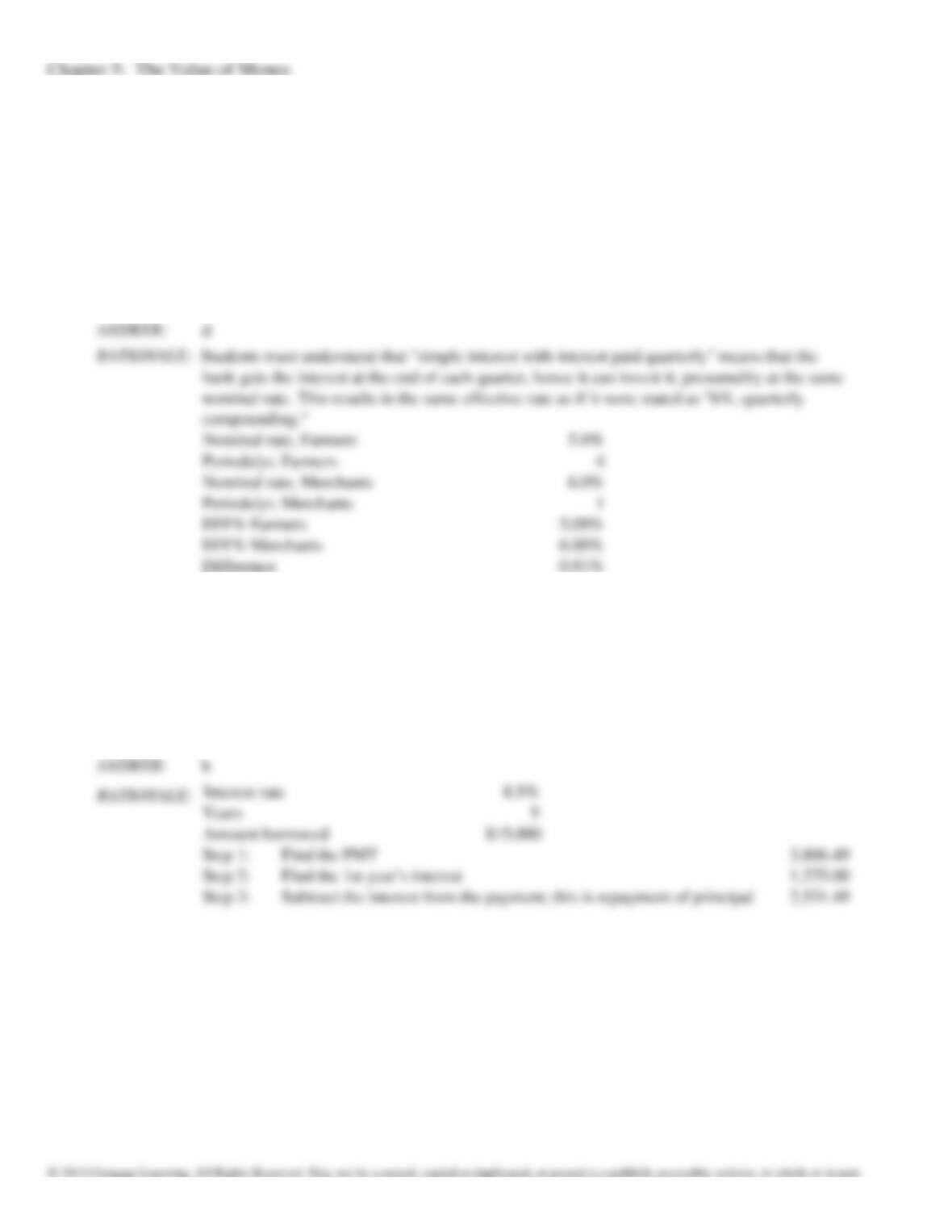
Farmers Bank offers to lend you $50,000 at a nominal rate of 5.0%, simple interest, with interest paid
quarterly.
Merchants Bank offers to lend you the $50,000, but it will charge 6.0%, simple interest, with
interest paid at the end
of the year. What’s the difference in the effective annual rates charged by the two
banks?
a. 1.56%
b. 1.30%
c. 1.09%
d. 0.91%
e. 0.72%
156.
Suppose you borrowed $15,000 at a rate of 8.5% and must repay it in 5 equal installments at the end of each
of the
next 5 years. By how much would you reduce the amount you owe in the first year?
a. $2,404.91
b. $2,531.49
c. $2,658.06
d. $2,790.96
e. $2,930.51
11.0%
Per. r
0.9167%
157.
Suppose you borrowed $15,000 at a rate of 8.5% and must repay it in 5 equal installments at the end of each
of the
next 5 years. How much would you still owe at the end of the first year, after you have made the first
payment?
a. $10,155.68
b. $10,690.19
c. $11,252.83
d. $11,845.09
e. $12,468.51
158.
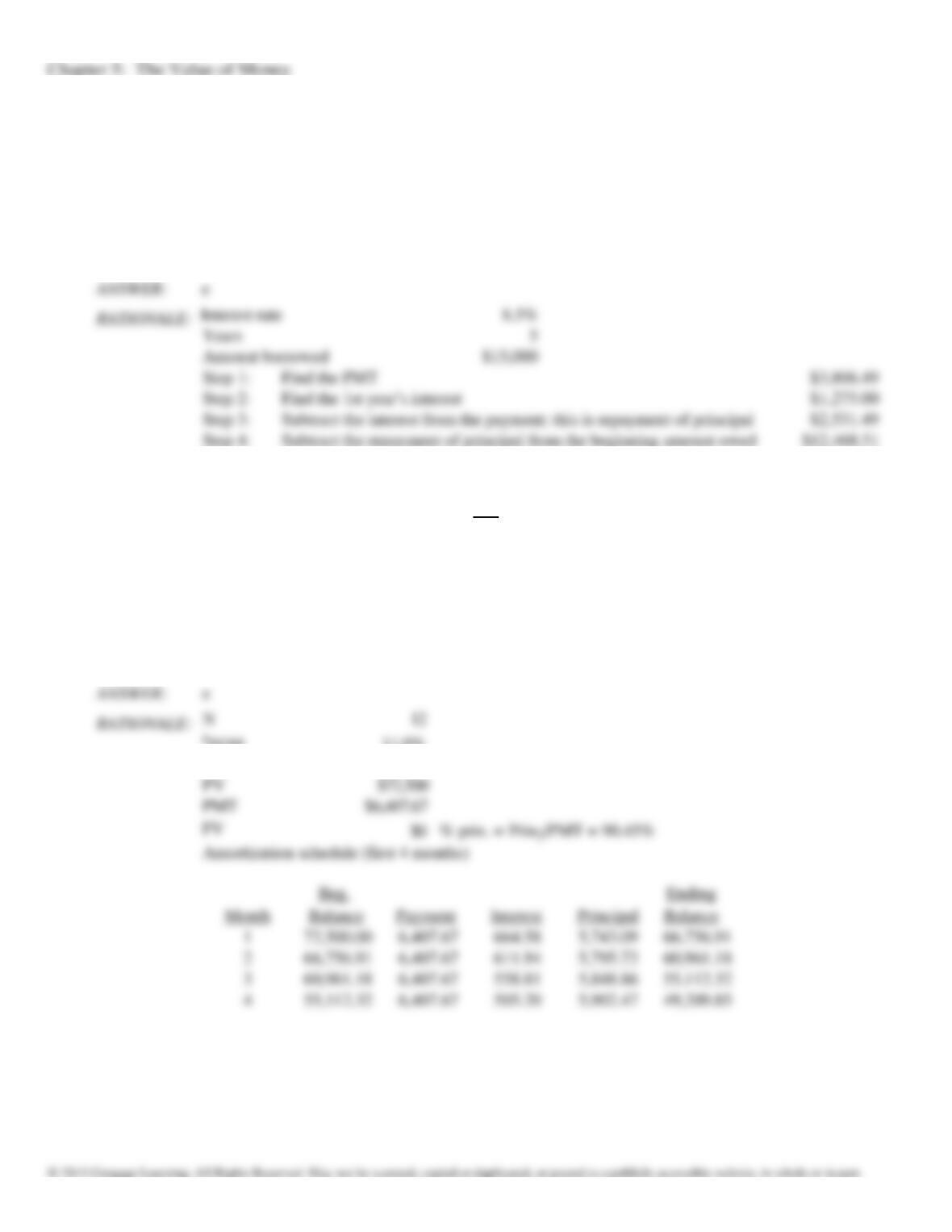
Your company has just taken out a 1-year installment loan for $72,500 at a nominal rate of 11.0% but with
equal
end-of-month payments. What percentage of the 2nd monthly payment will go toward the repayment of
principal?
a. 73.67%
b. 77.55%
c. 81.63%
d. 85.93%
e. 90.45%
159.
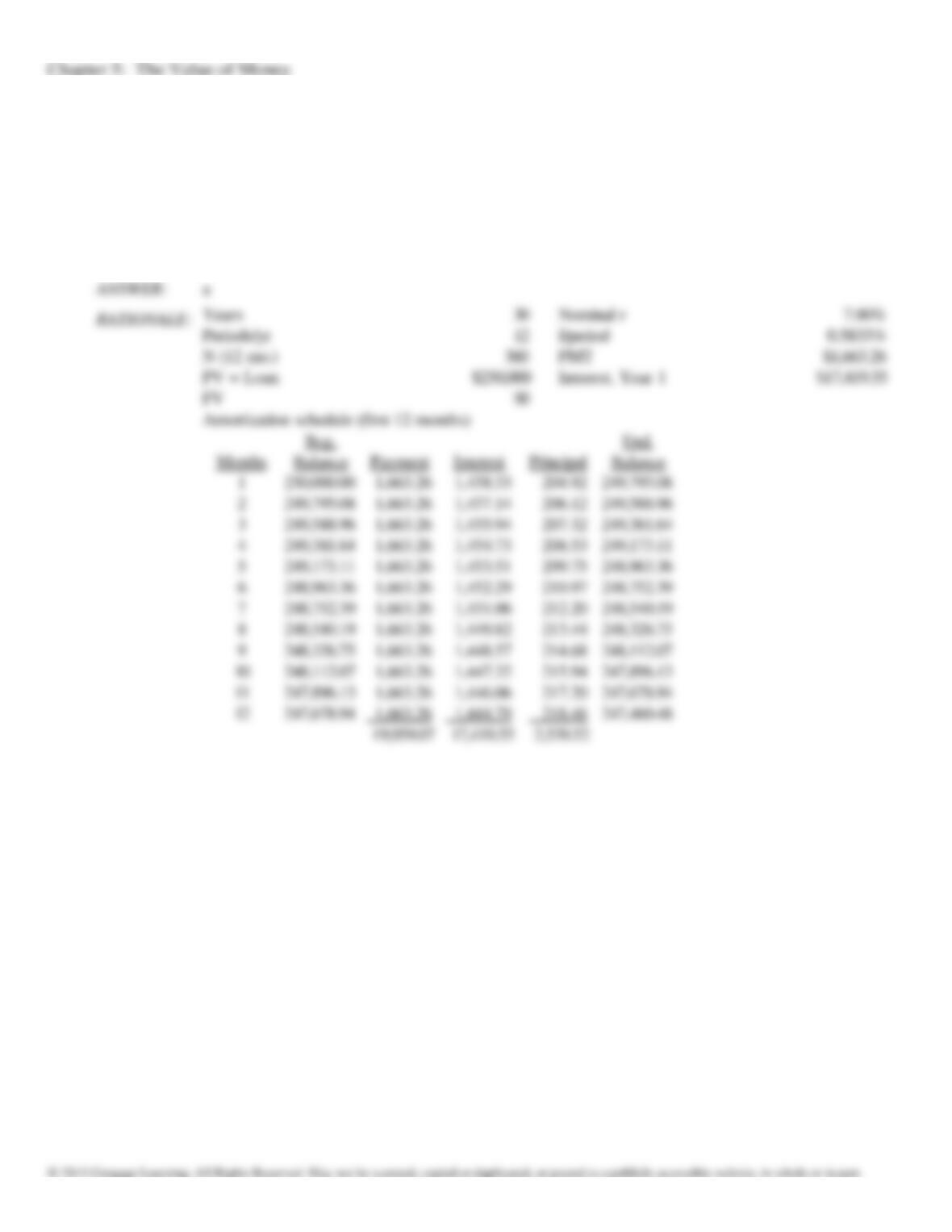
Your brother’s business obtained a 30-year amortized mortgage loan for $250,000 at a nominal annual rate of
7.0%,
with 360 end-of-month payments. The firm can deduct the interest paid for tax purposes. What will the
interest tax
deduction be for Year 1?
a. $17,419.55
b. $17,593.75
c. $17,769.68
d. $17,947.38
e. $18,126.85
160.
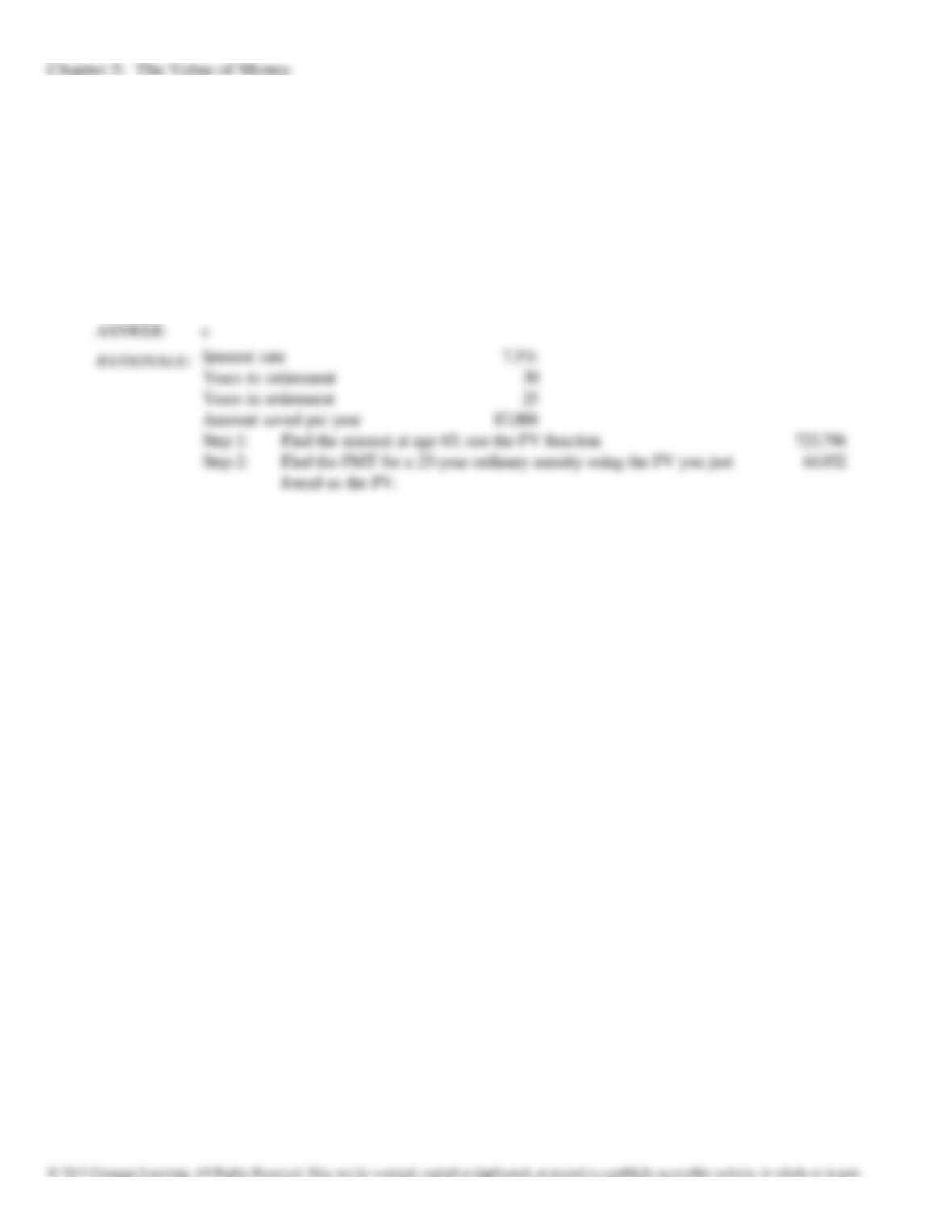
Your sister turned 35 today, and she is planning to save $7,000 per year for retirement, with the first deposit
to be
made one year from today. She will invest in a mutual fund that’s expected to provide a return of 7.5%
per year.
She plans to retire 30 years from today, when she turns 65, and she expects to live for 25 years after
retirement, to
age 90. Under these assumptions, how much can she spend each year after she retires? Her first
withdrawal will
be made at the end of her first retirement year.
a. $58,601
b. $61,686
c. $64,932
d. $68,179
e. $71,588
161.
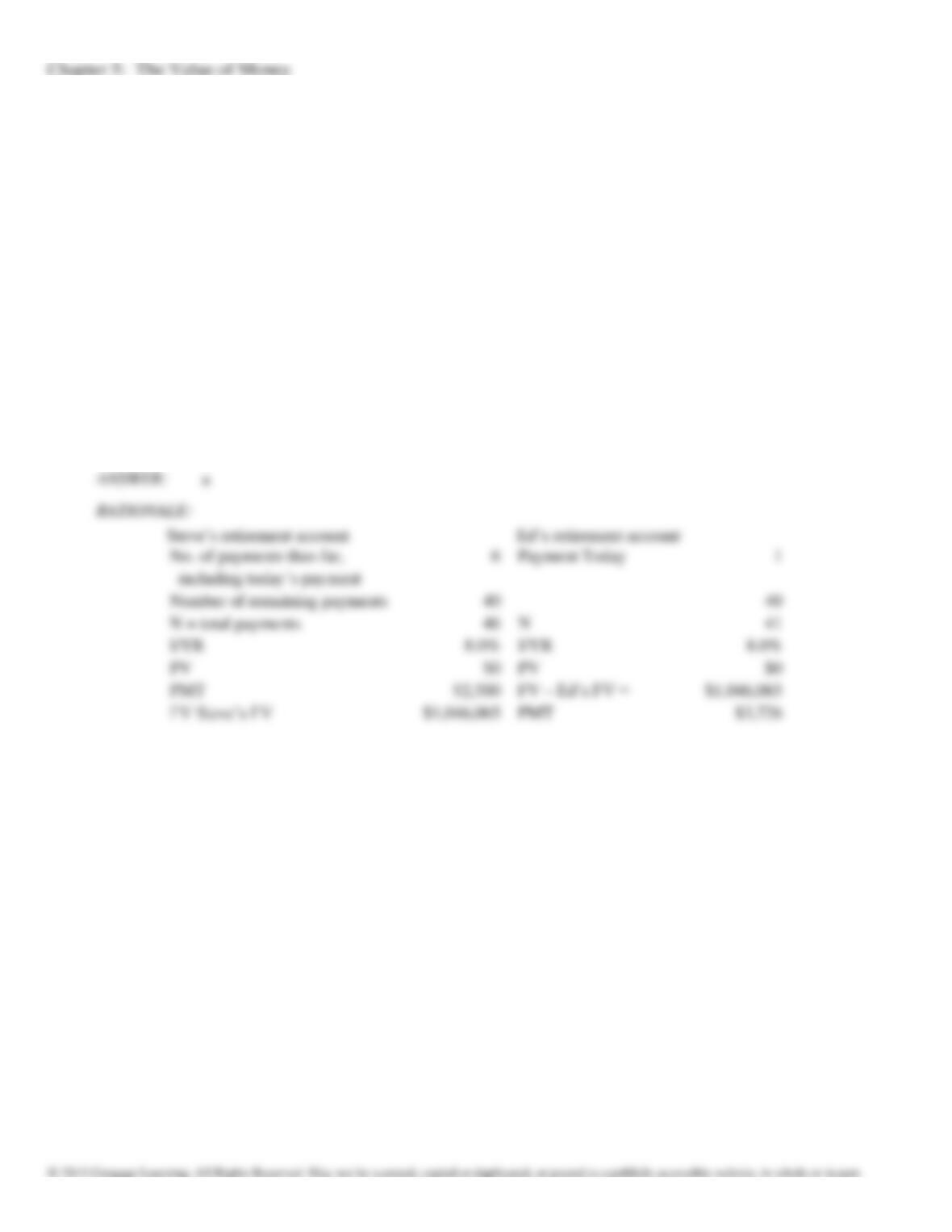
Steve and Ed are cousins who were both born on the same day, and both turned 25 today. Their grandfather
began
putting $2,500 per year into a trust fund for Steve on his 20th birthday, and he just made a 6th payment
into the
fund. The grandfather (or his estate’s trustee) will make 40 more $2,500 payments until a 46th and
final payment is
made on Steve’s 65th birthday. The grandfather set things up this way because he wants
Steve to work, not be a
“trust fund baby,” but he also wants to ensure that Steve is provided for in his old age.
Until now, the grandfather has been disappointed with Ed, hence has not given him anything. However, they
recently reconciled, and the grandfather decided to make an equivalent provision for Ed. He will make the
first
payment to a trust for Ed today, and he has instructed his trustee to make 40 additional equal annual
payments until
Ed turns 65, when the 41st and final payment will be made. If both trusts earn an annual return
of 8%, how much
must the grandfather put into Ed’s trust today and each subsequent year to enable him to
have the same retirement
nest egg as Steve after the last payment is made on their 65th birthday?
a. $3,726
b. $3,912
c. $4,107
d. $4,313
e. $4,528
162.
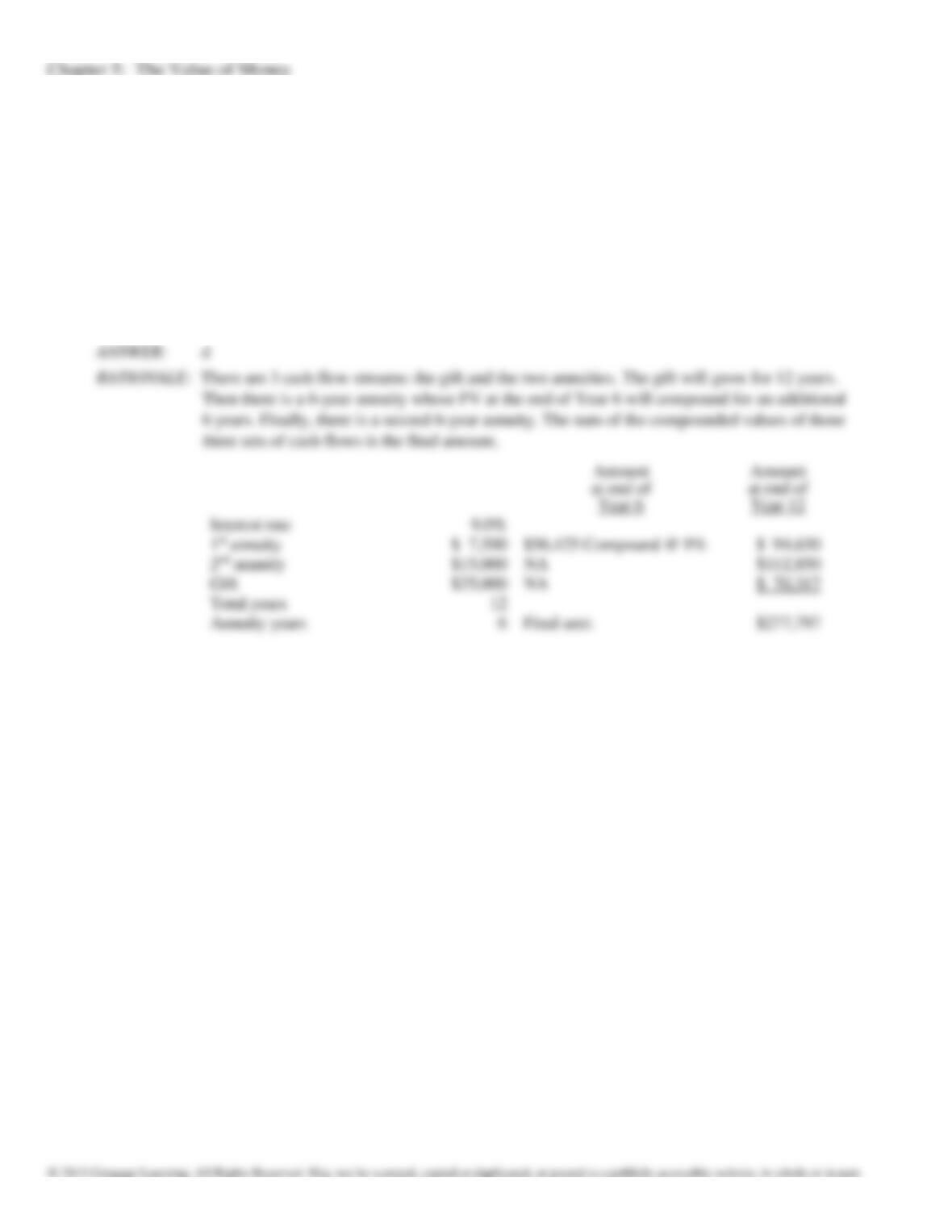
After graduation, you plan to work for Dynamo Corporation for 12 years and then start your own business.
You
expect to save and deposit $7,500 a year for the first 6 years (t = 1 through t = 6) and $15,000 annually
for the
following 6 years (t = 7 through t = 12). The first deposit will be made a year from today. In addition,
your
grandfather just gave you a $25,000 graduation gift which you will deposit immediately (t = 0). If the
account earns
9% compounded annually, how much will you have when you start your business 12 years
from now?
a. $238,176
b. $250,712
c. $263,907
d. $277,797
e. $291,687
163.
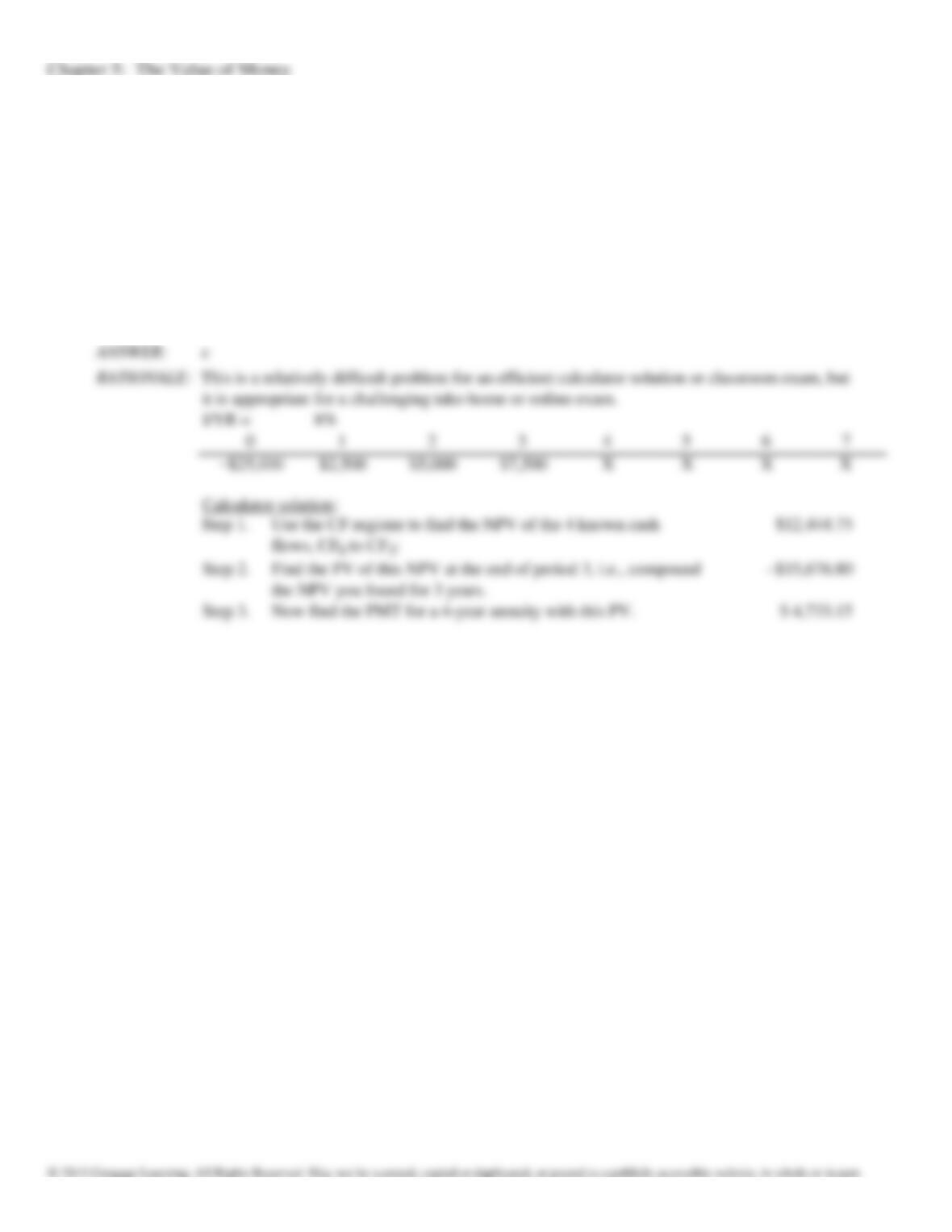
You are negotiating to make a 7-year loan of $25,000 to Breck Inc. To repay you, Breck will pay $2,500 at
the end
of Year 1, $5,000 at the end of Year 2, and $7,500 at the end of Year 3, plus a fixed but currently
unspecified cash
flow, X, at the end of each year from Year 4 through Year 7. Breck is essentially riskless, so
you are confident the
payments will be made. You regard 8% as an appropriate rate of return on a low risk but
illiquid 7-year loan. What
cash flow must the investment provide at the end of each of the final 4 years, that
is, what is X?
a. $4,271.67
b. $4,496.49
c. $4,733.15
d. $4,969.81
e. $5,218.30
164.
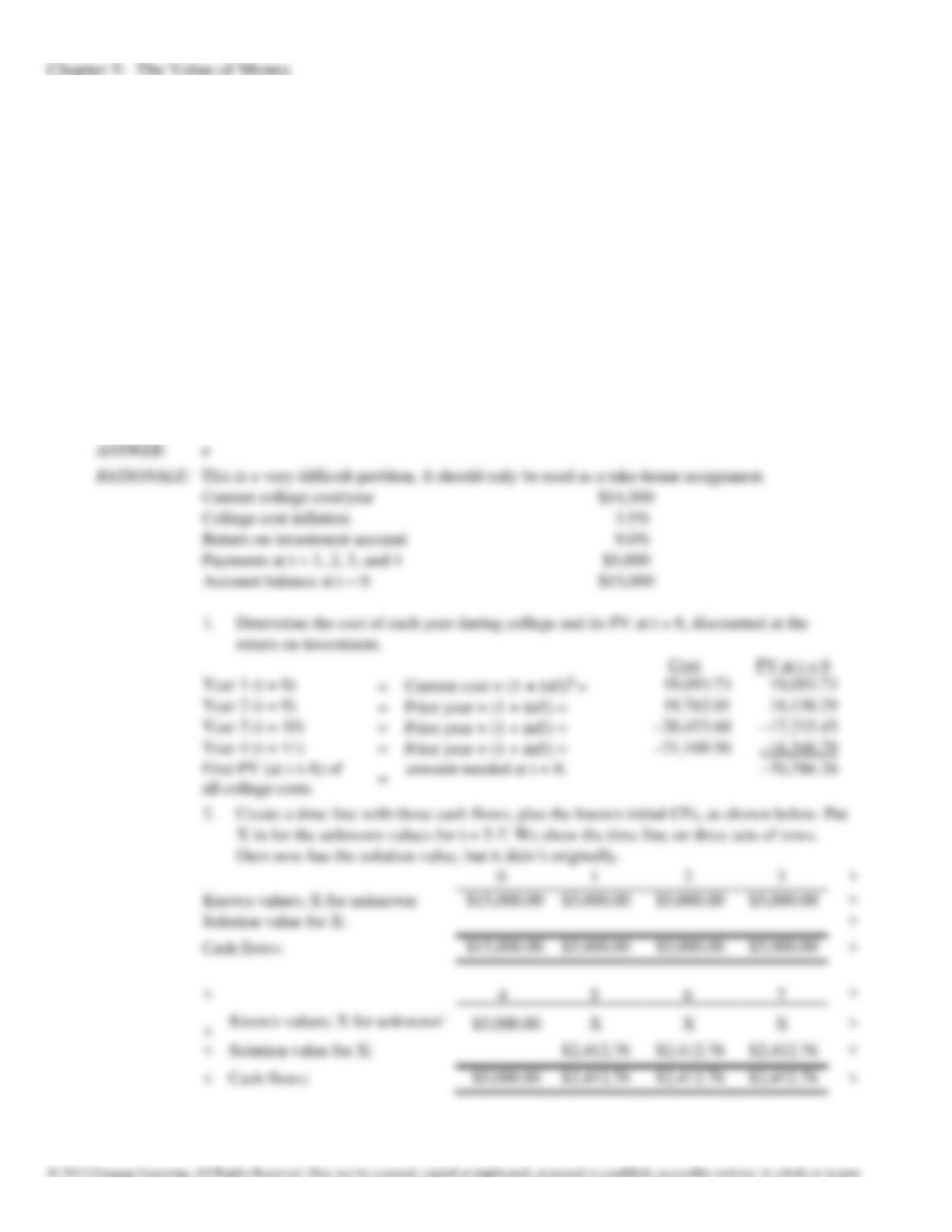
John and Daphne are saving for their daughter Ellen’s college education. Ellen just turned 10 (at t = 0), and
she will
be entering college 8 years from now (at t = 8). College tuition and expenses at State U. are currently
$14,500 a
year, but they are expected to increase at a rate of 3.5% a year. Ellen should graduate in 4 years if
she takes
longer or wants to go to graduate school, she will be on her own. Tuition and other costs will be due
at the
beginning of each school year (at t = 8, 9, 10, and 11).
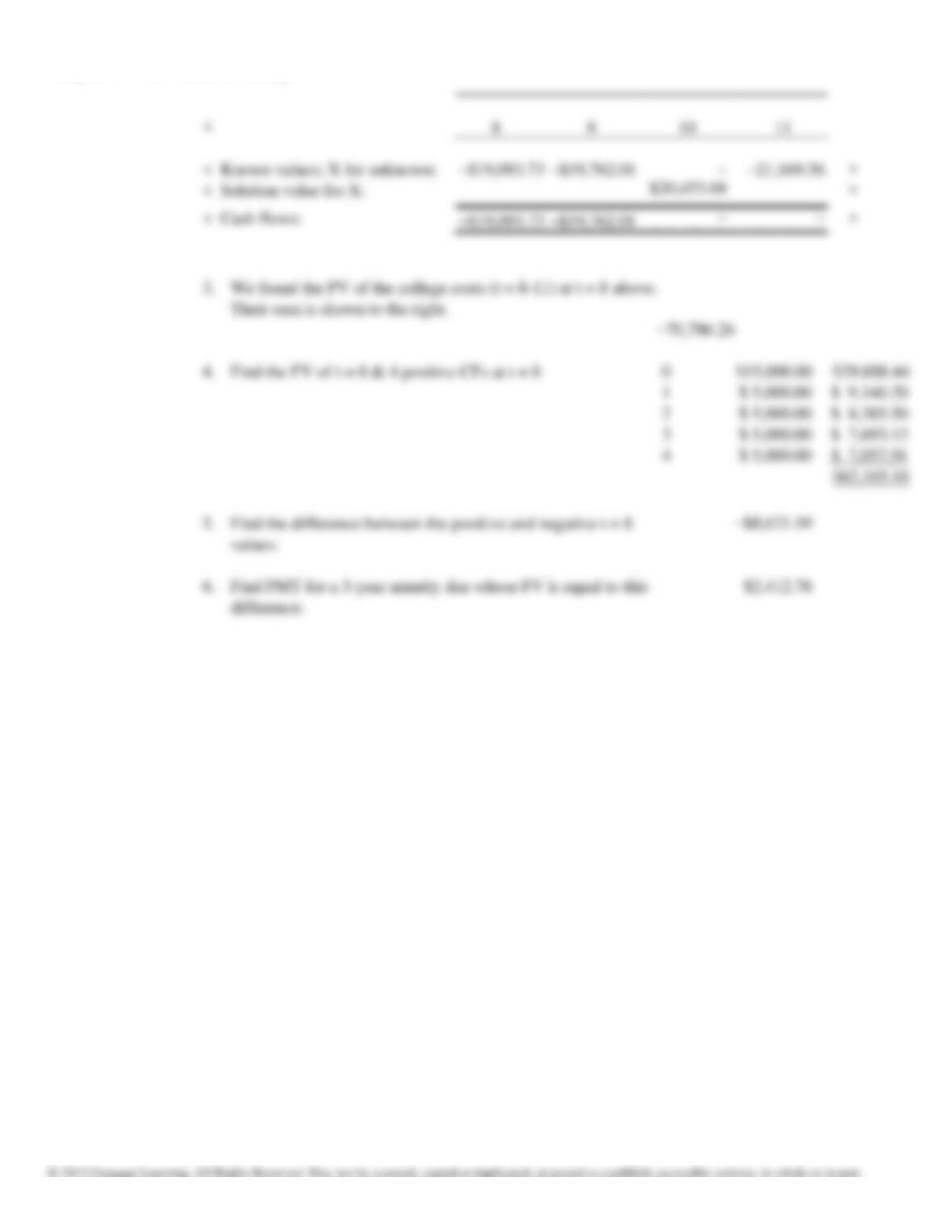
So far, John and Daphne have accumulated $15,000 in their college savings account (at t = 0). Their long-run
financial plan is to add an additional $5,000 in each of the next 4 years (at t = 1, 2, 3, and 4). Then they plan
to
make 3 equal annual contributions in each of the following years, t = 5, 6, and 7. They expect their
investment
account to earn 9%. How large must the annual payments at t = 5, 6, and 7 be to cover Ellen’s
anticipated college
costs?
a. $1,965.21
b. $2,068.64
c. $2,177.51
d. $2,292.12
e. $2,412.76
Chapter 5: The Value of Money