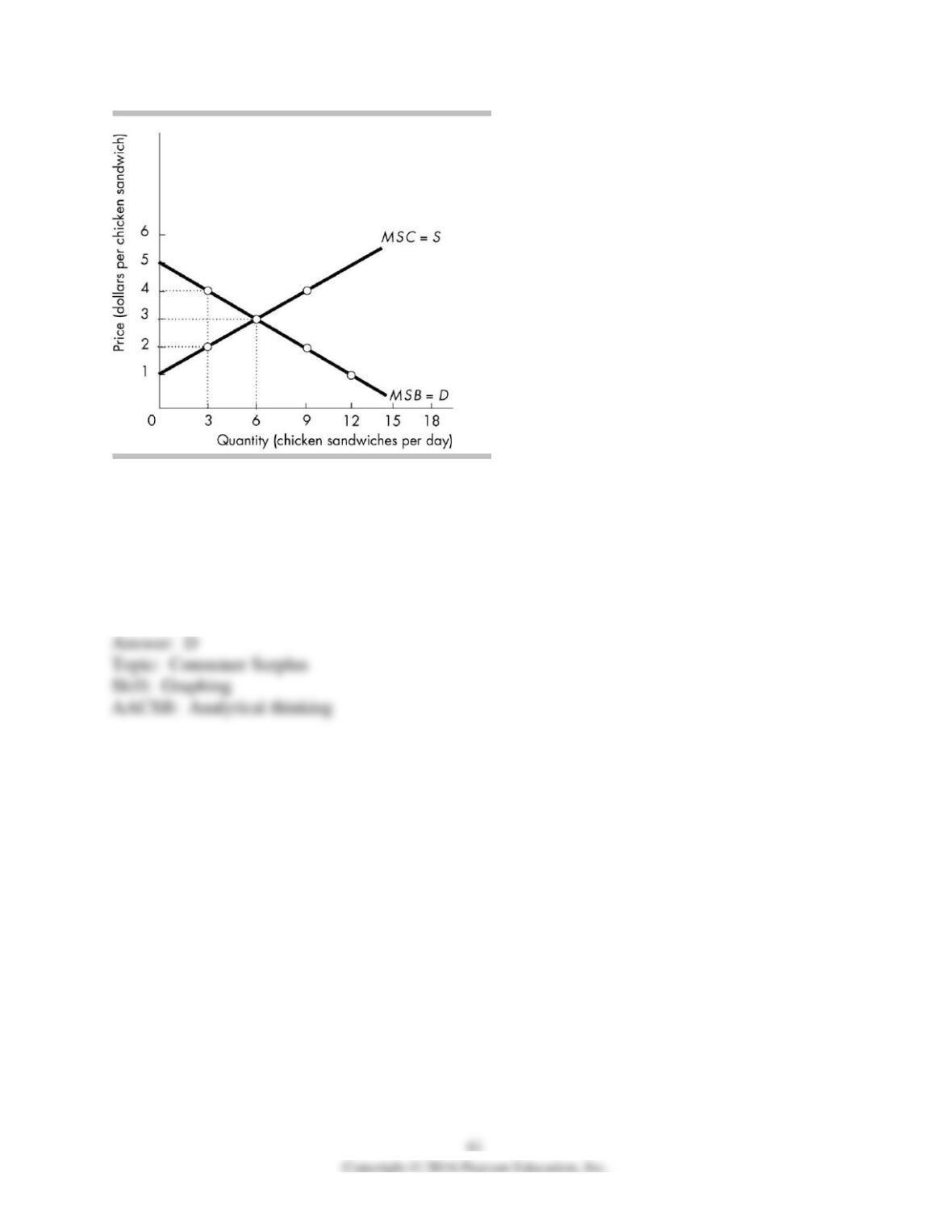
55) The above figure illustrates the marginal social benefit and marginal social cost for chicken
sandwiches. If the quantity is decreased from 6 to 3 and the price increases from $3 to $4,
consumer surplus will decrease by
A) $1.50.
B) $2.00.
C) $3.00.
D) $4.50.
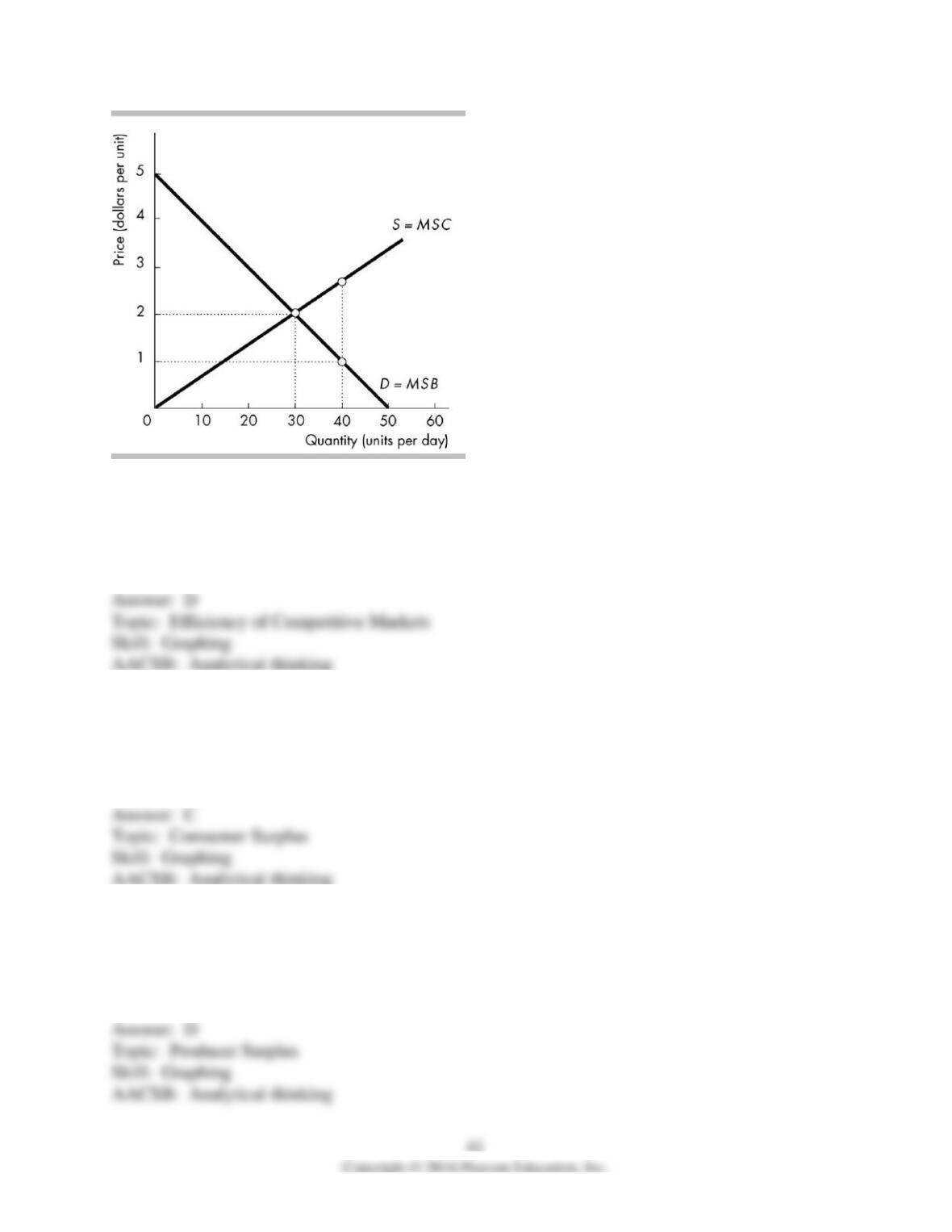
56) In the above figure, suppose the quantity produced is 40. Then
A) the marginal social cost of the 40th unit is $1.
B) the willingness to pay for the 40th unit is $2, the equilibrium price.
C) production is not efficient because MSB > MSC.
D) production is not efficient because MSC>MSB.
57) In the above figure, at the equilibrium price and quantity, consumer surplus is ________.
A) $90
B) $60
C) $45
D) $30
58) In the above figure, at the equilibrium price and quantity, producer surplus is ________.
A) $90
B) $60
C) $45
D) $30
59) Adam Smith argued that each person in a competitive market is led to promote the
A) efficient use of society’s resources, because each person’s intention is to make society better
off.
B) efficient use of society’s resources, even though it is no person’s intention to make society
better off.
C) inefficient use of society’s resources, even though each person’s intention is to make society
better off.
D) inefficient use of society’s resources, because it is no person’s intention to make society better
off.
60) At the efficient level of production, ________.
A) producer surplus must be greater than consumer surplus
B) consumer surplus must be greater than producer surplus
C) there is no deadweight loss
D) the market price is greater than the monopoly price
61) Underproduction of good ________ create a deadweight loss and overproduction of a good
________ create a deadweight loss.
A) will; will
B) will; will not
C) will not; will
D) will not; will not
62) If there are no external costs or benefits, no price or quantity regulations, no taxes or
subsidies, and the good is not a public good or a common resource, then efficiency is
A) achieved when a monopoly produces the good.
B) achieved when the good is produced in a competitive market.
C) achieved when the amount of output exceeds the amount produced in a competitive market.
D) unrelated to the amount produced in a competitive market.
63) A firm that is the only seller of a product and is in sole control of a market has a
A) monopoly.
B) quantity regulations.
C) subsidy.
D) public good.
64) A public good can be consumed by
A) only one person who does not have to pay for it.
B) only one person who has to pay for it.
C) everyone simultaneously, as long as they pay for it.
D) everyone simultaneously, even if they do not pay for it.
65) Among the sources of economic inefficiency are all of the following EXCEPT
A) price regulations.
B) rapid technological change.
C) monopoly.
D) taxes and subsidies.
66) Among the sources of economic inefficiency are all of the following EXCEPT
A) subsidies.
B) taxes.
C) competition.
D) external costs.
67) Which of the following can prevent markets from reaching efficiency?
I. decreasing marginal benefit
II. taxes
III. quantity regulations that limit the quantity that may be produced
A) I and II
B) I and III
C) II and III
D) I, II and III
68) Which of the following can prevent markets from reaching the efficient level of production?
I. a monopoly
II. taxes
III. the product is a public good
A) I and II
B) II
C) II and III
D) I, II and III
69) Which of the following can prevent markets from reaching efficiency?
I. price regulations that cap the price that may be charged
II. increasing marginal cost
III. monopoly
A) I only
B) I and II
C) II and III
D) I and III
70) Suppose a tax is imposed on a good. This will
A) increase the price paid by the buyer and decrease the price received by the seller.
B) increase the price paid by the buyer but leave the price received by the seller unchanged.
C) decrease the price received by the seller but leave the price received by the buyer unchanged.
D) increase the price received by the seller and decrease the price paid by the buyer.
71) Which of the following is a CORRECT statement?
A) Producer surplus is an external benefit.
B) Consumer surplus is an external benefit.
C) A government subsidy paid to a producer is an external benefit.
D) None of the above statements are correct.
72) A cost borne not by the producer but by other people is called ________ cost.
A) an unregulated
B) an external
C) a consumer
D) a non-production
73) If there is an external cost from making paper, an unregulated competitive market produces
A) less than the efficient quantity.
B) the efficient quantity.
C) more than the efficient quantity.
D) a quantity that could be greater than, the same as, or less than the efficient amount.
74) An external benefit is a benefit that ________.
A) is enjoyed by someone other than the buyer of a good
B) always equals external cost
C) experiences increasing marginal returns
D) is greatest at the equilibrium point
75) The pollution created when coal is burned by utilities to generate electricity is an example of
________.
A) a marginal benefit to coal producers
B) a welfare cost
C) an external cost
D) a cost paid by the utilities
76) The supplier of your ________ is most likely a monopoly.
A) shoes
B) toothpaste
C) textbooks
D) home electricity
77) Which of the following conditions could lead to an inefficient quantity of pretzels being
produced?
A) the existence of many producers of pretzels
B) the existence of many consumers of pretzels
C) the existence of a single producer and seller of pretzels
D) All of the above conditions could cause the actual quantity of pretzels to be an inefficient
quantity.
78) If the market for diamonds is a monopoly, then
A) there is an inefficient amount of resources allocated to the diamond market.
B) the prices of diamonds are too low.
C) diamond production is at the amount where the marginal social benefit equals the marginal
social cost.
D) the diamond market is efficient.
79) If the government subsidizes the production of a good
A) an efficient outcome for producers occurs.
B) overproduction relative to the efficient quantity occurs.
C) a deadweight loss is created.
D) Both answers B and C are correct.
80) Competitive markets will generally produce
A) too much of a public good.
B) too little of a public good.
C) the efficient amount of a public good.
D) the efficient amount of a public good in the short run, but not in the long run.
81) Underproduction compared to the efficient amount implies that for the last unit produced
A) marginal social benefit exceeds marginal social cost.
B) marginal social benefit equals marginal social cost.
C) marginal social cost exceeds marginal social benefit.
D) the deadweight loss is zero.
82) If the government restricts the selling of corn so that the quantity is less than the equilibrium
quantity, then the policy
I. creates a deadweight loss.
II. decreases total surplus.
A) Only I is correct.
B) Only II is correct.
C) Both I and II are correct.
D) Neither I nor II is correct.
83) Overproduction compared to the efficient amount implies that for the last unit produced
A) marginal social benefit exceeds marginal social cost.
B) marginal social benefit equals marginal social cost.
C) marginal social cost exceeds marginal social benefit.
D) the deadweight loss is zero.
84) If the quantity of corn is such that the marginal cost of corn is greater than the marginal
benefit of corn, then
I. there is a deadweight loss.
II. more than the efficient quantity of corn is produced.
A) Only I is correct.
B) Only II is correct.
C) Both I and II are correct.
D) Neither I nor II is correct.
85) The decrease in consumer surplus and producer surplus that results from an inefficient level
of production is called the
A) external cost.
B) external benefit.
C) deadweight loss.
D) big tradeoff.
86) Deadweight loss is
A) not a social loss.
B) made up of a loss of only consumer surplus.
C) made up of a loss of only producer surplus.
D) made up of a loss of both consumer surplus and producer surplus.
87) Deadweight loss can be the result of
A) overproduction, but not underproduction.
B) underproduction, but not overproduction.
C) both overproduction and underproduction.
D) neither overproduction, nor underproduction.
88) Deadweight loss is the decrease in ________ from producing an inefficient amount of a
product.
A) only consumer surplus
B) only producer surplus
C) consumer surplus and producer surplus
D) profit
89) When a deadweight loss occurs in a market, we can be certain that
A) taxes have been imposed in a market.
B) the market is a monopoly.
C) there underproduction in the market.
D) the entire society experiences a loss.
90) By reducing its output compared to a competitive market, a monopoly leads to
A) a more efficient use of resources.
B) external benefits.
C) external costs.
D) a deadweight loss.
91) The reduction in consumer and producer surplus that results from underproduction is called
A) an internal cost.
B) a deadweight loss.
C) a quantity loss.
D) None of the above answers is correct.
92) The figure illustrates the market for bagels. If the number of bagels is cut from 20 to 10 an
hour, the deadweight loss is ________.
A) $0.50 a bagel
B) -$5.00 an hour
C) $0 an hour
D) $5.00 an hour
93) The figure illustrates the market for bagels. If the number of bagels is increased from 20 to
30 an hour, consumer surplus plus producer surplus ________ and deadweight loss is ________.
A) decreases; negative
B) decreases; positive
C) increases; positive
D) increases; negative
94) In the above figure, the efficient quantity of magazines to produce per day is
A) 0, because that is where the marginal social benefit exceeds the marginal social cost by as
much as possible.
B) more than 0 and less than 300,000 magazines.
C) 300,000 magazines.
D) more than 300,000 magazines.
95) In the above figure, when the efficient quantity is produced the marginal social cost of the
last magazine is
A) $1.
B) $3.
C) $5.
D) some amount not given in the above three answers.
96) In the above figure, when the efficient quantity is produced the marginal social benefit of the
last magazine is
A) $1.
B) $3.
C) $5.
D) some amount not given in the above three answers.
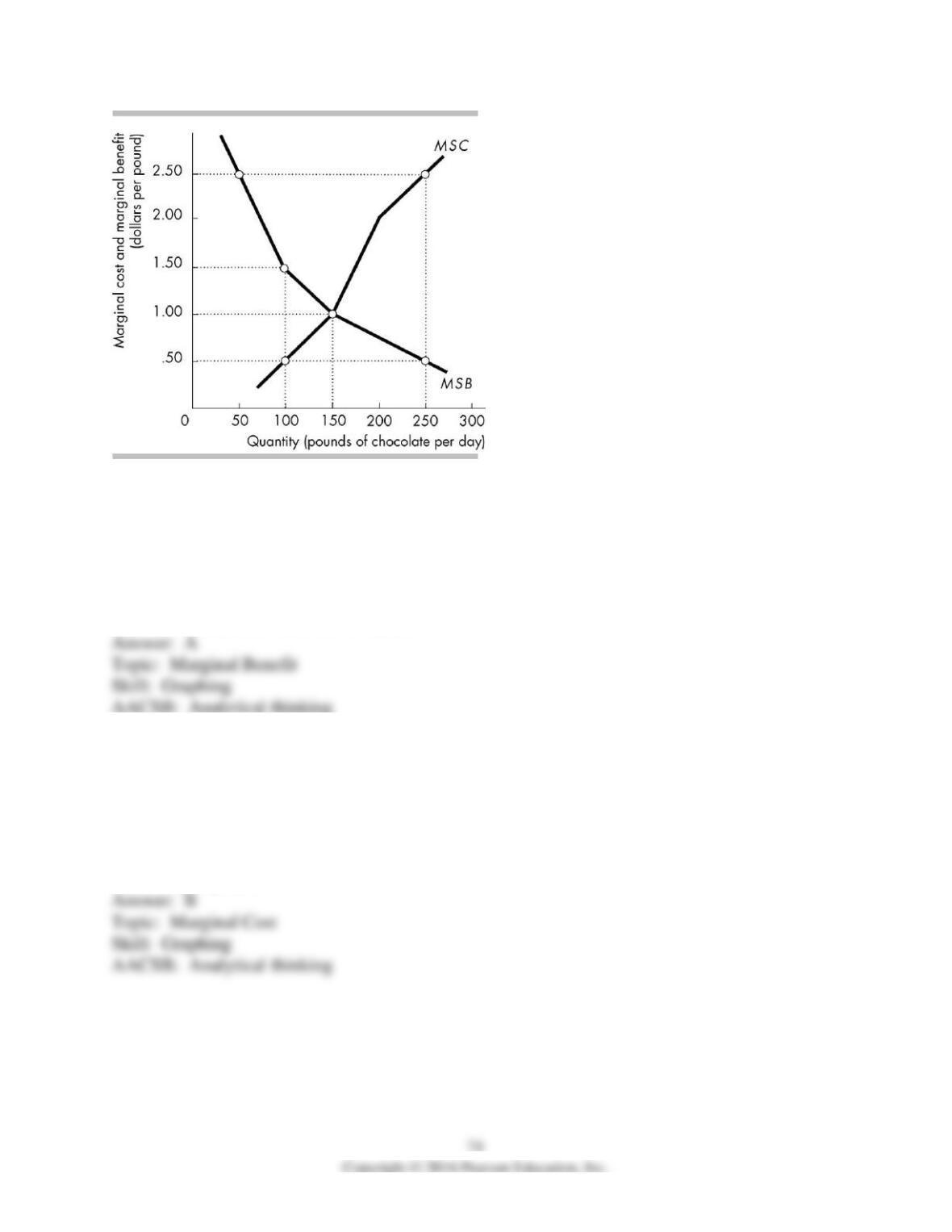
97) The above figure shows the marginal social benefit and marginal social cost curves of
chocolate in the nation of Kaffenia. What is the marginal social benefit from the 100th pound of
chocolate each day?
A) $1.50 per pound
B) $1.00 per pound
C) $0.50 per pound
D) None of the above answers is correct.
98) The above figure shows the marginal social benefit and marginal social cost curves of
chocolate in the nation of Kaffenia. What is the marginal social cost of producing the 250th
pound of chocolate each day?
A) $625.00 per pound
B) $2.50 per pound
C) $1.00 per pound
D) $0.50 per pound
99) The above figure shows the marginal social benefit and marginal social cost curves of
chocolate in the nation of Kaffenia. What is the efficient quantity of chocolate to produce each
day?
A) zero
B) 100 pounds
C) 150 pounds
D) 250 pounds
100) The above figure shows the marginal social benefit and marginal social cost curves of
chocolate in the nation of Kaffenia. When the marginal social benefit is equal to the marginal
social cost of chocolate in Kaffenia
A) either 100 pounds or 250 pounds can be produced each day.
B) no chocolate is produced.
C) 150 pounds will be produced each day.
D) any quantity up to 150 pounds will be efficient.
101) The above figure shows the marginal social benefit and marginal social cost curves of
chocolate in the nation of Kaffenia. There is no external benefit nor external cost. The demand
curve for chocolate is the same as the
A) marginal social cost curve of chocolate.
B) marginal social benefit curve of chocolate.
C) opportunity cost curve of chocolate.
D) marginal social benefit curve minus the marginal social cost curve of chocolate.
102) The above figure shows the marginal social benefit and marginal social cost curves of
chocolate in the nation of Kaffenia. At Kaffenia’s efficient quantity of chocolate
A) total consumer surplus is zero.
B) total producer surplus is zero.
C) the sum of consumer surplus and producer surplus is zero.
D) the sum of consumer surplus and producer surplus is maximized.
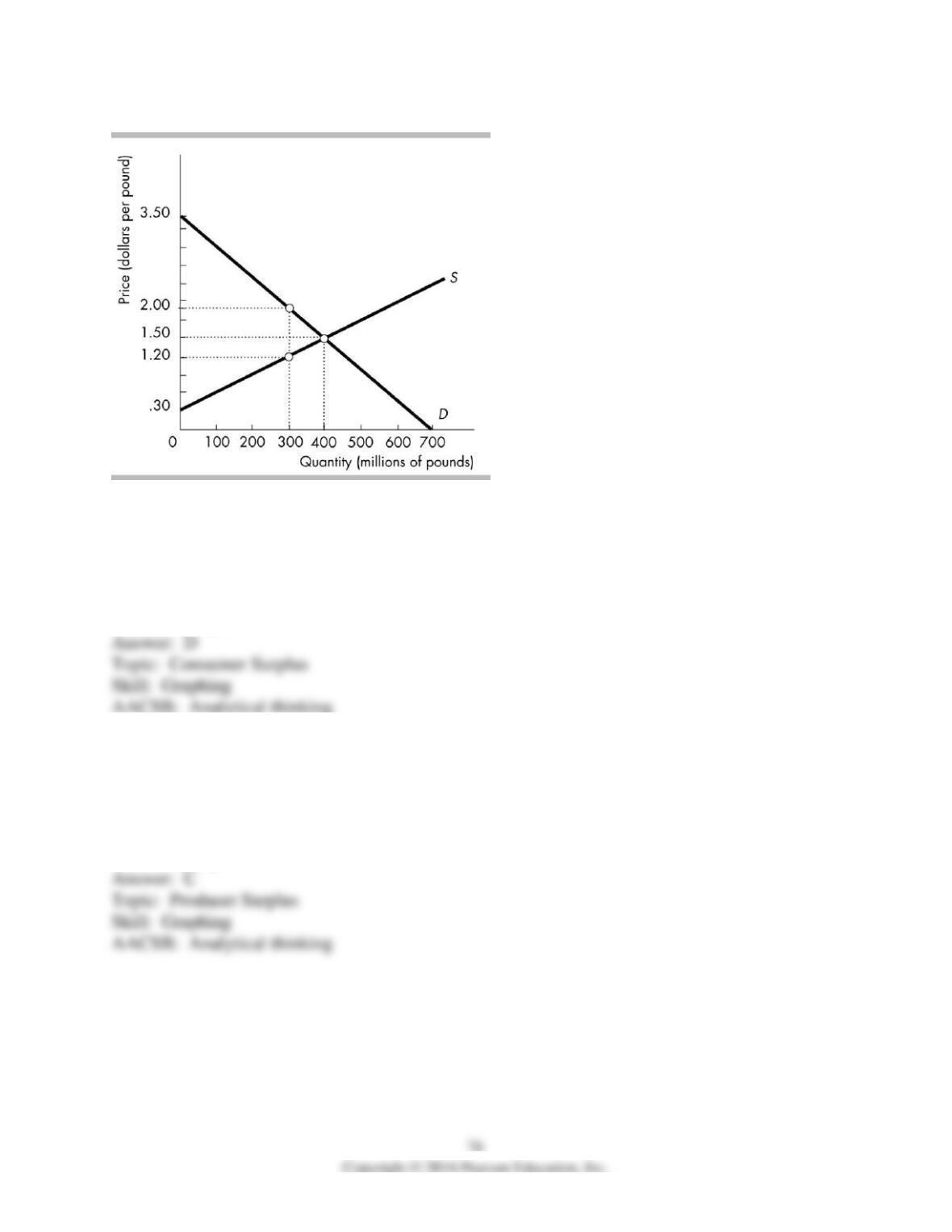
103) The above figure shows the competitive market for turkey. The consumer surplus for the
300 millionth pound of turkey is
A) $2.00 per pound.
B) $225 million.
C) $0.80 per pound.
D) $0.50 per pound.
104) The above figure shows the competitive market for turkey. The producer surplus for the 300
millionth pound of turkey is
A) $1.20 per pound.
B) $135 million.
C) $0.30 per pound.
D) $0.80 per pound.
105) At the competitive market outcome in the above figure, the
A) consumer surplus on the last pound of turkey consumed is equal to zero.
B) total consumer surplus from turkey consumption is $400 million.
C) deadweight loss from turkey consumption is equal to zero.
D) All of the above answers are correct.
106) At the competitive market outcome in the above figure, the
A) producer surplus is equal to $480 million.
B) total producer surplus from turkey sales is zero.
C) sum of consumer and producer surpluses from turkey is $640 million.
D) All of the above answers are correct.
107) In the above figure, if output were restricted to 300 million pounds of turkey, then
A) the marginal social benefit would exceed the marginal social cost on the last pound of turkey
traded by $0.80.
B) there would be a deadweight loss of $40 million.
C) there would be inefficient underproduction of turkey.
D) All of the above answers are correct.
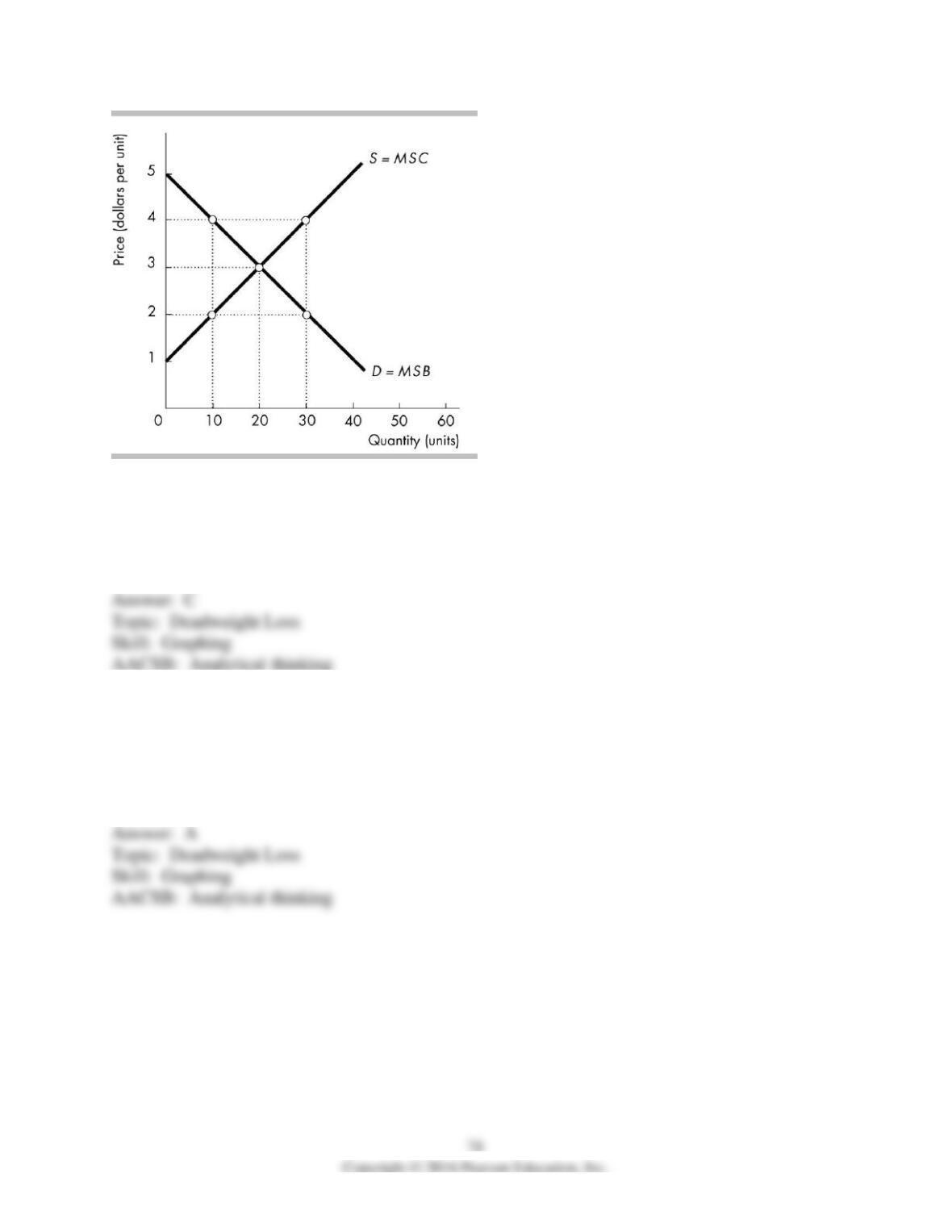
108) In the above figure, the deadweight loss is zero if output is
A) 0 units.
B) 10 units.
C) 20 units.
D) 30 units.
109) In the above figure, of the quantities listed below, for which is the total deadweight loss the
largest?
A) 0 units
B) 10 units
C) 20 units
D) 30 units
110) In the above figure, as output increases from 0 units to 10 units to 20 units to 30 units, the
deadweight loss
A) falls.
B) falls at first, then rises.
C) rises.
D) rises at first, then falls.
111) In the above figure, if output is 30 units, then the total deadweight loss is
A) $5.
B) $10.
C) $20.
D) $60.
112) In the above figure, if output is 10 units, then the total deadweight loss is
A) $5.
B) $10.
C) $20.
D) $60.
113) In the above figure, suppose that the government sets a limit to production at 10 units of
output and the price rises to $4. In comparison to a competitive market the consumer surplus
would fall by
A) $0.
B) $10.
C) $15.
D) $20.
114) In the above figure, suppose that the government sets a limit that may be produced of 10
units of output and the price rises to $4. In comparison to a competitive market the producer
surplus would rise by
A) $0.
B) $5.
C) $15.
D) $20.
115) In the above figure, suppose that the government sets a limit that may be produced of 10
units of output and the price rises to $4. The total deadweight loss would be
A) $0.
B) $10.
C) $15.
D) $20.