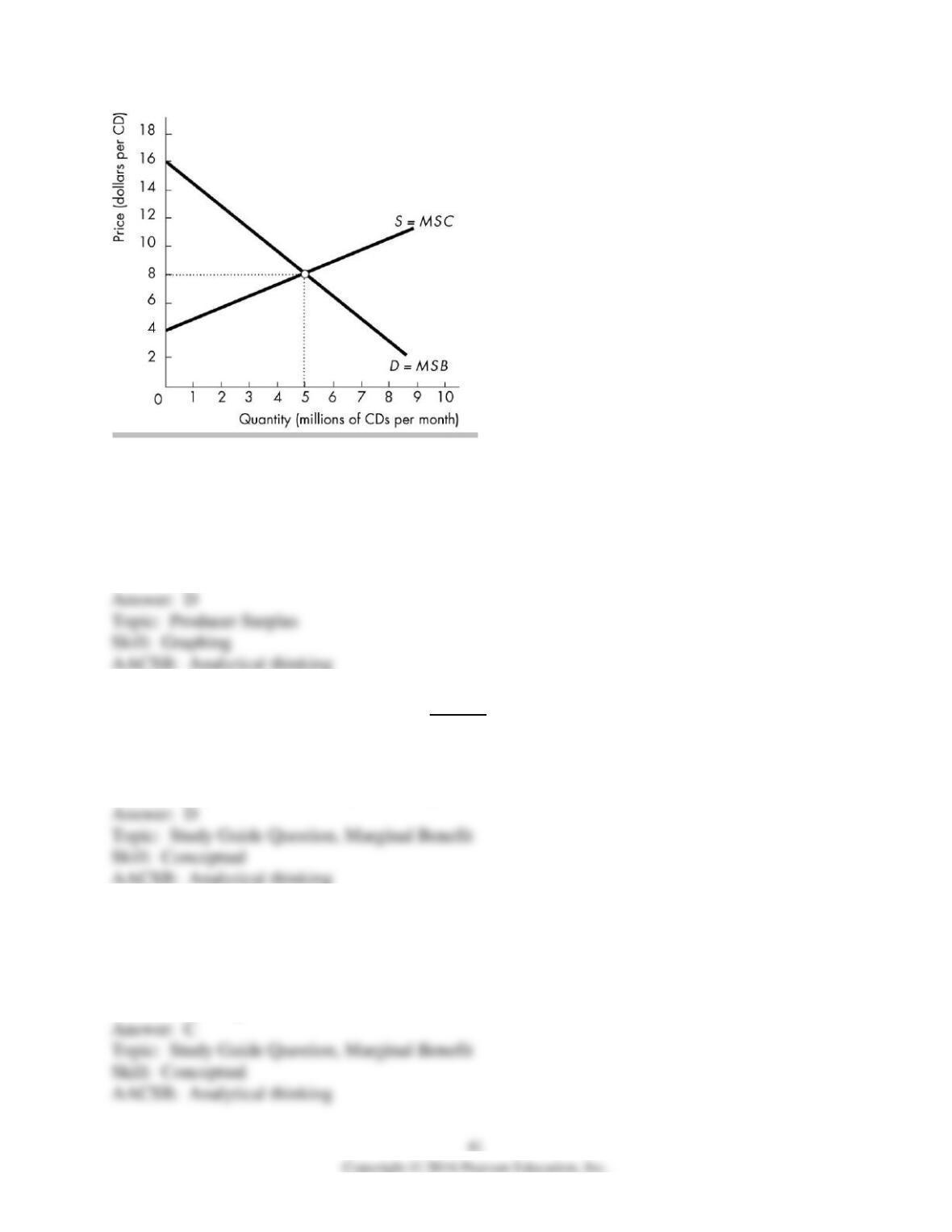
100) In the figure above, when the price of a CD is $8.00, total producer surplus from all the
CDs will be
A) zero.
B) greater than at $10.00 per CD.
C) $20 million.
D) $10 million.
101) Which of the following statements is FALSE?
A) The value of one more unit of a good is the good’s marginal benefit.
B) A good’s marginal benefit is the maximum price people are willing to pay for another unit.
C) The maximum price people are willing to pay for one more unit of a good is its value.
D) None of the above because all the statements are true.
102) The marginal social benefit curve for a product can be the same as the good’s
A) marginal cost curve.
B) supply curve.
C) demand curve.
D) consumer surplus curve.
103) Alice is willing to pay $3 for the second slice of pizza she eats. The price she pays is $2.
Alice’s consumer surplus for this slice of pizza equals
A) $0.
B) $1.
C) $2.
D) $3.
104) Charlie’s consumer surplus from the first slice of pizza he buys is greater than the consumer
surplus from the second slice because of
A) decreasing marginal benefits.
B) increasing marginal benefits.
C) decreasing marginal costs.
D) increasing marginal cost.
105) The cost of producing one more pizza is the
A) price.
B) marginal benefit.
C) marginal cost.
D) producer surplus.
106) The market supply curve shows the
A) minimum price suppliers must receive in order to produce another unit of the good.
B) maximum price suppliers must receive in order to produce another unit of the good.
C) amount of producer surplus suppliers receive.
D) profit that suppliers receive from producing another unit of the good.
107) The producer surplus from a good is equal to the
A) maximum amount a consumer is willing to pay for the good minus the price that actually
must be paid summed over the quantity sold.
B) actual price of the good minus the maximum amount a consumer is willing to pay for the
good.
C) opportunity cost of producing the good minus its price summed over the quantity sold.
D) price of the good minus its opportunity cost of production summed over the quantity sold.
3 Is the Competitive Market Efficient?
1) Total surplus is defined as
A) consumer surplus + producer surplus.
B) consumer surplus – producer surplus.
C) another word for profit.
D) another word for total revenue.
2) A market is allocatively efficient if
A) the sum of the consumer surplus and the producer surplus has been maximized.
B) consumer surplus has been maximized.
C) producer surplus has been maximized.
D) profit has been maximized.
3) If resources are used efficiently, then ________.
A) marginal social cost is minimized
B) consumer surplus plus producer surplus is maximized
C) consumer surplus equals producer surplus
D) producer surplus is maximized
4) Suppose a country produces only bikes and clothing. The country achieves an efficient
allocation of resources when
A) it can’t produce any more bikes unless it gives up clothing.
B) it produces equal amount of bikes and clothes.
C) the marginal social benefit of producing a bike equals the marginal social cost of producing a
bike.
D) the prices charged for the goods are as low as possible.
5) Resource use is efficient when
A) marginal social benefit exceeds marginal social cost.
B) marginal social cost is decreasing.
C) marginal social benefit equals marginal social cost.
D) marginal social benefit is increasing.
6) Allocative efficiency occurs when
A) marginal social cost exceeds marginal social benefit.
B) marginal social benefit exceeds marginal social cost.
C) marginal social benefit equals marginal social cost.
D) total social benefit exceeds total social cost.
7) Which of the following statements is TRUE?
A) At the efficient quantity, marginal social benefit equals marginal social cost.
B) Marginal social cost increases as the quantity produced decreases.
C) Marginal social benefit decreases as the quantity consumed decreases.
D) If marginal social benefit exceeds marginal social cost by as much as possible, production is
efficient.
8) Resource use is efficient when production is such that marginal social benefit is
A) greater than marginal social cost.
B) equal to marginal social cost.
C) less than marginal social cost.
D) at its maximum value.
9) In the competitive market for balloon rides, marginal social cost equals marginal social benefit
when 3,000 balloon rides a day are taken and the price of a ride is $130. Which of the following
statements is TRUE?
A) There is a free-rider problem.
B) Too many rides are available.
C) Too few rides are available and the price of a balloon ride is too high.
D) The efficient quantity of balloon rides is 3,000 a day.
10) It is efficient to produce an additional shirt if the
A) marginal social benefit of producing the shirt is greater than zero.
B) marginal social benefit of producing the shirt is zero.
C) marginal social benefit of producing the shirt is greater than the marginal social cost of
producing it.
D) total social benefit from producing shirts is maximized.
11) When 2,000 hamburgers per day are produced, the marginal social benefit is $1.50 and the
marginal social cost is $1.00. And when 7,500 hamburgers per day are produced, the marginal
social benefit is $1.00 and the marginal social cost is $1.50. The efficient production quantity of
hamburgers is ________ a day.
A) more than 7,500
B) 7,500
C) between 2,000 and 7,500
D) 2,000
12) In the market for DVDs, 500,000 DVDs a month are available. The value people place on the
500,000th DVD a month is less than the marginal social cost of producing it. Resource use
________.
A) is efficient
B) is inefficient
C) would be more efficient if people firms would produce more DVDs
D) would be more efficient if people would buy more DVDs
13) At the current level of output, the marginal social benefit from a slice of pizza is less than the
marginal social cost of producing a slice of pizza. Resources will be used more efficiently if
________ slices of pizza are produced and ________ other goods are produced.
A) fewer; fewer
B) more; fewer
C) more; more
D) fewer; more
14) At the current level of output, the marginal social benefit of pizza exceeds the marginal
social cost of pizza. Compared to the allocatively efficient quantity, we are producing too
________ pizza and too ________ of other goods.
A) much; little
B) much; much
C) little; little
D) little; much
15) At the current level of output, the marginal social cost of sandwiches exceeds the marginal
social benefit of sandwiches. Compared to the allocatively efficient quantity we are producing
too ________ sandwiches and too ________ of other goods.
A) many; little
B) many; much
C) few; little
D) few; much
16) At the current level of output, the marginal social cost of tennis balls is greater than the
marginal social benefit. Then
A) more than the efficient quantity of tennis balls is being produced.
B) there is excess demand for tennis balls.
C) firms producing tennis balls must be earning negative profit.
D) too few tennis balls are being produced.
17) When the amount of output is such that marginal social benefit exceeds marginal social cost,
then to reach the efficient quantity
A) production should be increased.
B) production should be decreased.
C) production should remain constant.
D) More information is needed to determine if production should be increased, decreased, or not
changed.
18) At the quantity of 200 bushels of apples, the marginal social benefit of a bushel of apples is
$100 and the marginal social cost is $50. To produce the efficient quantity of apples
A) more apples should be produced.
B) fewer apples should be produced.
C) there should be no change in the amount of apples produced.
D) More information on the willingness of consumers to purchase apples is needed to determine
the efficient level of apples.
19) At the current quantity of pizza, the marginal social benefit is greater than the marginal
social cost. Then
A) the number of pizzas produced is efficient.
B) more pizzas must be produced to reach the efficient level.
C) fewer pizzas must be produced to reach the efficient level.
D) revenue for pizza producers is maximized.
20) At the current quantity of table saws, the marginal social cost is more than the marginal
social benefit. Then
A) production of table saws should be decreased to reach the efficient level.
B) production of table saws should be increased to reach the efficient level.
C) production of table saws is currently at the efficient level.
D) producer surplus will be larger than consumer surplus.
21) At the quantity of 1000 tacos, the marginal social benefit of a taco is $.50 and the marginal
social cost is $.60. To produce the efficient quantity of tacos
A) more tacos should be produced.
B) fewer tacos should be produced
C) there should be no change in the amount of tacos produced.
D) More information on production costs is needed to determine the efficient level of tacos.
22) If the marginal cost of producing hair styling decreases, then the efficient quantity of hair
stylings to produce ________.
A) depends on the marginal benefit
B) remains the same
C) decreases
D) increases
Quantity
(DVDs per
week)
Marginal social
benefit
(dollars per
DVD)
Marginal
social cost
(dollars per
DVD)
1
24
16
2
22
18
3
20
20
4
18
22
5
16
24
23) The schedules in the table give the marginal social benefit and marginal social cost of a
DVD. If there are no external benefits or external costs, the efficient number of DVDs to produce
is ________ a week.
A) 1
B) 3
C) 5
D) any number less than 3
24) The schedules in the table give the marginal social benefit and marginal social cost of a
DVD. At the efficient quantity, the minimum supply-price of a DVD is ________ and the value
of a DVD is ________.
A) $16; $24
B) $16; $20
C) $20; $16
D) $20; $20
25) The schedules in the table give the marginal social benefit and marginal social cost of a
DVD. If the marginal cost of producing a DVD increases by $4, then the efficient number of
DVDs is ________ a week.
A) 1
B) 2
C) 5
D) 4
26) The schedules in the table give the marginal social benefit and marginal social cost of a
DVD. If the number of DVD produced is cut to 2 a week, then the ________.
A) minimum supply-price of the second DVD is $18
B) price is $18 a DVD
C) opportunity cost of the second DVD is $22
D) value of the second DVD is $20
27) When the competitive market is using its resources efficiently, the
A) total amount of consumer surplus is maximized.
B) total amount of producer surplus is maximized.
C) sum of the total amount of consumer surplus plus the total amount of producer surplus is
maximized.
D) sum of the total amount of consumer surplus plus the total amount of producer surplus equals
zero.
28) When a market is in equilibrium, the total amount of consumer surplus must be ________
the total amount of producer surplus.
A) larger than
B) equal to
C) less than
D) None of the above answers are correct.
29) When the efficient quantity of output is produced
A) the marginal social benefit of the last unit produced is equal to the marginal social cost of the
last unit produced.
B) the sum of consumer surplus and producer surplus is maximized.
C) resources are used in the activities in which they are most highly valued.
D) All of the above answers are correct.
30) If the market for roller blades is at a competitive equilibrium, and there are no external costs
or benefits, then
A) marginal social benefit is equal to marginal social cost.
B) the sum of consumer surplus and producer surplus is maximized.
C) resources are being used efficiently.
D) All of the above answers are correct.
31) If the marginal cost of producing every quantity decreases, all the following occur EXCEPT
A) minimum supply price does not change.
B) the marginal social benefit of the last unit bought changes.
C) the consumer surplus increases.
D) the efficient quantity increases.
Price
(cents per
brownie)
Quantity
demanded
(per day)
Quantity
supplied
(per day)
0
1,800
0
10
1,600
100
20
1,400
200
30
1,200
300
40
1,000
400
50
800
500
60
600
600
70
400
700
80
200
800
90
0
900
32) In the above table, what is the maximum price that consumers are willing to pay for the
200th brownie?
A) 0
B) 20¢
C) 60¢
D) 80¢
33) In the above table, what is the minimum price that producers must be offered to produce the
200th brownie?
A) 0
B) 20¢
C) 60¢
D) 80¢
34) In the above table, when 200 brownies are produced
A) marginal social benefit is greater than marginal social cost, and resource use is efficient.
B) marginal social benefit is greater than marginal social cost, and there is a deadweight loss.
C) marginal social benefit equals marginal social cost, and resource use is efficient.
D) marginal social benefit is less than marginal social cost, and there is a deadweight loss.
35) In the above table, the efficient quantity of brownies is produced when the price of a brownie
is equal to
A) 0.
B) 40¢.
C) 60¢.
D) 80¢.
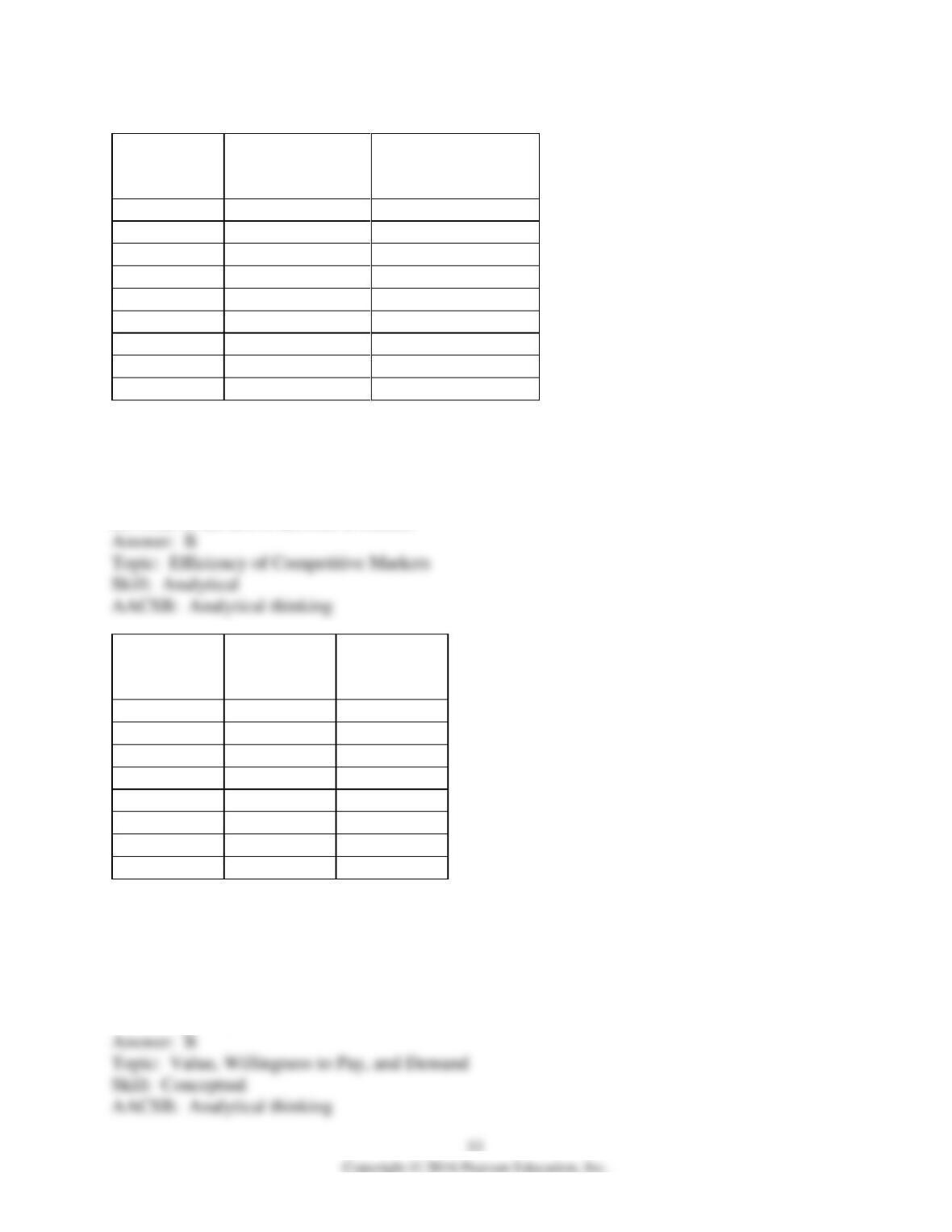
Price
(dollars)
Quantity supplied
(marginal social
cost)
Quantity demanded
(marginal social
benefit)
0
0
31
1
4
28
2
8
24
3
12
20
4
16
16
5
20
12
6
24
8
7
28
4
8
32
0
36) Based on the above table, which of the following is the efficient quantity of output?
A) 31
B) 16
C) 32
D) None of the above answers is correct.
Price
(dollars per
can)
Quantity
demanded
Quantity
supplied
0.30
1000
100
0.40
900
300
0.50
750
400
0.60
600
600
0.70
400
800
0.80
200
1000
0.90
100
1200
1.00
50
1400
37) The above table gives the market demand and market supply schedules for soda. What is the
maximum price consumers are willing to pay for the 400th can of soda?
A) $0.80 per can
B) $0.70 per can
C) $0.60 per can
D) $0.50 per can
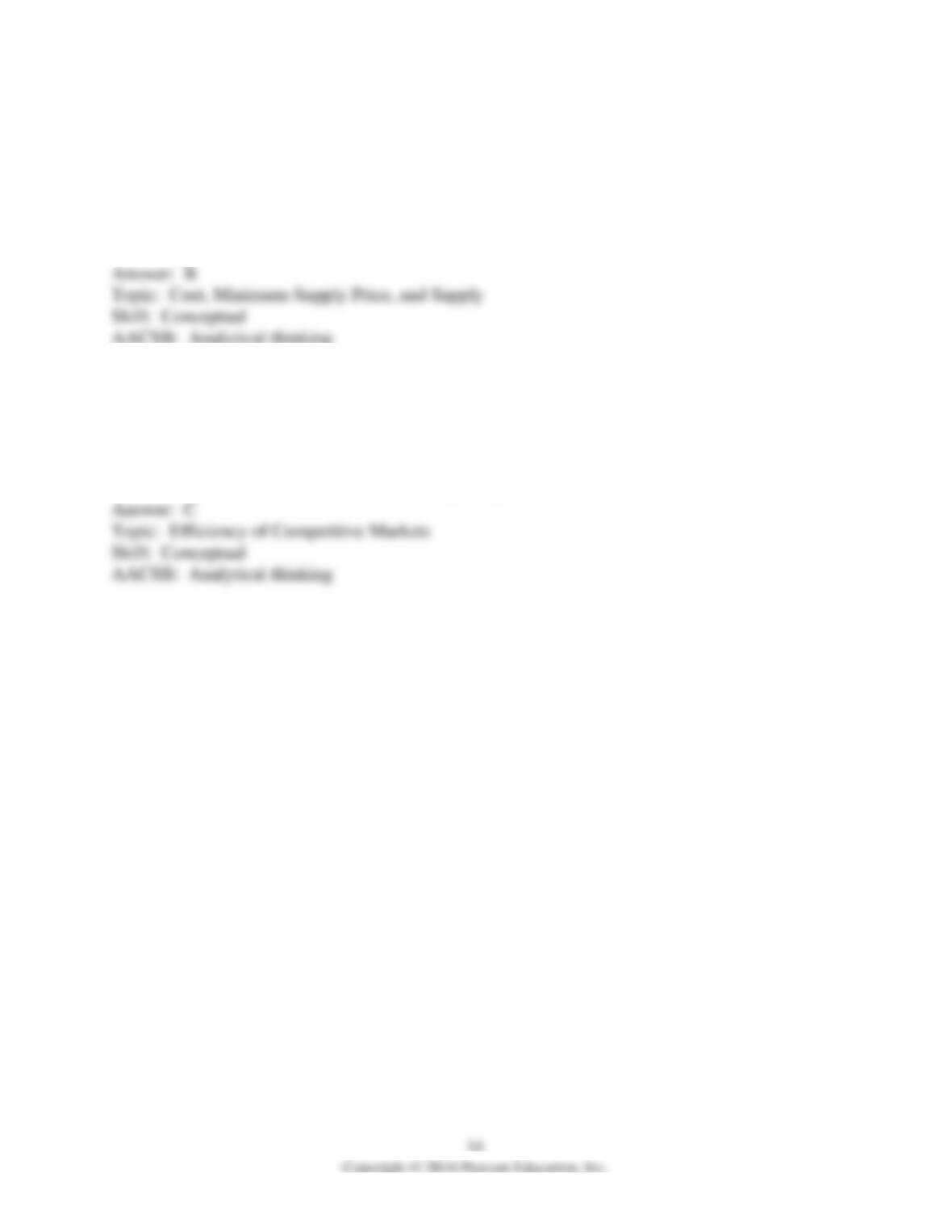
38) The above table gives the market demand and market supply schedules for soda. What is the
minimum price that producers are willing to accept for the 400th can of soda?
A) $0.40 per can
B) $0.50 per can
C) $0.60 per can
D) $0.70 per can
39) The above table gives the market demand and market supply schedules for soda. There are
no external benefits or external costs. What is the efficient quantity of soda?
A) 1400
B) 1000
C) 600
D) It is impossible to determine the efficient quantity without more information.
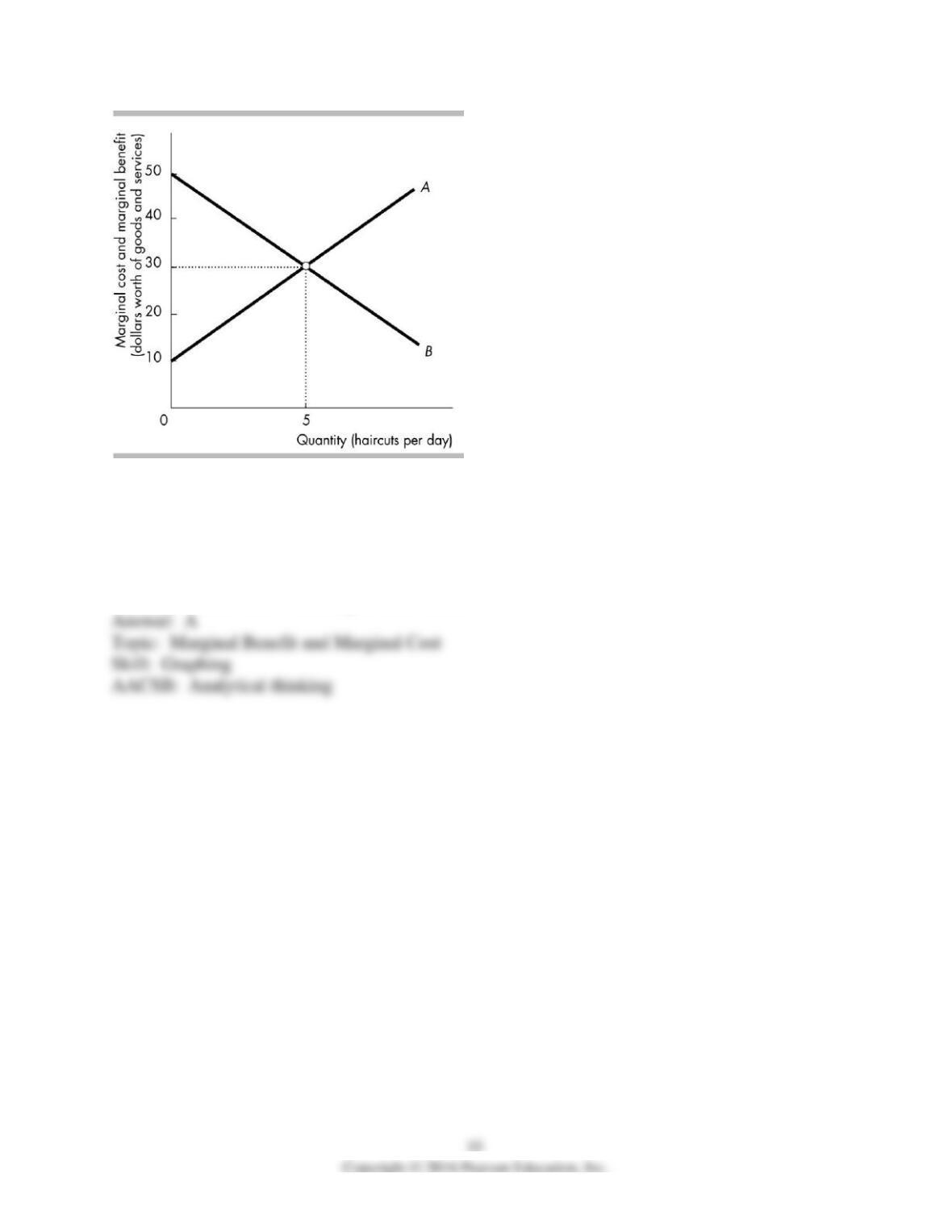
40) The figure illustrates the market for haircuts. Curve A is the ________ curve, and curve B is
the ________ curve.
A) marginal social cost; marginal social benefit
B) total social cost; total social benefit
C) opportunity cost; opportunity benefit
D) marginal social benefit; marginal social cost
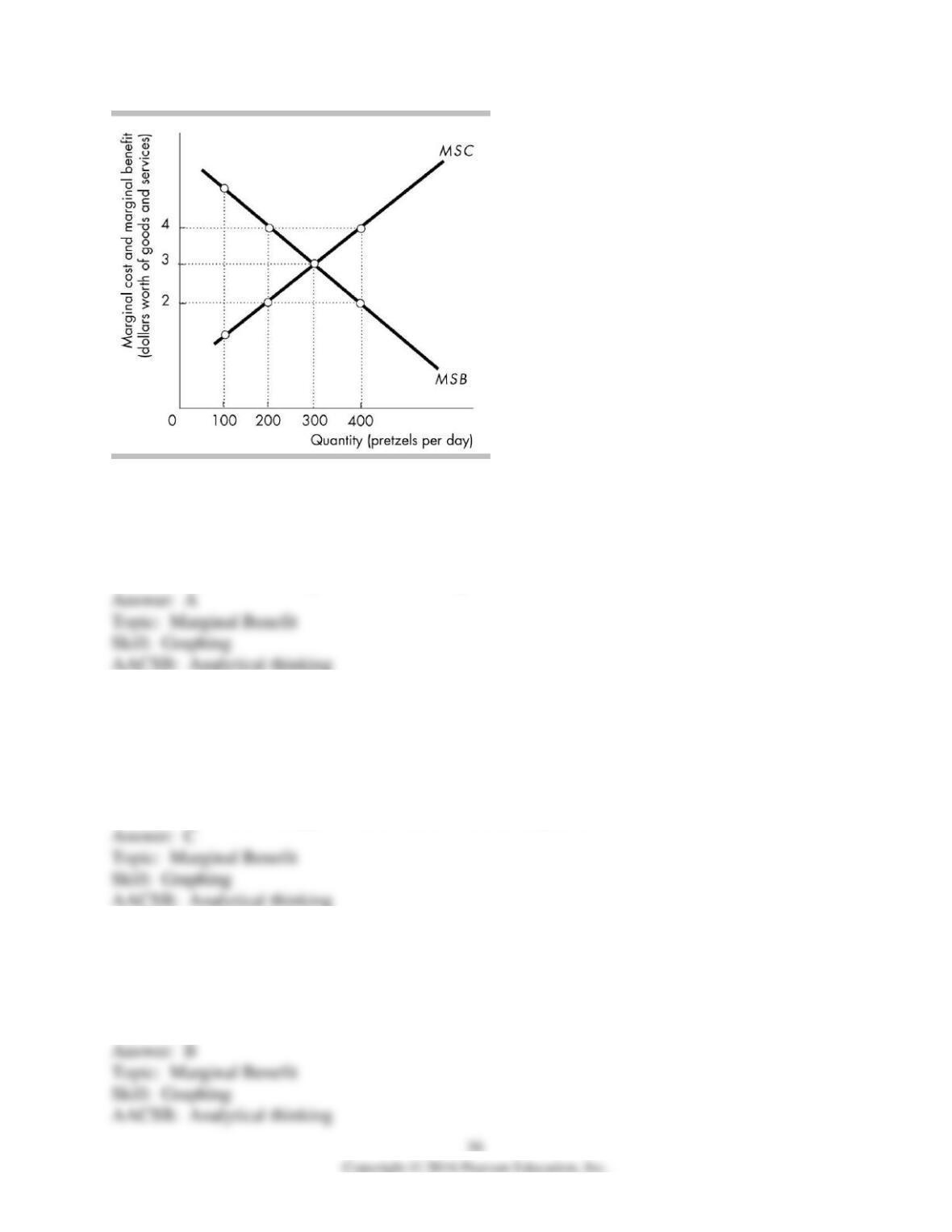
41) In the above figure, when the quantity equals 400 pretzels
A) consumers are willing to pay $2 for the 400th pretzel.
B) producers are willing to supply 400 pretzels for $3.
C) producers are willing to supply 400 pretzels for $2.
D) the marginal benefit is greater than the marginal cost.
42) The above figure shows that the maximum amount a person is willing to pay for the 400th
pretzel
A) is greater than the marginal social cost of the 400th pretzel.
B) is less than the marginal social benefit of the 400th pretzel.
C) and the marginal social benefit of the 400th pretzel are both $2.
D) is greater than the marginal social benefit of the 200th pretzel.
43) In the above figure, what is the marginal social benefit of the four-hundredth pretzel?
A) $0
B) $2.00
C) $3.00
D) $4.00
44) In the above figure, what is the marginal social cost to the economy of producing the four-
hundredth pretzel?
A) $0
B) $2.00
C) $4.00
D) None of the above answers are correct.
45) In the above figure, what is the efficient quantity of pretzels to produce each day?
A) one hundred
B) two hundred
C) three hundred
D) four hundred
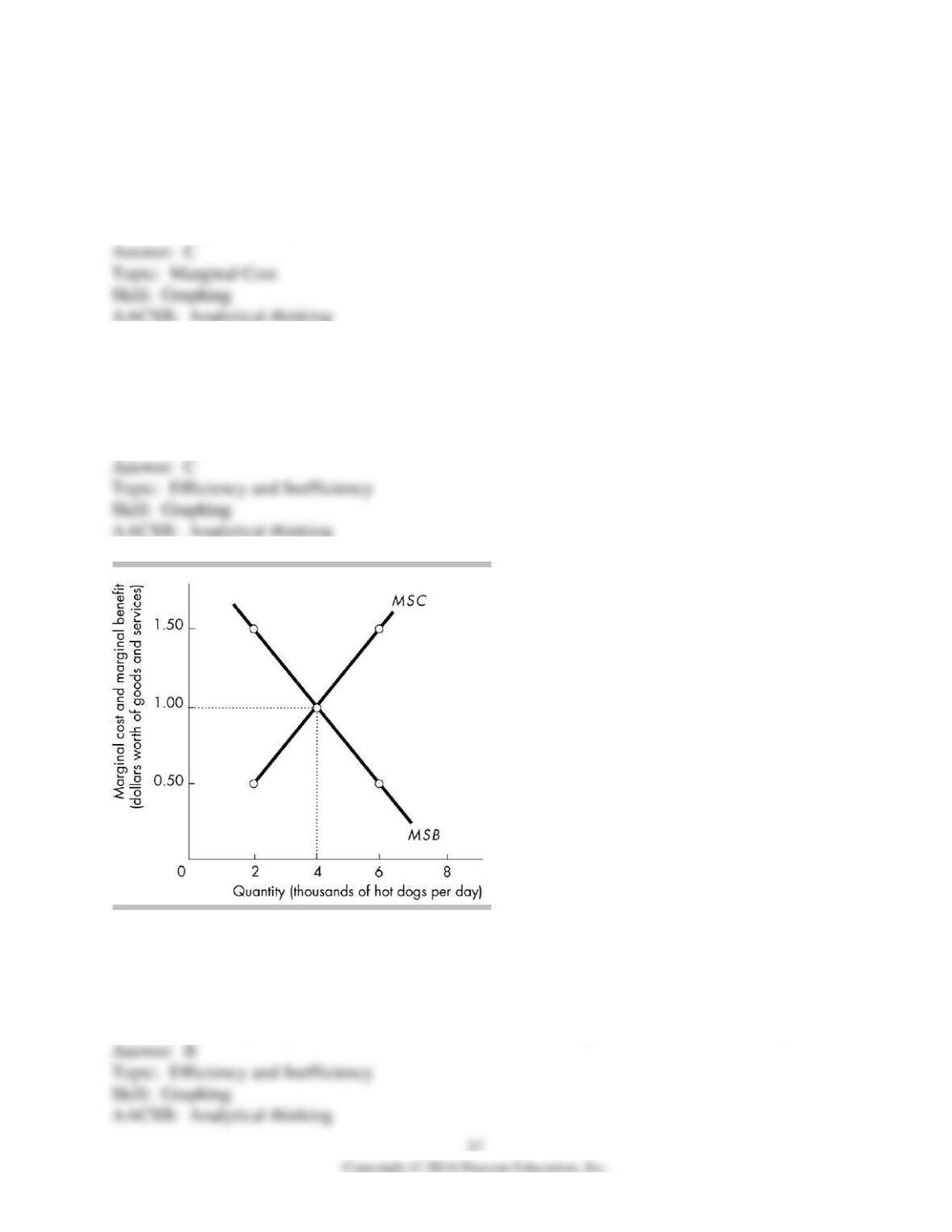
46) In the above figure, what is the efficient quantity of hot dogs to produce?
A) 2 thousand per day
B) 4 thousand per day
C) 6 thousand per day
D) The efficient quantity cannot be determined without knowing the PPF for this economy.
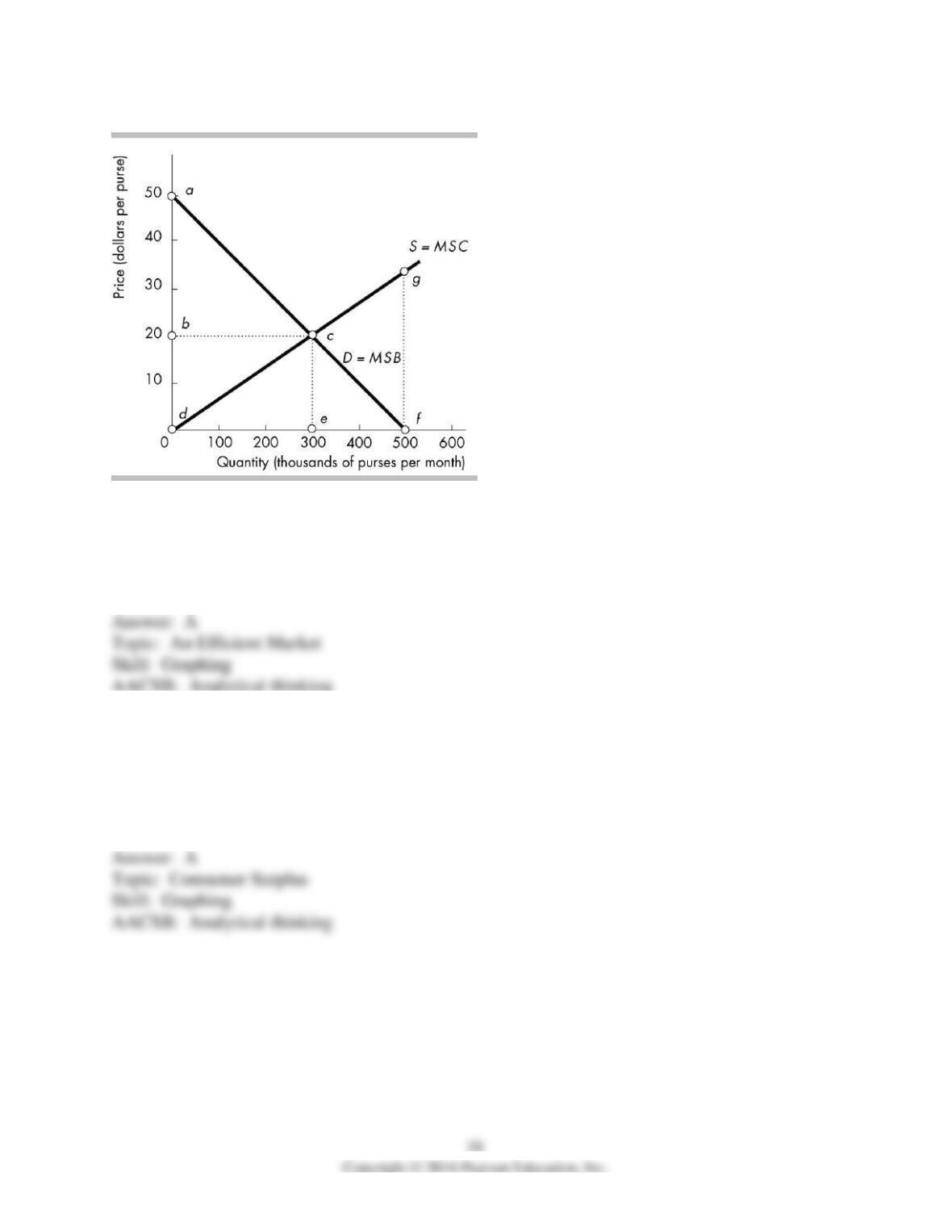
47) In the above figure
A) marginal social cost equals marginal social benefit when 300,000 purses are produced.
B) 500,000 purses should be sold for $50 each for an efficient outcome.
C) it is impossible to determine the efficient quantity of purses.
D) None of the above answers is correct.
48) In the above figure, if the market produces the efficient amount of purses, then consumer
surplus equals triangle
A) abc.
B) bcd.
C) adc.
D) cgf.
49) In the above figure, the total consumer surplus at the efficient level of output is ________.
A) $4.5 million
B) $9.0 million
C) $2.5 million
D) $8.5 million
50) In the above figure, if the market produces the efficient amount of purses then producer
surplus equals triangle
A) abc.
B) bcd.
C) adc.
D) dce.
51) In the above figure, if the market produces the efficient amount of purses then producer
surplus equals
A) triangle bcd.
B) triangle adc.
C) rectangle bcde.
D) trapezoid adec.
52) In the above figure, the total producer surplus at the efficient level of output is ________.
A) $4.5 million
B) $9.0 million
C) $2.5 million
D) $3.0 million
53) In the above figure, 300,000 purses per month is
A) the efficient amount to produce because consumer surplus is maximized.
B) the efficient amount to produce because the sum of consumer surplus and producer surplus is
maximized.
C) an inefficient amount to produce because consumer surplus is not maximized.
D) an inefficient amount to produce because the sum of consumer surplus and producer surplus
is not maximized.
54) In the above figure, 300,000 purses per month is
A) the efficient amount to produce because at 300,000 purses marginal social benefit equals
marginal social cost.
B) the efficient amount to produce because at 300,000 purses marginal social benefit is greater
than marginal social cost.
C) an inefficient amount to produce because at 300,000 purses marginal social benefit equals
marginal social cost.
D) an inefficient amount to produce because producing 500,000 purses sets the marginal social
benefit equal to zero.