Chapter 5: The Value of Money
127.
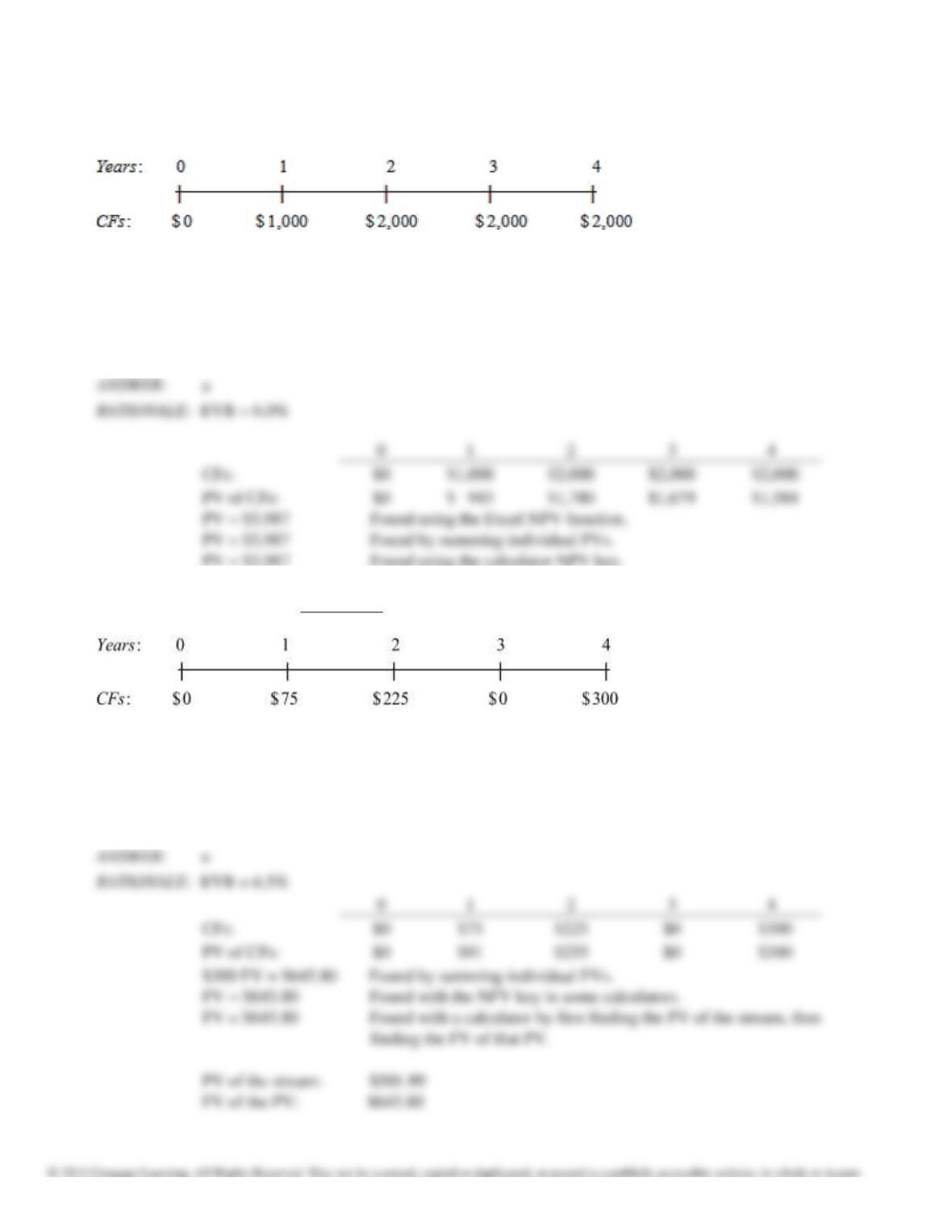
You sold a car and accepted a note with the following cash flow stream as your payment. What was the
effective
price you received for the car assuming an interest rate of 6.0%?
a. $5,987
b. $6,286
c. $6,600
d. $6,930
e. $7,277
128.
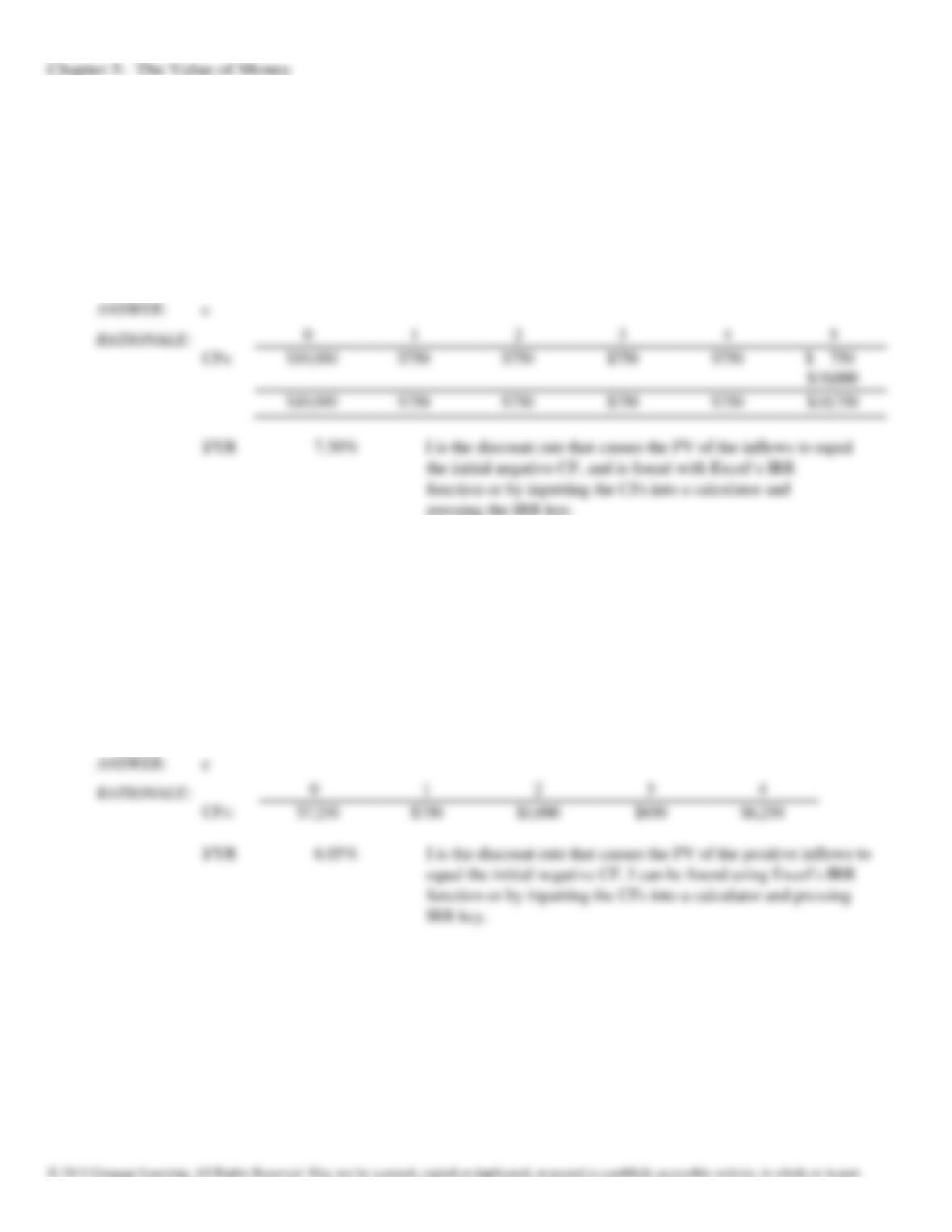
At a rate of 6.5%, what is the future value of the following cash flow stream?
a. $526.01
b. $553.69
c. $582.83
d. $613.51
e. $645.80
129.
Your father paid $10,000 (CF at t = 0) for an investment that promises to pay $750 at the end of each of the
next 5
years, then an additional lump sum payment of $10,000 at the end of the 5th year. What is the expected
rate of
return on this investment?
a. 6.77%
b. 7.13%
c. 7.50%
d. 7.88%
e. 8.27%
130.
You are offered a chance to buy an asset for $7,250 that is expected to produce cash flows of $750 at the end
of
Year 1, $1,000 at the end of Year 2, $850 at the end of Year 3, and $6,250 at the end of Year 4. What rate
of
return would you earn if you bought this asset?
a. 4.93%
b. 5.19%
c. 5.46%
d. 5.75%
e. 6.05%
131.
What’s the future value of $1,500 after 5 years if the appropriate interest rate is 6%, compounded
semiannually?
a. $1,819
b. $1,915
c. $2,016
d. $2,117
e. $2,223
132.
What’s the present value of $4,500 discounted back 5 years if the appropriate interest rate is 4.5%,
compounded
semiannually?
a. $3,089
b. $3,251
c. $3,422
d. $3,602
e. $3,782
133.
What’s the future value of $1,200 after 5 years if the appropriate interest rate is 6%, compounded monthly?
a. $1,537.69
b. $1,618.62
c. $1,699.55
d. $1,784.53
e. $1,873.76
134.
What’s the present value of $1,525 discounted back 5 years if the appropriate interest rate is 6%, compounded
monthly?
a. $ 969
b. $1,020
c. $1,074
d. $1,131
e. $1,187
135.
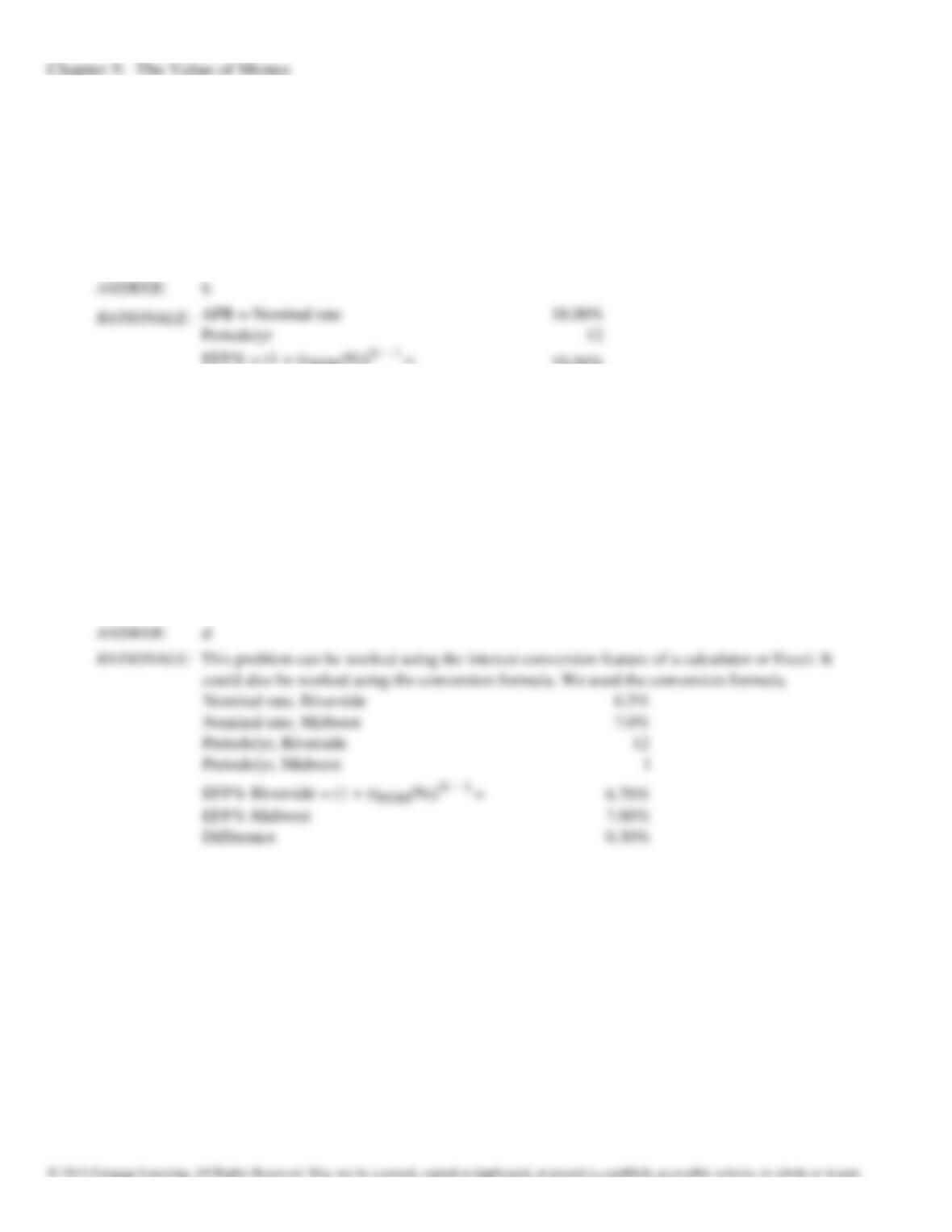
Master Card and other credit card issuers must by law print the Annual Percentage Rate (APR) on their
monthly
statements. If the APR is stated to be 18.00%, with interest paid monthly, what is the card’s EFF%?
a. 18.58%
b. 19.56%
c. 20.54%
d. 21.57%
e. 22.65%
136.
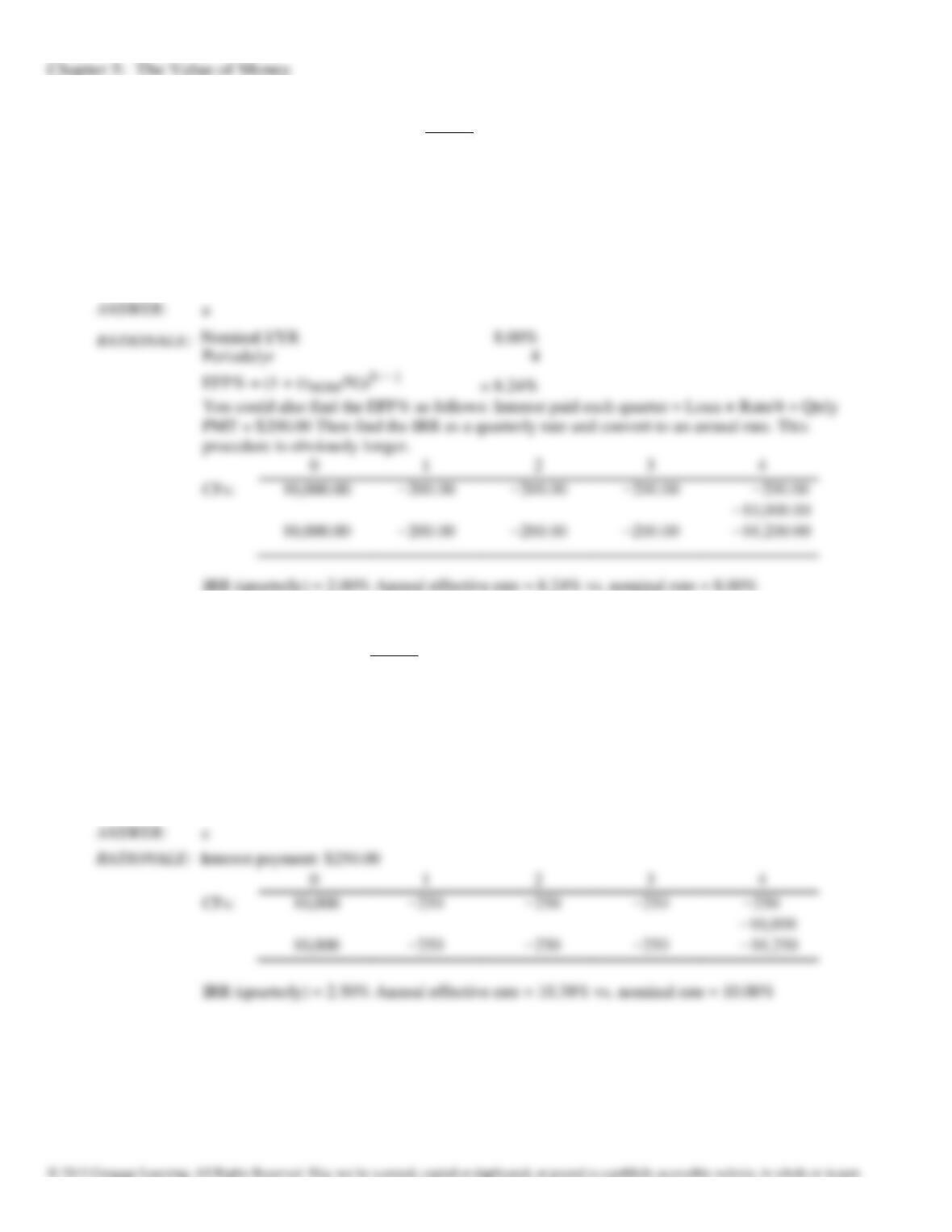
Riverside Bank offers to lend you $50,000 at a nominal rate of 6.5%, compounded monthly. The loan
(principal plus
interest) must be repaid at the end of the year. Midwest Bank also offers to lend you the
$50,000, but it will charge
an annual rate of 7.0%, with no interest due until the end of the year. How much
higher or lower is the effective
annual rate charged by Midwest versus the rate charged by Riverside?
a. 0.52%
b. 0.44%
c. 0.36%
d. 0.30%
e. 0.24%
137.
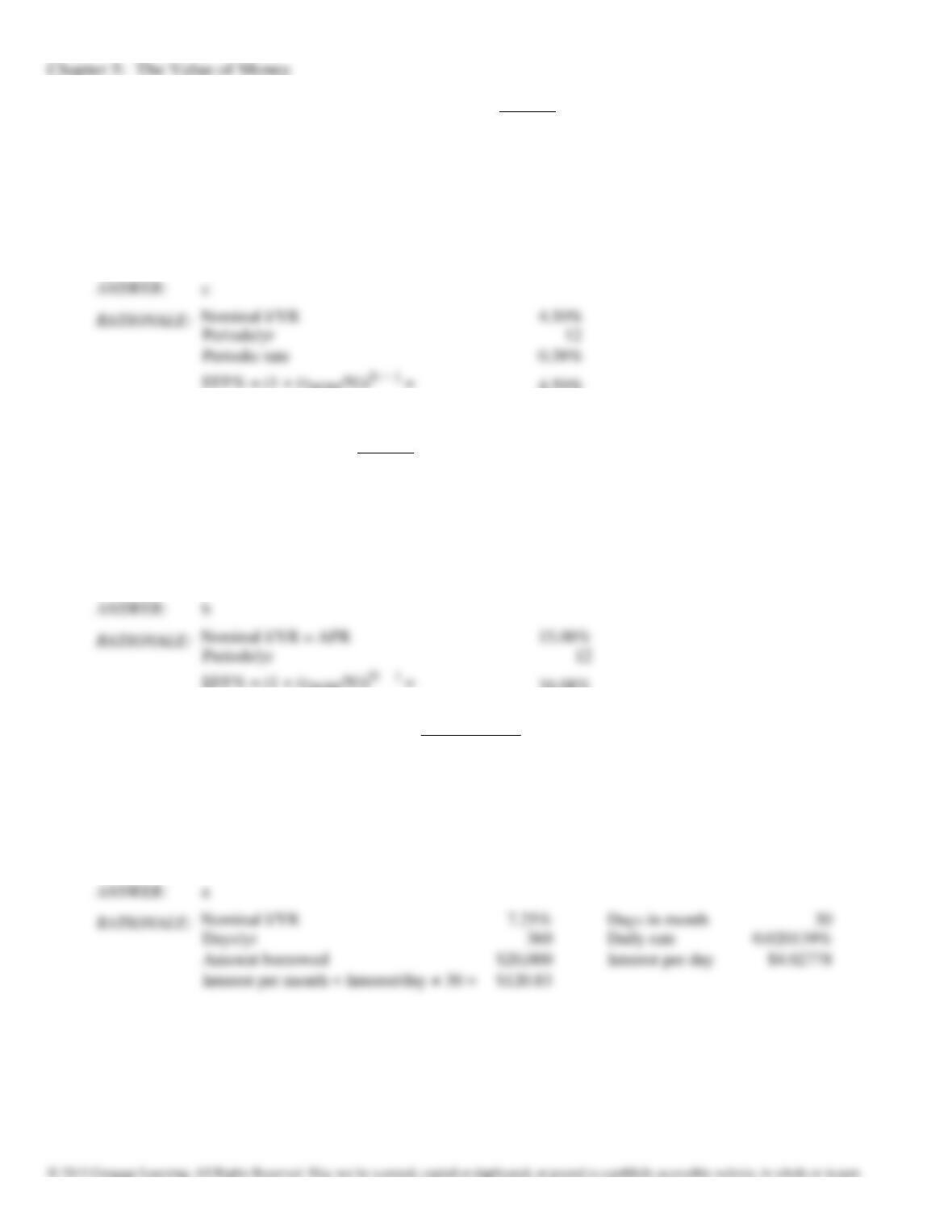
Suppose Community Bank offers to lend you $10,000 for one year at a nominal annual rate of 8.00%, but you
must
make interest payments at the end of each quarter and then pay off the $10,000 principal amount at the
end of the
year. What is the effective annual rate on the loan?
a. 8.24%
b. 8.45%
c. 8.66%
d. 8.88%
e. 9.10%
138.
Suppose a bank offers to lend you $10,000 for 1 year on a loan contract that calls for you to make interest
payments of $250.00 at the end of each quarter and then pay off the principal amount at the end of the year.
What
is the effective annual rate on the loan?
a. 8.46%
b. 8.90%
c. 9.37%
d. 9.86%
e. 10.38%
139.
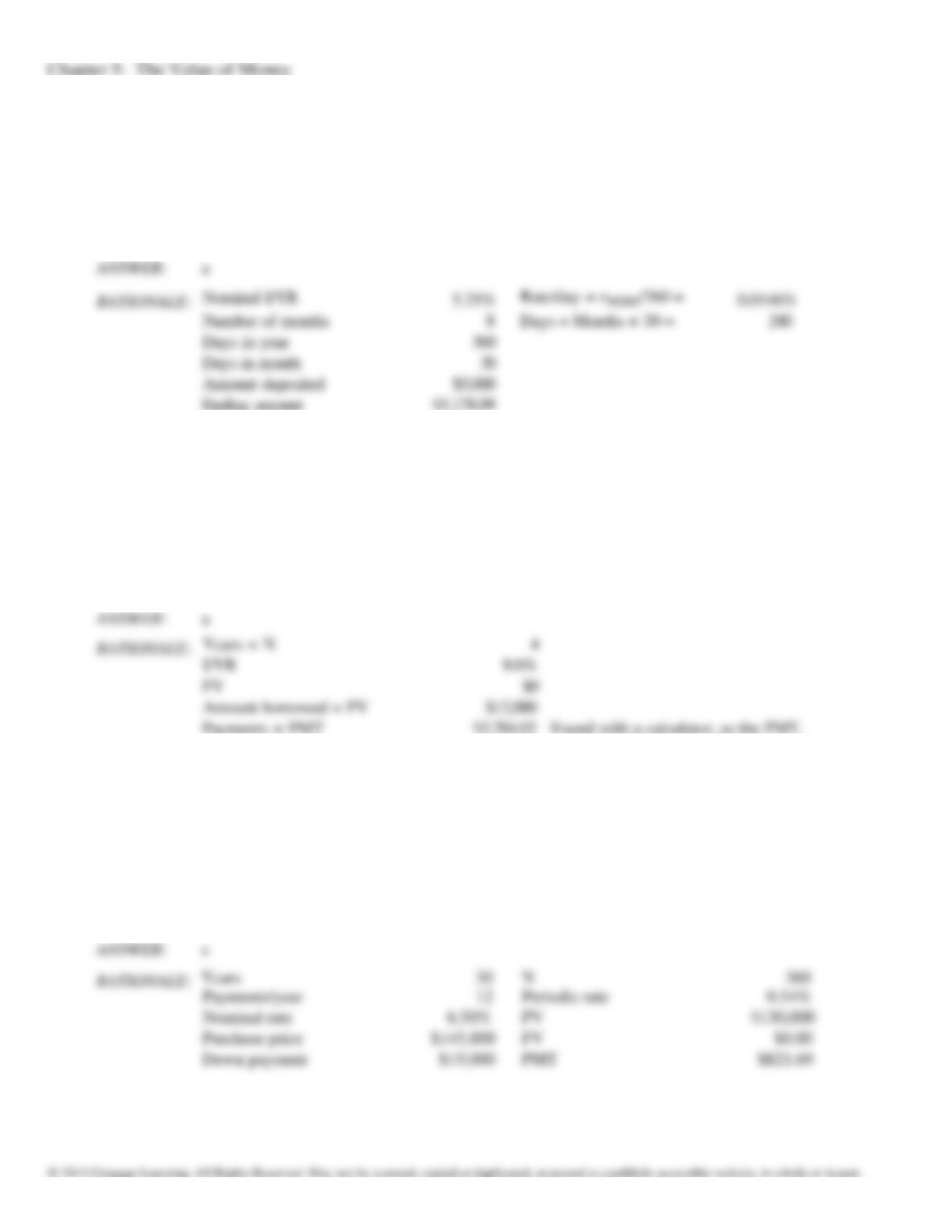
Charter Bank pays a 4.50% nominal rate on deposits, with monthly compounding. What effective annual rate
(EFF%) does the bank pay?
a. 3.72%
b. 4.13%
c. 4.59%
d. 5.05%
e. 5.56%
140.
Suppose your credit card issuer states that it charges a 15.00% nominal annual rate, but you must make
monthly
payments, which amounts to monthly compounding. What is the effective annual rate?
a. 15.27%
b. 16.08%
c. 16.88%
d. 17.72%
e. 18.61%
141.
Pace Co. borrowed $20,000 at a rate of 7.25%, simple interest, with interest paid at the end of each month.
The
bank uses a 360-day year. How much interest would Pace have to pay in a 30-day month?
a. $120.83
b. $126.88
c. $133.22
d. $139.88
e. $146.87
142.
Suppose you deposited $5,000 in a bank account that pays 5.25% with daily compounding based on a 360-day
year.
How much would be in the account after 8 months, assuming each month has 30 days?
a. $5,178.09
b. $5,436.99
c. $5,708.84
d. $5,994.28
e. $6,294.00
143.
Suppose you borrowed $12,000 at a rate of 9.0% and must repay it in 4 equal installments at the end of each
of the
next 4 years. How large would your payments be?
a. $3,704.02
b. $3,889.23
c. $4,083.69
d. $4,287.87
e. $4,502.26
144.
Suppose you are buying your first condo for $145,000, and you will make a $15,000 down payment. You
have
arranged to finance the remainder with a 30-year, monthly payment, amortized mortgage at a 6.5%
nominal interest
rate, with the first payment due in one month. What will your monthly payments be?
a. $741.57
b. $780.60
c. $821.69
d. $862.77
e. $905.91
145.
Your uncle will sell you his bicycle shop for $250,000, with “seller financing,” at a 6.0% nominal annual rate.
The
terms of the loan would require you to make 12 equal end-of-month payments per year for 4 years, and
then make
an additional final (balloon) payment of $50,000 at the end of the last month. What would your
equal monthly
payments be?
a. $4,029.37
b. $4,241.44
c. $4,464.67
d. $4,699.66
e. $4,947.01
146.
Suppose you borrowed $14,000 at a rate of 10.0% and must repay it in 5 equal installments at the end of each
of
the next 5 years. How much interest would you have to pay in the first year?
a. $1,200.33
b. $1,263.50
c. $1,330.00
d. $1,400.00
e. $1,470.00
147.
You plan to borrow $35,000 at a 7.5% annual interest rate. The terms require you to amortize the loan with 7
equal
end-of-year payments. How much interest would you be paying in Year 2?
a. $1,994.49
b. $2,099.46
c. $2,209.96
d. $2,326.27
e. $2,442.59
148.
Your bank offers to lend you $100,000 at an 8.5% annual interest rate to start your new business. The terms
require you to amortize the loan with 10 equal end–of-year payments. How much interest would you be
paying in
Year 2?
a. $7,531
b. $7,927
c. $8,323
d. $8,740
e. $9,177
149.
You are considering an investment in a Third World bank account that pays a nominal annual rate of 18%,
compounded monthly. If you invest $5,000 at the beginning of each month, how many months would it take
for your
account to grow to $250,000? Round fractional months up.
a.
23
b.
27
c.
32
d.
38
e.
44
150.
You are considering investing in a bank account that pays a nominal annual rate of 7%, compounded monthly.
If
you invest $3,000 at the end of each month, how many months will it take for your account to grow to
$150,000?
a.
39.60
b.
44.00
c.
48.40
d.
53.24
e.
58.57