c. increase; increase in the price of ethanol
d. decrease; increase in demand for ethanol
e. increase; decrease in the price of ethanol
103. Butter and margarine are substitute goods. A tax on butter will have what effect on the market for
margarine?
a. The supply of margarine will increase, causing its price to fall.
b. The demand for margarine will increase, causing its price to rise.
c. The demand for margarine will decrease, causing its price to fall.
d. Both the supply and demand of margarine will decrease, causing price to fall.
e. The supply of margarine will decrease, causing price to rise.
104. Compared to producers, consumers will lose the greater amount of surplus from a tax if
a. demand is more elastic than supply.
b. supply and demand are equally elastic.
c. demand is perfectly elastic.
d. demand is less elastic than supply.
e. supply is perfectly inelastic.
105. Compared to producers, consumers will lose the lesser amount of surplus from a tax if
a. demand is more elastic than supply.
b. supply and demand are equally elastic.
c. demand is perfectly inelastic.
d. demand is less elastic than supply.
e. supply is perfectly elastic.
106. Compared to consumers, producers will lose the greater amount of surplus from a tax if
a. supply and demand are equally elastic.
b. supply is less elastic than demand.
c. supply is more elastic than demand.
d. demand is perfectly inelastic.
e. supply is perfectly elastic.
107. Compared to consumers, producers will lose the lesser amount of surplus from a tax if
a. supply and demand are equally elastic.
b. supply is less elastic than demand.
c. supply is more elastic than demand.
d. demand is perfectly inelastic.
e. supply is perfectly elastic.
108. The elasticities of supply and demand are important in determining the distribution of tax burden
because they
a. measure how much consumers are willing to pay or how much firms must receive in order to
produce.
b. reflect who actually pays the tax out of pocket.
c. measure how responsive producers and consumers are to a change in price.
d. reflect how much tax revenue is collected from the tax.
e. determine who is legally responsible for remitting funds to the government.
109. Of the following items, which is/are most important in determining the distribution of tax burden?
a. the person who is legally responsible for paying the tax
b. the elasticities of supply and demand
c. the desired level of tax revenue
d. whether the tax is on income, wealth, sales, or imports
e. the dollar amount of the tax
110. All taxes create some deadweight loss except those on goods
a. with a very low demand.
b. that can be resold for a higher price.
c. that everyone likes to consume.
d. with a perfectly inelastic demand or supply.
e. with a very elastic demand or supply.
111. If a tax is imposed on a good where both supply and demand are somewhat elastic, but supply is
more elastic than demand, the burden of the tax will be borne
a. by consumers and producers equally.
b. by consumers alone.
c. by producers alone.
d. mostly by consumers but partially by producers.
e. mostly by producers but partially by consumers.
112. All taxes create some deadweight loss, unless
a. the tax is very small.
b. the tax is paid by consumers, not producers.
c. the government does not tell anyone that it has created a tax.
d. either supply or demand is perfectly inelastic.
e. the tax is very large.
113. In a market where supply and demand are both somewhat elastic, but supply is more elastic than
demand, producers will bear less of the burden of a tax because
a. consumers have a greater ability to change their behavior in response to the tax than producers
do.
b. producers are more likely to be responsible for paying the tax out of pocket.
c. both parties have equal ability to change their behavior in response to the tax.
d. consumers will experience higher prices as a result of the tax.
e. producers have a greater ability to change their behavior in response to the tax than consumers
do.
114. In a market where supply and demand are equally elastic, producers and consumers will share
equally the burden of a tax because
a. producers will simply raise the price of their output in response to the tax.
b. consumers will buy less of the good in question once the tax is imposed.
c. the tax is more likely to be paid out of pocket by producers.
d. the government doesn’t care who pays the tax as long as the revenue is collected.
e. both have equal ability to change their behavior in response to the tax.
115. In a market where supply and demand are both somewhat elastic, but demand is more elastic than
supply, consumers will bear less of the burden of a tax because
a. consumers have a greater ability to change their behavior in response to the tax than producers
do.
b. producers are more likely to be responsible for paying the tax out of pocket.
c. both parties have equal ability to change their behavior in response to the tax.
d. consumers will experience lower prices as a result of the tax.
e. producers have a greater ability to change their behavior in response to the tax than consumers
do.
116. The incidence of a tax is determined by
a. the relative elasticities of supply and demand.
b. who pays the tax out of pocket.
c. whether the supply curve or demand curve shifts as a result of the tax.
d. how much tax revenue it generates.
e. how much paperwork there is to complete.
117. When a good with equally elastic demand and supply is taxed, the incidence of the tax is borne
a. entirely by consumers. d. mostly by consumers.
b. entirely by producers. e. mostly by producers.
c. by both consumers and producers.
118. If a tax is imposed on a good with equally elastic supply and demand, the burden of the tax will be
borne
a. by consumers and producers equally.
b. by consumers alone.
c. by producers alone.
d. mostly by consumers but partially by producers.
e. mostly by producers but partially by consumers.
119. A(n) ________ in the elasticity of supply or demand in a market for a good that is taxed would
tend to ________ deadweight loss from that tax.
a. decrease; increase d. decrease; have no effect on
b. increase; decrease e. increase; increase
c. increase; have no effect on
120. A(n) ________ in the elasticity of supply or demand in a market for a good that is taxed would
tend to ________ tax revenue from that tax.
a. decrease; have no effect on d. increase; decrease
b. decrease; decrease e. increase; increase
c. increase; have no effect on
121. A(n) ________ in the elasticity of supply or demand in a market for a good that is taxed would
tend to ________ who is legally responsible for paying the tax.
a. decrease; broaden d. increase; narrow
b. decrease; have no effect on e. increase; have no effect on
c. increase; broaden
122. If a tax is imposed on a good where both supply and demand are somewhat elastic, but demand is
more elastic than supply, the burden of the tax will be borne
a. by consumers and producers equally.
b. by consumers alone.
c. by producers alone.
d. mostly by consumers but partially by producers.
e. mostly by producers but partially by consumers.
123. When demand is perfectly inelastic, the demand curve is
a. horizontal. d. downward sloping.
b. vertical. e. U-shaped.
c. upward sloping.
124. When demand is perfectly elastic, the demand curve is
a. vertical. d. horizontal.
b. upward sloping. e. downward sloping.
c. U-shaped.
125. The maximum amount of tax revenue is generated when the good being taxed has a
a. somewhat elastic demand. d. perfectly inelastic demand.
b. perfectly elastic demand. e. decreasing demand over time.
c. somewhat inelastic demand.
126. If a tax is imposed on a good with a perfectly inelastic demand, the burden of the tax will be borne
a. by both consumers and producers equally.
b. by consumers alone.
c. by producers alone.
d. mostly by consumers but partially by producers.
e. mostly by producers but partially by consumers.
127. Consumers will lose no consumer surplus due to a tax if
a. demand is somewhat elastic. d. demand is perfectly elastic.
b. supply is perfectly elastic. e. demand is perfectly inelastic.
c. supply is somewhat elastic.
128. If a tax is imposed on a good with a perfectly elastic demand, the burden of the tax will be borne
a. by both consumers and producers equally.
b. by consumers alone.
c. by producers alone.
d. mostly by consumers but partially by producers.
e. mostly by producers but partially by consumers.
129. Taxing goods with very inelastic demand generates less deadweight loss than taxing goods with
very elastic demand because
a. the change in consumer behavior is smaller.
b. the amount of the tax is larger.
c. consumers have to pay these taxes out of pocket.
d. the government does not bother collecting the revenue.
e. the change in consumer behavior is greater.
130. Taxing a good with very elastic demand generates more deadweight loss than taxing a good with
very inelastic demand because
a. the amount of the tax is larger.
b. the change in consumer behavior is greater.
c. consumers have to pay these taxes out of pocket.
d. the change in consumer behavior is smaller.
e. the government does not bother collecting the revenue.
131. When a good with a perfectly inelastic demand is taxed, the incidence of the tax is borne
a. entirely by producers.
b. by consumers and producers equally.
c. entirely by consumers.
d. mostly by consumers.
e. mostly by producers.
132. Goods that are necessities are very likely to have
a. highly elastic demand. d. very low demand.
b. highly elastic supply. e. very low supply.
c. highly inelastic demand.
133. Consumers will lose no consumer surplus due to a tax if demand in their market is perfectly elastic
because
a. consumers can effortlessly change their behavior in response to the tax.
b. firms will decide not to pay the tax to the government.
c. the government will decide to tax something else.
d. the amount of the tax is relatively low.
e. producers can effortlessly change their behavior in response to the tax.
134. Ireland’s tax on plastic shopping bags successfully reduced consumer use of these bags because the
a. demand for plastic bags is very inelastic.
b. grocery stores in Ireland refused to collect the tax.
c. demand for plastic bags is very elastic.
d. supply of plastic bags is very inelastic.
e. demand for plastic bags was increasing.
135. If the demand for bread is more elastic than the supply of bread, which group will bear more of the
incidence of a tax on bread?
a. consumers
b. the government
c. neither consumers nor producers
d. producers
e. both consumers and producers equally
136. When supply is perfectly inelastic, the supply curve is
a. horizontal. d. downward sloping.
b. vertical. e. U-shaped.
c. upward sloping.
137. If a tax is imposed on a good with a perfectly inelastic supply, the burden of the tax will be borne
a. by both consumers and producers equally.
b. by consumers alone.
c. by producers alone.
d. mostly by consumers but partially by producers.
e. mostly by producers but partially by consumers.
138. Producers will lose no producer surplus due to a tax if
a. supply is somewhat elastic. d. demand is perfectly elastic.
b. demand is somewhat elastic. e. supply is perfectly inelastic.
c. supply is perfectly elastic.
139. Producers bear the entire incidence of a tax when
a. supply is perfectly inelastic.
b. demand is perfectly elastic.
c. supply is perfectly elastic.
d. demand and supply are equally elastic.
e. demand is perfectly inelastic.
140. When supply is perfectly elastic, the supply curve is
a. vertical. d. horizontal.
b. upward sloping. e. downward sloping.
c. U-shaped.
141. A good with a ________ supply generates no deadweight loss when taxed.
a. perfectly elastic d. somewhat inelastic
b. perfectly inelastic e. slowly increasing
c. somewhat elastic
142. Taxing goods with very elastic supply generates more deadweight loss than taxing goods with very
inelastic supply because
a. the amount of the tax is larger.
b. the change in producer behavior is greater.
c. producers have to pay these taxes out of pocket.
d. the change in producer behavior is smaller.
e. the government does not bother collecting the revenue.
143. Taxing goods with very inelastic supply generates less deadweight loss than taxing goods with
very elastic supply because
a. producers have to pay these taxes out of pocket.
b. the amount of the tax is larger.
c. the change in producer behavior is smaller.
d. the government does not bother collecting the revenue.
e. the change in producer behavior is greater.
144. If a tax is imposed on a good with a perfectly elastic supply, the burden of the tax will be borne
a. by both consumers and producers equally.
b. by consumers alone.
c. by producers alone.
d. mostly by consumers but partially by producers.
e. mostly by producers but partially by consumers.
145. Producers will lose no producer surplus due to a tax if supply in their market is perfectly elastic
because
a. consumers can effortlessly change their behavior in response to the tax.
b. firms will decide not to pay the tax to the government.
c. the government will decide to tax something else.
d. the amount of the tax is relatively low.
e. producers can effortlessly change their behavior in response to the tax.
146. The benefit to society from the imposition of a tax is the
a. lost consumer surplus. d. lost producer surplus.
b. deadweight loss. e. the reduction in social welfare.
c. tax revenue.
147. How successful would a $1 excise tax on each Little Caesar’s pizza be in generating revenue if
Little Caesar’s is the only pizza chain that is taxed?
a. Many people like Little Caesar’s, so demand is inelastic and the tax revenue generated will be
large.
b. You can get pizza at many other places, which makes the demand for Little Caesar’s relatively
elastic and, as a result, the tax revenue collected will be small.
c. The supply of Little Caesar’s pizza is perfectly inelastic, so this tax would not generate any
revenue.
d. The demand for Little Caesar’s pizza is perfectly elastic, so the tax will not generate any
revenue.
e. The supply of Little Caesar’s pizza is perfectly elastic, so this tax will generate the maximum
amount of revenue.
148. As a tax rate grows larger and larger, eventually
a. supply can outweigh demand.
b. willingness to pay can outweigh deadweight loss.
c. demand can outweigh supply.
d. deadweight loss can outweigh tax revenue.
e. tax revenue can outweigh willingness to sell.
149. At very low tax rates________ is much larger than________.
a. supply; demand
b. willingness to pay; deadweight loss
c. demand; supply
d. tax revenue; deadweight loss
e. tax revenue; willingness to sell
150. The luxury tax of 1990 produced far less tax revenue than projected because
a. the government made the mistake of announcing the tax.
b. the tax was too low.
c. the supply of luxury goods is highly inelastic.
d. there are very few consumers of luxury goods.
e. the demand for luxury goods is highly elastic.
SHORT ANSWER
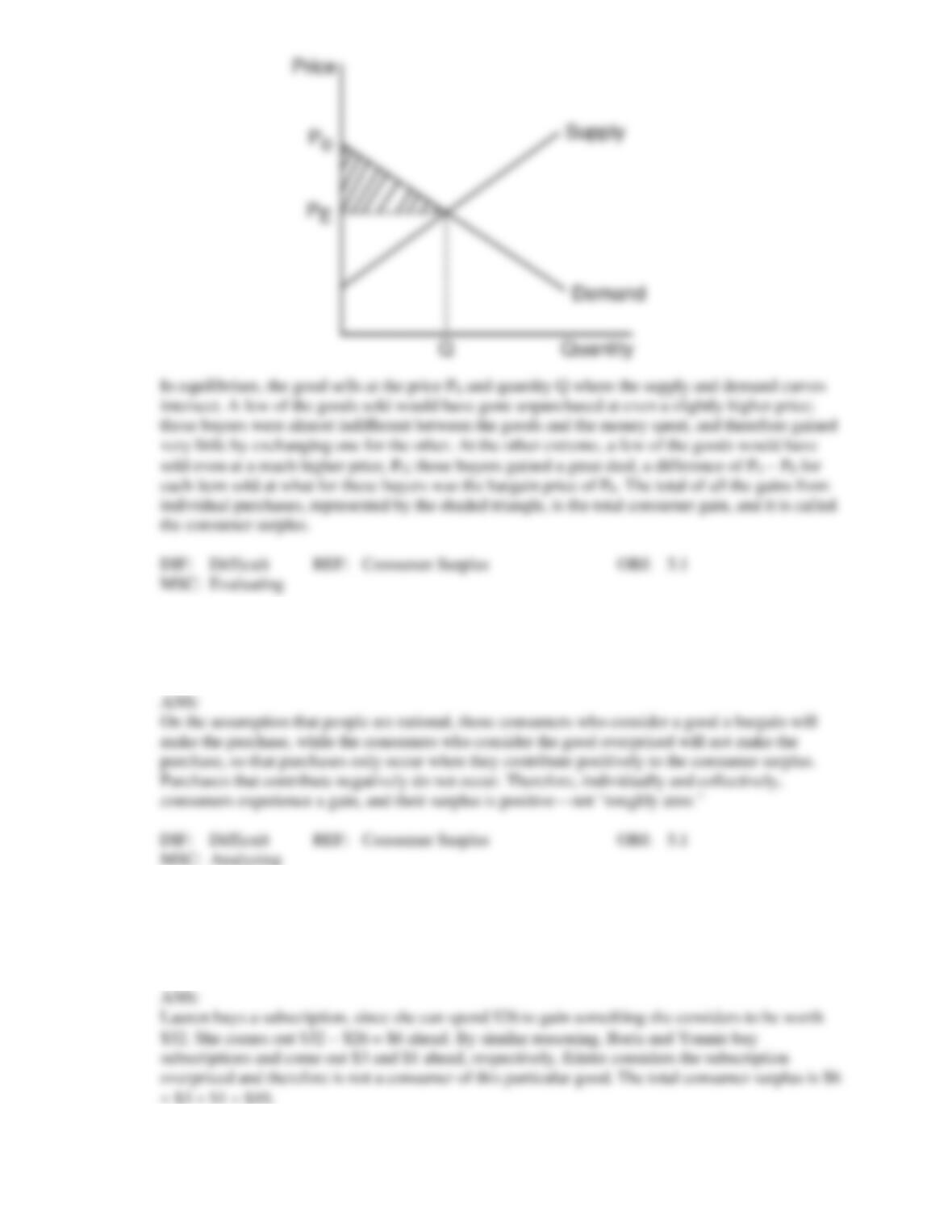
1. Draw a set of supply and demand curves and explain, with reference to the graph, why the
consumer surplus could be described as the “total consumer gain.”
2. “For any good, the consumer surplus should be roughly zero, because although there are some
consumers who consider the good a bargain at the market price, there are others who consider the
price too high and the good not worth the price.” Explain why this statement is incorrect.
3. An annual subscription for ECONO! magazine costs $26. If Lauren would be willing to pay up to
$32, Boris would be willing to pay up to $29, Yonnie would be willing to pay up to $27, and
Edette would pay no more than $23, what is the consumer surplus for this group of economics
enthusiasts? Explain how the number was obtained.
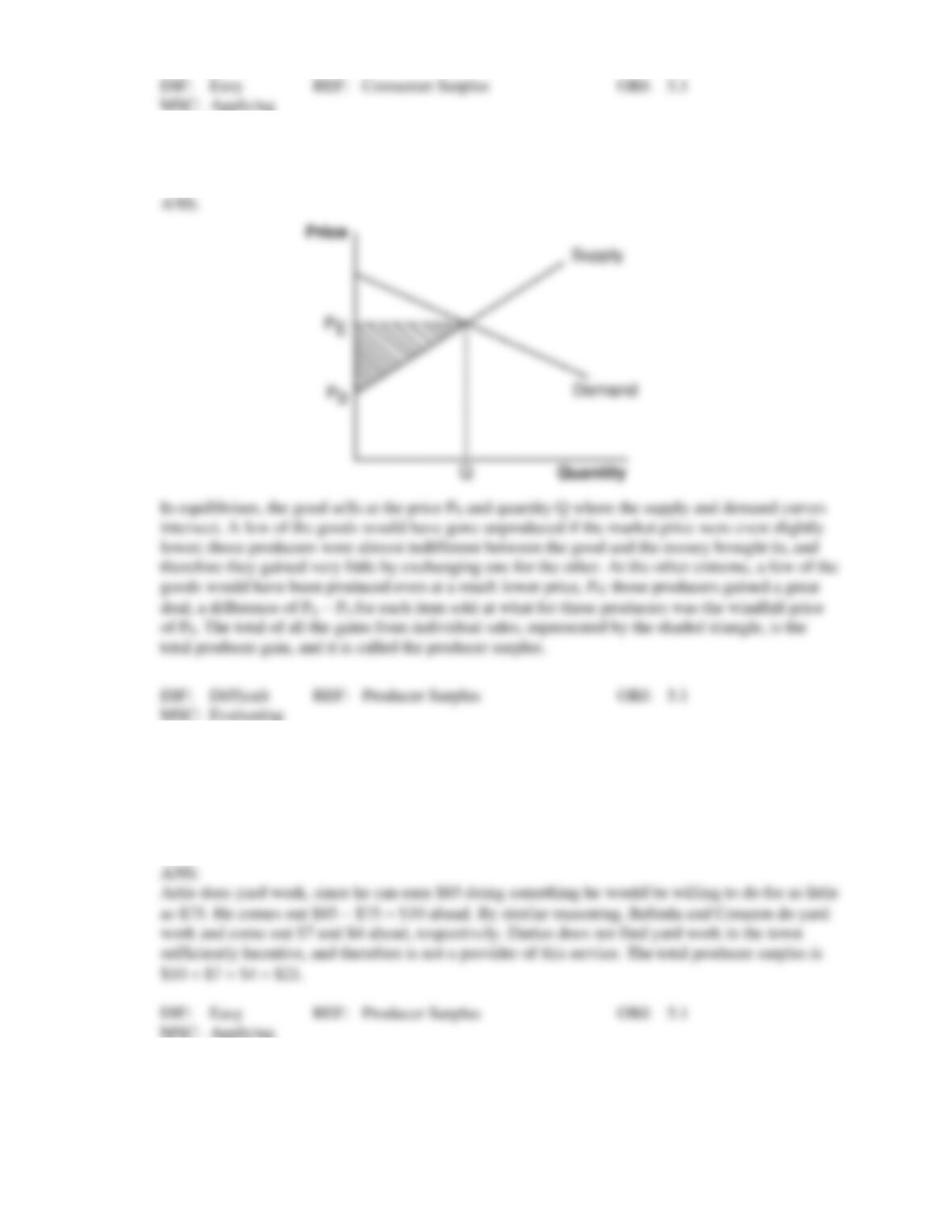
4. Draw a set of supply and demand curves and explain, with reference to the graph, why the
producer surplus could be “described as the total producer gain.”
5. In a small town, the market price for a day’s worth of yard work is $85. If Artie would be willing
to do the work for as little as $75, Belinda would do it for as little as $78, Corazon would do so for
as little as $81, and Darius would only do yard work for $88, what is the producer surplus for this
group of workers on a given day when everyone who wants to work does so? Explain how the
number was obtained.
6. Explain the concept of a producer’s willingness to sell and the two factors that go into it.
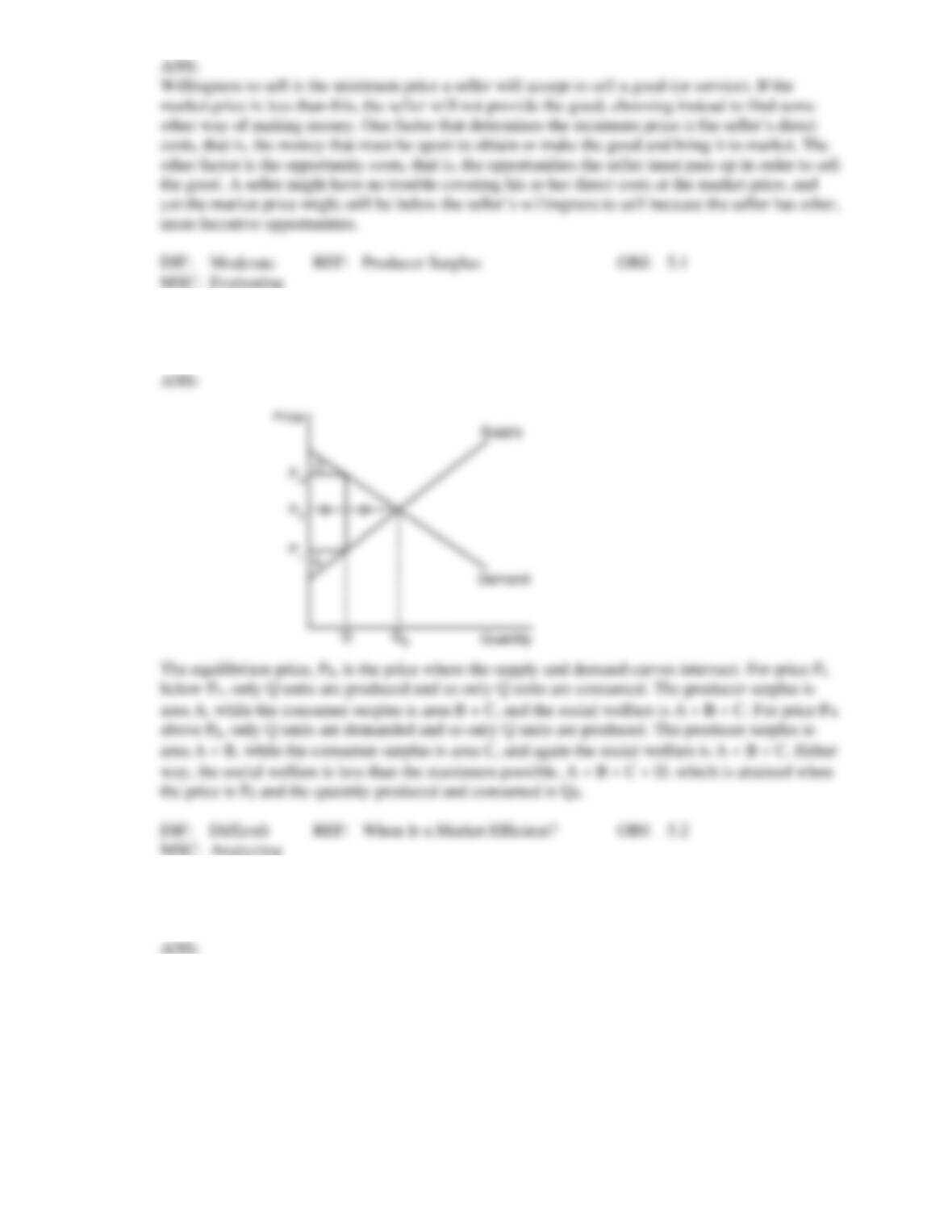
7. Use a figure with intersecting supply and demand curves to explain why social welfare is
maximized when the market price is the equilibrium price.
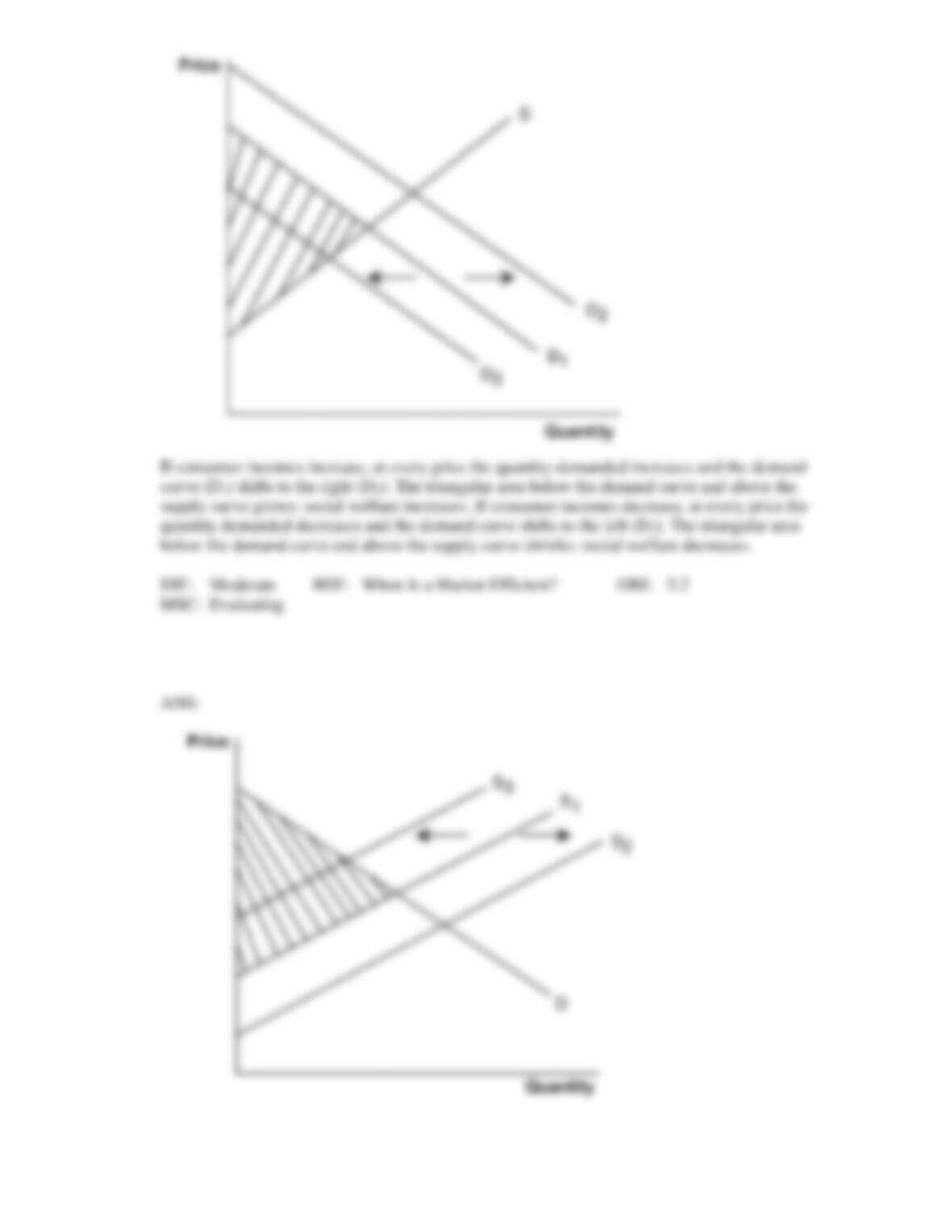
8. Use a figure with intersecting supply and demand curves to explain how a change in consumer
incomes affects social welfare.
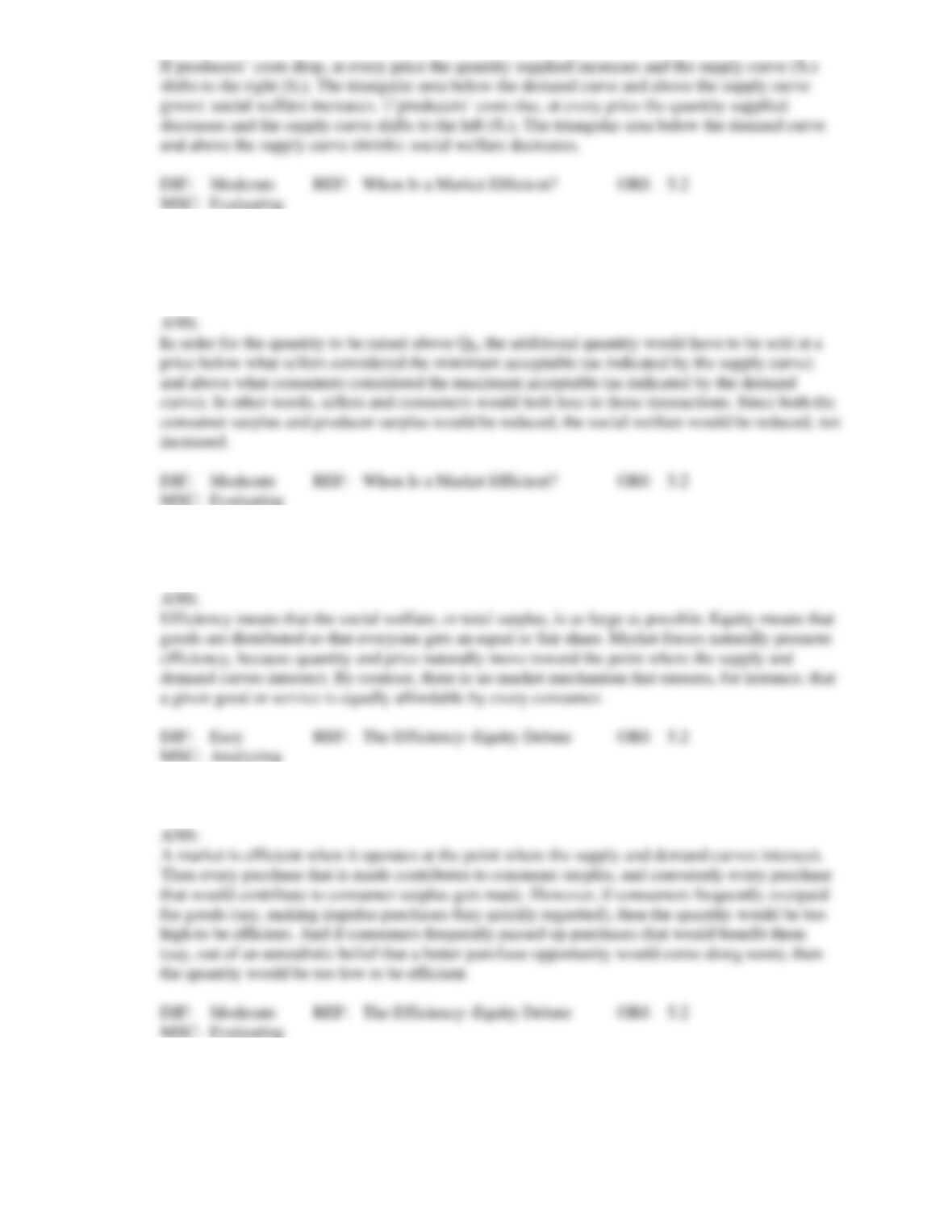
9. Use a figure with intersecting supply and demand curves to explain how a change in producer’s
direct costs (such as manufacturing and transport expenses) affects social welfare.
10. A good is selling at equilibrium price PE and equilibrium quantity QE. Explain why the social
welfare (= total surplus) would not be increased by raising the quantity supplied and consumed,
above QE.
11. Explain the difference between efficiency and equity. Which of the two is naturally promoted by
market forces (under ideal conditions)?
12. How would frequent consumer irrationality prevent a market from being efficient?
13. The demand for food is very inelastic, making it an attractive target for taxation. However, some
regard taxes on food as unfair. Explain why taxes on food might be regarded as unfair.
14. The incidence of a tax is not determined by who pays the tax out of pocket. Explain why this is so.
15. Explain the difference between the burden of a tax and who pays the tax out of pocket.
16. What makes an excise tax an especially simple example for understanding the effect of taxes on
consumer and producer surplus?
17. Explain why in an ideal supply and demand model it does not really matter whether a tax on a
good has to be paid out of pocket by the consumer or by the seller.
18. The government is exploring ways to increase revenues through taxation. Teresa is an economic
adviser to public policy makers who pose the following question: Should the government tax
yachts or should it tax gasoline? Explain your answer using price elasticity of demand.
19. Why will a government-imposed quantity restriction in the market for a good usually reduce social
welfare?
20. Explain why goods that are necessities are often attractive targets for taxation by governments.
21. True or False: An excise tax will always cause consumer prices to increase. Explain.
22. Taxes cause consumers to lose consumer surplus and producers to lose producer surplus. Where
does that surplus go?
23. Why is deadweight loss greater when goods with very elastic demands or supplies are taxed?
24. Supply and demand both tend to become more elastic in the long run. What does this mean for the
deadweight loss and tax revenue from a tax in the long run compared to the short run?
25. Explain why the elasticities of supply and demand determine who bears more of the burden of a
tax, consumers or producers.