Microeconomics, 12e (Parkin)
Chapter 5 Efficiency and Equity
1 Resource Allocation Methods
1) In the United States, resources are most often allocated by
A) market price.
B) command system.
C) lottery.
D) contest.
2) A contest is a good way to allocate scarce resources when
A) the efforts of the players are hard to monitor directly.
B) the lines of responsibility are clear.
C) the decision being made affects a large number of people.
D) there is no effective way to distinguish among potential users.
3) The resource allocation method that is used to allocate scarce resources between private use
and government use is
A) first-come, first-served.
B) personal characteristics.
C) majority rule.
D) lottery.
4) Which of the following is TRUE?
A) Lotteries work best when a resource can serve just one user at a time in a sequence.
B) A market price always allocates resources better than a command system.
C) In the United States, how tax dollars are allocated among competing uses is an example of
how resources are allocated by majority rule.
D) Force has never played an important role in allocating scarce resources.
5) Which of the following is TRUE?
A) When resources are allocated on the basis of personal characteristics, all people who are
willing and able to pay the price get the resource.
B) When the range of activities to be monitored is large and complex, a command system
allocates resources better than a market price.
C) When a market price allocates resources, some people who are willing and able to pay that
price don’t get the resource.
D) Force helps support the legal system on which markets function.
6) As a method of resource allocation, force
A) is not important.
B) plays a crucial negative role.
C) plays a crucial positive role.
D) plays a crucial role for both good and ill.
7) As a method of resource allocation, market price
A) means those who are willing and able to pay get a particular good or service.
B) works well when self-interest must be suppressed.
C) works best inside firms and government departments.
D) is efficient when there is no effective way to distinguish among potential users of a scarce
resource.
8) Which of the following is TRUE?
A) When a market price allocates resources, all people who are willing and able to pay that price
get the resource.
B) A command system works well when the range of activities to be monitored is large and
complex.
C) When the government decides how to allocate tax dollars among competing uses, resources
are allocated by market prices.
D) When a manager offers everyone in the company the opportunity to win a prize, resources are
allocated by a lottery.
9) When allocating resources using market price
A) everyone who is willing and able to pay for a good gets one.
B) everyone who wants a good gets one.
C) everyone who is willing to pay for a good gets one.
D) everyone who is able to pay for a good gets one.
10) When scarce resources can serve only one user at a time in sequence, which method works
well for allocating the scarce resources?
A) first come, first served
B) lottery
C) contest
D) command system
11) Currently kidneys are allocated based on the needs of each perspective recipient, their blood
type, and the urgency of their case. An alternative way to allocate kidneys is to go by the order in
which patients were placed on the waiting list. In that case, the allocation of resources is made
using
A) market price.
B) auction.
C) first-come, first-served.
D) personal characteristics.
12) The night before enrollment was to open for the University of Johannesburg a line of people
more than a mile long formed outside the gates. When the gates opened, a stampede started, and
a woman lost her life in her attempt to secure her son a spot at the university and a chance for a
better life. (Source: New York Times, January 10, 2012)
Based on the news clip above, the allocation of resources in made using
A) market price.
B) auction.
C) first-come, first-served.
D) lottery.
13) Which of the following is TRUE?
A) When a market price allocates resources, everyone who is able to pay the price gets the
resource.
B) A command system works well when the lines of authority and responsibility are clear.
C) When the government decides how to allocate tax dollars among competing uses, resources
are allocated by command.
D) When a manager offers everyone in the company the opportunity to win a prize, resources are
allocated by a market price.
14) Alvin Roth of Harvard won the 2012 Nobel Prize in Economics for designing systems that
allocate resources in innovative ways. For example, he designed a system that matches donated
kidneys to recipients waiting for such donations. This system takes into account the needs of
each perspective recipient, their blood type, and the urgency of their case. (Source: Washington
Post, October 16, 2012)
Based on the news clip above, the allocation of resources is made using
A) market price.
B) auction.
C) lottery.
D) personal characteristics.
15) Asian women lag far behind the West in their representation in management level positions.
The report by the McKinsley consulting company suggests that there is an opportunity for
companies to recruit under-utilized female talent and do well financially as a result. (Source: The
Economist, July 7, 2012)
The fact that Asian women are currently less likely to be hired as managers is a result of the
allocation system using which of the following methods for hiring?
A) lottery
B) auction
C) first-come, first-served
D) personal characteristics
16) Allocating resources by the order of someone in authority is a ________ allocation method.
A) first-come, first-served
B) market price
C) majority rule
D) command
17) Often people trying to withdraw money from their bank must wait in line, which reflects a
________ allocation method.
A) first-come, first-served
B) market price
C) contest
D) command
18) If a person will rent an apartment only to married couples over 30 years old, that person is
allocating resources using a ________ allocation method.
A) first-come, first-served
B) market price
C) personal characteristics
D) command
2 Benefit, Cost, and Surplus
1) The value of one more unit of a good or service is the
A) marginal benefit.
B) minimum price that people are willing to pay for another unit of the good or service.
C) marginal cost.
D) opportunity cost of producing one more unit of a good or service.
2) The value of a good is equal to the
A) maximum price you are willing to pay for it.
B) price that you actually pay for it.
C) price you actually pay for it minus the maximum you are willing to pay for it.
D) maximum you are willing to pay for it minus the price you actually pay for it.
3) Marginal benefit is the benefit received from ________.
A) consuming more goods or services
B) producing the efficient quantity
C) consuming the efficient quantity
D) consuming one more unit of a good or service
4) All of the following statements about marginal benefit are correct EXCEPT the marginal
benefit of a good
A) is the benefit a person receives from consuming one more unit of the good or service.
B) is measured as the maximum amount that a person is willing to pay for one more unit of the
good.
C) is equal to zero when resource use is efficient.
D) decreases as the quantity consumed of the good increases.
5) Sal likes to eat pizza. The ________ is the maximum amount that Sal is willing to pay for one
more piece of pizza.
A) efficient price
B) efficient amount
C) marginal benefit
D) marginal cost
6) Marginal benefit
A) is the same as the total benefit received from consuming a good.
B) is the maximum amount a person is willing to pay for one more unit of a good.
C) increases as consumption increases.
D) is the difference between total benefit and total cost.
7) Jane is willing to pay $80 for a pair of shoes. The actual price of the shoes is $50. Her
marginal benefit is
A) $80.
B) $30.
C) $50.
D) $1300.
The table below shows the demand schedules for pizza for Abby and Barry who are the only
buyers in the market.
Price
(dollars per slice)
Abby’s quantity
demanded
(slices per
month)
Barry’s quantity
demanded
(slices per
month)
2.50
25
50
3.00
20
40
3.50
15
30
4.00
10
20
4.50
5
10
5.00
0
0
8) Based on the table, what is Abby’s marginal benefit from the 10th slice of pizza?
A) $4
B) $13
C) $0.50
D) $40
9) Based on the table, what is Barry’s marginal benefit from the 40th slice of pizza?
A) $3
B) $5.50
C) $0.50
D) $12
10) Based on the table, what is the marginal social benefit from the 45th slice of pizza?
A) $3.50
B) $3.25
C) $0.50
D) $9
11) If you increase your consumption of soda by one additional can a week, your marginal
benefit of this last can is $1.00. The ________ of this last can of soda is $1.00.
A) value
B) price
C) opportunity cost
D) marginal cost
12) A person will choose to buy a good as long as
A) marginal benefit is at least as great as price.
B) consumer surplus is positive.
C) marginal benefit is positive.
D) consumer surplus is at least as great as price.
13) Sam’s demand curve for pizza
A) lies above her marginal benefit curve for pizza.
B) lies below her marginal benefit curve for pizza.
C) is the same as her marginal benefit curve for pizza.
D) has one point in common with her marginal benefit curve for pizza.
14) The market demand curve
A) can also be the marginal social cost curve.
B) shows the value of a good that consumers must give up to get another unit of a different good.
C) by itself determines equilibrium prices.
D) can also be the marginal social benefit curve.
15) The market demand curve also is
A) a marginal social cost curve.
B) a marginal social benefit curve.
C) an opportunity cost curve.
D) a consumer surplus curve.
16) The market demand curve for coffee is the same as the
A) marginal social cost curve of coffee.
B) marginal social benefit curve of coffee.
C) opportunity cost curve of coffee.
D) marginal social benefit curve minus the marginal social cost curve of coffee.
17) A market demand curve measures
A) how much a consumer is willing to pay for an additional unit of the good.
B) the marginal social benefit of an additional unit of the good.
C) the marginal social cost of an additional unit of the good.
D) Both answers A and B are correct.
18) Moving down along the market demand curve for hot dogs, the
A) maximum price that people are willing to pay for hot dogs increases.
B) marginal social benefit of hot dogs decreases.
C) marginal social cost of hot dogs increases.
D) consumer surplus of the last hot dog consumed increases.
19) The market demand curve is constructed by adding the
A) quantities demanded by each individual at each price.
B) prices that each individual is willing to pay at each quantity.
C) Neither answer A nor answer B is correct.
D) Both answer A and answer B are correct.
20) A market demand curve is constructed by
A) a horizontal summation of each individual demand curve.
B) averaging each individual demand curve.
C) dividing one individual demand curve by the number of consumers in the market.
D) a vertical summation of each individual demand curve.
21) A market demand curve can be constructed by
A) adding the prices all consumers will pay for any given quantity.
B) adding the quantities that all consumers buy at each price.
C) adding the quantities that a consumer buys at the highest price.
D) None of the above answers is correct.
22) The market demand curve for iPads is the ________ of all the individual demand curves for
iPads.
A) horizontal product
B) horizontal sum
C) vertical sum
D) vertical product
Quantity of videos demanded
Price (dollars)
Alex
Lynn
Liza
6
2
0
3
5
4
0
6
4
6
1
9
3
8
2
12
2
10
3
15
1
12
4
18
23) Given the individual demands for video downloads in the above table, and assuming that
these three people are the only ones in the market, which of the following statements is NOT true
about market demand for video downloads?
A) The market quantity demanded at a price of $5 is 10.
B) The height of the market demand curve at a quantity demanded of 22 is $3.
C) The height of the market demand curve at a quantity demanded of 16 is $5.
D) The market quantity demanded at a price of $2 is 28.
Quantity of tennis
rackets demanded
Price (dollars)
Jill
Jed
60
1
0
50
2
0
40
2
1
30
3
2
20
4
3
24) Jill and Jed have individual demand curves for tennis rackets given in the table above and are
the only two demanders in the market. What is the market quantity demanded at the price of
$30?
A) 2
B) 5
C) 11
D) 18
Price
dollars per
pound)
Bart’s quantity
demanded
(pounds)
Lisa’s quantity
demanded
(pounds)
Homer’s
quantity
demanded
(pounds)
2
9
5
7
3
7
4
6
4
4
2
5
5
1
0
3
25) Homer, Bart, and Lisa are the only consumers in the market. Using the information in the
above table, what is the market demand for chocolate chip cookies at $4.00 per pound?
A) 21 pounds
B) 17 pounds
C) 11 pounds
D) 4 pounds
26) Consumer surplus is the ________ summed over the quantity bought.
A) marginal social benefit minus the marginal social cost
B) number of dollars’ worth of other goods and services forgone to obtain one more unit of a
good or service
C) value of a good or service minus the price paid for the good or service
D) value of a good or service plus the price paid for the good or service
27) ________ is the value of a good minus the price paid for it summed over the quantity bought.
A) Producer surplus
B) Consumer surplus
C) Surplus
D) Shortage
28) Consumer surplus is the
A) value of a good expressed in dollars.
B) price of a good expressed in dollars.
C) value of a good minus the price paid for it summed over the quantity bought.
D) value of a good plus the price paid for it summed over the quantity bought.
29) Consider the market for hot dogs. As long as the marginal benefit of consuming hot dogs is
greater than the price of hot dogs
A) people receive consumer surplus from eating hot dogs.
B) the price of hot dogs will rise.
C) the value of hot dogs will rise.
D) there is no decreasing marginal benefit of eating hot dogs.
30) If the price of a pizza increases and the demand curve for pizza does not shift, then the
consumer surplus from pizza will ________.
A) increase
B) decrease
C) equal the producer surplus if the market produces the efficient quantity of pizza
D) remain the same
31) The drought in the Midwest over the summer has decreased the supply of corn and, as a
result, brought a sharp increase in the price of corn. (Source: The Economist, August 4, 2012)
The increase in the price of corn
A) always increases consumer surplus.
B) always decreases consumer surplus.
C) does not affect consumer surplus because this change reflects only a movement along the
demand curve.
D) increases consumer surplus if demand is elastic and decreases consumer surplus if demand is
inelastic.
32) For many years short wave radios were a way of getting news from faraway places and in
difficult conditions. But as new technologies have spread, the people listening to these devices
has decreased. (Source: The Economist, July 7, 2012)
As new technology creates substitutes for short-wave radios, the demand for short-wave radios
________ and the consumer surplus from short-wave radios ________.
A) increases; increases
B) decreases; decreases
C) does not change; decreases
D) decreases; does not change
33) Nick can purchase each milkshake for $2. For the first milkshake purchased Nick is willing
to pay $4, for the second milkshake $3, for the third milkshake $2 and for the fourth milkshake
$1. What is the value of Nick’s consumer surplus for the milkshakes he buys?
A) $2
B) $9
C) $3
D) $10
34) A used car was recently priced at $20,000.00. Seeing the car, Bobby thought, “It’s nice, but if
I have to pay more than $19,500 for this car, then I would rather do without it.” After
negotiations, Bobby purchased the car for $19,250.00. His consumer surplus was equal to
A) $19,500.00.
B) $1,750.00.
C) $250.00.
D) $0.00.
35) When the Smiths were shopping for their present home, the asking price from the previous
owner was $250,000.00. The Smiths had decided they would pay no more than $245,000.00 for
the house. After negotiations, the Smiths actually purchased the house for $239,000.00. They,
therefore, enjoyed a consumer surplus of
A) $239,000.00.
B) $5,000.00.
C) $6,000.00.
D) $11,000.00.
36) The latest model car in the dealer’s showroom has a sticker price of $35,000.00. Fred, the
shopper, has decided that he would pay no more than $32,000.00 for the car. After two hours of
bargaining with the saleswoman, Fred actually purchases the car for $31,000.00. Fred, therefore,
has obtained a consumer surplus of
A) $35,000.00.
B) $32,000.00.
C) $4,000.00.
D) $1,000.00.
37) Jane is willing to pay $50 for a pair of shoes. The actual price of the shoes is $30. Her
consumer surplus on this pair of shoes is
A) $20.
B) $50.
C) $30.
D) $80.
38) Charlene is willing to pay $5.00 for a sandwich. If Charlene must pay ________ for a
sandwich, she ________.
A) $4.00; does not receive consumer surplus
B) $4.00; receives consumer surplus
C) $6.00; receives consumer surplus
D) $6.00; receives a marginal cost
39) Joe is willing to pay $4 for his first slice of pizza and $3 for his second slice of pizza. If the
price is $2, on his two slices of pizza Joe receives a total consumer surplus of
A) $4.
B) $3.
C) $2.
D) $1.
40) Jane is willing to pay $4 for the first cup of coffee a day, $2.50 for the second cup, and $1 for
the third cup, after which she won’t buy any coffee. The price of a cup of coffee is $2.40. How
many cups of coffee per day will Jane buy?
A) 1
B) 2
C) 3
D) None
41) Jane is willing to pay $4 for the first cup of coffee a day, $2.50 for the second cup, and $1 for
the third cup, after which she won’t buy any coffee. The price of a cup of coffee is $2.40. Jane’s
consumer surplus from the coffee she buys is ________ per day.
A) $1.60
B) $1.70
C) $4.80
D) $6.50
42) Consider a market that has linear supply and demand curves, and is in equilibrium. The area
above the price line and below the demand curve is
A) consumer surplus.
B) producer surplus.
C) marginal cost.
D) marginal benefit.
43) Four people each have a different willingness to pay for one unit of a good: George will pay
$15, Glen will pay $12, Tom will pay $10, and Peter will pay $8. If price is equal to $9 per unit
then the quantity demanded in the market will be ________ and the consumer surplus for this
unit will be ________.
A) 3; $10
B) 3; $37
C) 3; $36
D) 4; $8
44) Four people each have a different willingness to pay for one unit of a good: George will pay
$15, Glen will pay $12, Tom will pay $10, and Peter will pay $8. If price decreases from $9 to
$8 then the consumer surplus from this unit will increase by
A) $3.
B) $4.
C) $2.
D) $1.
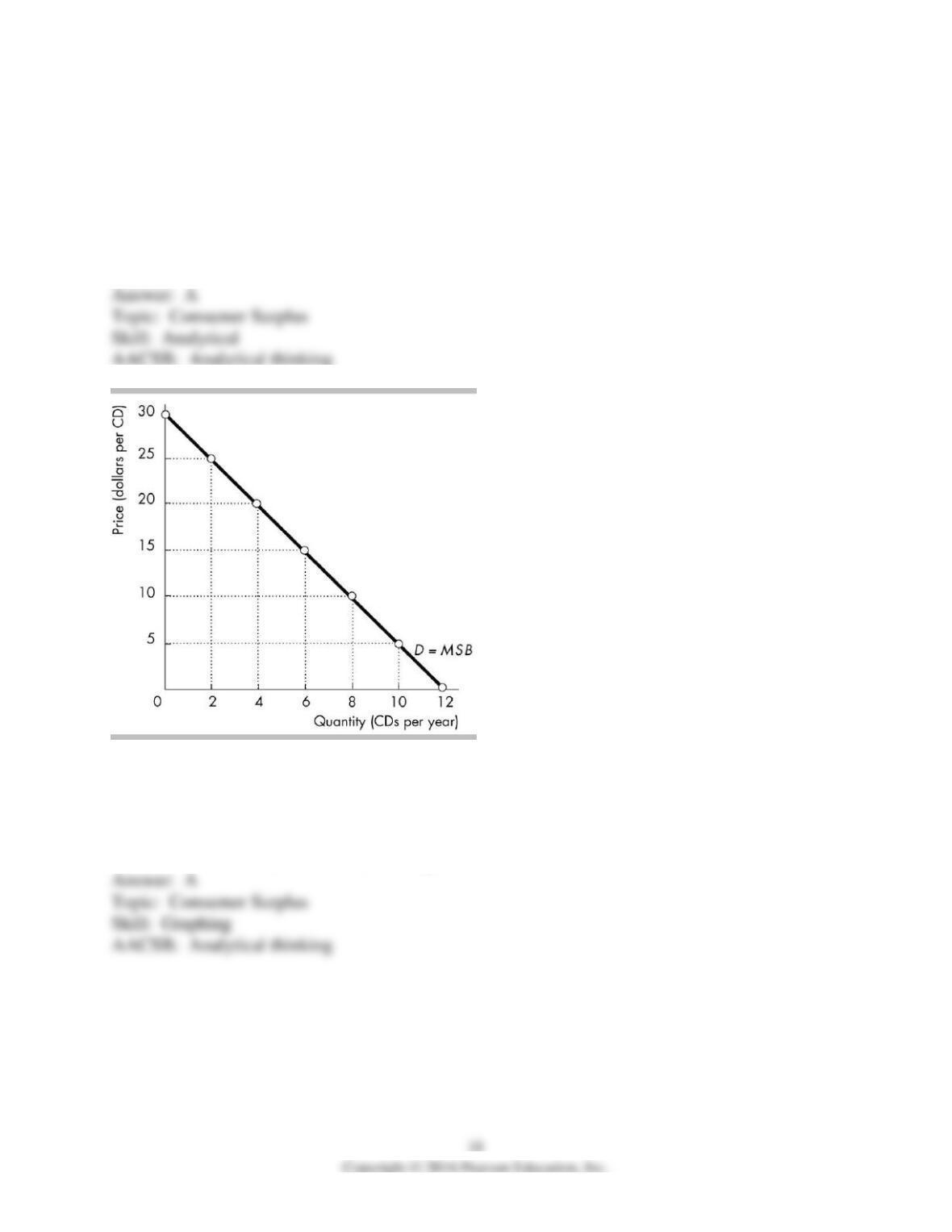
45) The figure above shows Clara’s demand for CDs. If the price for a CD is $15, then Clara
A) receives no consumer surplus on the 6th CD she buys.
B) receives a total of $10 of consumer surplus.
C) will buy no CDs.
D) receives a total of $40 of consumer surplus.
46) The figure above shows Clara’s demand for CDs. The price for a CD is $15. Which statement
is TRUE?
A) When Clara buys 6 CDs, she receives $15 of consumer surplus on her 6th CD.
B) When Clara buys 6 CDs, she receives a total of $15 of consumer surplus.
C) When Clara buys 6 CDs, she receives a total of $30 of consumer surplus.
D) When Clara buys 6 CDs, she receives a total of $45 of consumer surplus.
47) The figure above shows Clara’s demand for CDs. At a price of $20 for a CD, the value of
Clara’s total consumer surplus for all the CDs she buys is
A) $40.
B) $30.
C) $20.
D) $4.
48) The figure above shows Clara’s demand for CDs. At a price of $5 for a CD, the value of
Clara’s total consumer surplus for all the CDs she buys is
A) $5.
B) $10.
C) $25.
D) $125.
49) The figure above shows Clara’s demand for CDs. If the price of a CD were to increase from
$15 to $25, Clara’s total consumer surplus for all the CDs she buys would
A) decrease by $40.
B) remain unchanged.
C) decrease by $90.
D) increase by $80.
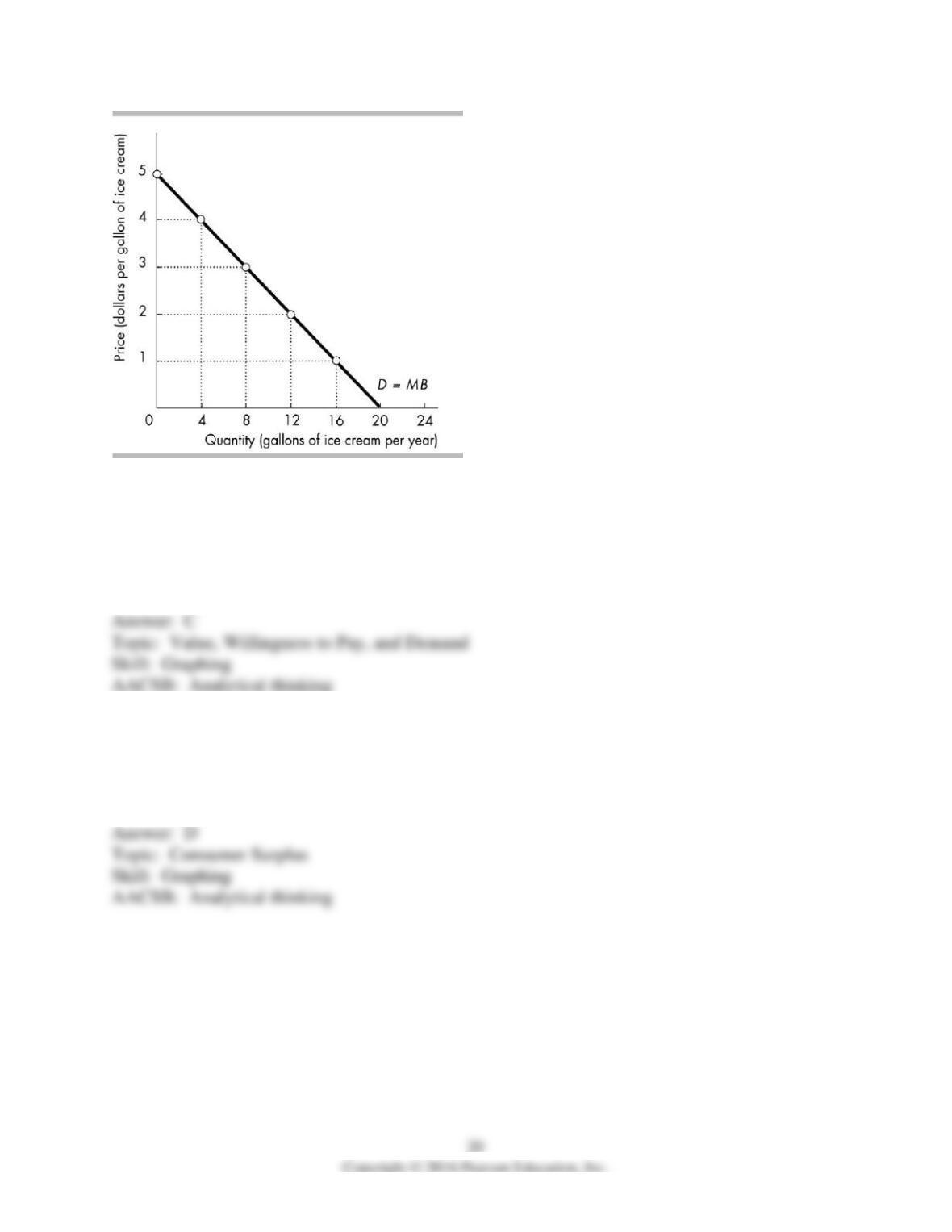
50) The above figure shows Dana’s marginal benefit curve for ice cream. If the price of ice cream
is $2 per gallon, then the maximum that Dana is willing to pay for the 8th gallon of ice cream is
A) $1.
B) $2.
C) $3.
D) $5.
51) In the above figure, the individual’s consumer surplus will be highest if
A) the price of ice cream is $5 per gallon.
B) the price of ice cream is $3 per gallon.
C) the price of ice cream is $2 per gallon.
D) ice cream is free.