
Chapter 5: The Value of Money
Note that there is an overlap between the T/F and multiple-choice questions, as some of the T/F statements
are used in multiple-choice questions.
Multiple Choice: True/False
1.
Starting to invest early for retirement increases the benefits of compound interest.
a.
True
b.
False
2.
Starting to invest early for retirement reduces the benefits of compound interest.
a.
True
b.
False
3.
A time line is meaningful even if all cash flows do not occur annually.
a.
True
b.
False
4.
A time line is not meaningful unless all cash flows occur annually.
a.
True
b.
False
5.
Time lines can be constructed in situations where some of the cash flows occur annually but others occur
quarterly.
a.
True
b.
False
6.
Time lines cannot be constructed in situations where some of the cash flows occur annually but others occur
quarterly.
a.
True
b.
False
7.
Time lines can be constructed for annuities where the payments occur at either the beginning or the end of the
periods.
a.
True
b.
False

8.
Time lines cannot be constructed for annuities unless all the payments occur at the end of the periods.
a.
True
b.
False
9.
Some of the cash flows shown on a time line can be in the form of annuity payments while others can be
uneven
amounts.
a.
True
b.
False
10.
Some of the cash flows shown on a time line can be in the form of annuity payments but none can be uneven
amounts.
a.
True
b.
False
11.
If the discount (or interest) rate is positive, the present value of an expected series of payments will always
exceed
the future value of the same series.
a.
True
b.
False
12.
If the discount (or interest) rate is positive, the future value of an expected series of payments will always
exceed
the present value of the same series.
a.
True
b.
False
13.
Disregarding risk, if money has time value, it is impossible for the present value of a given sum to exceed its
future
value.
a.
True
b.
False
14.
Disregarding risk, if money has time value, it is impossible for the future value of a given sum to exceed its
present
value.
a.
True
b.
False
15.
If a bank compounds savings accounts quarterly, the nominal rate will exceed the effective annual rate.
a.
True
b.
False
16.
If a bank compounds savings accounts quarterly, the effective annual rate will exceed the nominal rate.
a.
True
b.
False
17.
The greater the number of compounding periods within a year, then (1) the greater the future value of a lump
sum
investment at Time 0 and (2) the greater the present value of a given lump sum to be received at some
future date.
a.
True
b.
False
18.
The greater the number of compounding periods within a year, then (1) the greater the future value of a lump
sum
investment at Time 0 and (2) the smaller the present value of a given lump sum to be received at some
future date.
a.
True
b.
False
19.
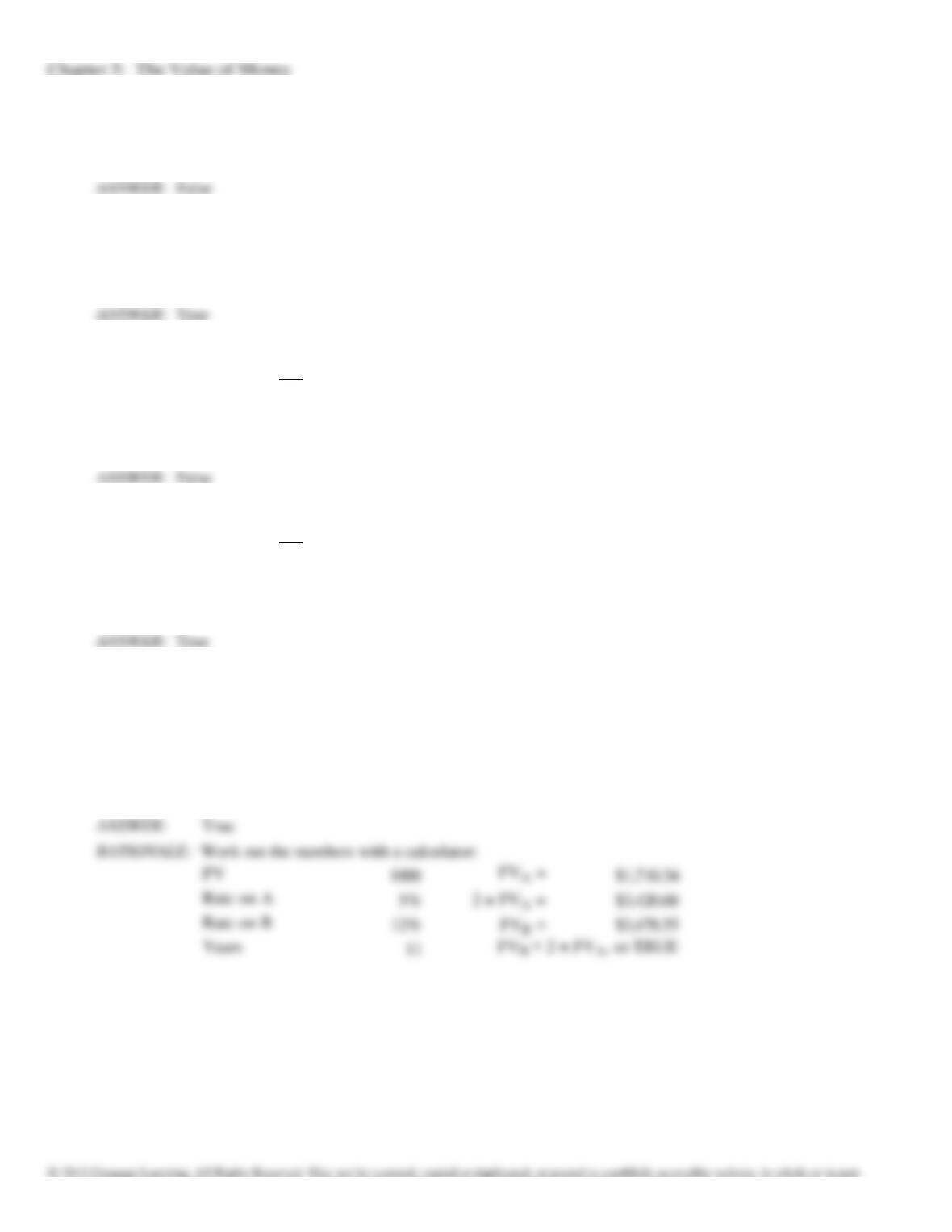
Suppose Sally Smith plans to invest $1,000. She can earn an effective annual rate of 5% on Security A, while
Security B has an effective annual rate of 12%. After 11 years, the compounded value of Security B should be
more than twice the compounded value of Security A. (Ignore risk, and assume that compounding occurs
annually.)
a.
True
b.
False
20.
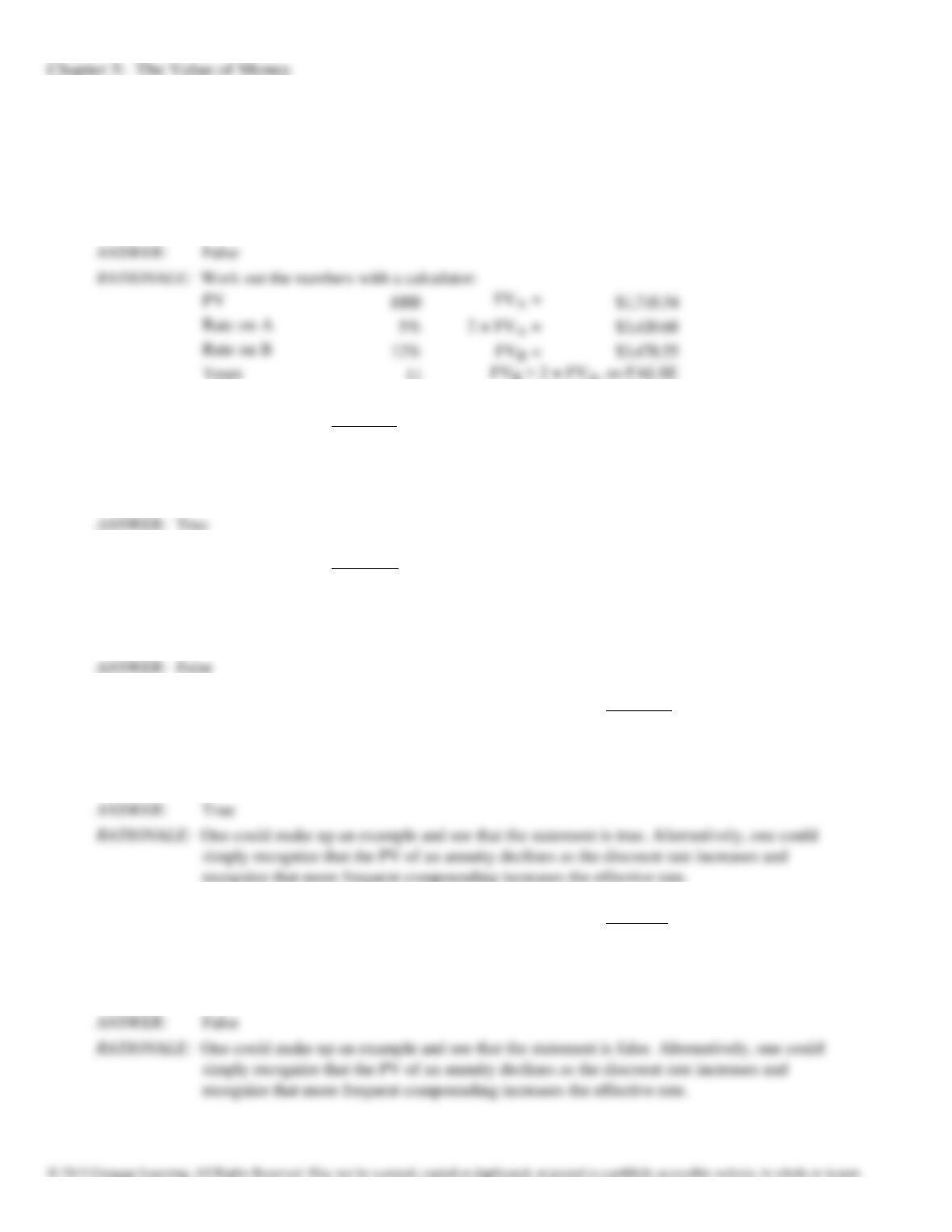
Suppose Randy Jones plans to invest $1,000. He can earn an effective annual rate of 5% on Security A, while
Security B has an effective annual rate of 12%. After 11 years, the compounded value of Security B should be
somewhat less than twice the compounded value of Security A. (Ignore risk, and assume that compounding
occurs
annually.)
a.
True
b.
False
21.
The present value of a future sum decreases as either the discount rate or the number of periods per year
increases, other things held constant.
a.
True
b.
False
22.
The present value of a future sum increases as either the discount rate or the number of periods per year
increases,
other things held constant.
a.
True
b.
False
23.
All other things held constant, the present value of a given annual annuity decreases as the number of periods
per
year increases.
a.
True
b.
False
24.
All other things held constant, the present value of a given annual annuity increases as the number of periods
per
year increases.
a.
True
b.
False

25.
If we are given a periodic interest rate, say a monthly rate, we can find the nominal annual rate by multiplying
the
periodic rate by the number of periods per year.
a.
True
b.
False
26.
If we are given a periodic interest rate, say a monthly rate, we can find the nominal annual rate by dividing the
periodic rate by the number of periods per year.
a.
True
b.
False
27.
As a result of compounding, the effective annual rate on a bank deposit (or a loan) is always equal to or
greater
than the nominal rate on the deposit (or loan).
a.
True
b.
False
28.
As a result of compounding, the effective annual rate on a bank deposit (or a loan) is always equal to or less
than
the nominal rate on the deposit (or loan).
a.
True
b.
False
29.
When a loan is amortized, a relatively high percentage of the payment goes to reduce the outstanding
principal in
the early years, and the principal repayment’s percentage declines in the loan’s later years.
a.
True
b.
False
30.
When a loan is amortized, a relatively low percentage of the payment goes to reduce the outstanding principal
in the
early years, and the principal repayment’s percentage increases in the loan’s later years.
a.
True
b.
False
31.
The payment made each period on an amortized loan is constant, and it consists of some interest and some
principal. The closer we are to the end of the loan’s life, the greater the percentage of the payment that will be
a
repayment of principal.
a.
True
b.
False
32.
The payment made each period on an amortized loan is constant, and it consists of some interest and some
principal. The closer we are to the end of the loan’s life, the smaller the percentage of the payment that will be
a
repayment of principal.
a.
True
b.
False
33.
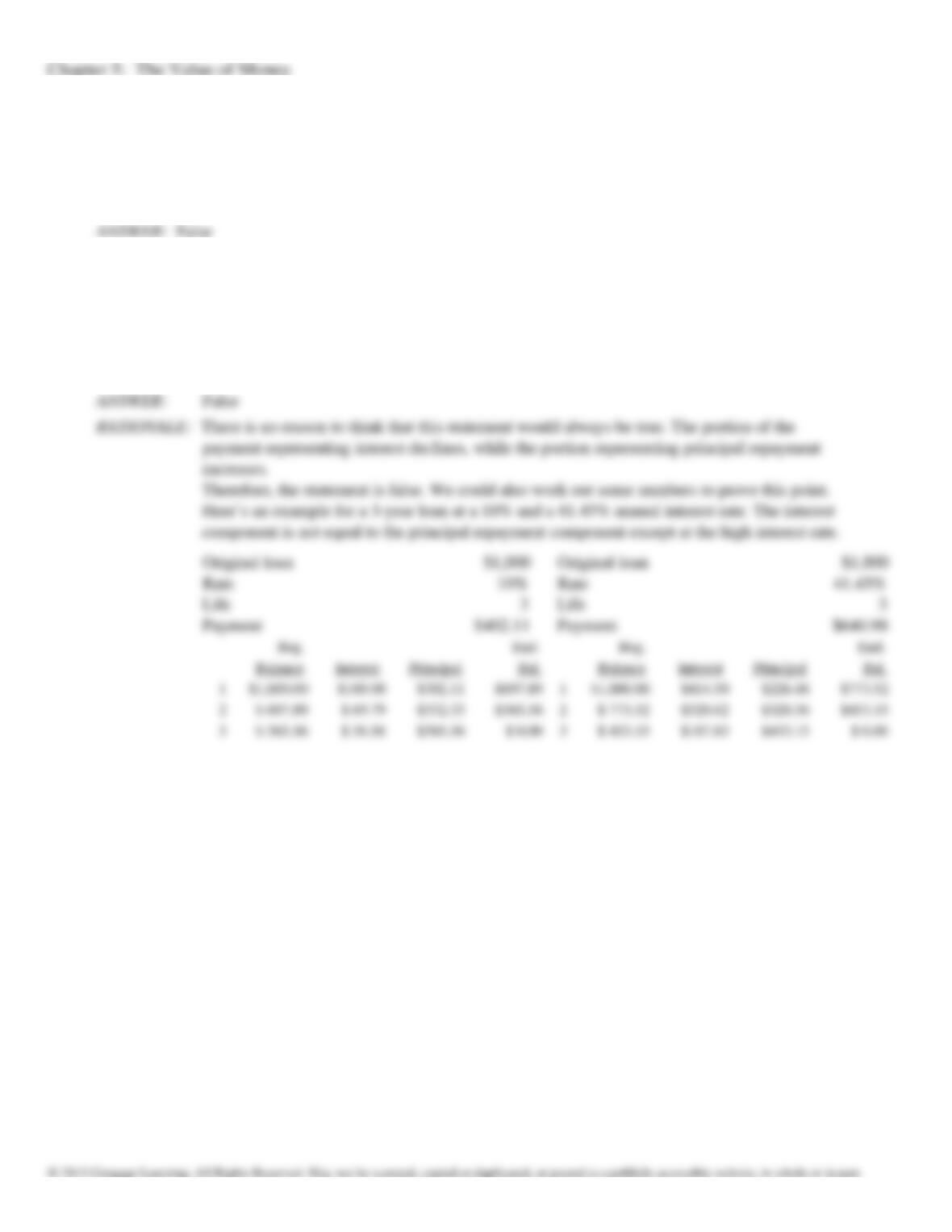
Midway through the life of an amortized loan, the percentage of the payment that represents interest must be
equal
to the percentage that represents repayment of principal. This is true regardless of the original life of the
loan or the
interest rate on the loan.
a.
True
b.
False
34.
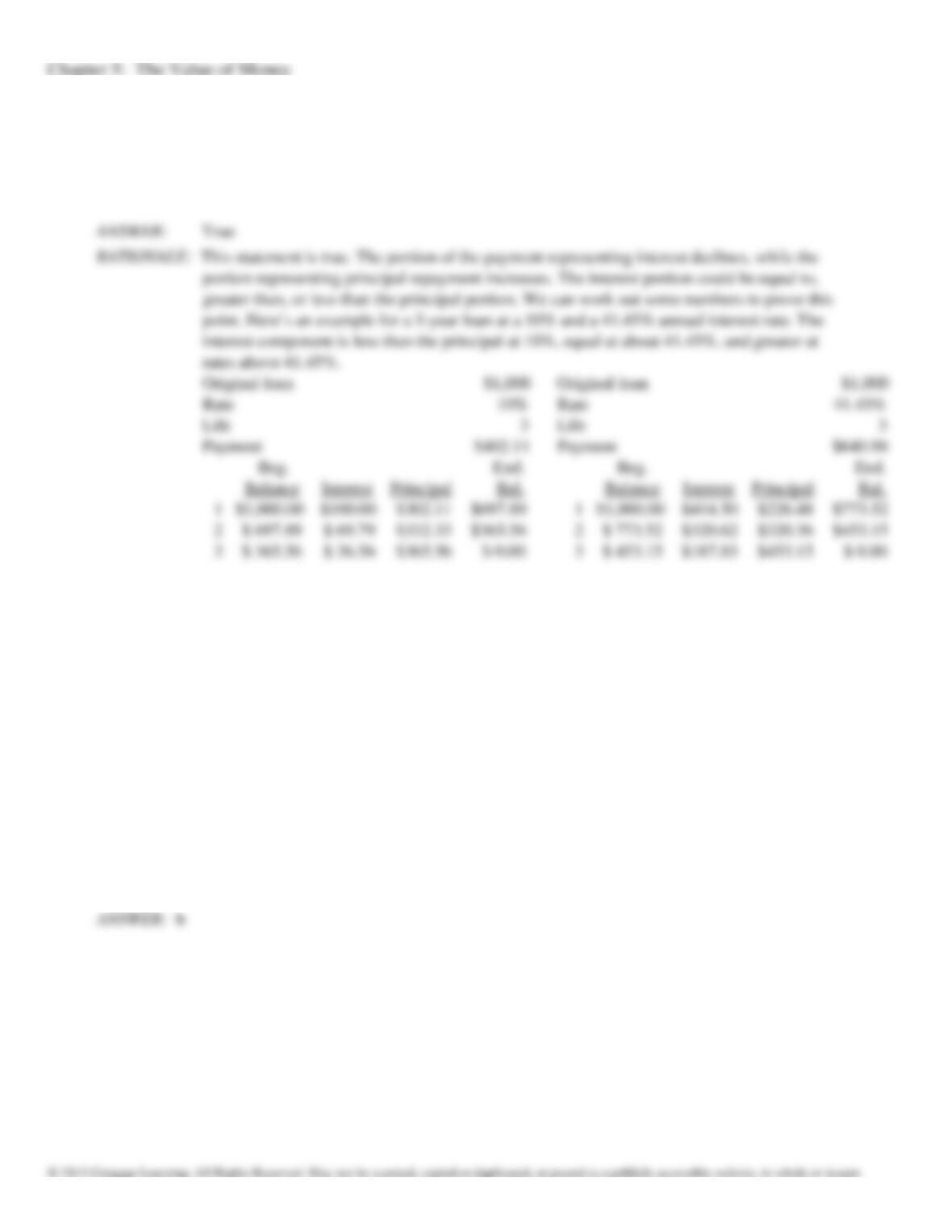
Midway through the life of an amortized loan, the percentage of the payment that represents interest could be
equal
to, less than, or greater than to the percentage that represents repayment of principal. The proportions
depend on
the original life of the loan and the interest rate.
a.
True
b.
False
Multiple Choice: Conceptual
Please note that some of the answer choices, or answers that are very close, are used in different questions.
This has caused us no difficulties, but please take this into account when you make up exams.
35.
Which of the following statements is CORRECT?
a.
A time line is not meaningful unless all cash flows occur annually.
b.
Time lines are useful for visualizing complex problems prior to doing actual calculations.
c.
Time lines cannot be constructed in situations where some of the cash flows occur annually but others
occur
quarterly.
d.
Time lines cannot be constructed for annuities where the payments occur at the beginning of the periods.
e.
Some of the cash flows shown on a time line can be in the form of annuity payments, but none can be
uneven amounts.

36.
Which of the following statements is CORRECT?
a.
A time line is not meaningful unless all cash flows occur annually.
b.
Time lines are not useful for visualizing complex problems prior to doing actual calculations.
c.
Time lines cannot be constructed in situations where some of the cash flows occur annually but others
occur
quarterly.
d.
Time lines can be constructed for annuities where the payments occur at either the beginning or the end of
the periods.
e.
Some of the cash flows shown on a time line can be in the form of annuity payments, but none can be
uneven amounts.
37.
Which of the following statements is CORRECT?
a.
A time line is not meaningful unless all cash flows occur annually.
b.
Time lines are not useful for visualizing complex problems prior to doing actual calculations.
c.
Time lines can be constructed to deal with situations where some of the cash flows occur annually but
others
occur quarterly.
d.
Time lines can only be constructed for annuities where the payments occur at the end of the periods, i.e.,
for
ordinary annuities.
e.
Time lines cannot be constructed where some of the payments constitute an annuity but others are unequal
and thus are not part of the annuity.
38.
Which of the following statements is CORRECT?
a.
A time line is not meaningful unless all cash flows occur annually.
b.
Time lines are not useful for visualizing complex problems prior to doing actual calculations.
c.
Time lines cannot be constructed to deal with situations where some of the cash flows occur annually but
others occur quarterly.
d.
Time lines can only be constructed for annuities where the payments occur at the end of the periods, i.e.,
for
ordinary annuities.
e.
Time lines can be constructed where some of the payments constitute an annuity but others are unequal and
thus are not part of the annuity.
39.
You plan to analyze the value of a potential investment by calculating the sum of the present values of its
expected
cash flows. Which of the following would lower the calculated value of the investment?
a.
The cash flows are in the form of a deferred annuity, and they total to $100,000. You learn that the annuity
lasts for only 5 rather than 10 years, hence that each payment is for $20,000 rather than for $10,000.
b.
The discount rate increases.
c.
The riskiness of the investment’s cash flows decreases.
d.
The total amount of cash flows remains the same, but more of the cash flows are received in the earlier
years and less are received in the later years.
e.
The discount rate decreases.

40.
You plan to analyze the value of a potential investment by calculating the sum of the present values of its
expected
cash flows. Which of the following would increase the calculated value of the investment?
a.
The cash flows are in the form of a deferred annuity, and they total to $100,000. You learn that the annuity
lasts for 10 years rather than 5 years, hence that each payment is for $10,000 rather than for $20,000.
b.
The discount rate decreases.
c.
The riskiness of the investment’s cash flows increases.
d.
The total amount of cash flows remains the same, but more of the cash flows are received in the later years
and less are received in the earlier years.
e.
The discount rate increases.
41.
Which of the following statements is CORRECT?
a.
The cash flows for an ordinary (or deferred) annuity all occur at the beginning of the periods.
b.
If a series of unequal cash flows occurs at regular intervals, such as once a year, then the series is by
definition an annuity.
c.
The cash flows for an annuity due must all occur at the ends of the periods.
d.
The cash flows for an annuity must all be equal, and they must occur at regular intervals, such as once a
year or once a month.
e.
If some cash flows occur at the beginning of the periods while others occur at the ends, then we have what
the textbook defines as a variable annuity.
42.
Which of the following statements is CORRECT?
a.
The cash flows for an ordinary (or deferred) annuity all occur at the beginning of the periods.
b.
If a series of unequal cash flows occurs at regular intervals, such as once a year, then the series is by
definition an annuity.
c.
The cash flows for an annuity due must all occur at the beginning of the periods.
d.
The cash flows for an annuity may vary from period to period, but they must occur at regular intervals,
such
as once a year or once a month.
e.
If some cash flows occur at the beginning of the periods while others occur at the ends, then we have what
the textbook defines as a variable annuity.
43.
Your bank account pays a 6% nominal rate of interest. The interest is compounded quarterly. Which of the
following statements is CORRECT?
a.
The periodic rate of interest is 1.5% and the effective rate of interest is 3%.
b.
The periodic rate of interest is 6% and the effective rate of interest is greater than 6%.
c.
The periodic rate of interest is 1.5% and the effective rate of interest is greater than 6%.
d.
The periodic rate of interest is 3% and the effective rate of interest is 6%.
e.
The periodic rate of interest is 6% and the effective rate of interest is also 6%.
44.
Your bank account pays an 8% nominal rate of interest. The interest is compounded quarterly. Which of the
following statements is CORRECT?
a.
The periodic rate of interest is 2% and the effective rate of interest is 4%.
b.
The periodic rate of interest is 8% and the effective rate of interest is greater than 8%.
c.
The periodic rate of interest is 4% and the effective rate of interest is less than 8%.
d.
The periodic rate of interest is 2% and the effective rate of interest is greater than 8%.
e.
The periodic rate of interest is 8% and the effective rate of interest is also 8%.
45.
A $50,000 loan is to be amortized over 7 years, with annual end–of-year payments. Which of these statements
is
CORRECT?
a.
The annual payments would be larger if the interest rate were lower.
b.
If the loan were amortized over 10 years rather than 7 years, and if the interest rate were the same in either
case, the first payment would include more dollars of interest under the 7-year amortization plan.
c.
The proportion of each payment that represents interest as opposed to repayment of principal
would be
lower if the interest rate were lower.
d.
The last payment would have a higher proportion of interest than the first payment.
e.
The proportion of interest versus principal repayment would be the same for each of the 7 payments.
46.
A $150,000 loan is to be amortized over 7 years, with annual end–of-year payments. Which of these
statements is
CORRECT?
a.
The annual payments would be larger if the interest rate were lower.
b.
If the loan were amortized over 10 years rather than 7 years, and if the interest rate were the same in either
case, the first payment would include more dollars of interest under the 7-year amortization plan.
c.
The proportion of each payment that represents interest as opposed to repayment of principal would be
higher if the interest rate were lower.
d.
The proportion of each payment that represents interest versus repayment of principal would be higher if
the
interest rate were higher.
e.
The proportion of interest versus principal repayment would be the same for each of the 7 payments.
47.
Which of the following statements regarding a 15-year (180-month) $125,000, fixed-rate mortgage is
CORRECT?
(Ignore taxes and transactions costs.)
a.
The remaining balance after three years will be $125,000 less one third of the interest paid during the first
three years.
b.
Because it is a fixed-rate mortgage, the monthly loan payments (which include both interest and principal
payments) are constant.
c.
Interest payments on the mortgage will increase steadily over time, but the total amount of each payment
will
remain constant.
d.
The proportion of the monthly payment that goes towards repayment of principal will be lower 10 years
from
now than it will be the first year.
e.
The outstanding balance declines at a slower rate in the later years of the loan’s life.
48.
Which of the following statements regarding a 15-year (180-month) $125,000, fixed-rate mortgage is
CORRECT?
(Ignore taxes and transactions costs.)
a.
The remaining balance after three years will be $125,000 less one third of the interest paid during the first
three years.
b.
Because the outstanding balance declines over time, the monthly payments will also decline over time.
c.
Interest payments on the mortgage will increase steadily over time, but the total amount of each payment
will
remain constant.
d.
The proportion of the monthly payment that goes towards repayment of principal will be lower 10 years
from
now than it will be the first year.
e.
The outstanding balance declines at a faster rate in the later years of the loan’s life.
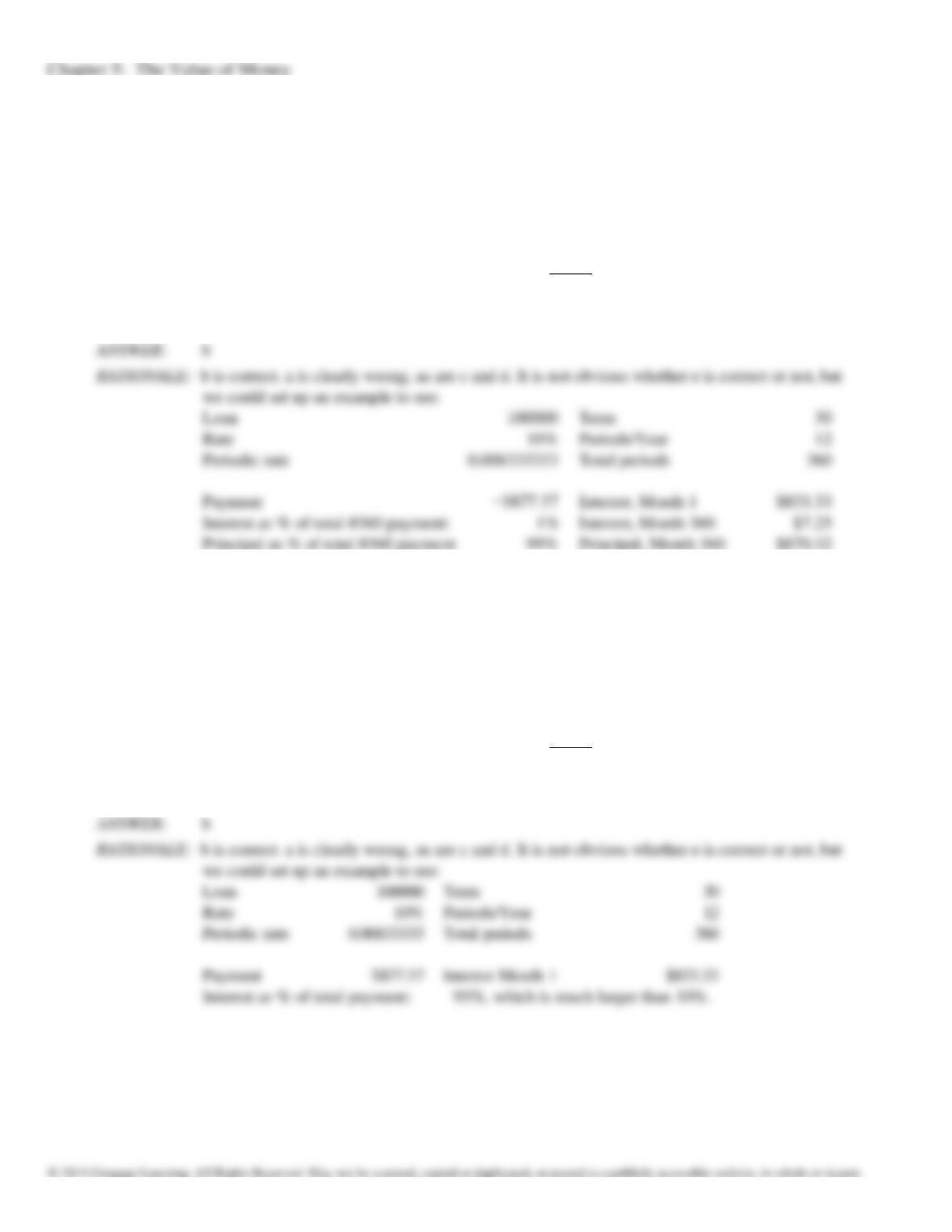
49.
Which of the following statements regarding a 30-year monthly payment amortized mortgage with a nominal
interest rate of 10% is CORRECT?
a.
The monthly payments will decline over time.
b.
A smaller proportion of the last monthly payment will be interest, and a larger proportion will be principal,
than for the first monthly payment.
c.
The total dollar amount of principal being paid off each month gets smaller as the loan approaches
maturity.
d.
The amount representing interest in the first payment would be higher if the nominal interest rate were 7%
rather than 10%.
e.
Exactly 10% of the first monthly payment represents interest.
50.
Which of the following statements regarding a 30-year monthly payment amortized mortgage with a nominal
interest rate of 10% is CORRECT?
a.
The monthly payments will increase over time.
b.
A larger proportion of the first monthly payment will be interest, and a smaller proportion will be principal,
than for the last monthly payment.
c.
The total dollar amount of interest being paid off each month gets larger as the loan approaches maturity.
d.
The amount representing interest in the first payment would be higher if the nominal interest rate were 7%
rather than 10%.
e.
Exactly 10% of the first monthly payment represents interest.
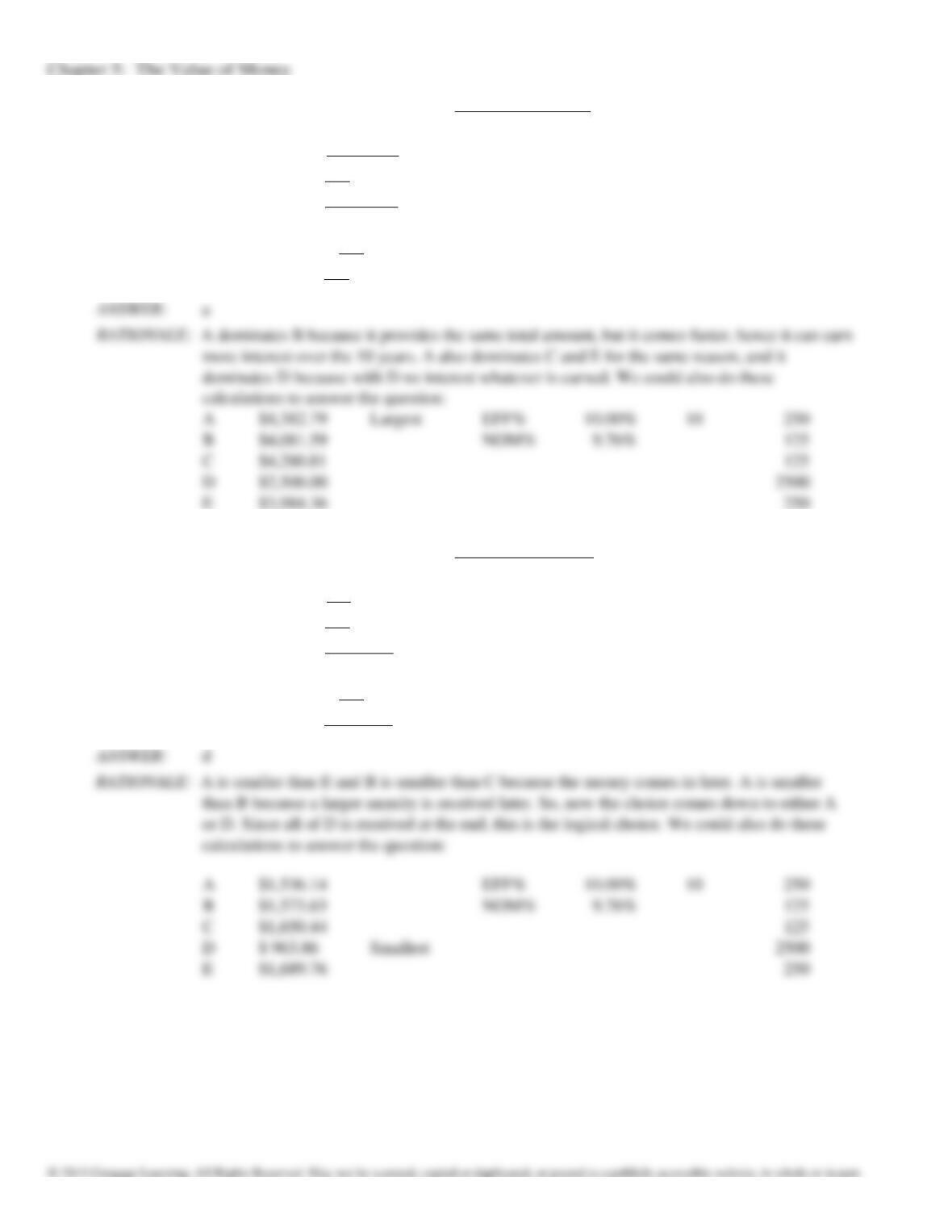
51.
Which of the following investments would have the highest future value at the end of 10 years? Assume that
the
effective annual rate for all investments is the same and is greater than zero.
a.
Investment A pays $250 at the beginning of every year for the next 10 years (a total of 10 payments).
b.
Investment B pays $125 at the end of every 6-month period for the next 10 years (a total of 20 payments).
c.
Investment C pays $125 at the beginning of every 6-month period for the next 10 years (a total of 20
payments).
d.
Investment D pays $2,500 at the end of 10 years (just one payment).
e.
Investment E pays $250 at the end of every year for the next 10 years (a total of 10 payments).
52.
Which of the following investments would have the lowest present value? Assume that the effective annual
rate for
all investments is the same and is greater than zero.
a.
Investment A pays $250 at the end of every year for the next 10 years (a total of 10 payments).
b.
Investment B pays $125 at the end of every 6-month period for the next 10 years (a total of 20 payments).
c.
Investment C pays $125 at the beginning of every 6-month period for the next 10 years (a total of 20
payments).
d.
Investment D pays $2,500 at the end of 10 years (just one payment).
e.
Investment E pays $250 at the beginning of every year for the next 10 years (a total of 10 payments).

53.
A U.S. Treasury bond will pay a lump sum of $1,000 exactly 3 years from today. The nominal interest rate is
6%,
semiannual compounding. Which of the following statements is CORRECT?
a.
The periodic interest rate is greater than 3%.
b.
The periodic rate is less than 3%.
c.
The present value would be greater if the lump sum were discounted back for more periods.
d.
The present value of the $1,000 would be smaller if interest were compounded monthly rather than
semiannually.
e.
The PV of the $1,000 lump sum has a higher present value than the PV of a 3-year, $333.33 ordinary
annuity.
54.
A U.S. Treasury bond will pay a lump sum of $1,000 exactly 3 years from today. The nominal interest rate is
6%,
semiannual compounding. Which of the following statements is CORRECT?
a.
The periodic interest rate is greater than 3%.
b.
The periodic rate is less than 3%.
c.
The present value would be greater if the lump sum were discounted back for more periods.
d.
The present value of the $1,000 would be larger if interest were compounded monthly rather than
semiannually.
e.
The PV of the $1,000 lump sum has a smaller present value than the PV of a 3-year, $333.33 ordinary
annuity.
55.
Which of the following statements is CORRECT, assuming positive interest rates and holding other things
constant?
a.
The present value of a 5-year, $250 annuity due will be lower than the PV of a similar ordinary annuity.
b.
A 30-year, $150,000 amortized mortgage will have larger monthly payments than an otherwise similar 20–
year mortgage.
c.
A bank loan’s nominal interest rate will always be equal to or less than its effective annual rate.
d.
If an investment pays 10% interest, compounded annually, its effective annual rate will be less than 10%.
e.
Banks A and B offer the same nominal annual rate of interest, but A pays interest quarterly and B pays
semiannually. Deposits in Bank B will provide the higher future value if you leave your funds on deposit.
56.
Which of the following statements is CORRECT, assuming positive interest rates and holding other things
constant?
a.
The present value of a 5-year, $250 annuity due will be lower than the PV of a similar ordinary annuity.
b.
A 30-year, $150,000 amortized mortgage will have larger monthly payments than an otherwise similar 20–
year mortgage.
c.
A bank loan’s nominal interest rate will always be equal to or greater than its effective annual rate.
d.
If an investment pays 10% interest, compounded quarterly, its effective annual rate will be greater than
10%.
e.
Banks A and B offer the same nominal annual rate of interest, but A pays interest quarterly and B pays
semiannually. Deposits in Bank B will provide the higher future value if you leave your funds on deposit.

57.
Which of the following statements is CORRECT?
a.
The present value of a 3-year, $150 annuity due will exceed the present value of a 3-year, $150 ordinary
annuity.
b.
If a loan has a nominal annual rate of 8%, then the effective rate can never be greater than 8%.
c.
If a loan or investment has annual payments, then the effective, periodic, and nominal rates of interest will
all
be different.
d.
The proportion of the payment that goes toward interest on a fully amortized loan increases over time.
e.
An investment that has a nominal rate of 6% with semiannual payments will have an effective rate that is
smaller than 6%.
58.
Which of the following statements is CORRECT?
a.
The present value of a 3-year, $150 ordinary annuity will exceed the present value of a 3-year, $150
annuity
due.
b.
If a loan has a nominal annual rate of 8%, then the effective rate will never be less than 8%.
c.
If a loan or investment has annual payments, then the effective, periodic, and nominal rates of interest will
all
be different.
d.
The proportion of the payment that goes toward interest on a fully amortized loan increases over time.
e.
An investment that has a nominal rate of 6% with semiannual payments will have an effective rate that is
smaller than 6%.
59.
You are considering two equally risky annuities, each of which pays $5,000 per year for 10 years. Investment
ORD
is an ordinary (or deferred) annuity, while Investment DUE is an annuity due. Which of the following
statements is
CORRECT?
a.
The present value of ORD must exceed the present value of DUE, but the future value of ORD may be less
than the future value of DUE.
b.
The present value of DUE exceeds the present value of ORD, while the future value of DUE is less than
the
future value of ORD.
c.
The present value of ORD exceeds the present value of DUE, and the future value of ORD also exceeds
the
future value of DUE.
d.
The present value of DUE exceeds the present value of ORD, and the future value of DUE also exceeds
the
future value of ORD.
e.
If the going rate of interest decreases from 10% to 0%, the difference between the present value of ORD
and the present value of DUE would remain constant.

60.
You are considering two equally risky annuities, each of which pays $5,000 per year for 10 years. Investment
ORD
is an ordinary (or deferred) annuity, while Investment DUE is an annuity due. Which of the following
statements is
CORRECT?
a.
A rational investor would be willing to pay more for DUE than for ORD, so their market prices should
differ.
b.
The present value of DUE exceeds the present value of ORD, while the future value of DUE is less than
the
future value of ORD.
c.
The present value of ORD exceeds the present value of DUE, and the future value of ORD also exceeds
the
future value of DUE.
d.
The present value of ORD exceeds the present value of DUE, while the future value of DUE exceeds the
future value of ORD.
e.
If the going rate of interest decreases from 10% to 0%, the difference between the present value of ORD
and the present value of DUE would remain constant.
61.
Which of the following statements is CORRECT?
a.
If you have a series of cash flows, each of which is positive, you can solve for I, where the solution value of
I causes the PV of the cash flows to equal the cash flow at Time 0.
b.
If you have a series of cash flows, and CF0 is negative but each of the following CFs is positive, you can
solve for I, but only if the sum of the undiscounted cash flows exceeds the cost.
c.
To solve for I, one must identify the value of I that causes the PV of the positive CFs to equal the absolute
value of the PV of the negative CFs. This is, essentially, a trial-and-error procedure that is easy with a
computer or financial calculator but quite difficult otherwise.
d.
If you solve for I and get a negative number, then you must have made a mistake.
e.
If CF0 is positive and all the other CFs are negative, then you cannot solve for I.
62.
Which of the following statements is CORRECT?
a.
If you have a series of cash flows, each of which is positive, you can solve for I, where the solution value of
I causes the PV of the cash flows to equal the cash flow at Time 0.
b.
If you have a series of cash flows, and CF0 is negative but each of the following CFs is positive, you can
solve for I, but only if the sum of the undiscounted cash flows exceeds the cost.
c.
To solve for I, one must identify the value of I that causes the PV of the positive CFs to equal the absolute
value of the FV of the negative CFs. It is impossible to find the value of I without a computer or financial
calculator.
d.
If you solve for I and get a negative number, then you must have made a mistake.
e.
If CF0 is positive and all the other CFs are negative, then you can still solve for I.
63.
Which of the following bank accounts has the highest effective annual return?
a.
An account that pays 8% nominal interest with monthly compounding.
b.
An account that pays 8% nominal interest with annual compounding.
c.
An account that pays 7% nominal interest with daily (365-day) compounding.
d.
An account that pays 7% nominal interest with monthly compounding.
e.
An account that pays 8% nominal interest with daily (365-day) compounding.
64.
Which of the following bank accounts has the lowest effective annual return?
a.
An account that pays 8% nominal interest with monthly compounding.
b.
An account that pays 8% nominal interest with annual compounding.
c.
An account that pays 7% nominal interest with daily (365-day) compounding.
d.
An account that pays 7% nominal interest with monthly compounding.
e.
An account that pays 8% nominal interest with daily (365-day) compounding.
65.
You plan to invest some money in a bank account. Which of the following banks provides you with the
highest
effective rate of interest?
a.
Bank 1; 6.1% with annual compounding.
b.
Bank 2; 6.0% with monthly compounding.
c.
Bank 3; 6.0% with annual compounding.
d.
Bank 4; 6.0% with quarterly compounding.
e.
Bank 5; 6.0% with daily (365-day) compounding.
66.
Sue now has $125. How much would she have after 8 years if she leaves it invested at 8.5% with annual
compounding?
a.
$205.83
b.
$216.67
c.
$228.07
d.
$240.08
e.
$252.08
67.
Jose now has $500. How much would he have after 6 years if he leaves it invested at 5.5% with annual
compounding?
a.
$591.09
b.
$622.20
c.
$654.95
d.
$689.42
e.
$723.89
68.
Suppose you have $1,500 and plan to purchase a 5-year certificate of deposit (CD) that pays 3.5% interest,
compounded annually. How much will you have when the CD matures?
a.
$1,781.53
b.
$1,870.61
c.
$1,964.14
d.
$2,062.34
e.
$2,165.46
69.
Suppose you have $2,000 and plan to purchase a 10-year certificate of deposit (CD) that pays 6.5% interest,
compounded annually. How much will you have when the CD matures?
a.
$3,754.27
b.
$3,941.99
c.
$4,139.09
d.
$4,346.04
e.
$4,563.34
70.
Last year Rocco Corporation’s sales were $225 million. If sales grow at 6% per year, how large (in millions)
will
they be 5 years later?
a.
$271.74
b.
$286.05
c.
$301.10
d.
$316.16
e.
$331.96
71.
Last year Dania Corporation’s sales were $525 million. If sales grow at 7.5% per year, how large (in millions)
will
they be 8 years later?
a.
$ 845.03
b.
$ 889.51
c.
$ 936.33
d.
$ 983.14
e.
$1,032.30
72.
How much would $1, growing at 3.5% per year, be worth after 75 years?
a.
$12.54
b.
$13.20
c.
$13.86
d.
$14.55
e.
$15.28
73.
How much would $100, growing at 5% per year, be worth after 75 years?
a.
$3,689.11
b.
$3,883.27
c.
$4,077.43
d.
$4,281.30
e.
$4,495.37