File: Chapter 05 Using Supply and Demand
True/False
[QUESTION]
1. When gasoline prices rose in the early 2000s, the demand for SUVs fell. An economist would
predict that SUV prices would decline or at least not rise as quickly.
2. Real-world experience shows that when weather conditions reduce crop yields, the price of
agricultural products will fall.
3. The effect of successful compliance with recycling regulation by homeowners on the market
for recycled paper along with a concurrent rise in demand for products made with recycled paper
is best shown by a shift to the right in the supply of and demand for recyclable paper and a
certain drop in its price.
4. Trade sanctions imposed on Iraq that limited Iraq’s production of oil after the 1990 Gulf War
on the oil market are best shown graphically with a price ceiling below equilibrium price.
5. The minimum wage is an example of a price floor.
6. A price floor causes excess demand, resulting in the need to ration by some means other than
price.
7. Given a downward sloping demand curve, a tax on the supply of a good will result in an
increase in equilibrium price that is less than the amount of the tax.
8. Tariffs increase equilibrium price and quantity.
9. When the person who chooses how much to purchase doesn’t have to bear the full cost, the
quantity demanded tends to be higher.
10. When a hurricane destroys a significant portion of an apple crop:
A. apple prices rise, and quantity sold rises.
B. apple prices decline, and quantity sold falls.
C. apple prices rise, and quantity sold falls.
D. apple prices decline, and quantity sold rises.
11. The standard supply/demand framework:
A. can be modified to explain real-world events.
B. cannot be modified to explain real-world events.
C. should not be modified to explain real-world events.
D. explains real-world events with no need for modification.
12. Suppose a recent and widely circulated medical article reports new benefits of exercise.
Simultaneously, the price of the parts needed to make bikes falls. What is the likely effect on the
equilibrium price and quantity of exercise bikes sold?
A. Price of exercise bikes decreases and quantity sold remains the same.
B. Price of exercise bikes increases and quantity sold also increases.
C. Price of exercise bikes remains the same and quantity sold increases.
D. The change in price is ambiguous, but the quantity sold increases.
13. The U.S. Postal Service printed 150,000 sheets of a stamp depicting Bill Pickett, but recalled
them when the USPS realized the image on the stamp was Bill’s brother, Ben instead. They were
unable to recall 183 sheets that had already been sold. The effect of this recall was to:
A. drastically reduce the demand for the stamps, causing their equilibrium price to fall.
B. have no effect on either supply of or demand for the Bill Pickett stamps because there is no
market for them.
C. drastically reduce the supply of the Bill Pickett stamps, causing their equilibrium price to
rise.
D. drastically reduce the supply of the Bill Pickett stamps, causing their equilibrium price to fall.
14. The Katrina disaster in New Orleans decreased the ability of oil companies to purify crude
oil into gasoline. This caused:
A. the supply curve for gasoline to shift inward.
B. the supply curve for gasoline to shift outward.
C. the quantity of gasoline demanded to move out along the demand curve.
D. the quantity of gasoline supplied to move in along the supply curve.
15. European Union subsidizes its farmers. How do these subsidies make it difficult for farmers
in developing economies to compete in the world farm market?
A. The subsidies set a price ceiling for EU farm goods, keeping prices below the market
equilibrium, and lowering the price developing country farmers can receive for their produce.
B. The subsidies shift the supply of EU farm goods to the right, lowering world prices of farm
goods and the price developing country farmers can receive for their produce.
C. The subsidies function as a tariff, causing imports from developing countries to become
artificially expensive, thus denying European consumers the benefits of cheap imported food
D. The subsidies create ethical problems for Europeans who want to buy farm products from
developing countries since the subsidies are raising the price of developing country produce.
16. Which of the following would be the most likely effect of a 75 percent tax on punitive
awards by juries?
A. An increase in the number of lawsuits asking for punitive damages
B. A decrease in the number of cases settled out of court
C. An increase in the incentive for plaintiffs to pursue legal action against individuals or
businesses who have caused injury due to gross negligence
D. An increase in pre-trial settlements since plaintiffs are willing to accept lower settlement
amounts that are not taxed
17. The U.S. imposes substantial taxes on cigarettes but not on loose tobacco. When the tax on
cigarettes went into effect, the demand for home cigarette rolling machines most likely:
A. decreased, causing the price of cigarette rolling machines to fall and the quantity of machines
purchased to fall.
B. decreased, causing the price of cigarette rolling machines to rise and the quantity of machines
purchased to fall.
C. increased, causing the price of cigarette rolling machines to rise and the quantity of machines
purchased to rise.
D. increased, causing the price of cigarette rolling machines to rise and the quantity of machines
purchased to fall.
18. Suppose the price of tomatoes dramatically increases. Which of the following could cause
this change?
A. Hurricanes during the late summer damages the Florida crop, shifting supply left
B. A reduction in tariffs of tomatoes from Central American, shifting supply right
C. Anews report stating that a pesticide used on tomatoes might cause cancer, shifting the
demand to the right
D. Advertising for catsup increases demand for catsup, shifting the demand curve to the left
19. Online music stores such as Apple’s iTunes provide an alternative to buying CDs. The
introduction of online music stores has shifted:
A. the supply curve of CDs to the right.
B. the supply curve of CDs to the left.
C. the demand curve of CDs to the right.
D. the demand curve of CDs to the left.
20. Refer to the following graphs.
Floods in the U.S. Midwest reduce the U.S. corn crop. Which graph depicts the effect of the
floods on the U.S. corn market?
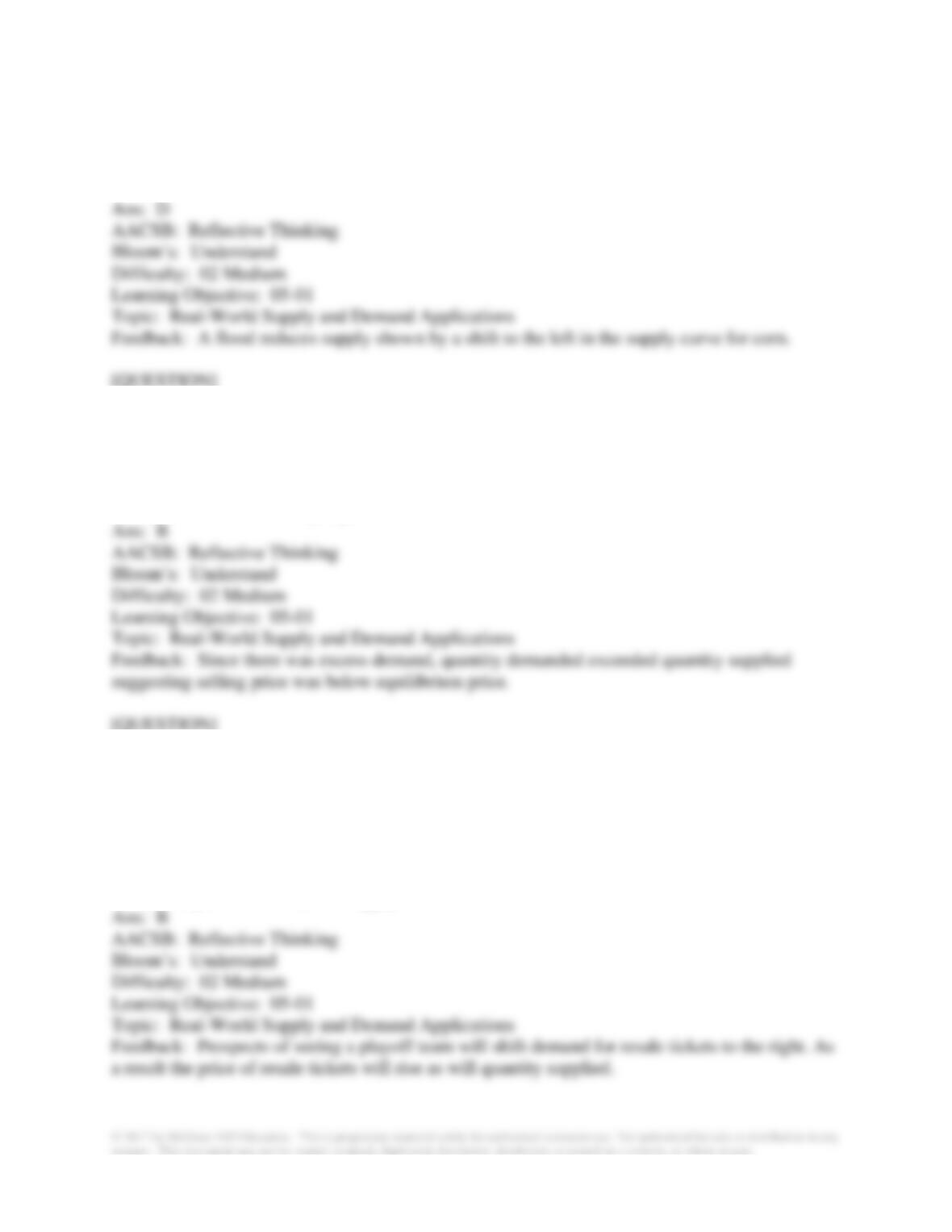
A. I
B. II
C. III
D. IV
21. At a Chicago Bulls game 20,000 tickets were sold at $30 apiece. The game was sold out and
some people did not get tickets. This suggests that the selling price:
A. was at equilibrium.
B. was below equilibrium.
C. was above equilibrium.
D. could not have been any higher.
22. Season tickets to the Miami Heat games are sold out at $30 a game and some people who
wanted to get tickets couldn’t buy them. As the season progresses, it is clear that the Heat will
make it to the playoffs. What is the effect on resale price of tickets to Miami Heat games,
assuming resale is legal?
A. Resale price will remain at $30 a game.
B. Resale price will rise and quantity supplied will rise.
C. Resale price will rise and supply will rise.
D. Resale price will decline as supply rises.
[QUESTION]
23. In the late 1990s “mad cow” disease caused people to buy less beef. It also caused the EU to
ban imported British beef and the British government to ban the sale of older cattle. What is the
effect of the following on price and quantity of British beef sold worldwide?
A. Price of British beef falls and quantity sold also falls
B. Price of British beef rises and quantity sold falls
C. Price of British beef falls initially, but regains some of its losses; quantity sold initially rises,
then falls
D. Price of British beef falls initially, but regains some of its losses; quantity sold falls
24. In 1990 the UN placed trade sanctions on Iraqi oil. In 1996, Iraq was allowed limited export
of oil to make war reparations. What was the predicted effect of the two events on equilibrium
price and quantity of oil?
A. price fell initially, then rose (failing to return to its former low level); quantity fell and then
rose
B. price fell initially, then rose (failing to return to its former low level); quantity rose and then
fell
C. price rose initially, then fell (failing to regain its former losses); quantity fell and then rose
D. price rose initially, then fell (failing to regain its former losses); quantity rose, then fell
25. When computer manufacturers overcame the enormous 13,000 Chinese character barrier by
creating a workable keyboard through voice and handwriting recognition, PCs became more
accessible to the Chinese. What was the predicted effect of the events on equilibrium price and
quantity of PCs sold in China?
A. price and quantity fell
B. price fell and quantity rose
C. price rose and quantity fell
D. price and quantity rose
26. U.S. baby boomers are beginning to retire and withdraw their savings for retirement. What
effect should we expect this to have on equilibrium price and quantity of financial assets?
A. price rises and quantity also rises
B. price rises and quantity falls
C. price falls and quantity rises
D. price falls and quantity also falls
27. More and more devices are being introduced in the market that perform tasks similar to that
of PCs, such as tablets and smartphones. At the same time, the price of computer chips to make
high-end PCs continues to fall. What is the effect of the events on equilibrium price and quantity
of high-end PCs?
A. price falls continuously as does quantity sold
B. price rises then falls while quantity sold falls continuously
C. price falls continuously while quantity falls initially but then rises, recouping earlier losses
D. price falls continuously and quantity rises continuously
28. An increase in price and decrease in quantity are consistent with a:
A. leftward shift in demand and no shift in supply.
B. leftward shift in supply and no shift in demand.
C. rightward shift in supply and a rightward shift in demand.
D. rightward shift in supply and a leftward shift in demand.
29. An increase in price and an indeterminate change in quantity are consistent with a:
A. leftward shift in demand and no shift in supply.
B. leftward shift in supply and no shift in demand.
C. rightward shift in supply and a leftward shift in demand.
D. leftward shift in supply and a rightward shift in demand.
30. A decrease in price and an indeterminate change in quantity are consistent with a:
A. leftward shift in demand and no shift in supply.
B. leftward shift in supply and no shift in demand.
C. rightward shift in supply and a leftward shift in demand.
D. leftward shift in supply and a rightward shift in demand.
31. An increase in quantity and an indeterminate change in price are consistent with a:
A. leftward shift in demand and supply
B. rightward shift in supply and demand.
C. rightward shift in supply, keeping demand constant.
D. rightward shift in demand, keeping supply constant.
32. A decrease in quantity and price is consistent with a:
A. leftward shift in demand keeping supply constant.
B. leftward shift in supply keeping demand constant.
C. rightward shift in supply and demand
D. rightward shift in demand and a leftward shift in supply.
33. Refer to the following graphs.
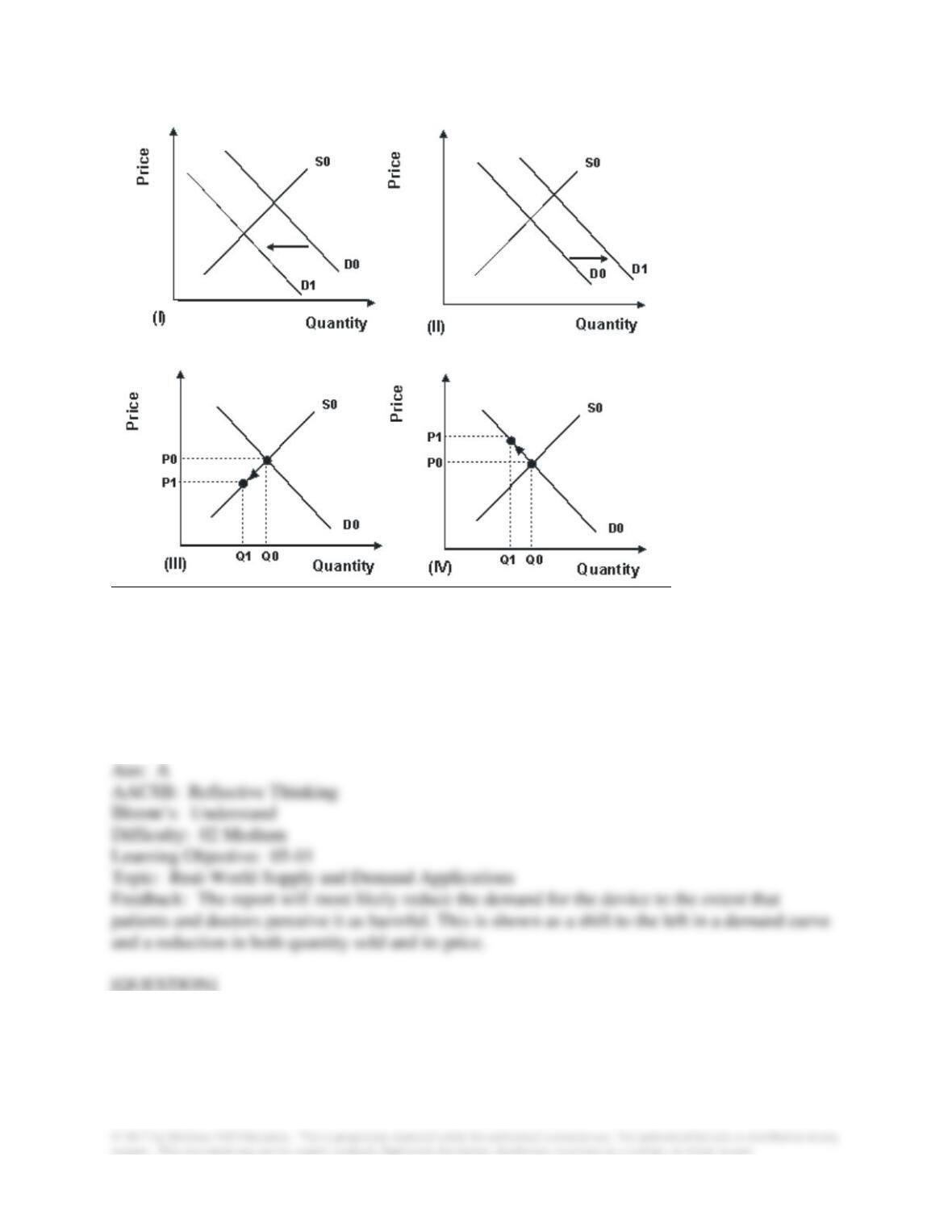
A recent report indicates that the device known as the right heart catheter used to diagnose heart
conditions poses more risks than previously thought. The effect of the report on the market for
right heart catheters is best shown by which of the graphs?
A. I
B. II
C. III
D. IV
34. Refer to the following graphs.
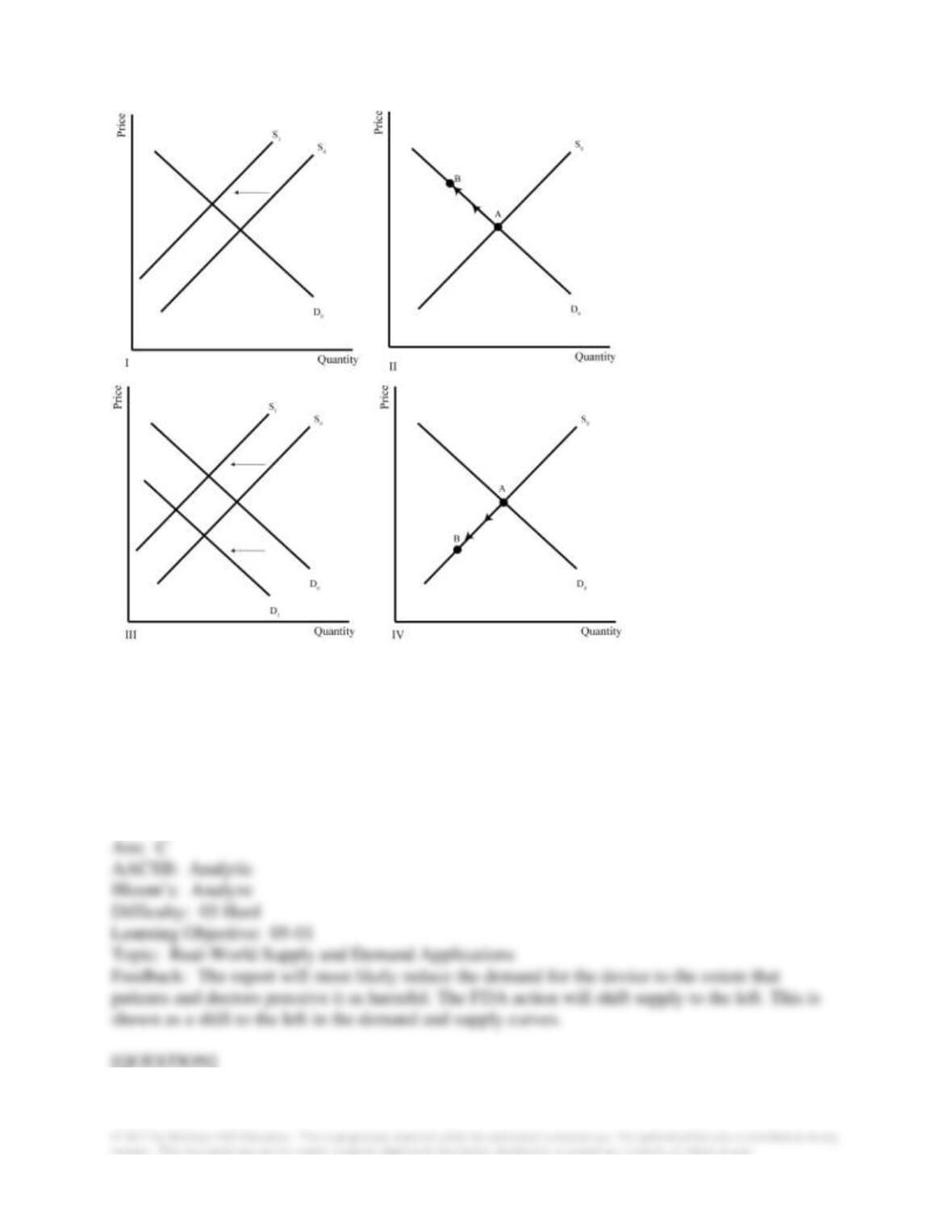
A recent report indicated that 50 intensive-care unit patients die for every 1,000 who are
managed with a heart device known as the right heart catheter. Suppose as a result, the FDA
limited supply of the heart catheters. The effect of the report and subsequent action by the FDA
on the market for right heart catheters is best shown by which of the graphs?
A. I
B. II
C. III
D. IV
35. Refer to the following graphs.
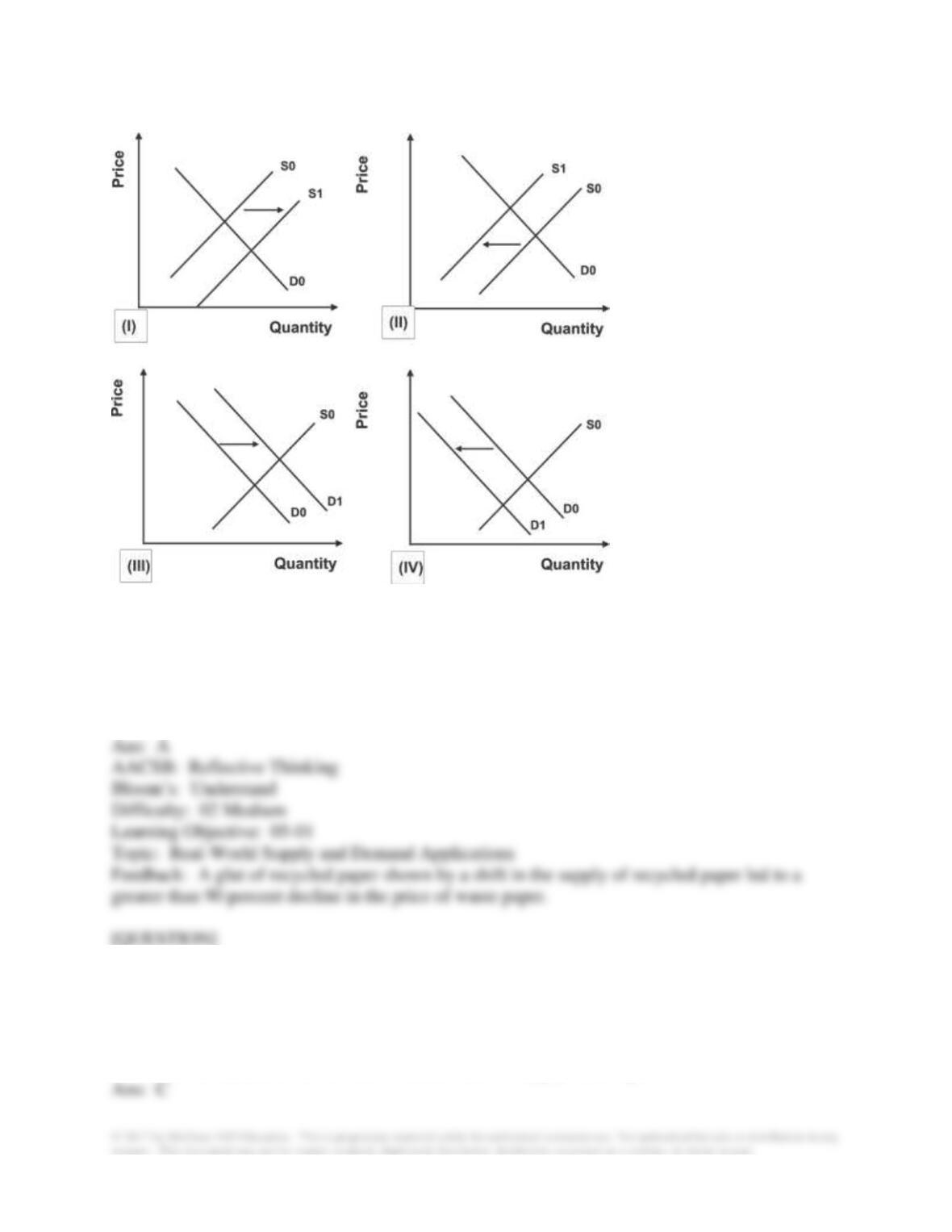
Americans nationwide have been complying with recycling regulations with unexpected zeal.
The effect on the market for recycled paper is best shown by which graph?
A. I
B. II
C. III
D. IV
36. Suppose caviar sales soars at the same time price increases. What would lead to both a
higher quantity sold and higher price of caviar?
A. A shift in demand to the right and a larger shift in supply to the right.
B. A shift in demand to the left and a smaller shift in supply to the left.
C. A shift in demand to the right and a shift in supply to the left.
D. A shift in demand to the left and a smaller shift in supply to the right.
37. Suppose that there is a renewed interest in eating caviar at the same time that the supply of
Russian caviar shrinks. What would be the most likely effect of these events on the price and
quantity of caviar sold?
A. Price rose and quantity sold fell
B. Price rose and the effect on the quantity of caviar sold is ambiguous
C. Price fell and the effect on the quantity of caviar sold is ambiguous
D. Price fell and quantity sold rise
38. Honus Wagner, a major league baseball player from 1897 to 1917 and one of the first five
men inducted into the Baseball Hall of fame, had his baseball card pulled from cigarette packs
because he wasn’t being paid for their distribution. What best describes the effect of his action on
the market for his baseball card?
A. Supply shifted to the left, price rose, and quantity demanded fell
B. Supply shifted to the left, price rose, and demand shifted to the left
C. Demand shifted to the left, price fell, and quantity supplied fell
D. Demand shifted to the left, price fell, and supply fell
39. Helped by desktop publishing, the number of vintage baseball card forgeries has flooded the
market for vintage baseball cards. Dealers left the market for fear of purchasing a phony. What
was the effect on the market for vintage baseball cards assuming phonies cannot be detected?
A. Demand shifted to the left, supply did not change, price declined, and quantity traded
declined
B. Supply shifted to the right, demand did not change, price declined, and quantity traded rose
C. Supply shifted to the right, demand shifted to the left, and price rose
D. Supply shifted to the right, demand shifted to the left, and price declined
40. A Wall Street Journal headline reads: “Cigar Shortage Draws New Brands into Market.”
The shortage resulted from a renewed interest in smoking cigars. What best describes facts
behind the headline?
A. Supply has shifted to the right. Price has fallen somewhat, but not enough to equilibrate
supply and demand.
B. Demand has shifted to the right. Price has risen somewhat, increasing quantity supplied, but
not enough to equal quantity demanded.
C. Demand has shifted to the right and price has risen to equilibrate supply and demand.
D. Supply has shifted to the left. Price has risen somewhat, but not enough to equilibrate supply
and demand.
41. A Wall Street Journal headline reads: “Cigar Shortage Draws New Brands into Market.”
The shortage resulted from a renewed interest in smoking cigars. What best describes the facts
behind the headline?
A. Price is too low, demand exceeds supply
B. Price is too low, quantity demanded exceeds quantity supplied
C. The cigar market is in equilibrium
D. A shift in supply has equilibrated supply and demand
42. After several years of slow economic growth, world demand for petroleum began to rise
rapidly in the 1990s. Much of the increase in demand was met by additional supplies from
sources outside OPEC. OPEC during this time was unable to restrain output among members in
its effort to lift oil prices. What best describes these events?
A. The rise in demand shifted the demand for oil to the right. OPEC actions shifted the demand
for oil back to the left.
B. The rise in demand shifted the demand for oil to the right. As price rose, supply of oil also
rose.
C. The rise in demand shifted the demand for oil to the right. As price rose, quantity of oil
supplied rose.
D. The rise in demand reflects a movement down along the demand curve as supply shifted to
the right when suppliers produced more oil.
43. Fishing for king crabs for a living is risky business. Their migration habits along the Bering
Strait are just not understood. The king crabs seem to disappear one year but return mysteriously
a few years later, wreaking havoc on the income of crabbers. When crabs disappear, consumers
buy lobster instead. What best describes this situation in the king crab market?
A. The supply curve shifts to the left when crabs disappear (their price rises) and shift to the
right when they reappear (their price declines).
B. The supply curve shifts to the left when crabs disappear, (their price rises) and the demand
curve shifts to the left when consumers substitute lobster for crab (lowering their price). The
supply curve then shifts to the right when crabs reappear (their price declines).
C. The price of crab rises when crabs are scarce creating excess demand. The price of crab falls
when crabs are abundant creating excess supply.
D. The quantity of crab falls and then rises as crabs disappear and reappear in response to shifts
in demand. Demand shifts to the left as consumers substitute toward lobster when crab is scarce
and shift to the right when crab is abundant.
44. Refer to the following graphs.
In the early 1990s, mounds of newspapers and worthless plastic piled up at recycling centers. As
the nation’s economy continued to grow, increased demand eliminated the mounds and turned
them into shortages. In the mid-1990s, as recycling became more popular, the mounds of
recycled materials returned. What graph best depicts these events on the market for recycled
materials?
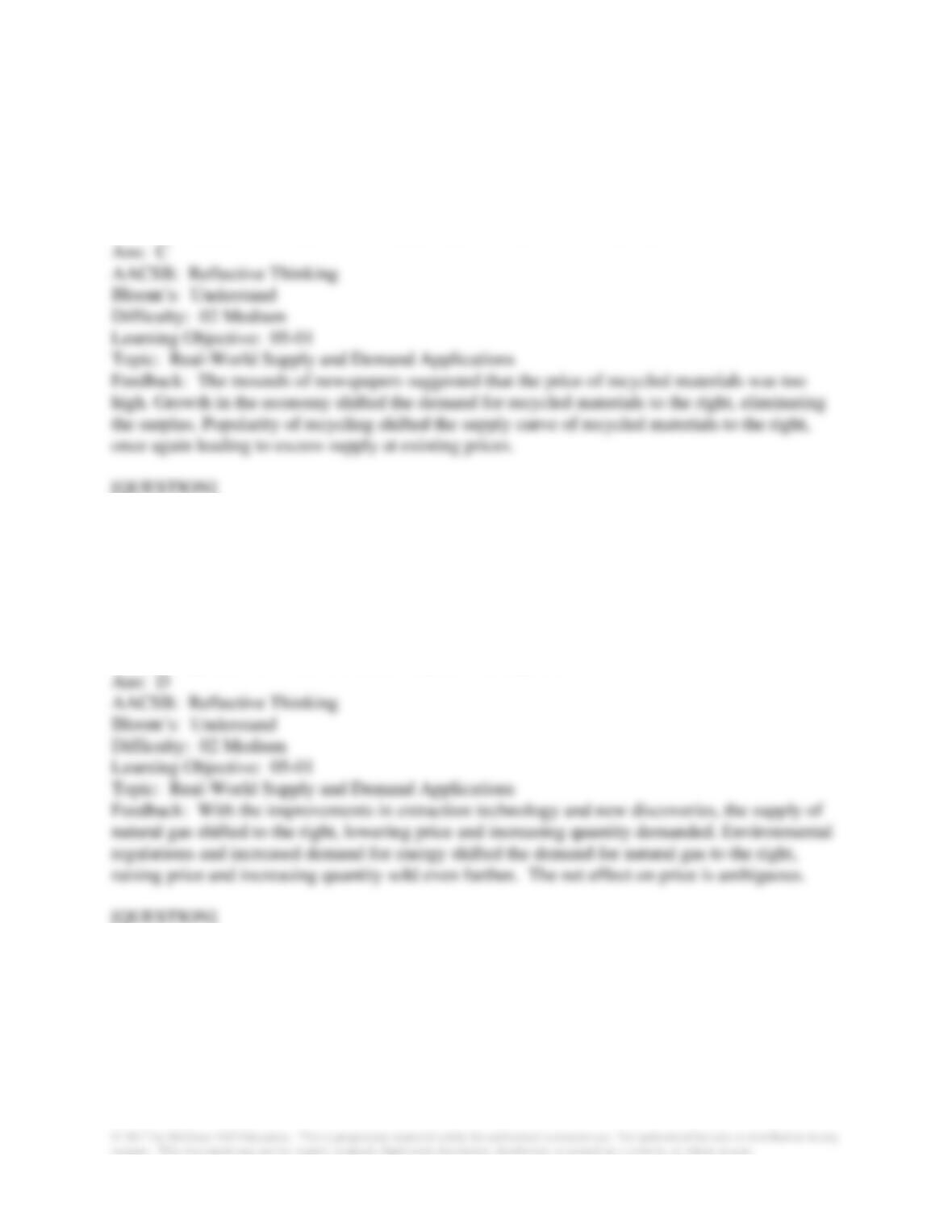
A. Price remained constant at P0. Quantity demanded first rose, while supply remained constant;
quantity supplied then rose, while demand remained constant.
B. Price remained constant at P0. Supply first shifted from S1 to S0 and then back to S1.
C. Price remained constant at P0. Demand shifted from D0 to D1 then supply shifted from S0 to
S1.
D. Price remained constant at P0. Demand shifted from D0 to D1 and then back to D0.
45. Stricter environmental regulations and increased demand for energy have caused an increase
in the demand for relatively clean natural gas. In the last several years, improved extraction
technologies and new discoveries have increased the availability of natural gas. What has been
the net effect on price and quantity for natural gas?
A. Quantity sold and price both fell with certainty.
B. Quantity sold fell and the effect on price is ambiguous.
C. Quantity sold and price both rose with certainty.
D. Quantity sold rose while the effect on price is ambiguous.
46. Suppose a scientific report states that fish contain dangerously high levels of mercury (toxic
to humans). At the same time, the price of diesel fuel, used by fishermen to fuel their boats, falls.
What is the effect on the market for fish?
A. A decrease in demand and a fall in price and quantity sold
B. A decrease in demand and supply; price and quantity sold falls
C. A decrease in demand and an increase in supply; price falls but the change in quantity is
ambiguous
D. A decrease in demand and supply; price and quantity sold rises