Chapter 05 – Perfect Competition, Monopoly, and Economic versus Normal Profit
Chapter 05 Perfect Competition, Monopoly, and Economic versus
Normal Profit
Multiple Choice
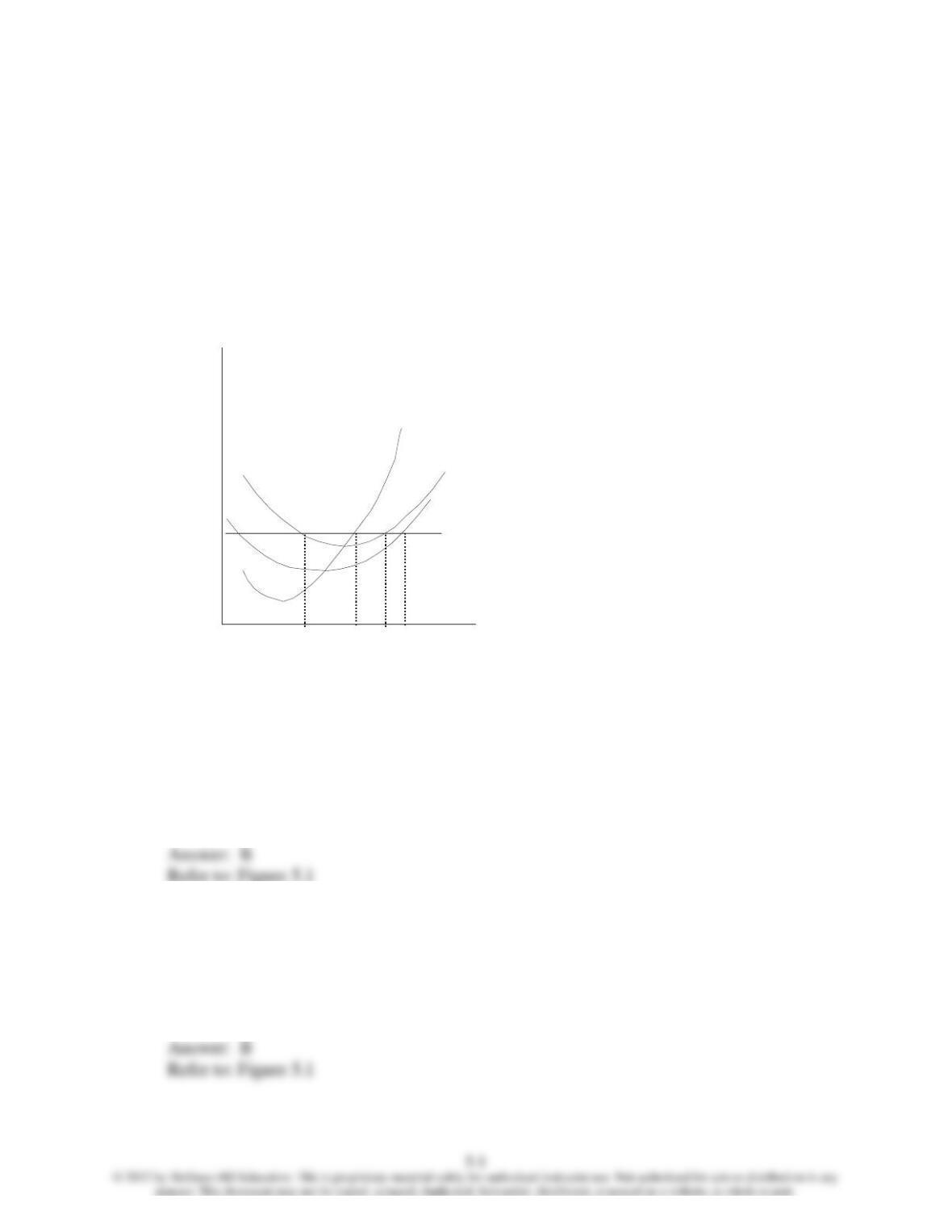
Use Figure 5.1 to answer questions 1-2:
P
MR
MC
ATC
AVC
P*
Q/t
Q1Q2Q3Q4
Figure 5.1
1. In Figure 5.1 above, what output would a perfect competitor produce?
A) Q1
B) Q2
C) Q3
D) Q4
2. In Figure 5.1 above, what profit would a perfect competitor earn?
A) a profit of zero
B) a positive profit
C) a loss less than its total fixed cost
D) a loss greater than its total fixed cost
Chapter 05 – Perfect Competition, Monopoly, and Economic versus Normal Profit
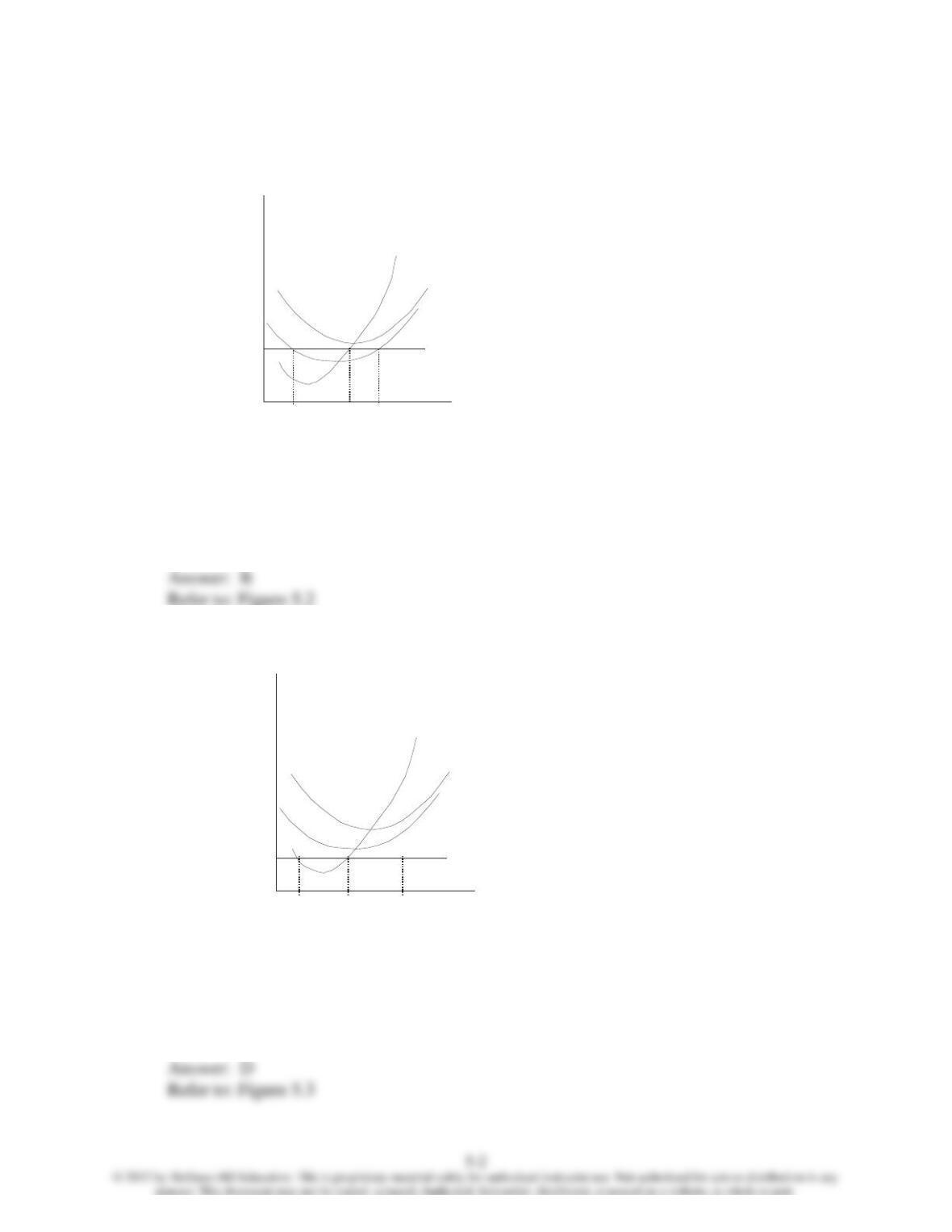
3. In Figure 5.2, what output would a perfect competitor produce?
P
MR
MC
ATC
AVC
P*
Q/t
Q1Q2Q3
Figure 5.2
A) Q1
B) Q2
C) Q3
D) 0
4. In Figure 5.3, what output would a perfect competitor produce?
P
MR
MC
ATC
AVC
P*
Q/t
Q1Q2Q3
Figure 5.3
A) Q1
B) Q2
C) Q3
D) 0
Chapter 05 – Perfect Competition, Monopoly, and Economic versus Normal Profit
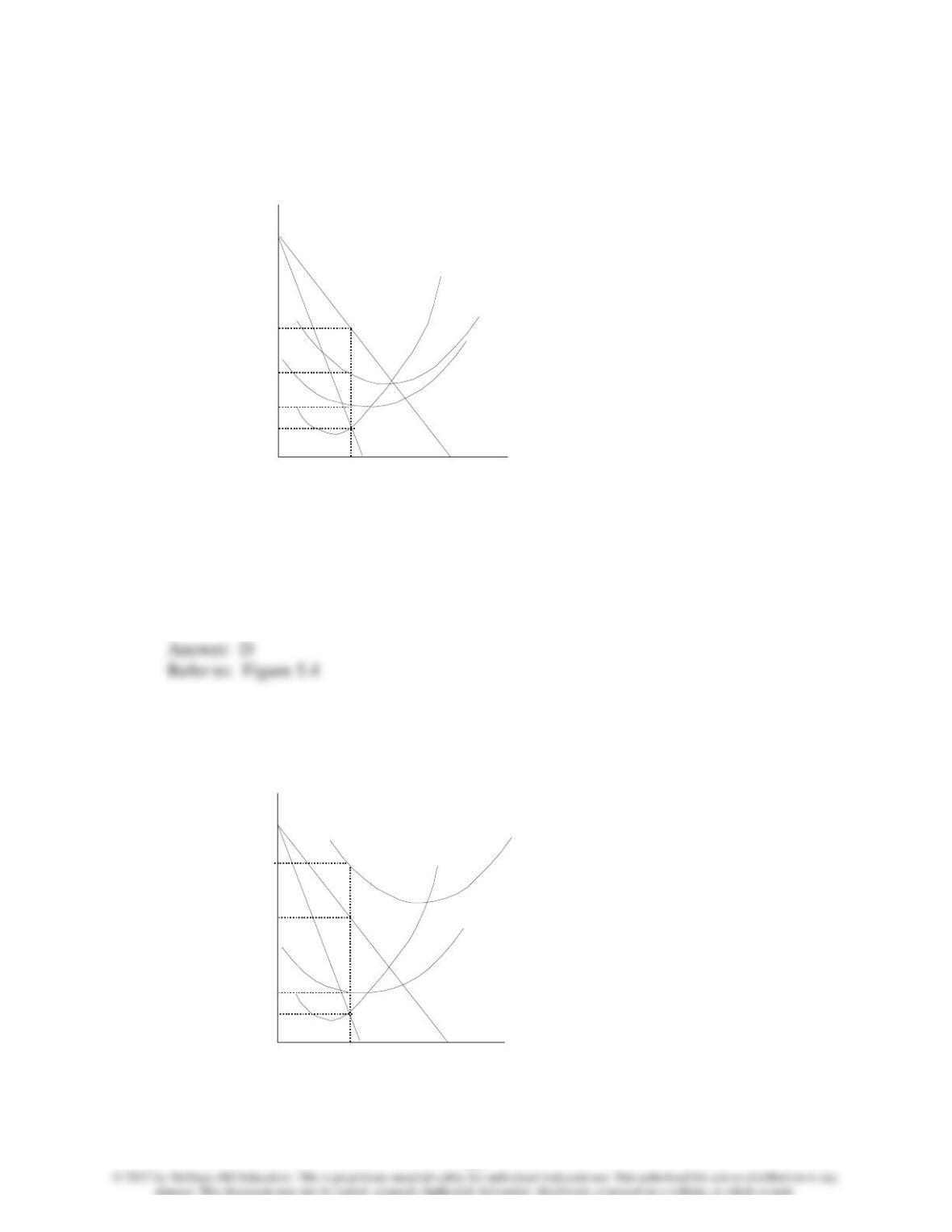
5. In Figure 5.4, a monopolist would charge which price?
P
DMR
AVC
MC
Q*
P1
P2
P3
P4
ATC
Figure 5.4
A) P1
B) P2
C) P3
D) P4
Use Figure 5.5 to answer questions 6-7:
P
DMR
AVC
MC
Q*
P1
P2
P3
P4
ATC
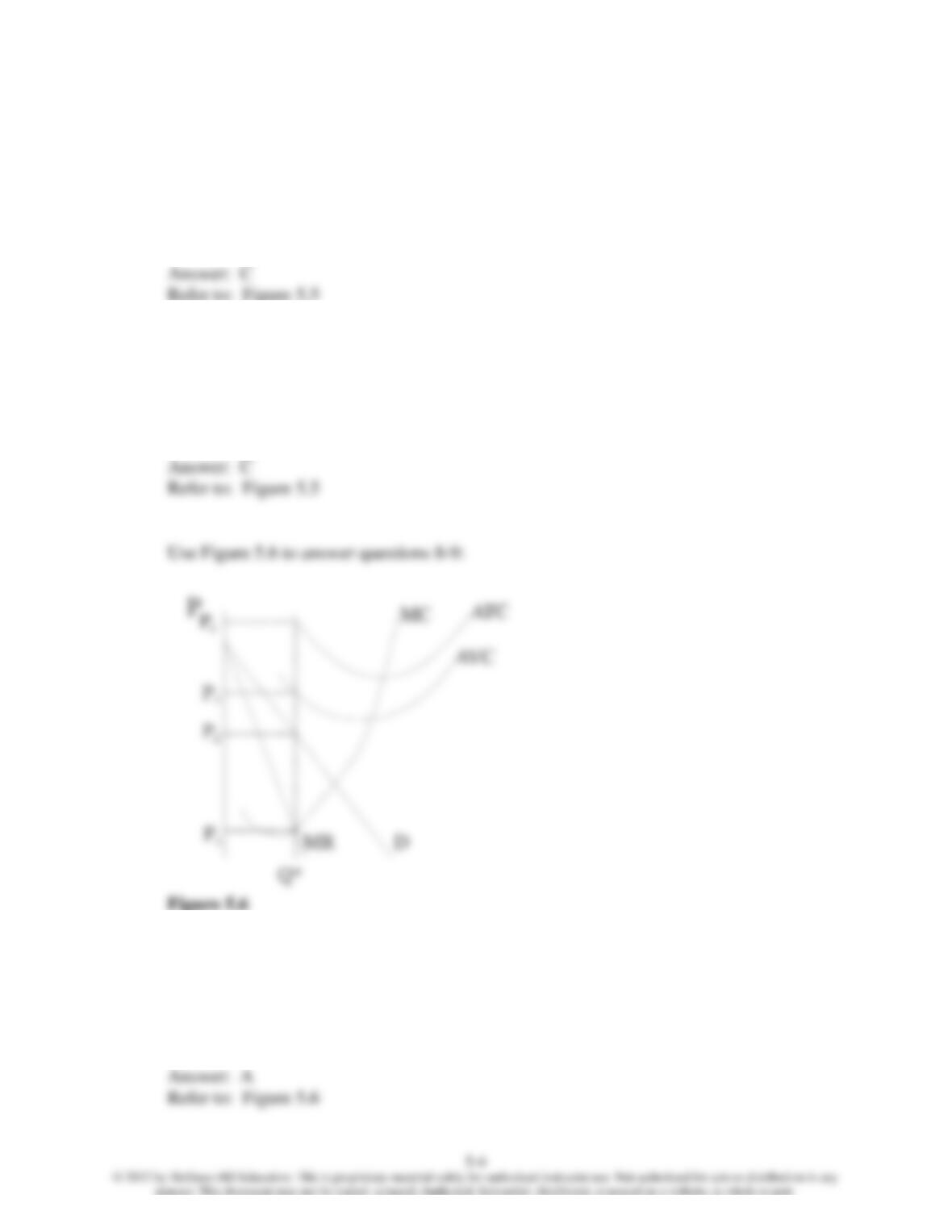
Figure 5.5
Chapter 05 – Perfect Competition, Monopoly, and Economic versus Normal Profit
6. In Figure 5.5, a monopolist would charge which price?
A) P1
B) P2
C) P3
D) P4
7. In Figure 5.5, what profit would the monopolist earn?
A) zero profit, because it would shut down.
B) a positive profit.
C) a loss less than its total fixed cost.
D) a loss greater than its total fixed cost.
8. In Figure 5.6, a monopolist would charge which price?
A) The monopolist would shutdown so no price would be charged.
B) P2
C) P3
D) P4
Chapter 05 – Perfect Competition, Monopoly, and Economic versus Normal Profit
9. In Figure 5.6, what profit would the monopolist earn? In the figure above, a monopolist
would charge which price?
A) zero profit.
B) a positive profit.
C) a loss equal to its total fixed cost.
D) a loss greater than its total fixed cost.
10. Which of the following is not an assumption of perfect competition
A) Branded products
B) Many buyers
C) Many sellers
D) Identical (or indistinguishable) products
11. Which of the following is not an assumption of perfect competition
A) Freedom of entry
B) Powerful buyers
C) Freedom of exit
D) Identical (or indistinguishable) products
12. Perfect competition means that firms are
A) Price makers (firms set the price of the market)
B) Price takers (firms must accept the price of the market)
C) Powerful sellers
D) Unable to make normal profits
13. When firms are in perfect competition the result is that firms charge a price that is always
equal to its
A) Minimum ATC
B) Minimum AVC
C) MC
D) AFC

Chapter 05 – Perfect Competition, Monopoly, and Economic versus Normal Profit
14. The typical firm in perfect competition is
A) An airline
B) A farm
C) A fast food restaurant chain
D) A electrical power company
15. A firm that has a branded product is
A) Likely in perfect competition
B) Not likely to be in perfect competition
C) Always in perfect competition
D) Always a price taker
16. For a market to be characterized by perfect competition, there must be
A) a large number of firms with no one able to influence price.
B) freedom of entry and exit.
C) indistinguishable products being sold.
D) all of the options are correct.
17. For a market to be characterized by monopoly, there must be
A) a large number of firms with no one able to influence price.
B) freedom of entry and exit.
C) indistinguishable products being sold.
D) a single seller
18. For a market to be characterized by monopoly, there must be
A) a large number of firms with no one able to influence price.
B) barriers to entry and exit.
C) indistinguishable products being sold.
D) good information about sales and costs.
Chapter 05 – Perfect Competition, Monopoly, and Economic versus Normal Profit
19. The key difference(s) between perfect competition and monopolistic competition is
A) the products sold are slightly different in perfect competition.
B) the products sold are slightly different in monopolistic competition.
C) there is poor information about prices in perfect competition.
D) there is poor information about prices in monopolistic competition.
20. The key difference(s) between monopoly and oligopoly is
A) that there are two in oligopoly rather than one competitor in a monopoly.
B) there are no barriers to entry with oligopoly.
C) there must be product differences in oligopoly.
D) there are no differences between oligopoly and a monopoly.
21. The firm’s supply curve is made up of the
A) Points where MC=MR
B) Points where MC=MR and they make a profit
C) Points where MC=MR and they make at least breakeven
D) Points where MC=MR above the minimum of AVC
22. The firm’s supply curve is their
A) Marginal cost curve above the minimum of ATC
B) Marginal cost curve above the minimum of AVC
C) The upward sloping portion of the marginal cost curve
D) The entire marginal cost curve
23. Agricultural Products can be modeled best using the model of
A) monopolistic competition.
B) perfect competition.
C) oligopoly.
D) monopoly.

Chapter 05 – Perfect Competition, Monopoly, and Economic versus Normal Profit
24. Lumber Products can be modeled best using the model of
A) monopolistic competition.
B) perfect competition.
C) oligopoly.
D) monopoly.
25. The fast food industry can be modeled best using the model of
A) monopolistic competition.
B) perfect competition.
C) oligopoly.
D) monopoly.
26. The breakfast cereals industry can be best modeled using the model of
A) monopolistic competition.
B) perfect competition.
C) oligopoly.
D) Monopoly.
27. The soft drink (colas in particular) industry can be best modeled using the model of
A) monopolistic competition.
B) perfect competition.
C) oligopoly.
D) monopoly.
28. The personal computer operating systems industry can be best modeled using the model
of
A) monopolistic competition.
B) perfect competition.
C) oligopoly.
D) Monopoly.

Chapter 05 – Perfect Competition, Monopoly, and Economic versus Normal Profit
29. The local residential electrical power industry can be best modeled using the model of
A) monopolistic competition.
B) perfect competition.
C) oligopoly.
D) monopoly.
30. There are hundreds of local water companies but economists insist that in each
community they are __________ because consumers have no other choices in the local
market in which they live.
A) perfect competition
B) monopolistic competition
C) oligopoly
D) monopoly
31. If you drive on a rural stretch of highway and come upon an intersection in which there is
only one gas station and you know it to be the only one for 100 miles, it is a
A) monopolist.
B) perfect competitor.
C) monopolistic competitor.
D) oligopolist.
32. If you drive on a rural stretch of highway and come upon an intersection in which there
are two gas stations and you know them to be the only ones for 100 miles, they are
A) monopolists.
B) monopolistic competitors.
C) perfect competitors.
D) oligopolists.
33. Suppose ten companies begin introducing new genetically engineered apples. Each has
their own distinctive taste and brand name. This market would be described by
A) perfect competition.
B) monopolistic competition.
C) oligopoly.
D) monopoly.

Chapter 05 – Perfect Competition, Monopoly, and Economic versus Normal Profit
34. Suppose you can get broadband only from your cable company or your phone company.
This market would be described by
A) perfect competition.
B) monopolistic competition.
C) oligopoly.
D) monopoly.
35. Suppose you can get the typical cable channels (ESPN, MTV, Bravo, etc.) from a cable
company, from DIRECTV, or from DISH Network. This market would be described by
A) perfect competition.
B) healthy competition.
C) oligopoly.
D) monopoly.
36. Suppose you can fly from your home city to New York but only one airline provides the
service. This market would be described by
A) perfect competition.
B) healthy competition.
C) oligopoly.
D) monopoly.
37. Suppose you can fly from LA to New York and 15 separate airlines provide the service.
This market would be described by
A) limited competition.
B) monopolistic competition.
C) oligopoly.
D) monopoly.
38. Suppose you can fly from Charlotte to London but only two airlines provide the service.
This market would be described by
A) limited competition.
B) monopolistic competition.
C) oligopoly.
D) monopoly.

Chapter 05 – Perfect Competition, Monopoly, and Economic versus Normal Profit
39. An industry in which there are many competitors with specific marketing niches is likely
to be characterized by
A) monopoly.
B) monopolistic competition.
C) oligopoly.
D) perfect competition.
40. An industry in which there are just a few large firms is likely to be characterized by
A) monopoly.
B) monopolistic competition.
C) oligopoly.
D) perfect competition.
41. The usefulness and relative simplicity of the supply and demand model is often used
A) because nearly every major industry in the U.S. is governed by perfect competition.
B) because nearly every major industry in the U.S. is governed by monopoly.
C) even though, strictly speaking, few industries in the U.S. are governed by perfect
competition.
D) even though it has no connection to economic reality.
42. Whether a firm stays in business or shuts down depends heavily on the concept of
A) economic profit.
B) actual profit.
C) market share.
D) concentration ratios.
43. Economic theory would suggest that the profitability of an industry would be
A) directly related to the number of firms competing in the industry.
B) inversely related to the number of firms competing in the industry.
C) unrelated to the number of firms competing in the industry.
D) zero in the long run, regardless of market structure.
Chapter 05 – Perfect Competition, Monopoly, and Economic versus Normal Profit
44. An indicator of the degree of competition in an industry is the concentration ratio. It
measures
A) the percentage of sales in the industry by the largest firms.
B) the percentage of profit in the industry by the smallest firms.
C) the sales in the industry as a percentage of all consumption in the U.S.
D) the profitability of the industry.
45. Local telephone service was once an area in which consumers had no choices. Many
young people no longer use “land lines” preferring instead to use their cellular phones.
This means that the market has moved toward
A) monopoly.
B) oligopoly.
C) perfect competition.
D) monopsony.
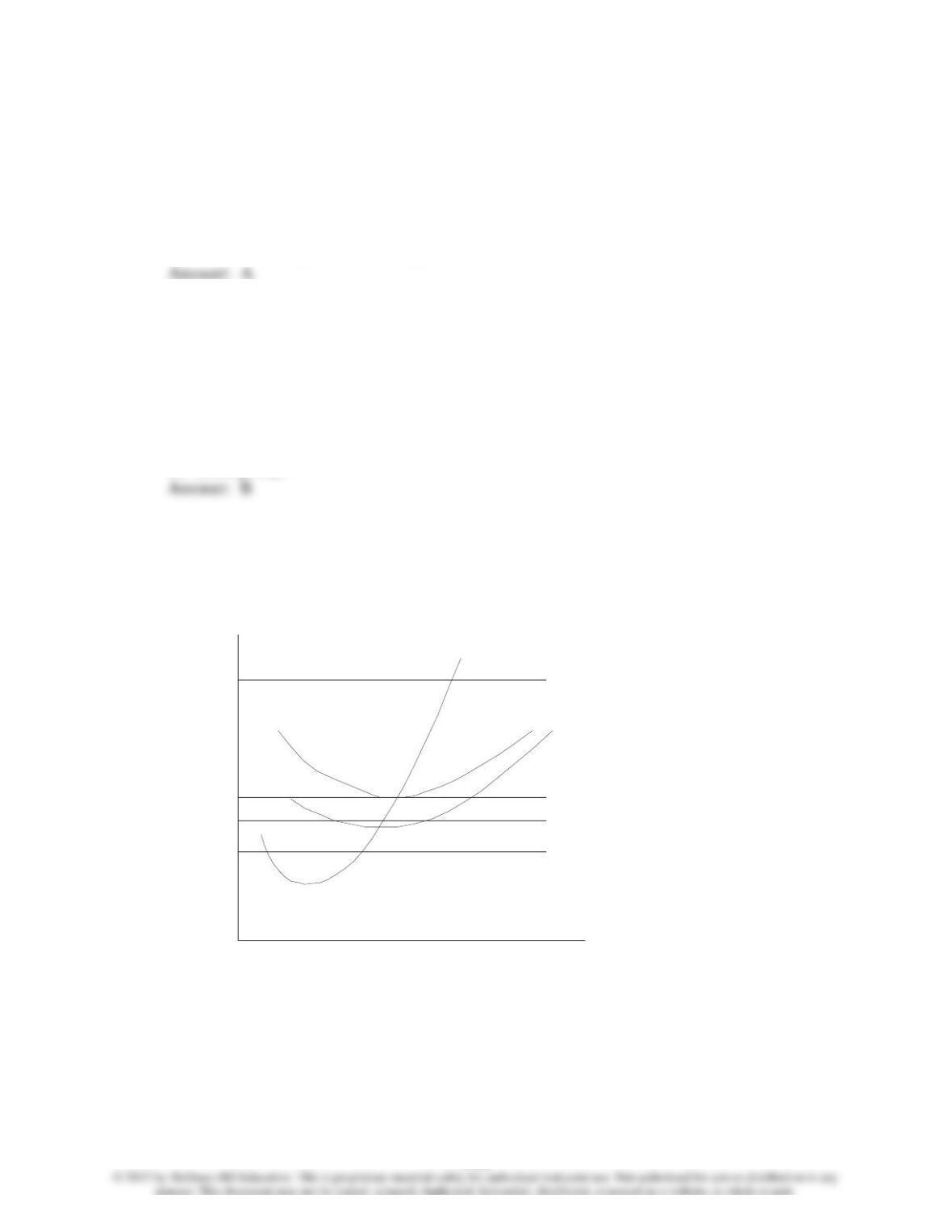
Use Figure 5.7 to answer questions 46-52:
Q
$MC
ATC
AVC
MR2
MR3
MR4
MR1
Figure 5.7