Microeconomics: Theory and Applications with Calculus, 3e (Perloff)
Chapter 5 Consumer Welfare and Policy Analysis
5.1 Consumer Welfare
1) Mister Jones was selling his house. The asking price was $220,000, and Jones decided he would take no
less than $200,000. After some negotiation, Mister Smith purchased the house for $205,000. Smith’s
consumer surplus is
A) $5,000.
B) $15,000.
C) $20,000.
D) not able to be calculated from the information given.
2) Shin’s uncompensated demand for widgets is given by Q = 10/p. According to this demand, Shin’s
Marginal Willingness to Pay function is
A) 10/Q.
B) 10/p.
C) 10Q.
D) –10/p2.
3) Jeong’s uncompensated demand for gizmos is given by Q = 30 – 2p. Jeong’s marginal willingness to pay
function is
A) 30-2p.
B) 15-.5Q.
C) 30-2Q.
D) –2.
4) You enter a store and buy a bottle of soda. Do you usually receive consumer surplus?
A) Yes, because you wouldn’t buy the soda if your willingness to pay would be less than the price.
B) Yes, because you are thirsty.
C) No, because you value other drinks more.
D) No, because you have less money after the transaction.
5) You pay $15 for an all-you-can-eat buffet. The food isn’t so good, but definitely edible. When you finish
eating, what is the marginal value of the last bite of food you consumed?
A) zero
B) $15
C) positive
D) negative
6) Mary purchased a stuffed animal toy for $5. After a few weeks, someone offered her $100 for the toy.
Mary refused. One can conclude that Mary’s consumer surplus from the toy is
A) less than $5.
B) at least $95.
C) at least $100.
D) $105.
7) Joe’s demand for spring water can be represented as p = 10 – Q (where p is measured in $/gallon and Q
is measured in gallons). He recently discovered a spring where water can be obtained free of charge. His
consumer surplus from this water is
A) $0.
B) $50.
C) $100.
D) unknown based upon the information provided.
8) Assume a consumer has a horizontal demand curve for a product. His consumer surplus from buying
the product
A) is maximized.
B) can’t be calculated.
C) equals zero.
D) Need more information.
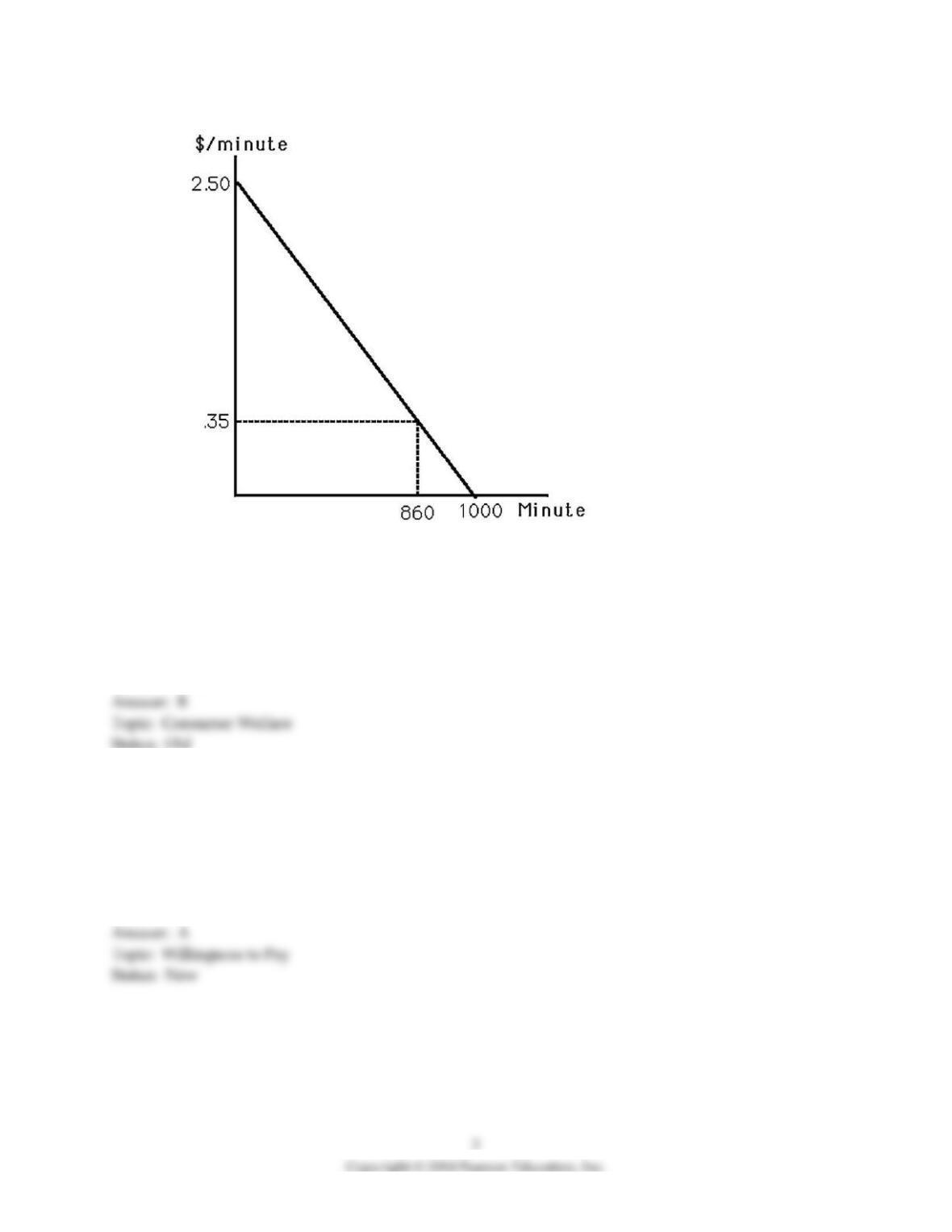
9) The above figure shows the market demand curve for telecommunication while driving one’s car (time
spent on the car phone). The current price is 35¢ per minute. If the price were to increase by ten cents per
minute, consumer surplus would
A) fall to $820.
B) fall by $84.
C) fall by $58.
D) fall to $369.
10) The above figure shows the market demand curve for telecommunication while driving one’s car
(time spent on the car phone). The current price is 35¢ per minute. What is the consumer surplus at the
current price?
A) 924.5
B) 1075
C) 301
D) 1250
11) Sandy’s uncompensated demand for candy is given by the equation Q = 15/p, where Q is the quantity
of candy and p is the price. When the price of candy rises from $1 to $3, the change in consumer surplus
is
A) $16.5.
B) -$20.
C) -$15.
D) $15.
12) Sandy’s current consumer surplus for candy is 20. Candy is a normal good for her. When her income
increases and the price of candy remains unchanged, her consumer surplus will
A) increase.
B) decrease.
C) remain the same.
D) Not enough information.
13) Sandy’s current consumer surplus for candy is 20. Candy is an inferior good for her. When her income
increases and the price of candy remains unchanged, her consumer surplus will
A) increase.
B) decrease.
C) remain the same.
D) Not enough information.
For the following, please answer “True” or “False” and explain why.
14) Consumer surplus from a given purchase is the difference between what one was willing to pay for
that purchase and what was actually paid.
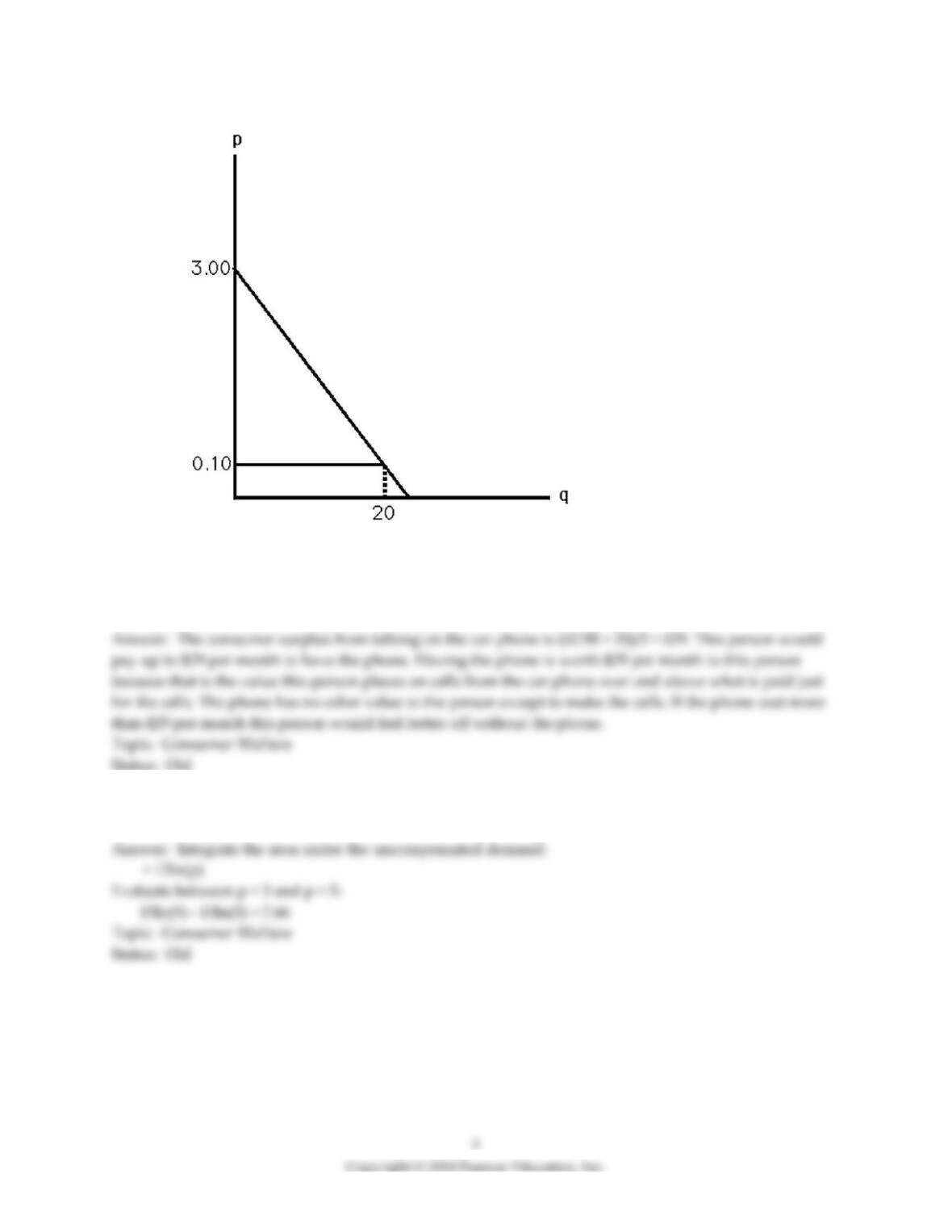
15) The above figure shows an individual‘s demand curve for time per month spent telecommunicating
while driving (talking on the car phone.) A car phone is useless except for talking with somebody who is
not in the car. If calls are priced at ten cents per minute, what is the consumer surplus derived from
talking? What is the most this person would pay for the car phone? Explain.
16) Ted’s uncompensated demand function for bacon is given by Q = 15/p. What is Ted’s change in
consumer surplus when the price of bacon rises from p = 3 to p = 5?
17) Ralf’s uncompensated demand function for shoes is given by Q = 100/p. What is the change in
consumer surplus when the price of shoes rises from p=20 to p=25?
5.2 Expenditure Function and Consumer Welfare
1) The Equivalent Variation for an increase in the price of a good is
A) the reduction in a consumer’s income necessary to harm the consumer by as much as the price
increase.
B) the increase in a consumer’s income necessary to eliminate the consumer’s harm from a price increase.
C) the change in consumer surplus resulting from a price increase.
D) the amount of money a consumer would accept to be subject to a price increase.
2) The Compensating Variation for an increase in the price of a good is
A) the minimum amount of money a consumer would accept to voluntarily accept the price increase.
B) the maximum amount of money a consumer would pay to avoid the price increase.
C) the change in consumer surplus resulting from a price increase.
D) the change in utility resulting from the increase in price.
3) Suppose a victim of an accident brings the injurer to court. You are hired to determine the amount of
damages. You are specifically asked to find a measure of the amount of money needed to restore the
victim to the position he was in prior to the accident. What welfare measure will provide the most
accurate measure of this amount?
A) compensating variation
B) equivalent variation
C) consumer surplus
D) the loss of utility
4) The compensation variation and equivalent variation will be closer to each other when
A) the income elasticity is greater.
B) the budget share is greater.
C) the price change is smaller.
D) the income elasticity is smaller.
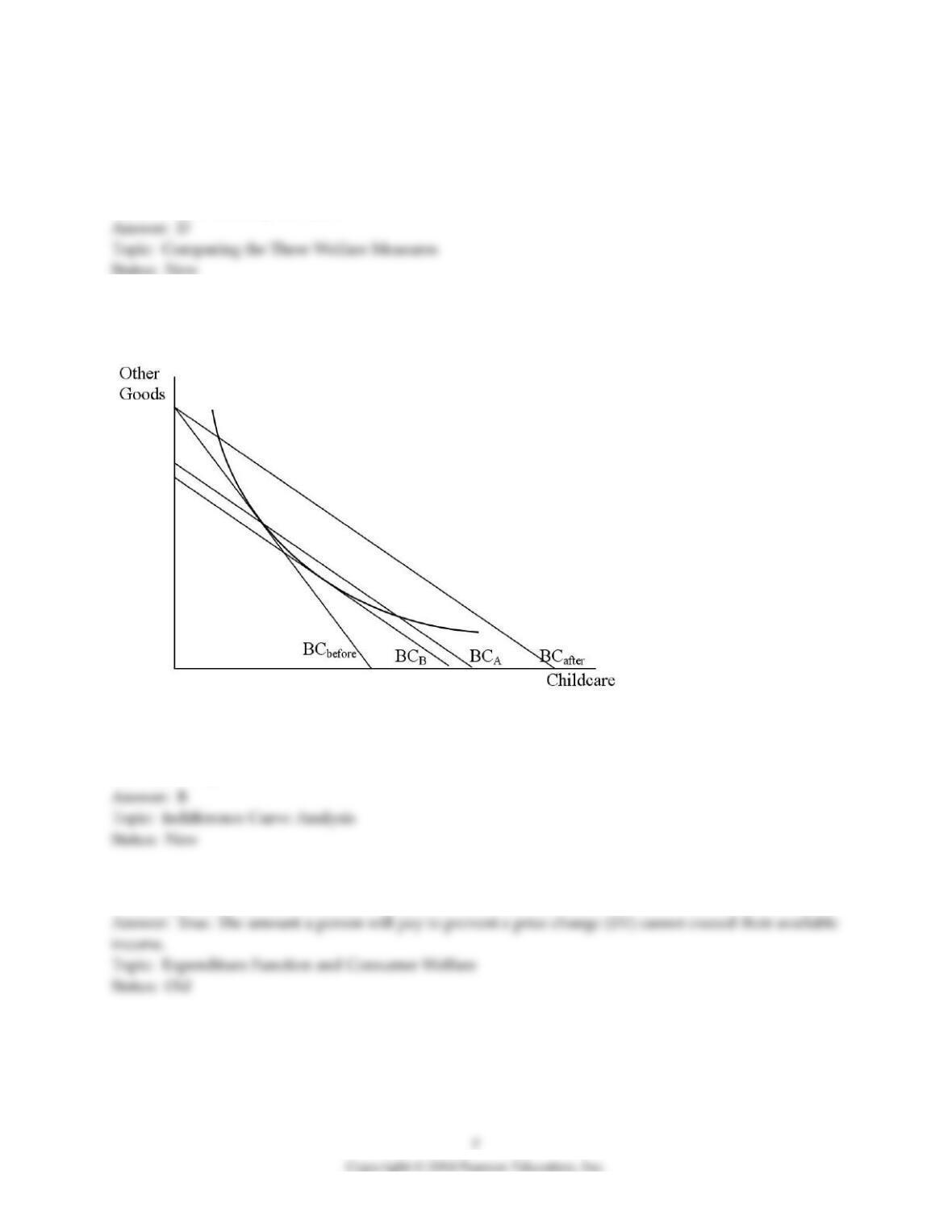
5) Suppose an analyst attempts to estimate a consumer’s willingness to pay for a policy that lowers the
price of childcare. The willingness to pay should be measured as
A) BCafter to BCA.
B) BCafter to BCB.
C) BCafter to BCbefore.
D) BCA to BCB.
For the following, please answer “True” or “False” and explain why.
6) The equivalent variation is always less than the consumer’s income
7) The difference between the equivalent variation and compensating variation is greater for goods with
large income elasticities.
8) Ed’s utility from vacations (V) and meals (M) is given by the function U(V,M) = V2M. Last year, the
price of vacations was $200 and the price of meals was $50. This year, the price of meals rose to $75, the
price of vacations remained the same. Both years, Ed had an income of $1500.
a. Calculate the change in consumer surplus from meals resulting from the change in meal prices.
b. What is the compensating variation for the price change in meals?
c. Calculate the equivalent variation for the price change in meals.
9) Jeremy derives all of his utility from consuming milk shakes; he devotes his entire $20 allowance to
milk shakes each week. Suppose the price of milk shakes rise from $2 to $4. Compute Jeremy’s
Compensating Variation and Equivalent Variation.
10) Ian views playing Wartcraft and drinking soda as perfect complements (one soda with one hour of
playing Wartcraft). Currently, sodas are $1 each and Wartcraft costs $1 per hour. Ian has $12 of income.
a. Compute Ian’s Compensating Variation if the price of Wartcraft rises to $2.
b. Compute Ian’s Equivalent Variation if the price of Wartcraft rises to $2.
c. Compute Ian’s change in Consumer Surplus if the price of Wartcraft rises to $2.
11) Suppose you work for a government agency that is considering removing certain agricultural
subsidies. The removal of these subsidies will increase the price, thus lowering consumers’ welfare.
Because only aggregate market data is available, you are unable to measure the exact values for the
compensated and equivalent variation by consumer. However, you are able to estimate the change in
market consumer surplus. Assuming agricultural products are normal goods, how does your estimate of
consumer surplus compare to the unknown EV and CV? Explain. Under what conditions will the three
measures of welfare be close to one another?
For the following, please answer “True” or “False” and explain why.
12) Kisa consumes the same amount of cigarettes each week regardless of her income (assume that her
income is sufficiently large such that the quantity is affordable). The Equivalent Variation equals the
Compensating Variation.
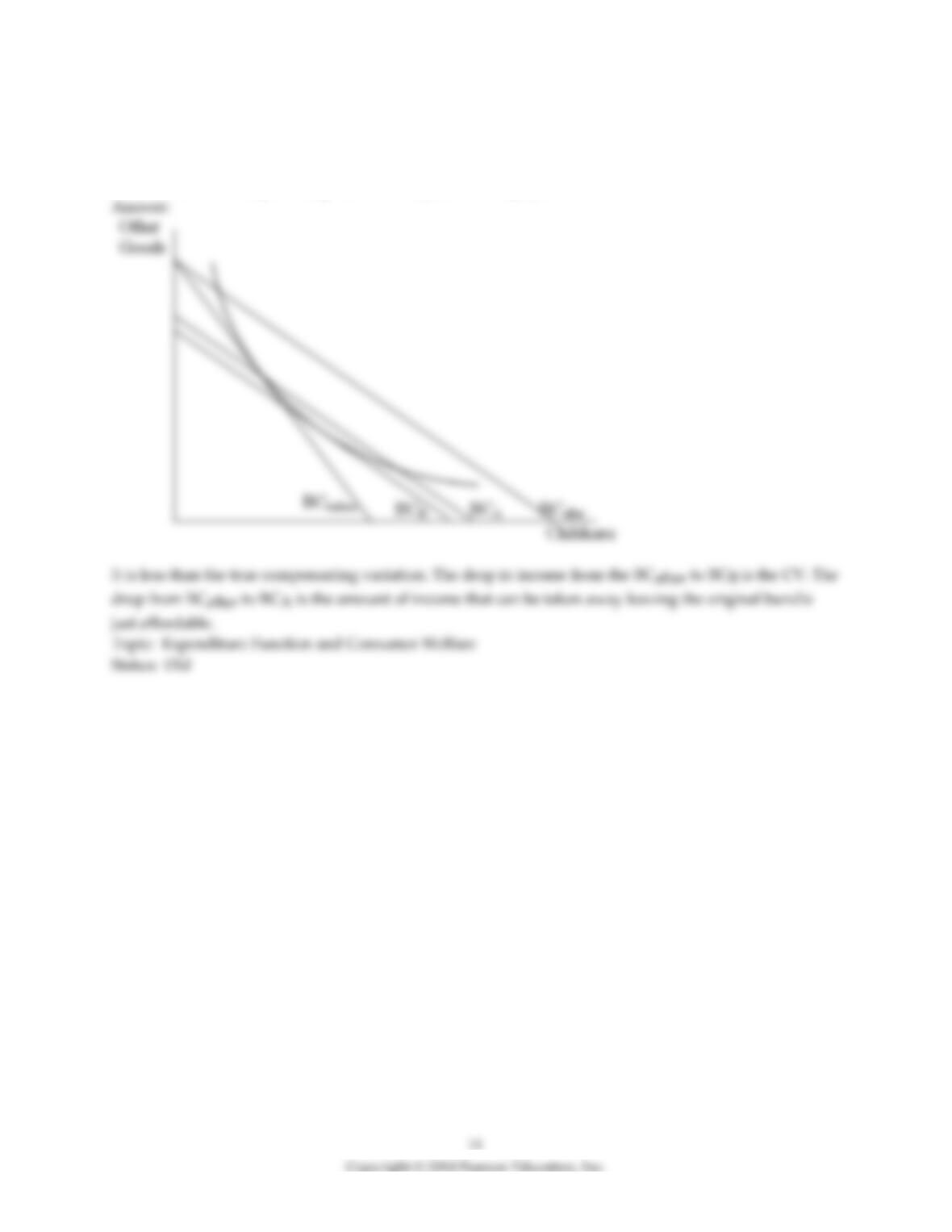
13) Suppose an analyst attempts to estimate a consumer’s willingness to pay for a policy that lowers the
price of childcare by measuring the amount of income that can be taken away from the consumer (at the
new price) such that they can just afford their original bundle of goods. Is this correct? If not, is it more or
less than the true compensating variation? Explain with a graph.
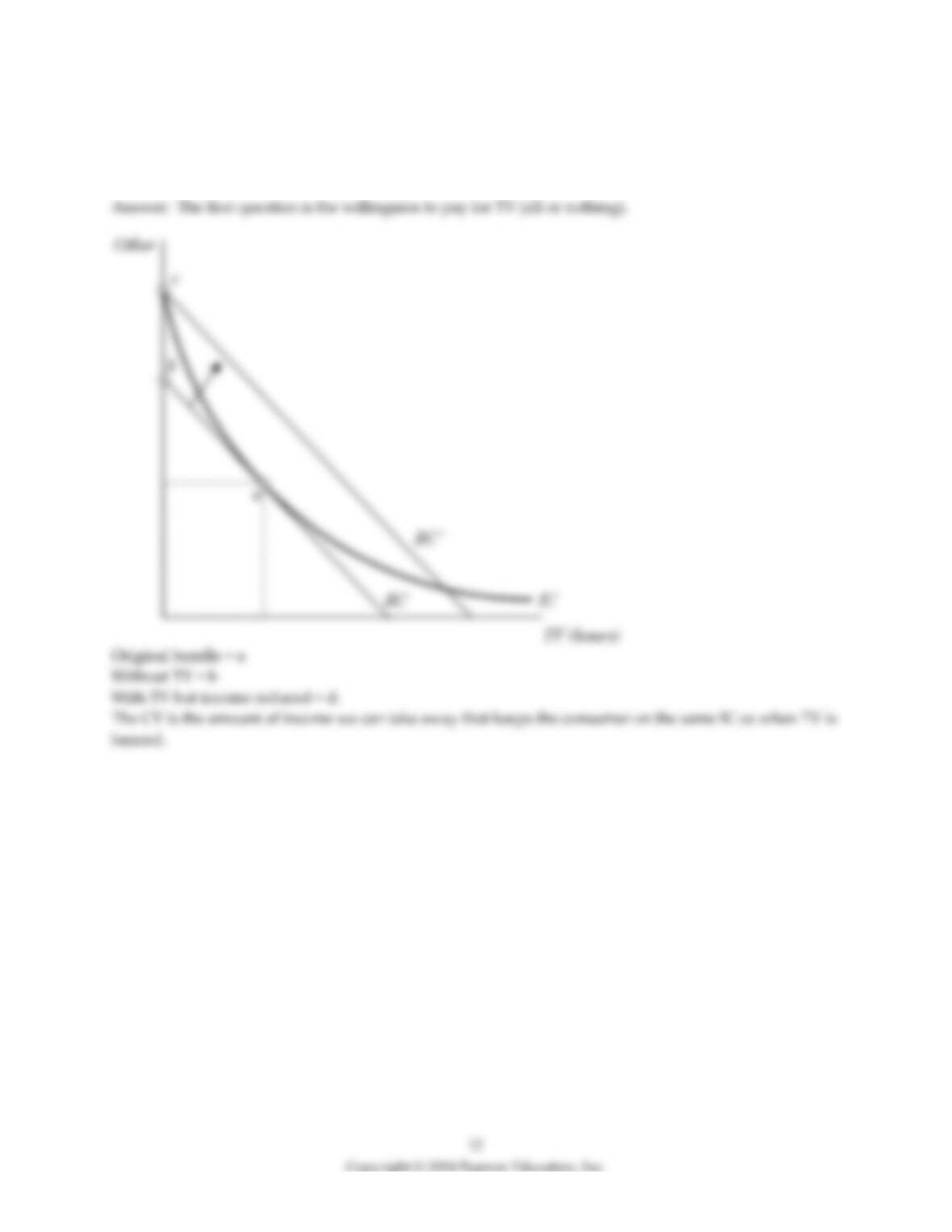
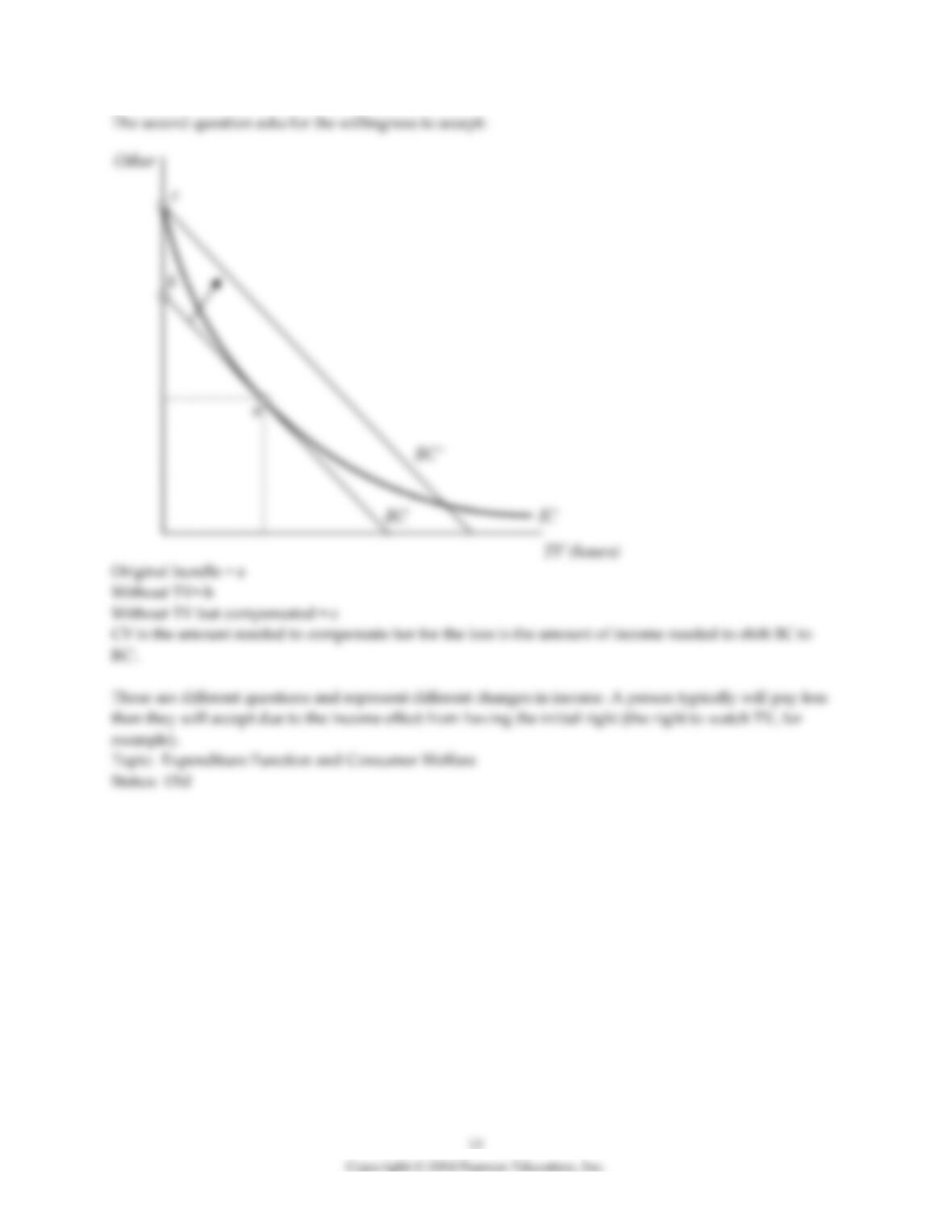
14) A study of the benefits of television asked consumers two questions: (1) How much would you pay to
watch TV (versus no TV watching), and (2) How much would you have to be paid to voluntarily stop
watching TV. Show how these are found with two separate graphs of indifference curves and budget
constraints. Are these values likely to be equal? Discuss briefly.
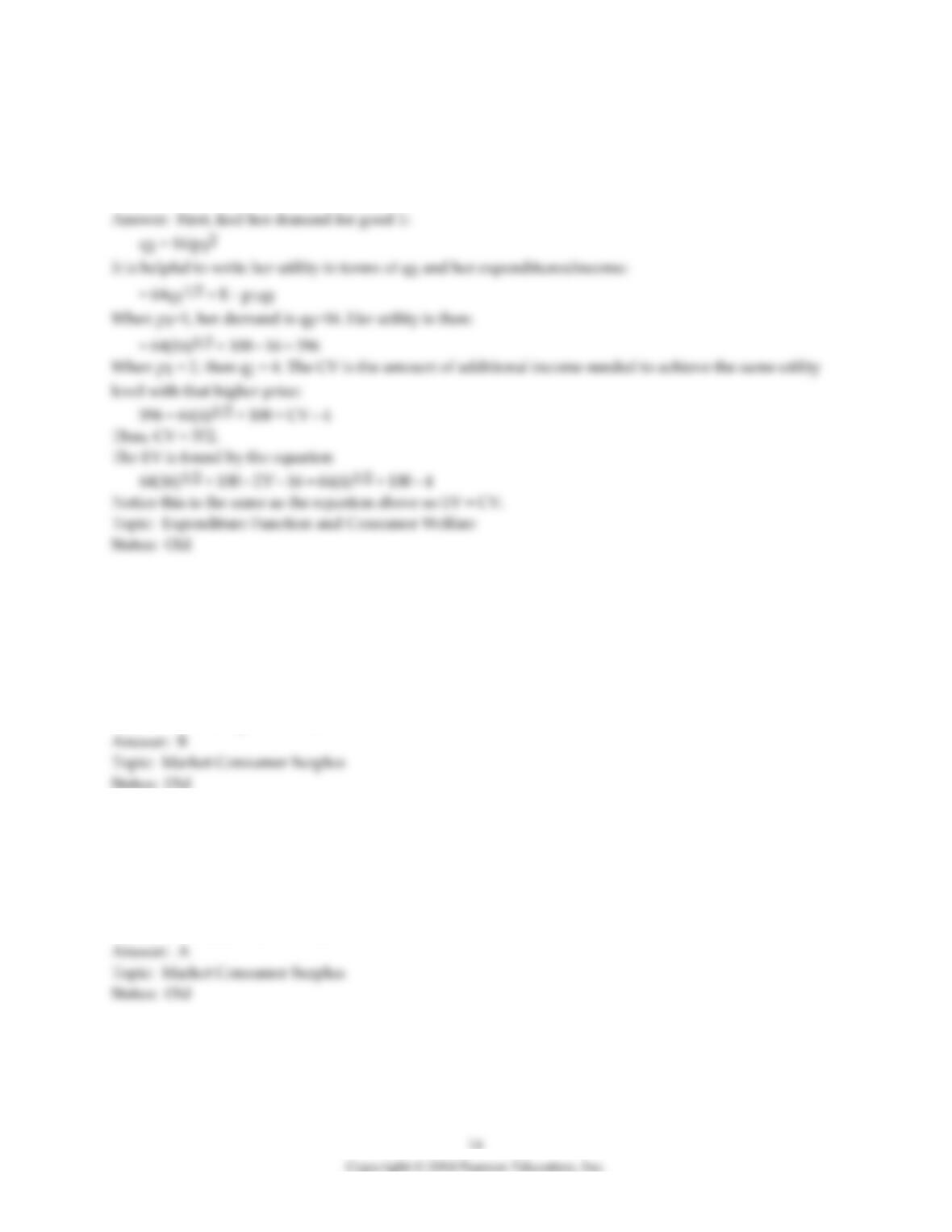
15) A consumer has the quasi-linear utility function
U(q1,q2) = 64q11/2 + q2
Assume p2 = 1 and Y = 100. Find the consumer’s compensating and equivalent variations for an increase
in p1 from 1 to 2.
5.3 Market Consumer Surplus
1) As the price of a good increases, the loss in consumer surplus is larger,
A) the more elastic demand is.
B) the more money previously spent on the good.
C) the less money previously spent on the good.
D) the smaller the price increase.
2) Sarah’s demand curve for whiskey has the same slope as Pete’s; however, it lies to the right of Pete‘s.
An increase in the price of whiskey will cause
A) Sarah to incur a greater loss of consumer surplus than Pete will.
B) Pete to incur a greater loss of consumer surplus than Sarah will.
C) Sarah and Pete to incur the same loss of consumer surplus.
D) Sarah’s demand curve to shift closer to Pete‘s.
3) Sarah and David both have linear demand curves for lemonade. Sarah’s demand curve for lemonade
intersects David’s demand curve at a price of 50 cents per glass. Sarah’s demand curve is more inelastic
than David’s. A change in the price of lemonade from 50 cents to 25 cents per glass will
A) decrease Sarah’s consumer surplus more than David’s.
B) decrease David’s consumer surplus more than Sarah’s.
C) increase Sarah’s consumer surplus more than David‘s.
D) increase David’s consumer surplus more than Sarah’s.
4) Sarah and David both have linear demand curves for lemonade. Sarah’s demand is more elastic than
David’s. At the current price of $0.50 per glass, they both choose to buy 5 glasses. A change in the price of
lemonade to $0.75 per glass will
A) decrease Sarah’s consumer surplus more than David’s.
B) decrease David’s consumer surplus more than Sarah’s.
C) increase Sarah’s consumer surplus more than David‘s.
D) increase David’s consumer surplus more than Sarah’s.
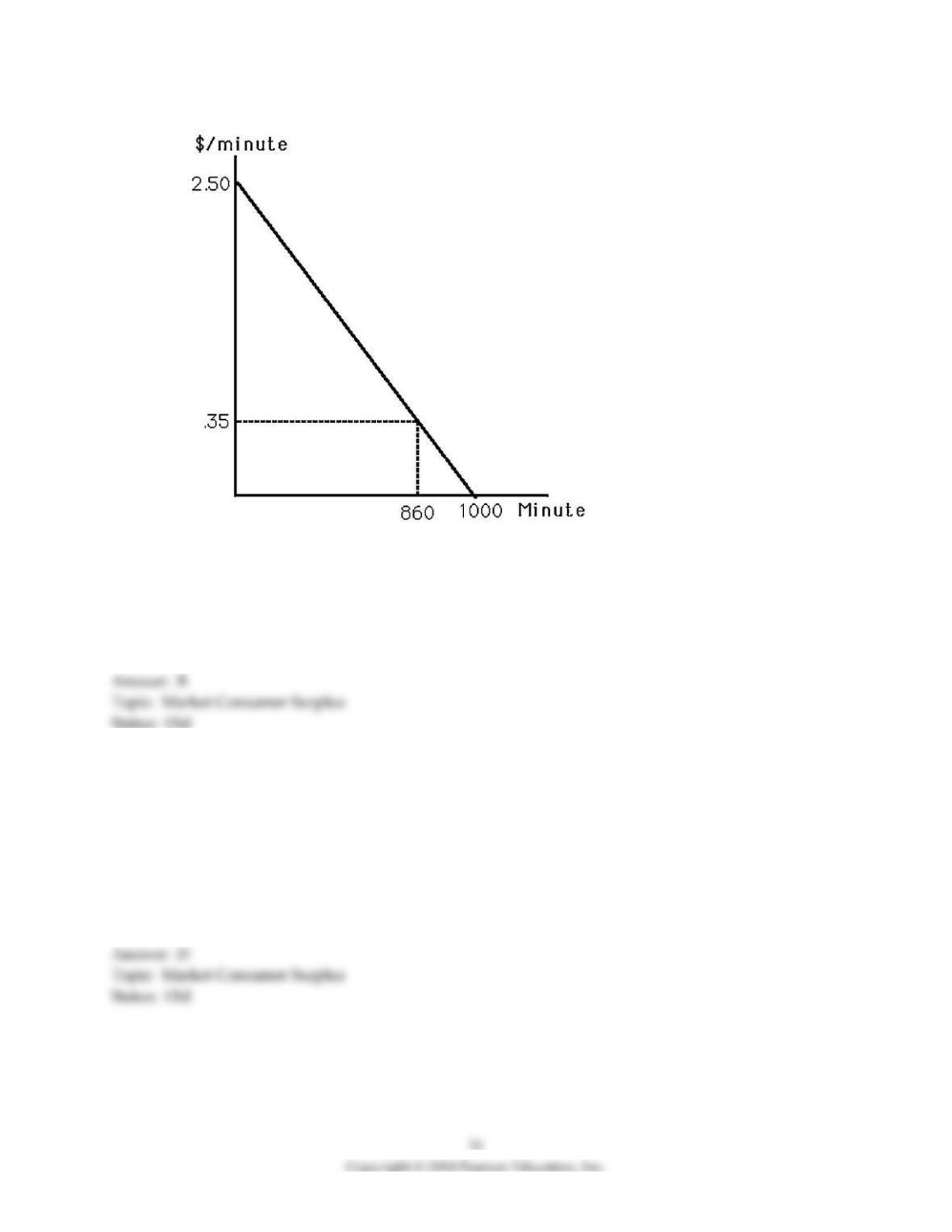
5) The above figure shows the market demand curve for telecommunication while driving one’s car (time
spent on the car phone). At the current price of 35¢ per minute, consumer surplus equals
A) $301.
B) $924.50.
C) $1,225.50.
D) $1,250.
6) If lower-income households spend a greater share of their income on cigarettes than do higher–income
households, then a tax that raises the price of cigarettes will
A) cause lower-income households to incur a greater loss of consumer surplus than that incurred by
higher-income households.
B) cause higher-income households to incur a greater loss of consumer surplus than that incurred by
lower-income households.
C) raise consumer surplus among higher-income households.
D) cause consumer surplus to decline among smokers, but the relative impact cannot be determined from
the given information.