
A) the kinked shape of the new supply curve.
B) the shift in old supply curve.
C) the slope of the old demand curve.
D) the increase in the demand curve.
31. A labor system whereby a limited number of workers can be certified to work in a particular
field but are of higher ability because of the training necessary for certification will cause
A) the demand for these workers to decrease.
B) the wage paid to these workers to decrease.
C) the supply for these workers to increase.
D) the supply curve for these workers to become vertical at some point.
32. A labor system whereby a limited number of workers can be certified to work in a particular
field but are of higher ability because of the training necessary for certification will cause
A) the demand for these workers to increase.
B) the wage paid to these workers to decrease.
C) the supply for these workers to increase.
D) the supply curve for these workers to become horizontal at some point.
33. A labor system whereby a limited number of workers can be certified to work in a particular
field but are of higher ability because of the training necessary for certification will cause
A) the demand for these workers to decrease.
B) the wage paid to these workers to increase.
C) the supply for these workers to increase.
D) the supply curve for these workers to become horizontal at some point.
34. A labor system whereby a limited number of workers can be certified to work in a particular
field but are of higher ability because of the training necessary for certification will cause
A) the demand for these workers to decrease.
B) the wage paid to these workers to decrease.
C) the supply for these workers to decrease.
D) the supply curve for these workers to become horizontal at some point.

35. To the degree that the American Medical Association constraints the number of new spots
that are available in the nation’s medical schools, it is
A) shifting the demand for physicians to the right.
B) shifting the supply of physicians to the right.
C) shifting the demand for physicians to the left.
D) kinking the supply of physicians to make it vertical at the level of the constraint.
36. To the degree that the IBEW conducts costly training and apprentice requirements for
prospective electricians, it is
A) shifting the supply of electricians to the left.
B) shifting the supply of electricians to the right.
C) shifting the demand for electricians to the left.
D) kinking the supply of electricians to make it vertical at the level of the constraint.
37. To the degree that the IBEW ensures that through its rigorous training requirements for
prospective electricians are qualified to do the work, it is
A) shifting the supply of electricians to the left.
B) shifting the supply of electricians to the right.
C) shifting the demand for electricians to the right.
D) kinking the supply of electricians to make it vertical at the level of the constraint.
38. To the degree that the Plumbers and Steamfitters union conducts costly training and
apprentice requirements for prospective electricians, it is
A) shifting the supply of plumbers to the left.
B) shifting the supply of plumbers to the right.
C) shifting the demand for plumbers to the left.
D) kinking the supply of plumbers to make it vertical at the level of the constraint.
39. To the degree that the Plumbers and Steamfitters union ensures that through its rigorous
training requirements for prospective plumbers are qualified to do the work, it is
A) shifting the supply of plumbers to the left.
B) shifting the supply of plumbers to the right.
C) shifting the demand for plumbers to the right.
D) kinking the supply of plumbers to make it vertical at the level of the constraint.

40. In Figure 41.4, when compared to the perfectly competitive equilibrium, the wage paid to
employees as a result of unionization
Wage
Labor
W*
L*
S
D=MRPL
A
B
C
O
W’
MR
E
F
L’
Figure 41.4
A) increases from W* to W’.
B) decreases from W’ to W*.
C) remains at W’.
D) remains at W*.
41. In Figure 41.4, when compared to the perfectly competitive equilibrium, the number of
workers hired as a result of unionization
Wage
Labor
W*
L*
S
D=MRPL
A
B
C
O
W’
MR
E
F
L’
Figure 41.4

A) decreases from L* to L’.
B) increases from L’ to L*.
C) remains at L’.
D) remains at L*.
42. In Figure 41.4, it is clearly the case that
Wage
Labor
W*
L*
S
D=MRPL
A
B
C
O
W’
MR
E
F
L’
Figure 41.4
A) the total amount paid to workers is greater under perfect competition than unionization.
B) the total amount of labor employed is greater under perfect competition than
unionization.
C) every individual worker is better off under perfect competition than unionization.
D) every individual worker is better off under unionization than perfect competition.

43. In Figure 41.4, it is clearly the case that
Wage
Labor
W*
L*
S
D=MRPL
A
B
C
O
W’
MR
E
F
L’
Figure 41.4
A) the total amount paid to workers depends upon the elasticity of labor demand.
B) the total amount of labor employed is less under perfect competition than unionization.
C) every individual worker is better off under perfect competition than unionization.
D) every individual worker is better off under unionization than perfect competition.
44. A union model changes the market form from that of perfect competition to that of a
A) monopoly.
B) monopsony.
C) oligopoly.
D) monopolistic competition.
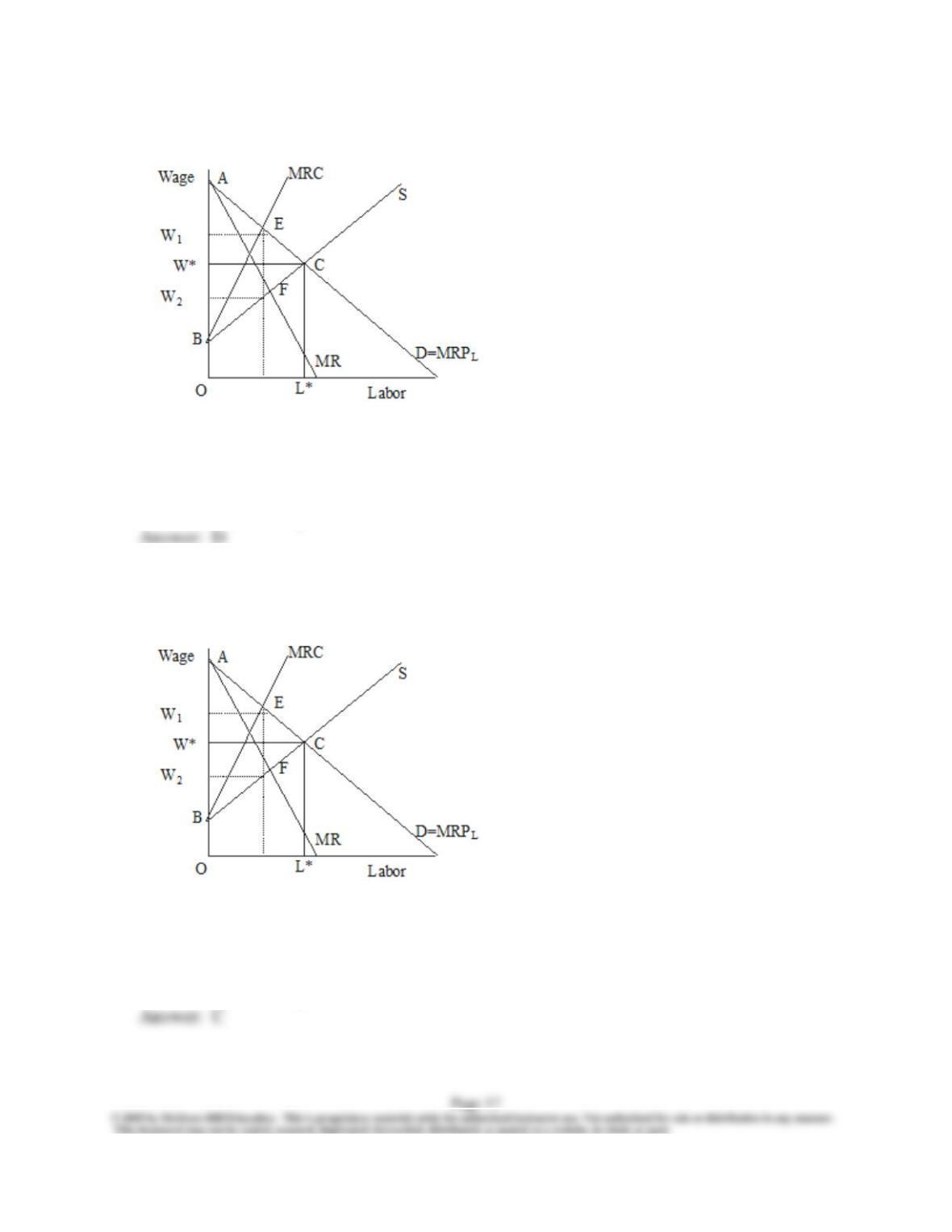
45. In Figure 41.5, where one union is bargaining against one employer, the wage paid to
workers will be
Figure 41.5
A) W*.
B) W1.
C) W2.
D) an undetermined point between W1 and W2.
46. In Figure 41.5, where one union is bargaining against one employer, the lowest possible
negotiated wage paid to workers will be
Figure 41.5
A) W*.
B) W1.
C) W2.
D) an undetermined point between W1 and W2.

47. In Figure 41.5, where one union is bargaining against one employer, the highest possible
negotiated wage paid to workers will be
Figure 41.5
A) W*.
B) W1.
C) W2.
D) an undetermined point between W1 and W2.
48. When the number of workers hired deviates from the perfectly competitive level, economists
A) see that the gain to workers is always outweighed by the loss to employers.
B) see that the gain to workers is always less than the loss to employers.
C) the gain to the group that is helped is always greater than the loss to the group hurt.
D) the gain to the group that is helped is always less than the loss to the group hurt.
49. Economists label the net loss to society due to an uncompetitive labor market structure as a
A) consumer surplus.
B) producer surplus.
C) consumer deficit.
D) dead weight loss.
50. The first labor-friendly law that allowed unions to organize labor and collectively bargaining
was
A) The Clayton Act.
B) The Norris-LaGuardia Act.
C) The National Industrial Recovery Act.
D) The Wagner Act.

51. The Clayton Act was
A) declared unconstitutional by the United States Supreme Court.
B) repealed by the next Congress.
C) vetoed by President Wilson.
D) eviscerated by President George W. Bush.
52. Which of the following acts limited the power of unions?
A) The Taft-Hartley Act
B) The Norris-LaGuardia Act
C) The National Industrial Recovery Act
D) The Wagner Act
53. Which of the following granted collective bargaining rights to Federal government workers?
A) The Taft-Hartley Act
B) The Norris-LaGuardia Act
C) The National Industrial Recovery Act
D) An executive order of President Kennedy
54. The future of private sector labor unions is
A) bright, because of the success of the PATCO strike.
B) bright, because of the increased availability of undocumented workers from other
countries.
C) bleak, because of the growing economic importance of small employers in service
industries.
D) bleak, because of the recent increases in the minimum wage earned by non-union
workers.
55. The future of private sector labor unions is
A) bright, because of the booming Chinese export-driven economy.
B) bleak, because of the growing economic influence of Walmart upon its suppliers.
C) bleak, because of the sweep of Congress by Democrats in 2006.
D) bright, because of the numerous recent innovations in recreational technologies now
available for overworked and highly-stressed union members.

56. The future of private sector labor unions is
A) bleak, because of growing pressure on U.S. manufacturers from foreign competition to
control costs.
B) bleak, because of the recent increases in the minimum wage earned by non-union
workers.
C) bright, because of rapid growth of maquiladoras on the Mexican side of the Rio Grande.
D) bright, because of the surging college enrollment trends of recent U.S. high school
graduates.
57. The future of private sector labor unions is
A) bright, because of the spectacular success of the PATCO strike.
B) bright, because of the increased availability of undocumented workers from other
countries.
C) bleak, because of the growing economic importance of the service and retailing
industries.
D) bleak, because of the recent increases in the minimum wage earned by non-union
workers.
58. In 2005, the membership of the AFL-CIO changed significantly when the
A) CIO separated from the AFL.
B) Teamsters and other unions withdrew from the umbrella organization.
C) AFL-CIO became a union of public-sector employees only.
D) AFL-CIO was able to organize its first factories in mainland China.
59. Firefighters and other municipal employees can have a key advantage when unionizing
because
A) municipal employers tend to be much less inexperienced negotiators.
B) municipal employees such as firefighters tend to be much more aggressive negotiators.
C) municipal employers, unlike private-sector employers, are always strongly pro-union.
D) municipal employers, unlike businesses, are unable to move to another state to avoid
unionization.

60. The 2005 dispute between the Teamsters and the AFL-CIO centered around whether union
A) resources would be devoted to electing sympathetic politicians or expanding union
membership.
B) negotiating priorities would seek hourly wage increases over a shorter work week.
C) members who were truck drivers would also be required to unload their own trucks.
D) negotiating priorities would seek improved healthcare benefits over hourly wage
increases.
61. Public employees (more frequently than private employees) tend to have their retirements in
A) defined benefit pension programs.
B) defined contribution programs.
C) Ponzi schemes.
D) private savings plans.
62. Private employees (more frequently than public employees) tend to have their private
retirements in
A) defined benefit pension programs.
B) defined contribution programs.
C) Ponzi schemes.
D) Social Security.
63. Public employees (more frequently than private employees) tend
A) to begin and end their career with the same employer.
B) participate in defined contribution programs.
C) fall for Ponzi schemes.
D) have well-funded private savings plans.
64. Which of the following explains why public employees (more frequently than private
employees) tend be in defined benefit programs?
A) They tend to begin and end their career with the same employer.
B) They tend to move from employer to employer.
C) They tend to fall for Ponzi schemes.
D) They have well-funded private savings plans.

65. Which of the following explains why private employees (more frequently than public
employees) tend be in defined contribution programs?
A) They tend to begin and end their career with the same employer.
B) They tend to move from employer to employer.
C) They tend to fall for Ponzi schemes.
D) They have well-funded private savings plans.
66. Which of the following explains why private employers (more frequently than public
employers) have tended to shift away from defined benefit programs?
A) Their employees have begun to reduce the amount they shift from one employer to the
next.
B) Their employees have begun to increase the amount they shift from one employer to the
next.
C) Their employees have increasing fallen victim to Ponzi schemes.
D) People have begun to create well-funded private savings plans.