Page 1
1.
Government payments to individuals for which no good or service is exchanged are:
A)
spending.
B)
purchases.
C)
spending on goods and services.
D)
transfer payments.
2.
Which transaction is a transfer payment?
A)
The government pays an employee by making a direct transfer to the employee’s
bank account.
B)
An army officer transfers part of her pay to the government to pay her taxes.
C)
A senior citizen receives a Social Security payment.
D)
Government spends additional funds on infrastructure.
3.
An example of a social insurance program is:
A)
expenditure on national defense.
B)
Social Security payments to the disabled.
C)
the food stamp program.
D)
purchasing a new city police car.
4.
Which example best illustrates social insurance?
A)
liability insurance for automobiles
B)
food stamps
C)
housing subsidies
D)
Social Security
5.
Children raised in poverty are more likely to live in poverty as adults than are other
children because low income is highly correlated with:
I. higher high school dropout rates.
II. a greater risk of mental problems and behavioral disorders.
III. higher rates of illness and hospitalization.
A)
I only
B)
II only
C)
III only
D)
I, II, and III
Page 2
6.
Given that the definition of poverty has not been adjusted to reflect the long-term rise in
average incomes, you would expect _____ in the percentage of the population living
below the poverty line.
A)
a decrease
B)
an increase
C)
no change
D)
It is impossible to determine how the percentage of the population living in poverty
might change.
7.
Which factor is not a leading cause of poverty in the United States?
A)
lack of adequate employment
B)
lack of education
C)
the welfare system
D)
discrimination
8.
Which factor is not a major cause of poverty in the United States?
A)
inadequate educational attainment
B)
discrimination
C)
lack of adequate health coverage
D)
welfare
9.
The percentage of the population that falls below the poverty threshold is called the:
A)
poor rate.
B)
poverty rate.
C)
homeless rate.
D)
absolute number of people in poverty.
10.
In 2015, _____ of the U.S. population was living in poverty.
A)
approximately 13%
B)
20% to 24%
C)
25% to 29%
D)
more than 30%
Page 3
11.
Which factor is/are associated with poverty?
I. lack of adequate employment
II. lack of education
III. lack of proficiency in English
A)
I and II only
B)
I and III only
C)
II and III only
D)
I, II, and III
12.
The poverty threshold is adjusted each year to reflect:
A)
changes in the cost of living.
B)
changes in the size of the average family.
C)
the long-term rise in the average standard of living.
D)
changes in the cost of living and changes in the size of the average family.
13.
In 2015, which demographic group had the highest poverty rate?
A)
African-Americans
B)
Hispanics
C)
Whites
D)
female-headed families with no husband present
14.
In 2017, the poverty threshold for a household with one person was:
A)
$12,060.
B)
$21,100.
C)
$24,300.
D)
$38,000.
15.
America’s Gini coefficient is _____ than that of most _____ nations.
A)
higher; developing
B)
higher; other wealthy
C)
just a little lower; other wealthy
D)
not lower; developing
16.
During the past 25 years, the degree of income inequality in the United States has been
rising. Which factor is not a possible reason for this phenomenon?
A)
technological progress that has increased the demand for high-skilled workers
relative to the demand for low-skilled workers
B)
increased imports of labor-intensive products
C)
increased immigration
D)
higher divorce rates
Page 4
17.
Economists believe that looking at the distribution of income by quintiles at one
moment overstates the true inequality of income because:
A)
it ignores the effect of taxes.
B)
it ignores the effect of transfer payments.
C)
families near the bottom of the distribution in any given year may be having an
unusually bad year, while those at the top may be having an unusually good one.
D)
families near the bottom of the distribution in any given year are often having an
unusually good year, while those at the top are often having an unusually bad one.
18.
Studies of family income over time reveal that:
A)
most people in the highest quintile tend to fall to the lowest quintile during their
lifetime.
B)
income mobility is rare for all quintiles of the income distribution.
C)
many people who move down the income ladder are young.
D)
many people who start out at the bottom of the income ladder when they are young
move up the income ladder as they age and move down again when they retire.
19.
The _____ is widely used to measure income inequality.
A)
Gini coefficient
B)
median household income
C)
poverty rate
D)
ability-to-pay principle
20.
The _____ identifies the level of income at which half of the households in the
population earn more and half of the population earns less.
A)
median household income
B)
mean household income
C)
poverty level
D)
Gini coefficient
21.
If a nation’s Gini coefficient is rising over time, it is an indicator of a(n):
A)
increase in the poverty rate.
B)
decrease in the poverty rate.
C)
increase in income inequality.
D)
decrease in income inequality.
Page 5
22.
There are six households in a rural community. Each household earns $40,000 per year.
Suppose that a new resident builds a mansion in the community and that the income in
the new household is $4 million per year. After the new resident arrives, the median
household income has _____, and the mean household income has _____.
A)
increased; increased
B)
not changed; increased
C)
increased; not changed
D)
not changed; not changed
23.
Over the past two decades, the share of income going to the richest Americans has
_____ than the share going to the poorest Americans.
A)
risen faster
B)
risen more slowly
C)
fallen faster
D)
fallen more slowly
24.
In the United States in the first two decades following World War II:
A)
income distribution became less equal.
B)
income-equality measures stayed the same.
C)
income distribution became more equal.
D)
there was no way to determine income distribution.
25.
In the United States since World War II, the distribution of income has:
A)
become more nearly equal.
B)
become more unequal.
C)
stayed about the same.
D)
changed first toward equality and then, after 1968, toward greater inequality.
26.
Which factor was not mentioned in the textbook as possibly increasing income
inequality in the United States since 1968?
A)
increases in immigration
B)
growth in international trade
C)
technological change
D)
a reduction in the number of people attending college
Page 6
27.
A factor that has been associated with the increase in income inequality in the United
States is:
A)
the growth in technology.
B)
the reduction in the percentage of the population over the age of 65.
C)
the smaller gap between the wages of skilled and unskilled workers.
D)
affirmative action programs.
28.
A factor that has been associated with the increase in income inequality in the United
States is the:
A)
decrease in households headed by single women.
B)
reduction in the percentage of the population over age 65.
C)
increase in immigration.
D)
slowdown in technological change.
29.
Which factor is one that has been associated with the increase in income inequality in
the United States?
A)
a decrease in households headed by single women
B)
a reduction in the percentage of the population over age 65
C)
a smaller gap between the wages of skilled and unskilled workers
D)
the way technological change has affected labor demand
30.
A popular choice for the most important cause of the increase in income inequality in
recent years is:
A)
the elimination of many income redistribution programs.
B)
rapid technological change.
C)
the failing education system.
D)
the failing education system and rapid technological change.
31.
Food stamps, Medicaid, and housing subsidies are all:
A)
negative income taxes.
B)
unemployment benefits.
C)
in-kind transfers.
D)
part of the Temporary Assistance for Needy Families program.
32.
A _____ program is one for which the recipient qualifies on the basis of _____.
A)
social insurance; income
B)
means-tested; age
C)
means-tested; income
D)
social insurance; need
Page 7
33.
Which program provides in-kind transfers?
A)
the Earned Income Tax Credit
B)
Temporary Assistance for Needy Families
C)
Social Security
D)
Medicaid
34.
Redistribution programs are means-tested. To qualify for such a program, a person must
demonstrate that:
A)
his or her family is larger than the mean family size for the country as a whole.
B)
his or her average (or mean) family income has fallen (or not gone up) during the
past three years.
C)
though unemployed, he or she is making serious efforts to get a job.
D)
his or her income (or means) is below a certain specified level.
35.
Which U.S. welfare program is an in-kind benefit that is NOT means-tested?
A)
Medicaid
B)
Medicare
C)
food stamps
D)
Social Security income
36.
When a welfare program is provided to those whose income falls below some minimum,
it is said to be:
A)
means-tested.
B)
an in-kind benefit.
C)
a monetary benefit.
D)
a negative income tax.
37.
Food stamps are an example of:
A)
a negative income tax.
B)
an in-kind benefit.
C)
a monetary benefit.
D)
unemployment insurance.
38.
Measured by the amount of money spent by the U.S. government, which U.S. welfare
program is the largest?
A)
food stamps
B)
unemployment insurance
C)
Medicare
D)
Social Security
Page 8
39.
_____ programs are designed to provide benefits to people whose income falls below
some minimum.
A)
Means-tested
B)
Relative income
C)
Absolute income
D)
Nominal income
40.
The provision of specific goods and services (rather than cash) to needy people by way
of welfare programs is:
A)
the income effect.
B)
the wealth effect.
C)
in-kind benefits.
D)
Rawlsian assistance.
41.
The largest _____ program in the United States is _____.
A)
social insurance; Medicaid
B)
social insurance; Social Security payments to retired persons
C)
means-tested; farmers’ aid
D)
means-tested; Social Security payments to retired persons
42.
The negative income tax:
A)
describes a badly designed tax system.
B)
is a system in which low incomes are taxed at a higher rate than are high incomes.
C)
is a program in which low-income working families receive income supplements,
rather than having to pay taxes.
D)
is the minimum tax that must be paid by a business, even if it has a negative
income (or a loss).
43.
Compared with a generation ago, the monetary benefits from public aid programs,
adjusted for inflation, are:
A)
zero.
B)
lower.
C)
higher.
D)
about the same.
44.
_____ is a means-tested program.
A)
Expenditure on national defense
B)
Social Security payments to the disabled
C)
The food stamp program
D)
Purchasing a new city police car
Page 9
45.
Critics of Aid to Families with Dependent Children argue that it creates perverse
incentives such as:
A)
family breakup since a family with both spouses present may not qualify for aid.
B)
a reward for not seeking work.
C)
the abandonment of children.
D)
a reward for not seeking work, and the abandonment of children.
46.
Which U.S. welfare program is a means-tested, in-kind benefit?
A)
Social Security
B)
Temporary Assistance to Needy Families
C)
food stamps
D)
unemployment insurance
47.
_____ is/are a means-tested monetary benefit in a welfare program.
A)
Food stamps
B)
Medicaid
C)
Temporary Assistance for Needy Families
D)
Unemployment insurance
48.
Which program is not an antipoverty program?
A)
the Earned Income Tax Credit
B)
Temporary Assistance for Needy Families
C)
Social Security
D)
Medicaid
49.
Which U.S. welfare program is a monetary benefit that is not means-tested?
A)
Earned Income Tax Credit
B)
Social Security
C)
food stamps
D)
Medicaid
50.
In most wealthy countries, excluding the United States, the government pays _____ of
medical costs.
A)
100%
B)
70% to 80%
C)
30% to 40%
D)
less than 20%
Page 10
51.
In the United States, the government pays _____ of all medical costs.
A)
100%
B)
between 70% and 80%
C)
approximately 50%
D)
less than 20%
52.
In the United States, individuals pay directly (out of pocket) _____ of medical costs.
A)
100%
B)
between 70% and 80%
C)
50%
D)
less than 15%
53.
Becky works for a large grocery store that provides a health insurance program to all
workers. This is an example of:
A)
Medicaid.
B)
employment-based health insurance.
C)
government health insurance.
D)
a single-payer health care system.
54.
Suppose ABC Health is a private health insurance company that offers an identical
policy to all customers. Each customer pays a premium equal to the average consumer’s
annual medical expenses. This is a system that has the potential to fail because of the
_____ problem.
A)
adverse selection
B)
income inequality
C)
single-payer
D)
equity versus efficiency
55.
In 2016, health care expenditures in the United States were approximately _____ per
person.
A)
$500
B)
$1,200
C)
$10,372
D)
$12,000
56.
In 2016, health care expenditures in the United States accounted for _____ of GDP.
A)
approximately 1%
B)
15% to 20%
C)
40% to 50%
D)
over 80%
Page 11
57.
Private health insurance is funded by:
A)
the government.
B)
tax contributions to Medicare, which come primarily from the richest individuals in
a population.
C)
extremely ill people, who pay very high premiums.
D)
members of a large pool of individuals, each paying a fixed premium to a private
company that agrees to pay some portion of the medical expenses of the members.
58.
Sometimes healthy people drop their health insurance, leaving only sicker people to buy
insurance. This phenomenon creates a situation known as:
A)
moral hazard.
B)
an efficient free market outcome.
C)
adverse selection.
D)
maximizing profits.
59.
Insurance companies attempt to minimize adverse selection by:
A)
relying on the government to pay for health insurance.
B)
screening and employment-based health insurance.
C)
relying on the free market to allocate risk efficiently.
D)
charging high premiums to young, healthy people.
60.
When adverse selection occurs, healthy people pay premiums that are _____ their actual
health care costs.
A)
higher than
B)
equal to
C)
less than
D)
positively correlated to
61.
An advantage of employment-based insurance is that it:
A)
reduces moral hazard.
B)
helps reduce the problem of adverse selection.
C)
increases government tax revenues.
D)
guarantees better care than is provided by government insurance such as Medicare.
62.
An advantage for an individual of having employment-based insurance is that it:
A)
increases moral hazard.
B)
increases the likelihood of adverse selection.
C)
increases government tax revenues.
D)
receives favorable tax treatment.
Page 12
63.
Most Americans receive their health insurance through:
A)
Medicare.
B)
Medicaid.
C)
their employer.
D)
direct purchase.
64.
The U.S. government health insurance program for people aged 65 years and older is:
A)
Medicare.
B)
Medicaid.
C)
the Veterans Administration.
D)
health savings accounts.
65.
The means-tested U.S. government health insurance program is:
A)
Medicare.
B)
Medicaid.
C)
the Veterans Administration.
D)
health savings accounts.
66.
Medicaid is funded by:
A)
private charities.
B)
the federal government only.
C)
state governments only.
D)
federal and state governments.
67.
As of 2016, approximately _____ of working-age adult Americans have no health
insurance.
A)
1% to 10%
B)
11% to 20%
C)
21% to 50%
D)
over 50%
68.
Children in low-income families that can’t afford insurance but are above the poverty
threshold are covered by:
A)
Medicare.
B)
Medicaid.
C)
SCHIP (State Children’s Insurance Health Program)
D)
the Veteran’s Administration.
Page 13
69.
People who are uninsured are likely not so because:
A)
their employer does not provide health insurance.
B)
they are too old to qualify for health insurance.
C)
they are relatively healthy and choose to save their money, rather than buy
insurance.
D)
they are unemployed and can’t afford to purchase insurance.
70.
Progress in medical science has contributed to _____ health care costs.
A)
increasing
B)
decreasing
C)
constant
D)
randomly fluctuating
71.
Community rating is a regulation that requires:
A)
cities to give ratings to movies shown in local theaters.
B)
insurance companies to offer the same policies for the same premium to everyone,
regardless of medical history.
C)
insurance companies to charge higher premiums to healthy people.
D)
insurance companies to charge higher premiums to the sickest people in the
community.
72.
The problem with community rating is that it:
A)
causes moral hazard.
B)
results in poor-quality health care.
C)
is very unpopular with health care providers.
D)
may cause adverse selection.
73.
The individual mandate is the requirement that:
A)
each health care provider must provide care for Medicare patients.
B)
each health care provider must provide care for Medicaid patients.
C)
each individual must purchase health insurance.
D)
everyone must go to school for at least 12 years.
74.
To ensure that low- and middle-income families have health insurance that they can
afford, the Affordable Care Act of 2010:
A)
provides government subsidies to low- and middle-income families.
B)
provides Medicaid for low- and middle-income families.
C)
exempts low- and middle-income families from the individual mandate.
D)
forces employers to provide them with health insurance.
Page 14
75.
Poverty can be defined either in absolute terms or in relative terms.
A)
True
B)
False
76.
The poverty threshold is the same, regardless of the number of members in a household.
A)
True
B)
False
77.
People with more education have a lower poverty rate.
A)
True
B)
False
78.
In the United States, inequality has increased over the past 25 years, in part because of
rapid technological change.
A)
True
B)
False
79.
Technological change in the United States over the past three decades has increased the
demand for skilled labor and decreased the demand for unskilled labor.
A)
True
B)
False
80.
Means-tested programs are available only to those with sufficiently low income. An
example of a means-tested program is Temporary Assistance for Needy Families.
A)
True
B)
False
81.
A negative income tax is levied on firms, even if they have negative income.
A)
True
B)
False
82.
Poverty tends to be more prevalent for those over age 65 than for those under age 18.
A)
True
B)
False
83.
How do poverty programs differ from social insurance programs?
Page 15
84.
What are some of the causes of poverty in the United States?
85.
Why do economists generally regard median income as a better measure of a typical
American’s well-being than they do mean income?
86.
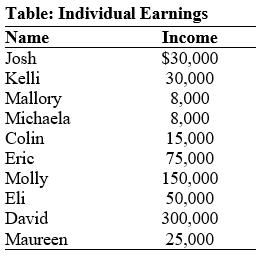
(Table: Individual Earnings) Use Table: Individual Earnings. The table shows the
income of 10 workers.
A) Compute the mean and median income.
B) Draw up a new table that arranges the workers into quintiles from the lowest to the
highest income.
C) Add a column to the table that shows the percentage of total income going to the
workers in each quintile.
87.
Since about 1950, the share of income going to the richest 10% of Americans has
steadily increased. What explains this trend?
88.
Critics of traditional welfare programs often cite a disincentive to work as a flaw in the
policy. Why would these critics be in favor of the Earned Income Tax Credit (EITC)?
And why is the EITC described as a negative income tax?
89.
Explain what is meant by the adverse selection problem, which has the potential to
doom a private health insurance company to failure.
90.
What are the fundamental differences between the Medicare and Medicaid programs?
91.
How have advancements in medicine contributed to the soaring cost of health care in the
United States? Isn’t medical progress a good thing?
Page 16
92.
The welfare state:
A)
often takes up a large share of government spending in wealthy countries.
B)
is generally referred to as Social Security.
C)
usually takes up only a small share of government spending in wealthy countries.
D)
affects only low-income households.
93.
Payments from the government to assist individuals are called:
A)
taxes.
B)
transfers.
C)
the welfare state.
D)
SCHIP.
94.
A high-income household is taxed a certain amount of money. A low-income household
receives financial assistance in the same amount from government. The value of the
marginal dollar of the financial assistance to the family and the taxes paid by the
high-income family are:
A)
the same since it is the same amount of money.
B)
different since the marginal dollar is worth more to the low-income family.
C)
different since the high-income family’s lost income will keep them from buying
necessities.
D)
unimportant in determining the impact of this plan on the welfare state.
95.
Poverty programs are aimed at:
A)
keeping people from earning less than $10,000.
B)
people who have run into problems paying for high-priced gas.
C)
reducing the percentage of families living below the poverty line.
D)
Social Security recipients.
96.
A social insurance program is aimed at:
A)
keeping people from earning less than $10,000.
B)
people who have encountered unexpected financial distress.
C)
reducing the percentage of families living below the poverty line.
D)
households with children.
97.
Among the reasons for a welfare state is the desire to alleviate income inequality and:
A)
achieve economic equality for all households.
B)
eliminate poverty.
C)
alleviate economic insecurity.
D)
increase efficiency.
Page 17
98.
For which item(s) is/are the ability-to-pay principle is a good justification?
I. the welfare state
II. government transfers
III. the income tax structure
IV. Pigouvian subsidies
A)
I and II only
B)
I and III only
C)
I, II, and III only
D)
I, II, III, and IV
99.
Political conservatives and liberals:
A)
both oppose programs associated with the welfare state.
B)
generally agree on their support of programs associated with the welfare state but
disagree on the appropriate extent of these programs.
C)
have conflicting views; conservatives support programs associated with the welfare
state, while liberals oppose such programs.
D)
have conflicting views; liberals support programs associated with the welfare state,
while conservatives oppose such programs.
100.
Programs associated with the welfare state are believed to cause deadweight loss since
they:
A)
affect the amount of disposable income that households below the poverty line
have to spend.
B)
affect incentives to work and to save.
C)
are supported by many political parties.
D)
are based on the ability-to-pay principle.
101.
The poverty threshold is defined as:
A)
less than $15,000.
B)
the minimum annual income that is considered adequate to purchase the necessities
of life.
C)
a static and inaccurate figure since it does not change when prices change.
D)
$20,000 for both individuals and households.
102.
The poverty threshold depends on:
A)
only the major wage earner’s annual income.
B)
the size and composition of a family.
C)
only the size of the family.
D)
only the composition of the family.
Page 18
103.
Since 1967, the percentage of the population living below the poverty line has:
A)
not fluctuated.
B)
steadily increased.
C)
steadily decreased.
D)
fluctuated, but not in any consistent direction.
104.
A definition of poverty that compares the individual’s level of income with that of other
individuals in the country:
A)
is an absolute measure.
B)
would show that poverty has remained constant in the United States for the past 50
years.
C)
is a relative measure.
D)
is a relatively little used measure.
105.
Compared with other countries of comparable wealth, the United States has:
A)
unusually high poverty rates.
B)
similar levels of poverty.
C)
relatively low levels of poverty.
D)
low levels of poverty only when relative measures of poverty are used.
106.
Some of the major causes of poverty are lack of education, bad luck, lack of proficiency
in English, and:
A)
racial and gender discrimination.
B)
geographic region.
C)
differences in religious preference.
D)
government restrictions.
107.
In the United States, income inequality fell:
A)
during the 1930s and 1940s.
B)
after 1980.
C)
during the years following World War II.
D)
after 1917 and has remained consistent since then.
108.
The rising income gap among highly educated workers in the United States:
A)
is an important feature of the increase in income inequality.
B)
has not been a cause of concern for income inequality policy makers.
C)
is less of a concern than is the effect of increased immigration on income
inequality.
D)
has been present for the past 80 years.
Page 19
109.
Increases in income inequality in the United States are partially attributed to:
A)
equal and rising increases in the salaries of low-wage workers.
B)
the impact of technological innovation on the demand for labor.
C)
a reduction in the effect of international trade on the economy.
D)
stricter immigration policies.
110.
If the median household income in 2016 was $59,039:
A)
the average income for a U.S. household was $59,039.
B)
poverty rates fell during this period.
C)
half of the households in the United States earned less than $59,039, and half
earned more than $59,039.
D)
incomes in the United States were rising.
111.
The mean household income is:
A)
the income of households lying at the exact middle of the income distribution.
B)
the average income across all households.
C)
the income level that policy makers wish to achieve for all households on average.
D)
also the poverty threshold level.
112.
The Gini coefficient:
A)
varies between 0 and 1.
B)
is also equal to the mean household income for a country.
C)
is the same for most industrially developed countries.
D)
is seldom used since it does not help one understand income inequality.
113.
For the United States in 2012, a Gini coefficient of 0.47 suggests that:
A)
the United States has almost achieved income equality.
B)
the average household income is $47,000.
C)
compared with most European countries, the United States has unusually high
levels of income inequality.
D)
the median household income for the United States is $47,000.
114.
Much of the rise in income inequality in the past 20 years in the United States comes
from:
A)
a rising gap among the incomes of highly educated workers.
B)
the use of median income levels instead of mean income levels.
C)
a predictable rising gap between the incomes of highly educated and less
well-educated workers.
D)
declining government controls on wage supports.
Page 20
115.
A sudden loss of income and a significant increase in costly medical expenses are
examples of:
A)
economic insecurity.
B)
economic inequality.
C)
poverty thresholds.
D)
the Great Compression.
116.
Means-tested programs:
A)
provide benefits for all.
B)
are poverty programs that specifically help those with low incomes.
C)
provide benefits only for households that earn below the mean household income
in the United States for a given year.
D)
provide only in-kind benefits.
117.
Programs that are not means-tested:
A)
provide benefits for people regardless of income level.
B)
specifically help those with low incomes.
C)
provide benefits only for households that earn below the mean household income
in the United States for a given year.
D)
provide only in-kind benefits.
118.
Which program was introduced in 1990 to replace the means-tested program Aid to
Families with Dependent Children?
A)
Social Security
B)
Medicare
C)
food stamps
D)
Temporary Assistance to Needy Families
119.
Temporary Assistance for Needy Families is a means-tested program that:
A)
offers assistance to anyone who is defined as below the poverty threshold.
B)
provides limited assistance to poor households with children.
C)
is essentially an in-kind benefit.
D)
is the same thing as Medicaid.
120.
Unemployment insurance is a(n) _____ that is _____.
A)
monetary transfer; means-tested
B)
monetary transfer; not means-tested
C)
in-kind benefit; means-tested
D)
in-kind benefit; not means-tested
Page 21
121.
In the United States and other wealthy countries, a large part of the welfare state is
devoted to payments for:
A)
health care.
B)
unemployment insurance.
C)
food stamps.
D)
Temporary Aid to Needy Families.
122.
In 2016, the largest share of health care costs was paid for by:
A)
the government.
B)
private insurers.
C)
private individuals.
D)
charities.
123.
The adverse selection death spiral occurs when private insurance companies:
A)
charge higher-than-average prices for health insurance because only sick people
want it, which in turn further drives off healthy individuals and leaves only sicker,
high-cost individuals, resulting in yet higher premiums the following period.
B)
find themselves with only healthy individuals to insure, so they raise their prices to
take advantage of healthier, richer customers.
C)
offer health insurance at average cost, which results in losses to the company.
D)
refuse to insure very sick individuals because of their high cost to the company.
124.
Employment-based insurance:
A)
is provided by companies to their employees.
B)
is provided only to those who are not working.
C)
consistently runs into the problem of adverse selection death spiral.
D)
does not receive benefits from the U.S. government.
125.
Medicare is health insurance coverage provided to:
A)
all Americans age 65 and older and is means-tested.
B)
individuals who fall below the poverty threshold and is means-tested.
C)
all Americans age 65 and older and is not means-tested.
D)
individuals who fall below the poverty threshold and is not means-tested.
Page 23
Page 24