
CHAPTER 40
Keynesian View of Aggregate Supply and Demand
MULTIPLE CHOICE
435. Keynes defined aggregate supply as
a. the total dollar amount of money spent on goods and services by consumers, investors,
government and net spending by foreigners at a given price level.
b. the total dollar amount of money spent on goods and services by consumers at a given
price level.
c. the total output produced and offered for sale at a given price level by all economic units.
d. the total output produced and offered for sale at a given price level by the private sector.
436. Keynes defined aggregate demand as
a. the total dollar amount of money spent on goods and services by consumers, investors,
government and net spending by foreigners at a given price level.
b. the total dollar amount of money spent on goods and services by consumers at a given
price level.
c. the total output produced and offered for sale at a given price level by all economic units.
d. the total output produced and offered for sale at a given price level by the private sector.
437. Keynes stressed the importance of effective demand which is
a. when business firms are effective in convincing consumers that they have a demand for
certain goods.
b. when consumers have the desire for goods and services as well as the income to purchase
these goods.
c. when the demand for goods and services is effective in satisfying individuals desires.
d. when aggregate demand is less than aggregate supply.
438. National or aggregate income includes
a. profits, rent and interest income.
b. wages, salaries and profits.
c. wages, salaries, rent and interest income.
d. wages, salaries, rent, profits and interest income.
439. The Keynesian cross diagram shows
a. the relationship between equilibrium income and full employment.
b. the relationship between aggregate demand and aggregate supply.
c. the relationship between equilibrium demand and the price level.
d. the relationship between full employment and the price level.
440. The basic definition of GDP used in the Keynesian framework is
a. GDP = C + I + S + X
b. GDP = C + I + G + X
c. GDP = C + I + G + NX
d. GDP = C + S + B + NX
441. Leakages from the circular flow include
a. savings, investment, and taxes.
b. savings, imports, and taxes.
c. exports, savings, and investment.
d. exports, investment, and imports.
e. investment, taxes, and imports.
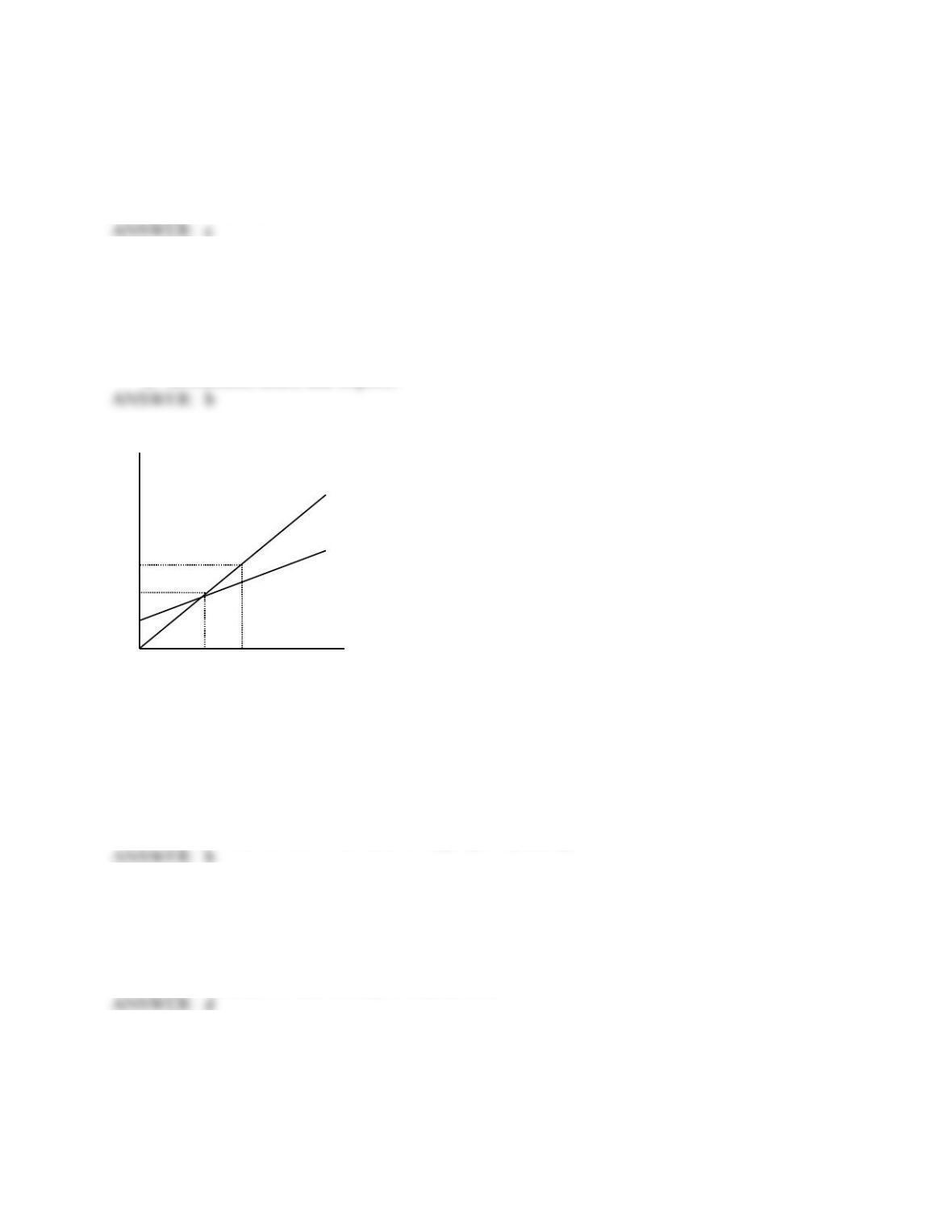
Diagram 40a
442. Diagram 40a indicates that
a. equilibrium income is above full employment.
b. equilibrium income is below full employment.
c. equilibrium income is the same as full employment.
d. equilibrium income is the same as aggregate spending.
443. Diagram 40a indicates that
a. the economy is experiencing stagflation.
b. the economy is experiencing economic growth
c. the economy is experiencing inflation
d. the economy is experiencing unemployment.
Aggregate
Income
A
g
g
r
e
g
a
t
e
S
p
e
n
d
i
n
g
EQ
Aggregate
Product
Aggregate
Spending
FE
444. Diagram 40a indicates that
a. aggregate spending and aggregate product are the same.
b. aggregate spending and aggregate income are the same.
c. aggregate product and aggregate income are the same.
d. aggregate spending and equilibrium income are the same
445. Conservatives and Keynesians differ on the appropriate response of the government to a
recession. Which of the following is a true statement?
a. Conservatives believe the economy will not recover from an outside shock without
government assistance.
b. Conservatives believe the economy will automatically adjust to an outside shock.
c. Conservatives believe there is no such thing as an outside shock.
d. Conservatives believe that governments can prevent an outside shock.
446. Conservatives and Keynesians differ on the appropriate response of the government to a
recession. Which of the following is a true statement?
a. Keynesians believe that governments should increase spending to make up for a
deficiency of aggregate demand.
b. Keynesians believe that governments should intervene in the economy only in the case of
an outside shock.
c. Keynesians believe that governments do not need to intervene, because the economy is
always in equilibrium.
d. Keynesians believe that governments can prevent an outside shock.
APPENDIX 40.1
Marx, Mitchell, and the Keynesian Revolution
MULTIPLE CHOICE
447. Wesley Mitchell made a study of business cycles and found that booms and busts
a. occur in all types of economies.
b. only occur under capitalism.
c. were more severe in the feudal period.
d. occur more often in a barter system.

448. At the beginning of the Great Depression
a. neoclassical economists insisted that the government should increase spending.
b. neoclassical economists predicted that the economy would soon return to normal.
c. neoclassical economists agreed that the problem was lack of effective demand.
d. neoclassical economists predicted the fall of capitalism.
449. According to Keynesian economists, the problem in the Great Depression was
a. a major outside shock.
b. deficit spending by the government.
c. a lack of effective demand.
d. government interfering with the natural tendency of the economy to restore equilibrium.