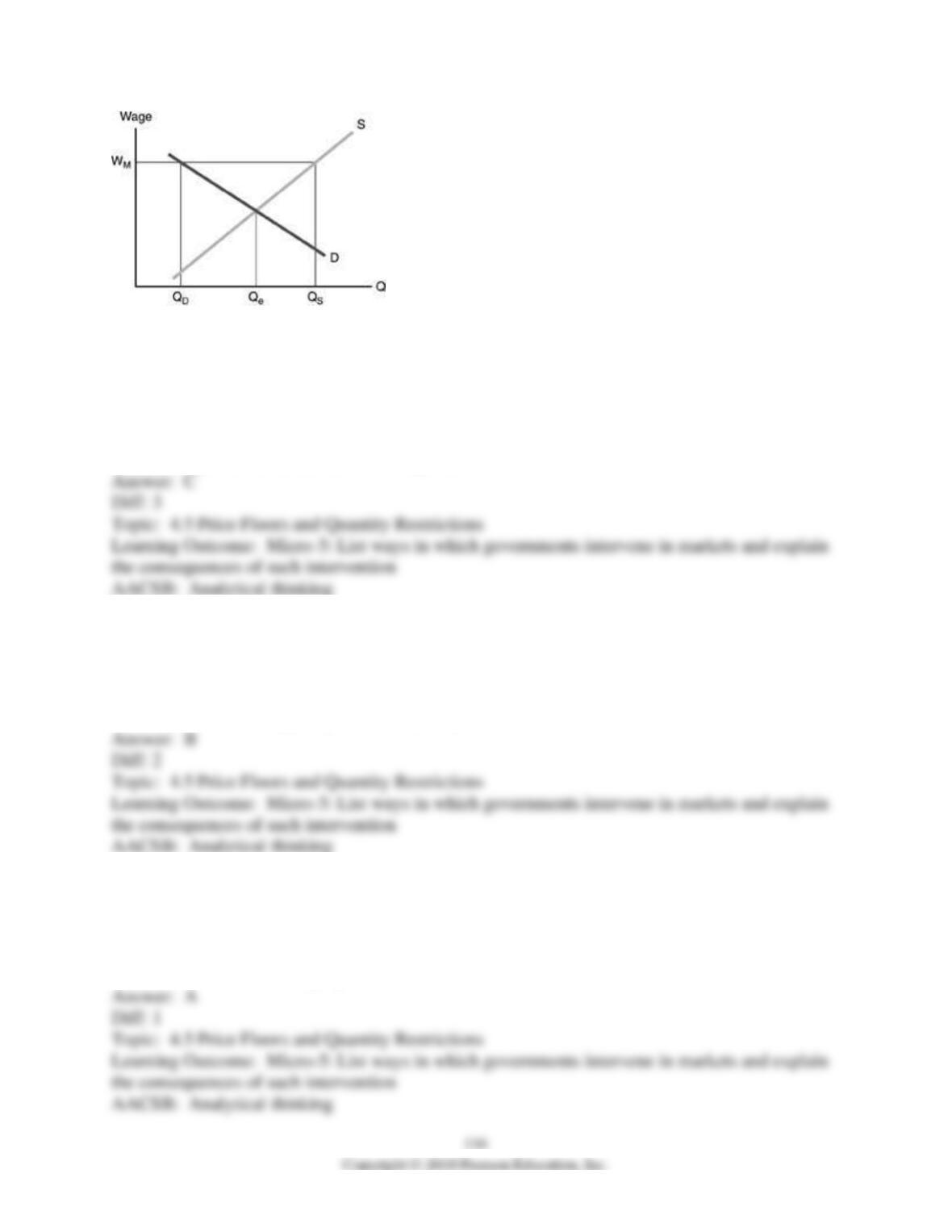
34) Refer to the above figure. A minimum wage has been set at WM. The amount of
unemployment is
A) zero.
B) at Qe.
C) QS minus QD.
D) not computable from the information given.
35) A reduction in the minimum wage will tend to cause which of the following?
A) a reduction in poverty
B) an increase in the number of workers employed
C) an increase in the quantity supplied of labor
D) a reduction in the quantity demanded of labor
36) An increase in the minimum wage will tend to cause which of the following to occur?
A) an increase in the size of the surplus of labor
B) a leftward shift in the demand for labor
C) a rightward shift in the supply of labor
D) a reduction in the unemployment rate
37) Since the minimum wage rate began it has typically stayed at about what percentage of the
average manufacturing wage?
A) 10-20%
B) 20-30%
C) 40-50%
D) 75-80%
38) Many economists estimate that for every 10% increase in relative minimum wage rates, there
is a corresponding decrease in employment of those affected equal to
A) 5-10%.
B) 1-2%.
C) 10-20%.
D) 30-40%.
39) The minimum wage laws seek to
A) penalize employers that are not complying with labor laws.
B) assure a minimum standard of payment for work.
C) assure that all workers are paid the same wage rate.
D) help teenagers find work.
40) The effect of a legal minimum wage set above the equilibrium wage rate is
A) an excess quantity of labor demanded.
B) an excess quantity of labor supplied.
C) an increase in the quantity of labor demanded.
D) a decrease in quantity of labor supplied.
41) Minimum wages are examples of
A) a price floor.
B) a price ceiling.
C) the rationing function of prices not working.
D) government increasing the demand for certain products.
42) An import quota is an example of
A) a price ceiling.
B) a price floor.
C) a queuing device.
D) a quantity restriction.
43) An import quota for sugar results in an increase in
A) the domestic market price of sugar.
B) the domestic demand for sugar.
C) the domestic market supply of sugar.
D) sugar imports.
44) Government-imposed quantity restrictions
A) generate a higher price for the good than would prevail under freely competitive markets.
B) generate a lower price for the good than would prevail under freely competitive markets.
C) does not affect the price of the good because quantity restrictions always ban sale of the good
completely.
D) can cause prices to either be higher or lower, but always cause excess quantities supplied to
develop.
45) An example of a quantity restriction is
A) the minimum wage.
B) an import quota.
C) rent controls.
D) price supports in agriculture.
46) An import quota will
A) lead to a shift of the demand curve.
B) leave the equilibrium price unchanged and increase the quantity sold.
C) limit the amount of a foreign good that can be brought into the United States.
D) limit the amount of a good local producers can make.
47) A supply restriction that restricts the amount of a good that can be imported is a(n)
A) white market.
B) tariff.
C) black market.
D) import quota.
48) An import quota is
A) a quantity restriction.
B) a price ceiling.
C) a price floor.
D) a direct tax on imports.
49) When the government restricts the quantity of a good to zero
A) an underground market develops.
B) there is none of the good available anywhere.
C) people’s demand for the product evaporates.
D) producers stop all production.
50) If the government should decide to legalize marijuana, all other things remaining the same,
we should expect to see
A) a decrease in the price of marijuana.
B) an increase in the price of marijuana.
C) a decrease in the demand for marijuana.
D) an increase in the use of imported versus domestic marijuana.
51) A supply restriction on imported goods, such as the government’s restriction of imported oil
for many years, is referred to as
A) an export quota.
B) an import quota.
C) a price floor.
D) a price ceiling.
52) An import quota is a limit on the
A) number of foreign workers allowed to work in a country.
B) number of container ships allowed to enter the territorial waters of the United States.
C) value of low-priced foreign goods that are allowed to be imported into the United States.
D) amount of a product that may be imported.
53) A limit on the amount of strawberries that can be imported into the United States is an
example of
A) the rationing function of prices protecting domestic strawberry farmers.
B) a price floor set by the government.
C) a price ceiling set by government.
D) an import quota.
54) When import quotas are imposed by a government
A) the domestic producers always lower the prices of their products to ensure that their products
are sold.
B) the government is trying to discourage consumers from buying foreign-made goods.
C) the supply of the product on the domestic market increases.
D) the price ceiling for the product has to be lowered.
55) An unexpected import restriction imposed on mangoes by the USDA
A) will reduce the price of mangoes in the United States.
B) will increase the price of mangoes in the United States.
C) will discourage American producers of mangoes.
D) will reduce the price of mango juice in the United States.
56) An import quota
A) is a price ceiling imposed on an imported good.
B) is a price floor imposed on an imported good.
C) is a supply restriction limiting the quantity of a good that can be imported.
D) is a legislative requirement stating that firms which import some of their merchandise must
hire a certain number of immigrant workers.
57) The difference between quantity restrictions and price ceilings as to their effect on the
market is that
A) only price ceilings make the market inefficient.
B) only quantity restrictions make the market inefficient.
C) while some consumers gain from price ceilings, no consumers gain from quantity restrictions.
D) while price ceilings are efficient, quantity restrictions are not.
58) Explain how agricultural price supports work and what the effects of the supports are.
59) What are the effects of an increase in the minimum wage? Who would be most affected?
60) The U.S. government imposes import quotas on many agricultural products, especially
products that receive price supports. Offer an economic explanation for this.
4.6 Appendix B: Consumer Surplus
1) Consumer surplus is
A) the total difference between the total amount that consumers actually pay for an item and the
total amount that they would have been willing to pay.
B) the total difference between the total costs firms incur in producing an item and the utility
consumers derive from purchasing the item.
C) the total difference between the total amount that consumers would have been willing to pay
for an item and the total amount that they actually pay.
D) the total difference between the utility consumers derive from purchasing an item and the
total costs firms incur in producing the item.
125
2) When consumers would have been willing to pay higher prices at various quantities consumed
than the market clearing price, the differences are called
A) consumer surplus.
B) scarcity.
C) opportunity cost.
D) producer surplus.
3) Total consumer surplus in a market is measured as the
A) area bounded above the market clearing price and beneath the market demand curve.
B) area bounded below the market clearing price and above the market supply curve.
C) vertical distance from the horizontal (quantity) axis to the market clearing price.
D) horizontal distance from the vertical (price) axis to the equilibrium quantity.
4) For a given market demand curve, if the market clearing price increases, then the amount of
consumer surplus will
A) increase.
B) decrease.
C) become negative.
D) none of the above due to insufficient information.
5) The difference between the total amount that people would have been willing to pay for the
total quantity produced and consumed in a market and what they actually pay at the market
clearing price is called
A) production excess.
B) excess demand.
C) market surplus.
D) consumer surplus.
6) If Johnny is willing to pay up to $3 for an ice-cream cone but she actually pays $1 for it. The
consumer surplus of the ice-cream cone for Johnny
A) is $1.
B) is $2.
C) is $4.
D) cannot be determined without information about the market structure.
4.7 Appendix B: Producer Surplus
1) Producer surplus is
A) the total difference between the total amount that producers actually receive for an item and
the total amount that they would have been willing to accept.
B) the total difference between the total costs firms incur in producing an item and the utility
consumers derive from purchasing the item.
C) the total difference between the total amount that consumers are willing to pay for an item
and the total amount that producers would like to receive.
D) the total difference between the utility consumers derive from purchasing an item and the
total costs firms incur in producing the item.
2) When producers would have been willing to accept lower prices at various quantities
produced than the market clearing price, the differences are called
A) producer surplus.
B) monopoly profits.
C) opportunity cost.
D) consumer surplus.
3) Total producer surplus in a market is measured as the
A) area bounded above the market clearing price and beneath the market demand curve.
B) area bounded below the market clearing price and above the market supply curve.
C) vertical distance from the horizontal (quantity) axis to the market clearing price.
D) horizontal distance from the vertical (price) axis to the equilibrium quantity.
4) For a given market demand curve, if the market clearing price increases, then the amount of
producer surplus will
A) decrease.
B) increase.
C) become negative.
D) none of the above due to insufficient information.
5) The difference between the total amount that producers would have been willing to accept for
the total quantity produced in a market and what they actually received at the market clearing
price is called
A) production excess.
B) excess demand.
C) market surplus.
D) producer surplus.
6) If a producer is willing to receive at least $2 for a pen that she manufactures but she actually
receives $7 for it. The producer surplus of the pen for that producer is
A) $2.
B) $5.
C) $9.
D) -$5.
4.8 Appendix B: Gains from Trade within a Price System
1) The gains from trade within a price system is
A) the sum of consumer surplus and producer surplus.
B) consumer surplus less producer surplus.
C) consumer surplus divided by producer surplus.
D) consumer surplus multiplied by producer surplus.
2) The gains from consumer surplus and producer surplus occur when
A) both consumers and producers engage in voluntary exchange.
B) consumers are willing to buy a good but producers are not willing to provide it.
C) producers are willing to provide a good but consumers are not willing to pay for it.
D) the government supplies the good instead of firms.
3) The total gains from trade within a price system is
A) the area beneath the market demand curve and above the market clearing price plus the area
above the market supply curve and beneath the market clearing price.
B) the area beneath the market supply curve and above the market clearing price plus the area
above the market demand curve and beneath the market clearing price.
C) the area beneath the market demand curve and above the market clearing price minus the area
beneath the market supply curve and beneath the market clearing price.
D) always equal to zero.
1) If the government imposes a price ceiling that is lower than the market clearing price, then
A) consumer surplus will increase while producer surplus will decrease.
B) consumer surplus will decrease while producer surplus will increase.
C) both consumer surplus and producer surplus will decrease.
D) both consumer surplus and producer surplus will increase.
2) If the government imposes a price floor that is higher than the market clearing price, then
A) consumer surplus will increase while producer surplus will decrease.
B) consumer surplus will decrease while producer surplus will increase.
C) both consumer surplus and producer surplus will decrease.
D) both consumer surplus and producer surplus will increase.
3) The total amount of consumer surplus and producer surplus is at its maximum when
A) consumers and producers are allowed to trade at the market clearing price.
B) the government imposes a price floor that is higher than the market clearing price.
C) the government imposes a price ceiling that is lower than the market clearing price.
D) free market exchanges do not exist.
4) As compared to the market clearing price, the total amount of consumer surplus and producer
surplus is
A) greater for a government-imposed price floor that is higher than that market clearing price.
B) greater for a government-imposed price ceiling that is lower than that market clearing price.
C) the same as a government-imposed price floor that is higher than that market clearing price.
D) smaller for a government-imposed price ceiling that is lower than that market clearing price.